Closely watched gauges of manufacturing in South Korea and Taiwan slumped in August as China’s slowdown weighed on the region and risks piled up in the global economy.
(Bloomberg) — Closely watched gauges of manufacturing in South Korea and Taiwan slumped in August as China’s slowdown weighed on the region and risks piled up in the global economy.
The hit to factory output from some of the world’s biggest trading hubs is a key warning for global demand as rising interest rates and inflation start to weigh on consumption.
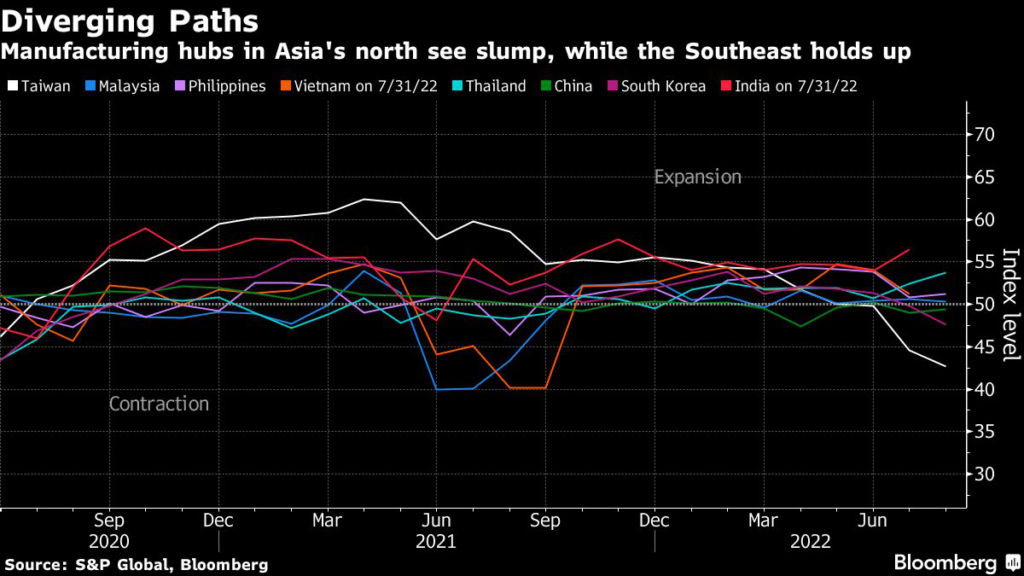
The purchasing managers index for Taiwan fell to 42.7 from 44.6 in July — its lowest since May 2020 — while South Korea’s fell to 47.6 from 49.8 — its lowest since July 2020 — according to S&P Global.
Japan’s reading weakened to 51.5 from 52.1. A reading below 50 indicates a contraction, while anything above that level points to an expansion.
The drop in new orders to Taiwanese firms seen in the data indicates the decline seen in export orders in July is continuing.
A series of chipmakers have warned recently of slowing demand for semiconductors, which are a key export from both Taiwan and South Korea.
In South Korea, a bellwether for global trade, “firms often commented on concerns that the economy would continue to perform poorly amid weak demand and challenging global economic conditions,” Usamah Bhatti, economist at S&P Global Market Intelligence, said in a report.
Shipments of Korean semiconductors fell for the first time in more than two years last month, dropping 7.8% from a year earlier, according to official data released Thursday.
Chips comprise about 20% of South Korea’s exports by value, but the drop was compensated for by other goods, with total exports rising 6.6%.
“Concern that the economic slowdown would deepen grew among manufacturers, while businesses also noted the lingering impact of inflation and the war in Ukraine,” pushing the level of positive sentiment down to the lowest since last October, Bhatti said.
The regional data came after more evidence of weakness in China’s manufacturing sector.
Factory activity contracted in August, according to a private survey suggesting that fallout from power shortages and Covid outbreaks is hitting smaller firms alongside large and state-owned ones. The Caixin Manufacturing Purchasing Managers’ Index fell to 49.5 last month from 50.4 in July, according to a statement Thursday from Caixin and S&P Global.
JOIN: This week’s MLIV Pulse survey on investing in China
That reading matched official data released Wednesday which showed activity contracted in August for a second month in a row.
The official manufacturing purchasing managers index rose to 49.4 from 49 in July.
Elsewhere in the region it was a mixed picture. Malaysia’s PMI reading slipped to 50.3 from 50.6, while gauges for the Philippines, Indonesia and Thailand all increased.
The data add to a highly uncertain environment for the global economy as the world’s two biggest economies move in different directions and most central bankers keep up a race to hike interest rates and fight inflation.
Many of China’s regional trading partners in north Asia were already seeing the negative effects of depressed Chinese consumer demand through July exports data, while Southeast Asian economies showed some resilience with essential goods shipments.
A boost to Asia exports from China’s initial reopening from bruising lockdowns is now fading, with shipments likely to weaken further, according to Alex Holmes, a senior economist at Oxford Economics Ltd.
“This adds weight to our view that Asian export growth will return to its broad decelerating trend in the second half, as the external sector cools due to faltering global demand,” he wrote in a report.
(Updates with chart on Taiwan slump, and China data in the seventh paragraph.)
More stories like this are available on bloomberg.com
©2022 Bloomberg L.P.