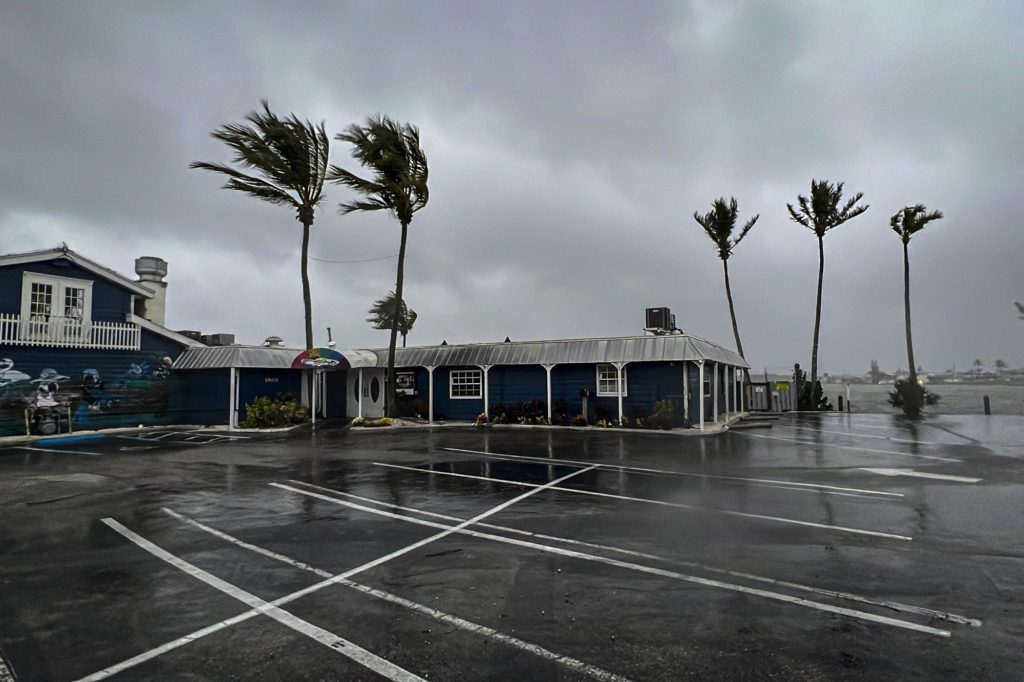
(Bloomberg) — Hurricane Ian slammed into the coast of South Carolina with violent wind and a deadly storm surge, making its second US landfall after tearing a 160-mile path of ruin across Florida.
(Bloomberg) — Hurricane Ian slammed into the coast of South Carolina with violent wind and a deadly storm surge, making its second US landfall after tearing a 160-mile path of ruin across Florida.
Ian, a Category 1 hurricane, came ashore just after 2 p.m.
local time near Georgetown, South Carolina, with 85 mile-per-hour winds, according to the National Hurricane Center. It drove a wall of water onto land and is expected to inundate a 200-mile stretch of coastline that includes the historic city of Charleston.
Florida, meanwhile, continues to reel under the storm’s impact.
More than 1.8 million homes and businesses remain without power, and Lee County, the hardest-hit area, has no running water. Homes, bridges and other infrastructure are in ruin, with damage estimates ranging from $68 billion to $100 billion.
Florida Governor Ron DeSantis said it will take years to recover.
Florida officials have confirmed one death from Ian, while 20 more remain unconfirmed, according to Kevin Guthrie, director of the state’s division of emergency management.
Authorities have warned the death toll may climb. Three people were killed in Cuba, according to the Associated Press.
Some Florida Customers Face Extended Power Outages (2:07 p.m.)
Some customers may be in the dark for more than a month because Ian’s damage means parts of the grid will have to be rebuilt from the ground up, according to Lee County Electric Cooperative, which serves Florida’s hardest-hit country.
Ian Hit Florida at Key Time for Fruit, Vegetable Planting (12:59 p.m.)
Ian has hit a leading producer of fruits and vegetables in the US for the cooler fall and winter months, disrupting planting at a time when food inflation already is soaring.
Though the toll on Florida’s agriculture is still uncertain, many in the industry are facing power outages, widespread flooding and the inability to access fields, groves and packinghouses, said Christina Morton, director of communications for the state’s Fruit and Vegetable Association.
Disaster Survivors Prepare for Prolonged Blackouts (12:22 p.m.)
Residents lined up outside big-box retailers on Friday in search of portable generators to see them through what are expected to be extended and widespread power outages following the storm.
At a Home Depot in Cape Coral on Florida’s western coast, a long line of customers waited in bright sunlight for their turn to shop.
Once inside, individual shoppers were escorted up and down the aisles and to a cash register by an employee. Once outside, the escort extended to their car. Extra security guards were present throughout the store.
White House to Meet With Oil Producers on Gasoline (11:53 p.m.)
The White House plans to meet Friday with some of the largest gasoline producers in the US, including Exxon Mobil Corp.
and Shell Plc, amid concerns about potential price spikes in the wake of hurricanes Ian and Fiona.
The meeting is scheduled to involve National Economic Council director Brian Deese, Energy Secretary Jennifer Granholm and Amos Hochstein, a senior energy advisor within the State Department, according to a person familiar with the matter.
Ian to Make Landfall Around 3 p.m., AccuWeather Says (11:02 a.m.)
Ian will probably make landfall near the mouth of the Santee River about 60 miles northeast of Charleston around 3 p.m., said Paul Walker, a meteorologist with the commercial forecaster AccuWeather Inc.
The hurricane’s top winds were holding steady at 85 miles per hour, the National Hurricane Center said in an 11 a.m.
advisory. The storm was about 60 miles southeast of Charleston.
North Carolina’s Outer Banks could get high winds and storm surge could cut off roads, Walker said. Wilmington may also take some damage, he said.
None of Ian’s impacts Friday and through the weekend will rival what it did to Florida.
“The biggest thing about Ian is that it has done most of its damage,” Walker said.
Tampa Ports Set to Reopen as Trucks Move Fuel (10:04 a.m.)
The port of Tampa Bay is expected to resume vessel operations later on Friday after Hurricane Ian forced its closure, according to spokesperson Lisa Wolf-Chason.
The land side of the port opened on Thursday morning and trucks are moving fuel out of terminals.
The waterways are being assessed by the Coast Guard, Wolf-Chason said.
Florida’s Lee County Has No Running Water After Ian (9:58 a.m.)
Lee County, the hardest-hit area in Florida, has no running water due to a water main break, DeSantis said during a press conference.
An “extraordinary amount of water has been staged” to supply residents there, he said.
Rescuers have gone to more than 3,000 homes and are continuing to conduct searches, DeSantis said. Fuel supply is flowing to the state, though some gas stations remain without power, he said.
Power has been restored to 117 healthcare facilities.
Florida Power Outages Drop Below 2 Million (9:24 a.m.)
Power outages in Florida have dipped below 2 million homes and businesses for the first time since Hurricane Ian barreled across the state.
Just over 1.9 million customers were without service at 9 a.m. local time, according to PowerOutage.us, which tracks utility outages.
At peak, around 2.6 million homes and businesses were without electricity in the wake of the storm.
Officials have warned many of the outages could be prolonged because of extensive damage to the grid from Ian.
Most of the outages remain concentrated in southwest Florida, where Ian land landfall with 150 mile per hour winds.
Roughly 85% of homes in Lee and Charlotte counties remain without electricity.
Ian Strengthens to Become Strong Category 1 Storm (7:45 a.m.)
Ian’s top winds are now gusting at 85 miles per hour, making it a strong Category 1 hurricane.
Shortly before dawn, it was about 145 miles southeast of Charleston, South Carolina.
The hurricane will hit a large part of the state’s coast with a wall of water 3 feet (0.9 meters) high, with the surge reaching as much as 7 feet in the area around flood-prone Charleston.
Some areas will get as much as 12 inches (30 centimeters) of rain. About half of all hurricane deaths are from flooding.
Storm Surge, Flooding Rains Forecast (5 a.m. NY)
Ian is expected to bring life-threatening storm surge and hurricane conditions along the Carolina coast by the afternoon, the National Hurricane Center said in an update just before 5 a.m.
Flooding rains are likely across the Carolinas and southern Virginia.
The storm was located about 145 miles south-southeast of Charleston in South Carolina, and 225 miles south-southwest of Cape Fear in North Carolina.
Maximum sustained winds were 85 miles per hour, with higher gusts, and hurricane-force winds extend outward up to 70 miles from the center. The storm is moving north-northeast at 9 mph.
“On the forecast track, the center of Ian will approach and reach the coast of South Carolina today, and then move farther inland across eastern South Carolina and central North Carolina tonight and Saturday.”
While little change in strength is expected before it reaches the coast later today, Ian should see a “rapid” weakening after landfall.
Biden Declares Emergency for South Carolina (2 a.m.
NY)
Biden declared an emergency exists in South Carolina, authorizing the Federal Emergency Management Agency to provide equipment and resources to the state now in the storm’s crosshairs.
More stories like this are available on bloomberg.com
©2022 Bloomberg L.P.