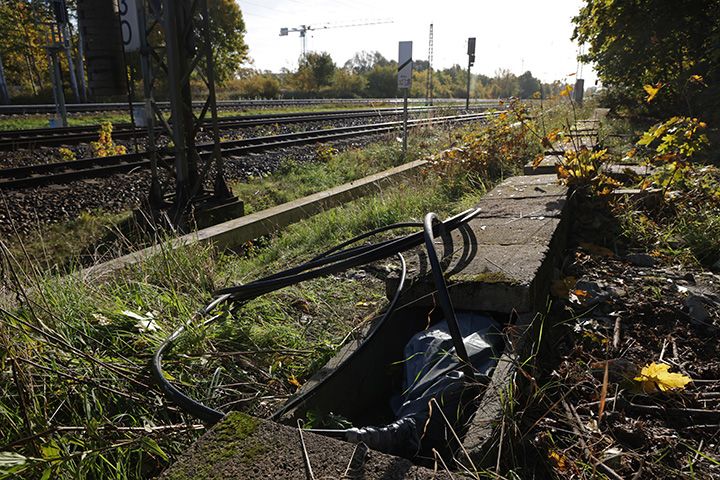
German Transport Minister Volker Wissing said he can’t rule out involvement of foreign countries in what he called an act of sabotage that halted train services across northern Germany on Oct.
8, highlighting the government’s sense of alert to protect crucial infrastructure.
(Bloomberg) — German Transport Minister Volker Wissing said he can’t rule out involvement of foreign countries in what he called an act of sabotage that halted train services across northern Germany on Oct.
8, highlighting the government’s sense of alert to protect crucial infrastructure.
“We have increased vigilance since the beginning of the war in Ukraine, because we know that infrastructures have become an increased target,” Wissing told German public broadcaster ARD on Monday.
He didn’t name any countries or particular groups that might be to blame for the act.
Rail traffic in northern Germany was halted for several hours this past weekend after two separate radio cables were severed, disrupting communications for the national network.
The complexity of the sabotage — the two cables are located several hundred miles from one another, with one operating as a backup for the other — raises the question of detailed inside knowledge about how rail company Deutsche Bahn AG operates.
The country’s police force called the attack on the network professional and targeted.
Germany’s federal police has taken over the investigation.
“It is clear that there is a connection between the crime in Berlin and in Herne, and there is little to suggest that it was a coincidence,” Wissing said, referring to the two locations of the cables.
The disruption came less than two weeks after several massive leaks damaged the Nord Stream gas pipeline linking Russia and Germany via the Baltic Sea, which authorities have also called an act of deliberate sabotage.
Germany has implied that Russia is to blame for what appears to have been detonations at the submerged link, a view the Kremlin denies. President Vladimir Putin in turn has blamed “Anglo-Saxons” for the damage.
No group has claimed responsibility for the attack on the German rail network and no suspects have been identified.
Train travel has been disrupted in the past by acts of metal and cable theft, and there have been cases of militant activist groups cutting cables to disrupt train services, though these perpetrators have typically claimed responsibility.
The Transport Minister said it was able to swiftly restore operations because it followed existing security protocol.
The government is aware that infrastructures has become a target and has displayed “increased vigilance since the beginning of the war in Ukraine,” according to Wissing.
European Commission President Ursula von der Leyen said on Monday that European infrastructure has increasingly become a target, calling critical installations “the new frontier of modern warfare and Europe will be prepared.”
The bloc is working to strengthen the resilience of key EU entities, coordinating stress tests of European infrastructure to detect weak points and boosting the ability to respond to outages and attacks with civil protection teams, she said.
The EU also plans to make better use of its satellite surveillance capacity to detect possible threats and to strengthen cooperation with NATO and the US, von der Leyen said.
“If we have reason to raise our high safety standards, we will do so without fail,” Wissing said.
(Updated with von der Leyen comment in ninth paragraph.)
More stories like this are available on bloomberg.com
©2022 Bloomberg L.P.