In contradiction to its usual tempestuousness, Bitcoin and some other cryptocurrencies have become less choppy, stupefying market-watchers who’ve long known them for their volatility.
(Bloomberg) — In contradiction to its usual tempestuousness, Bitcoin and some other cryptocurrencies have become less choppy, stupefying market-watchers who’ve long known them for their volatility.
The average spread between the past month’s peak and trough across the 10 largest digital assets has only been around 23%, according to data compiled by Bespoke Investment Group.
Since late 2017, no other period has seen this level of serenity. Since the start of 2020, in fact, the average reading was in a range of over 80%, the researcher said.
“BTC and ETH continue to confound us all with narrow moves and languishing volatility,” Noelle Acheson, author of the “Crypto is Macro Now” newsletter, said of Bitcoin and Ether.
“This is not what crypto assets are supposed to do.”
It’s the latest reading to show that activity in the crypto markets has slowed markedly from its usual near-daily wild swings. And a number of volatility gauges have shown Bitcoin to be in a less-choppy phase as it meanders around the $20,000 level.
It traded down 0.9% on Monday at about $19,300.
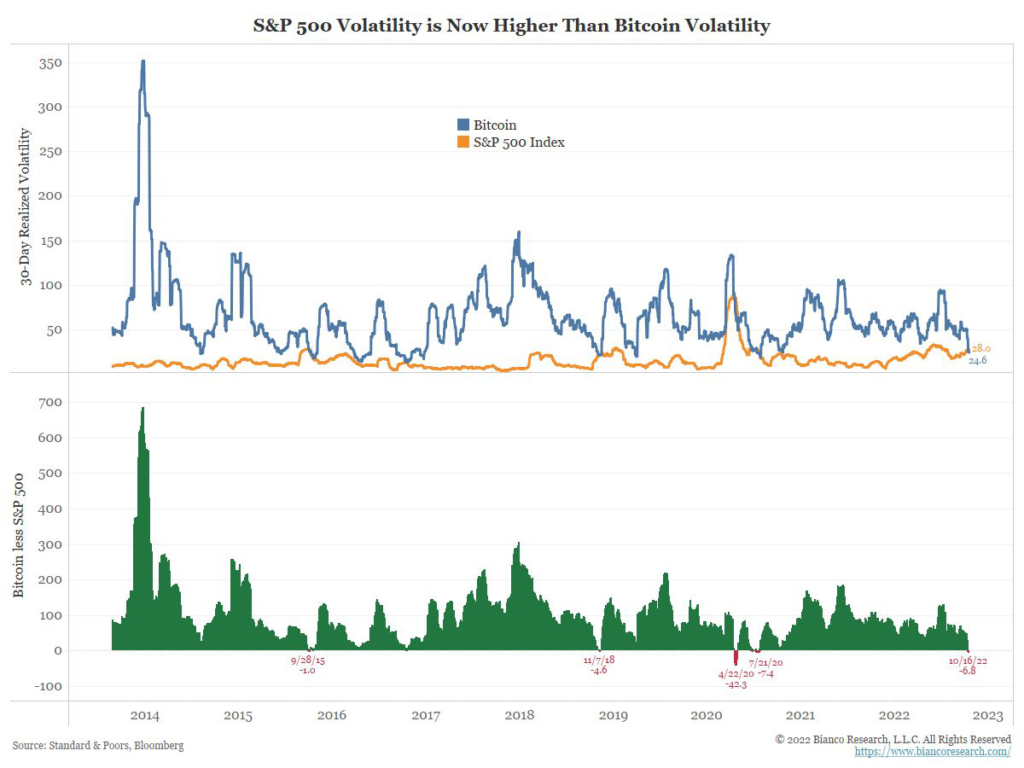
The T3i Bitcoin volatility index, for instance, clocks in at 62, down from a 2022 high of 140 in May. And this lull is happening amid a rally for the US stock market — Bitcoin’s volatility has dipped below that of the S&P 500, something that’s only happened on four other occasions in the coin’s history, according to Jim Bianco, president of Bianco Research LLC.
Though stocks and cryptocurrencies have traded in tandem for most of the year, the correlation has lessened in recent days.
The 60-day correlation coefficient of Bitcoin and the S&P 500 currently stands around 0.61, down from 0.70 earlier this month.
“Crypto is largely agnostic to equity earnings,” Sean Farrell, head of digital asset strategy at Fundstrat Global Advisors LLC, wrote in a note.
“Crypto has decoupled from equities in recent trading sessions in which equities moved higher/lower due to key earnings announcements.”
The fact that Bitcoin’s been less volatile recently has caught a lot of attention considering its reputation for fluctuating wildly.
Still, some have warned that its calming might not be great news: the development coinciding with lower volumes might mean it crashes faster in the event of a downturn.
Viewed from the lens of investors, the lack of volatility could also be seen as a negative.
A lot of individual traders have been in the space precisely because of its wild nature, says Acheson. While warnings abound about staying away from such volatile markets, their turbulence is also a reason for many to dive in, especially considering that some platforms “offer eye-watering leverage,” she wrote in a note.
“Without traders, we wouldn’t have liquid markets. And without liquid markets, we would not have institutional interest,” she said. “And without institutional interest, our industry would still be insignificant, poorly funded, less innovative and more vulnerable to regulatory interference.”
Read more: The Bitcoin Futures ETF at 1: $1.8 Billion Lured, Over Half Lost
Elsewhere, results from a Bloomberg Markets Live survey showed that traders are welcoming of further regulation of the space, with many saying they’d be more comfortable to invest in cryptos should greater enforcement come about.
Almost half of respondents also expect the world’s largest cryptocurrency by market value to continue trading between $17,600 and $25,000 until the end of this year.
Rick Bensignor, president of Bensignor Investment Strategies and a former Morgan Stanley strategist, points out that Bitcoin last week climbed above its downtrend line, though “buyers didn’t really show up.” The token “has not proven bulls right, yet,” he wrote in a note.
More stories like this are available on bloomberg.com
©2022 Bloomberg L.P.