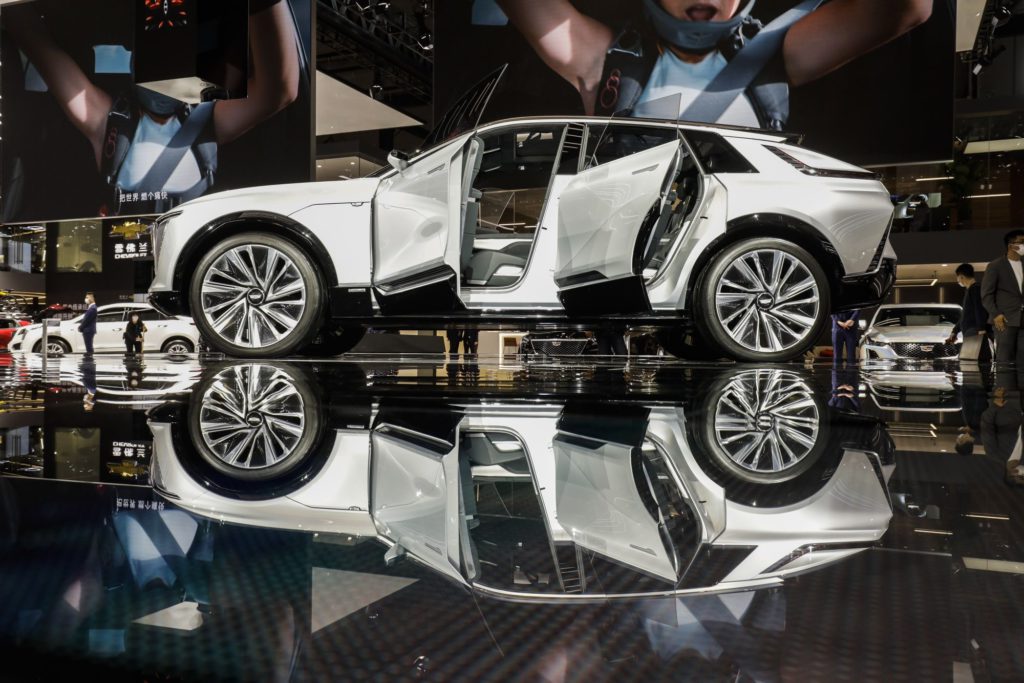
General Motors Co. said its electric-vehicle program will be profitable by 2025 — answering a key question about its longer-term strategy — and predicted annual revenue growth of 12% over the next three years, chiefly through rising purchases of EVs.
(Bloomberg) — General Motors Co.
said its electric-vehicle program will be profitable by 2025 — answering a key question about its longer-term strategy — and predicted annual revenue growth of 12% over the next three years, chiefly through rising purchases of EVs.
In an presentation to investors Thursday, the automaker said it expects EVs to start generating a profit in 2025.
For this year, the company now projects free cash flow of as much as $11 billion, compared with prior guidance of $7 billion to $9 billion. Adjusted earnings before interest and taxes will be $13.5 billion to $14.5 billion, narrowing both ends of its projection by $500 million.
Beyond 2022, management expects GM to cumulatively grow by almost 50% over the next three years, with EVs a solid contributor to the bottom line by 2025.
Bloomberg reported earlier this week that GM plans to turn a profit on EVs in that time frame.
“GM’s ability to grow EV sales is the payoff for many years of investment in R&D, design, engineering, manufacturing, our supply chain and a new EV customer experience that is designed to be the best in the industry,” Chief Executive Officer Mary Barra said in a statement.
Analysts expect revenue to exceed $153 billion this year.
Shares of GM closed little changed at $38.64 in New York.
Electric-vehicle sales should top $50 billion in 2025, GM said. The Detroit-based company plans to build 400,000 EVs in North America from 2022 through the first half of 2024.
Production capacity will reach 1 million units annually in North America in 2025.
Market Share
Chief Financial Officer Paul Jacobson said the breadth of GM’s EV program will increase its market share.
By 2025, its family of electric crossover SUVs, pickups and luxury models will compete in segments that represent about 70% of EV industry volume.
That’s when GM expects to reach sufficient volume to earn a profit on its entire EV portfolio, the CFO told reporters on a conference call.
EVs won’t be as profitable as internal combustion vehicles at that point, but GM’s margins in North America will still be in the 8% to 10% range, Jacobson said.
EVs are expected to earn “low-to mid-single-digit Ebit-adjusted margins” in 2025, the company said.
With electric-vehicle credits offered by the US’s Inflation Reduction Act, GM could see parity between margins on EVs and gasoline-fueled vehicles.
GM’s EVs should be eligible for $3,750 in per-vehicle consumer tax credits next year, according to Jacobson, who said the company will start working toward sourcing production of battery materials to qualify for the full $7,500 after that.
Batteries Matter
A key to EV profit will be lower battery costs, he said.
GM aims to lower battery costs to about $87 per kilowatt hour in 2025 and get under $70 by later in the decade.
Backed by its forecast for higher profit and rising cash flow, GM plans to boost capital spending to as much as $13 billion a year from $9 billion and $10 billion.
That will fund a rapid launch of its EVs and internal-combustion models, the company said.
GM also expects its BrightDrop electric delivery vans to bring in $1 billion in sales next year and $10 billion by the end of the decade.
The Cruise self-driving business plans to add $1 billion in revenue in 2025, the company has said.
The automaker invests about $2 billion a year in Cruise, which provides robotaxi services in San Francisco and is expanding to Austin, Texas, and Phoenix.
The company has been giving driverless rides at night and started providing daytime service for employees, Cruise CEO Kyle Vogt said on Twitter.
Barra said that if a recession comes, GM will have to look at spending, but maintained that the automaker is committed to investing in its autonomous vehicle (AV) business.
“We are the only AV company that is out there ready to launch in three markets and bringing in revenue,” Barra said.
“When we think about the strength of the business and what we have built, we feel we can reinvest in the business because we see these great opportunities.”
(Updates shares, adds capital spending plans in 13th paragraph.)
More stories like this are available on bloomberg.com
©2022 Bloomberg L.P.