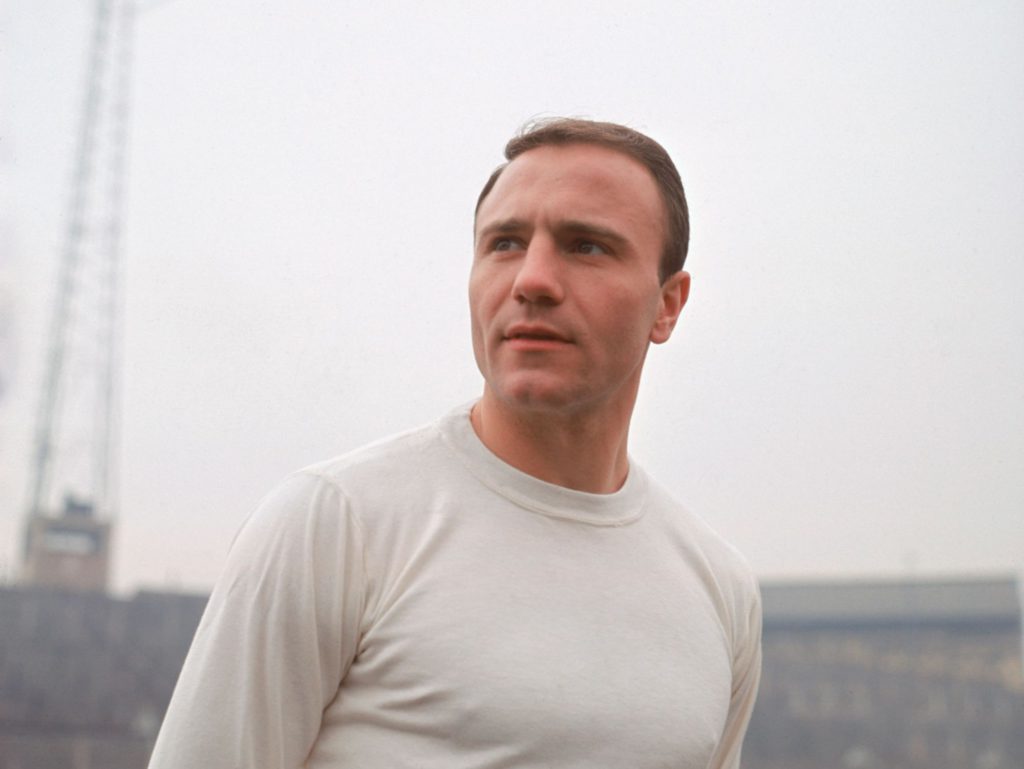
George Cohen, a member of England’s 1966 World Cup winning team who spent his entire professional career at Fulham FC, has died. He was 83.
(Bloomberg) — George Cohen, a member of England’s 1966 World Cup winning team who spent his entire professional career at Fulham FC, has died.
He was 83.
Fulham announced the news on Friday and didn’t give a cause of death.
“Everyone associated with Fulham Football Club is desperately saddened to learn of the passing of one of our greatest ever players – and gentlemen – George Cohen MBE,” the club said on its website.
Cohen’s death leaves Geoff Hurst and Bobby Charlton as the two remaining members of the 1966 team still alive.
Hurst, who scored three goals in the final, led the tributes.
Described by Manchester United’s George Best as “the best right-back I have played against,” Cohen played 459 times for Fulham before a crippling knee injury in 1968 forced him to retire prematurely at the age of 29.
He won the only trophy of his career two years earlier as one of the foundations of Sir Alf Ramsay’s England World Cup team, helping the tournament’s host beat West Germany 4-2 in the final at Wembley Stadium.
Cohen, who was vice-captain, had set up England’s decisive goal against Portugal in the semi-finals, while in the final he had crucially blocked a last minute free-kick from West Germany’s Lothar Emmerich.
“When the final came you could cut the atmosphere with a knife,” Cohen later recalled.
“It was fantastic. When I walked into the tunnel and stood next to the German players the first thing I noticed was that I couldn’t hear anything. Then as you got closer to the pitch I heard this buzzing like a bee.
The buzzing became a roar. When I got to the pitch all I could see was movement and color. That was the only time I felt nervous.”
One of the most famous photographs featuring Cohen wasn’t of the final but taken after a fractious quarter-final match against Argentina.
Cohen was prevented by Ramsey, who had described the Argentines as “animals,” from exchanging shirts with an opposing player. Cohen later said he had a copy of the picture hanging on his wall.
George Reginald Cohen was born in Kensington, London, on Oct.
22, 1939. His father was a gas-fitter and his mother worked for London Transport. Cohen was a keen boxer as a child but also played football for West London Schools, London Schools and Middlesex Youth.
“The biggest assets I had were speed and strength,” Cohen told the Guardian in 2006.
“I was chunky, never fat. We didn’t have the food to be fat.”
He joined Fulham when he was 17, making his debut in March 1957 in a 2-1 defeat to Liverpool. He helped the London club to promotion to the top flight in 1958-59 when they finished runners-up to Sheffield Wednesday in the old Second Division.
Cohen made his England debut in 1964 in a 2-1 win against Uruguay at Wembley.
In his 37 international appearances he suffered only three defeats.
After his playing career he worked as a property developer and also had stints as Fulham’s youth team manager and a coaching role with the England under-23 team.
The injury which had ended his career was the first of several tragedies.
In 1971, his mother was killed in a traffic accident, while in 2000 his brother, Peter — father of England rugby international Ben Cohen — died after being attacked by a group of men in his nightclub.
‘Hellish’
But it was Cohen’s battles with cancer that marked his life after soccer.
First diagnosed with bowel cancer at just 36, he recovered, only for the disease to return twice. On the third occasion he was advised by doctors to prepare for the worst.
“It was hellish,” Cohen told the Daily Mail in an interview in 2008.
“Even now — almost 30 years later — I can still hear the beep of the radiotherapy machine in my head, and it brings back all the feelings of fear and pain.”
His treatment proved so successful that in 1990 he was given the all-clear.
Financial hardships in later life forced Cohen to sell his World Cup winner’s medal.
It was bought by Fulham for a reputed 80,000 pounds and was put on display at the club’s Craven Cottage ground, where a section of the hospitality facilities was renamed the “George Cohen Suite.”
Cohen, who was made an MBE, or Member of the Order of the British Empire, in Queen Elizabeth II’s New Year’s Honours List in 2000, was not the only member of his family to win a World Cup.
His nephew Ben was in England’s rugby squad when it won the world title in Australia in November 2003.
Cohen and his wife, Daphne, lived in Tunbridge Wells, southeast England, for many years.
They had two sons, Anthony and Andrew.
More stories like this are available on bloomberg.com
©2022 Bloomberg L.P.