(Bloomberg) — South Korea’s largest-ever apartment complex risks turning from national milestone into financial millstone amid fears that sluggish sales might herald the kind of property slump that sends shockwaves through the economy and credit markets.
(Bloomberg) — South Korea’s largest-ever apartment complex risks turning from national milestone into financial millstone amid fears that sluggish sales might herald the kind of property slump that sends shockwaves through the economy and credit markets.
The vast Dunchon project in Seoul is designed to accommodate more than 10,000 households and has been one of the most anticipated developments in a country that heavily favors apartments.
But it has run up against a looming glut of new homes and a string of interest-rate hikes by the Bank of Korea that has pushed up borrowing costs and turned buyers wary.
The central bank meets on Friday and must decide whether to plow on with another rate hike even as concerns build over their possible impact on financial stability and economic growth.
While a resounding take-up for the mega-complex would likely ease concerns that Korea’s property market is heading for a painful correction after booming in recent years, much-lower-than-expected initial interest suggests a risk of unsold units.
Weak demand for the showcase real-estate project may strengthen concerns of a property slump that sends jitters through markets and ramps up scrutiny over the finances of construction firms in the wake of an autumn credit rout.
That credit meltdown, now largely overcome, was triggered by a missed debt payment by the developer of a local Legoland theme park.
“Markets see Dunchon as an inflection point,” said Ahn Jae-kyun, a fixed-income analyst at Shinhan Securities.
“The bottom line is whether it will threaten construction firms. This all focuses attention on the BOK’s decision.”
South Korea is one of the first economies to grapple with financial stability fallout from an unprecedented policy tightening to combat inflation.
Should Dunchon fail to draw enough buyers to assuage market concerns, it may mean trouble ahead for debt-laden construction firms that have emerged as a problem area for policymakers.
As one of the world’s biggest residential redevelopment projects, Dunchon would hit home harder than Legoland because it sits at the center of the Seoul metropolitan area that’s home to about half of the country’s 51 million people.
The upshot is the BOK’s Friday meeting may see the last rate hike in a tightening cycle that began in August 2021.
If, as expected, policymakers raise by a quarter percentage point, it would bring their cumulative increase in borrowing costs to 3-percentage points in 18 months.
The initial subscription rate still shows 3.7 buyers per apartment, but that figure is about a fifth of the national average in 2021.
Government officials are aware of the risks of confidence in the property market nosediving and have responded with incentives to try to shore up sentiment. These include an easing of regulations on buyers that had been put in place during the boom in property prices.
Purchasers at Dunchon will pay fewer taxes and be able to borrow more.
They will also only have to live in a property for one year before being able to sell it, compared with the previous rule of eight years.
The government is trying to prevent the broader economy from being “swept in the market situation and undermined,” Land Minister Won Hee-ryong told reporters last week.
At the same time, he denied that the easing of regulations was specifically targeted at Dunchon.
Still, how much the measures encourage potential buyers to sign contracts by mid-January will mean Dunchon apartments serve as a bellwether for the rest of the property market.
House prices are now falling in Korea following a multiyear boom.
During the property upturn, construction firms aggressively sought projects to cash in on the market growth, leading to a jump in housing supply.
The subsequent decline in prices has led potential buyers to adopt a wait-and-see approach.
Still, Dunchon is considered among the more attractive options given it’s in Seoul and borders the Gangnam district symbolizing wealth and status.
Mega apartment projects are generally popular among Koreans because they command bargaining power that helps drive down utility costs and other prices.
Cram schools also tend to mushroom around bigger complexes, offering more choices to parents who intend to send their children to top universities.
Borrowing to buy property has resulted in a surge in Korean private debt that the central bank has identified as among the biggest long-term risks to the economy.
The experience of the Legoland Korea developer’s default on 205 billion won ($165 million) of debt in late September 2022 shows what’s at stake.
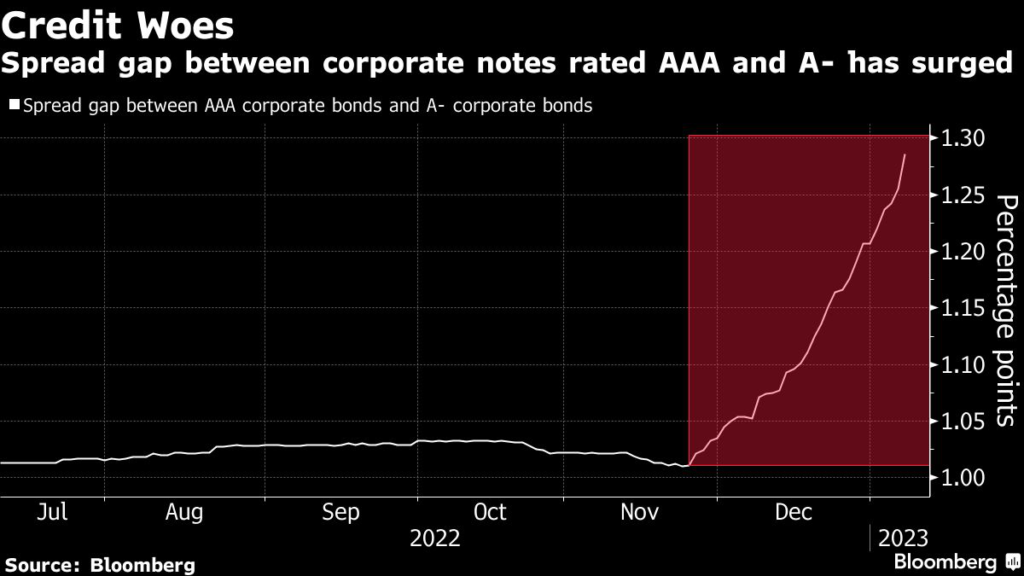
That sparked the worst meltdown in Korea’s credit market since the global financial crisis, sending short-term credit yields soaring.
“As rates rise and the economy deteriorates, there’s great potential corporate defaults will spike,” said Ju Hyeon, president of the Korea Institute for Industrial Economics and Trade.
“It’s highly possible that household debt will become the biggest risk factor in the near term.”
More stories like this are available on bloomberg.com
©2023 Bloomberg L.P.