China’s property industry rebounded for the first time in more than a year, while the government said it will take more measures to boost consumption, adding to optimism about the economy’s outlook.
(Bloomberg) — China’s property industry rebounded for the first time in more than a year, while the government said it will take more measures to boost consumption, adding to optimism about the economy’s outlook.
The real estate sector grew 1.3% in January-March from a year earlier, according to National Bureau of Statistics data released Wednesday.
That marked a sharp rebound from the 7.2% decline in the final three months of last year — and it was the first quarter of growth since the second quarter of 2021, before the government began significantly tightening the screws on the sector.
The data added to evidence the property market downturn has bottomed out after the government ramped up support for major developers and cities loosened curbs on home purchases.
That’s helped to bolster economic growth, which accelerated to 4.5% in the first quarter, according to NBS data published Tuesday.
Economists are becoming more bullish about the growth outlook, with several major banks raising their 2023 growth projections close to 6% or higher.
That’s well above the government’s target of around 5% for the year.
UBS Group AG economists raised their full-year growth forecast to 5.7% this week, citing the “robust rebound in consumption and property” in the first quarter.
JPMorgan Chase & Co. economists upgraded theirs to 6.4%, while Citigroup Inc.’s new projection was set at 6.1%.
It’s possible the property market recovery will continue over the next few quarters as sales gradually improve, said Jacqueline Rong, chief China economist at BNP Paribas SA.
A low base of comparison should help those numbers as well, she said, adding that the bank sees upside risk to its 2023 growth forecast of 5.6%.
Rong said, though, that concern among buyers over the timely delivery of new housing remains a hindrance for a stronger rebound.
Tuesday’s data also showed a continuing contraction in property investment, even though housing sales have started to expand again.
Consumption Drive
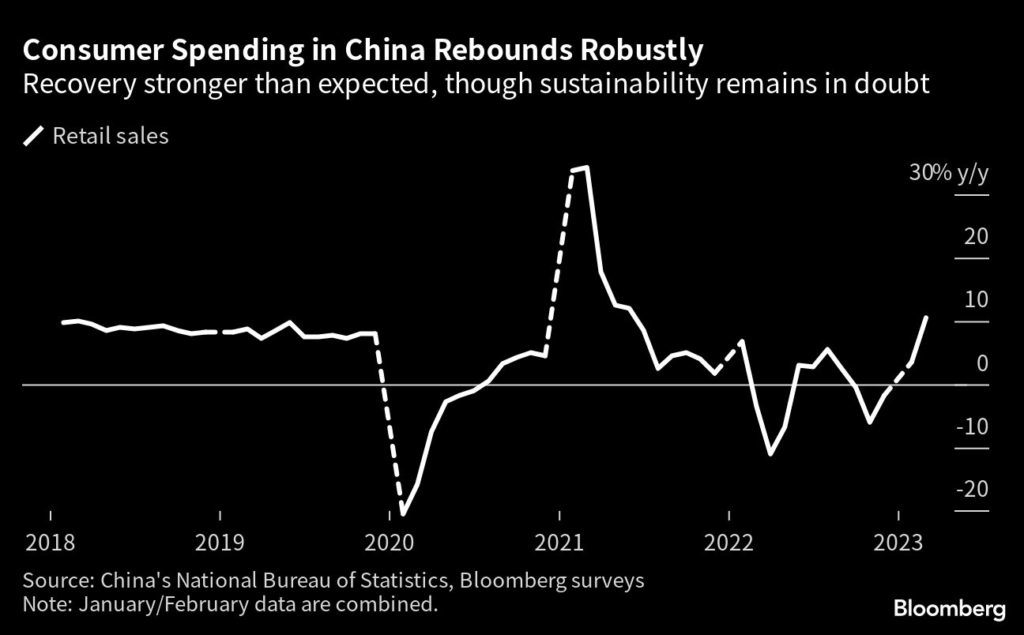
Along with property becoming less of a drag, first quarter growth was propelled by a surge in consumer activity as Covid restrictions were finally dropped.
Hotels and catering, as well as transportation and postal services, expanded after contracting in October-December, while retail and wholesale trades grew at a much faster pace.
The nation’s top economic planner on Wednesday vowed more measures to ensure that rebound in consumer spending continues, doubling down on their plan for the recovery would be driven by consumption this year.
The momentum of the consumption rebound “still needs to be strengthened,” Meng Wei, spokesperson of the National Development and Reform Commission, said at a regular briefing.
“We are studying the drafting of policies aimed at restoring and expanding consumption.”
Those measures will focus on boosting services and rural consumption, stabilizing car sales and increasing household income.
Nearly 3 million urban jobs were created in the first quarter — 120,000 more than a year earlier, Meng said.
As the nation looks to boost car sales, Meng highlighted plans to build more battery charging facilities for electric vehicles.
Automakers will also be encouraged to develop EV models better suited for rural areas, she added.
Concerns remain about the sustainability of the consumption rebound, though.
There’s also still property market weakness in lower-tier cities, said Lu Ting, chief China economist at Nomura International (Hong Kong) Ltd.
He added that pressure on exports will be a headwind for China’s growth as the global economy slows.
Even so, Lu said the country’s economy should have “no problem” achieving growth of 5% to 6% this year, adding that the long-term recovery will benefit from more rational and prudent government policy.
“The government has not taken excessive stimulus to boost property or some specific sectors,” he said at an event in Beijing on Wednesday.
That “may lay the foundation for the Chinese economy to grow steadily in the next few years.”
–With assistance from Zhu Lin and Tom Hancock.
(Updates throughout with additional context and details, analyst comments.)
More stories like this are available on bloomberg.com
©2023 Bloomberg L.P.