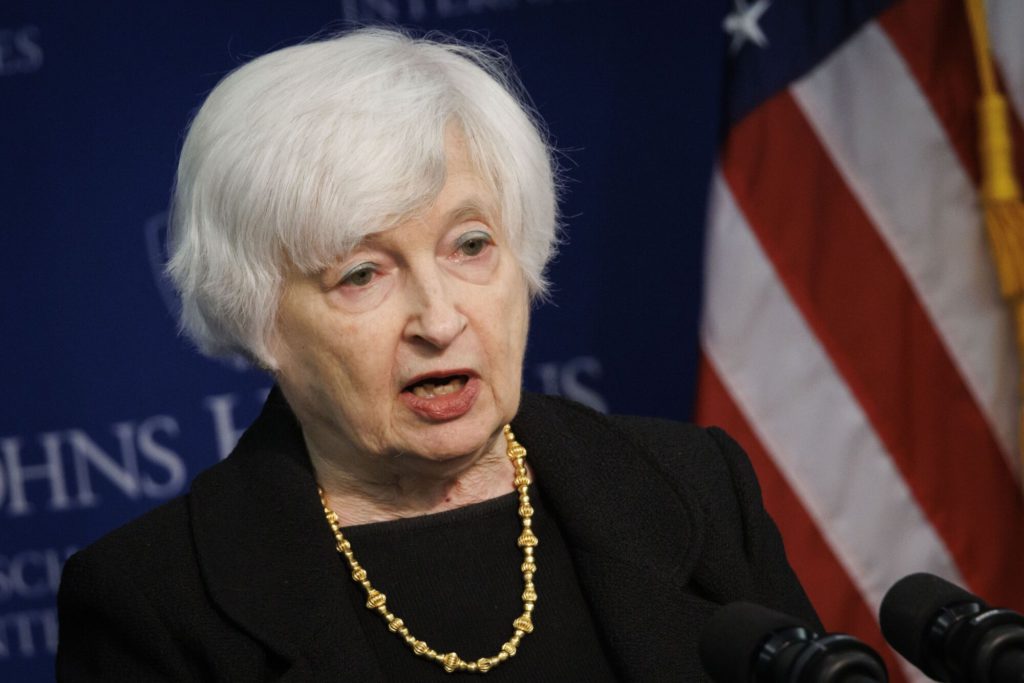
Treasury Secretary Janet Yellen said Washington intends to crack down on Russia’s ability to skirt sanctions imposed by the US and allies after its invasion of Ukraine.
(Bloomberg) — Treasury Secretary Janet Yellen said Washington intends to crack down on Russia’s ability to skirt sanctions imposed by the US and allies after its invasion of Ukraine.
“Because these sanctions are having an impact, Russia is trying to get around them,” Yellen said at a press conference in Niigata, Japan.
“This year, a central piece of our strategy is to take further actions to disrupt Russia’s attempts to evade our sanctions.”
Yellen is in Japan meeting with finance ministers and central bank governors from Group of Seven countries, where she intends to push allies to help tighten up the sanctions regime.
She outlined a three-pronged approach focused on improving information sharing among the countries participating in sanctions, putting pressure on “companies and jurisdictions that we know are allowing or facilitating evasion,” and shutting down specific channels used by Russia to “equip and fund its military.”
She made no reference to imposing penalties on countries for helping Russia evade sanctions.
The Treasury has stepped up warnings to companies already this year over transactions that could help Russia evade western sanctions.
The European Union has also been discussing new mechanisms targeting third countries it believes aren’t doing enough to prevent Russia from acquiring banned goods.
Shipments to Russia of goods such as semiconductors, integrated circuits and other technologies have surged from countries including Kazakhstan, the United Arab Emirates, Turkey and China.
Yellen also lauded the US-led price cap on Russian oil that, combined with EU sanctions, has helped lower Russian revenue from oil exports without disrupting global supplies.
Yellen didn’t speak to a need to tighten enforcement of that program, despite reports that widespread breaches of the price cap likely took place in Asia in the first quarter.
The cap works in conjunction with a rule that prohibits G-7 and EU-based companies from providing maritime services to support seaborne shipments of Russian oil.
Service providers gain an exemption from the ban if a shipment of oil is priced under the cap, currently set at $60 a barrel of crude oil.
In response to questions following her remarks, Yellen said she hoped to discuss with her G-7 counterparts a new set of possible restrictions on outbound investments to China that the Biden administration has been mulling for some time but has not yet finalized.
“We’re committed to discussing this with our partners,” Yellen said.
“‘Obviously, it would be most effective if there’s coordinated action by a group of like-minded countries and agreement that this is a useful approach.”
She said the restrictions would be “narrowly scoped and targeted at technologies where there are clear national security implications.”
In her speech the Treasury chief also promoted the US policy of “friend-shoring,” a strategy that would limit the dependence of the US and its allies on China for critical goods and materials by moving supply chains to countries deemed more reliable.
She emphasized the strategy could benefit developing countries.
“We also believe that our supply-chain diversification efforts can open up more trade and investment opportunities for developing countries that have traditionally only had limited footprints in global supply chains,” she said.
Yellen and her staff have been pitching the idea to countries like India, Indonesia and Vietnam, all of which could benefit if developed countries move supply chains out of China.
Yellen noted “actions to bring down inflation, sustain growth, and help mitigate the impact of external shocks” and “bolster economic resilience and security,” as among her core priorities at the Niigata meetings.
–With assistance from Alberto Nardelli.
(Updates with comments on potential outbound investment curbs from 11th paragraph)
More stories like this are available on bloomberg.com
©2023 Bloomberg L.P.