Sweden’s Riksbank will probably raise borrowing costs again this week as the krona’s plunge to a record low forces policymakers to broaden their fight against inflation.
(Bloomberg) — Sweden’s Riksbank will probably raise borrowing costs again this week as the krona’s plunge to a record low forces policymakers to broaden their fight against inflation.
Riksbank Governor Erik Thedeen is widely expected to announce a quarter-point increase in the benchmark interest rate to 3.75% on Thursday, and may also accelerate bond sales to support the currency, which fell to its weakest ever against the euro last week.
The decision showcases one of the tougher policy landscapes in the advanced world, as officials puzzle over how to fight stubborn consumer-price growth, confronting a challenging foreign-exchange backdrop while considering the damage higher borrowing costs will inflict on Sweden’s floundering commercial real-estate sector.
“Inflation is still trending lower but the data have been mixed, with some disappointments recently,” Jens Magnusson, chief economist at Sweden’s largest bank, SEB AB, said in a phone interview.
“I don’t think the Riksbank can sit back and relax.”
The krona’s plunge has been driven both by real-estate worries and by aggressive tightening elsewhere. Both the Bank of England and Norges Bank ramped up rate hikes last week, while the European Central Bank is projecting at least one more increase to come.
While the latest moves have increased pressure on the Riksbank, they are unlikely to convince it that a larger increase is warranted, according to Magnusson, who still expects a quarter-point hike that would put the bank’s benchmark level of borrowing costs just above those in the euro zone.
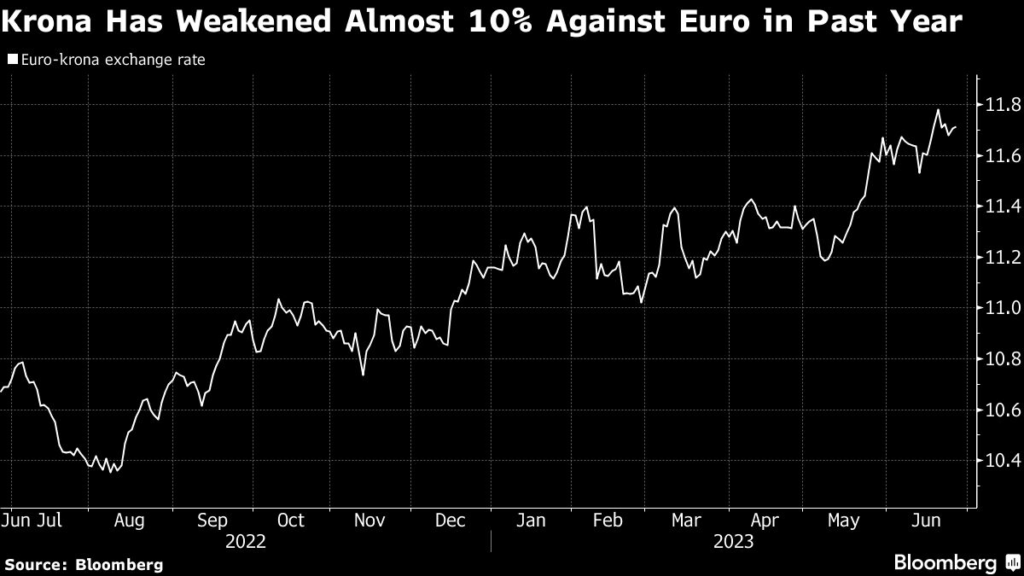
It’s unclear whether that will give meaningful support to the krona, which has lost almost 10% against the euro in the past 12 months.
That plunge is concerning Riksbank officials worried that more expensive imports will hamper efforts to rein in inflation, currently at 6.7% on the measure they target.
Deputy governors Per Jansson and Anna Breman have both highlighted the currency’s input to monetary policy.
Even so, with the krona’s weakness also driven by alarm at Sweden’s real-estate stress, rate hikes may both hurt landlords and further impact the currency.
Samhallsbyggnadsbolaget i Norden AB, commonly known as SBB, has become the face of the sector’s crisis after a downgrade to junk by S&P Global Ratings, and other companies could face similar pressures.
“A large hike could worsen rather than improve that situation,” Magnusson said.
“I believe, and I hope, that the Riksbank steers clear of that and settles for 25 basis points.”
That’s where speeding up bond sales may help. Announcements on changes in the balance sheet “have a sizable impact on longer term yields” and “could attract foreign investment to help with the struggling currency,” said Selva Bahar Baziki, an economist at Bloomberg Economics.
“We see the Riksbank pulling this lever on June 29.”
One bright spot is the resilience of Sweden’s economy, which has defied expectations for a severe contraction. That’s partly due to a healthy export demand, helping to buoy the labor market.
In May, employment rose to the highest level in three decades. The market for private homes, which declined throughout 2022, has improved significantly this year.
But some deputy governors worry about the ultimate damage that higher borrowing costs may have on growth.
Anna Breman and Martin Floden argued in April for slower tightening in the first dissent on the executive board since Thedeen became governor this year.
Given that backdrop, observers have since wondered if officials could do something else to shore up the currency, as Thedeen’s move to announce bond sales when he started out only helped to support the krona temporarily.
In an SEB survey of Swedish fixed-income investors published Monday, 35% said the Riksbank should directly intervene in the foreign-exchange market.
But Magnusson, the chief economist there, doubts that policymakers would consider such a move.
“Direct currency interventions have a long history of not being very successful,” he said. “They will have to wait and see, and hope for an improvement as the economy stabilizes or when there is more clarity on how deep or shallow the downturn will be.”
–With assistance from Zoe Schneeweiss.
More stories like this are available on bloomberg.com
©2023 Bloomberg L.P.