Elon Musk says the carmaker is in talks about licensing its driving system to a major manufacturer.
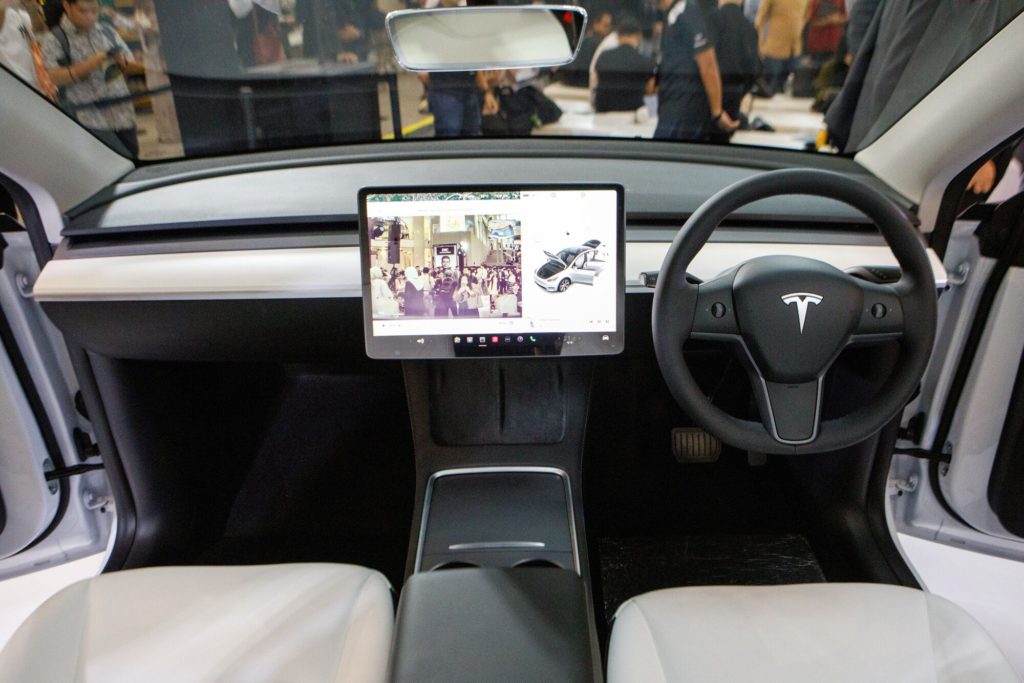
(Bloomberg) — Elon Musk sighed and snickered during Tesla Inc.’s latest earnings call, then let loose a familiar prediction.
“I know I’m the boy who cried FSD,” he said, referring to the feature Tesla has marketed as Full Self-Driving.
“But man, I think we’ll be better than human by the end of this year.”
The chief executive officer’s chuckle and self-deprecation were nods to the fact Musk has been saying for a decade that Teslas are on the verge of driving autonomously.
“I’ve been wrong in the past,” he said. “I may be wrong this time.”
Those caveats are meaningful for Tesla shareholders, considering the emphasis the CEO is increasingly putting on autonomy over business fundamentals.
He downplayed the significance of the company’s shrinking profit margins, calling the trends minor compared to what will happen when its cars are able to upload self-driving capability.
Another prediction Musk has made before — that the upload will augur “the single biggest step-change in asset value, maybe in history” — apparently wasn’t convincing.
Tesla shares sank 9.7% on Thursday, costing the company about $90 billion in market capitalization.
There was one element of Musk’s autonomy messaging that analysts did like: the notion that Tesla is having early discussions with a major manufacturer about licensing FSD, which until now only about 400,000 of the company’s customers have had access to.
Potentially licensing FSD “would represent an important change of scope” in Tesla’s total addressable market, Morgan Stanley’s Adam Jonas said in a note.
It “could be a significant part of Tesla’s long-term investment thesis,” wrote Tom Narayan of RBC Capital Markets.
Neither analyst mentioned in their reports that Musk has made similar comments about licensing talks before.
During a quarterly earnings call in January 2021, he said Tesla had preliminary discussions about offering Autopilot — the company’s standard-equipment driving system — to other manufacturers.
Those talks apparently didn’t go anywhere, as no automaker has paid Tesla to license Autopilot.
A licensing deal with a competitor seems more plausible now than it did just a few months ago.
One of the reasons Tesla’s stock has still more than doubled this year — even after Thursday’s rout — is the traction its charging connector has been getting in North America. Ford Motor Co., General Motors Co.
and half a dozen other automakers have adopted the design Tesla is trying to make an industry standard.
But while Musk evoked those developments on this week’s earnings call, he also drew a distinction.
Whereas Tesla would want to charge others to use the driving system, the company made the design and specifications of its connectors and ports openly available in November and invited carmakers and charging-network operators to use them.
Convincing another manufacturer to pay for FSD — a feature Tesla recalled early this year, under pressure from the US National Highway Traffic Safety Administration — would be a much taller task.
“There will be a very high bar for FSD to be proven out to a legacy OEM,” Evercore ISI analyst Chris McNally wrote in a report.
“FSD’s yet-to-be-proven AV software path is NOT the same thing as the highly visible, extensively used, existing physical Supercharger network.”
McNally isn’t alone in his caution.
“We are miles from being a true believer in the technology,” Needham analyst Chris Pierce wrote, “putting us in the company of the majority of institutional investors that we speak with.”
More stories like this are available on bloomberg.com
©2023 Bloomberg L.P.