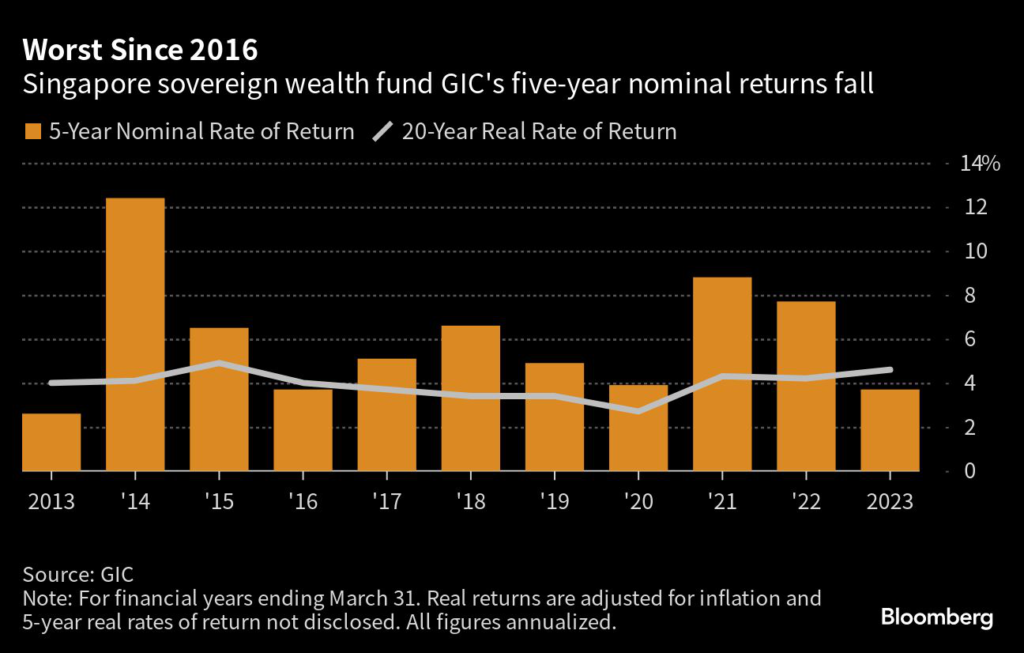
Singapore sovereign wealth fund GIC Pte reported its worst five-year returns since 2016, citing the slowing global economy as it warned the consequences of rising interest rates are yet to fully play out.
(Bloomberg) — Singapore sovereign wealth fund GIC Pte reported its worst five-year returns since 2016, citing the slowing global economy as it warned the consequences of rising interest rates are yet to fully play out.
The firm, which the Sovereign Wealth Fund Institute has estimated runs $690 billion, posted annualized nominal returns of 3.7% for the five years ending March 31, the lowest in seven years.
Its 20-year real return hit an eight-year high of 4.6% after moving past 2003, a fiscal year when markets slumped. The fund doesn’t publish one-year results or its assets under management.
The returns underscore how institutional investors have been grappling with the fallout from rising interest rates and geopolitical tensions as well as a correction in global bonds and equities.
Earlier this month, Singapore state-owned peer Temasek Holdings Pte warned of an uncertain road ahead as it suffered a rare annual net loss.
Read More: Temasek Posts Worst Return in Seven Years as Markets Slump
“We are not out of the woods yet,” said GIC Chief Executive Officer Lim Chow Kiat.
“The consequences of the policy tightening are still being felt in the economy and markets.”
Global Outlook
The firm’s latest fiscal year includes much of the fall in equities that came with efforts to fight inflation and the impact from Russia’s invasion of Ukraine, but not all of the rebound that’s taken place since March.
Its five-year returns also include other major developments, from the Covid-19 pandemic to more fractious great power rivalries.
Looking ahead, banking stress and tighter lending conditions are among factors that have increased the risk of recession in core advanced economies, the firm warned, while China’s recovery is driven by services and consumption rather than investment as in the past.
“Global growth is therefore expected to slow in 2023,” the firm said in the report.
GIC has 17% of its portfolio invested in private equity but with the cost of borrowing going up, Chief Investment Officer Jeffrey Jaensubhakij sees private credit – the business of lending money to companies – as a big opportunity.
“Both through our managers but also with our internal teams, this is the asset class that has a risk reward that seems the most attractive currently,” he said.
Real Estate Shift
Jaensubhakij added the five-year returns are symptomatic of both the rocky markets it warned about even when times were good and its chosen solution – a shift to sectors like infrastructure that he said will deliver better returns amid rising inflation and volatility.
Its real estate allocation rose to 13% as of March 2023 compared to 7% three years ago.
Part of that has been driven by infrastructure deals, with the team for such investments now consisting of about 70 staff.
“We thought it would be best to be able to put assets into areas such as infrastructure or real estate where you do get some rental increases if you’re in the right segments,” he said.
More broadly, the wealth fund’s investments in Asia excluding Japan – a metric that includes its assets in China – dipped slightly to 23% of the total portfolio as of March 2023 compared to a year earlier, while US investments rose to 38%.
Investments in developed market equities fell to 13% while nominal bonds and cash continued its downward trajectory and now makes up around a third of the portfolio.
More stories like this are available on bloomberg.com
©2023 Bloomberg L.P.