By Emma-Victoria Farr and Pablo Mayo Cerqueiro
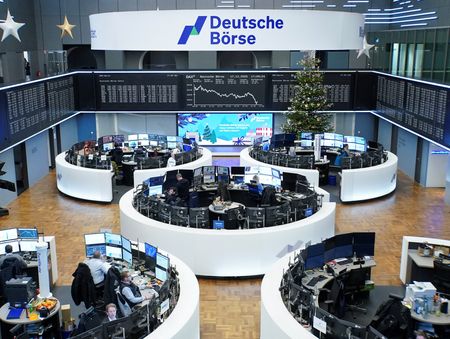
FRANKFURT/LONDON (Reuters) -Schott Pharma began trading on the Frankfurt Stock Exchange on Thursday, in Germany’s largest initial public offering (IPO) so far this year.
Shares in the German medical vials manufacturer were changing hands at around 29.9 euros ($31.4) in morning trading, up from the 27 euros paid by investors in the IPO, in an encouraging sign for Europe’s capital markets.
Its parent Schott AG expects to raise up to 935 million euros ($982.50 million) through the share sale, which saw the Qatar Investment Authority (QIA) participate as a cornerstone investor.
“It is a super start in the reopening of the IPO market after the summer,” said Christoph Heuer, co-head of equity capital markets (ECM) for Northern Europe at BNP Paribas, one of the banks leading the deal.
“The market has been challenging to navigate in the last two weeks, but investors were convinced of the equity story.”
Schott Pharma’s listing comes as the IPO market is showing signs of life after a lengthy drought, with several companies going public in Europe and the United States after the summer lull.
German defence contractor Renk is poised to list on the Frankfurt bourse next week, while on-road payments firm DKV Mobility is gearing up to launch its own IPO.
Reception for U.S.
IPOs, however, has been mixed, with the price of shares in grocery delivery platform Instacart and Arm Holdings falling in recent days after soaring on their market debuts.
Before Schott Pharma, Germany had only seen two IPOs this year raising around 1 billion euros combined, after soaring interest rates and Russia’s invasion of Ukraine all but froze IPO activity in the country, with the exception of Porsche last September.
Mainz-headquartered Schott Pharma focuses on the growing market for injectable drugs.
It generated 670 million euros in sales in the first nine months of its 2023 fiscal year, and 187 million euros in earnings before interest, taxes, depreciation and amortisation (EBITDA).
Vial manufacturers profited during the COVID-19 pandemic when vaccine makers scrambled for equipment as governments worldwide sought to inoculate citizens against the coronavirus.
In the 1890s, company founder Otto Schott invented heavy-duty borosilicate glass, a raw material for medical bottles.
($1 = 0.9509 euros)
(Reporting by Emma-Victoria Farr in Frankfurt and Pablo Mayo Cerqueiro in London, Editing by Anousha Sakoui, Emelia Sithole-Matarise, Anil D’Silva and Sharon Singleton)