Just a year after Liz Truss’s failed attempt to jump-start the UK economy using unfunded tax cuts, Prime Minister Rishi Sunak and Chancellor of the Exchequer Jeremy Hunt have picked up her baton and are pushing their own supply-side boost to try to lift growth and fill a hole in the public finances.
(Bloomberg) — Just a year after Liz Truss’s failed attempt to jump-start the UK economy using unfunded tax cuts, Prime Minister Rishi Sunak and Chancellor of the Exchequer Jeremy Hunt have picked up her baton and are pushing their own supply-side boost to try to lift growth and fill a hole in the public finances.
Both see driving growth as the only solution to the country’s twin economic challenges of soaring national debt and high taxes.
With a general election expected next year and the Conservatives trailing Labour in the polls, Hunt finds himself with little if any room to reduce the tax burden. Bloomberg Economics estimates the chancellor may even have a £9 billion ($11 billion) hole to fill when he gives a fiscal statement on Nov.
22.
So whereas Truss’s team tried the “biggest tax cut package in generations” that triggered market turmoil and ultimately ended her premiership in record time, Sunak and Hunt have opted for a series of smaller, cheaper changes they hope will add up to something substantial.
The aim is to drive business investment and boost the UK’s growth potential using a mixture of incentives, labor market reforms and policy clarity.
Some measures have already been announced, including tax relief on investments and expansion of childcare as part of a broader effort to boost the workforce.
The economy is stuck in a “low-growth trap,” Hunt told reporters at the International Monetary Fund meeting in Marrakesh on Friday.
“In the autumn statement you will hear our plans as to how the UK will get out of it.”
Hunt and Sunak are attempting a “supply-side blitz” even if it is difficult to calibrate the impact, said Simon French, chief economist at Panmure Gordon.
“You can make a case for Hunt being a reformist chancellor.”
There is intense political and financial pressure on them to act. Truss’s premiership imploded but her considerable power over the right wing of Sunak’s party was clear when hundreds queued to hear her demand pre-election tax cuts at the Conservatives’ annual conference this month.
“Liz Truss was the hare who tried to do too much, too quick,” said Julian Jessop, a fellow at the Institute of Economic Affairs who advised Truss during her winning Tory leadership campaign.
“Maybe Rishi Sunak is the tortoise who gets there in the end by moving more slowly and more effectively.”
Meanwhile the UK’s fiscal picture is getting worse. In March, the Office for Budget Responsibility estimated that Hunt had just £6.5 billion of headroom against his fiscal rule that debt must be falling as a share of GDP in 2027-8, the fifth year of the current forecast period.
That’s the smallest margin on record, and risks leaving Hunt or a future chancellor with little space to tackle any sudden shocks.
The picture has further eroded. Higher interest rates have added up to £30 billion a year to debt servicing costs, Hunt told reporters.
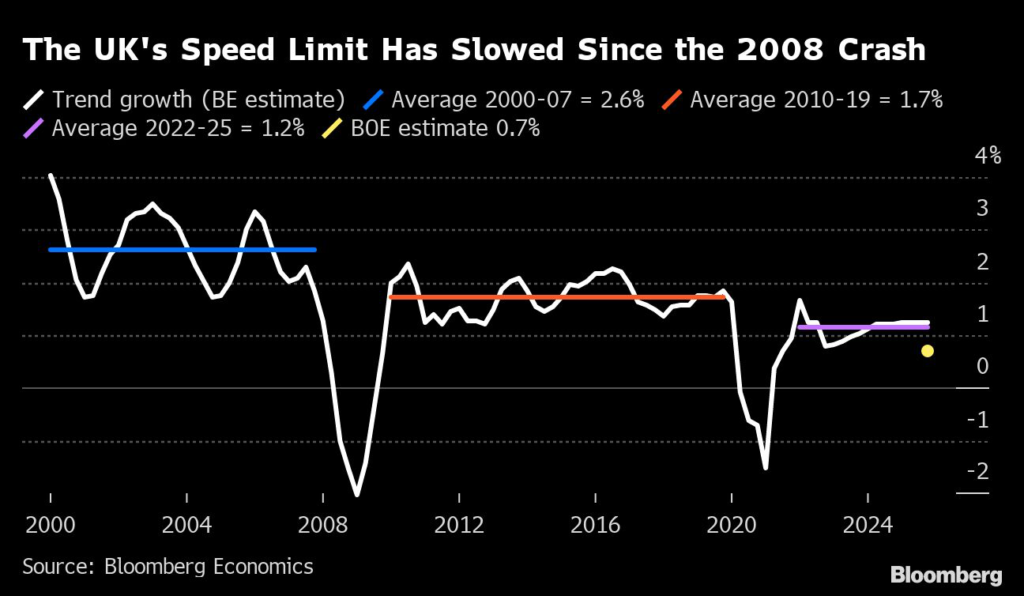
Officials fear the Office for Budget Responsibility is about to make Hunt’s challenge even harder by downgrading its estimate of trend growth ahead of the autumn statement.
Concerns were triggered when analysis of the OBR’s performance concluded the fiscal watchdog has tended to overestimate real GDP growth by about 0.5 percentage points since 2010.
Correcting the bias by just 0.25 percentage points for the final three years of the forecast period, and factoring in economic developments since March, would leave Hunt with a £9 billion hole in the public finances, according to Dan Hanson, senior UK economist at Bloomberg Economics.
The immediate issue for Hunt is that he can’t rely on a more generous OBR forecast to give him headroom in November, which effectively rules out tax cuts.
“We are not in that territory,” Hunt said in Marrakesh.
Officials said privately the government’s view is that if it can get the policies right, the growth will come and the politics will take care of itself – giving them a chance in the general election that must be held by January 2025.
Recent decisions to delay measures to cut greenhouse gas emissions, as well as cutting short the UK’s flagship HS2 high-speed rail line, have fueled a sense of policy chaos.
In other areas, though, the government has made progress in improving the investment climate — a key demand of businesses.
Measures so far include:
- Better relations with the European Union including on Northern Ireland trade, access to the Horizon research program and a memorandum of understanding on regulatory cooperation in financial services
- Giving firms a temporary 100% tax relief on investment spending
- Welfare reforms to bring more sick and disabled people into the workforce alongside a higher minimum wage
- Abolishing environment rules to clear the way for 100,000 new home starts if the government can persuade parliament to permit river pollution
- Encouraging pension funds to commit an extra £50 billion of investment into startups and infrastructure
- New licenses for North Sea oil and gas, to create jobs and investment
- Overhauling planning rules for onshore wind and speeding up the notorious queue to get a connection to the UK power grid
- Adding bricklayers and construction workers to the shortage occupation list to ensure the UK has the builders it needs
“I’m very supportive of measures that are being taken both on labor market supply, but also critically on investment and financing investment,” Bank of England Governor Andrew Bailey said Friday in Marrakesh, adding that he holds regular talks with Hunt on the subject.
Business investment is now well-above pre-pandemic levels and grew almost 10% in the year to June, new data from the Office of National Statistics show.
Officials see that as proof the “super-deduction” — 25 pence of tax relief for every £1 of investment since 2021 — has worked.
“There has been quiet progress,” said Rain Newton-Smith, director general of the Confederation of British Industry lobby group.
“But more needs to be done and the international signals need to be more positive.”
With the Tories trailing Labour by about 20 points in most national opinion polls, there’s an urgency for the measures to show immediate gains.
But the scale of the challenge makes the ambitions of Truss and Kwarteng look lethargic.
Their goal was to raise trend growth to 2.5% from 1.5%. “The world thinks it’s a big achievement if you get 2% growth,” Hunt said at the Tory conference in Manchester this month. “We need to be in the 3%-4% growth.”
–With assistance from Andrew Atkinson.
More stories like this are available on bloomberg.com
©2023 Bloomberg L.P.