By Uditha Jayasinghe and Swati Bhat
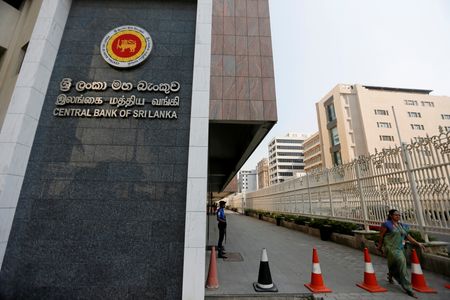
COLOMBO (Reuters) -Sri Lanka’s central bank lowered interest rates on Friday in an unexpected move to shore up economic growth but said it would hold off from any further easing, while projecting inflation would remain subdued over the medium term.
Helped by an International Monetary Fund bailout, the South Asian island nation is recovering from its worst financial crisis in seven decades and awaiting the finalisation of its first review from the global lender.
The Central Bank of Sri Lanka (CBSL) lowered key rates by 100 basis points (bps), reducing the standing deposit facility rate and the standing lending facility rate to 9% and 10%, respectively, and taking total rate cuts to 650 bps since the current easing cycle began in June.
“We expect this rate reduction to continue normalising the economy in the short term,” Governor P.
Nandalal Weerasinghe told reporters. “We see this monetary policy stance as appropriate as we expect inflation to remain within our projections.”
The central bank had raised rates by a record 10.50 percentage points to bring down sky-high inflation between April 2022 and March this year.
But inflation has now eased to around 1.5% in October from a high of nearly 70% in September 2022.
The monetary board arrived at the decision, “with the aim of achieving and maintaining inflation at the targeted level of 5% over the medium term, while enabling the economy to reach and stabilise at the potential level,” the central bank said in a statement.
There were upside risks to inflation projections in the near term due to supply-side factors and an increase in value-added tax by the government, the central bank said.
PAUSE IN EASING
With this reduction, further easing will be paused in the near term, CBSL said, given that space exists for market interest rates to adjust downwards and reiterated the need for that to happen to ease domestic monetary conditions further.
“This rate cut is independent of an IMF decision on the first review.
Growth is below expectation. So to stimulate growth they are front-loading the policy rate cut,” said Udeeshan Jonas, chief strategist at equity research firm CAL.
The CBSL has forecast Sri Lanka’s economy will shrink 2% this year after a 7.8% contraction in 2022 when it went into a tailspin because of a severe foreign exchange shortage.
The World Bank, however, has predicted a 3.8% contraction in 2023.
Asked if he was standing by his projection of a 2% contraction for full-year GDP, Weerasinghe said he expected the third and fourth quarters to post a marginal expansion while the economy could record a small contraction for the full year.
Benefiting from a more stable economy, the Sri Lankan rupee has appreciated by 10.7% against the U.S.
dollar so far this year. Financial markets saw little movement after the policy announcement with the Colombo share index up 0.06%.
Thilina Panduwawala, head of research at Frontier Research, said the central bank’s guidance – putting a hold on further easing for the time being – appeared to be influenced by expectations that the inflation trajectory will rise more sharply than previously thought in 2024.
The slower transmission of rate cuts to borrowers and the broader economy since October was another reason for flagging the pause in easing, he said.
(Reporting by Uditha Jayasinghe; Editing by Sudipto Ganguly, Simon Cameron-Moore and Jacqueline Wong)