By Michael Holden and David Milliken
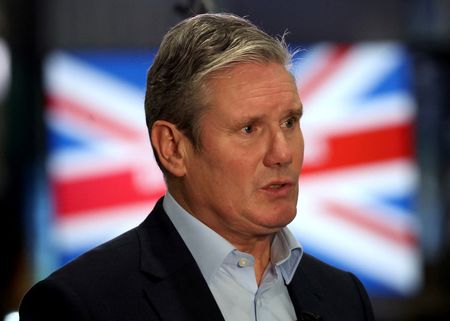
LONDON (Reuters) -A Labour government would not “quickly turn on the spending taps” and would focus instead on boosting growth because British Prime Minister Rishi Sunak’s Conservatives have wrecked the public finances, party leader Keir Starmer said on Monday.
With Labour some 20 points ahead in opinion polls before an election expected next year, Starmer has been trying to reassure businesses and voters who are struggling with a cost of living crisis that his party can be trusted with the economy.
He suggested the governing Conservative Party was seeking to “salt the earth” with policies that would make the budget situation Starmer would inherit even more difficult.
“The decisions the government are taking, not to mention their record over the last 13 years, will constrain what a future Labour government can do,” Starmer said in a speech.
“Anyone who expects an incoming Labour Government to quickly turn on the spending taps is going to be disappointed.”
Finance minister Jeremy Hunt last month announced what analysts called the biggest giveaway package since 1988, including a deeper-than-expected cut to social security contributions.
But his move was only made possible by large spending cuts planned for public services in future years.
Leading think-tanks said those cuts appeared implausible given the existing strains in areas such as prisons and local authority spending.
DEFINING PURPOSE
Since replacing veteran socialist Jeremy Corbyn as leader after Labour suffered its worst election defeat since the 1930s four years ago, Starmer has sought to move the party to the centre ground of British politics.
That shift has seen Labour try to shake off a spendthrift image and bolster its economic credentials.
But his remarks, a day after he praised former Conservative leader Margaret Thatcher, might disappoint some traditional supporters calling for substantial spending on areas such as health and education.
Starmer said Labour was having “quite detailed discussions with business” and he reiterated that Labour would seek a closer trading relationship with the European Union.
The economy was once regarded as the Conservatives strong point.
But in recent years, most notably after former Prime Minister Liz Truss’ uncosted spending plans caused market chaos last year, polls suggest voters now trust Starmer’s party more.
Starmer spoke at the launch of a Resolution Foundation think-tank report that blamed weak investment for much of Britain’s sluggish productivity growth since the global financial crisis in 2008/09, something Starmer pledged to fix.
“The defining purpose of the next Labour government… will be raising Britain’s productivity growth,” Starmer said.
“That’s a big change for us. Having wealth creation as your number one priority, that’s not always been the Labour Party’s comfort zone.”
Speaking at the event earlier in the day, Hunt said he hoped in the future to reverse the decline in public investment that was forecast in the government’s latest budget plans.
(Writing by Alistair Smout; additional reporting by Farouq Suleiman; Editing by Sharon Singleton and Alex Richardson)