
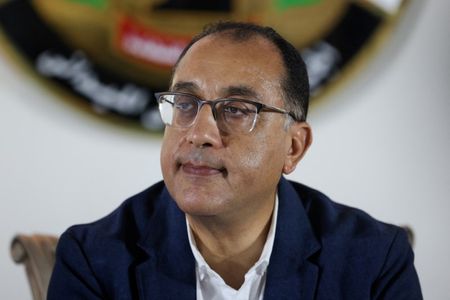
CAIRO (Reuters) – The “hot money” that left Egypt on Monday as foreign investors sold T-bills and bought dollars during a global markets rout represented no more than 7-8% of their holdings, Prime Minister Mostafa Madbouly told a news conference on Thursday.
Foreign investors sold Egyptian pound treasury bills and converted the proceeds to U.S. dollars as part of a broader shift into safer assets, analysts and bankers said. The sell-off was compounded by regional political tensions and concerns about government finances, they said.
Madbouly said the money that left Egypt during the sell-off left at a high price to investors because Egypt let its exchange rate move freely.
“This issue was dealt with with the utmost professionalism, it was dealt with by the Central Bank, which confirms that we are committed to having a flexible exchange rate and that the state does not interfere so that there are no negative repercussions.”
Madbouly also said Egypt aims to reduce inflation to below 10% by the end of 2025 or the beginning of 2026.
The country’s statistics agency CAPMAS earlier reported annual urban consumer price inflation of 25.7% in July, easing from 27.5% and by more than analysts had expected.
Egypt has tightened monetary policy under an $8 billion International Monetary Fund financial support package signed in March which also required it to increase many domestic prices and devalue its currency.
(Reporting by Patrick Werr and Momen Saeed Attallah in Cairo, writing by Amina Ismail and Patrick Werr, Editing by Tomasz Janowski, Kirsten Donovan)



