AFP

UK issues extreme heat warning as temperatures soar

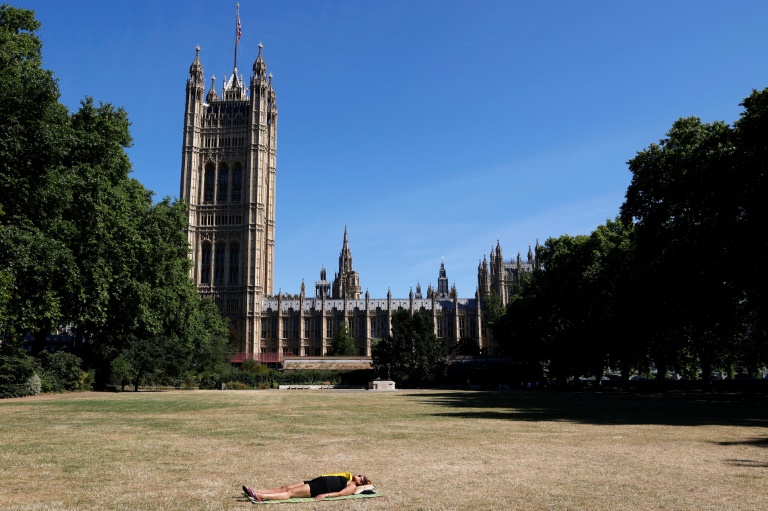
Britain on Monday issued an extreme heat warning, with temperatures predicted to hit more than 30 degrees Celsius (86 Fahrenheit) across large parts of England and Wales.

Forecasters said the warm weather would remain for much of the week, particularly in southern and central England and Wales, with peaks of 33C possible in southeast England on Tuesday.

Temperatures were still several degrees cooler than the heatwave in parts of Spain and Portugal, where the mercury was set to soar past 40C.

But Met Office deputy chief meteorologist Rebekah Sherwin said the UK highs would continue into early next week.

“From Sunday and into Monday, temperatures are likely to be in excess of 35C in the southeast (of England), although the details still remain uncertain,” she said.

“Elsewhere, temperatures could be fairly widely above 32C in England and Wales, and in the mid-to-high 20s Celsius further north.”

Britain’s highest recorded temperature was 38.7C at Cambridge Botanic Garden, in eastern England, on July 25, 2019.

Sherwin said meteorologists could not rule out that record being broken but it was “still only a low probability”.

“A number of weather scenarios are still possible and at the current time, mid- or perhaps high-30s are looking more likely,” she added.

The extreme heat warning was classified as “amber”, the second-highest of three, indicating a “high impact” on daily life and people.

Mark McCarthy, head of the Met Office National Climate Information Centre, said “strongly embedded warming due to climate change” across Europe was increasing the chances of a new UK record.

Kyiv warns Russia to intensify Donbas fight, 6 killed in Kharkiv

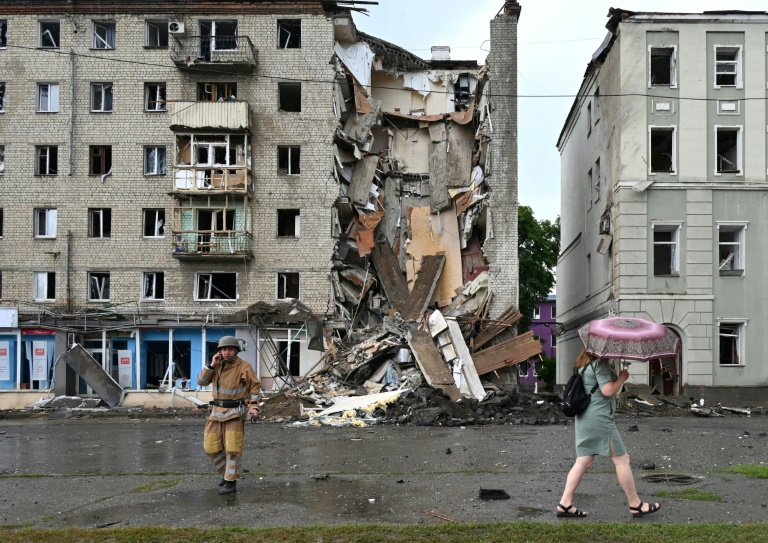
Ukraine warned Monday that Russian forces were preparing to intensify their fight for key cities in the Donbas, where the death toll from a weekend attack rose to 26 as rocket strikes killed six in the country’s second city.

The attacks in Kharkiv in northeastern Ukraine came as Europe braced for deeper cuts in gas supplies from Russia.

Kharkiv regional chief Oleg Synyegubov said Russian fire on Monday targeted “a shopping centre and civilian residences.”

Prosecutors in his region said “six civilians were killed, including a 17-year-old and his father, who were driving past” at the time of the attack, according to the Interfax-Ukraine news agency.

In eastern Ukraine — the focal point for a grinding Russian offensive — 26 people were left dead by Russian strikes over the weekend on the town of Chasiv Yar in the Donetsk region, the emergency services said.

Russian defence ministry spokesman Igor Konashenkov claimed that “more than 300” Ukrainian combatants had been killed in a Russian strike near Chasiv Yar, without giving a date.

Having fought long battles to capture areas of the eastern Lugansk region, Russian troops are now turning their focus to Donetsk as they look to take control of the whole Donbas.

The eastern region was under persistent shelling, but Russian ground attacks were all but paused, the Ukrainian army said Monday.

– ‘No safe place’ –

It warned, however, that Russian troops were likely planning to launch some of their heaviest attacks yet in the Donetsk region.

“There are signs of enemy units preparing to intensify combat operations in the direction of Kramatorsk and Bakhmut,” it said, referring to two main cities still under Ukrainian control.

Moscow’s slow advance into the east — despite fierce Ukrainian resistance emboldened by recent deliveries of Western-supplied artillery — contrasts with their failure to capture the capital Kyiv at the start of the invasion.

Dutch Prime Minister Mark Rutte during a visit to Kyiv said his country would supply Ukraine with more long-range artillery and an aid package worth 200 million euro ($201 million).

“This war may last longer than we all hoped or expected. But that does not mean we can sit back and passively watch how it unfolds. We have to stay focused and continue to support Ukraine in every way,” Rutte told a press conference with Ukrainian President Volodymyr Zelensky.

Western weapons — in particular, precision, long-range artillery — were “already changing the course of the war,” Secretary of the National Security and Defence Council, Oleksiy Danilov, said earlier Monday.

In Bucha, a town outside Kyiv, 36-year-old web designer Maxim said just three months ago, Russian soldiers were rummaging through his home and sleeping in his children’s bedroom.

“In this atmosphere, I feel like nothing can happen and that life is normal,” he said, sitting with his family outside his home. 

“But we know there’s a war and there’s no place safe in Ukraine right now.”

– Gas worries –

The repercussions of the conflict were being felt in western Europe as Russian gas giant Gazprom on Monday began more than a week of routine maintenance on its Nord Stream 1 pipeline.

Germany and other European countries cast a worried eye on energy supplies after Italy’s Eni and Austria’s OMV said Gazprom was further reducing the supply of gas.

Eni said flows were dropping to 21 million cubic meters (741 million cubic feet) per day, down from a recent average of about 32 million, while OMV said it would see a 70-percent reduction.

After Russia’s invasion of Ukraine in February, Germany suspended certification of a second pipeline, Nord Stream 2, as fears grew over Europe’s massive dependence on Russian gas.

In a bureaucratic swipe at Kyiv, Russian President Vladimir Putin on Monday signed a decree to fast-track citizenship for all Ukrainians.

The move builds on previous orders — including one issued earlier in the invasion — making it easier for Ukrainians living under Moscow-occupied territory to receive Russian passports.

Putin and his Belarusian counterpart, strongman Alexander Lukashenko, meanwhile discussed possible joint measures against neighbouring Lithuania over its “illegal” transit restrictions affecting Moscow’s exclave of Kaliningrad.

The Baltic country last month began to restrict transit of EU-sanctioned goods into Kaliningrad, a Russian region sandwiched between NATO members Lithuania and Poland, infuriating Moscow.

burs-jbr/jm

Argentina will honor economic goals agreed with IMF: new minister

Argentina’s new economy minister said Monday the country would honor fiscal deficit goals and other commitments made under a deal struck with the IMF to refinance a debt of some $44 billion.

Under the agreement negotiated by Silvina Batakis’ predecessor Martin Guzman, who resigned suddenly nine days ago, Argentina committed to reducing its fiscal deficit from 3.0 percent of GDP last year to 2.5 percent in 2022, 1.9 percent in 2023 and 0.9 percent in 2024.

“The goals agreed with the IMF are maintained,” Batakis said in Buenos Aires at her first press conference since taking office a week ago.

“It is an agreement we signed as a state and we must comply.”

In 2018, under the government of conservative President Mauricio Macri, the International Monetary Fund granted its biggest-ever loan of $57 billion to Argentina.

The country received $44 billion of that amount and Macri’s successor Alberto Fernandez refused to accept the rest.

As the country struggled to repay its debt, a refinancing agreement was reached this year after protracted negotiations.

Guzman resigned suddenly on July 2 amid a power struggle between Argentina’s president and vice president, sparking fresh uncertainty in Latin America’s third largest economy.

The peso fell sharply last Monday against the US dollar after Batakis’ appointment.

On Monday, the 53-year-old said there was a need to “give order and balance to the public finances,” and vowed that “we will not spend more than we have.”

Among her proposals: to reduce energy subsidies, which in 2021 amounted to $11 billion or 2.3 percent of GDP, by applying a sliding scale to prices for gas and electricity based on income.

In 2020, the Argentine economy contracted 9.9 percent before rebounding the following year by 10.3 percent.

For this year, the IMF predicts growth of 4.0 percent.

At the time the refinancing agreement was reached, Argentina’s inflation was projected to reach 52 percent in 2022 — already one of the highest in the world.

Since then, the war in Ukraine has sent prices soaring worldwide, and Argentina marked year-on-year inflation of 60 percent in May.

“The agreement was signed before the rise in global inflation,” said Batakis, adding a new estimate for 2022 was being compiled.

“It is a methodological issue we are evaluating, not a shifting of the goal,” she insisted.

A survey by Argentina’s central bank of projections for 2022 inflation put the rate at some 76 percent.

Excitement builds as Biden to release first image from Webb telescope

US President Joe Biden will Monday release one of the first images taken by the James Webb Space Telescope, the most powerful observatory ever sent into orbit and a leap forward in uncovering the secrets of the distant universe.

The unveiling will take place at 5:00 pm (2100 GMT) during a livestreamed event at the White House, official statements said, leaving the space community in a state of keen anticipation.

NASA revealed last week Webb’s first targets included distant galaxies, bright nebulae and a faraway giant gas planet.

The very first image, released by the US president, will be of the “deep field” — an image taken with very long exposure time, to detect the faintest of objects in the distance — according to a person familiar with the matter.

NASA previously said Webb would achieve this shot by pointing its primary imager towards massive foreground galaxy clusters called SMACS 0723, which bend the light of objects far behind them towards the observer, an effect called “gravitational lensing.”

This promises to be what NASA chief Bill Nelson called last month the “deepest image of our Universe that has ever been taken.”

The rest of the first wave of images are set to be released by NASA on Tuesday.

Webb’s infrared capabilities are what make it uniquely powerful, allowing it to both pierce through cosmic dust clouds and detect light from the earliest stars, which has been stretched into infrared wavelengths as the universe expanded.

This lets it peer further back in time than any previous telescope, to the period shortly after the Big Bang, 13.8 billion years ago.

“When I first saw the images… I suddenly learned three things about the Universe that I didn’t know before,” Dan Coe, a Space Telescope Science Institute (STSI) astronomer and expert on the early Universe, told AFP. “It’s totally blown my mind.”

– First targets –

An international committee decided the first wave of images would include the Carina Nebula, an enormous cloud of dust and gas 7,600 light years away.

Carina Nebula is famous for its towering pillars that include “Mystic Mountain,” a three-light-year-tall cosmic pinnacle captured in an iconic image by the Hubble Space Telescope, until now humanity’s premier space observatory.

Webb has also carried out a spectroscopy — an analysis of light that reveals detailed information — on a faraway gas giant called WASP-96 b, which was discovered in 2014.

Nearly 1,150 light-years from Earth, WASP-96 b is about half the mass of Jupiter and zips around its star in just 3.4 days.

Nestor Espinoza, an STSI astronomer, told AFP that previous exoplanet spectroscopies carried out using existing instruments were very limited compared to what Webb could do.

“It’s like being in a room that is very dark and you only have a little pinhole you can look through,” he said of the prior technology. Now, with Webb, “You’ve opened a huge window, you can see all the little details.”

– Million miles from Earth –

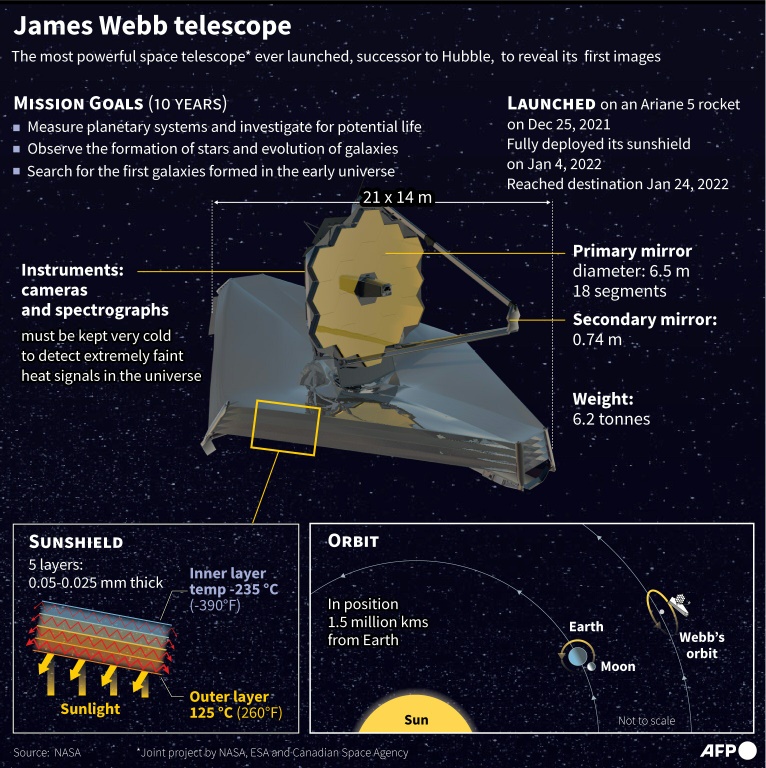
Launched in December 2021 from French Guiana on an Ariane 5 rocket, Webb is orbiting the Sun at a distance of a million miles (1.6 million kilometers) from Earth, in a region of space called the second Lagrange point.

Here, it remains in a fixed position relative to the Earth and Sun, with minimal fuel required for course corrections. 

A wonder of engineering, the total project cost is estimated at $10 billion, making it one of the most expensive scientific platforms ever built, comparable to the Large Hadron Collider at CERN.

Webb’s primary mirror is over 21 feet (6.5 meters) wide and is made up of 18 gold-coated mirror segments. Like a camera held in one’s hand, the structure must remain as stable as possible to achieve the best shots.

Charlie Atkinson, chief engineer on the James Webb Space Telescope program at lead contractor Northrop Grumman, told AFP that it wobbles no more than 17 millionths of a millimeter.

After the first images, astronomers around the globe will get shares of time on the telescope, with projects selected competitively through a process in which applicants and selectors don’t know each others’ identities, to minimize bias.

Thanks to an efficient launch, NASA estimates Webb has enough propellant for a 20-year life, as it works in concert with the Hubble and Spitzer space telescopes to answer fundamental questions about the cosmos.

Excitement builds as Biden to release first image from Webb telescope

US President Joe Biden will Monday release one of the first images taken by the James Webb Space Telescope, the most powerful observatory ever sent into orbit and a leap forward in uncovering the secrets of the distant universe.

The unveiling will take place at 5:00 pm (2100 GMT) during a livestreamed event at the White House, official statements said, leaving the space community in a state of keen anticipation.

NASA revealed last week Webb’s first targets included distant galaxies, bright nebulae and a faraway giant gas planet.

The very first image, released by the US president, will be of the “deep field” — an image taken with very long exposure time, to detect the faintest of objects in the distance — according to a person familiar with the matter.

NASA previously said Webb would achieve this shot by pointing its primary imager towards massive foreground galaxy clusters called SMACS 0723, which bend the light of objects far behind them towards the observer, an effect called “gravitational lensing.”

This promises to be what NASA chief Bill Nelson called last month the “deepest image of our Universe that has ever been taken.”

The rest of the first wave of images are set to be released by NASA on Tuesday.

Webb’s infrared capabilities are what make it uniquely powerful, allowing it to both pierce through cosmic dust clouds and detect light from the earliest stars, which has been stretched into infrared wavelengths as the universe expanded.

This lets it peer further back in time than any previous telescope, to the period shortly after the Big Bang, 13.8 billion years ago.

“When I first saw the images… I suddenly learned three things about the Universe that I didn’t know before,” Dan Coe, a Space Telescope Science Institute (STSI) astronomer and expert on the early Universe, told AFP. “It’s totally blown my mind.”

– First targets –

An international committee decided the first wave of images would include the Carina Nebula, an enormous cloud of dust and gas 7,600 light years away.

Carina Nebula is famous for its towering pillars that include “Mystic Mountain,” a three-light-year-tall cosmic pinnacle captured in an iconic image by the Hubble Space Telescope, until now humanity’s premier space observatory.

Webb has also carried out a spectroscopy — an analysis of light that reveals detailed information — on a faraway gas giant called WASP-96 b, which was discovered in 2014.

Nearly 1,150 light-years from Earth, WASP-96 b is about half the mass of Jupiter and zips around its star in just 3.4 days.

Nestor Espinoza, an STSI astronomer, told AFP that previous exoplanet spectroscopies carried out using existing instruments were very limited compared to what Webb could do.

“It’s like being in a room that is very dark and you only have a little pinhole you can look through,” he said of the prior technology. Now, with Webb, “You’ve opened a huge window, you can see all the little details.”

– Million miles from Earth –

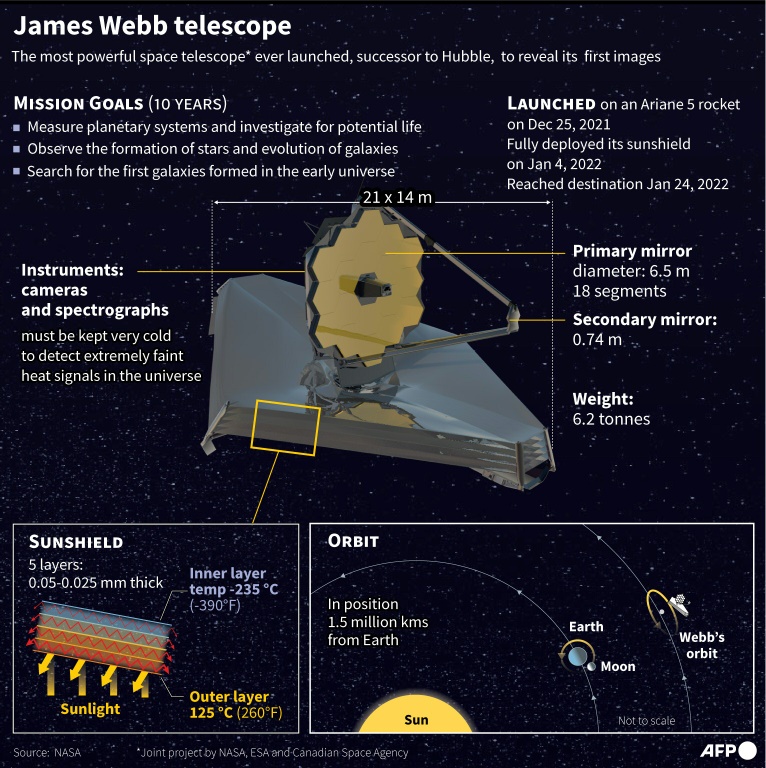
Launched in December 2021 from French Guiana on an Ariane 5 rocket, Webb is orbiting the Sun at a distance of a million miles (1.6 million kilometers) from Earth, in a region of space called the second Lagrange point.

Here, it remains in a fixed position relative to the Earth and Sun, with minimal fuel required for course corrections. 

A wonder of engineering, the total project cost is estimated at $10 billion, making it one of the most expensive scientific platforms ever built, comparable to the Large Hadron Collider at CERN.

Webb’s primary mirror is over 21 feet (6.5 meters) wide and is made up of 18 gold-coated mirror segments. Like a camera held in one’s hand, the structure must remain as stable as possible to achieve the best shots.

Charlie Atkinson, chief engineer on the James Webb Space Telescope program at lead contractor Northrop Grumman, told AFP that it wobbles no more than 17 millionths of a millimeter.

After the first images, astronomers around the globe will get shares of time on the telescope, with projects selected competitively through a process in which applicants and selectors don’t know each others’ identities, to minimize bias.

Thanks to an efficient launch, NASA estimates Webb has enough propellant for a 20-year life, as it works in concert with the Hubble and Spitzer space telescopes to answer fundamental questions about the cosmos.
Excitement builds as Biden to release first image from Webb telescope

US President Joe Biden will Monday release one of the first images taken by the James Webb Space Telescope, the most powerful observatory ever sent into orbit and a leap forward in uncovering the secrets of the distant universe.

The unveiling will take place at 5:00 pm (2100 GMT) during a livestreamed event at the White House, official statements said, leaving the space community in a state of keen anticipation.

NASA revealed last week Webb’s first targets included distant galaxies, bright nebulae and a faraway giant gas planet.

The very first image, released by the US president, will be of the “deep field” — an image taken with very long exposure time, to detect the faintest of objects in the distance — according to a person familiar with the matter.

NASA previously said Webb would achieve this shot by pointing its primary imager towards massive foreground galaxy clusters called SMACS 0723, which bend the light of objects far behind them towards the observer, an effect called “gravitational lensing.”

This promises to be what NASA chief Bill Nelson called last month the “deepest image of our Universe that has ever been taken.”

The rest of the first wave of images are set to be released by NASA on Tuesday.

Webb’s infrared capabilities are what make it uniquely powerful, allowing it to both pierce through cosmic dust clouds and detect light from the earliest stars, which has been stretched into infrared wavelengths as the universe expanded.

This lets it peer further back in time than any previous telescope, to the period shortly after the Big Bang, 13.8 billion years ago.

“When I first saw the images… I suddenly learned three things about the Universe that I didn’t know before,” Dan Coe, a Space Telescope Science Institute (STSI) astronomer and expert on the early Universe, told AFP. “It’s totally blown my mind.”

– First targets –

An international committee decided the first wave of images would include the Carina Nebula, an enormous cloud of dust and gas 7,600 light years away.

Carina Nebula is famous for its towering pillars that include “Mystic Mountain,” a three-light-year-tall cosmic pinnacle captured in an iconic image by the Hubble Space Telescope, until now humanity’s premier space observatory.

Webb has also carried out a spectroscopy — an analysis of light that reveals detailed information — on a faraway gas giant called WASP-96 b, which was discovered in 2014.

Nearly 1,150 light-years from Earth, WASP-96 b is about half the mass of Jupiter and zips around its star in just 3.4 days.

Nestor Espinoza, an STSI astronomer, told AFP that previous exoplanet spectroscopies carried out using existing instruments were very limited compared to what Webb could do.

“It’s like being in a room that is very dark and you only have a little pinhole you can look through,” he said of the prior technology. Now, with Webb, “You’ve opened a huge window, you can see all the little details.”

– Million miles from Earth –

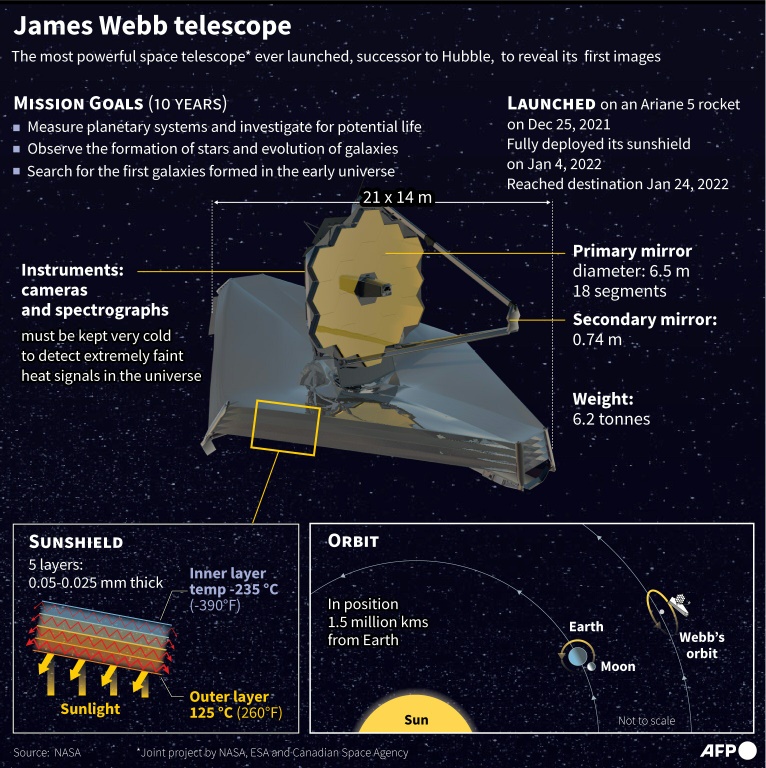
Launched in December 2021 from French Guiana on an Ariane 5 rocket, Webb is orbiting the Sun at a distance of a million miles (1.6 million kilometers) from Earth, in a region of space called the second Lagrange point.

Here, it remains in a fixed position relative to the Earth and Sun, with minimal fuel required for course corrections. 

A wonder of engineering, the total project cost is estimated at $10 billion, making it one of the most expensive scientific platforms ever built, comparable to the Large Hadron Collider at CERN.

Webb’s primary mirror is over 21 feet (6.5 meters) wide and is made up of 18 gold-coated mirror segments. Like a camera held in one’s hand, the structure must remain as stable as possible to achieve the best shots.

Charlie Atkinson, chief engineer on the James Webb Space Telescope program at lead contractor Northrop Grumman, told AFP that it wobbles no more than 17 millionths of a millimeter.

After the first images, astronomers around the globe will get shares of time on the telescope, with projects selected competitively through a process in which applicants and selectors don’t know each others’ identities, to minimize bias.

Thanks to an efficient launch, NASA estimates Webb has enough propellant for a 20-year life, as it works in concert with the Hubble and Spitzer space telescopes to answer fundamental questions about the cosmos.

China lockdown fears hit equities, oil prices

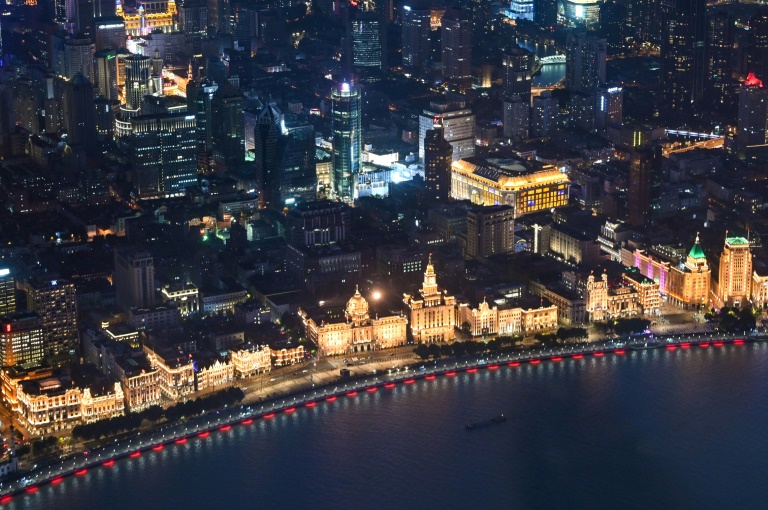
Stock markets and oil prices slid Monday with a fresh Covid flare-up in Shanghai fanning fears of another painful lockdown in China’s biggest city.

European equities headed south following hefty losses for most main Asian markets, and Wall Street followed suit as investors braced for the beginning of the corporate earnings season later this week.

The euro continued to weaken against the dollar, heading towards parity with the greenback for the first time in more than 20 years.

And the European Commission said it would again cut its growth forecast for the current year and hike its expectations for inflation.

“It is no longer a question of if euro-dollar will fall to one, but more a question of how quickly and will it stop there,” City Index analyst Fiona Cincotta told AFP.

“With energy security concerns rising by the day in Europe, a recession seems almost impossible to avoid. Meanwhile, the strong US jobs report means that a 100-basis-point rate hike this month can’t be discounted. The diverging economic outlooks and the significantly more hawkish Fed means that euro-dollar could comfortably fall below parity,” she said.

AJ Bell investment analyst Danni Hewson said “three catalysts… could shake investors out of their torpor as we get the latest reading of US inflation, GDP (gross domestic product) figures from China and the big US banks kick-off the second quarter earnings season across the Atlantic.” 

Traders were keeping tabs on US President Joe Biden as he weighs removing some of the tariffs on Chinese goods worth hundreds of billions of dollars that were imposed by predecessor Donald Trump.

– China growth fears –

The prospect of another lockdown sparked an equities sell-off in Hong Kong and Shanghai on Monday.

Chinese tech firms took a battering after authorities fined giant Tencent and Alibaba over not properly reporting past deals.

Hong Kong-listed casino operators were also sharply lower after officials in Macau embarked on a week-long lockdown to curb its worst coronavirus outbreak.

There were also losses in Sydney, Seoul, Taipei, Manila, Mumbai, Jakarta and Wellington.

However, Tokyo rose as traders welcomed Japan’s ruling bloc securing a strong win in Sunday’s upper house election, held days after the assassination of former premier Shinzo Abe.

The result should provide the government with some stability, while there were also hopes for a cabinet reshuffle and economic stimulus.

Shanghai recorded more than 120 virus cases at the weekend, having seen its first one of the highly contagious BA.5 Omicron strain, forcing officials to launch another mass testing drive.

With China fixated on its zero-Covid strategy to wipe out the disease, there is increasing concern that authorities will revert to another painful lockdown. Shanghai residents only emerged from a two-month confinement in June.

There have meanwhile been new infections uncovered in other parts of the country, including Beijing.

Data this week will provide a fresh update on the economic impact of those measures, as well as similar strict controls in Beijing.

– Key figures at around 1345 GMT –

New York – Dow: DOWN 0.5 percent at 31,181.08 points

London – FTSE 100: DOWN 0.2 percent at 7,178.74

Frankfurt – DAX: DOWN 1.5 percent at 12,823.32

Paris – CAC 40: DOWN 1.1 percent at 5,969.67

EURO STOXX 50: DOWN 1.2 percent at 3,466.34

Tokyo – Nikkei 225: UP 1.1 percent at 26,812.80 (close)

Hong Kong – Hang Seng Index: DOWN 2.8 percent at 21,124.20 (close)

Shanghai – Composite: DOWN 1.3 percent at 3,313.58 (close)

West Texas Intermediate: DOWN 2.3 percent at $102.35 per barrel

Brent North Sea crude: DOWN 2.0 percent at $104.85 per barrel

Euro/dollar: DOWN at $1.0062 from $1.0183 on Friday

Pound/dollar: DOWN at $1.1892 from $1.2034 

Euro/pound: UP at 84.63 pence from 84.59 pence

Dollar/yen: UP at 137.37 yen from 136.10 yen

burs-spm/bp

Spain, Portugal swelter under new heat wave

Temperatures were set to soar above 40 degrees Celsius across large parts of Spain and Portugal on Monday as the Iberian Peninsula faces a second heat wave in less than a month.

The mercury was to hit 42 degrees Celsius (107.6 Fahrenheit) in Spain’s southeastern region of Extremadura and 41 degrees in Andalusia, Spain’s meteorological agency AEMET said.

Temperatures in Spain’s normally cooler northwestern region of Galicia were predicted to rise above 35C.

“This heatwave really has the potential to be exceptional,” said AEMET spokesman Ruben del Campo.

The heat wave began Sunday and could “last nine or ten days, which would make it one of the three longest heat waves Spain has seen since 1975,” he told AFP.

Heat waves have become more likely due to climate change, scientists say. As global temperatures rise over time, heat waves are expected to become more frequent and intense.

June also saw Spain grapple with temperatures above 40C in swathes of the country.

And the previous month was Spain’s hottest May since the beginning of the century.

In August 2021 Spain recorded its highest ever temperature when the mercury reached 47.4C in the southern town of Montoro.

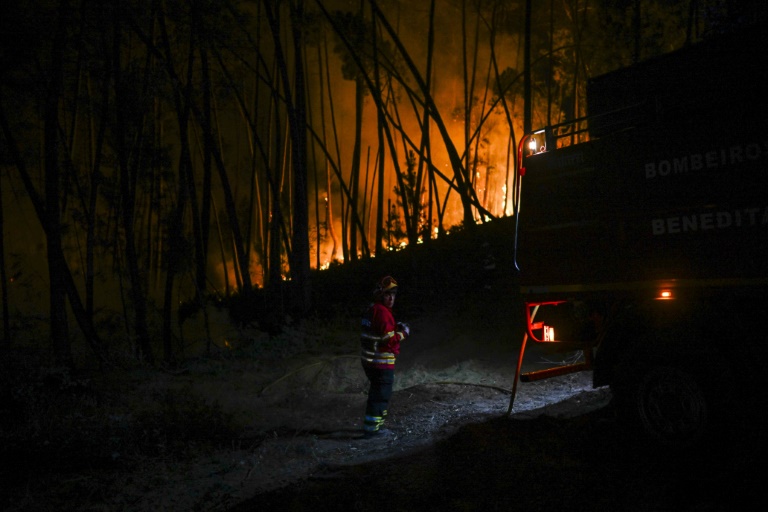
In neighbouring Portugal the thermometer topped 44C over the weekend, fuelling wildfires and vast smoke clouds which were visible in the capital Lisbon.

Firefighters brought under control Monday the largest blaze which was burning in the central municipality of Ourem, local officials said.

While temperatures eased somewhat in Portugal on Monday they were expected to soar again in the coming days with 44C forecast for the southeastern city of Evora.

Water reservoirs in Spain stood at 45.3 percent of capacity on Monday, well below the average of 65.7 percent recorded during this period over the past decade.

Big CAT scan: London Zoo treats lion with earache

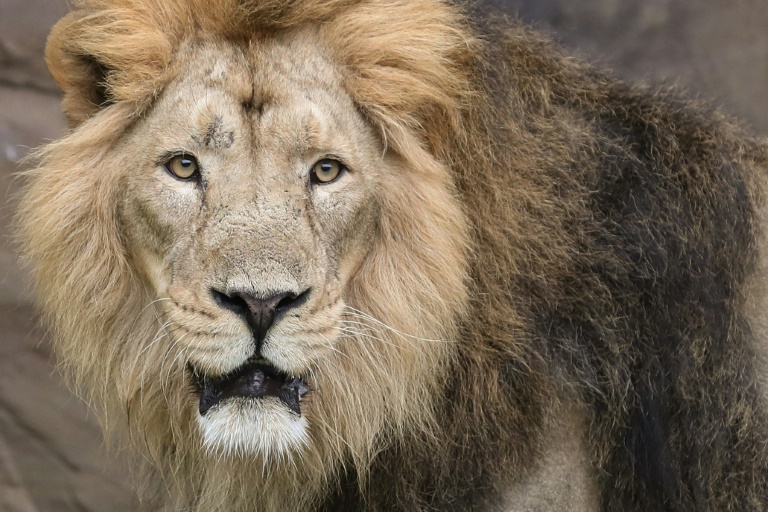
How do you treat an endangered 12-year-old lion with persistent earache? Normally, the answer is: with difficulty.

But London Zoo on Monday said they made the process easier by hiring a CAT scanner for Bhanu the lion to find out the cause of his repeated ear infections.

The equipment was brought in to prevent the 180-kilogram (28-stone) Asiatic lion having to be sedated and transported off-site for tests.

Senior veterinary officer Taina Strike said the zoo hit upon the intervention as part of a long-term treatment plan for the animal.

“We first had to find out what was causing the problem and urgently rule out any worst-case scenarios, such as a tumour or a deep-seated infection, which would show up on a CAT scan immediately,” she said. 

“Bhanu is an important member of the European-wide breeding programme for endangered Asiatic lions and deserves the very best care, so we arranged the full VIP treatment; bringing a CAT scanner to a big cat for the first time, so we could see deeper into his ear without him needing to travel.”

Bhanu was sedated in his den then taken to the scanner on the back of a flatbed truck. Six members of staff then manoeuvred him into position on the scanner.

Specialists from around the world dialled in to diagnose the problem, which was found to be a very narrow left ear canal prone to blockages and infections.

“Just like your pet cat at home, big cats can naturally get ear infections too, which are normally treated with ear drops,” said Strike.

While he was under anaesthetic, vets gave the big cat’s ear a thorough clean before he was deposited back in his den.

Twitter stock falls after Musk abandons takeover plan

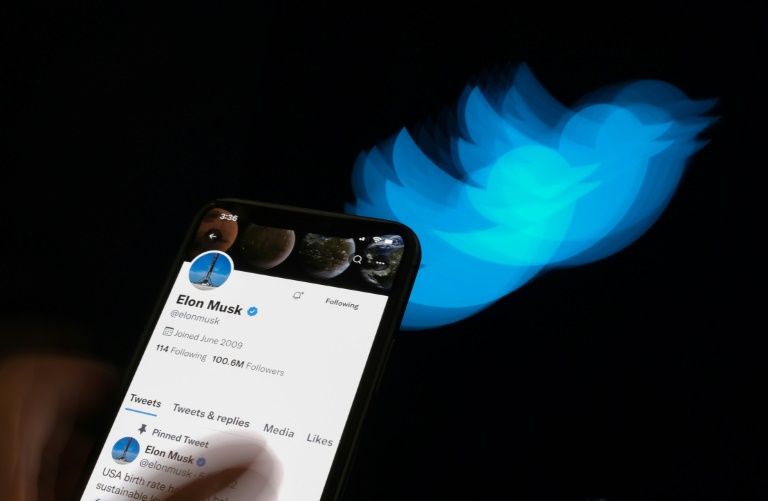
Twitter stock fell Monday after Tesla chief Elon Musk ditched a $44 billion deal to buy the social media giant.

The platform stock dropped 5.46 percent on Wall Street, to $34.80 by around 7:05 am (11:05 GMT). It had lost 5.10 percent before the weekend.

Musk on Friday pulled the plug on the deal, accusing the company of “misleading” statements about the number of fake accounts, according to a letter from his lawyers, a copy of which was filed with the Securities and Exchange Commission.

Musk’s effort to terminate the deal that he inked in April sets the stage for an epic court battle over a billion-dollar breakup fee.

The social network says the number of fake accounts is less than five percent, a figure challenged by the multi-billionaire who believes the number to be much higher. 

According to several US media, Twitter has hired prominent New York law firm Wachtell, Lipton, Rosen & Katz. Twitter declined to comment to AFP.

After the news broke, Musk tweeted: “They said I couldn’t buy Twitter. Then they wouldn’t disclose bot info. Now they want to force me to buy Twitter in court. Now they have to disclose bot info in court,” accompanied by pictures of him laughing.

For analyst Dan Ives at Wedbush Securities, “this is a ‘code red’ situation for Twitter and its Board as now the company will go head to head against Musk in a Game of Thrones court battle.”

“We see no other bidders emerging at this time while legal proceedings play out in the courts.”

Close Bitnami banner
Bitnami