AFP

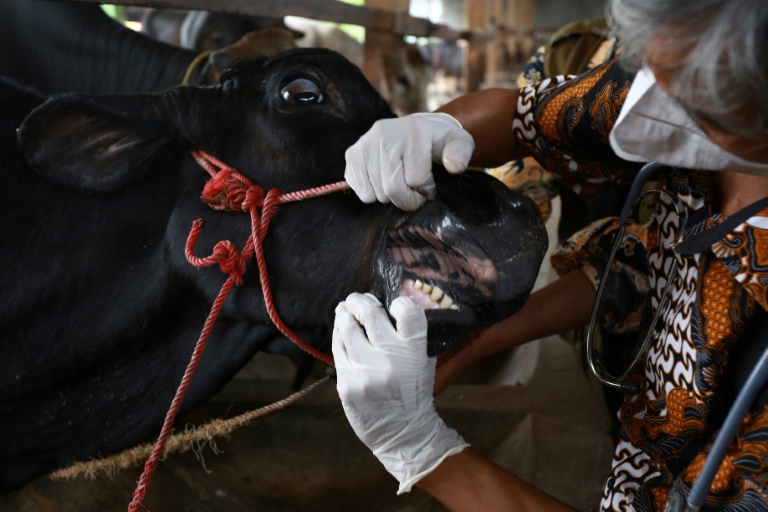
Indonesian farmers pay price of foot and mouth outbreak before Eid sacrifice

Indonesian farmer Okky Pratama usually sells dozens of cattle for Eid al-Adha, making his biggest earnings around the Islamic day of sacrifice, but this year he has sold just five.

A foot-and-mouth disease outbreak has ripped through two Indonesian provinces since April, killing thousands of cows and infecting hundreds of thousands more, raising consumer fears before the July 10 festival.

Clusters of the highly infectious animal virus in East Java and Aceh provinces have rattled cattle farmers and their output during the most profitable time of year in a country with the world’s biggest Muslim population.

“I am pessimistic about the sales. Regular buyers unusually did not send me any purchase inquiries,” said Pratama, whose cow farm in the mountainous Batu City is situated in the hardest-hit East Java province. 

“When I contacted them, they said they did not (want to) sacrifice any livestock this year because of the foot-and-mouth disease.”  

Profits from the holiday season — around 60 million rupiah ($4,000) — account for 75 percent of his annual earnings, 31-year-old Pratama told AFP. 

But he has so far lost two of his cattle to the disease — which was first detected in early May. 

Thirty-three others were infected but recovered after intensive care.

As of July 6, the disease had spread to 21 provinces across Indonesia and infected more than 320,000 livestock, according to official data. 

Over 2,100 of them have died from the disease.

– Sales struggle – 

Indonesia had been outbreak-free for 30 years, but farmers are reeling from a fresh blow to their business after the coronavirus pandemic shuttered restaurants and food stalls.

Cow-farmer Masrizal said he has struggled to sell his cattle because of sluggish demand for meat and shuttered livestock markets in Aceh province. 

“As markets are closed, I had to proactively offer the sacrificial livestock to mosques and people in villages,” he said.

The disease specifically attacks cloven-hoofed animals such as cattle, swine, sheep and goats, and the policy in Europe — such as during the British outbreak in 2001 -– has typically been to slaughter herds of animals as a precaution. 

But farmers in Indonesia are trying to keep their precious assets alive despite the risk of the disease spreading through close contact between animals, contaminated feed and farm equipment. 

Animals infected by the disease usually lose their appetite and temporarily cannot walk as they develop blisters inside the mouth and on the feet. 

– Swift vaccination key –  

The government has stepped in, setting up a task force and ordering the culling of more than 2,800 livestock.

The country’s religious affairs minister has told Muslims they “should not force themselves” to sacrifice cattle during the outbreak.

Suharyanto, the head of the government’s new task force, compared the outbreak to the Covid-19 pandemic, and Jakarta said it would attempt to administer 800,000 vaccine shots to healthy cattle by July 7, before the day of sacrifice.

“As long as the livestock are well-treated and well-fed, God willing, they can recover,” the agriculture ministry’s director of livestock production Agung Suganda said in a webinar last week. 

Suharyanto said small farmers whose cattle were culled will receive up to 10 million rupiah ($666) in compensation — well short of the thousands of dollars farmers earned from Eid sales last year. 

And the cancellation of pre-outbreak orders and demands for refunds have left farmers with “extraordinary” losses, the Indonesian Cattle and Buffalo Breeders Association (PPSKI) chairman Nanang Purus Subendro said. 

“We need to accelerate the process because we are in a race against the virus.”
The Cold War on a chessboard 50 years ago

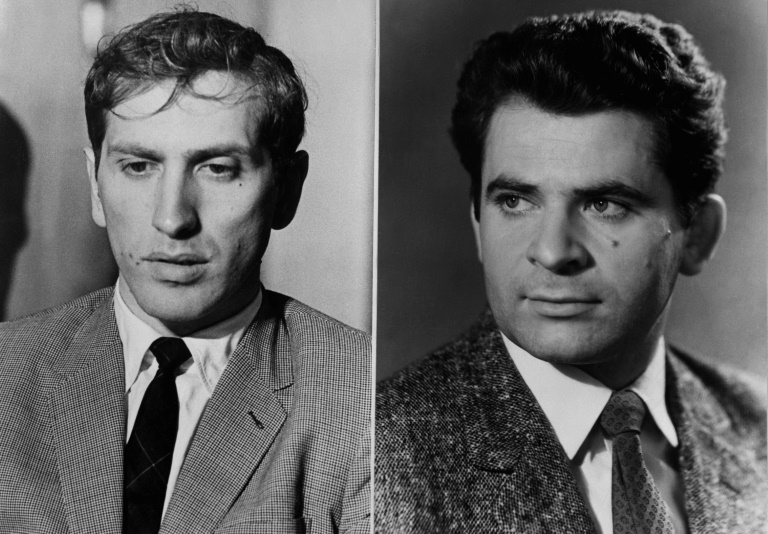
Fifty years ago, the Cold War was transposed to a chessboard as Bobby Fischer of the United States took on defending world champion Boris Spassky of the Soviet Union in a thrilling East-West clash dubbed the “match of the century”.

Some 50 million TV viewers tuned into the two-month-long tussle in the Icelandic capital Reykjavik, where chess’s enfant terrible Fischer set out to wrest the championship from the Soviet Union, which had dominated the game for decades.

AFP reported daily from the competition. This account is based on its reporting.

– Polar opposites –

On one side of the table is Fischer, an eccentric, fiercely competitive 29-year-old former boy wonder, who was holding his own among America’s greats by the age of 12 and has already won eight US chess championships. 

Born in Chicago, Fischer grew up in the New York suburb of Brooklyn where his older sister taught him chess at the age of six.

He became the world’s youngest ever chess grand master at the age of 15 and dropped out of school to focus on the game.

AFP’s correspondent in Reykjavik says “he has few friends and doesn’t care to make any” and that his motto is: “It’s not enough to defeat an adversary, you have to crush them.”

He goes into the competition having won 101 out of his previous 120 games.

In the other seat is 35-year-old Boris Spassky, a trained journalist and married father of two children who has been world champion for three years. 

Born in Leningrad (now Saint Petersburg) in 1937 he was sent to an orphanage in Siberia during the Nazi German siege of the city during World War II.

A pure product of the Soviet chess machine, he began playing at five and became world champion at 19.

A likeable, modest character, he is the antithesis of the cantankerous Fischer. 

– Temper tantrums –

Fischer is the first US-born player to have a stab at the title (since 1946, the two finalists have always been Soviet).

Neutral countries vie to host the match, which is eventually awarded to Iceland.

Fischer makes a series of demands before agreeing to participate. The venue, a sports hall, must be sound-proofed, fitted with a new carpet and the room temperature kept to 22.5 degrees Celsius.

But on the eve of the competition, he has still not shown up and Spassky is growing impatient. 

Henry Kissinger, who is US national security advisor at the time under President Richard Nixon, calls Fischer and convinces him to take part.

AFP reports that the US champion “appears tired” when he lands in Reykjavik on July 4. He ducks out of the opening ceremony. An outraged Spassky demands an apology.

The competition finally gets underway on July 11, nine days late.

– ‘Scandal of the century’ –

Spassky arrives 20 minutes early to the opening game to “vigorous applause” from the 2,500 spectators in the packed hall. Fischer dashes in at the last minute, “pushes past the photographers, rushes towards Spassky, shakes his hand” and sits down. The game is finally on.

The two proceed cautiously and at the 28th move, the game looks headed for a draw. But Fischer then makes two bad moves and resigns on the 56th move.

Stung by his loss, he demands that all cameras be removed from the hall. When the request is denied, he refuses to show up to the second game, forfeiting it. 

“The spectators are disappointed and exasperated,” AFP reports. 

Icelandic daily Timinn declares that the match of the century has turned into the “scandal of the century”. 

As the third game looms Fischer is nowhere to be found. Kissinger again picks up the phone. “Please, continue the game,” Fischer later quotes him as pleading.

The hall is packed when the competition resumes on July 16, but the stage is empty. Spassky has accepted Fischer’s demand that they play in a small back room normally used for ping pong (with a camera in the ceiling broadcasting the events to the main hall outside).

Some commentators see Spassky’s concession as a bad omen for the Russian, who goes on to lose the game.

The fourth is a draw and Spassky resigns the fifth.

The two are now neck-and-neck.

– Games for the history books –

The 6th game is one of the toughest of the competition. Spassky throws in the towel at the 41st move.

“I’m proud of this game, it was one of my best,” Fischer tells AFP, adding: “When Spassky joined the crowd in applauding my victory I thought ‘what a gentleman’.”

Spassky also resigns the 13th game, a chess masterclass, according to AFP’s correspondent, who reported that, after congratulating his opponent, Spassky “sits back down in contemplation for six minutes, his gaze lost in the chessboard”. 

Fischer is looking increasingly assured of victory. “He will be champion,” his sister Joan tells AFP after the seventh game.

The Russian asks that the 14th game be postponed and the next seven are all draws. 

Game 21, which goes to Fischer, turns out to be the last. The next day Spassky resigns the game, making Fischer, who is still asleep, the 11th world chess champion, with a final score of 12.5-8.5.

– From hero to zero –

With the chessboard seen as a metaphor for great power politics, Fischer’s win is feted in the United States as a symbolic victory of capitalism over communism. 

Nixon invites Fischer to the White House.

A broken Spassky returns to an icy reception in the Soviet Union, where he is banned from taking part in chess competitions and placed under surveillance by the KGB, the secret police. 

In 1976, he marries a Frenchwoman and moves to Paris, but the self-professed Russian nationalist later returns to Moscow.

Fischer never plays another chess competition. 

In 1975, he refuses to defend his title against the Soviet Union’s Anatoly Karpov and therefore loses it. A conspiracy theorist with a visceral hatred of “world Jewry” he disappears for years at a time, re-emerging in 1992 for a rematch against Spassky in Yugoslavia, despite the war-torn country being under US sanctions.

In 2004 he renounces his US citizenship and later moves to Iceland where he dies on January 17, 2008 at the age of 64 — the number of squares on a chessboard.

Musk and Twitter: From volatile courtship to messy divorce

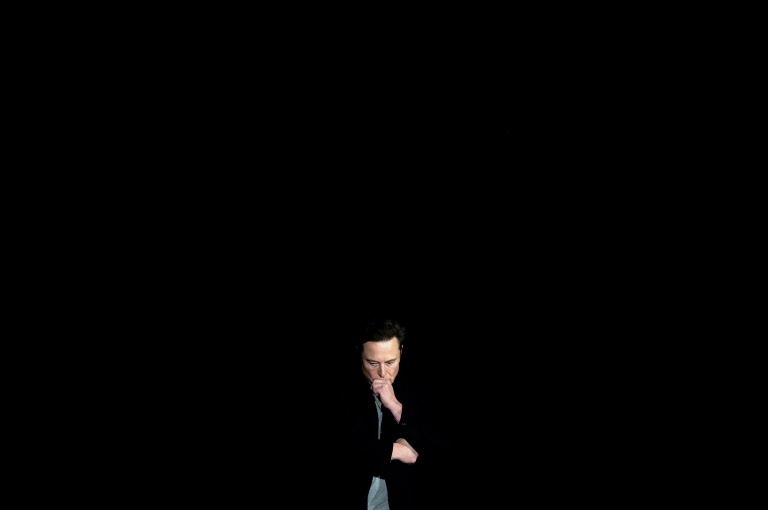
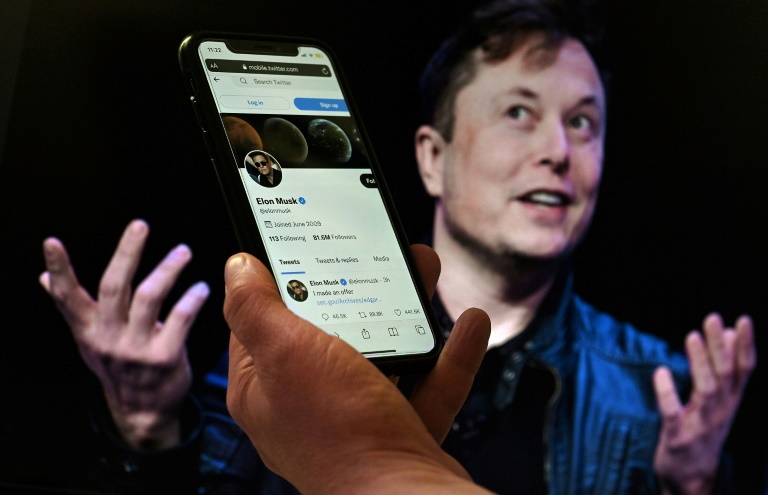
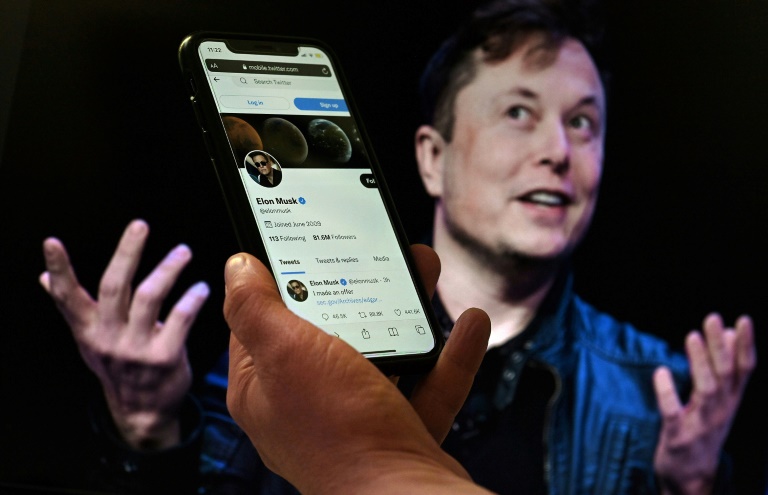
Elon Musk’s pursuit of Twitter was a melodrama from beginning to end — a volatile courtship between a mercurial billionaire and the massively influential social media platform.

That relationship — an obvious love-hate affair from Musk’s side — now seems set to end in an acrimonious divorce.

– The courtship –

It all began with an expensive first date: Musk — a longtime Twitter user known for inflammatory tweets — snapped up 73.5 million shares at a cost of nearly $2.9 billion.

The purchase, which was revealed in an April 4 regulatory filing and gave him a 9.2 percent stake in the company, sent Twitter shares soaring and sparked speculation that Musk was seeking an active role in the social media company’s operations.

It also earned him a seat on the board. CEO Parag Agrawal announced the offer — in a tweet, of course — and called Musk “a passionate believer and intense critic of the service which is exactly what we need.”

But the honeymoon didn’t last long: Agrawal said on April 10 that Musk had decided against joining the board, a move the Twitter CEO believed was “for the best.”

Rather than amicably parting ways, Musk launched a hostile takeover bid for the company, offering $54.20 a share, an April 13 filing showed.

After saying it would “carefully review” the offer, Twitter adopted a “poison pill” defense, announcing a plan that would allow shareholders to purchase additional stock.

– The engagement –

Then came the plans for a walk down the corporate aisle: Twitter reversed course and said on April 25 that it was selling to Musk in a deal valued at $44 billion.

But weddings can be expensive, so Musk took action to cover the cost, parting with $8.4 billion in shares in electric carmaker Tesla. He pledged up to $21 billion from his personal fortune, with the rest financed by debt.

Musk was already planning his new life with Twitter, saying a few days later that he would lift the ban on Donald Trump, which was handed down after the January 2021 riot at the US Capitol by the then-president’s supporters.

– The breakup –

But Musk soon began showing signs of cold feet, saying on May 13 that the deal to buy Twitter was “temporarily on hold” pending details on spam and fake accounts on the platform.

In early June, advocacy groups decided to speak now instead of forever holding their peace, launching a campaign to stop Musk from going through with the purchase, which they said would allow him to “hand a megaphone to demagogues and extremists.”

Musk meanwhile accused Twitter of failing to provide data on fake accounts, and threatened to withdraw his bid.

On June 16, however, he offered signs that the match was still a go, pitching a vision to Twitter staff of a one-billion-user platform. But he was hazy on issues such as potential layoffs and free speech limits.

It all came crashing down on July 8, when Musk called off the wedding and accused Twitter of making “misleading” statements about the number of fake accounts.

The breakup between the billionaire and the social media platform is set to be far from friendly.

Twitter’s chairman tweeted that the company will pursue legal action to enforce the deal, setting up a pricey showdown as the divorce heads to court.

Musk and Twitter: From volatile courtship to messy divorce

Elon Musk’s pursuit of Twitter was a melodrama from beginning to end — a volatile courtship between a mercurial billionaire and the massively influential social media platform.

That relationship — an obvious love-hate affair from Musk’s side — now seems set to end in an acrimonious divorce.

– The courtship –

It all began with an expensive first date: Musk — a longtime Twitter user known for inflammatory tweets — snapped up 73.5 million shares at a cost of nearly $2.9 billion.

The purchase, which was revealed in an April 4 regulatory filing and gave him a 9.2 percent stake in the company, sent Twitter shares soaring and sparked speculation that Musk was seeking an active role in the social media company’s operations.

It also earned him a seat on the board. CEO Parag Agrawal announced the offer — in a tweet, of course — and called Musk “a passionate believer and intense critic of the service which is exactly what we need.”

But the honeymoon didn’t last long: Agrawal said on April 10 that Musk had decided against joining the board, a move the Twitter CEO believed was “for the best.”

Rather than amicably parting ways, Musk launched a hostile takeover bid for the company, offering $54.20 a share, an April 13 filing showed.

After saying it would “carefully review” the offer, Twitter adopted a “poison pill” defense, announcing a plan that would allow shareholders to purchase additional stock.

– The engagement –

Then came the plans for a walk down the corporate aisle: Twitter reversed course and said on April 25 that it was selling to Musk in a deal valued at $44 billion.

But weddings can be expensive, so Musk took action to cover the cost, parting with $8.4 billion in shares in electric carmaker Tesla. He pledged up to $21 billion from his personal fortune, with the rest financed by debt.

Musk was already planning his new life with Twitter, saying a few days later that he would lift the ban on Donald Trump, which was handed down after the January 2021 riot at the US Capitol by the then-president’s supporters.

– The breakup –

But Musk soon began showing signs of cold feet, saying on May 13 that the deal to buy Twitter was “temporarily on hold” pending details on spam and fake accounts on the platform.

In early June, advocacy groups decided to speak now instead of forever holding their peace, launching a campaign to stop Musk from going through with the purchase, which they said would allow him to “hand a megaphone to demagogues and extremists.”

Musk meanwhile accused Twitter of failing to provide data on fake accounts, and threatened to withdraw his bid.

On June 16, however, he offered signs that the match was still a go, pitching a vision to Twitter staff of a one-billion-user platform. But he was hazy on issues such as potential layoffs and free speech limits.

It all came crashing down on July 8, when Musk called off the wedding and accused Twitter of making “misleading” statements about the number of fake accounts.

The breakup between the billionaire and the social media platform is set to be far from friendly.

Twitter’s chairman tweeted that the company will pursue legal action to enforce the deal, setting up a pricey showdown as the divorce heads to court.

'Sopranos' star Tony Sirico dies aged 79: family

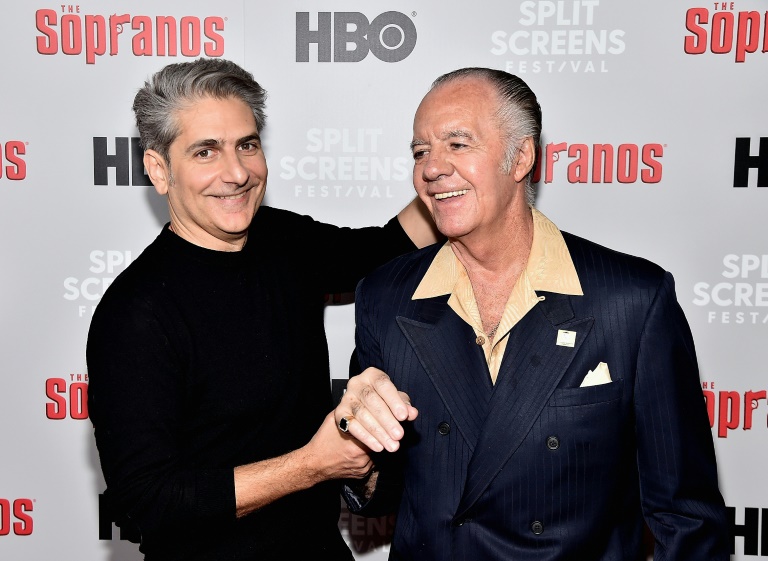
US actor Tony Sirico, best known for portraying Paulie “Walnuts” Gualtieri in “The Sopranos,” has died aged 79, his family and a former castmate said Friday.

Sirico played minor mobster roles in television and film for decades before being cast in his fifties as the eccentric and sometimes brutal Paulie on HBO’s hit show — becoming one of the series’ most memorable characters.

“It is with great sadness, but with incredible pride, love and a whole lot of fond memories, that the family of Gennaro Anthony ‘Tony’ Sirico wishes to inform you of his death on the morning of July 8, 2022,” his family said in a statement on Facebook.

His “Sopranos” co-star Michael Imperioli added: “It pains me to say that my dear friend, colleague and partner in crime, the great Tony Sirico has passed away today.”

“Tony was like no one else: he was as tough, as loyal and as big hearted as anyone I’ve ever known… Heartbroken today,” Imperioli — who played Christopher Moltisanti — wrote on Instagram.

Sirico’s representatives did not immediately respond to an AFP request for comment.

Born in Brooklyn, New York in 1942, Sirico was frequently arrested as a youth, but caught the acting bug in prison after seeing a troupe of ex-convicts perform.

He took multiple small parts as thugs and wise guys from the late 1970s onward, appearing in TV shows such as “Kojak” and “Miami Vice,” and mob-themed films including “Goodfellas” and “Mickey Blue Eyes.”

Sirico was in his fifties when he was cast for his best-known part in “Sopranos,” the ground-breaking HBO series which explored the private lives of a New Jersey crime group.

His character Paulie delivered many of the show’s most memorable lines, displaying both a playful humor and a vicious loyalty to boss Tony Soprano. 

Elon Musk: smasher of elites or self-serving pragmatist?

He has scorned organized labor, mocked political correctness and espoused small government — so conservatives may be disappointed that he wants to pull out of his deal to buy Twitter.

Yet smoking marijuana during interviews, courting Hollywood with movie cameos and musing about nuking Mars make Elon Musk an improbable talisman for political traditionalists.

In polarized America, the 51-year-old triple divorcee’s opposition to Covid-19 restrictions is often taken to demonstrate Republican sympathies, although his disdain for draconian immigration control suggests the opposite.

The world’s richest man has berated President Joe Biden for proposing a tax credit for electric cars produced by unionized workers. He has even called for an end to all US federal subsidies.

Yet he has aggressively pursued government support himself, taking billions in handouts for his own companies.

James Hickman, founder of the libertarian-leaning Sovereign Man newsletter, sees Musk as a check on the “tyranny of the minority” — a supposed cabal of elites in tech, media and academia who make decisions for the rest of us and “consistently get it wrong.”

“What makes someone a true libertarian is an outright rejection of labels and being completely independent in one’s thinking,” Hickman told AFP.

“Musk clearly qualifies in this regard.”

Other analysts have suggested that, as inconsistent as his political philosophy appears, Musk rarely diverges from his business interests.

Meanwhile his political donations don’t cleave to one party or point of view either.

A self-styled “moderate” independent — although he has described himself as a “socialist” too — Musk ostentatiously moved to deeply conservative Texas from ultra-liberal California in 2020.

He has given donations to the governors of both states, despite criticizing Texas anti-abortion laws and a “complacent” business environment in California.

– Free speech, or not? –

Other donations have gone to Democratic grandees Hillary Clinton and Barack Obama, right-wing House Minority Leader Kevin McCarthy and the Republican Party itself. 

He is also not averse to lashing out on social media at Washington establishment figures, from one-time presidential nominee Elizabeth Warren (“Senator Karen”) to Biden himself.

And then there’s the issue of free speech, which he has called “the bedrock of a functioning democracy.”

Musk has complained that Twitter is too censorious, simultaneously illustrating and undermining his point in a tweet depicting the company’s CEO Parag Agrawal as brutal Soviet dictator Joseph Stalin.

Critics say his passion for unfettered conversation has often appeared less profound when his own interests are at stake.  

Some media outlets have raised questions over Musk’s reaction to journalists writing stories critical of Tesla.

Accused of unleashing his army of supporters on individual reporters, he once mulled creating a website for the profession as a whole called Pravda — presumably a tribute to the Soviet propaganda outlet.

“Going to create a site where the public can rate the core truth of any article & track the credibility score over time of each journalist, editor & publication,” he tweeted in 2018. Nothing came of it.

– ‘Pragmatic’ and ‘self-interested’ –

Former Hillary Clinton campaign staffer Judd Legum has pointed to a tweet — also 2018 — in which Musk appeared to threaten to rescind employee stock options at Tesla if workers decided to join a union.

Critics say there is a pattern of suppressing less powerful voices that has also included forcing workers to sign restrictive non-disclosure agreements (NDAs).

A Tesla NDA reportedly warned employees that “they were not allowed to speak with media without explicit written permission” — but the company neglected to add that labor laws protected them from reprisals when discussing work conditions.

Baruch Labunski, an internet marketing expert and web consultancy CEO, says that, amid much “contradictory evidence,” it’s safest to describe Musk’s politics as “pragmatic.”

“He is frequently characterized as a libertarian but that designation doesn’t accurately describe the man whose businesses have benefited from government tax breaks and business subsidies,” Labunski told AFP.

Musk is a “fundamentally self-interested” celebrity, says Labunski.

“Musk gets to play in and around politics because he’s rich and he’s outspoken.”

Elon Musk: smasher of elites or self-serving pragmatist?

He has scorned organized labor, mocked political correctness and espoused small government — so conservatives may be disappointed that he wants to pull out of his deal to buy Twitter.

Yet smoking marijuana during interviews, courting Hollywood with movie cameos and musing about nuking Mars make Elon Musk an improbable talisman for political traditionalists.

In polarized America, the 51-year-old triple divorcee’s opposition to Covid-19 restrictions is often taken to demonstrate Republican sympathies, although his disdain for draconian immigration control suggests the opposite.

The world’s richest man has berated President Joe Biden for proposing a tax credit for electric cars produced by unionized workers. He has even called for an end to all US federal subsidies.

Yet he has aggressively pursued government support himself, taking billions in handouts for his own companies.

James Hickman, founder of the libertarian-leaning Sovereign Man newsletter, sees Musk as a check on the “tyranny of the minority” — a supposed cabal of elites in tech, media and academia who make decisions for the rest of us and “consistently get it wrong.”

“What makes someone a true libertarian is an outright rejection of labels and being completely independent in one’s thinking,” Hickman told AFP.

“Musk clearly qualifies in this regard.”

Other analysts have suggested that, as inconsistent as his political philosophy appears, Musk rarely diverges from his business interests.

Meanwhile his political donations don’t cleave to one party or point of view either.

A self-styled “moderate” independent — although he has described himself as a “socialist” too — Musk ostentatiously moved to deeply conservative Texas from ultra-liberal California in 2020.

He has given donations to the governors of both states, despite criticizing Texas anti-abortion laws and a “complacent” business environment in California.

– Free speech, or not? –

Other donations have gone to Democratic grandees Hillary Clinton and Barack Obama, right-wing House Minority Leader Kevin McCarthy and the Republican Party itself. 

He is also not averse to lashing out on social media at Washington establishment figures, from one-time presidential nominee Elizabeth Warren (“Senator Karen”) to Biden himself.

And then there’s the issue of free speech, which he has called “the bedrock of a functioning democracy.”

Musk has complained that Twitter is too censorious, simultaneously illustrating and undermining his point in a tweet depicting the company’s CEO Parag Agrawal as brutal Soviet dictator Joseph Stalin.

Critics say his passion for unfettered conversation has often appeared less profound when his own interests are at stake.  

Some media outlets have raised questions over Musk’s reaction to journalists writing stories critical of Tesla.

Accused of unleashing his army of supporters on individual reporters, he once mulled creating a website for the profession as a whole called Pravda — presumably a tribute to the Soviet propaganda outlet.

“Going to create a site where the public can rate the core truth of any article & track the credibility score over time of each journalist, editor & publication,” he tweeted in 2018. Nothing came of it.

– ‘Pragmatic’ and ‘self-interested’ –

Former Hillary Clinton campaign staffer Judd Legum has pointed to a tweet — also 2018 — in which Musk appeared to threaten to rescind employee stock options at Tesla if workers decided to join a union.

Critics say there is a pattern of suppressing less powerful voices that has also included forcing workers to sign restrictive non-disclosure agreements (NDAs).

A Tesla NDA reportedly warned employees that “they were not allowed to speak with media without explicit written permission” — but the company neglected to add that labor laws protected them from reprisals when discussing work conditions.

Baruch Labunski, an internet marketing expert and web consultancy CEO, says that, amid much “contradictory evidence,” it’s safest to describe Musk’s politics as “pragmatic.”

“He is frequently characterized as a libertarian but that designation doesn’t accurately describe the man whose businesses have benefited from government tax breaks and business subsidies,” Labunski told AFP.

Musk is a “fundamentally self-interested” celebrity, says Labunski.

“Musk gets to play in and around politics because he’s rich and he’s outspoken.”

Musk ditches Twitter deal, triggering defiant response

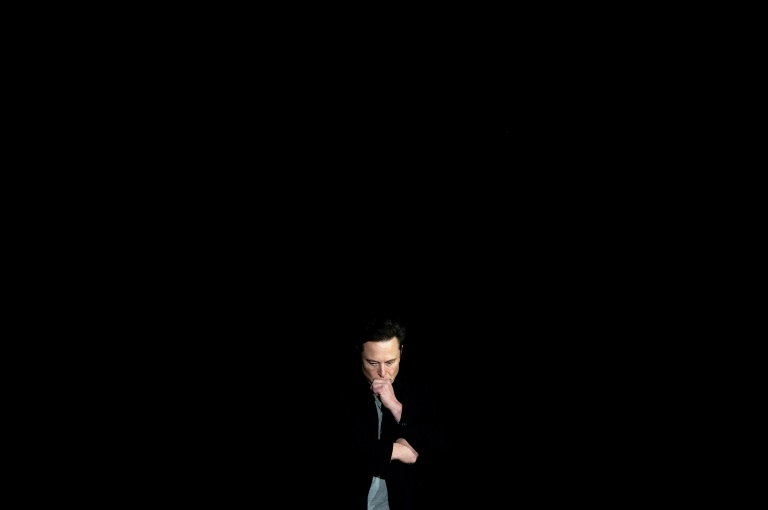
Elon Musk on Friday pulled the plug on his $44 billion deal to buy Twitter, accusing the social media giant of “misleading” statements about the number of fake accounts, a regulatory filing showed.

Musk’s effort to terminate the deal that he inked in April sets the stage for an epic court battle over a billion-dollar breakup fee and more.

“Mr. Musk hereby exercises (the) right to terminate the Merger Agreement and abandon the transaction,” his lawyers said in a letter to Twitter, a copy of which was filed with the Securities and Exchange Commission.

Musk’s change of heart appeared to suggest some “buyer’s remorse” for offering a price of $54.20 per share that now appears “laughable,” CFRA Research senior equity analyst Angelo Zino said in a note to investors before the deal was officially nixed.

Twitter has held firm that no more than five percent of accounts are run by software instead of people, while Musk has said he believes the number to be much higher.

Immediately after the news broke, Twitter board chair Bret Taylor vowed to sue Musk to hold him to the terms of the buyout deal, saying “we are confident we will prevail.”

The clock was ticking for Musk to make a decision, with Twitter’s board recommending shareholders approve the buyout at a special vote expected to be held in August.

Musk — the world’s richest man — used a chunk of his fortune in Tesla shares to back loans to buy Twitter, but the tumult and market factors have pushed down the electric car maker’s stock price.

“The Twitter deal has clearly caused chaos at Twitter and has resulted in an overhang on Tesla’s stock since April given the Musk financing angle, coupled by a brutal market backdrop for risk,” Wedbush analyst Dan Ives said in a note to investors.

“This soap opera has seen many twists and turns… this was always a head scratcher to go after Twitter at a $44 billion price tag for Musk and never made much sense to (Wall) Street, now it ends in a Twilight Zone.”

– ‘Erratic behavior’ –

Concerns about Tesla included worries that its chief executive was being distracted by the Twitter saga, and that the tech platform would certainly demand his attention if he owned it.

“I am sure Musk thought he could come out of the gate strong, generate a wave of buzz and then ride it to get investors who want a piece of something that looks like it is going to be big,” said Angelo Carusone, president of nonprofit group Media Matters for America.

“His erratic behavior obviously affected the price of Tesla shares, which undermined the financing everything was set on.”

Musk, 51, proclaimed in May that he would largely let anyone say anything allowed by law on Twitter, becoming a hero to ultra-conservatives offended by attempts to curb bullying, lies and other abuses on the platform.

His comments came during an annual event at which Twitter and other social media companies typically lock in bulk ad contracts worth hundreds of millions of dollars.

But a Twitter free-for-all would scrap precautions that brands want in place to make sure their ads aren’t associated with abusive posts, Carusone said.

“Musk couldn’t control himself long enough,” Carusone said. “He opened his mouth and pushed the first domino that has cascaded into blowing up the deal.”

Musk also faces a lawsuit accusing him of pushing down Twitter’s stock price in order to give himself an escape hatch from his buyout bid.

Twitter shares jumped to $51.70 in April when Musk’s deal was announced, only to plunge to $35.76 a month later as his commitment came into doubt. Twitter was priced at just below $37 a share in after-market trades on Friday.

Carusone believed Twitter shareholders should be furious with the company board as well as Musk.

“They got into bed with a madman and significantly harmed shareholder value as a result,” he said.

Musk ditches Twitter deal, triggering defiant response

Elon Musk on Friday pulled the plug on his $44 billion deal to buy Twitter, accusing the social media giant of “misleading” statements about the number of fake accounts, a regulatory filing showed.

Musk’s effort to terminate the deal that he inked in April sets the stage for an epic court battle over a billion-dollar breakup fee and more.

“Mr. Musk hereby exercises (the) right to terminate the Merger Agreement and abandon the transaction,” his lawyers said in a letter to Twitter, a copy of which was filed with the Securities and Exchange Commission.

Musk’s change of heart appeared to suggest some “buyer’s remorse” for offering a price of $54.20 per share that now appears “laughable,” CFRA Research senior equity analyst Angelo Zino said in a note to investors before the deal was officially nixed.

Twitter has held firm that no more than five percent of accounts are run by software instead of people, while Musk has said he believes the number to be much higher.

Immediately after the news broke, Twitter board chair Bret Taylor vowed to sue Musk to hold him to the terms of the buyout deal, saying “we are confident we will prevail.”

The clock was ticking for Musk to make a decision, with Twitter’s board recommending shareholders approve the buyout at a special vote expected to be held in August.

Musk — the world’s richest man — used a chunk of his fortune in Tesla shares to back loans to buy Twitter, but the tumult and market factors have pushed down the electric car maker’s stock price.

“The Twitter deal has clearly caused chaos at Twitter and has resulted in an overhang on Tesla’s stock since April given the Musk financing angle, coupled by a brutal market backdrop for risk,” Wedbush analyst Dan Ives said in a note to investors.

“This soap opera has seen many twists and turns… this was always a head scratcher to go after Twitter at a $44 billion price tag for Musk and never made much sense to (Wall) Street, now it ends in a Twilight Zone.”

– ‘Erratic behavior’ –

Concerns about Tesla included worries that its chief executive was being distracted by the Twitter saga, and that the tech platform would certainly demand his attention if he owned it.

“I am sure Musk thought he could come out of the gate strong, generate a wave of buzz and then ride it to get investors who want a piece of something that looks like it is going to be big,” said Angelo Carusone, president of nonprofit group Media Matters for America.

“His erratic behavior obviously affected the price of Tesla shares, which undermined the financing everything was set on.”

Musk, 51, proclaimed in May that he would largely let anyone say anything allowed by law on Twitter, becoming a hero to ultra-conservatives offended by attempts to curb bullying, lies and other abuses on the platform.

His comments came during an annual event at which Twitter and other social media companies typically lock in bulk ad contracts worth hundreds of millions of dollars.

But a Twitter free-for-all would scrap precautions that brands want in place to make sure their ads aren’t associated with abusive posts, Carusone said.

“Musk couldn’t control himself long enough,” Carusone said. “He opened his mouth and pushed the first domino that has cascaded into blowing up the deal.”

Musk also faces a lawsuit accusing him of pushing down Twitter’s stock price in order to give himself an escape hatch from his buyout bid.

Twitter shares jumped to $51.70 in April when Musk’s deal was announced, only to plunge to $35.76 a month later as his commitment came into doubt. Twitter was priced at just below $37 a share in after-market trades on Friday.

Carusone believed Twitter shareholders should be furious with the company board as well as Musk.

“They got into bed with a madman and significantly harmed shareholder value as a result,” he said.

US shares flat on strong job growth, euro closes in on dollar parity

Global stock markets finished mostly higher Friday, though Wall Street was flat following a surprisingly strong jobs report, while the euro was near parity with the dollar as traders bet on the prospect of a eurozone recession caused by soaring inflation.

The yen initially strengthened against the dollar following the assassination of Japan’s former prime minister, Shinzo Abe, before falling back.

Major US indices see-sawed throughout the day but still notched solid gains for the week, with investors weighing optimism that the US economy can withstand higher borrowing costs against fears the Fed will do too much to choke off growth and cause a downturn.

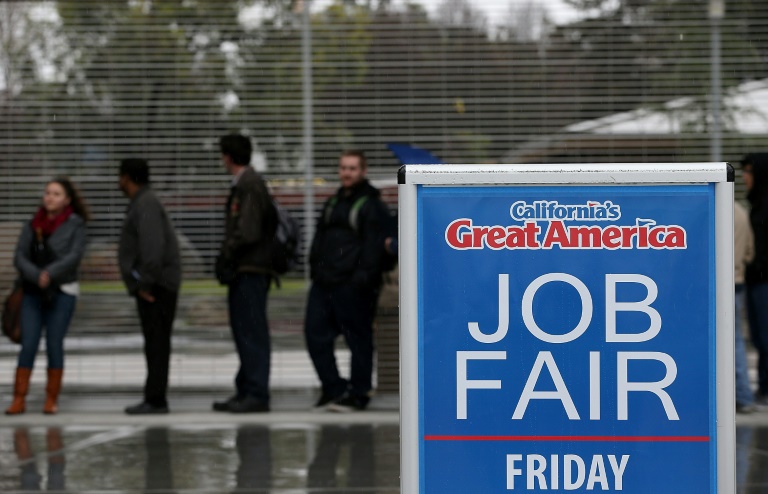
American employers added 372,000 new positions in the month, the Labor Department reported, far more than economists expected, while wage growth slowed slightly. 

The resilient US labor market gives the Federal Reserve more of a free hand to raise interest rates sharply to combat soaring inflation, although some investors still fear policymakers could do too much, choking off growth and causing a downturn.

Gregori Volokhine of Meeschaert Financial Services said the hope is the US economy avoids the “worst-case scenario,” where the economy slows but inflation stays high and the Fed continues to hike rates.

The jobs report was “not necessarily ideal but it offers comfort about the economy and gives the impression that the Fed will not do too much damage too quickly,” Volokhine said.

Fed officials have signaled they are still on target for another aggressive 75 basis point interest rate increase later this month, matching the move in June — the biggest since 1994 — but they will reassess later in the year.

– Dollar parity? –

The euro on Friday slumped to $1.0072, a fresh 20-year low, before recovering back above $1.018.

“The depreciation in the euro to its lowest level in almost two decades against the dollar this week in large part reflects investors’ view that the ECB will tighten less aggressively than the Fed,” said Jessica Hinds, senior Europe economist at Capital Economics.

Meanwhile, world oil prices rose following the US jobs report, comforted about the health of the world’s top economy and demand for oil.

Asian stock markets closed higher, boosted by hopes that US President Joe Biden would remove some tariffs from Chinese goods, and amid reports Beijing was considering a huge stimulus push to aid the struggling Chinese economy.

– Political upheaval –

Markets are also tracking political unrest in Britain and Japan.

London’s benchmark FTSE 100 index edged 0.1 percent higher — and the pound was mixed — one day after Prime Minister Boris Johnson said he was stepping down later this year following a string of scandals.

In Japan, Abe was assassinated by a gunman who opened fire at close range as the hugely influential politician delivered a campaign speech ahead of upper house elections. 

The murder of the 67-year-old, who had been Japan’s longest-serving leader, stunned the nation and prompted an international outpouring of grief and condemnation.

The killing “could be negative for markets if the government’s policy, including its stance on monetary easing, is affected, as it was evident that he was pulling the strings behind the scenes in many ways,” said Masahiro Yamaguchi at SMBC Trust Bank.

“If it becomes possible for (current Prime Minister Fumio) Kishida to carry out policies he wanted to, such as financial tax and regulations on share buy-back, that would be negative for markets.”

– Key figures at around 2100 GMT –

New York – Dow: UP 1.1 percent at 31,384.55 (close)

New York – S&P 500: UP 1.5 percent at 3,902.62 (close)

New York – Nasdaq: UP 2.3 percent at 11,621.35 (close)

Euro/dollar: UP at 1.0183 from $1.0162 on Thursday

Pound/dollar: UP at 1.2034 from $1.2024 

Euro/pound: UP at 84.59 pence from 84.49 pence

Dollar/yen: UP at 136.10 yen from 136.01 yen

EURO STOXX 50: UP 0.5 percent at 3,505.40 (close)

London – FTSE 100: UP 0.1 percent at 7,196.24 (close)

Frankfurt – DAX: UP 1.3 percent at 13,105.23 (close)

Paris – CAC 40: UP 0.4 percent at 6,033.13 (close)

Tokyo – Nikkei 225: UP 0.1 percent at 26,517.19 (close)

Hong Kong – Hang Seng Index: UP 0.4 percent at 21,725.78 (close)

Shanghai – Composite: DOWN 0.4 percent at 3,356.08 (close)

Brent North Sea crude: UP 2.4 percent at $107.12 per barrel

West Texas Intermediate: UP 2.0 percent at $104.78 per barrel

Close Bitnami banner
Bitnami