AFP

Kerry vows US to meet climate goal despite court setback

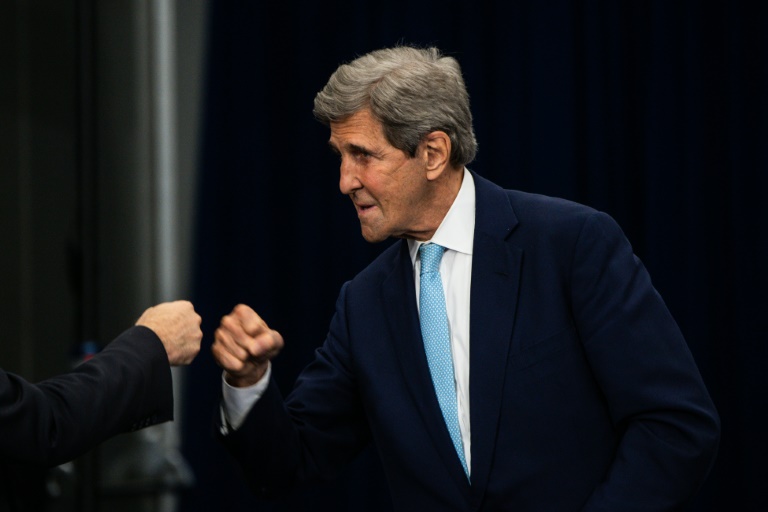
US climate envoy John Kerry vowed Friday the United States will meet goals it submitted to the United Nations on slashing greenhouse gas emissions, despite a Supreme Court ruling that curtailed the government’s powers.

“We are determined to achieve our goals. We can achieve our goals,” Kerry told AFP.

“But obviously it would help if we had a majority of the Supreme Court in the United States of America that actually understood the gravity of the situation and was more willing to try to be helpful rather than present a hurdle of one kind or another,” he said.

President Joe Biden, after defeating the climate-skeptic Donald Trump, in April last year said the United States would reduce greenhouse gas emissions by 50 to 52 percent by 2030 from 2005 levels, dramatically increasing the climate ambitions of the world’s largest economy.

He submitted the so-called nationally determined contribution to the UN climate body in line with the 2015 Paris Agreement, the landmark deal brokered by Kerry when he was secretary of state.

China, the world’s largest carbon emitter, called Friday on all nations to live up to Paris commitments, with foreign ministry spokesman Zhao Lijian saying of the United States, “it is not enough to just chant slogans.”

Kerry, who has worked with Chinese officials in his climate role despite soaring tensions between Beijing and Washington, said that he was “not surprised by the messaging” from the Asian power.

“We will show China precisely how we’re going to get the job done,” Kerry said.

Stephane Dujarric, the spokesman for UN Secretary-General Antonio Guterres, called the Supreme Court decision “a setback in our fight against climate change.”

– Biden proposes drilling –

Despite Biden’s pledges to wean the United States off fossil fuels, the Interior Department on Friday released a five-year proposal that would authorize offshore oil and gas drilling in federal waters in the Gulf of Mexico and Alaska, although it would still ban drilling in the Atlantic and Pacific Oceans.

The proposal comes amid soaring gas prices and as Biden seeks to woo Senator Joe Manchin, a Democrat from coal-producing West Virginia with the crucial vote, to back a package that would also boost clean energy. 

Environmentalists see the legislation as a last hope amid expectations that Trump’s Republican Party will make advances in November congressional elections.

The Supreme Court, finishing a term in which three justices nominated by Trump pushed it sharply to the right, on Thursday cut the wings off a key way in which the government could have tackled climate change without fresh legislation.

In a 6-3 ruling branded “devastating” by Biden, the top court said the Environmental Protection Agency did not have authority to order sweeping cuts on emissions from coal-fired power plants.

“I am convinced — and our legal people are looking at it very carefully — that this decision leaves plenty of latitude for us to be able to do a lot of things that we need to do,” Kerry said.

Asked about calls by some lawmakers from his Democratic Party for Biden to declare a climate emergency, Kerry said, “I think the president needs to evaluate every option available.”

– ‘Pin into balloon’ –

Coal accounts for around 20 percent of US electricity generation — still roughly on par with renewables. China, despite investing heavily in wind and solar, has also kept building coal production capacity.

But Kerry said that the marketplace showed that coal was not the future.

“Nobody’s going to fund any new coal power in the United States — no bank, no private lender. Coal is the dirtiest fuel in the world,” he said.

Scientists warn that the world is far off track in avoiding the worst ravages of climate change including severe heatwaves, floods, droughts, rising sea levels and storm surges. 

The Paris accord set the goal of limiting end-of-century warming to two degrees Celsius (3.6 Fahrenheit) above pre-industrial levels — and preferably not beyond 1.5 degrees — but the planet has already warmed by nearly 1.2 Celsius.

Ruth Greenspan Bell, a climate expert at the Woodrow Wilson International Center for Scholars, said it was difficult for the United States to show climate leadership while also fighting internally on whether it is a priority.

“It’s kind of putting a pin into a balloon. There’s a little bit less air in the balloon than there was before,” she said of the court decision. 

“The times call for a moonshot but imagine trying to pull off a moonshot when you are at the same time in a defensive crouch.”

Kerry vows US to meet climate goal despite court setback

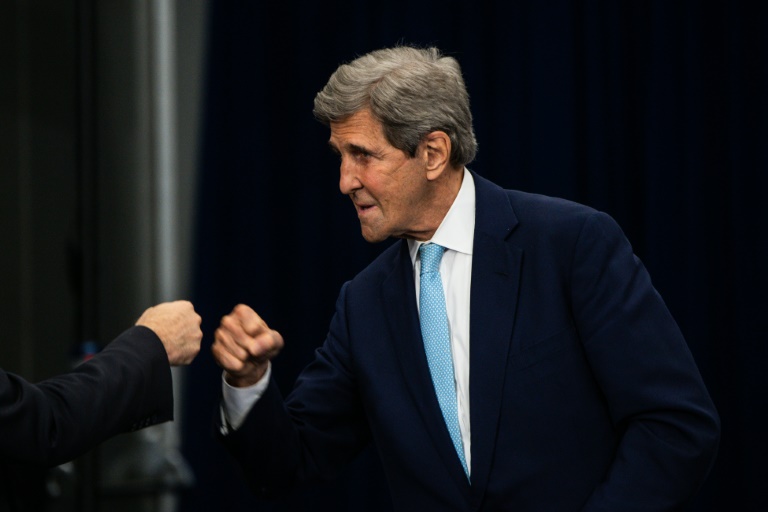
US climate envoy John Kerry vowed Friday the United States will meet goals it submitted to the United Nations on slashing greenhouse gas emissions, despite a Supreme Court ruling that curtailed the government’s powers.

“We are determined to achieve our goals. We can achieve our goals,” Kerry told AFP.

“But obviously it would help if we had a majority of the Supreme Court in the United States of America that actually understood the gravity of the situation and was more willing to try to be helpful rather than present a hurdle of one kind or another,” he said.

President Joe Biden, after defeating the climate-skeptic Donald Trump, in April last year said the United States would reduce greenhouse gas emissions by 50 to 52 percent by 2030 from 2005 levels, dramatically increasing the climate ambitions of the world’s largest economy.

He submitted the so-called nationally determined contribution to the UN climate body in line with the 2015 Paris Agreement, the landmark deal brokered by Kerry when he was secretary of state.

China, the world’s largest carbon emitter, called Friday on all nations to live up to Paris commitments, with foreign ministry spokesman Zhao Lijian saying of the United States, “it is not enough to just chant slogans.”

Kerry, who has worked with Chinese officials in his climate role despite soaring tensions between Beijing and Washington, said that he was “not surprised by the messaging” from the Asian power.

“We will show China precisely how we’re going to get the job done,” Kerry said.

Stephane Dujarric, the spokesman for UN Secretary-General Antonio Guterres, called the Supreme Court decision “a setback in our fight against climate change.”

– Biden proposes drilling –

Despite Biden’s pledges to wean the United States off fossil fuels, the Interior Department on Friday released a five-year proposal that would authorize offshore oil and gas drilling in federal waters in the Gulf of Mexico and Alaska, although it would still ban drilling in the Atlantic and Pacific Oceans.

The proposal comes amid soaring gas prices and as Biden seeks to woo Senator Joe Manchin, a Democrat from coal-producing West Virginia with the crucial vote, to back a package that would also boost clean energy. 

Environmentalists see the legislation as a last hope amid expectations that Trump’s Republican Party will make advances in November congressional elections.

The Supreme Court, finishing a term in which three justices nominated by Trump pushed it sharply to the right, on Thursday cut the wings off a key way in which the government could have tackled climate change without fresh legislation.

In a 6-3 ruling branded “devastating” by Biden, the top court said the Environmental Protection Agency did not have authority to order sweeping cuts on emissions from coal-fired power plants.

“I am convinced — and our legal people are looking at it very carefully — that this decision leaves plenty of latitude for us to be able to do a lot of things that we need to do,” Kerry said.

Asked about calls by some lawmakers from his Democratic Party for Biden to declare a climate emergency, Kerry said, “I think the president needs to evaluate every option available.”

– ‘Pin into balloon’ –

Coal accounts for around 20 percent of US electricity generation — still roughly on par with renewables. China, despite investing heavily in wind and solar, has also kept building coal production capacity.

But Kerry said that the marketplace showed that coal was not the future.

“Nobody’s going to fund any new coal power in the United States — no bank, no private lender. Coal is the dirtiest fuel in the world,” he said.

Scientists warn that the world is far off track in avoiding the worst ravages of climate change including severe heatwaves, floods, droughts, rising sea levels and storm surges. 

The Paris accord set the goal of limiting end-of-century warming to two degrees Celsius (3.6 Fahrenheit) above pre-industrial levels — and preferably not beyond 1.5 degrees — but the planet has already warmed by nearly 1.2 Celsius.

Ruth Greenspan Bell, a climate expert at the Woodrow Wilson International Center for Scholars, said it was difficult for the United States to show climate leadership while also fighting internally on whether it is a priority.

“It’s kind of putting a pin into a balloon. There’s a little bit less air in the balloon than there was before,” she said of the court decision. 

“The times call for a moonshot but imagine trying to pull off a moonshot when you are at the same time in a defensive crouch.”

Outgunned island states vow to fight deep-sea mining

A handful of postage-stamp nations in the South Pacific launched an uphill battle this week against the deep-sea mining of unattached, fist-sized rocks rich in rare Earth metals.

The stakes are potentially enormous.

Companies keen to scrape the ocean floor five to six thousand metres (17,000 to 20,000 feet) below sea level stand to earn billions harvesting manganese, cobalt, copper and nickel currently used to build batteries for electric vehicles.

But the extraction process would disfigure what may be the most pristine ecosystem on the planet and could take millennia, if not longer, for nature to repair. 

The deep-sea jewels in question, called polymetallic nodules, grow with the help of microbes over millions of years around a kernel of organic matter, such as a shark’s tooth or the ear-bone of a whale.

“They are living rocks, not just dead stones,” former US National Oceanic and Atmospheric Administration (NOAA) chief scientist Sylvia Earle said in Lisbon. 

“I look at them as miracles.”  

An incipient deep-sea mining industry also sees them as miraculous, though for different reasons.

“High grades of four metals in a single rock means that four times less ore needs to be processed to obtain the same amount of metal,” notes The Metals Company, which has formed exploratory partnerships with three South Pacific nations — Nauru, Kiribati and Tonga — in the mineral-rich Clarion-Clipperton fracture zone.

Nodules also have low levels of heavy elements, which means less toxic waste compared to land-based extraction, according to the company.

Commercial mining has not started anywhere in the world, but about 20 research institutes or companies hold exploration contracts with the International Seabed Authority (ISA) in the Indian, Pacific and Atlantic oceans.

Surangel Whipps Jr., president of Palau, kicked off the anti-mining campaign at the just-concluded UN Ocean Conference in Lisbon, flanked by Fiji Prime Minister Frank Bainimarama.

“Deep-sea mining compromises the integrity of our ocean habitat and should be discouraged to the greatest extent possible,” Whipps said, calling for an open-ended moratorium. 

Likeminded neighbouring nation states Samoa, Tuvalu and the Solomon Islands have backed the call, along with more than 100 mostly green party legislators from three dozen nations across the world. 

A similar motion put to a vote last September before the International Union for the Conservation of Nature (IUCN) — an umbrella organisation of 1,400 research institutes, environmental NGOs and indigenous groups — passed easily. 

– ‘Who’s watching?’ –

“Mining, wherever it occurs, is well known to have environmental costs,” said Earle, the scientist.

“On the land at least we can monitor, see and fix problems, and minimise the damage. Six thousand metres (20,000 feet) beneath the surface, who’s watching?”

But in Lisbon, explicit support from other countries for a temporary ban on ocean-floor mining on the high seas, outside of national territorial waters known as exclusive economic zones (EEZs), was scarce.

Chile stepped up, calling for a 15-year pause to allow for more research.

The United States, along with other developed nations, took a more ambiguous stance, calling for scientific evaluation of environmental impacts but not closing the door to future mining. 

“We haven’t taken an official position on it,” US climate envoy John Kerry told AFP in an interview. 

“But we have expressed deep concerns about adequately researching the impacts of any deep-sea mining, and we have not approved any.”

To the surprise of many in Lisbon, France’s President Emmanuel Macron appeared to endorse a halt to deep-sea mining on the seas, despite the fact that France holds mining exploration licenses from ISA, the intergovernmental body overseeing exploitation of the ocean floor.  

“I think we have, indeed, to create the legal framework to stop the high-sea mining and not to allow new activities putting in danger these ecosystems,” Macron said at a side event. 

“We have to promote our scientists and explorers to better know and discover these high seas.”

Deep-sea mining opponents were thrilled with the statement, but are waiting to see what follows.

“Is the French government going to put in the diplomatic effort in order to make what he said they’ll do actually happen? We’ll see,” said Matthew Gianni, co-founder of Deep Sea Conservation Coalition.

The clock is ticking because last year Nauru, in cooperation with The Metals Company, triggered a rule requiring the ISA to finalise regulations for high-seas mining worldwide within two years.

The ISA, criticised for lacking transparency and favouring corporate interests, meets later this month in Kingston, Jamaica.

Sources say they are likely to try to push through draft regulations which, if adopted, could see mining operations licenced by this time next year.

Global stocks mixed as eurozone inflation hits record

Wall Street stocks shrugged off early weakness to begin the second half of 2022 on a solid note Friday, but record eurozone inflation underscored the potential for more turbulence ahead.

New York equities spent much of the morning in the red, absorbing an industry survey showing slowing growth in the manufacturing sector.

But US markets reversed course in the final hours of trading, rallying into the Independence Day holiday weekend amid hopes for a better second half of the year.

Investors are coming off the worst six-month start to a year for the S&P 500 since 1970.

Earlier, both Paris and Frankfurt stocks ended the day with small gains despite news of record-high eurozone inflation that reinforced expectations of a European Central Bank interest rate hike later this month.

The EU’s Eurostat data agency said annual consumer price inflation in the 19 countries that use the euro soared to 8.6 percent in June, up from the prior record of 8.1 percent in May.

“With eurozone inflation now becoming more broad-based in nature, the outlook for the eurozone for the rest of 2022 continues to look bleak,” warned Pushpin Singh, Economist at the Centre for Economics and Business Research.

“This comes amid a mounting possibility of a severe gas crisis in Europe, with Russia using gas exports as a means to counter sanctions,” he added.

The ECB stated last month that it will deliver its first interest rate hike in more than a decade in July to combat inflation. 

With the war in Ukraine showing no sign of ending — keeping energy costs elevated — there is an expectation that borrowing costs will continue to rise and send economies into recession.

Comments from top finance chiefs, including Federal Reserve boss Jerome Powell, suggest they are willing to endure the pain of a contraction as long as they can rein in prices — which are rising at their fastest pace in 40 years on both sides of the Atlantic.

“Investors know that inflation is high and is likely to push higher,” City Index analyst Fiona Cincotta told AFP.

“Instead, the market’s obsession is turning from inflation to recession fears. Given the steep declines in stock prices this week, much of the bad news is priced in for now, until it starts again next week,” she added.

The dollar, a safe-haven currency, advanced against the pound and the euro on rising expectations of a recession.

Oil rebounded on tight supplies despite persistent recession concerns.

– Key figures at around 2030 GMT –

New York – Dow: UP 1.1 percent at 31,097.26 (close)

New York – S&P 500: UP 1.1 percent at 3,825.33 (close)

New York – Nasdaq: UP 0.9 percent at 11,127.85 (close)

London – FTSE 100: FLAT at 7,168.65 (close) 

Frankfurt – DAX: UP 0.2 percent at 12,813.03 (close)

Paris – CAC 40: UP 0.1 percent at 5,931.06 (close)

EURO STOXX 50: DOWN 0.2 percent at 3,448.31 (close)

Tokyo – Nikkei 225: DOWN 1.7 percent at 25,935.62 (close)

Shanghai – Composite: DOWN 0.3 percent at 3,387.64 (close)

Hong Kong – Hang Seng Index: Closed for a holiday

Brent North Sea crude: UP 2.4 percent at $111.63 per barrel

West Texas Intermediate: UP 2.5 percent at $108.43 per barrel

Euro/dollar: DOWN at $1.0433 from $1.0484 Thursday

Pound/dollar: DOWN at $1.2098 from $1.2178

Euro/pound: UP at 86.21 pence from 86.09 pence

Dollar/yen: DOWN at 135.28 yen from 135.72 yen

burs-jmb/to

Global stocks mixed as eurozone inflation hits record

Wall Street stocks shrugged off early weakness to begin the second half of 2022 on a solid note Friday, but record eurozone inflation underscored the potential for more turbulence ahead.

New York equities spent much of the morning in the red, absorbing an industry survey showing slowing growth in the manufacturing sector.

But US markets reversed course in the final hours of trading, rallying into the Independence Day holiday weekend amid hopes for a better second half of the year.

Investors are coming off the worst six-month start to a year for the S&P 500 since 1970.

Earlier, both Paris and Frankfurt stocks ended the day with small gains despite news of record-high eurozone inflation that reinforced expectations of a European Central Bank interest rate hike later this month.

The EU’s Eurostat data agency said annual consumer price inflation in the 19 countries that use the euro soared to 8.6 percent in June, up from the prior record of 8.1 percent in May.

“With eurozone inflation now becoming more broad-based in nature, the outlook for the eurozone for the rest of 2022 continues to look bleak,” warned Pushpin Singh, Economist at the Centre for Economics and Business Research.

“This comes amid a mounting possibility of a severe gas crisis in Europe, with Russia using gas exports as a means to counter sanctions,” he added.

The ECB stated last month that it will deliver its first interest rate hike in more than a decade in July to combat inflation. 

With the war in Ukraine showing no sign of ending — keeping energy costs elevated — there is an expectation that borrowing costs will continue to rise and send economies into recession.

Comments from top finance chiefs, including Federal Reserve boss Jerome Powell, suggest they are willing to endure the pain of a contraction as long as they can rein in prices — which are rising at their fastest pace in 40 years on both sides of the Atlantic.

“Investors know that inflation is high and is likely to push higher,” City Index analyst Fiona Cincotta told AFP.

“Instead, the market’s obsession is turning from inflation to recession fears. Given the steep declines in stock prices this week, much of the bad news is priced in for now, until it starts again next week,” she added.

The dollar, a safe-haven currency, advanced against the pound and the euro on rising expectations of a recession.

Oil rebounded on tight supplies despite persistent recession concerns.

– Key figures at around 2030 GMT –

New York – Dow: UP 1.1 percent at 31,097.26 (close)

New York – S&P 500: UP 1.1 percent at 3,825.33 (close)

New York – Nasdaq: UP 0.9 percent at 11,127.85 (close)

London – FTSE 100: FLAT at 7,168.65 (close) 

Frankfurt – DAX: UP 0.2 percent at 12,813.03 (close)

Paris – CAC 40: UP 0.1 percent at 5,931.06 (close)

EURO STOXX 50: DOWN 0.2 percent at 3,448.31 (close)

Tokyo – Nikkei 225: DOWN 1.7 percent at 25,935.62 (close)

Shanghai – Composite: DOWN 0.3 percent at 3,387.64 (close)

Hong Kong – Hang Seng Index: Closed for a holiday

Brent North Sea crude: UP 2.4 percent at $111.63 per barrel

West Texas Intermediate: UP 2.5 percent at $108.43 per barrel

Euro/dollar: DOWN at $1.0433 from $1.0484 Thursday

Pound/dollar: DOWN at $1.2098 from $1.2178

Euro/pound: UP at 86.21 pence from 86.09 pence

Dollar/yen: DOWN at 135.28 yen from 135.72 yen

burs-jmb/to

Global stocks mixed as eurozone inflation hits record

Wall Street stocks shrugged off early weakness to begin the second half of 2022 on a solid note Friday, but record eurozone inflation underscored the potential for more turbulence ahead.

New York equities spent much of the morning in the red, absorbing an industry survey showing slowing growth in the manufacturing sector.

But US markets reversed course in the final hours of trading, rallying into the Independence Day holiday weekend amid hopes for a better second half of the year.

Investors are coming off the worst six-month start to a year for the S&P 500 since 1970.

Earlier, both Paris and Frankfurt stocks ended the day with small gains despite news of record-high eurozone inflation that reinforced expectations of a European Central Bank interest rate hike later this month.

The EU’s Eurostat data agency said annual consumer price inflation in the 19 countries that use the euro soared to 8.6 percent in June, up from the prior record of 8.1 percent in May.

“With eurozone inflation now becoming more broad-based in nature, the outlook for the eurozone for the rest of 2022 continues to look bleak,” warned Pushpin Singh, Economist at the Centre for Economics and Business Research.

“This comes amid a mounting possibility of a severe gas crisis in Europe, with Russia using gas exports as a means to counter sanctions,” he added.

The ECB stated last month that it will deliver its first interest rate hike in more than a decade in July to combat inflation. 

With the war in Ukraine showing no sign of ending — keeping energy costs elevated — there is an expectation that borrowing costs will continue to rise and send economies into recession.

Comments from top finance chiefs, including Federal Reserve boss Jerome Powell, suggest they are willing to endure the pain of a contraction as long as they can rein in prices — which are rising at their fastest pace in 40 years on both sides of the Atlantic.

“Investors know that inflation is high and is likely to push higher,” City Index analyst Fiona Cincotta told AFP.

“Instead, the market’s obsession is turning from inflation to recession fears. Given the steep declines in stock prices this week, much of the bad news is priced in for now, until it starts again next week,” she added.

The dollar, a safe-haven currency, advanced against the pound and the euro on rising expectations of a recession.

Oil rebounded on tight supplies despite persistent recession concerns.

– Key figures at around 2030 GMT –

New York – Dow: UP 1.1 percent at 31,097.26 (close)

New York – S&P 500: UP 1.1 percent at 3,825.33 (close)

New York – Nasdaq: UP 0.9 percent at 11,127.85 (close)

London – FTSE 100: FLAT at 7,168.65 (close) 

Frankfurt – DAX: UP 0.2 percent at 12,813.03 (close)

Paris – CAC 40: UP 0.1 percent at 5,931.06 (close)

EURO STOXX 50: DOWN 0.2 percent at 3,448.31 (close)

Tokyo – Nikkei 225: DOWN 1.7 percent at 25,935.62 (close)

Shanghai – Composite: DOWN 0.3 percent at 3,387.64 (close)

Hong Kong – Hang Seng Index: Closed for a holiday

Brent North Sea crude: UP 2.4 percent at $111.63 per barrel

West Texas Intermediate: UP 2.5 percent at $108.43 per barrel

Euro/dollar: DOWN at $1.0433 from $1.0484 Thursday

Pound/dollar: DOWN at $1.2098 from $1.2178

Euro/pound: UP at 86.21 pence from 86.09 pence

Dollar/yen: DOWN at 135.28 yen from 135.72 yen

burs-jmb/to

Flights cancelled in Spain due to Ryanair, EasyJet strikes

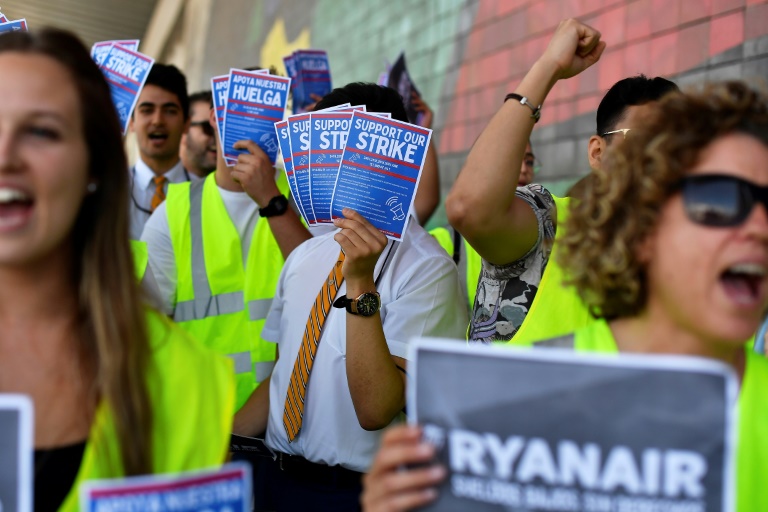
Fifteen flights to and from Spain were cancelled on Friday and dozens of others delayed due to the latest strike by cabin crew at low-cost airlines Ryanair and EasyJet.

The work stoppage over pay and working conditions comes as European schools are breaking up for the summer.

The strikes add more headaches to passengers and the aviation sector, which has struggled to recruit people after massive layoffs during the Covid pandemic.

By 7:00 pm (1700 GMT) nine EasyJet flights had been cancelled and 54 delayed, the USO union which called the strike said.

Six Ryanair flights were cancelled and 277 were delayed, it added.

EasyJet crew are set to strike during the first three weekends of July to demand parity in working conditions in line with other European airlines.

The strike by Ryanair cabin crew in Spain, where there are some 1,900 employees, began on June 24 and is due to run until Saturday. It is affecting 10 of the airline’s bases in Spain.

On Thursday, over 50 Ryanair flights to and from the country were cancelled because of the job action. 

A strike by the airline’s crew between June 24 and 26 cancelled 129 flights.

Flights from Paris’ two largest airports, Charles de Gaulle and Orly, were disrupted on Friday for the second day in a row due to a strike by airport workers.  

UN urges ambitious action to protect the oceans

World leaders must do more to protect the oceans, a major United Nations conference concluded on Friday, setting its sights on a new treaty to protect the high seas.

“Greater ambition is required at all levels to address the dire state of the ocean,” the UN Ocean Conference in Lisbon said in its final declaration.

The meeting in the Portuguese capital — attended by government officials, experts and advocates from 140 countries — is not a negotiating forum. 

But it sets the agenda for final international negotiations in August on a treaty to protect the high seas — those international waters beyond national jurisdiction.

“Biodiversity loss, the decline of the ocean’s health, the way the climate crisis is going… it all has one common reason, which is… human behaviour, our addiction to oil and gas, and all of them have to be addressed,” Peter Thomson, the UN Special Envoy for the Ocean, told AFP.

Oceans produce half the oxygen we breathe, regulate the weather and provide humanity’s single largest source of protein.

They also absorb a quarter of CO2 pollution and 90 percent of excess heat from global warming, thus playing a key role in protecting life on Earth.

But they are being pushed to the brink by human activities. 

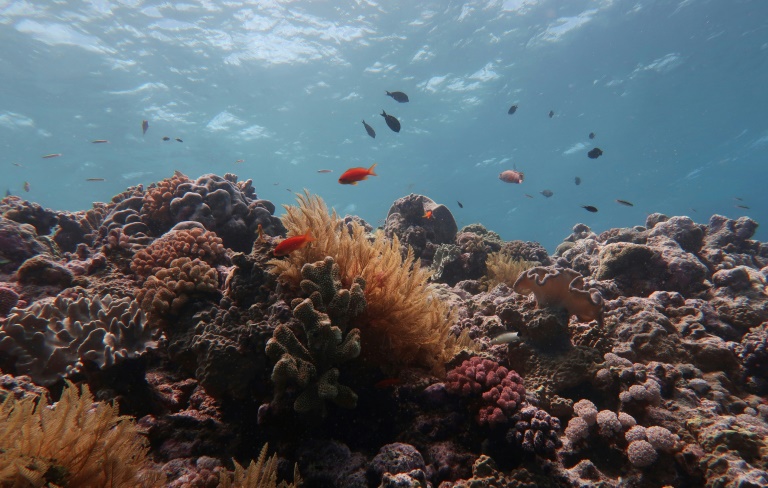
Sea water has turned acidic, threatening aquatic food chains and the ocean’s capacity to absorb carbon. Global warming has spawned massive marine heatwaves that are killing off coral reefs and expanding dead zones bereft of oxygen.

Humans have fished some marine species to the edge of extinction and used the world’s waters as a rubbish dump. 

– Patchwork of agreements – 

Today, a patchwork of agreements and regulatory bodies govern shipping, fishing and mineral extraction from the sea bed.

Thomson said he was “very confident” national governments could agree on a “robust but operable” high seas treaty in August.

Tiago Pitta e Cunha, head of Portuguese foundation Oceano Azul (Blue Ocean) said: “Pressure has increased a lot on less interested countries to create an effective mechanism to protect the high seas.”

Laura Meller from Greenpeace called for more action.

“We know that if words could save the oceans, then they wouldn’t be on the brink of collapse,” she told AFP. 

“So in August when governments meet at the United Nations, they really need to finalise a strong global ocean treaty.”

Efforts to protect the oceans will then continue at two key summits later this year — UN climate talks in November and UN biodiversity negotiations in December.

– Overfishing, mining, plastic –

At the heart of the draft UN biodiversity treaty is a plan to designate 30 percent of Earth’s land and oceans as protected zones by 2030.

Currently, under eight percent of oceans are protected.

A number of new, protected marine areas could be declared off-limits to fishing, mining, drilling or other extractive activities which scientists say disrupt fragile seabed ecosystems.

Making things worse is an unending torrent of pollution, including a rubbish truck’s worth of plastic every minute, the United Nations says. 

“The ocean is not a rubbish dump,” UN Secretary General Antonio Guterres warned on Monday. “It is not a source of infinite plunder. It is a fragile system on which we all depend.”   

Brazil sets new six-month Amazon deforestation record

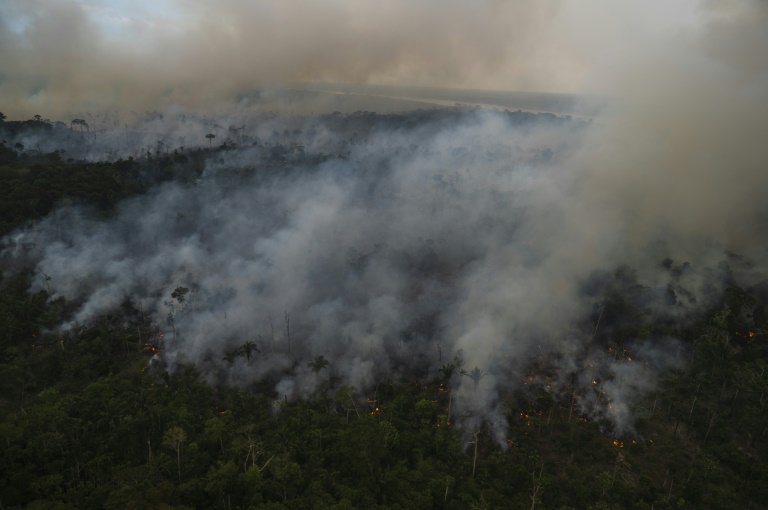
Deforestation of the Brazilian Amazon reached a record level during the first half of 2022, the INPE national space agency said Friday.

The world’s largest tropical rainforest lost 3,750 square kilometers (1,450 square miles) of jungle since the beginning of the year, the worst numbers for that period since record-keeping began in 2016.

The previous worst figure of 3,605 square kilometers was set last year.

The new figure does not even include the final six days of June.

This year has seen the worst June in 15 years for forest fires.

Monthly records were also beaten in January and February, when deforestation is usually lower, and in April.

INPE satellites identified more than 2,500 fires in the Amazon last month, the largest number since more than 3,500 were recorded in June 2007, and an 11 percent increase over June 2021.

More than 7,500 fires have been recorded since the start of the year, another 17 percent increase on 2021 and the worst numbers since 2010.

“The dry season has barely begun in the Amazon and already we’re beating environmental destruction records,” said Cristiane Mazzetti, from Greenpeace Brazil.

Environmentalists and opposition figures accuse the government of President Jair Bolsonaro of implementing policies that encourage big businesses to damage the environment.

“The impact of this negligence will be the increasing loss of the resilience of these surroundings, not to mention the damage done to local communities and health,” said Mariana Napolitano, of the Brazilian World Wildlife Fund.

Bolsonaro has encouraged mining and farming activity in protected areas.

Critics also accuse him of supporting impunity for gold prospectors, farmers and logging traffickers involved in illegal deforestation.

Last year, the main government environmental protection body spent only 41 percent of its surveillance budget, according to the Climate Observatory NGO.

Automakers reports lower Q2 US sales as supply chain woes persist

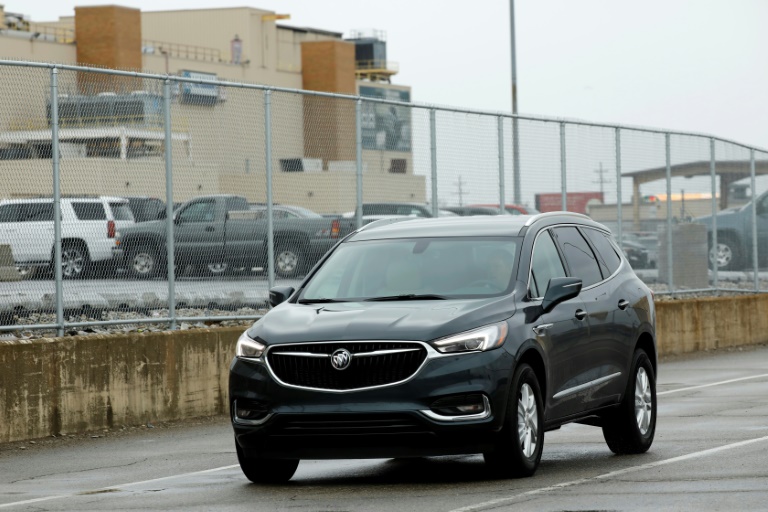
General Motors, Toyota and other automakers suffered a hit to US sales in the latest quarter as supply chain woes continued to crimp inventories, according to results released Friday.

GM sold 582,401 autos in the three months ending June 30, a drop of 15 percent from the same period a year ago. 

The Detroit giant said it is holding 95,000 partially-built vehicles in need of components that it expects to deliver by the end of 2022. 

Such maneuvers have become the norm over the last year as manufacturers try to make headway on as many high-margin vehicles as possible amid limited supply of semiconductors and other key items. 

On the positive side, GM said it scored strong sales for its pickup trucks, the Chevrolet Silverado and GMC Sierra, despite low inventories. And “pent-up demand” drove sales growth in other vehicles, including the Chevrolet Camaro and Chevrolet Colorado.

GM reaffirmed its full-year profit outlook, but its second-quarter net income range of between $1.6 billion and $1.9 billion lagged consensus estimates.

Meanwhile, Toyota reported sales of 531,105 over the same period, a drop of 23 percent compared with the 2021 quarter, and the Japanese company also cited “ongoing inventory challenges” hindering its dealerships.

A bright spot has been a jump in sales of Toyota’s electric vehicles, which have comprised more than 25 percent of Toyota’s sales so far this year.

Cox Automotive has forecast a 19.3 percent drop in US auto sales for the second quarter.

“Even though economic conditions have worsened in the past months, the lack of supply is still the greatest headwind facing the auto industry today,” said Charlie Chesbrough, senior economist at Cox.

Hyundai Motor America reported a drop of 23 percent sales drop to 184,191 units.

Close Bitnami banner
Bitnami