AFP

Dead rivers: The cost of Bangladesh's garment-driven economic boom

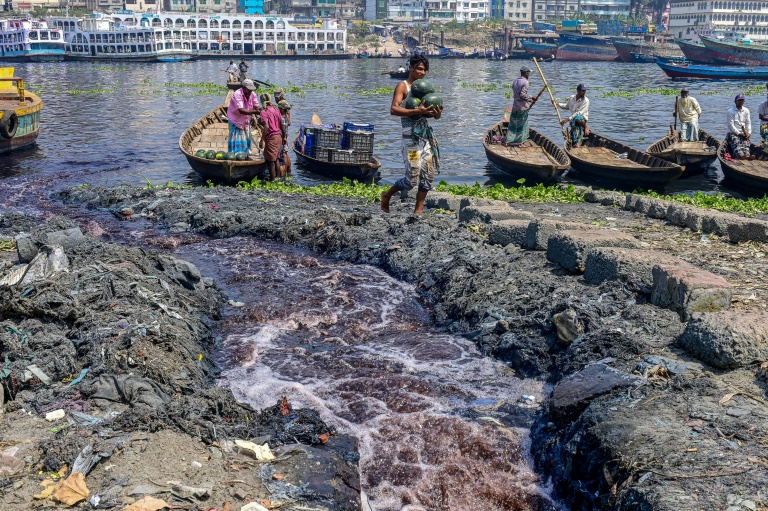
Bangladeshi ferryman Kalu Molla began working on the Buriganga river before the patchwork of slums on its banks gave way to garment factories — and before its waters turned pitch black.

The 52-year-old has constant cough, allergies and skin rashes, and doctors have told him the vile-smelling sludge that has also wiped out marine life in one of Dhaka’s main waterways is to blame.

“Doctors told me to leave this job and leave the river. But how is that possible?” Molla told AFP near his home on the industrial outskirts of the capital Dhaka. “Ferrying people is my bread and butter.”

In the half-century since a devastating independence war left its people facing starvation, Bangladesh has emerged as an often unheralded economic success story.

The South Asian country of 169 million has overtaken its neighbour India in per capita income and will soon graduate from the United Nations’ list of the world’s least developed countries.

Underpinning years of runaway growth is the booming garment trade, servicing global fast-fashion powerhouses, employing millions of women and accounting for around 80 percent of the country’s $50 billion annual exports.

But environmentalists say the growth has come at an incalculable cost, with a toxic melange of dyes, tanning acids and other dangerous chemicals making their way into the water.

Bangladesh’s capital Dhaka was founded on the banks of the Buriganga more than 400 years ago by the Mughal empire.

“It is now the largest sewer of the country,” said Sheikh Rokon, the head of the Riverine People environmental rights group.

“For centuries people built their homes on its banks to bask in the river breeze,” he added. “Now the smell of toxic sludge during winter is so horrible that people have to hold their noses as they come near it.”

Water samples from the river found chromium and cadmium levels over six times the World Health Organization’s recommended maximums, according to a 2020 paper by the Bangladeshi government’s River Research Institute. 

Both elements are used in leather tanning and excessive exposure to either is extremely hazardous to human health: chromium is carcinogenic, and chronic cadmium exposure causes lung damage, kidney disease and premature births. 

Ammonia, phenol and other byproducts of fabric dyeing have also helped to starve the river of the oxygen needed to sustain marine life. 

– ‘They are powerful people’ –

In Shyampur, one of several sprawling industrial districts around Dhaka, locals told AFP that at least 300 local factories were discharging untreated wastewater into the Buriganga river.

Residents say they have given up complaining about the putrid smell of the water, knowing that offending businesses are easily able to shirk responsibility.

“The factories bribe (authorities) to buy the silence of the regulators,” said Chan Mia, who lives in the area. 

“If someone wants (to) raise the issue to the factories, they’d beat them up. They are powerful people with connections.” 

The crucial position of the textile trade in the economy has created a nexus between business owners and the country’s political establishment. In some cases, politicians themselves have become powerful industry players. 

Further south, in Narayanganj district, residents showed AFP a stream of crimson-coloured water draining into stagnant canals from a nearby factory. 

“But you cannot say a word about it loudly,” an area resident told AFP, speaking on condition of anonymity. “We only suffer in silence.”

The Bangladesh Garment Manufacturers and Exporters Association (BGMEA), which represents the interests of around 3,500 top factories, defends its record by pointing out the environmental certifications given out to its members.

“We are going green — that’s why we are witnessing big jumps in export orders,” BGMEA president Faruque Hassan told a recent press conference.

But smaller factories and sub-contractors operating on the industry’s razor thin margins say they are unable to afford the cost of wastewater treatment.

A top garment official in the Savar industrial district, speaking to AFP on condition of anonymity, said even most high-end factories serving major US and European brands often do not turn on their treatment machinery. 

“Not everyone regularly uses it. They want to save costs,” he said.

– ‘Facing the same fate’ –

Bangladesh is a delta country criss-crossed by more than 200 waterways, each of them connected to the mighty Ganges and Brahmatura rivers that course from the Himalayas and through the South Asian subcontinent.

More than a quarter of them are now heavily contaminated with industrial pollutants and need to be “urgently” saved, said an April legal notice sent to the government by the Bangladesh Environmental Lawyers Association (BELA). 

Authorities have established a commission tasked with saving key water bodies, upon which close to half the country’s population depend for farming, according to the UN Food and Agriculture Organization. 

The National River Commission has launched several high profile drives to fine factories found to have polluted rivers.

Its newly appointed chief, Manjur Chowdhury, said “greedy” industrialists were to blame for the state of the country’s waterways.

But he also admitted that the enforcement of existing penalties was inadequate to address the scale of the problem.

“We have to frame new laws to face this emergency situation. But it will take time,” he told AFP.

Any action will be too late for the five rivers that circle Dhaka and its industrial outskirts.

All are already technically dead, meaning they are completely devoid of marine life, said prominent environmental activist Sharif Jamil. 

“With factories now moving deep into the rural heartland, rivers across the country are facing the same fate,” he told AFP.

Kremlin spokesman says Americans captured in Ukraine committed 'crimes'

Two Americans captured in Ukraine while fighting with Kyiv’s military were “endangering” Russian soldiers and should be “held accountable for those crimes,” Kremlin spokesman Dmitry Peskov said in an interview released by NBC News on Monday.

The interview marks the first time the Kremlin has commented on the cases of Alexander Drueke and Andy Huynh, both US military veterans, according to NBC.

“They’re soldiers of fortune and they were involved in illegal activities on the territory of Ukraine. They were involved in firing and shelling our military personnel. They were endangering their lives,” Peskov told the network in English.

“They should be held responsible for those crimes that they have committed,” he added in the first bits of the interview made public.

“Those crimes have to be investigated.”

When pressed on what crimes the Americans had committed, Peskov admitted their specific offenses were not yet known but claimed that they would not be covered by the Geneva conventions on prisoners of war.

“They are not (in the) Ukrainian army, so they are not subject to the Geneva Conventions,” the Kremlin spokesman said.

Last week, a Russian state TV channel aired videos on social media of Drueke and Huynh.

The circumstances under which the two men were being held were not fully clear, nor who specifically was holding them. Peskov would only say they were being held by “authorities.”

As to whether they could face the death penalty, Peskov said: “It depends on the investigation.”

US President Joe Biden said Friday that he did not know the whereabouts of Drueke and Huynh, who are believed to have joined other foreigners in volunteering alongside Ukrainian troops.

A US State Department spokesperson on Saturday confirmed American authorities had seen the photos and videos of the two US citizens “reportedly captured by Russia’s military forces in Ukraine.”

“We are closely monitoring the situation and our hearts go out to their families during this difficult time,” the spokesperson told AFP.

Rolling Stone magazine also reported Monday that a second American citizen had died while fighting in Ukraine after stepping on a landmine.

— Kremlin says WNBA star not a ‘hostage’ —

An obituary for 52-year-old Stephen Zabielski, posted in early June to a Florida newspaper’s website, said that he had died on May 15 in Ukraine’s eastern Zaporizhia region.

A 22-year-old former marine, Willy Joseph Cancel, was confirmed as the first American killed fighting for Ukraine in late April.

On the case of WNBA superstar Brittney Griner, who is being held in pre-trial detention in Russia on drug charges, Peskov strongly rejected that she was being held as a hostage.

“We cannot call her a hostage. Why should we call her a hostage? She violated Russian law and now she is being prosecuted,” the Kremlin spokesman said.

Griner, a two-time Olympic gold medallist and WNBA champion, was detained at Moscow airport in February on charges of carrying vape cartridges with cannabis oil in her luggage, which could carry a 10-year prison sentence.

Washington says that Russia has “wrongfully detained” the 31-year-old Griner and turned her case over to the US special envoy in charge of hostages.

Her pre-trial detention has been extended until July 2.

Eighth day of Indigenous fuel price protests in Ecuador

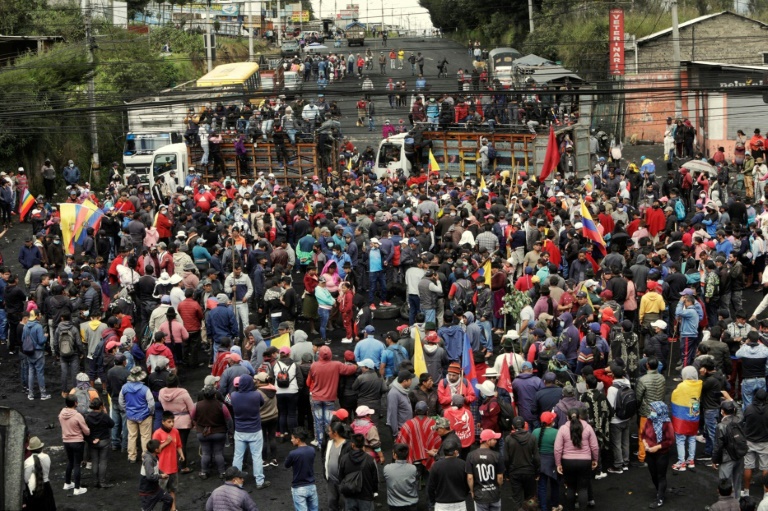
Thousands of Indigenous people and members of other disgruntled groups marched into Ecuador’s capital on the eighth day of fuel price protests Monday, accused by the president of seeking only “chaos” and his removal.

President Guillermo Lasso extended a state of emergency to cover six provinces, with a nighttime curfew in Quito, as he seeks to curtail demonstrations that have seen roads barricaded countrywide, cost the economy tens of millions of dollars and left dozens of people injured.

“With this decision, the welfare of citizens is safeguarded in the face of violence. At the same time, the rights of those who demonstrate peacefully are protected,” the government said.

On foot, on motorcycles and in crowded trucks, the Indigenous protesters began a peaceful march towards the city center from Cutuglagua, an area in southern Quito where they have been steadily growing in number since Sunday.

A hundred Indigenous people also entered the city from the north.

The powerful Confederation of Indigenous Nationalities of Ecuador (Conaie) — credited with helping topple three presidents between 1997 and 2005 — called the protest as Ecuadorans increasingly struggle to make ends meet.

Indigenous people comprise more than a million of Ecuador’s 17.7 million inhabitants, and their protest has since been joined by students, workers and others feeling the economic pinch.

“We have reached out, we have called for dialogue, but they do not want peace,” Lasso said in a video on Twitter Monday.

“They seek chaos. They want to eject the president.”

Police say 63 personnel have been wounded in clashes and 21 others briefly held hostage since the protests began, while human rights observers reported 79 arrests and 55 civilians wounded.

– ‘Zone of peace’ –

A state of emergency declared last Friday allowed Lasso to mobilize the armed forces to maintain order, suspend certain civil rights and declare curfews.

On Sunday, Ecuadoran police requisitioned an Indigenous cultural center in Quito to use as a base for protest monitoring.

The center had sheltered thousands of Indigenous people during 2019 anti-government demonstrations that left 11 dead and more than 1,000 injured but forced then-president Lenin Moreno to abandon plans to eliminate fuel subsidies.

The Salesian University, in the north of the capital, decided on Monday to “open the doors” of its facilities as a “zone of peace and humanitarian shelter” for the indigenous people and called “to stop actions and attitudes that interfere or alter the processes of dialogue and the search for solutions.”

Oil producer Ecuador has been hit by rising inflation, unemployment and poverty exacerbated by the coronavirus pandemic.

Fuel prices have risen sharply since 2020, almost doubling for diesel from $1 to $1.90 per gallon and rising from $1.75 to $2.55 for gasoline.

Conaie demands a price cut to $1.50 a gallon for diesel and $2.10 for gasoline.

It also wants food price controls and a commitment to renegotiating the personal bank loans of about four million families.

'World's biggest' freshwater fish netted in Cambodia

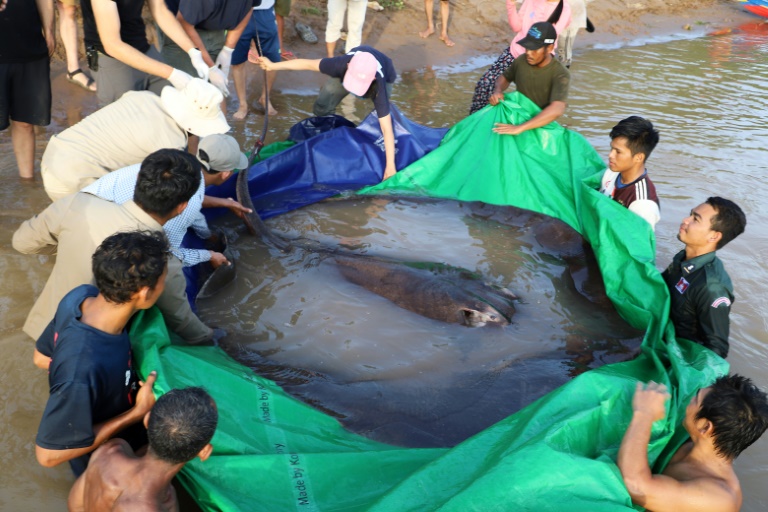
A fisherman on the Mekong river in Cambodia has hooked the biggest freshwater fish ever recorded, scientists said — a 300-kilogram stingray.

The giant freshwater stingray, which measured four metres (13 feet) from snout to tail, was caught last week and released back into the wild after being fitted with a tag to track its behaviour.

The monstrous bottom-dweller beat the previous record for biggest recorded freshwater fish, held by a 293-kilo (646-pound) Mekong giant catfish caught in Thailand in 2005, the US-funded Wonders of the Mekong research project said.

The stingray, caught in Stung Treng province in northern Cambodia, was more than twice the weight of an average lowland gorilla, the experts said.

“In 20 years of researching giant fish in rivers and lakes on six continents, this is the largest freshwater fish that we’ve encountered or that’s been documented anywhere worldwide,” Zeb Hogan, a fish biologist leading the Wonders of the Mekong project, said in a statement released Tuesday.

“This is an absolutely astonishing discovery, and justifies efforts to better understand the mysteries surrounding this species and the incredible stretch of river where it lives.”

The researchers fitted an acoustic tag to the stingray before returning it to the river, to try to learn more about the secretive creature’s elusive behaviour.

Last month, an endangered giant freshwater stingray four metres long and weighing 180 kilos was also hooked by a fisherman in the same province.

More than 1,000 fish species call the Mekong home and the stingray is not the only giant lurking in the muddy waters — the giant catfish and giant barb also reach up to three metres long and 270 kilos in weight.

Scientists have warned that plastic waste threatens wildlife even in the deepest stretches of the Mekong, along with “ghost nets” — abandoned by fishers but still able to snare fish.

The famous waterway starts in China and twists south through parts of Thailand, Laos, Myanmar, Cambodia and Vietnam, feeding 60 million people through its basin and tributaries.

But environmentalists have long voiced concerns about dam building along the Mekong River that will destroy fish stocks.

Ukraine says attacks escalating, as Russia-EU tensions surge

Russia’s blockade of Ukrainian grain exports sparked fresh tensions with Europe as fears grow of a global food crisis, while Kyiv accused Moscow of stepping up attacks in the east of the country.

In New York, Dmitry Muratov, the Russian editor-in-chief of the independent newspaper Novaya Gazeta, auctioned off his Nobel Peace Prize gold medal for $103.5 million to benefit children displaced by the war in Ukraine.

Since being repelled from Kyiv and other parts of Ukraine following their February invasion, Moscow is focusing its offensive on the eastern Donbas region.

Its navy is blockading ports, which Ukraine says is preventing millions of tonnes of grain from being shipped to world markets, contributing to soaring food prices.

Prior to the war, Ukraine was a major exporter of wheat, corn and sunflower oil. 

EU foreign policy chief Josep Borrell called the Russian blockade “a real war crime”, which was happening “while in the rest of the world people are suffering hunger”.

Moscow denies responsibility for the disruption to deliveries and, following Borrell’s comments, took aim at the “destructive” stance of the West for surging grain prices. 

Growing concerns about a food crisis are “the fault of Western regimes, which act as provokers and destroyers,” said foreign ministry spokeswoman Maria Zakharova.

Ukrainian President Volodymyr Zelensky said Kyiv was engaged in “complex negotiations” to unblock grain exports, although cautioned that there was no progress as yet. 

In an address to the African Union, he also warned that the continent was a “hostage” of the conflict, and rising food prices “have already brought (the war) to the homes of millions of African families”.

– ‘Extremely tough’ –

With the European Union set to decide at a summit this week on whether to grant Ukraine candidate status — allowing them to vie for membership — Kyiv has warned that attacks are escalating. 

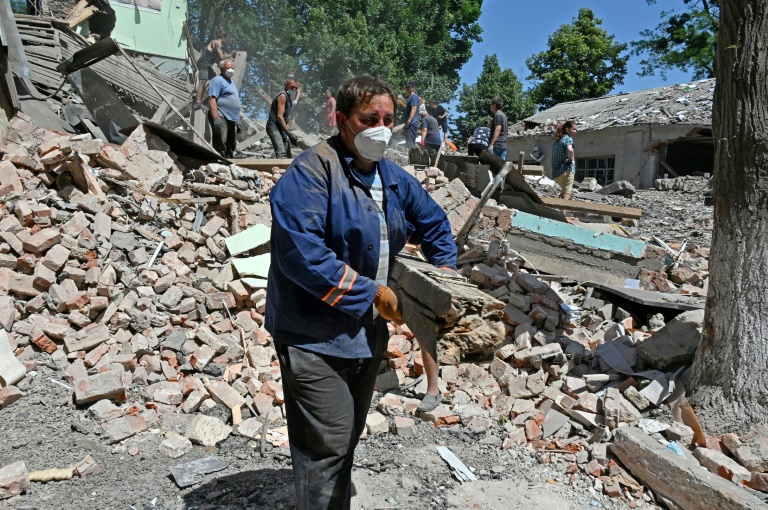
Ukraine said it had lost control of the village of Metyolkine. The settlement is adjacent to Severodonetsk, which has been the focus of fighting for weeks and is now largely under Russian control.

A chemical plant in Severodonetsk where hundreds of civilians are said to be sheltering was being shelled “constantly”, Ukraine said.

Sergiy Gaiday — governor of the Lugansk region, which includes Severodonetsk — said the situation on the frontlines was “extremely tough”.

“Every town and village under Ukrainian control in the Lugansk region is under almost non-stop fire,” he said on Ukrainian TV.

Three people were injured and seven more missing after Ukrainian forces attacked oil drilling platforms in the Black Sea off the coast of Crimea, which was annexed by Russia in 2014, Moscow-backed Crimea leader Sergey Aksyonov said.

It was the first reported strike against offshore energy infrastructure in Crimea since Russia launched its invasion.

The city of Kramatorsk, about 50 kilometres (30 miles) from Severodonetsk, is yet to experience the intense battles seen closer to the frontline but residents are worried the conflict will reach them. 

“People worry a lot about the war, everyone is stressed,” Valentina, a 57-year-old food vendor at a market, told AFP. 

Another food seller, Sofiya, 16, said it was “frightening” being so close to the frontline. 

“But we are trying to hold on,” she said.

– Stiller meets Zelensky –

In the United States, Novaya Gazeta editor Muratov’s Nobel medal was sold to an as yet unidentified phone bidder.

Muratov, who won the prize in 2021 alongside journalist Maria Ressa of the Philippines, and others at the auction expressed shock when the final bid came in at tens of millions of dollars more than the previous offer. 

With US-Russia tensions soaring, Kremlin spokesman Dmitry Peskov told NBC News that two Americans captured in Ukraine while fighting with Kyiv’s military were “endangering” Russian soldiers and should be “held accountable for those crimes”.

The interview marks the first time the Kremlin has commented on the cases of Alexander Drueke and Andy Huynh, both US military veterans, according to NBC.

Denmark meanwhile became the latest European country to warn of potential gas supply problems when its energy agency issued an early warning, as Moscow reduces supplies in response to sanctions.

In a lighter moment, Hollywood star Ben Stiller met Zelensky in Kyiv, hailing the comedian-turned-president as “my hero”.

“What you’ve done, the way that you’ve rallied the country, the world, it’s really inspiring,” said the 56-year-old, best known for roles in “Meet the Parents” and the “Night at the Museum”. 

burs-sr/dhc

Kremlin spokesman says Americans captured in Ukraine committed 'crimes'

Two Americans captured in Ukraine while fighting with Kyiv’s military were “endangering” Russian soldiers and should be “held accountable for those crimes,” Kremlin spokesman Dmitry Peskov said in an interview released by NBC News on Monday.

The interview marks the first time the Kremlin has commented on the cases of Alexander Drueke and Andy Huynh, both US military veterans, according to NBC.

“They’re soldiers of fortune and they were involved in illegal activities on the territory of Ukraine. They were involved in firing and shelling our military personnel. They were endangering their lives,” Peskov told the network in English.

“They should be held responsible for those crimes that they have committed,” he added in the first bits of the interview made public.

“Those crimes have to be investigated.”

When pressed on what crimes the Americans had committed, Peskov admitted their specific offenses were not yet known but claimed that they would not be covered by the Geneva conventions on prisoners of war.

“They are not (in the) Ukrainian army, so they are not subject to the Geneva Conventions,” the Kremlin spokesman said.

Last week, a Russian state TV channel aired videos on social media of Drueke and Huynh.

The circumstances under which the two men were being held were not fully clear, nor who specifically was holding them. Peskov would only say they were being held by “authorities.”

As to whether they could face the death penalty, Peskov said: “It depends on the investigation.”

US President Joe Biden said Friday that he did not know the whereabouts of Drueke and Huynh, who are believed to have joined other foreigners in volunteering alongside Ukrainian troops.

A US State Department spokesperson on Saturday confirmed American authorities had seen the photos and videos of the two US citizens “reportedly captured by Russia’s military forces in Ukraine.”

“We are closely monitoring the situation and our hearts go out to their families during this difficult time,” the spokesperson told AFP.

Rolling Stone magazine also reported Monday that a second American citizen had died while fighting in Ukraine after stepping on a landmine.

— Kremlin says WNBA star not a ‘hostage’ —

An obituary for 52-year-old Stephen Zabielski, posted in early June to a Florida newspaper’s website, said that he had died on May 15 in Ukraine’s eastern Zaporizhia region.

A 22-year-old former marine, Willy Joseph Cancel, was confirmed as the first American killed fighting for Ukraine in late April.

On the case of WNBA superstar Brittney Griner, who is being held in pre-trial detention in Russia on drug charges, Peskow strongly rejected that she was being held as a hostage.

“We cannot call her a hostage. Why should we call her a hostage? She violated Russian law and now she is being prosecuted,” the Kremlin spokesman said.

Griner, a two-time Olympic gold medallist and WNBA champion, was detained at Moscow airport in February on charges of carrying vape cartridges with cannabis oil in her luggage, which could carry a 10-year prison sentence.

Washington says that Russia has “wrongfully detained” the 31-year-old Griner and turned her case over to the US special envoy in charge of hostages.

Her pre-trial detention has been extended until July 2.

Modern phoenix: The bird brought back from extinction in Japan

Every day for the past 14 years, 72-year-old Masaoki Tsuchiya has set out before sunrise to search for a bird rescued from extinction in Japan.

Starting his car under star-dotted skies unpolluted by light, he works alone in the pre-dawn chill, marking sightings or absences in a planner, interrupted only by the crackle of a walkie-talkie.

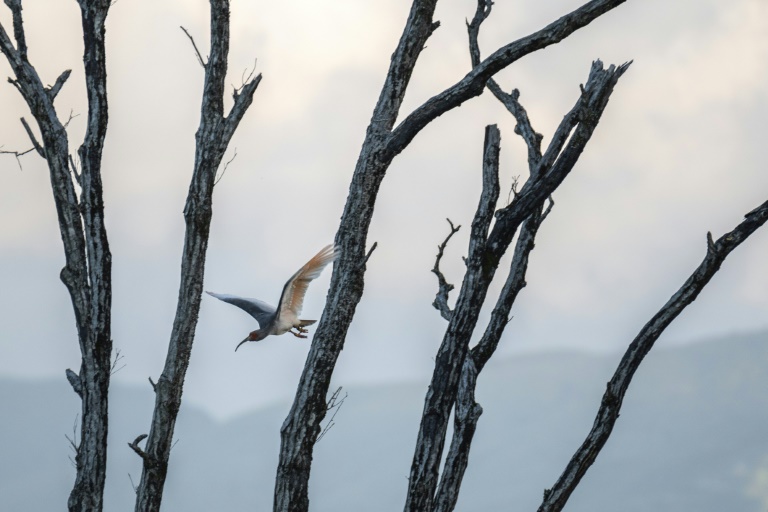
The bird he is looking for is called “toki” in Japanese, and its presence on his home of Sado island is testament to a remarkable conservation programme.

In just under two decades, Japan’s population of wild toki has gone from zero to nearly 500, all on Sado, where the bird’s delicate pink plumage and distinctive curved beak now draw tourists.

It’s a rare conservation success story when one in eight bird species globally are threatened with extinction, and involved international diplomacy and an agricultural revolution on a small island off Japan’s west coast.

– A cautionary tale –

Tsuchiya, stocky and spry with an impish grin, doesn’t eat breakfast until he has made all his stops, and after years of practice he can spot chicks hidden in nests through the monocular attached to his rolled-down car window.

He points to virtually imperceptible marks on a road or a wall that help him remember where to park and start surveying.

“The number I see at this spot depends on the season,” he explains.

Some days dozens of the birds appear in one area, something unimaginable in 2003, when a toki called Kin or “gold” died in a cage on Sado at the record-breaking age of 36.

Her death meant not a single wild-born toki was left in Japan, despite the bird being so synonymous with the country that it is also known as the Japanese crested ibis.

“I knew the day was coming. She was very old and frail,” Tsuchiya said. “But it was still a real pity.”

Efforts to get Kin to mate with Sado’s last wild-born male toki Midori — meaning “green” — had long since failed, and she lived out her last years as a curiosity and a cautionary environmental tale.

Her death made national headlines and appeared to mark the end of a long and seemingly futile battle to protect the toki in Japan, where its feathers even inspire the word for peach pink: “toki-iro”.

But now so many roam the skies and rice paddies of Sado that local officials have gone from discouraging eager birdwatchers to training guides to help visitors spot the local icon, and the government is even studying reintroducing the bird elsewhere.

– Wiped out –

Wild toki once lived across Japan, as well as in Russia, Taiwan and South Korea.

They were considered a pest that damaged rice plants, but during Japan’s Edo era, from 1603 to 1867, hunting restrictions meant only high-ranking officials could actively pursue birds like toki.

That changed in the Meiji era and as guns became more available. Toki meat was believed to have health benefits, and its feathers were favoured for everything from dusters to decorative flourishes on hats.

“Over just 40 years, the toki basically disappeared,” said Tsuchiya on an observation deck where visitors now try to spot the bird.

By the early 1930s, only a few dozen toki remained in Japan, mostly on Sado and the nearby Noto peninsula, and the species won protected status.

A fresh threat then emerged during Japan’s post-war drive for growth: rising use of chemical fertilisers and pesticides.

Toki feed primarily in rice paddies that mimic marshy wetland habitats and they are undiscriminating diners, eating everything from insects to small crabs and frogs.

The chemicals affected the birds and their food, and by 1981 just five wild toki remained in Japan, all on Sado, where officials took them into protective captivity.

But by bizarre coincidence, the same year a population of seven wild toki was discovered in a remote area of China’s Shaanxi province, reviving hopes for the bird’s survival.

Sado’s captive birds failed to mate, but China’s programme had more success, and when then-Chinese president Jiang Zemin made a historic first state visit in 1998 he offered Japan the gift of a pair of toki.

You You and Yang Yang arrived the following year on first-class seats, producing their first chick months later in an event that led national television broadcasts.

Other birds arrived from China, and with time Sado had a large enough population to consider reintroducing the toki to the wild.

But first they had to tackle the use of chemical fertilisers and pesticides on Sado.

“Back then people didn’t think about the environment when farming. Their priorities were selling products at a high price and harvesting as much as possible,” said Shinichiro Saito, a 60-year-old rice farmer.

Farmers were asked to cut chemical fertilisers and pesticides by half from the level allowed by local rules, but there was pushback.

Fewer chemicals meant smaller harvests, lost income, and more weeding.

And some farmers couldn’t see the point of other proposals like underground channels connecting rice fields to rivers to increase the flow of aquatic life.

– ‘Toki-friendly’ –

Local officials used a carrot-and-stick approach, refusing to buy rice from farmers who rejected the new chemical limits and creating a new premium brand of “toki-friendly” rice for those who did.

But Saito, who was an early adopter, said the real difference came when the first birds were released in 2008.

“It was the toki that changed their minds,” he said, with a lop-sided grin.

Even farmers reluctant to adapt were “delighted” to see a bird with almost mythical status on Sado wandering through their fields.

“This is a true story. The toki was almost like an environmental ambassador, it helped create a good environment for itself.”

Tsuchiya’s daily rounds began with the 2008 release. 

He has since witnessed triumphs including the first wild-born chick, and the first chick born to wild-born birds — moments he describes with the proud anxiety of a parent sending a child off to school for the first time.

He still runs his own business, though the toki feather tucked into his car’s folding mirror makes clear where his heart lies.

And the breeding programme has continued, supplemented by birds from China that help broaden the gene pool.

Around 20 birds are released twice a year after graduating from a three-month training programme that prepares them for life outside a cage.

“They learn how to fly, how to find food and to get used to being around humans,” explained Tomoki Tsuchiya, who works with Sado’s local government to make the island toki-friendly.

City officials even farm around the birds to acquaint them with the sound.

– ‘Like family’ –

When the first toki were released on Sado, there were so many gaps in knowledge about the species that volunteers analysed their droppings to find out what the birds were eating.

There were missteps: officials prepared a remote mountain location for the release, believing the birds would prefer seclusion, but the toki instead flew down to fields that were frequented by farmers.

Tomoki Tsuchiya’s interest in toki was fostered by his father, Masaoki.

But it is a fascination shared by many on Sado, where the bird is rendered in cute mascot form on everything from T-shirts to milk cartons.

“How can I express it? The toki is so important for people on Sado,” the 42-year-old said.

“It’s like family.”

Even after training, a toki’s future is precarious: only about half survive predators like snakes and weasels, and the survival rate for newborn chicks is similar.

But enough have thrived that Japan may expand the Sado programme, and there have been successes elsewhere. 

China’s wild population now numbers over 4,450, and a South Korean project released 40 toki for the first time in 2019.

For Saito, who speaks as toki squawk nearby, the bird’s resurrection is part of a bigger achievement on Sado — a new approach to farming and the environment.

“When this project started, what I dreamed of the most was seeing toki flying overhead while I farmed,” he said.

“An environment that is good for toki is an environment that is also safe for humans, and that’s something people on Sado can be proud of.”

Asian markets climb as calm returns after sharp sell-off

Equities rose Tuesday in Asia as some stability returned to markets after last week’s upheaval, but analysts warned of further pain for traders after central bank officials hinted at further interest rate hikes to reel in inflation.

While there was no catalyst from Wall Street owing to a public holiday, a healthy performance across Europe provided a little boost, while bargain-buying was also lending support.

However, there remains an overarching sense of gloom as traders speculate that the sharp lift in borrowing costs around the world will tip economies into recession.

Focus this week is on Federal Reserve boss Jerome Powell’s two days of testimony to lawmakers in Washington, which will be closely watched for some insight into the bank’s thinking and possible clues about its plans for fighting surging prices.

The Fed announced a three-quarter point lift last week, after inflation data days earlier had smashed forecasts and hit a four-decade high.

“While (investors do) not expect Powell to reinvent the policy wheel, we could expect him to reinforce the idea that the Fed is in data-dependent mode,” said Stephen Innes of SPI Asset Management. 

“Hence, any shift in Fed rhetoric will be a function of incoming data, virtually all of which now presents event risk. From that perspective, further evidence of persistent inflation will trigger policy panic, while any signs of sluggish growth momentum will confirm the recession narrative.

“Neither suggests that now is the time to board the rally wagon.”

In early trade, Tokyo, Hong Kong, Shanghai, Sydney, Seoul, Singapore, Wellington, Taipei, Manila and Jakarta all rose.

“There might be a narrative that we’ve hit a bottom, we are oversold, the Fed is taking inflation seriously and that might be slightly bullish in the interim,” Frances Stacy, of Optimal Capital, told Bloomberg TV.

However, while the volatility of last week has gone, banks’ intention to continue hiking rates could cause fresh ructions.

Several officials — including at the Fed, Bank of England, Reserve Bank of Australia and European Central Bank — have come out in recent days to flag a further tightening of borrowing costs.

In commodities markets, oil extended gains as traders moved back in after Friday’s plunge fuelled by concerns over a possible recession.

The gains have been helped by optimism for a boost to demand as China gradually eases out of its period of Covid containment, while the US summer driving period picks up.

– Key figures at around 0230 GMT –

Tokyo – Nikkei 225: UP 1.8 percent at 26,225.15 (break)

Hong Kong – Hang Seng Index: UP 1.1 percent at 21,392.60

Shanghai – Composite: UP 0.1 percent at 3,319.07

Euro/dollar: UP at $1.0534 from $1.0528 Monday

Pound/dollar: UP at $1.2269 from $1.2243

Euro/pound: DOWN at 85.86 pence from 86.02 pence

Dollar/yen: UP at 135.10 yen from 135.06 yen

West Texas Intermediate: UP 2.2 percent at $112.012

Brent North Sea crude: UP 1.6 percent at $115.91 per barrel

London – FTSE 100: UP 1.5 percent at 7,121.81 points (close)

New York – Dow: DOWN 0.1 percent at 29,888.78 (close)

For Iraqis a sweltering summer of 'hell' has begun

Umm Mohammed, 74, waves a fan back and forth to cool down, but in the blistering heat of Iraq’s southern city of Basra there is nothing but stiflingly hot air.

While Basra is used to scorching summers, this year it has started sooner than expected, bringing misery to residents in a city also plagued by chronic electricity shortages. 

“By God, we are tired,” Umm Mohammed said faintly, adding that the heat had woken her up in the middle of the night.

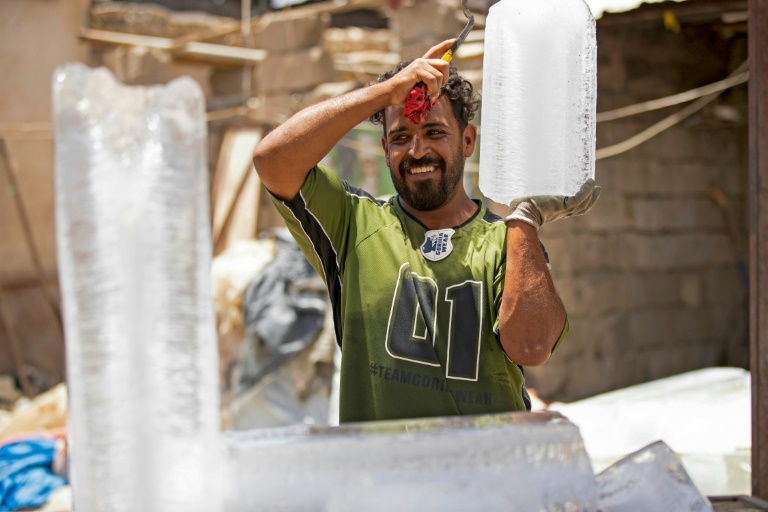
Just days into summer, the temperature in Basra has already soared to around 45 degrees Celsius (113 Fahrenheit).

Umm Mohammed’s modest home has a flimsy sheet-metal roof that retains the sweltering heat.

Further north in the capital Baghdad, temperatures have already topped 50 Celsius — in the shade.

Battered by decades of conflict that has sapped its infrastructure, Iraq is struggling with droughts, repeated sandstorms, desertification and a drop in some river levels.

Chronic power cuts are exacerbated in the summer, and only those who can afford private generators are able to keep their fridges or air conditioning units running.

In Basra, high humidity compounds the oppressive heat.

And with many Iraqis struggling to survive, spending around $105 dollars a month for a private generator is not an option.

The authorities “must help poor people”, Umm Mohammed said, decrying their failure to provide an adequate mains supply.

Referring to how the government treats its citizens, she said: “Even God does not agree to that.” 

– ‘It’s hell’ – 

Iraq is the second-largest oil producer in the OPEC cartel.

But the once thriving country has for years bought gas from neighbouring Iran, which supplies about one-third of its power sector needs.

US sanctions on Iranian oil and gas have complicated Baghdad’s payments for the imports, leaving Iraq in heavy arrears and prompting Tehran to periodically switch off the taps.

The result is longer power cuts for most of Iraq’s 41-million-strong population, many of whom blame politicians and endemic corruption for their plight.

Anger over blackouts helped fuel deadly protests from late 2019 to mid-2020, including many in southern Iraq.

Nataq al-Khafaji, who lives in Nasiriyah, just north of Basra, said getting by in the heat without electricity was “very difficult for the children and the elderly”.

“It’s hell,” he added.

During the summer holidays, Khafaji’s three children have nowhere to go and little to do.

Stuck in their darkened home, they try as best as they can to escape the suffocating heat outdoors.

Khafaji has bought a battery-operated fan, but expressed worry that it would not be enough during the worst months “when it will be close to 50 degrees”.

– ‘National priority’ –

The United Nations ranks Iraq as one of the top five countries most vulnerable to climate change.

Since mid-April, it has been battered by 10 sandstorms — a product of intense drought, soil degradation, high temperatures and low rainfall linked to climate change.

President Barham Saleh has warned that tackling climate change “must become a national priority for Iraq as it is an existential threat to the future of our generations to come”.

Saleh said desertification affects 39 percent of Iraq, where water supplies are also dwindling drastically and crop yields are declining.

With heat waves and dust storms “expected to increase over the years”, so will health issues, said Seif al-Badr, a spokesman for the health ministry.

“We expect to be treating more people for a variety of illnesses linked to climate” change, he told AFP.

But efforts to address such issues appear to have been shelved, as Iraq grapples with political deadlock that has left it without a new government after polls last October.

The World Bank has warned that unless solutions are found, Iraq could lose 20 percent of its water resources by 2050 due to climate change.

Eighth day of Indigenous fuel price protests in Ecuador

Thousands of Indigenous people and members of other disgruntled groups marched into Ecuador’s capital on the eighth day of fuel price protests Monday, accused by the president of seeking only “chaos” and his removal.

President Guillermo Lasso extended a state of emergency to cover six provinces, with a nighttime curfew in Quito, as he seeks to curtail demonstrations that have seen roads barricaded countrywide, cost the economy tens of millions of dollars, and left dozens of people injured.

“With this decision, the welfare of citizens is safeguarded in the face of violence. At the same time, the rights of those who demonstrate peacefully are protected,” the government said.

On foot, on motorcycles and in crowded trucks, the Indigenous protesters began a peaceful march towards the city center from Cutuglagua, an area in southern Quito where they have been steadily growing in number since Sunday.

A hundred Indigenous people also entered the city from the north.

The powerful Confederation of Indigenous Nationalities of Ecuador (Conaie) — credited with helping topple three presidents between 1997 and 2005 — called the protest as Ecuadorans increasingly struggle to make ends meet.

Indigenous people comprise more than a million of Ecuador’s 17.7 million inhabitants, and their protest has since been joined by students, workers and others feeling the economic pinch.

“We have reached out, we have called for dialogue, but they do not want peace,” Lasso said in a video on Twitter Monday.

“They seek chaos. They want to eject the president.”

Police say 63 personnel have been wounded in clashes and 21 others briefly held hostage since the protests began, while human rights observers reported 79 arrests and 55 civilians wounded.

– ‘Zone of peace’ –

A state of emergency declared last Friday allowed Lasso to mobilize the armed forces to maintain order, suspend certain civil rights and declare curfews.

On Sunday, Ecuadoran police requisitioned an Indigenous cultural center in Quito to use as a base for protest monitoring.

The center had sheltered thousands of Indigenous people during anti-government demonstrations in 2019 that left 11 dead and more than 1,000 injured but forced then-president Lenin Moreno to abandon plans to eliminate fuel subsidies.

The Salesian University, in the north of the capital, decided on Monday to “open the doors” of its facilities as a “zone of peace and humanitarian shelter” for the indigenous people and called “to stop actions and attitudes that interfere or alter the processes of dialogue and the search for solutions.”

Oil producer Ecuador has been hit by rising inflation, unemployment and poverty exacerbated by the coronavirus pandemic.

Fuel prices have risen sharply since 2020, almost doubling for diesel from $1 to $1.90 per gallon and rising from $1.75 to $2.55 for gasoline.

Conaie demands a price cut to $1.50 a gallon for diesel and $2.10 for gasoline.

It also wants food price controls and a commitment to renegotiating the personal bank loans of about four million families.

Close Bitnami banner
Bitnami