AFP

Ukraine suffers setbacks in strategic city Severodonetsk

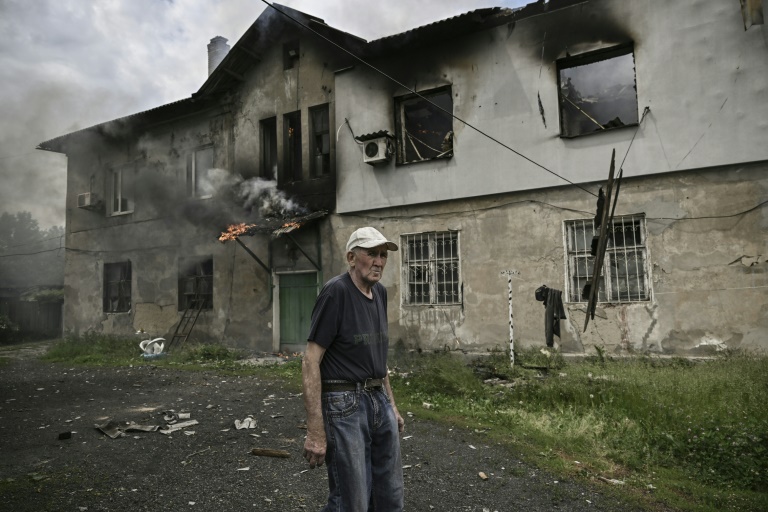
Ukrainian troops suffered setbacks after retaking parts of flashpoint eastern city Severodonetsk from Russian forces, local officials said on Monday, as the see-saw battle raged on for the strategically important city.

With Russia bringing the weight of its artillery to bear around Severodonetsk — the largest city in the Lugansk region not under Russian control — more help was promised from abroad.

The United Kingdom said it would follow the United States and send long-range missile systems to Ukraine, defying warnings from Russian President Vladimir Putin against supplying Kyiv with the advanced weapons.

Thousands of civilians have been killed and millions forced to flee their homes since Putin ordered Russian troops into Ukraine on February 24.

Fighting since April has been concentrated in the east of the country, where Russian forces have made slow but steady advances after being beaten back from other parts of Ukraine, including the capital Kyiv.

“Fighting is very fierce in Severodonetsk,” regional governor Sergiy Gaiday told Ukraine’s 1+1 television.

“Our defenders managed to counter-attack and liberate half of the city, but the situation has worsened for us.”

Russian forces “are destroying everything with their usual scorched earth tactics” so that “there’s nothing left to defend”, he said.

Gaiday said on Sunday that Kyiv’s troops had “cleared half of Severodonetsk and are moving forward”, after Ukrainian forces earlier appeared on the verge of being driven out of the city.

– ‘It’s a horror show’ –

Artillery strikes have intensified on Severodonetsk and neighbouring city Lysychansk, where pensioner Oleksandr Lyakhovets said he had just enough time to save his cat before the flames engulfed his flat after it was hit by a Russian missile.

“They shoot here endlessly… It’s a horror show,” the 67-year-old told AFP.

Lysychansk was among areas visited on Sunday by President Volodymyr Zelensky, who “got himself acquainted with the operational situation on the front line of defence”, the presidency said.

In Moscow, Russian Foreign Minister Sergei Lavrov on Monday blasted European countries for blocking his plane from travelling to Serbia, saying: “The unthinkable has happened.”

“This was a deprivation of a sovereign state of the right to carry out foreign policy,” Lavrov told an online press conference in Moscow after several of Serbia’s neighbours prevented his plane from passing through their airspace.

Lavrov had been due to hold talks with top officials in Belgrade, one of Moscow’s few remaining allies in Europe since the launch of its military offensive in Ukraine.

Serbian daily Vecernje Novosti reported that Bulgaria, Macedonia and Montenegro had refused access to their airspace.

While Serbia has condemned Russia’s military action in Ukraine, it has not joined the European Union in imposing sanctions in Moscow, despite its bid to join the bloc.

– UK pledges missiles –

Ukraine has asked supporting countries for ever more powerful arms to fend off the Russian attack, and its deputy defence minister stressed on Sunday this support was needed until Moscow was defeated.

The United States last week said it would supply Ukraine with advanced missile systems, the latest in a long list of weaponry sent or pledged to the pro-Western country.

But Putin said long-range missile supplies to Ukraine meant “we will draw the appropriate conclusions and use our arms… to strike targets we haven’t hit before”.

Unveiling the latest UK contribution, Defence Secretary Ben Wallace insisted Ukraine’s Western allies must maintain their weapons deliveries to enable it to win.

The UK defence ministry said London had coordinated closely with Washington over its gift of the multiple-launch rocket systems, known as MLRS.

The M270 launchers, which can strike targets up to 80 kilometres (50 miles) away with precision-guided rockets, will “offer a significant boost in capability for the Ukrainian forces”, the ministry added.

Western powers have imposed increasingly stringent sanctions on Russia but divisions have emerged on how to act, particularly on whether to engage in dialogue with Russia.

– Grain talks –

Russian troops now occupy a fifth of Ukraine’s territory, according to Kyiv, and Moscow has imposed a blockade on its Black Sea ports, sparking fears of a global food crisis.

Ukraine and Russia are among the top wheat exporters in the world. Some 30 percent of the world’s grain exports originate from the warring countries.

The United Nations said it was leading intense negotiations with Russia to allow Ukraine’s grain harvest to leave the country.
bur-cjo/raz

Stocks, oil prices rise on China boost

Global stock markets and oil prices advanced Monday, helped by an easing of Covid lockdowns in the world’s second biggest economy China.

London’s stock market, reopening after a British public holiday to mark Queen Elizabeth II’s Platinum Jubilee, shrugged off news that embattled British Prime Minister Boris Johnson was Monday to face a confidence vote from MPs in his own Tory party.

Elsewhere, eurozone stocks climbed ahead of a European Central Bank meeting Thursday when the ECB is is set to draw a line under its massive bond-buying stimulus programme.

Wall Street ended last week in the red as news of larger-than-expected jobs creation in the United States gave the Federal Reserve room to continue hiking interest rates amid decades-high inflation.

Stocks “have started the week on a positive note buoyed by a strong US jobs report on Friday”, noted Victoria Scholar, head of investment at Interactive Investor.

Traders took heart also from a wind-down of Covid containment measures in China that have crippled its economy for months.

With infections trending down in major cities including Shanghai and Beijing, authorities have allowed some sense of normality to return, raising hopes for a pick-up in consumer activity.

“Positive news around Chinese economic activity and cheaper equity valuations could offer value from a long-term investment perspective, but volatility will remain high in the short-term,” noted Diana Mousina, of AMP Capital.

– Oil boost –

Oil prices extended recent gains as a pledge by OPEC and other major producers to boost output fell short of what markets hoped for. 

“Despite OPEC+’s increased output, prices could remain elevated driven by the EU partial ban on Russian imports, the easing of covid restrictions in China and peak driving season in the United States,” said Scholar. 

With supplies tight, Saudi Arabia has raised the price of the oil it sells to Asia.

Adding to the upbeat mood were comments from US commerce chief Gina Raimondo that she was considering lifting tariffs on some goods from China to help in the battle against inflation.

In foreign exchange, the British pound was higher heading into the confidence vote on Johnson’s leadership.

“Markets have responded favourably to the news of the contest, with sterling appreciating,” noted Samuel Tombs, chief UK economist at Pantheon Macroeconomics. 

“This appears to reflect the general principle that markets favour Conservative governments, and the chances of the Tories winning the next election likely will be higher under a new leader.”

Johnson’s public image has suffered in the past year, most notably over the “Partygate” controversy that saw him become the first serving UK prime minister found to have broken the law.

The Conservative government has come under pressure also from a cost-of-living crisis in Britain as UK inflation stands at the highest level in four decades, driven by surging oil and gas prices.

– Key figures at around 1030 GMT –

London – FTSE 100: UP 1.4 percent at 7,640.39 points

Frankfurt – DAX: UP 1.0 percent at 14,601.10

Paris – CAC 40: UP 1.1 percent at 6,559.45

EURO STOXX 50: UP 1.3 percent at 3,832.54

Tokyo – Nikkei 225: UP 0.6 percent at 27,915.89 (close)

Hong Kong – Hang Seng Index: UP 2.7 percent at 21,653.90 (close)

Shanghai – Composite: UP 1.3 percent at 3,236.37 (close)

New York – Dow: DOWN 1.0 percent to 32,899.7 (close)

Brent North Sea crude: UP 0.5 percent at $120.35 per barrel

West Texas Intermediate: UP 0.5 percent at $119.51 per barrel

Euro/dollar: UP at $1.0743 from $1.0719 

Pound/dollar: UP at $1.2560 from $1.2488

Euro/pound: DOWN at 85.52 pence from 85.81 pence

Dollar/yen: DOWN at 130.67 yen from 130.81 yen

Markets mixed as US jobs data give Fed room to hike rates

Equity markets were mixed Monday following losses on Wall Street as a forecast-topping US jobs report gave the Federal Reserve room to continue hiking interest rates, while there was some cheer in China as leaders eased Covid curbs.

US traders took flight after the closely watched non-farm payroll figures Friday, which showed a slowdown in hiring but still with more new posts created than expected.

That came as more officials suggested the Federal Reserve could continue lifting borrowing costs sharply as they try to rein in inflation.

However, with prices being driven higher by factors ranging from the Ukraine war to China’s lockdown-induced slowdown, there are fears the bank’s measures could deal a blow to the world’s biggest economy.

The jump in inflation has forced finance chiefs around the world to tighten monetary policy, with the European Central Bank indicating it will raise rates in July for the first time in more than a decade.

“The critical issue for markets is whether inflation can be brought under control by central banks without generating a recession,” Shane Oliver, head of investment strategy and chief economist at AMP Capital, said in a note. 

“Shares are likely to see continued short-term volatility as central banks continue to tighten to combat high inflation, the war in Ukraine continues and fears of recession remain.”

All three main indexes on Wall Street ended deep in the red, with tech firms taking most of the pain, though Asia fared a little better Monday.

Hong Kong, Tokyo, Shanghai and Taipei all rose, but there were losses in Sydney, Mumbai, Singapore, Manila, Bangkok and Jakarta.

London, Paris and Frankfurt rose at the open.

Diana Mousina, of AMP Capital, said: “Positive news around Chinese economic activity and cheaper equity valuations could offer value from a long-term investment perspective, but volatility will remain high in the short-term.” 

Traders took some heart from a wind down of Covid containment measures that have crippled the world’s number two economy for months.

With infections trending down in major cities including Shanghai and Beijing, authorities have allowed some sense of normality to return, raising hopes for a pick-up in consumer activity.

“The expectations for economic recovery is rising as Beijing and Shanghai try best to resume work and production,” Meng Shen, of investment bank Chanson & Co, said.

Adding to the upbeat mood were comments from US commerce chief Gina Raimondo that she was considering lifting tariffs on some goods from China to help in the battle against inflation.

Oil prices — a key driver of inflation — continued to rise, as a pledge by OPEC and other major producers to boost output fell short of what markets had hoped for. 

The increase came as Saudi Arabia also said it had hiked the official selling price for customers in Asia, while demand expectations rose on the back of the easing of some Covid lockdown measures in China and the start of the US summer driving season.

– Key figures at around 0720 GMT –

Tokyo – Nikkei 225: UP 0.6 percent at 27,915.89 (close)

Hong Kong – Hang Seng Index: UP 1.5 percent at 21,405.99

Shanghai – Composite: UP 1.3 percent at 3,236.37 (close)

London – FTSE 100: UP 0.9 percent at 7,600.01

Brent North Sea crude: UP 0.7 percent at $120.57 per barrel

West Texas Intermediate: UP 0.7 percent at $119.66 per barrel

Euro/dollar: UP at $1.0723 from $1.0719 on Thursday

Pound/dollar: UP at $1.2527 from $1.2488

Euro/pound: DOWN at 85.60 pence from 85.81 pence

Dollar/yen: DOWN at 130.51 yen from 130.81 yen

New York – Dow: DOWN 1.0 percent to 32,899.7 (close)

— Bloomberg News contributed to this story —

At least 10 killed in four weekend shootings across US

At least 10 people were killed and more than two dozen wounded in four shootings across the United States this weekend, as lawmakers struggle to respond to the country’s long-running epidemic of gun violence.

The shootings came after a spate of mass killings that have sparked renewed calls for reform of the nation’s gun laws.

An eruption of violence in Chattanooga, Tennessee on Sunday resulted in 14 people being shot, including two killed, while another person died and two more were injured after they were struck by vehicles fleeing the scene, police chief Celeste Murphy said, adding “several” victims remained in critical condition.

The pre-dawn incident occurred near a nightclub.

In Philadelphia on Saturday, two men and a woman were killed when multiple people opened fire on a crowd at a popular South Street nightlife area.

Philadelphia Police Commissioner Danielle Outlaw said one of the victims got into a fight with another man, which could have been the cause of the shooting.

The two others were “innocent bystanders,” she told reporters.

In Saginaw, Michigan, three people were killed and two others wounded in a shooting on Sunday, MLive.com and WEYI television reported, citing police.

And in Clarendon County, South Carolina, five teens and a 12-year-old were among seven people wounded in a shooting at a graduation party on Saturday that killed one adult, police said in a statement.

– Cries for action –

Gun attacks are common in America, but the shock felt over recent mass shootings at a grocery store in Buffalo, New York and an elementary school in Uvalde, Texas — which killed 10 and 21 people respectively — have spurred cries for action.

Democratic Senator Chris Murphy has been working with a bipartisan group of senators on reform measures — a heavy lift with Republicans routinely rejecting most forms of gun control.

Senator Murphy said Sunday the group hoped to hammer together a legislative package that draws at least 10 Republican votes on top of expected support from nearly every Democrat.

“I think the possibility of success is better than ever before,” he told CNN. 

The emerging package, he said, would probably include “significant mental health investment, school safety money, and some modest but impactful changes in gun laws,” including an expansion of background checks for gun buyers.

“Congress needs to do their jobs and pass commonsense regulation that will help stop this nonsense,” an angry Chattanooga Mayor Tim Kelly told reporters.

He called for “mandatory background checks and prohibiting high-capacity magazines that allow shooters to hurt dozens of people without even having to reload.” 

In addition to the massacres in Texas and New York, recent weeks have seen mass shootings at a hospital in Oklahoma and a church in California.

While Republicans have successfully blocked most efforts at gun control for years, some have recently spoken out for change.

In conservative, gun-loving Texas, more than 250 self-declared firearm enthusiasts, including donors to Republican Governor Greg Abbott, signed an open letter supporting efforts at bipartisan gun reform, the Dallas Morning News reported.

The letter, running as a full-page ad in the newspaper, endorsed an expansion of background checks, raising the age to buy guns to 21, and creating “red flag” laws intended to keep guns from people deemed to be at risk of violence.

US President Joe Biden last week called for new gun-control legislation. On Sunday he renewed his call for restrictions on semi-automatic rifles.

“If we can’t ban assault weapons as we should, we must at least raise the age to buy assault weapons to 21,” he tweeted.

A CBS News/YouGov poll published Sunday shows 62 percent of Americans back a nationwide ban on semi-automatic rifles. Support is even higher for background checks on all gun buyers (81 percent) and “red flag” laws (72 percent).

US gun violence has killed more than 18,000 people so far in 2022, including nearly 10,300 suicides, according to the Gun Violence Archive.

burs-pdh/sw/des/dva/leg

Zendaya's 'Euphoria' and 'Spider-Man' win at MTV awards

Zendaya dominated the MTV Movie and TV Awards on Sunday as her teen drama “Euphoria” and big-screen superhero blockbuster “Spider-Man: No Way Home” were voted best show and best movie respectively.

The light-hearted awards, taking place at the start of the summer blockbuster season, are voted for online by the public, and underscored the huge popularity of the 25-year-old former Disney child star.

Zendaya won best performance in a show for “Euphoria,” HBO’s often bleak and hard-hitting look at modern teen life, which also won offbeat awards for “best fight” and a new award for the best on-screen “hookup.”

The MTV awards have long bestowed tongue-in-cheek “golden popcorn” statuettes for categories ranging from “best kiss” to “most frightened performance.”

With obsessive fans encouraged to vote multiple times for their favorites, the awards tend to recognize mainstream and commercial hits with large and devoted social media followings.

It was little surprise therefore that “Spider-Man: No Way Home” — by far the biggest box office hit since the pandemic — won best movie.

The film has earned almost $1.9 billion worldwide, and is the third-biggest hit for domestic theaters ever.

It also won best performance in a movie for Zendaya’s on-screen and real-life boyfriend Tom Holland, who plays the latest incarnation of the web slinging superhero — although neither attended the ceremony in Santa Monica, near Los Angeles, in person.

Lending some A-list stardust to the room, Jennifer Lopez was presented a non-competitive “Generation Award.”

She thanked “true love” before telling her fiance Ben Affleck “and everybody at home” that she was on her way back for dinner.

Lopez also won best song, for “On My Way (Marry Me),” while 19-year-old multiple Grammy winner Olivia Rodrigo won best music documentary “Olivia Rodrigo: driving home 2 u.”

Jack Black was also honored by MTV for his career on Sunday. The 52-year-old attempted an energetic entrance, somersaulting on stage to youthful cheers from the audience, before breathlessly calling for “a little blast of oxygen.”

Daniel Radcliffe, who won best villain for adventure comedy “The Lost City,” joked that his British accent had made his evil turn a breeze.

“This is a universally recognized accent of pure evil,” he said.

“This is a voice that would kick a puppy or not give Oliver Twist more food. 

“I really should thank my parents most for just having the foresight, all those years ago, to have me be British, so that I could grow up sounding naturally evil enough to one day win this award.”

Climate talks test global resolve on warming

Negotiators from almost 200 countries will meet in Bonn Monday for climate talks tasked with reigniting momentum on tackling global warming, as Russia’s invasion of Ukraine overshadows the threat from rising emissions.

The conference will set the stage for a fresh round of major United Nations talks later this year in Egypt.

It will also be a chance to test the resolve of nations facing a catalogue of crises, including escalating climate impacts, geopolitical tensions, bloodshed in Ukraine and the threat of a devastating global food crisis.

“Climate change is not an agenda we can afford to push back on our global schedule,” said outgoing UN climate change chief Patricia Espinosa ahead of the meeting. 

She said it is imperative that nations arrive at the UN COP27 meeting in Sharm el-Sheikh in November prepared to show they are taking “bold, concrete steps — backed by specific plans — to deliver the urgent and transformational climate ambition we simply must see before it’s too late”.

Governments have already accepted that climate change is a grave threat to humanity and the planet, and have advocated immediate action to cut fossil fuel emissions and prepare for the accelerating impacts of warming.

The summary to this year’s landmark climate report from the Intergovernmental Panel on Climate Change concluded that any further delay in action “will miss a brief and rapidly closing window of opportunity to secure a liveable and sustainable future for all”.

But as things are going, the world is unlikely to be able to meet the Paris climate deal’s commitment to limit warming “well below” 2 degrees Celsius above pre-industrial levels.

“There is this disconnect between the scientific evidence of global crisis in the making, of potentially rushing towards unmanageable climate impact, versus the lack of action,” Johan Rockstrom, director of the Potsdam Institute for Climate Impact Research, told AFP.

“This is a deep worry.”

The world has warmed nearly 1.2C so far — enough to usher in a crescendo of deadly heatwaves, floods and storm surges made worse by rising seas.

– Funding focus –

While the June 6 to 16 conference in Bonn is a largely technical meeting aimed at preparing for Egypt, there are a number of key issues up for debate.

A particular focus will be funding from rich polluters to help vulnerable developing nations least responsible for global heating to cope with its increasingly ferocious consequences.

A promise of $100 billion a year from 2020 to help them adapt to a warming world has still not been met.

Meanwhile, there are growing calls for “loss and damage” funding for countries already struck by devastating climate impacts, with a specific dialogue on the subject slated for this week. 

The Alliance of Small Island States has warned that the Bonn conference must not be “just another talk shop”, calling for a “clear view” on when and how this financing will be put in place.

– ‘Fragile’ world –

UN Secretary General Antonio Guterres last week warned that Russia’s invasion of Ukraine risked slowing action to combat the climate crisis.

“But I think this war has demonstrated one thing: how fragile the world is in its dependence to fossil fuels,” he added.

The invasion has prompted countries, particularly in Europe, to scramble to shore up energy supplies. It has also caused wheat and fertiliser prices to soar.

Fears of a food crisis have intensified in recent weeks, with India moving to ban wheat exports after the hottest March and April on record — blamed largely on climate change — hit harvests.

One opportunity for exhibiting political will comes on Wednesday when the European Parliament votes several hotly debated planks of the bloc’s sprawling “Fit for 55” climate plan.

EU member states have set themselves the target of reducing their greenhouse gas emissions by 55 percent by 2030 compared to 1990, and achieving carbon neutrality for the continent by 2050.

In May, an analysis from non-profit groups found that countries in the G20 group of major economies have yet to strengthen greenhouse gas reduction goals, despite agreeing to revisit their plans.

Last year in Glasgow, countries made new pledges to slash methane emissions, stop deforestation and other measures that — in addition to existing national carbon cutting pledges — could theoretically cap warming under 2C, said Rockstrom. 

But that means the focus at this year’s meetings needs to be on “accountability”, he added. 

“We are now in the delivery phase”.

Climate talks test global resolve on warming

Negotiators from almost 200 countries will meet in Bonn Monday for climate talks tasked with reigniting momentum on tackling global warming, as Russia’s invasion of Ukraine overshadows the threat from rising emissions.

The conference will set the stage for a fresh round of major United Nations talks later this year in Egypt.

It will also be a chance to test the resolve of nations facing a catalogue of crises, including escalating climate impacts, geopolitical tensions, bloodshed in Ukraine and the threat of a devastating global food crisis.

“Climate change is not an agenda we can afford to push back on our global schedule,” said outgoing UN climate change chief Patricia Espinosa ahead of the meeting. 

She said it is imperative that nations arrive at the UN COP27 meeting in Sharm el-Sheikh in November prepared to show they are taking “bold, concrete steps — backed by specific plans — to deliver the urgent and transformational climate ambition we simply must see before it’s too late”.

Governments have already accepted that climate change is a grave threat to humanity and the planet, and have advocated immediate action to cut fossil fuel emissions and prepare for the accelerating impacts of warming.

The summary to this year’s landmark climate report from the Intergovernmental Panel on Climate Change concluded that any further delay in action “will miss a brief and rapidly closing window of opportunity to secure a liveable and sustainable future for all”.

But as things are going, the world is unlikely to be able to meet the Paris climate deal’s commitment to limit warming “well below” 2 degrees Celsius above pre-industrial levels.

“There is this disconnect between the scientific evidence of global crisis in the making, of potentially rushing towards unmanageable climate impact, versus the lack of action,” Johan Rockstrom, director of the Potsdam Institute for Climate Impact Research, told AFP.

“This is a deep worry.”

The world has warmed nearly 1.2C so far — enough to usher in a crescendo of deadly heatwaves, floods and storm surges made worse by rising seas.

– Funding focus –

While the June 6 to 16 conference in Bonn is a largely technical meeting aimed at preparing for Egypt, there are a number of key issues up for debate.

A particular focus will be funding from rich polluters to help vulnerable developing nations least responsible for global heating to cope with its increasingly ferocious consequences.

A promise of $100 billion a year from 2020 to help them adapt to a warming world has still not been met.

Meanwhile, there are growing calls for “loss and damage” funding for countries already struck by devastating climate impacts, with a specific dialogue on the subject slated for this week. 

The Alliance of Small Island States has warned that the Bonn conference must not be “just another talk shop”, calling for a “clear view” on when and how this financing will be put in place.

– ‘Fragile’ world –

UN Secretary General Antonio Guterres last week warned that Russia’s invasion of Ukraine risked slowing action to combat the climate crisis.

“But I think this war has demonstrated one thing: how fragile the world is in its dependence to fossil fuels,” he added.

The invasion has prompted countries, particularly in Europe, to scramble to shore up energy supplies. It has also caused wheat and fertiliser prices to soar.

Fears of a food crisis have intensified in recent weeks, with India moving to ban wheat exports after the hottest March and April on record — blamed largely on climate change — hit harvests.

One opportunity for exhibiting political will comes on Wednesday when the European Parliament votes several hotly debated planks of the bloc’s sprawling “Fit for 55” climate plan.

EU member states have set themselves the target of reducing their greenhouse gas emissions by 55 percent by 2030 compared to 1990, and achieving carbon neutrality for the continent by 2050.

In May, an analysis from non-profit groups found that countries in the G20 group of major economies have yet to strengthen greenhouse gas reduction goals, despite agreeing to revisit their plans.

Last year in Glasgow, countries made new pledges to slash methane emissions, stop deforestation and other measures that — in addition to existing national carbon cutting pledges — could theoretically cap warming under 2C, said Rockstrom. 

But that means the focus at this year’s meetings needs to be on “accountability”, he added. 

“We are now in the delivery phase”.

Asian markets mixed as US jobs data give Fed room to hike rates

Asian markets were mixed Monday following a steep drop on Wall Street in response to a forecast-topping US jobs report that gave the Federal Reserve room to continue hiking interest rates as it struggles to contain surging inflation.

US traders took flight after the closely watched non-farm payroll figures Friday, which showed a slowdown in hiring but still with more new posts created than expected.

That came as more officials suggested the Federal Reserve could continue lifting borrowing costs sharply as they try to rein in inflation.

However, with prices being driven higher by factors ranging from the Ukraine war to China’s lockdown-induced slowdown, there are fears the bank’s measures could deal a blow to the world’s biggest economy.

The jump in inflation has forced finance chiefs around the world to tighten monetary policy, with the European Central Bank indicating it will raise rates in July for the first time in more than a decade.

“The critical issue for markets is whether inflation can be brought under control by central banks without generating a recession,” Shane Oliver, head of investment strategy and chief economist at AMP Capital, said in a note. 

“Shares are likely to see continued short-term volatility as central banks continue to tighten to combat high inflation, the war in Ukraine continues and fears of recession remain.”

All three main indexes on Wall Street ended deep in the red, with tech firms taking most of the pain, though Asia fared a little better in early trade.

Hong Kong, Tokyo, Shanghai and Taipei all rose, but there were losses in Sydney, Singapore, Manila and Jakarta.

Oil prices — a key driver of inflation — continued to rise, as a pledge by OPEC and other major producers to boost output fell short of what markets had hoped for. 

The increase came as Saudi Arabia also said it had hiked the official selling price for customers in Asia, while demand expectations rose on the back of the easing of some Covid lockdown measures in China and the start of the US summer driving season.

– Key figures at around 0230 GMT –

Tokyo – Nikkei 225: UP 0.3 percent at 27,844.26 (break)

Hong Kong – Hang Seng Index: UP 0.8 percent at 21,250.08

Shanghai – Composite: UP 0.4 percent at 3,208.52

Brent North Sea crude: UP 0.7 percent at $120.51 per barrel

West Texas Intermediate: UP 0.7 percent at $119.76 per barrel

Euro/dollar: UP at $1.0721 from $1.0719 on Thursday

Pound/dollar: UP at $1.2492 from $1.2488

Euro/pound: UP at 85.83 pence from 85.81 pence

Dollar/yen: DOWN at 130.61 yen from 130.81 yen

New York – Dow: DOWN 1.0 percent to 32,899.7 (close)

London – FTSE 100: Closed for a holiday

Zendaya's 'Euphoria' and 'Spider-Man' win at MTV awards

Zendaya dominated the MTV Movie and TV Awards on Sunday as her teen drama “Euphoria” and big-screen superhero blockbuster “Spider-Man: No Way Home” were voted best show and best movie respectively.

The light-hearted awards, taking place at the start of the summer blockbuster season, are voted for online by the public, and underscored the huge popularity of the 25-year-old former Disney child star.

Zendaya won best performance in a show for “Euphoria,” HBO’s often bleak and hard-hitting look at modern teen life, which also won offbeat awards for “best fight” and a new award for the best on-screen “hookup.”

The MTV awards have long bestowed tongue-in-cheek “golden popcorn” statuettes for categories ranging from “best kiss” to “most frightened performance.”

With obsessive fans encouraged to vote multiple times for their favorites, the awards tend to recognize mainstream and commercial hits with large and devoted social media followings.

It was little surprise therefore that “Spider-Man: No Way Home” — by far the biggest box office hit since the pandemic — won best movie.

The film has earned almost $1.9 billion worldwide, and is the third-biggest hit for domestic theaters ever.

It also won best performance in a movie for Zendaya’s on-screen and real-life boyfriend Tom Holland, who plays the latest incarnation of the web slinging superhero — although neither attended the ceremony in Santa Monica, near Los Angeles, in person.

Lending some A-list stardust to the room, Jennifer Lopez was presented a non-competitive “Generation Award.”

She thanked “true love” before telling her fiance Ben Affleck “and everybody at home” that she was on her way back for dinner.

Lopez also won best song, for “On My Way (Marry Me),” while 19-year-old multiple Grammy winner Olivia Rodrigo won best music documentary “Olivia Rodrigo: driving home 2 u.”

Jack Black was also honored by MTV for his career on Sunday. The 52-year-old attempted an energetic entrance, somersaulting on stage to youthful cheers from the audience, before breathlessly calling for “a little blast of oxygen.”

Daniel Radcliffe, who won best villain for adventure comedy “The Lost City,” joked that his British accent had made his evil turn a breeze.

“This is a universally recognized accent of pure evil,” he said.

“This is a voice that would kick a puppy or not give Oliver Twist more food. 

“I really should thank my parents most for just having the foresight, all those years ago, to have me be British, so that I could grow up sounding naturally evil enough to one day win this award.”

ECB to end stimulus in prelude to rate hikes

The European Central Bank is set to draw a line under its massive bond-buying stimulus programme at a meeting in Amsterdam on Thursday, as inflation in the eurozone soars to all-time highs.

The decision, already extensively flagged in advance by senior policymakers, is then expected to pave the way for the ECB to raise its interest rates for the first time in over a decade in the weeks that follow. 

Eurozone consumer prices rose by 8.1 percent year-on-year in May, a record since the single currency was launched and well above the ECB’s own target of two percent.

The surge, driven by the war in Ukraine and the consequent rise in energy prices, has boosted calls for the ECB to move more quickly to end its expansionary monetary policy. 

The ECB is lagging behind the central banks in Britain and the United States, which have moved aggressively to try to stamp out inflation.

But the ECB first plans to discontinue asset purchases under its crisis-era stimulus programme before proceeding to actual rate hikes. 

The so-called asset purchase programme, or APP, is the last in a series of debt-purchasing measures worth a total of around five trillion euros ($5.4 trillion) deployed by the ECB since 2014.

ECB chief Christine Lagarde suggested recently that the APP would “end very early in the third quarter”.

– ‘Lift off’ –

For ING’s head of macro, Carsten Brzeski, the comments by Lagarde, a former French finance minister, were “remarkable” in that she has taken the unusual step of mapping out a timetable for ECB policy into the second half of the year.

Lagarde said that rates were set to “lift off” at the ECB’s meeting in July — the first upward move in borrowing costs in over a decade — and the euro’s guardian would then close the era of negative interest rates by the end of September.

Of the ECB’s three main interest rates, the so-called deposit rate — which is normally the interest commercial banks would receive for parking their cash with the ECB overnight — has been negative since 2014.

A negative rate effectively means that commercial banks have to pay the ECB to park their cash, a move introduced by the then president Mario Draghi to keep cash circulating in the eurozone financial system at a time of looming deflation.

For Brzeski, the ECB “has clearly passed the stage of discussing whether and even when policy rates should be increased” and the “only discussion” for the coming weeks was how big the first step would be. 

A number of governing council members have openly discussed the possibility of a 50-basis-point, or half-point, hike to lift ECB interest rates out of negative territory in one go.

Before the most recent eurozone inflation data was released, the head of the Dutch central bank, Klaas Knot, said that such a move was “clearly not off the table”.

On the other side of the Atlantic, the US Federal Reserve already raised rates by half-a-percentage point last month, and some of its policymakers are arguing for more big increases.

But observers have urged the ECB to proceed more cautiously.

Smaller steps of 25 basis points, or a quarter of a percentage point, were the “benchmark pace” for the move out of negative interest rates, the ECB’s chief economist Philip Lane said at the end of May.

– ‘Neutral’ rates –

The idea is to “normalise” eurozone borrowing costs and bring them to a more “neutral” level — which neither stimulates nor stifles the economy — even if opinions differ as to what that level might be. 

Ultimately, the appropriate level of borrowing costs will depend on the eurozone’s economic outlook.

A worrying further acceleration in inflation could prompt the ECB to step on the brakes harder.

The ECB is also scheduled to publish its new economic forecasts on Thursday.

Its previous estimates — published in the immediate aftermath of Russia’s invasion of Ukraine — cut projected growth in 2022 to 3.7 percent and saw inflation rising to 5.1 percent.

But for the chief executive of US bank Citi, Jane Fraser, Europe faced a “very high likelihood” of going to recession on the back of the war, she told journalists in Frankfurt last week.

Close Bitnami banner
Bitnami