AFP

36 years later, 'Top Gun' again tops N.America box office

Much-anticipated action film “Top Gun: Maverick” was expected to have a big opening and it did not disappoint, taking in an estimated $151 million in North America for the four-day Memorial Day weekend, industry watcher Exhibitor Relations reported.

Viewers had to wait 36 years to see the sequel to the original “Top Gun,” but critics say the Paramount/Skydance production was worth the wait, with some calling it superior to the original film.

“The source material remains strong, the execution is excellent, and Tom Cruise makes it work impeccably well,” said analyst David A. Gross of Franchise Entertainment Research.

The film — whose release had been delayed two years by the Covid-19 pandemic — notched $124 million for the first three days of the holiday weekend and took in the same amount overseas, despite not playing in China or Russia. It was Cruise’s first opening to top $100 million.

He again plays cocky (if grayer) navy test pilot Pete “Maverick” Mitchell, now a captain, as he trains to bomb a rogue nation’s uranium enrichment facility. A strong supporting cast includes Ed Harris, Jennifer Connelly, Miles Teller and Jon Hamm; original “Top Gun” veteran Val (Iceman) Kilmer appears briefly.

Slipping a notch to second place was “Doctor Strange in the Multiverse of Madness,” which in its fourth weekend took in $16.4 million for the Friday-through-Sunday period and $21.1 million for the full four days. 

The Disney film, starring Benedict Cumberbatch, had opened to a year’s best $187 million.

In third spot was 20th Century’s new “Bob’s Burgers Movie.” The animated film, based on a popular television show, earned $12.6 million for three days and $15 million for four. 

Focus Features’ “Downton Abbey: A New Era” took fourth place, with $5.9 million for three days and $7.5 million for four. Based on the hugely popular British series, it again stars Maggie Smith, Hugh Bonneville, Elizabeth McGovern and Michelle Dockery.

And in fifth was Universal’s family-friendly animation “The Bad Guys,” at $4.6 million for three days and $6.1 million for four.

Rounding out the top 10 were:

“Sonic the Hedgehog 2” ($2.5 million for three days; $3.1 million for four)

“Everything Everywhere All at Once” ($2.5 million; $3.1 million)

“The Lost City” ($1.8 million; $2.3 million)

“Men” ($1.2 million; $1.5 million)

“Fantastic Beasts: The Secrets of Dumbledore” ($905,000; $1.1 million)

Zelensky visits Ukraine's east as Russia makes push in Donbas

Ukrainian President Volodymyr Zelensky on Sunday made his first trip to the country’s war-torn east since the launch of Moscow’s invasion, as Russian forces tightened their grip around key cities in the Donbas region.

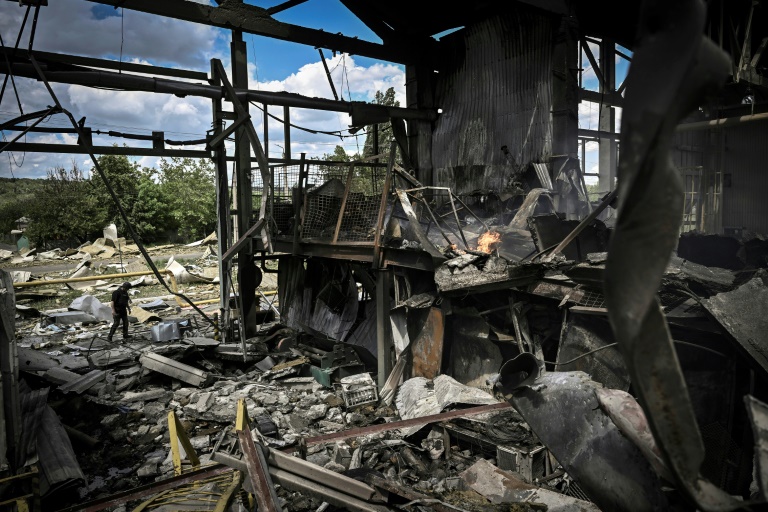
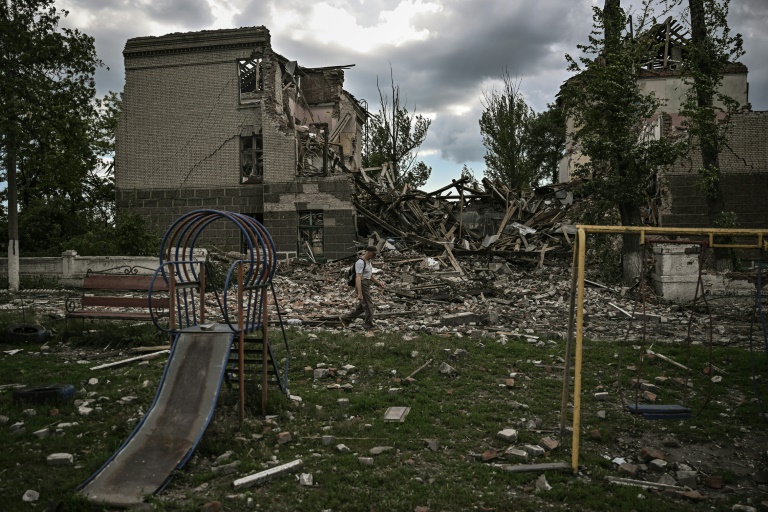
Zelensky’s office posted a video on Telegram of him wearing a bullet-proof vest and being shown destroyed buildings in Kharkiv and its surroundings, from where Russian forces have retreated in recent weeks.

Since failing to capture the capital Kyiv in the early stages of the war, Russia has shifted its focus to the eastern Donbas region as it attempts to consolidate areas under its control.

Its forces said on Saturday they had captured Lyman in the contested region and were upping the pressure on the twin cities of Severodonetsk and Lysychansk.

Zelensky has been based in Kyiv since Russian President Vladimir Putin launched his full-scale attack on Ukraine on February 24.  

“In this war, the occupiers are trying to squeeze out at least some result,” Zelensky said in a later Telegram post Sunday. 

“But they should have understood long ago that we will defend our land to the last man,” he added.

The Ukrainian president was set to speak to European Union leaders at an emergency summit Monday to decide on a Russian oil embargo.

Member states were considering excluding Russian pipeline oil as they sought to break the deadlock on a sixth round of economic sanctions, EU sources told AFP.

– ‘Constant shelling’ –

The situation in Lysychansk had become “significantly worse”, the regional governor of the Lugansk region, Sergiy Gaiday, said on Telegram. 

“A Russian shell fell on a residential building, a girl died and four people were hospitalised,” he said.

On the other bank of the Donets river, Russian forces “carried out assault operations in the area of the city of Severodonetsk,” according to the Ukrainian general staff.

Fighting in the city was advancing street by street, Gaiday said.

In the embattled city, where an estimated 15,000 civilians remain, a local official said “constant shelling” made it increasingly difficult to get in or out.

“Evacuation is very unsafe, it’s isolated cases when we manage to get people out. Now the priority is for the wounded and people who need serious medical assistance,” said Oleksandr Stryuk, head of the city’s military and civil administration.

The water supply is also increasingly unstable, and residents have gone more than two weeks without a mobile phone connection, he added.

On Sunday, the Russian defence ministry said it had destroyed a Ukrainian armed forces arsenal in the southeastern city of Kryvyi Rih with “long-range high-precision missiles”. 

Russian forces also targeted a Ukrainian anti-air defence system near Mykolaivka in the Donetsk region, as well as a radar station near Kharkiv and five munitions depots, one close to Severodonetsk.

– ‘New face’ –

Zelensky discussed reconstruction plans with local officials on his trip to Kharkiv, saying there was a chance for areas devastated by Russian attacks to “have a new face”.

According to local officials over 2,000 apartment blocks have been wholly or partially destroyed by Russian shelling in the region.

In the city of Kharkiv itself, customers were returning to the  well-known Crystal cafe in the central public park after it reopened its doors at the end of April.

Residents come by for a coffee, a bite to eat or to sample the “Biloshka” ice cream, a Crystal speciality the vendor has been serving since the 1960s. 

“We need to keep employment. The city is coming back little by little,” the cafe’s manager, Alyona Kostrova, 36, told AFP.

The menu has been trimmed due to supply problems and the locale is operating with a reduced staff, down to seven or eight from 30 or 40 before the war. 

Far from the city centre in the neighbourhood of Saltivska, where Russian shells continue to fall, the atmosphere is different.

“I would not say that people are buying a lot. People have no money,” said Vitaly Kozlov, 41, who peddles eggs, meat and vegetables locally.

Volodymyr Svidlo, 82, told AFP he “has no pension”, and comes “once a week” to the neighbourhood to sell items, such as onions, dill and flowers, from his garden in order to make ends meet. 

– Emergency summit –

Zelensky will speak to EU leaders at their emergency, as he seeks to crank up international pressure on Moscow.

A new round of European sanctions has been held up by Hungary, whose Prime Minister Viktor Orban has close relations with Russian President Vladimir Putin.

The landlocked country is dependent for most of its oil needs on Russian crude supplied via the Druzhba pipeline.

Hungary has asked for at least four years and 800 million euros ($860 million) in EU funds to adapt its refineries and up pipeline capacity for alternative suppliers, like Croatia.

But under a new proposal put to national negotiators on Sunday the Druzhba pipeline could be excluded from a sanctions package, which would only target oil shipped to the EU by tankers.

burs-sea/lc

Biden arrives in Texas school massacre town

US President Joe Biden arrived Sunday in Uvalde to console residents mourning 19 children and two teachers who were gunned down at an elementary school in the small Texas town.

Biden and First Lady Jill Biden were to visit a memorial outside the school and attend a Catholic Mass, as well as meet with first responders and mourning relatives of the dead.

Harrowing accounts emerged of the ordeal faced by survivors of Tuesday’s attack, as Biden called for action to prevent future massacres in a country where efforts to tighten firearms regulations have repeatedly failed.

“We cannot outlaw tragedy, I know, but we can make America safer. We can finally do what we have to do to protect the lives of the people and of our children,” Biden said Saturday in a speech at the University of Delaware.

As residents gathered in a central square in Uvalde over the weekend to pay homage to the victims, haunting stories emerged of students who played dead while the teen gunman sprayed bullets and police held back from storming in to the rescue.

Ten-year-old Samuel Salinas was sitting in his fourth-grade classroom when the shooter, later identified as Salvador Ramos, 18, barged in with a chilling announcement: “You’re all going to die.”

Then “he just started shooting,” Salinas told ABC News.

Texas authorities admitted Friday that as many as 19 police officers were in the school hallway for nearly an hour without breaching the room where the shooter was, thinking he had ended his killing. Officials called this delay the “wrong decision.”

Ramos was finally killed by police.

Survivors of the attack have described making desperate, whispered pleas for help in 911 phone calls during his assault. Some played dead to avoid drawing the shooter’s attention.

Eleven-year-old Miah Cerrillo even smeared the blood of a dead friend on herself as she feigned death. 

– ‘Don’t move’ –

Salinas said he thinks Ramos fired at him, but the bullet struck a chair, sending shrapnel into the boy’s leg. “I played dead so he wouldn’t shoot me,” he said.

Another student, Daniel, whose mother would not provide his last name, said he saw Ramos fire through the glass in the classroom door, striking his teacher.

The bullets were “hot,” he told The Washington Post, and when another bullet ricocheted and struck a fellow student in the nose, he said he could hear the sickening sound it made.

Though his teacher lay on the floor bleeding, she repeatedly told the students, “‘Stay calm. Stay where you are. Don’t move,'” Daniel recalled.

He was finally rescued by police who broke the windows of his classroom. Since then, he has had recurrent nightmares.

A makeshift memorial has sprung up at Uvalde’s courthouse square.

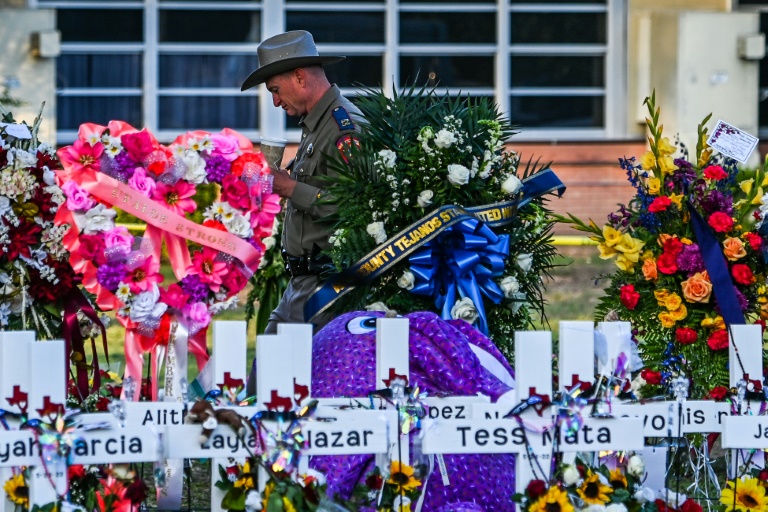
Twenty-one simple white crosses have been erected around a fountain — one for each victim. And people have left growing piles of stuffed animals and flowers, as well as heart-rending messages: “Love you” and “You will be missed.”

Vice President Kamala Harris on Saturday attended the funeral of a victim of another recent mass shooting — Ruth Whitfield, who was among 10 people killed when a self-described white supremacist opened fire in a supermarket in Buffalo, New York on May 14.

– ‘Have the courage’ –

She also urged US lawmakers to take action on guns.

“Congress must have the courage to stand up, once and for all, to the gun lobby and pass reasonable gun safety laws,” Harris tweeted.

The Uvalde shooting was the deadliest school attack since 20 children and six staff were killed at Sandy Hook Elementary School in Newtown, Connecticut in 2012.

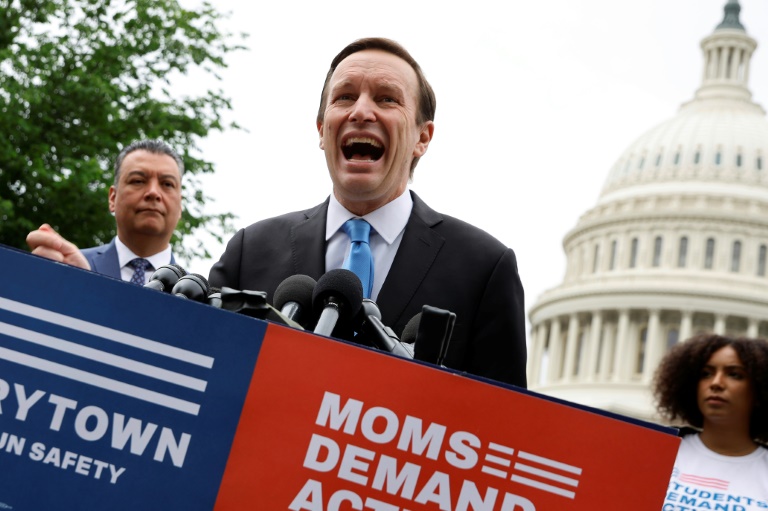
Despite years of growing paralysis on the issue in Congress, Democratic Connecticut Senator Chris Murphy said Sunday there were “serious negotiations” on getting approval for some new gun control measures.

Key US lawmakers offer guarded hope for gun reform

Key US lawmakers expressed guarded optimism Sunday that the shocking school shooting in Texas might lead to at least small steps against gun violence.

“There are more Republicans interested in talking about finding a path forward this time than I have seen since Sandy Hook,” Democratic Senator Chris Murphy said on ABC, referring to the 2012 school shooting in his home state of Connecticut that claimed 26 lives.

Since the shooting Tuesday in the town of Uvalde, Texas left 19 children and two teachers dead, Murphy has been a leader in talks with Republicans — who have long resisted gun-control measures — about potential steps.

Dick Durbin, the number two Democrat in the Senate, said Sunday that compromise would not come easily, but that after Uvalde, he sensed “a different feeling among my colleagues.”

“The real challenge is whether the Republicans will step forward and show courage, political courage, in a very tough situation,” he told CNN. 

But, he added, “There will be some.”

One moderate House Republican, Adam Kinzinger, told CNN that Uvalde might have opened him up to greater gun control measures.

Kinzinger, a military veteran, said he had opposed the idea of a ban on assault-style weapons until “fairly recently.”

But, he added, “I think I’m open to a ban now,” or at least to imposing training or certification requirements on potential buyers. 

“We have to be coming to the table with ways to mitigate 18-year-olds buying these guns and walking into schools,” he said. “My side’s not doing that.”

Opposition to gun control runs deep among Republicans and some Democrats representing rural states.

In the wake of the Uvalde shooting, several Republican lawmakers have advocated improved school security or additional mental health support.

Durbin acknowledged the difficulty of achieving real reform in a country where guns outnumber people.

“The AR-15 that was used by this individual in Uvalde, there are now 20 million of those owned by Americans across the nation, just to put it in perspective,” he said. 

“So we have got to be realistic about what we can achieve.”

Biden departs to console Texas town reeling from school massacre

US President Joe Biden departed for Uvalde on Sunday to console residents mourning 19 children and two teachers who were gunned down at an elementary school in the small Texas town.

Harrowing accounts are emerging of the ordeal faced by survivors of the Tuesday attack, as Biden calls for action to prevent future massacres in a country where efforts to tighten firearms regulations have repeatedly failed.

“We cannot outlaw tragedy, I know, but we can make America safer. We can finally do what we have to do to protect the lives of the people and of our children,” Biden said Saturday in a speech at the University of Delaware.

The president and first lady departed their Delaware home early Sunday and are due to visit the memorial outside Robb Elementary School on their arrival in Uvalde before attending a mass then meeting with relatives of those caught in the shooting and first responders.

As residents gathered in a central square in Uvalde on Saturday to pay homage to the victims, haunting stories told by young students who played dead while a gunman killed their classmates and teachers were underscored by accounts of the slow reaction by police.

Ten-year-old Samuel Salinas was sitting in his fourth-grade classroom when the shooter, later identified as Salvador Ramos, 18, barged in with a chilling announcement: “You’re all going to die.”

Then “he just started shooting,” Salinas told ABC News.

Texas authorities admitted Friday that as many as 19 police officers were in the school hallway for nearly an hour without breaching the room where the shooter was, thinking he had ended his killing. Officials called this delay the “wrong decision.”

Ramos was finally killed by police.

Survivors of the attack have described making desperate, whispered pleas for help in 911 phone calls during his assault. Some played dead to avoid drawing the shooter’s attention.

Eleven-year-old Miah Cerrillo even smeared the blood of a dead friend on herself as she feigned death. 

– ‘Don’t move’ –

Salinas said he thinks Ramos fired at him, but the bullet struck a chair, sending shrapnel into the boy’s leg. “I played dead so he wouldn’t shoot me,” he said.

Another student, Daniel, whose mother would not provide his last name, said he saw Ramos fire through the glass in the classroom door, striking his teacher.

The bullets were “hot,” he told The Washington Post, and when another bullet ricocheted and struck a fellow student in the nose, he said he could hear the sickening sound it made.

Though his teacher lay on the floor bleeding, she repeatedly told the students, “‘Stay calm. Stay where you are. Don’t move,'” Daniel recalled.

He was finally rescued by police who broke the windows of his classroom. Since then, he has had recurrent nightmares.

By mid-morning Saturday, several dozen people had gathered at Uvalde’s courthouse square, which has become a somber place of homage to victims and survivors.

Twenty-one simple white crosses have been erected around a fountain — one for each victim.

People have left growing piles of stuffed animals and flowers, as well as heart-rending messages: “Love you” and “You will be missed.”

Vice President Kamala Harris on Saturday attended the funeral of a victim of another recent mass shooting — Ruth Whitfield, who was among 10 people killed when a self-described white supremacist opened fire in a supermarket in Buffalo, New York on May 14.

“We will not let those people who are motivated by hate to separate us or make us feel fear,” Harris said at the funeral for the 86-year-old.

– ‘Have the courage’ –

She also urged US lawmakers to take action on guns.

“Congress must have the courage to stand up, once and for all, to the gun lobby and pass reasonable gun safety laws,” Harris tweeted.

The Uvalde shooting was the deadliest school attack since 20 children and six staff were killed at Sandy Hook Elementary School in Newtown, Connecticut in 2012.

Steven McCraw, director of the Texas Department of Public Safety, revealed on Friday a series of emergency calls — including by a child begging for police help — that were made from two adjoining classrooms where the gunman was barricaded.

But, explaining the delayed reaction by law enforcement, he said the on-scene commander believed at the time that Ramos was in there with no survivors after his initial assault.

McCraw separately told reporters, however, that a 911 call from a child received at 12:16 pm reported eight or nine children still alive. 

As many as 19 officers were outside the classroom door at that time, according to McCraw’s timeline.

McCraw said the child, who dialed 911 multiple times — begged for police to come. Her final call was cut off as she made it outside.

Russia tightens grip on key cities as battle for Donbas rages

The battle for control of the eastern Ukrainian region of Donbas raged on Sunday as Russian forces tightened their grip around the key cities of Severodonetsk and Lysychansk.

The situation in Lysychansk had become “significantly worse”, the regional governor of the Lugansk region, Sergiy Gaiday, said on the messaging service, Telegram. 

“A Russian shell fell on a residential building, a girl died and four people were hospitalised,” he said.

Meanwhile, on the eastern bank of the Donets river, Russian forces “carried out assault operations in the area of the city of Severodonetsk,” according to the Ukrainian general staff. 

Fighting was advancing street-by-street in the city, Gaiday said. 

More than three months after Moscow invaded its pro-Western neighbour, French President Emmanuel Macron and German Chancellor Olaf Scholz called for “direct serious negotiations” between Russian leader Vladimir Putin and his Ukrainian counterpart Volodymyr Zelensky. 

The two European leaders also “insisted on an immediate ceasefire and a withdrawal of Russian troops” in an 80-minute phone call with the Russian leader on Saturday, the German chancellor’s office said.

– ‘Very difficult’ –

Since failing to capture the capital Kyiv in the early stages of the war, Russia has shifted its focus to the eastern Donbas region as it attempts to consolidate areas under its control.

“The situation is very difficult, especially in those areas in the Donbas and Kharkiv regions, where the Russian army is trying to squeeze at least some result for itself,” Zelensky said in his daily address to the nation late Saturday. 

Earlier, Russia’s defence ministry had said the “town of Krasny Liman (Moscow’s name for Lyman) has been entirely liberated from Ukrainian nationalists.”

Lyman lies on the road to Kramatorsk and Severodonetsk, which is “now surrounded,” according to a police official in Lugansk province cited by Russian state media. 

But governor Gaiday insisted that “Severodonetsk has not been cut off.

“There is still the possibility to deliver humanitarian aid,” he told Ukrainian television.

– ‘Constant shelling’ –

In Severodonetsk, where an estimated 15,000 civilians remain, a local official said “constant shelling” made it increasingly difficult to get in or out.

“Evacuation is very unsafe, it’s isolated cases when we manage to get people out. Now the priority is for the wounded and people who need serious medical assistance,” said Oleksandr Stryuk, head of the city’s military and civil administration.

The water supply was also increasingly unstable, as a lack of electricity meant the pumps at city wells no longer functioned, he said. 

Residents had gone more than two weeks without a mobile phone connection, he added.

Governor Gaiday said the sole road link to the outside world was expected to be the focus of continued Russian attacks. 

“Next week will be very hard, as Russia puts all its resources into seizing Severodonetsk, or cutting off the (area) from communication with Ukraine,” he said.

– Putin ‘ready’ to export grain –

In their call with Putin, Scholz and Macron pointed to a looming global food security crisis. 

In addition to capturing key ports such as Mariupol, Russia has used its warships to cut off other cities still in Ukrainian hands, blocking grain supplies from being transported out.

Russia and Ukraine supply about 30 percent of the wheat traded on global markets.

Russia has tightened its own exports and Ukraine has vast amounts stuck in storage, driving up prices and reducing availability across the globe.

Putin has repeatedly rejected any responsibility, instead blaming Western sanctions.

But on Saturday, he told Macron and Scholz that Russia was “ready” to look for ways to allow more wheat onto the global market.

“Russia is ready to help find options for the unhindered export of grain, including the export of Ukrainian grain from the Black Sea ports,” the Kremlin quoted him as saying.

He also called for the lifting of sanctions to allow “an increase in the supply of Russian fertilisers and agricultural products” to the global market.

– Zelensky to speak to EU –

Urgent calls by Zelensky for more advanced weaponry from Ukraine’s Western allies appear to paying off, with Washington agreeing to send advanced long-range rocket systems, according to US media reports.

Pentagon spokesman John Kirby did not confirm the plans to deliver the M270 Multiple Launch Rocket System, highly mobile equipment capable of firing up to 300 kilometres (186 miles) that Kyiv has said it badly needs.

But he said Washington was “still committed to helping them succeed on the battlefield”.

Putin warned Macron and Scholz that ramping up arms supplies to Ukraine would be “dangerous” and risk “further destabilisation”.

On Sunday, the Russian defence ministry said it had destroyed a Ukrainian armed forces arsenal in the southeastern city of Kryvyi Rih with “long-range high-precision missiles”.

Russian forces also targeted a Ukrainian anti-air defence system near Mykolaivka in the Donetsk region, as well as a radar station near Kharkiv and five munitions depots, one of which was close to Severodonetsk.

As Zelensky seeks to ramp up international pressure on Moscow, he will speak to EU leaders at an emergency summit Monday on an embargo on Russian oil. 

Agreement is being held up by Hungary, whose Prime Minister Viktor Orban has close relations with Putin.

burs-sea/spm

Toxic smoke and suspicious plastic plant fires in Turkey

The number of fires breaking out in plastic recycling plants has soared in Turkey.

Experts and activists suspect it’s not a coincidence, believing that some entrepreneurs want to get rid of unwanted rubbish sometimes imported from Europe.

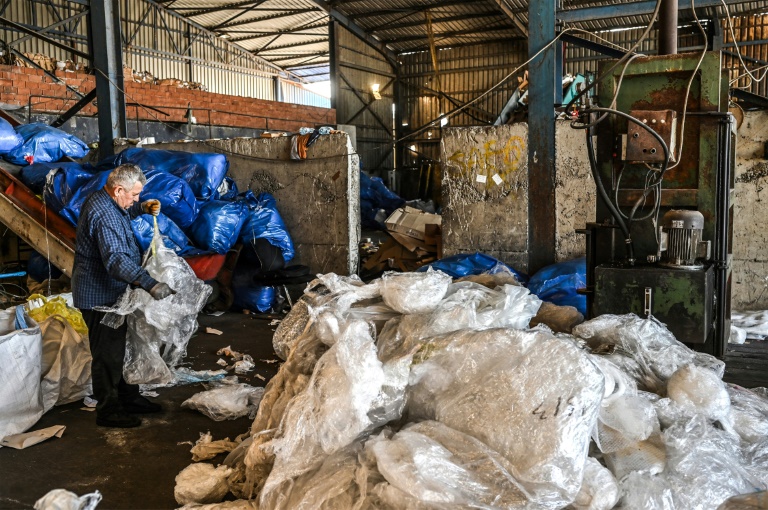
In Kartepe, an industrial town in the country’s north-west, one of these sites was closed by the authorities in December after the outbreak of three fires in less than a month. 

One burned for more than 50 hours, spewing toxic black smoke over the area wedged between the mountains and the Sea of Marmara.

“We don’t want our lakes and springs to be polluted,” said Beyhan Korkmaz, an environmental activist in the city.

She is concerned about the polluting dioxin emissions from a dozen similar fires within a five-kilometre (three-mile) radius in less than two years.

“Should we wear masks?” she said.

There was a fire every three days in Turkey’s plastic reprocessing plants on average last year. The number rose from 33 in 2019 to 121 in 2021, according to Sedat Gundogdu, a professor specialising in plastic pollution at Cukurova University in the southern city of Adana.

– ‘Plastic lobby’ –

Over the same period, Turkey became the leading importer of European plastic waste — ahead of Malaysia — after China banned imports at the start of 2018.

Nearly 520,000 tonnes arrived in Turkey in 2021, adding to the four to six million tonnes the country generates each year, according to data compiled by the Turkish branch of the NGO Greenpeace.

Much of this waste ends up in the south of the country, especially in Adana province, where companies operating illegally have been closed down in recent years.

Other waste containers arrive at the ports of Izmir in the west and Izmit, not far from Kartepe.

“The problem is not importing plastic from Europe, the problem is importing non-recyclable or residual plastics,” said Baris Calli, professor of environmental engineering at Marmara University in Istanbul.

“My feeling is that most of these fires are not just a coincidence,” he said.

He explained only 20 to 30 percent of imported plastic waste is recyclable. 

“The remaining residues should be sent to incineration plants but the incineration plants charge some money… that’s why when some companies have significant amounts of residues on their hands they try to find some easy way to get rid of them,” he said.

Gundogdu finds it curious that “most of these fires are happening at night” and in outlying storage sections of reprocessing centres, away from the machines.

In a report published in August 2020, international police organisation Interpol expressed concern about an “an increase in illegal waste fire and landfills in Europe and Asia”, citing Turkey in particular.

Following an October 2021 regulation, companies in the sector found guilty of arson can have their permits withdrawn. 

The environment ministry and the vice-president of the waste and recycling branch of the Union of Chambers of Commerce of Turkey did not respond when asked by AFP how many companies have been sanctioned.

“The ministry cannot investigate really carefully, or maybe they don’t want to find” out, Calli said.

He said the plastic industry lobby has grown stronger in Turkey in recent years.

According to Turkish recyclers’ association GEKADER, the plastic waste sector generates $1 billion a year and employs some 350,000 people in 1,300 companies.

– ‘A ray of sunlight is enough’ –

In her office overlooking a shabby warehouse in Kartepe, where plastics are sorted before being recycled or legally incinerated, Aylin Citakli rejected accusations of arson.

“I don’t believe it,” the sorting centre’s environmental manager said.

“These are easily flammable materials, anything can start a fire, a ray of sunlight is enough,” she said.

Turkey announced a ban on the import of plastic waste in May 2021 following outcry after the publication of images of waste from Europe dumped in ditches and rivers.

The ban was lifted a week after it came into force.

Back in Kartepe, environmental activist Korkmaz is worried about the future of her region, where she has lived for 41 years.

She cited the example of Dilovasi, a town 40 kilometres (25 miles) away that houses many chemical and metal factories. Scientists have found abnormally high cancer rates there. 

“We don’t want to end up like them,” she said.

Decline in North Sea puffins causes concern

The Isle of May, off Scotland’s east coast, is home to one of the UK’s biggest colonies of seabirds. Some 200,000 birds, from kittiwakes to guillemots can flock to the rocky outcrop at the height of the breeding season.

But conservationists are concerned about dwindling numbers of one of the island’s most distinctive visitors — the Atlantic puffin.

“The population was really booming in the 80s and 90s and then suddenly, a crash,” David Steel, a manager at the nature reserve, told AFP.

“We lost nearly 30 percent of all puffins in the mid-2000s and since then the population has slowly increased but nothing compared to what it used to be.”

Just over 50 miles (80 kilometres) down the coast on the Farne Islands, off Northumberland in northeast England, there are similar concerns.

In both places, global warming, high winds, rains, coastal erosion, pollution and overfishing of its favoured food — sand eels — is being blamed for dwindling numbers.

“Climate change is having a big effect with prey items in the sea,” affecting sand eels which feed on plankton in the North Sea, said Steel. 

“The plankton is moving north as the sea temperature increases. So if there are less sand eels the puffins are going to struggle.”

– Census –

On a meadow on one of the Farne Islands, rangers slowly slide their arms into narrow sandy burrows, searching for signs of nesting pairs of puffins, which are known locally as “tommy noddies”.

“Quite often you will get a bit of a nip, which is a good sign because it means then that the burrow is occupied,” said one of the rangers, Rosie Parsons.

In 2015, the International Union for the Conservation of Nature gave puffins “vulnerable” status, after large declines over much of their European range.

Rising sea temperatures have caused sand eels to move north to cooler waters, forcing the birds to follow but where more extreme weather can be fatal for them.  

The traditional enemies of puffins, which grow to just under 30 centimetres (one foot) tall and weigh around 450 grams (around a pound), are seagulls and seals.

Puffins mate for life and lay a single egg in April or May. 

Due to their low reproductive rate, populations can take decades to recover from a sudden knock.

A full puffin census is being carried out on the Farne Islands and the Isle of May this year.

Concerns were raised last year when a limited count recorded 36,211 breeding pairs across four of the Farne Islands compared to 42,474 pairs in 2018.

Puffin numbers on the islands peaked at 55,674 pairs in 2003 before a sudden crash to 36,835 in 2008 a due to an extremely low number of sand eels.

Zoologist Richard Bevan, from Newcastle University, hopes the resumed annual count will provide a more accurate estimate of puffins on the islands.

“Up until 2018 surveys were done on the Farnes every five years, which means you don’t know what’s happening in the four years in between,” he told AFP.

Before 2018, teams of researchers would check every burrow they came across on an island and form an estimate from that.

The university then found a way to subsample to form an accurate estimate of the population. This has sped up the count and made the task far less arduous.

– Concern –

Measuring puffin numbers is difficult, said Bevan.

Sometimes it will be easy to spot one of the birds, returning to nests with a sand eel clamped in its beak, but puffins are often underground.

“Often the only way to do it is to stick your arm into a burrow and check,” he said. 

The 2022 census will give scientists a picture of how the puffin population is being affected by factors such as climate change and local changes in sand eel availability, Bevan says.

“Looking at the data, it is worrying to see that over the last four years we have seen a downward trend,” he says.

“However, these are data for a short time period and compared to the population counts in the early 1990s they are still reasonable numbers.”

Although there is not an immediate danger of the puffins becoming extinct, the fact that their numbers are falling “triggers concern”.

“With a declining population you have to keep your eye on it to make sure that doesn’t continue,” he said. 

“If it does continue we have to be aware of the factors that contribute to it and how we can ameliorate those.”

US 'concerned' after UN human rights chief visits China

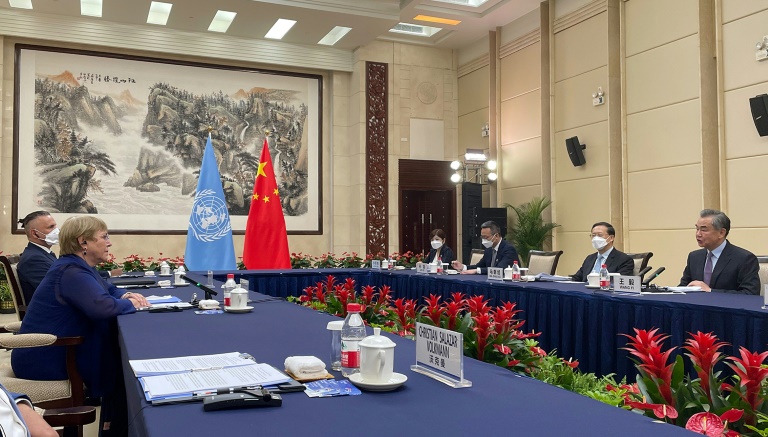
The United States expressed concern on Saturday over China’s “efforts to restrict and manipulate” the UN human rights chief’s visit to the Xinjiang region where Beijing is accused of detaining over a million people in indoctrination camps.

Michelle Bachelet’s long-planned trip this week took her to the far-western Xinjiang region, where the United States has labeled China’s detention of a million Uyghurs and other Muslim minorities a “genocide.”

“We are concerned the conditions Beijing authorities imposed on the visit did not enable a complete and independent assessment of the human rights environment in (China), including in Xinjiang, where genocide and crimes against humanity are ongoing,” US Secretary of State Antony Blinken said in a statement.

The top US diplomat reiterated his country’s stance that Chinese authorities would not allow Bachelet full access during her long-planned trip, saying the United States was “concerned” about China’s “efforts to restrict and manipulate her visit.” 

Bachelet defended her visit earlier on Saturday while still inside China, saying it was “not an investigation” but called on Beijing to avoid “arbitrary and indiscriminate measures” in its crackdown in Xinjiang.

She said the trip was a chance for her to speak with “candour” to Chinese authorities as well as civil society groups and academics.

Her visit was the first to China by a UN high commissioner for human rights in 17 years and comes after painstaking negotiations over the conditions of the visit.

– ‘Warned not to complain’ –

“We are further troubled by reports that residents of Xinjiang were warned not to complain or speak openly about conditions in the region, that no insight was provided into the whereabouts of hundreds of missing Uyghurs and conditions for over a million individuals in detention,” Blinken said. 

“The High Commissioner should have been allowed confidential meetings with family members of Uyghur and other ethnic minority diaspora communities in Xinjiang who are not in detention facilities but are forbidden from traveling out of the region.”

Bachelet’s remarks were also swiftly criticised by activists and NGOs, who accused her of providing Beijing with a major propaganda win.

“Resignation is the only meaningful thing she can do for the Human Rights Council,” said Dilxat Raxit, spokesperson for the World Uyghur Congress advocacy group, while US-based Uyghur activist Rayhan Asat called it a “total betrayal” on Twitter.

The trip included a virtual meeting with President Xi Jinping in which state media suggested Bachelet supported China’s vision of human rights.

Her office later clarified that her remarks did not contain a direct endorsement of China’s rights record.

Witnesses and rights groups say more than one million people have been detained in indoctrination camps in the western Chinese region that aim to destroy the Uyghurs’ Islamic culture and forcibly integrate them into China’s Han majority. 

Beijing denies the allegations and says it is offering vocational training to reduce potential for Islamist extremism.

Russia presses battle for eastern Ukraine, claims key city surrounded

Russian forces engaged in an all-out battle in eastern Ukraine have captured the strategic town of Lyman and surrounded a key industrial centre, Moscow has claimed.

But a Ukrainian official has denied that the city of Severodonetsk — the focus of weeks of fierce fighting — has been encircled, saying government troops had repelled Russian forces from its outskirts.

As the battle for Ukraine’s industrial heartland raged on Saturday, French President Emmanuel Macron and German Chancellor Olaf Scholz called for “direct serious negotiations” between Russian leader Vladmir Putin and his counterpart Volodymyr Zelensky.

The EU leaders also “insisted on an immediate ceasefire and a withdrawal of Russian troops” in an 80-minute phone call with the Russian leader, the German chancellor’s office said. 

Since failing in its bid to capture the capital Kyiv in the war’s early stages, Russia has shifted its focus to the eastern Donbas region as it attempts to consolidate areas under its control.

“The situation is very difficult, especially in those areas in the Donbas and Kharkiv regions, where the Russian army is trying to squeeze at least some result for itself,” Ukrainian President Zelensky said in his daily address to the nation.

Earlier Saturday, Russia’s defence ministry said the “town of Krasny Liman has been entirely liberated from Ukrainian nationalists”, using Moscow’s name for Lyman.

Lyman lies on the road to Kramatorsk and Severodonetsk, which a police official in Lugansk province cited by Russian state media said was “now surrounded”.

But regional governor Sergiy Gaiday told Ukrainian television “Severodonetsk has not been cut off… there is still the possibility to deliver humanitarian aid.”

His remarks came as Russia, in another exercise in military muscle-flexing, said it had successfully tested hypersonic missiles in the Arctic.

– Noose tightens –

Inside Severodentsk, where an estimated 15,000 civilians remain, a local official said “constant shelling” made it increasingly difficult to get in or out.

“Evacuation is very unsafe, it’s isolated cases when we manage to get people out. Now the priority is for the wounded and people who need serious medical assistance,” said Oleksandr Stryuk, head of the city’s military and civil administration.

The water supply was also increasingly tenuous, as a lack of electricity meant the pumps at city wells no longer functioned, he said, adding residents had gone more than two weeks without a cellphone connection. 

The sole road maintaining contact with the outside world, meanwhile, was expected to be the focus of continued Russian attacks, Lugansk governor Gaiday said Saturday night.

“Next week will be very hard, as Russia puts all its resources into seizing Severodonetsk, or cutting off the oblast from communication with Ukraine,” he said.

– France, Germany urge talks –

As France and Germany called for talks aimed at ending a war that has created millions of refugees, Saturday’s phone call with Putin also focused on a looming global food security crisis.

In addition to capturing key port cities such as Mariupol, Russia has used its warships to cut off others still in Ukrainian hands, blocking grain supplies from being transported out.

Russia and Ukraine supply about 30 percent of the wheat traded on global markets.

Russia has tightened its own exports and Ukraine has vast amounts stuck in storage, driving up prices and cutting availability across the globe.

Putin has repeatedly rejected any responsibility, instead blaming Western sanctions.

But on Saturday, he told Macron and Scholz that Russia was “ready” to look for ways to allow more wheat onto the global market.

“Russia is ready to help find options for the unhindered export of grain, including the export of Ukrainian grain from the Black Sea ports,” the Kremlin quoted him as saying.

He also called for the lifting of sanctions to allow “an increase in the supply of Russian fertilisers and agricultural products” onto the global market.

– Putin warns on weapons –

Urgent calls by Zelensky for more advanced weaponry from Ukraine’s Western allies, meanwhile, appear to paying off, with Washington agreeing to send advanced long-range rocket systems, according to US media reports.

Pentagon spokesman John Kirby did not confirm the plans to deliver the M270 Multiple Launch Rocket System, highly mobile equipment capable of firing up to 300 kilometres (186 miles) that Kyiv has said it badly needs.

But he said Washington was “still committed to helping them succeed on the battlefield”.

In a phone call Saturday, British Prime Minister Boris Johnson told Zelensky his country would continue to help “provide the equipment they need”, his office said.

But Putin warned Macron and Scholz that ramping up arms supplies to Ukraine would be “dangerous” and risk “further destabilisation”.

He spoke after Russian forces said they had successfully fired one of their Zircon hypersonic cruise missiles some 1,000 kilometres across the Arctic.

As Zelensky seeks to ramp up international pressure on Moscow, he will speak to EU leaders at an emergency summit Monday on an embargo on Russian oil. 

Agreement on the measure is being held up by Hungary, whose Prime Minister Viktor Orban has close relations with Putin.

burs-ah/cwl/mtp

Close Bitnami banner
Bitnami