AFP

London's long-delayed commuter rail link opens

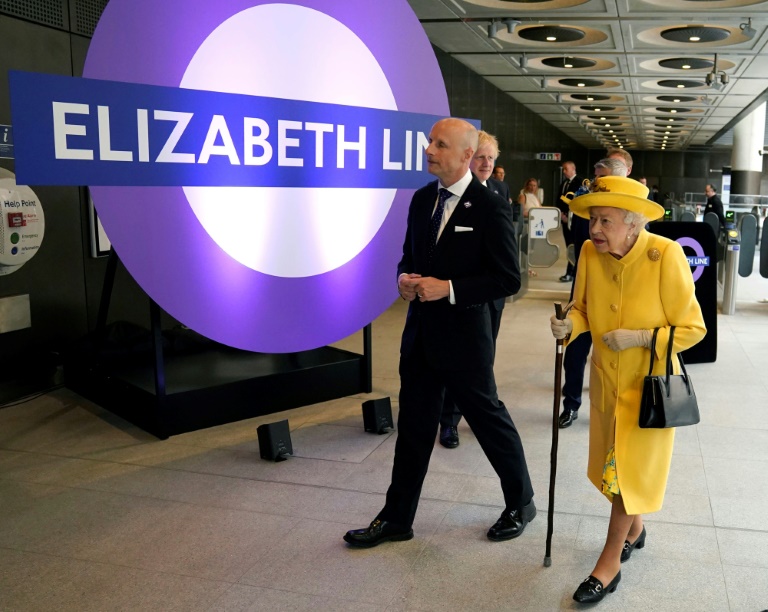
The long-delayed and over-budget Elizabeth line rail link finally opened in London on Tuesday, with hopes it will speed up journeys across the British capital and provide an economic boost.

Hundreds of people queued outside Paddington station in west London to be on the first train when it left at 6:33 am (0533 GMT).

London Mayor Sadiq Khan called the opening “historic” and “the most significant addition to our transport network in decades”.

“The Elizabeth line is much more than just a new railway –- it will provide a crucial economic boost to the whole country and help to turbo-charge our recovery from the pandemic,” he added.

Khan’s predecessor as mayor, Prime Minister Boris Johnson, said the project is forecast to boost the UK economy by £42 billion ($52 billion, 49 billion euros).

Only one of the line’s three branches has opened, from Paddington to Abbey Wood in southeast London.

Sections from Shenfield, east of London to Liverpool Street and Heathrow Airport and Reading, west of the capital, to Paddington will open by May next year.

Trains are currently scheduled to run from 6:30 am to 11:00 pm Monday to Saturday, with a Sunday service expected to start later this year.

The line, named after Queen Elizabeth II, is projected to carry up to 200 million passengers a year, adding 10 percent more capacity to London’s transport network.

Work started on the project back in 2009 and was initially called Crossrail. It was originally due to open in 2018.

But it was hit by problems with construction and complex signalling systems. Costs ballooned to £18.9 billion — some £3 billion over budget.

Quad nations warn against 'change by force' with eyes on China

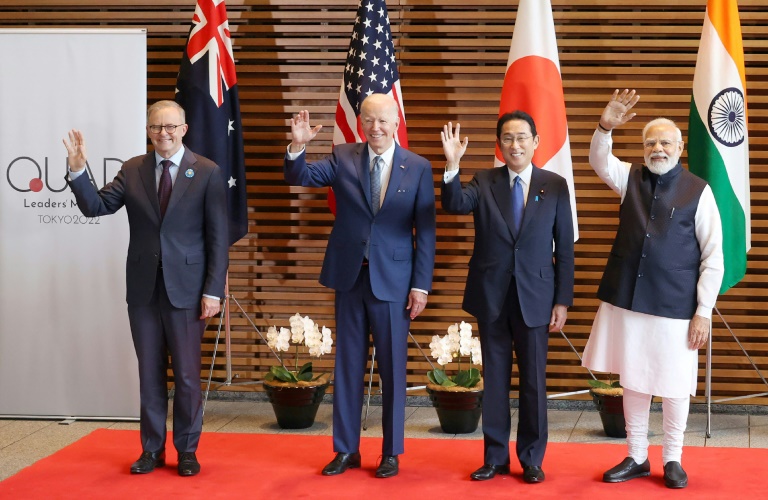
Leaders of Japan, India, Australia and the United States warned Tuesday against attempts to “change the status quo by force” as concerns grow about whether China could invade self-ruled Taiwan.

A joint statement by the so-called Quad bloc avoided any direct mention of China’s growing military power in the region, but left little doubt about where its concerns lie.

The carefully worded document also made reference to the conflict in Ukraine, but without offering any joint position on the Russian invasion that India has pointedly declined to condemn.

The Quad’s other members have been less coy about their view that a strong response to Russia’s war is needed, one that would a message that will deter other countries, including China.

“As Russia’s invasion of Ukraine is shaking the fundamental principles of the international order… (we) confirmed that unilateral attempts to change the status quo by force will never be tolerated anywhere, particularly in the Indo-Pacific region,” Japan’s Prime Minister Fumio Kishida said, using another term for the Asia-Pacific.

The group’s statement made no mention of Russia, or China, but listed a range of activities that Beijing has regularly been accused of in the region.

“We strongly oppose any coercive, provocative or unilateral actions that seek to change the status quo and increase tensions in the area, such as the militarisation of disputed features, the dangerous use of coast guard vessels and maritime militia and efforts to disrupt other countries’ offshore resource exploitation activities,” it said.

The four nations are attempting to build their loose grouping into a more substantive counterweight to China’s rising military and economic power, despite their differences.

They unveiled plans to invest at least $50 billion into regional infrastructure projects over the next five years and a maritime monitoring initiative seen as intended to bolster surveillance of Chinese activities.

The moves come with worries over recent efforts by China to build ties with Pacific nations including the Solomon Islands, which signed a security pact with Beijing last month.

China’s foreign minister will visit the Solomon Islands this week, with reports suggesting he could add stops in other Pacific nations including Vanuatu, Samoa, Tonga and Kiribati.

– ‘Democracies versus autocracies’ –

In a nod to those concerns, Kishida earlier urged Quad members to “listen carefully” to regional neighbours, including the Pacific islands.

“Without walking together with countries in the region, the Quad cannot be successful,” he said.

Australia’s newly elected Prime Minister Anthony Albanese also said the bloc needed to “push our shared values in the region at a time when China was clearly seeking to exert more influence”.

The Quad met a day after US President Joe Biden raised eyebrows and the regional temperature by saying Washington was ready to intervene militarily to defend Taiwan against any Chinese attack.

He insisted Tuesday that his comments did not mean a change to Washington’s longstanding “strategic ambiguity” on how it might respond to a Chinese invasion, prompting another fierce response from Beijing.

Foreign ministry spokesman Wang Wenbin accused Washington of playing “word games” on Taiwan.

“If (the United States) carries on down the wrong path, it will not only cause irredeemable consequences for the US-China relationship, but also eventually incur an unbearable cost to the United States,” he said.

There is growing regional discomfort with Chinese military activity including sorties, naval exercises and encroachments by fishing vessels that are viewed as probing regional defences and red lines.

The bloc said its new maritime monitoring programme would “promote stability and prosperity in our seas and oceans”, again avoiding pointing the finger at Beijing while referencing illegal fishing — an accusation frequently levelled at China.

And if Biden was keen to avoid being seen as changing policy on Tuesday, he left little doubt about where the Quad’s focus lies.

“This is about democracies versus autocracies, and we have to make sure we deliver,” he said as the summit began.

The leaders are set to meet again in person next year, in Australia.

Asian markets fall on China growth concerns

Asian stocks retreated Tuesday on concerns over the impact of China’s Covid-19 restrictions on the world’s second-largest economy as investment banks slashed their forecasts.

A strong rally on Wall Street, where the Dow closed 2.0 percent higher, did not carry over to Asia, and Beijing’s announcement of a fresh raft of measures to stimulate the economy did little to calm nerves.

The package announced on Monday includes more than 140 billion yuan ($21 billion) in additional tax rebates, bringing the total amount of tax relief this year to 2.64 trillion yuan, Xinhua news agency reported following a meeting of the State Council chaired by Premier Li Keqiang.

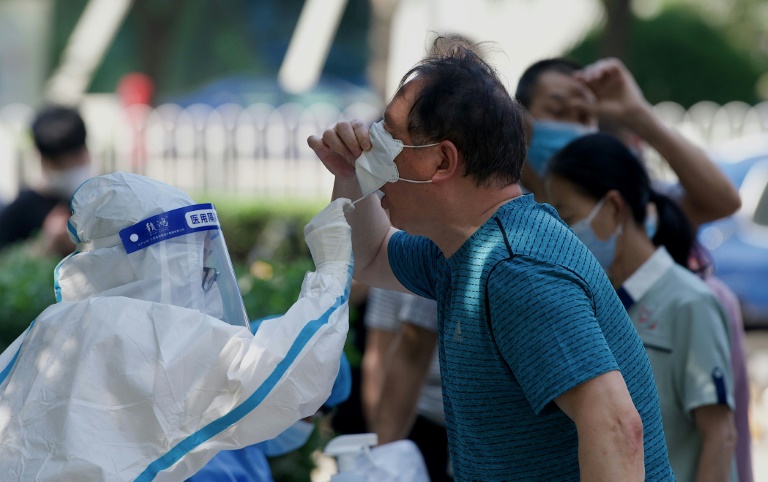
China’s economy has taken a hit from Beijing’s zero-Covid approach to the pandemic, which has resulted in lengthy lockdowns of major cities and mass testing of millions of people.

Prolonged virus lockdowns have constricted supply chains, dampened demand and stalled manufacturing.

Investment banks UBS Group and JPMorgan Chase cut their China economic growth forecasts due to the impact of the coronavirus strategy.

UBS on Tuesday cut its 2022 GDP growth forecast to 3.0 percent from 4.2 percent while JPMorgan on Monday trimmed its forecast to 3.7 percent from 4.3 percent, Bloomberg News reported.

“The lingering restrictions and lack of clarity on an exit strategy from the current Covid policy will likely dampen corporate and consumer confidence and hinder the release of pent-up demand,” UBS economists including Tao Wang wrote in a research note, according to Bloomberg.

China has targeted full-year growth of around 5.5 percent, but data published in April showed that first-quarter growth slowed to 4.8 percent after its economy lost steam in the latter half of last year.

Concerns over the economic fallout from China’s dogged pursuit of a zero-Covid approach and its knock-on impact on supply chains and the wider global economy spooked investors, with Asian markets well into the red on Tuesday.

Tokyo lost 0.9 percent and Shanghai closed 2.4 percent lower while Hong Kong slipped 2.0 percent after the city’s leader Carrie Lam said there would likely be no relaxation of quarantine travel restrictions for the remainder of her term, which ends on June 30.

Seoul was off 1.6 percent, while Taipei, Sydney, Singapore and Manila were all lower. Bangkok was flat while Jakarta was one of the few markets to post gains.

The sell-off continued in Europe, with London and Frankfurt falling 1.0 percent, and Paris sliding 1.2 percent at the start of trade.

Later in the week, investors will be eyeing the minutes from the latest Federal Reserve rate-setting meeting for clues about further hikes aimed at reining in inflation. A raft of economic figures will also provide insights into the state of the US economy.

“The contradictory signals pouring into markets from all directions mean we can expect to see plenty of volatility across asset classes in the weeks ahead, even if we don’t get a thematic directional move,” said OANDA senior market analyst Jeffrey Halley.

“I’m still not sure how that environment is going to be constructive for equities though.”

Concerns over the Chinese economy and its impact on oil demand sent both contracts sharply lower, with Brent falling 1.4 percent to below $112 and WTI also down 1.4 percent to below $109.

– Key figures at around 0710 GMT –

Tokyo – Nikkei 225: DOWN 0.9 percent at 26,748.14 (close)

Hong Kong – Hang Seng Index: DOWN 2.0 percent at 20,053.02

Shanghai – Composite: DOWN 2.4 percent at 3,070.93 (close)

London – FTSE 100: DOWN 1.0 percent at 7,442.20

Dollar/yen: DOWN at 127.39 yen from 127.90 yen at 2030 GMT Monday

Euro/dollar: UP at $1.0724 from $1.0692

Pound/dollar: UP at $1.2594 from $1.2587

Euro/pound: UP at 85.15 pence from 84.92 pence

Brent North Sea crude: DOWN 1.4 percent at $111.79 per barrel

West Texas Intermediate: DOWN 1.4 at $108.74 per barrel

New York – Dow: UP 2.0 percent at 31,880.24 (close)

'Kind of complicated': Growing grapes in the world's driest desert

In the middle of Chile’s Atacama desert, the driest in the world, Hector Espindola has an unexpected job: he runs a vineyard.   

Nearly 2,500 meters (8,000 feet) above sea level, his small Bosque Viejo farm produces muscat grapes — and another of a unique “criollo,” or local, variety — in the shadow of quince, pear and fig trees irrigated by a stream fed by melting Andean snow.

Espindola, 71, farms in an oasis in the Toconao region in Chile’s extreme north — some 1,500 kilometers (932 miles) from the vineyards at the center of the world’s longest country that have made it one of the world’s top 10 wine exporters.  

But growing grapes in the desert is no easy task.  

Espindola contends with extreme day-night temperature fluctuations and extreme solar radiation on top of wind and frost.  

“You have to be dedicated. I water here at night… at three in the morning, eleven at night,” he told AFP while caressing his vines, dry and brown two months after the harvest.  

“You have to be careful because here the heat, the climate is no joke,” he said.

“Sometimes it is windy and production is lost, sometimes the frost comes early. It is kind of complicated.”  

– For her sons –

Espindola sends his crop to the Ayllu cooperative which since 2017 has received grapes from 18 small vineyards around Toconao.

In 2021, the cooperative received 16 tons of grapes for a yield of 12,000 bottles.   

The harvest was better in 2022 with more than 20 tons of grapes — enough for 15,000 bottles but still just a drop, at about one percent, of Chile’s annual production.  

Most contributors to the cooperative are members of indigenous communities who were previously individual, small-scale producers.

One of them, 67-year-old Cecilia Cruz, grows syrah and pinot noir grapes at an altitude of about 3,600 meters outside the village of Socaire — Chile’s highest vineyard.  

“I feel special… to have this vineyard here and to produce wine at this altitude,” she said amid the vines that still sport a few bunches of wrinkled, dried grapes.

But she has a bigger goal: “a future” for her three sons.  

– ‘Taste the Atacama’ –

For Ayllu oenologist Fabian Munoz, 24, the mission is to create a unique wine that captures the characteristics of the volcanic rock in which the grapes grow. 

“When the consumer tastes an Ayllu wine (they should) think: ‘Wow! I’m tasting the Atacama desert’,” he said. 

Carolina Vicencio, an expert in wine chemistry, said the altitude, low atmospheric pressure and extreme temperature fluctuations make for a thicker-skinned grape.

“This generates more tannin molecules in the skin of the grape which gives a certain bitterness in the wine,” she said.

“There is also higher salinity of the soil… which makes for a touch of mineralization in the mouth” that makes the Atacama desert wine one of a kind.

Samsung commits $356 bn in investments with 80,000 new jobs

Samsung Group on Tuesday unveiled a massive 450 trillion won ($356 billion) investment blueprint for the next five years aimed at making it a frontrunner in a wide range of sectors from semiconductors to biologics.

The new figure is an increase of more than a third over its investments spent over the past five years.

The tech giant is South Korea’s largest conglomerate and its overall turnover is equivalent to a fifth of the national gross domestic product.

Samsung Electronics, its flagship subsidiary, is the world’s biggest smartphone maker. 

The investment plan would bring “long-term growth in strategic businesses and help strengthen the global industrial ecosystem of crucial technology”, Samsung said in a statement.

The 80,000 new jobs would be created “primarily in core businesses including semiconductors and biopharmaceuticals” through 2026.

It also noted the investment would “bring forward the mass production of chips based on the 3-nanometer process,” the latest technology to further shrink down the size of semiconductors and boost computing power.

It will also invest heavily in biopharmaceuticals with its affiliates Samsung Biologics and Samsung Bioepis in the field.

The new plan represents a 36 percent increase in investment over its total investments over the past five years. 

Of the 450 trillion won Samsung plans to spend over the next five years, it will commit 360 trillion won to South Korea.

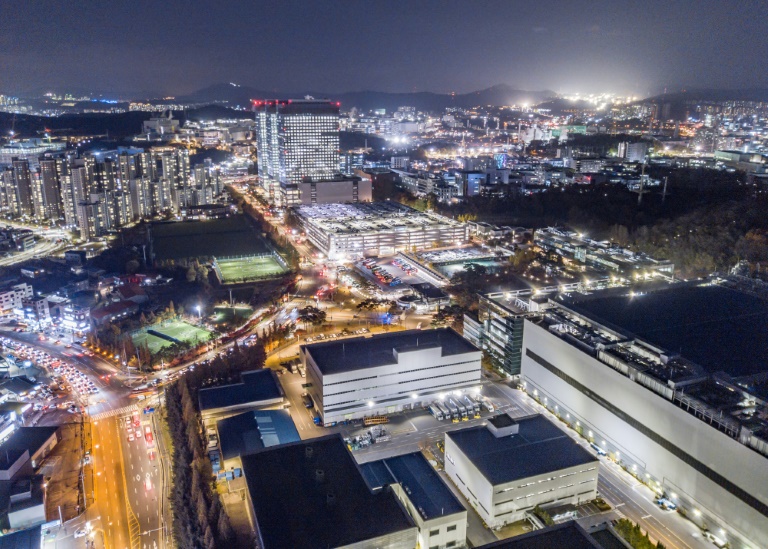
The announcement comes after US President Joe Biden toured Samsung Electronics’ massive Pyeongtaek semiconductor factory on Friday, underscoring the South Korean giant’s role in securing global supply chains of microchips, on his first Asia trip as US leader.

South Korea and the United States need to work to “keep our supply chains resilient, reliable and secure,” Biden said, calling semiconductors manufactured there as “a wonder of innovation” and crucial to the global economy.

Lee Jae-yong, the firm’s vice-chairman and the de facto leader of the wider Samsung conglomerate, escorted Biden and newly-sworn in South Korean President Yoon Suk-yeol inside the assembly line, and introduced the two to an audience in English in his highest-profile public appearance since his release on parole in August. 

Lee had spent over half of a two and a half year sentence for bribery, embezzlement and other offences in connection with a corruption scandal that brought down ex-South Korean president Park Geun-hye before his release.  

Samsung employs about 20,000 people within the United States and work is underway to build a new semiconductor plant in Texas, scheduled to open in 2024.

China offers bonds, tax breaks as new medicine for ailing economy

Tax breaks and a bond drive for Chinese aviation and railway firms are among a blizzard of fresh measures agreed by China’s economic planners to gee up an economy stunted by a coronavirus surge.

China is the last major economy bolted to a zero-Covid strategy of mass testing and tough lockdowns to stamp out infections.

Movement curbs have hit dozens of cities in recent months — from the manufacturing hubs of Shenzhen and Shanghai to the breadbasket of Jilin — seizing up supply chains and crushing retail sales and industrial output to their lowest levels in around two years.

The State Council on Monday announced measures to “stabilise the country’s economy and bring it back onto a normal track”, according to the official Xinhua news agency. 

Beijing will expand the quota of value-added tax refunds by 140 billion yuan ($21 billion), the agency said.

This takes the overall target of tax refunds, cuts and fee reductions to 2.64 trillion yuan this year, according to a readout of the State Council meeting on Xinhua.

Authorities will also double the lending quota for banks to help smaller enterprises, while allowing some borrowers to postpone their repayments, the report added.

The government will also issue 200 billion yuan in bonds to support the aviation industry, cut the purchase tax on some cars, and support the issuance of 300 billion yuan in railway construction bonds, Xinhua said.

“We believe these measures will provide some help and alleviate the severity of the growth slowdown… (but) remain cautious about growth prospects for this year,” Nomura analysts said in a note on Tuesday.

The moves come as Chinese cities roll out more regular Covid testing, crowding out other fiscal spending, Nomura said.

Meanwhile, the zero-Covid strategy is likely to bog down private demand, analysts added.

Markets remained gloomy despite the pledges, with the Shanghai Composite Index down 1.2 percent on Tuesday, while the Shenzhen Composite Index slid two percent in afternoon trade.

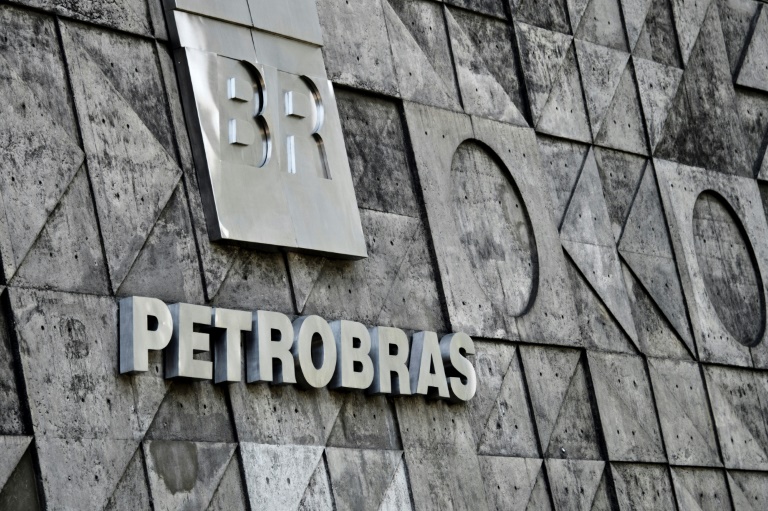
Brazil's Bolsonaro fires third Petrobras chief as fuel prices soar

Brazilian President Jair Bolsonaro on Monday dismissed the president of state oil giant Petrobras, who had been in the job for only 40 days.

Fuel prices in Brazil have increased more than 33 percent in the past year, according to official figures, driving annual inflation of more than 12 percent and hurting Brazilians’ wallets.

Inflation is a central issue as the far-right Bolsonaro seeks re-election in October and trails leftist ex-president Luiz Inacio Lula da Silva in the polls.

“The Federal Government, as controlling shareholder of Petroleo Brasileiro S.A., Petrobras, advises that it decided to make a change to the Company’s presidency,” said the Ministry of Mines and Energy in a statement.

Without giving specific reasons for the dismissal, it thanked Jose Mauro Coelho for his service but said: “Brazil is currently experiencing a challenging moment, due to the effects of the extreme volatility of hydrocarbons in international markets.”

Coelho was appointed in April to finish the term of his predecessor, Joaquim Silva e Luna, and became the third Petrobras president to be dumped by Bolsonaro with fuel prices soaring.

The government proposed for Coelho to be replaced by Caio Mario Paes de Andrade, the current secretary for de-bureaucratization at the Economy Ministry.

He must be confirmed by the company’s board of directors.

– Inflation worries –

Earlier this month, Bolsonaro also replaced his longtime energy minister, Bento Albuquerque, days after Petrobras reported record quarterly profits.

Bolsonaro said those profits amounted to “rape,” and called on Albuquerque and Coelho to stop Petrobras from raising prices.

However, Albuquerque and the energy ministry had no direct role in price decisions by Petrobras, whose pricing policy is based on the international oil market.

Disregarding the president’s fervent demands, Petrobras went on to hike diesel prices by an additional 8.9 percent in the following days.

According to a statement by the Ministry of Mines and Energy, the proposed new Petrobras president Andrade holds degrees from Harvard and Duke universities in the United States.

“The nominee has all the qualifications to lead the company to overcome the challenges imposed by the current situation,” the government statement said.

But according to economist Andre Perfeito of the consulting firm Necton, Brazilians should likely expect more of the same given Andrade’s background.

“It does not seem reasonable to assume that Petrobras’ pricing policy will change, quite the contrary,” Perfeito said in a statement.

“Andrade is a professional with liberal values and close to (Economy) Minister Paulo Guedes,” who launched a study of privatizing Petrobras, added Perfeito.

To use rather than collect, the second coming of NFTs

NFTs have been called everything from fads to outright scams, but early adopters see a future for them as uniquely useful tools for business, health and the arts that goes beyond mere digital collecting.

The non-fungible token (NFT) craze, just over a year old, has given the world works that have sold for millions and includes collections from the “Bored Ape Yacht Club” to an image of a naked Donald Trump following his 2020 election defeat.

This booming world of digital assets has opened up a new market into which tens of billions of dollars have been poured, while also provoking discussions about how they could be useful in the real world. 

“NFTs are very rudimentary right now,” said Sandy Khaund, founder of start-up Credenza, which helps companies adopt new technologies based on blockchain, which underlies cryptocurrencies and NFTs. 

Beyond the art world, “they don’t have a lot of functionality. They don’t have a lot of utility,” Khaund added.

“Most of them are just monkeys or apes or whatever that do nothing,” agreed Juan Otero, CEO of Travala, an online travel site, in reference to the famous “Bored Apes”. 

Yet there is a class of the digital assets bridging the real and virtual worlds.

Starbucks, which will soon launch its own NFTs, sees them as a “programmable, brandable digital asset, that also doubles as an access pass.” 

Owning one of the coffee giant’s NFTs, will open access to “unique experiences,” as well as to a “community,” a new vision of a loyalty program, based on the blockchain. 

This technology, on which cryptocurrencies and NFTs are based, allows the same token to be used for different applications. 

On the institutional side, the tiny republic of San Marino, nestled within Italy, launched a coronavirus vaccine passport in July that incorporates NFT technology. 

While the European digital Covid certificate was designed for the European Union, this passport was intended to be able to be verified anywhere, without requiring a dedicated mobile application. 

– ‘Guaranteed insanity’ –

Credenza, for its part, is in discussions with sports teams and leagues to set a multi-purpose vision for NFTs. 

NFTs and blockchain are “accessible by multiple worlds whether you are physically at the arena ready to go see a New York Knicks game, or you’re ready to go to the metaverse and you want to see a concert there,” said Khaund.

Jenn McMillen of marketing firm Incendio cited rock band Kings of Leon, which have integrated the technology into their work.

As part of the NFT release of their album “When You See Yourself,” the group issued eight “golden tickets,” each of which guaranteed four front-row seats on all of the band’s future tours.

“If you were a brand, think of the most desirable experiences, the most insider-y access, or something that was guaranteed to go viral and just start working backwards from there,” McMillen said.

“(It’s) guaranteed insanity because of the scarcity,” she added.

Among the most successful examples is the travel booking platform Travala, which claims more than 300,000 monthly active users.

The site, which was already accepting cryptocurrency payments, launched the Travel Tiger loyalty program in January.

On the surface, each of the NFTs distributed to existing customers of the platform is a digital drawing of a tiger, reminiscent of the “Bored Apes” designs.

But associated with it is a series of privileges, from entry to exclusive events, in the real world and the metaverse, discounts or loyalty points. 

“It’s about retaining these users, making sure that these users continue to use the platform,” said Juan Otero, CEO of Travala. 

“For these to really push to mainstream and more traditional corporate players and so on, we’ll probably have to wait another two to three years,” he added.

Regardless, NFTs, in conjunction with growing interest in the metaverse and a decentralized vision for the internet’s future, dubbed web3, are part of building wave of growth. 

“The next wave, when it comes, I think is going to be unprecedented,” Otero said. 

Asian markets fall on China growth concerns

Asian stocks retreated Tuesday on concerns over the impact of China’s Covid restrictions on the world’s second-largest economy as investment banks slashed their forecasts.

A strong rally on Wall Street, where the Dow closed 2.0 percent higher, did not carry over to Asia, and Beijing’s announcement of a fresh raft of measures to stimulate the economy did little to calm nerves.

The package announced on Monday includes more than 140 billion yuan ($21 billion) in additional tax rebates, bringing the total amount of tax relief this year to 2.64 trillion yuan, Xinhua news agency reported following a meeting of the State Council chaired by Premier Li Keqiang.

China’s economy has taken a hit from Beijing’s zero-Covid approach to the pandemic, which has resulted in lengthy lockdowns of major cities and mass testing of millions of people.

Prolonged virus lockdowns have constricted supply chains, dampened demand and stalled manufacturing.

Investment banks UBS Group and JPMorgan Chase cut their China economic growth forecasts due to the impact of the coronavirus strategy.

UBS on Tuesday cut its 2022 GDP growth forecast to 3.0 percent from 4.2 percent while JPMorgan on Monday trimmed its forecast to 3.7 percent from 4.3 percent, Bloomberg News reported.

“The lingering restrictions and lack of clarity on an exit strategy from the current Covid policy will likely dampen corporate and consumer confidence and hinder the release of pent-up demand,” UBS economists including Tao Wang wrote in a research note, according to Bloomberg.

China has targeted full-year growth of around 5.5 percent, but data published in April showed that first-quarter growth slowed to 4.8 percent after its economy lost steam in the latter half of last year.

Concerns over the economic fallout from China’s dogged pursuit of a zero-Covid approach and its knock-on impact on supply chains and the wider global economy spooked investors, with Asian markets well into the red on Tuesday.

Tokyo was off 0.5 percent while Hong Kong was down 1.5 percent after the city’s leader Carrie Lam said there would likely be no relaxation of quarantine travel restrictions for the remainder of her term, which ends on June 30.

Shanghai and Seoul were both down 0.8 percent, while Taiwan, Bangkok, Sydney and Manila also retreated. Singapore was one of the few markets to post gains.

Later in the week, investors will be eyeing the minutes from the latest Federal Reserve rate-setting meeting for clues about further rate hikes aimed at reining in inflation. A raft of economic figures will also provide insights into the state of the US economy.

“If inflation remains sticky and the Fed needs to be more aggressive, assets are not cheap enough yet -– in that world, more recession risk will need to be priced through lower earnings,” said Stephen Innes of SPI Asset Management. 

“However, if inflation does cool down, there are many compelling opportunities, significantly if ‘storm clouds’ over the economy dissolve.”

Oil was lower, with both contracts down 0.4 percent.

“Energy traders see choppy waters ahead for oil prices as uncertainty persists with the global economic outlook and over the EU’s progress with a ban on Russian oil,”  said Edward Moya of OANDA

– Key figures at around 0330 GMT –

Tokyo – Nikkei 225: DOWN 0.5 percent at 26,863.33 (break)

Hong Kong – Hang Seng Index: DOWN 1.5 percent at 20,172.28

Shanghai – Composite: DOWN 1.1 percent at 3,112.37

Dollar/yen: DOWN at 127.73 yen from 127.90 yen at 2030 GMT Monday

Euro/dollar: UP at $1.0670 from $1.0692

Pound/dollar: DOWN at $1.2564 from $1.2587

Euro/pound: UP at 84.93 pence from 84.92 pence

Brent North Sea crude: DOWN 0.4 percent at $112.94 per barrel

West Texas Intermediate: DOWN 0.4 at $109.81 per barrel

New York – Dow: UP 2.0 percent at 31,880.24 (close)

London – FTSE 100: UP 1.7 percent at 7,513.44 (close) 

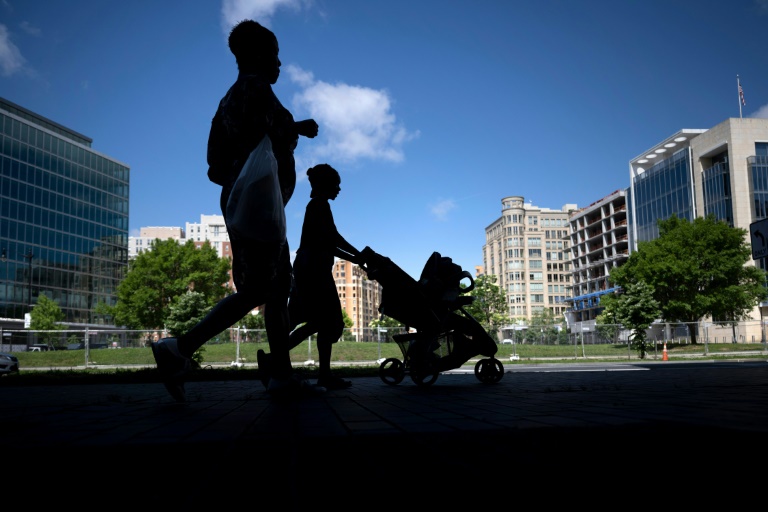
Slight rise in US births in 2021 after pandemic plummet

The number of births in the United States rose slightly in 2021, the first increase in seven years, according to preliminary data published by authorities Tuesday.

There were 3,659,289 births recorded in 2021, up one percent from 2020, a report by the National Center for Health Statistics said.

With the exception of 2014, the number of US births has been declining every year since 2008 — and fell four percent in 2020 compared to 2019.

The drop in 2020 was accentuated by the Covid-19 pandemic, according to the US Census bureau, and it’s possible people who postponed having babies had them in 2021.

The general fertility rate in 2021 was 1.66 children per woman, again up one percent from the previous year, which had set an all-time low.

Despite this slight increase, the fertility rate remained well below the rate necessary for a generation to be replaced (2.1 births per woman), which the United States has been generally below since 1971 and consistently below since 2007.

The birth rate for teenagers ages 15 to 19 declined by six percent in 2021 to 14.4 births per 1,000 females.

The rate among this age group has declined by 65 percent since 2007, the most recent peak, the report said.

The cesarean delivery rate shot up 32.1 percent in 2021. 

Rates of C-sections have been rising as more patients request them and more doctors carry them out for reasons of convenience. 

The preterm birth rate rose four percent to 10.5 percent — the highest level since 2007.

Close Bitnami banner
Bitnami