AFP

Musk, Bolsonaro talk free speech, deforestation in Brazil

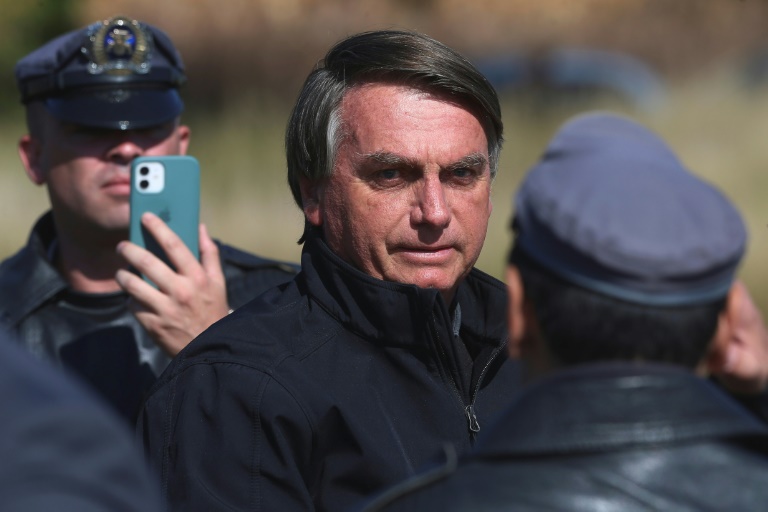
Billionaire Elon Musk jetted into Brazil Friday to meet far-right President Jair Bolsonaro and unveil a project to link thousands of Amazonian schools to the internet and expand satellite monitoring of the rainforest.

The two men met at a luxury hotel in Porto Feliz, some 100 kilometers (60 miles) outside Sao Paulo, with executives of several Brazilian companies present. 

“Super excited to be in Brazil for launch of Starlink for 19,000 unconnected schools in rural areas & environmental monitoring of Amazon!” tweeted Musk of the project. 

In comments made at the meeting, snippets of which were shared on social media, the CEO of SpaceX and Tesla said the project would be “really good” for “deforestation… for education (and), environmental reasons.”

No further details were released of the deal, and journalists were kept at a distance from the meeting venue.

Amazon destruction has risen sharply under the government of Bolsonaro, who is accused of promoting impunity for gold miners, farmers and timber traffickers who illegally clear the rainforest.

The president, however, claimed Friday the new project would reveal the “truth” about the state of the Amazon: “the exuberance of this region, how it is preserved by us.”

Experts point out there are already projects in place to monitor Brazilian deforestation.

“What is missing is action, not monitoring,” said Tasso Azevedo, coordinator of Mapbiomas — a consortium of NGOs, universities and startups that does exactly such work with satellite images.

– Free speech? –

Bolsonaro told Musk his announcement last month of a $44 billion bid for Twitter had come as a “ray of hope.”

The offer has since been suspended, with Musk demanding proof of the number of Twitter spam accounts.

Bolsonaro has had several social media posts deleted over the years amid accusations that he uses fake news as a political weapon, and has welcomed Musk’s statements on loosening restrictions in the name of free expression.

The billionaire had vowed, among other things, to reinstate the account of ex-president Donald Trump — a political idol of Bolsonaro’s.

“Musk has become in recent weeks a kind of hero of Bolsonarism,” said Oliver Stuenkel, an international relations expert at Sao Paulo’s Getulio Vargas foundation.

“His possible acquisition of Twitter was seen as good news because it would supposedly end the restrictions” ahead elections in October.

Bolsonaro, who will seek re-election, is lagging behind leftist Luiz Inacio Lula da Silva in opinion polls.

Bolsonaro tweeted a photograph of him and Musk shaking hands, and said they had also discussed “the use of technology… in the realization of Brazil’s economic potential.”

The meeting was kept under wraps until just hours before it happened.

– High-speed internet- 

Musk is listed by Forbes as the world’s wealthiest person, with a fortune of more than $200 billion.

“Since we are going to connect the Amazon, we brought one of the largest entrepreneurs in the world to help us in this mission,” tweeted Communications Minister Fabio Faria, who met Musk in Texas last November.

At the time, the government announced it was negotiating with SpaceX for satellite access.

SpaceX has thousands of Starlink satellites in orbit to provide high-speed internet, especially to areas underserved by fixed and mobile networks. 

Many more launches are planned to expand the service that has more than 100,000 subscribers worldwide.

Friday’s meeting came hours after Musk rejected allegations on Twitter that he had groped a flight attendant and exposed himself to her six years ago.

Musk tweeted that the latest “attacks” on him were related to his plans to “restore free speech to Twitter & vote Republican.”
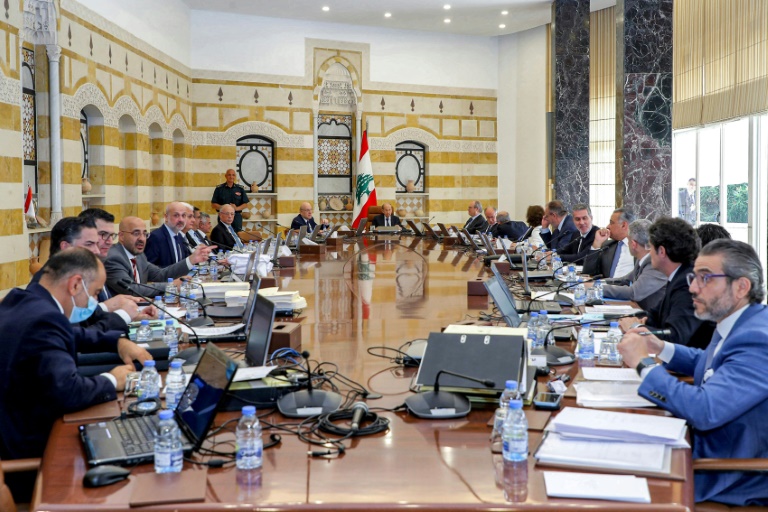

Lebanon cabinet passes financial recovery plan during last session

The cabinet of bankrupt Lebanon, at its final session on Friday, passed a financial recovery plan needed to secure international aid, but its implementation will depend on the fractious incoming parliament.

The session came five days after Lebanon held its first election since an economic crisis, widely blamed on corruption and negligence by the ruling elite, dragged the country to the brink of becoming a failed state.

“Any delay in implementing the financial recovery plan will be very costly to Lebanese,” Prime Minister Najib Mikati said at a press conference after cabinet met.

The International Monetary Fund and Lebanon in April struck a conditional deal for $3 billion in aid. Enacting reforms, including a financial recovery plan, is one of many prerequisites for the package, and analysts have expressed scepticism that the reforms can take place.

It will be up to the new government and parliament to implement the plan approved by the outgoing cabinet.

The financial plan passed by ministers includes restructuring and recapitalising the banking system, and protecting small depositors “as much as possible”, according to an official five-page document seen by AFP.

Sunday’s election yielded a polarised and fragmented legislature likely prone to the kind of deadlock that has characterised Lebanese politics for decades.

This could complicate the formation of a new government and delay implementation of the reforms.

Lebanon has been battered by triple-digit inflation, soaring poverty rates and the collapse of its currency since a 2020 debt default.

In a move adding to the economic pain, cabinet also raised telecom prices. Starting July, the internet bill of Lebanon residents will more than double, as will mobile phone bills.

Telecommunications Minister Johnny Corm warned Thursday the cash-strapped sector might collapse if there were no hikes, because current prices were set according to pre-inflation rates. 

The outgoing Lebanese cabinet will continue to function with limited caretaker powers until a new one is formed, a process that could take months.

“I call on elected lawmakers to expedite the formation of a new government,” Mikati said.

Also on Friday, Saudi Arabia’s de facto ruler Crown Prince Mohammed bin Salman and French President Emmanuel Macron reiterated their call for “structural reforms” in Lebanon.

“They reaffirmed the need to implement the structural reforms necessary for the country’s recovery, as expected by the Lebanese population and the international community,” the French presidency announced after a telephone conversation between the two leaders.

Macron and Salman also “reaffirmed their willingness to continue their coordination to support the Lebanese population”.

Key Iraq irrigation reservoir close to drying out

Iraq’s Lake Hamrin, a once-vast reservoir northeast of Baghdad that is the sole source of water for irrigation across Diyala province, has nearly dried out, a senior official said Friday.

Successive years of low rainfall and a sharp reduction in the flow of water down the Sirwan River from neighbouring Iran have reduced much of the lake to a dust bowl, the official told AFP.

“There has been a sharp reduction in the water level — reserves currently stand at 130 million cubic metres against two billion cubic metres normally,” said Aoun Dhiab, a senior adviser in the water ministry.

Dhiab said a number of factors were to blame including the prolonged drought and Iranian dam construction and river diversion projects upstream.

Dhiab said it was not the first time water levels had fallen so low. “In 2009, the lake dried out completely. There was just a stream.” 

He said the impact on surrounding farmland should not be underestimated.

“There are no other sources of water in the province — the volume arriving in Lake Hamrin is the volume used in the province.”

He said the government had asked Iran to increase the flow of water across the border. Otherwise all that could be done was to pray for higher rainfall next year.

The problem is not exclusive to Diyala province. The World Bank predicts that without major changes, Iraq will have lost 20 percent of its water resources by 2020.

The country is classified as one of five most vulnerable to climate change effects and desertification. Water shortages have led this year to reduced quotas for rice and wheat farmers.

Iraq’s upstream neighbours Iran, Turkey and Syria experience similar shortfalls, meaning that its appeals for help generally fall unheaded. 

Boeing's Starliner approaching ISS in high-stakes test mission

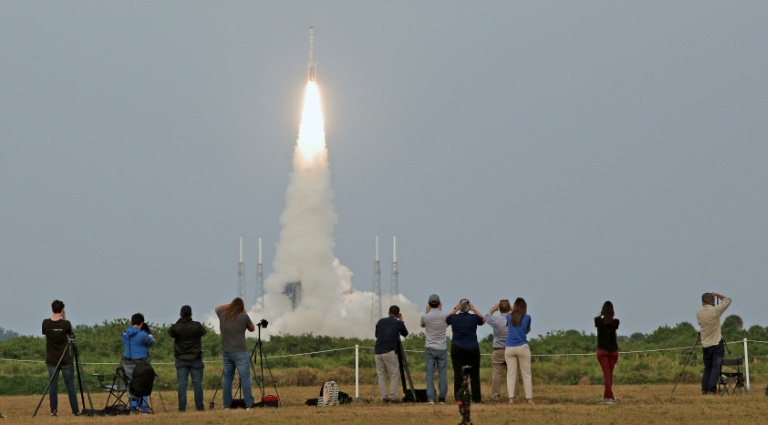
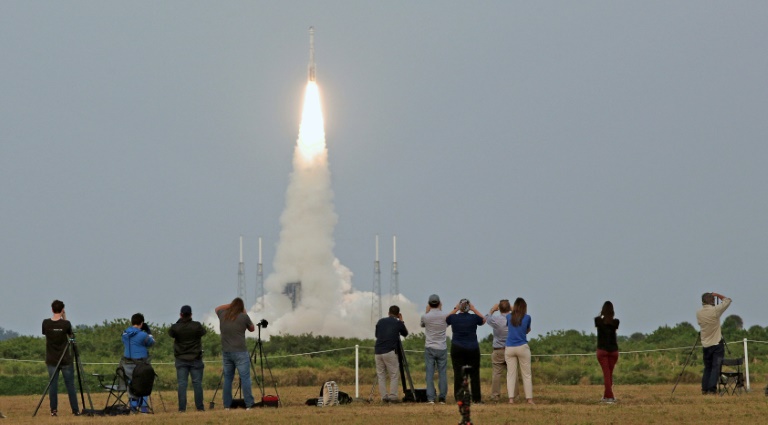
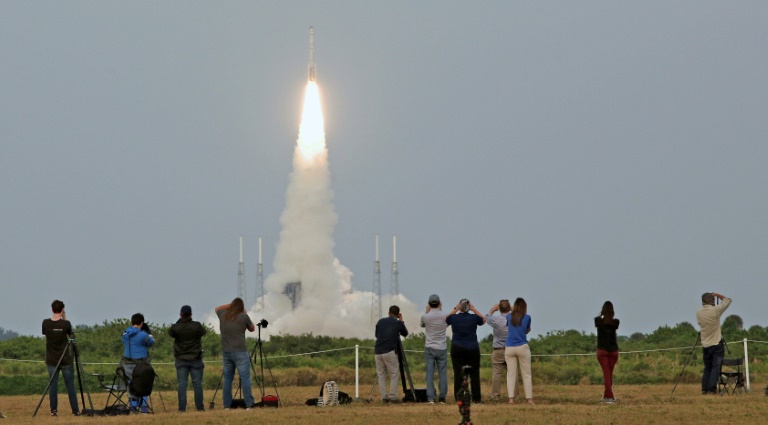
Boeing’s Starliner capsule was preparing to dock with the International Space Station Friday, in a high-stakes uncrewed test flight key to reviving the US aerospace giant’s reputation after a series of failures.

The spaceship blasted off from the Kennedy Space Center in Florida on Thursday evening, and is now set to rendezvous with the ISS at 7:10 pm Eastern Time (2310 GMT), as part of a mission to prove it is capable of providing safe rides for NASA astronauts.

Starliner encountered some propulsion problems early in its journey, with two thrusters responsible for placing it in a stable orbit failing for unclear reasons — though officials insisted everything remained on track.

“Overall, the spacecraft is doing really well,” Steve Sitch, program manager for  NASA’s Commercial Crew Program told reporters at a post-launch press conference, in which he nonetheless flagged anomalies that engineers are working to understand.

One of 12 orbital maneuvering and attitude control (OMAC) thrusters located on Starliner’s aft side failed after one second, at which point a second thruster kicked in and took over, but also cut out after 25 seconds. 

The ship’s software then engaged a third thruster that completed the necessary burn. 

The OMAC thrusters are set to be used to bring Starliner closer to the ISS, and to help de-orbit the spacecraft near the end of the mission.

“We’ll go look at the data and try to understand what happened. And then from a redundancy perspective, can we recover those thrusters?” said Sitch.

Starliner’s success is key to repairing Boeing’s frayed reputation after its first launch, back in 2019, failed to dock with the ISS due to software bugs — one that led to it burning too much fuel to reach its destination, and another that could have destroyed the vehicle during re-entry. 

A second try was scheduled in August 2021, but the capsule was rolled back from the launchpad to address sticky valves that weren’t opening as they should, and the vessel was eventually sent back to the factory for fixes.

NASA is looking to certify Starliner as a second “taxi” service for its astronauts to the space station — a role that Elon Musk’s SpaceX has provided since succeeding in a test mission for its Dragon capsule in 2020.

– Seeking redemption –

Both companies were awarded fixed-price contracts — $4.2 billion to Boeing, and $2.6 billion to SpaceX — in 2014, shortly after the end of the Space Shuttle program, during a time when the United States was left reliant on Russian Soyuz rockets for rides to the orbital outpost. 

Boeing, with its hundred-year history, was considered by many as the sure shot, while then-upstart SpaceX was less proven. 

In reality, it was SpaceX that rocketed ahead, and recently sent its fourth routine crew to the research platform — while Boeing’s development delays have cost the company hundreds of millions of dollars.

Starliner should dock with the ISS about 24 hours after launch, and deliver more than 800 pounds of cargo.

Its sole passenger is a mannequin named Rosie the Rocketeer — a play on the World War II campaign icon Rosie the Riveter — whose job is to collect flight data with her sensors in order to learn what human astronauts would experience.

“We are a little jealous of Rosie,” NASA astronaut Mike Fincke, who is expected to be among the first crew selected for a manned demonstration mission should OFT-2 succeed, said at a press conference this week.

The gumdrop-shaped capsule will spend about five days in space, then undock and return to Earth on May 25, using giant parachutes to land in the desert of the western United States. 

NASA sees a second provider to low Earth orbit as a vital backup, should SpaceX encounter problems. 

Boeing's Starliner approaching ISS in high-stakes test mission

Boeing’s Starliner capsule was preparing to dock with the International Space Station Friday, in a high-stakes uncrewed test flight key to reviving the US aerospace giant’s reputation after a series of failures.

The spaceship blasted off from the Kennedy Space Center in Florida on Thursday evening, and is now set to rendezvous with the ISS at 7:10 pm Eastern Time (2310 GMT), as part of a mission to prove it is capable of providing safe rides for NASA astronauts.

Starliner encountered some propulsion problems early in its journey, with two thrusters responsible for placing it in a stable orbit failing for unclear reasons — though officials insisted everything remained on track.

“Overall, the spacecraft is doing really well,” Steve Sitch, program manager for  NASA’s Commercial Crew Program told reporters at a post-launch press conference, in which he nonetheless flagged anomalies that engineers are working to understand.

One of 12 orbital maneuvering and attitude control (OMAC) thrusters located on Starliner’s aft side failed after one second, at which point a second thruster kicked in and took over, but also cut out after 25 seconds. 

The ship’s software then engaged a third thruster that completed the necessary burn. 

The OMAC thrusters are set to be used to bring Starliner closer to the ISS, and to help de-orbit the spacecraft near the end of the mission.

“We’ll go look at the data and try to understand what happened. And then from a redundancy perspective, can we recover those thrusters?” said Sitch.

Starliner’s success is key to repairing Boeing’s frayed reputation after its first launch, back in 2019, failed to dock with the ISS due to software bugs — one that led to it burning too much fuel to reach its destination, and another that could have destroyed the vehicle during re-entry. 

A second try was scheduled in August 2021, but the capsule was rolled back from the launchpad to address sticky valves that weren’t opening as they should, and the vessel was eventually sent back to the factory for fixes.

NASA is looking to certify Starliner as a second “taxi” service for its astronauts to the space station — a role that Elon Musk’s SpaceX has provided since succeeding in a test mission for its Dragon capsule in 2020.

– Seeking redemption –

Both companies were awarded fixed-price contracts — $4.2 billion to Boeing, and $2.6 billion to SpaceX — in 2014, shortly after the end of the Space Shuttle program, during a time when the United States was left reliant on Russian Soyuz rockets for rides to the orbital outpost. 

Boeing, with its hundred-year history, was considered by many as the sure shot, while then-upstart SpaceX was less proven. 

In reality, it was SpaceX that rocketed ahead, and recently sent its fourth routine crew to the research platform — while Boeing’s development delays have cost the company hundreds of millions of dollars.

Starliner should dock with the ISS about 24 hours after launch, and deliver more than 800 pounds of cargo.

Its sole passenger is a mannequin named Rosie the Rocketeer — a play on the World War II campaign icon Rosie the Riveter — whose job is to collect flight data with her sensors in order to learn what human astronauts would experience.

“We are a little jealous of Rosie,” NASA astronaut Mike Fincke, who is expected to be among the first crew selected for a manned demonstration mission should OFT-2 succeed, said at a press conference this week.

The gumdrop-shaped capsule will spend about five days in space, then undock and return to Earth on May 25, using giant parachutes to land in the desert of the western United States. 

NASA sees a second provider to low Earth orbit as a vital backup, should SpaceX encounter problems. 

Boeing's Starliner approaching ISS in high-stakes test mission

Boeing’s Starliner capsule was preparing to dock with the International Space Station Friday, in a high-stakes uncrewed test flight key to reviving the US aerospace giant’s reputation after a series of failures.

The spaceship blasted off from the Kennedy Space Center in Florida on Thursday evening, and is now set to rendezvous with the ISS at 7:10 pm Eastern Time (2310 GMT), as part of a mission to prove it is capable of providing safe rides for NASA astronauts.

Starliner encountered some propulsion problems early in its journey, with two thrusters responsible for placing it in a stable orbit failing for unclear reasons — though officials insisted everything remained on track.

“Overall, the spacecraft is doing really well,” Steve Sitch, program manager for  NASA’s Commercial Crew Program told reporters at a post-launch press conference, in which he nonetheless flagged anomalies that engineers are working to understand.

One of 12 orbital maneuvering and attitude control (OMAC) thrusters located on Starliner’s aft side failed after one second, at which point a second thruster kicked in and took over, but also cut out after 25 seconds. 

The ship’s software then engaged a third thruster that completed the necessary burn. 

The OMAC thrusters are set to be used to bring Starliner closer to the ISS, and to help de-orbit the spacecraft near the end of the mission.

“We’ll go look at the data and try to understand what happened. And then from a redundancy perspective, can we recover those thrusters?” said Sitch.

Starliner’s success is key to repairing Boeing’s frayed reputation after its first launch, back in 2019, failed to dock with the ISS due to software bugs — one that led to it burning too much fuel to reach its destination, and another that could have destroyed the vehicle during re-entry. 

A second try was scheduled in August 2021, but the capsule was rolled back from the launchpad to address sticky valves that weren’t opening as they should, and the vessel was eventually sent back to the factory for fixes.

NASA is looking to certify Starliner as a second “taxi” service for its astronauts to the space station — a role that Elon Musk’s SpaceX has provided since succeeding in a test mission for its Dragon capsule in 2020.

– Seeking redemption –

Both companies were awarded fixed-price contracts — $4.2 billion to Boeing, and $2.6 billion to SpaceX — in 2014, shortly after the end of the Space Shuttle program, during a time when the United States was left reliant on Russian Soyuz rockets for rides to the orbital outpost. 

Boeing, with its hundred-year history, was considered by many as the sure shot, while then-upstart SpaceX was less proven. 

In reality, it was SpaceX that rocketed ahead, and recently sent its fourth routine crew to the research platform — while Boeing’s development delays have cost the company hundreds of millions of dollars.

Starliner should dock with the ISS about 24 hours after launch, and deliver more than 800 pounds of cargo.

Its sole passenger is a mannequin named Rosie the Rocketeer — a play on the World War II campaign icon Rosie the Riveter — whose job is to collect flight data with her sensors in order to learn what human astronauts would experience.

“We are a little jealous of Rosie,” NASA astronaut Mike Fincke, who is expected to be among the first crew selected for a manned demonstration mission should OFT-2 succeed, said at a press conference this week.

The gumdrop-shaped capsule will spend about five days in space, then undock and return to Earth on May 25, using giant parachutes to land in the desert of the western United States. 

NASA sees a second provider to low Earth orbit as a vital backup, should SpaceX encounter problems. 

China rate cut boosts Asian, European stocks

Asian and European stocks rebounded Friday on China’s interest rate cut, but US equities continued to slump on fears that sky-high inflation will spark a global downturn.

“Markets have been looking for an excuse to bounce, and a China rate cut provided the reason,” IG analyst Chris Beauchamp told AFP.

China’s central bank announced it would lower its five-year loan prime rate — a key interest rate governing how lenders base their mortgage rates — to 4.45 percent from 4.6 percent.

The news comes in contrast to other major central banks — like the US Federal Reserve and the Bank of England — that are raising borrowing costs to combat rocketing consumer prices.

“It isn’t much when set against the broader (rate) tightening we are seeing globally, but equities do look a bit stretched to the downside in the short term,” Beauchamp added.

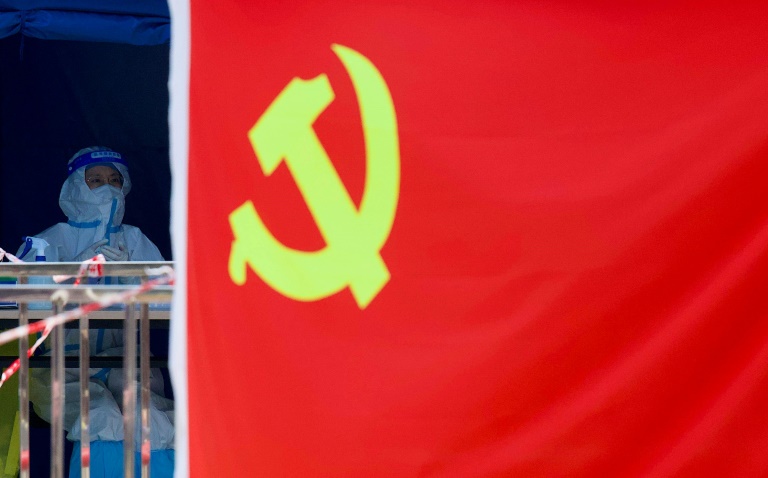
The Chinese move sparked optimism among traders that it could boost the world’s second-largest economy from its Covid-induced stupor.

“The rate cut announced by the PBOC (People’s Bank of China) is obviously good news and is clearly targeted at revitalising the ailing property market which continues to suffer due to the crackdown last year and Covid lockdowns this,” said Craig Erlam, senior market analyst at OANDA.

“This could help to revive a hugely important part of the economy,” he added, but “whether it’s enough to help China hit its 5.5 percent growth target this year is another thing.” 

Asian stocks closed with gains, as did Europe’s main markets although those faded as the day wore on. 

Wall Street opened higher, but then sank lower in morning trading. 

“Stocks remain on a shaky footing,” said market analyst Fawad Razaqzada at City Index and FOREX.com.

He said investors are worried about inflation, interest rate hikes, low economic growth, stagflation, and recession.

“Perhaps most importantly for stocks, the Fed is not there to provide cushion, like before,” he added, as the US central bank is raising interest rates to get to grips with inflation.

– Rollercoaster ride –

Markets had taken a beating Thursday on intensifying recession worries.

Wall Street has faced the brunt of selling, suffering its worst batterings in two years over the past couple of sessions.

Downcast earning reports from retailers have heightened market uncertainty at a time of rising interest rates, surging energy prices, China’s Covid lockdowns and Russia’s ongoing war on Ukraine.

“It has been a rollercoaster ride for markets this week after Thursday’s bloodbath when US equities suffered their worse session since 2020 with that negativity reverberating across global stock markets,” said Victoria Scholar, head of investment at trading firm Interactive Investor.

Major stock indices have lost huge portions of their value in recent months, with the tech-heavy Nasdaq Composite down 30 percent from the peak it set in November, while the blue-chip Dow is off 15.9 percent.

In Europe, both Paris and Frankfurt stocks are down between 14 and 15 percent, while London’s main index has shed a modest 3.9 percent.

– Key figures at around 1530 GMT –

New York – Dow: DOWN 0.7 percent at 31,026.51 points

EURO STOXX 50: UP 0.5 percent at 3,657.03

London – FTSE 100: UP 1.2 percent at 7,389.98 (close)

Frankfurt – DAX: UP 0.7 percent at 13,981.91 (close)

Paris – CAC 40: UP 0.2 percent at 6,285.24 (close)

Hong Kong – Hang Seng Index: UP 3.0 percent at 20,717.24 (close)

Shanghai – Composite: UP 1.6 percent at 3,146.57 (close)

Tokyo – Nikkei 225: UP 1.3 percent at 26,739.03 (close)

Brent North Sea crude: UP 0.4 percent at $112.52 per barrel

West Texas Intermediate: UP 0.4 percent at $112.65 per barrel

Euro/dollar: DOWN at $1.0555 from $1.0588

Pound/dollar: UP at $1.2475 from $1.2467

Euro/pound: DOWN at 84.61 pence from 84.93 pence

Dollar/yen: UP at 127.88 yen from 127.79

burs-rl/pvh

Ukraine orders end to defence of Mariupol

Ukraine on Friday ordered its last troops holed up in Mariupol’s besieged Azovstal steelworks to lay down their arms after nearly three months of desperate resistance against a ferocious Russian assault.

Russia’s flattening of the strategic port city has drawn multiple accusations of war crimes, including a deadly attack on a maternity ward, and Ukraine has begun a reckoning for captured Russian troops.

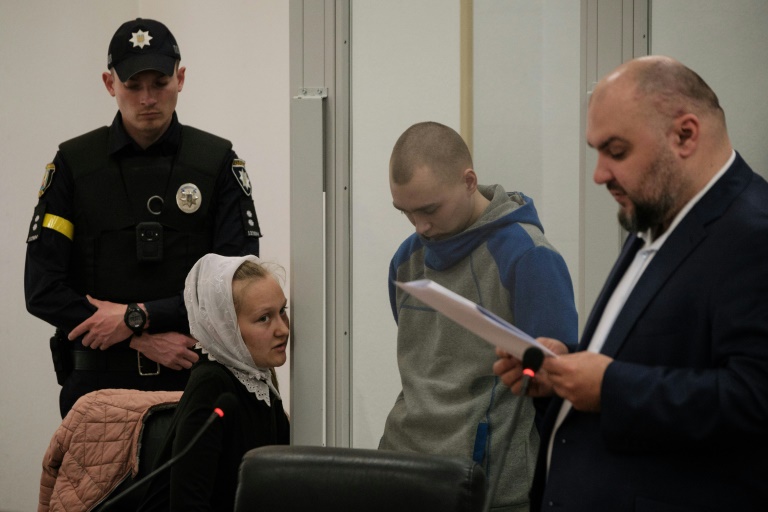
The first post-invasion trial of a Russian soldier for war crimes neared its climax in Kyiv, after 21-year-old sergeant Vadim Shishimarin admitted to killing an unarmed civilian early in the offensive. The verdict is due on Monday.

Shishimarin told the court on Friday that he was “truly sorry”. But his lawyer said in closing arguments that the young soldier was “not guilty” of premeditated murder and war crimes.

While Ukrainian forces fended off the Russian offensive around Kyiv, helped by a steady infusion of Western arms, both eastern Ukraine and Mariupol in the south have borne the brunt of a remorseless ground and artillery attack.

“Russian occupation forces are conducting intense fire along the entire line of contact and trying to hit artillery deep into the defences of Ukrainian troops,” Ukrainian defence ministry spokesman Oleksandr Motuzyanyk told reporters.

The fighting is fiercest in the eastern region of Donbas, a Russian-speaking area that has been partially controlled by pro-Kremlin separatists since 2014.

“In Donbas, the occupiers are trying to increase pressure,” President Volodymyr Zelensky said in his nightly video address late on Thursday. “There’s hell — and that’s not an exaggeration.”

In the eastern city of Severodonetsk, 12 people were also killed and another 40 wounded by Russian shelling, the regional governor said.

– Burial with honours –

Zelensky described the bombardment of Severodonetsk as “brutal and absolutely pointless”, as residents cowering in basements described an unending ordeal of terror.

The city forms part of the last pocket of Ukrainian resistance in Lugansk, which along with the neighbouring region of Donetsk comprises the Donbas war zone.

Russian Defence Minister Sergei Shoigu said his forces’ campaign in Lugansk was “nearing completion”.

Also apparently complete is the capture of the Azovstal steelworks, a totemic symbol of Ukraine’s dogged resistance since Russian President Vladimir Putin launched the invasion on February 24.

A total of 1,908 Ukrainian troops have surrendered this week at the steelworks, according to Russia’s defence ministry, after releasing a video showing bedraggled defenders being taken into captivity.

Ukraine’s Azov battalion commander Denys Prokopenko said only the dead remained.

“The higher military command has given the order to save the lives of the soldiers of our garrison and to stop defending the city,” he said in a video on Telegram.

“I now hope that soon, the families and all of Ukraine will be able to bury their fighters with honours.”

Ukraine wants to exchange the surrendering Azovstal soldiers for Russian prisoners. But in Donetsk, the pro-Kremlin authorities are in turn threatening to put some of them on trial.

The International Committee of the Red Cross urged both sides to grant it access to prisoners of war and civilian internees, “wherever they are held”. 

“Many more families need answers,” it said in a statement. 

In Washington, Pentagon spokesman John Kirby said all prisoners of war should “be treated in accordance with the Geneva Convention and the law of war”.

US President Joe Biden has cast the Ukraine war as part of a US-led struggle pitting democracy against authoritarianism.

The US Congress approved a $40-billion (38-billion-euro) aid package, including funds to enhance Ukraine’s armoured vehicle fleet and air defence system.

– Underground living –

And meeting in Germany, G7 industrialised nations pledged $19.8 billion to shore up Ukraine’s shattered public finances.

Biden offered “full, total, complete backing” to Finland and Sweden in their bid to join the NATO military alliance, when he welcomed their leaders to the White House on Thursday.

But all 30 existing NATO members need to agree on any new entrants, and Turkey has condemned the historically non-aligned Nordic neighbours’ alleged toleration of Kurdish militants.

Shoigu said the Kremlin would respond to any NATO expansion by creating more military bases in western Russia.

Russia’s own expansion in Ukraine has ebbed around the northeastern city of Kharkiv, its troops forced to retreat from a rearguard offensive by defending forces.

But Kharkiv remains in Russia artillery range, and hundreds of people are refusing to leave the relative safety of its metro system.

“We’re tired. You can see what home comforts that we have,” said Kateryna Talpa, 35, pointing to mattresses and sheets on the ground, and some food in a cardboard box.

She and her husband Yuriy are doing their best to cope in the Soviet-era station called “Heroes of Labour”, alongside their cats Marek and Sima.

“They got used to it,” Talpa said.

burs-jit/har 

Israeli firm hopes AI can curb drownings

An Israeli city is testing whether an artificial intelligence programme that detects drowning threats can help save lives off its beaches.

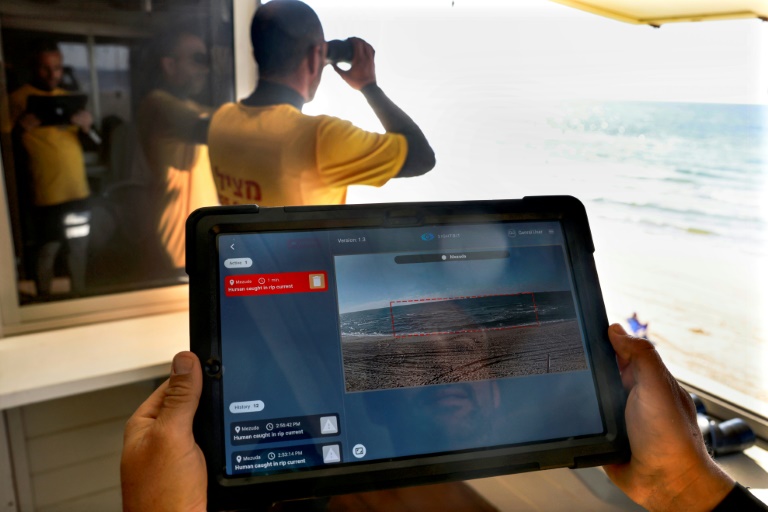
The programme, developed by a company called SightBit, uses information collected from surveillance cameras to determine who is in the water — an adult or child, for example — if they are moving or limp, and the current’s movement at that location.

If a threat is determined, the programme sends an alert to a tablet held by the user — a lifeguard, in this case — with urgent instructions to act.

SightBit’s chief executive Netanel Eliav told AFP that he developed the technology after identifying a shortfall in how closed-circuit footage was being applied to boost safety in the water.

The programme has been in use for more than a year in Ashdod, a city on Israel’s Mediterranean coast that chose to deploy SightBit technology in an area at a distance from the nearest lifeguard.

“We chose to locate the technology in areas away from the lifeguard towers, so the additional ‘eyes’ there help the lifeguards very much,” said Arie Turjeman, director of Ashdod’s coast division.

Eliav voiced confidence that SightBit can “save lives”, in a country that sees dozens of drowning deaths a year. 

According to official figures, last year 29 people died during Israel’s March to October beach season, 22 of them in the Mediterranean, and 21 in areas with no lifeguard services.

Thirty-two people drowned during the 2020 season and 27 in 2019.

Elon Musk in Brazil to launch plan to survey and connect Amazon

Billionaire Elon Musk arrived in Brazil Friday, announcing a project to bring internet access to schools in the Amazon and improve satellite monitoring of the rainforest.

The world’s richest man touched down in a private jet at an airfield outside Sao Paolo, according to the G1 news portal.

Mush was set to meet Brazil’s far-right President Jair Bolsonaro at a luxury hotel in Porto Feliz, some 100 kilometers (60 miles) outside Sao Paulo, according to the O Globo newspaper.

“Super excited to be in Brazil for launch of Starlink for 19,000 unconnected schools in rural areas & environmental monitoring of Amazon!” tweeted Musk, CEO of SpaceX and Tesla.

Communications Minister Fabio Faria, who met Musk in Texas last November, tweeted the businessman was visiting “to discuss Connectivity and Protection of the Amazon with the Brazilian government.” 

He added: “Since we are going to connect the Amazon, we brought one of the largest entrepreneurs in the world to help us in this mission.”

A large security detail kept journalists at a distance from the hotel where the meeting was to take place. An AFP reporter saw two helicopters land nearby.

– ‘A very important person’ –

On Thursday, Bolsonaro announced he would have a meeting “with a very important person who is recognized throughout the world.”

“He is coming to offer his help for our Amazon,” the president said in his weekly social media broadcast, without naming Musk.

The Amazon is a hot topic in Brazil, with deforestation rising sharply under the government of Bolsonaro — which is accused of promoting impunity for gold miners, farmers and timber traffickers who illegally clear the rainforest.

The Brazilian government said in November it was negotiating with SpaceX to secure satellite internet in the Amazon rainforest and boost detection of illegal deforestation.

In a bid to provide high-speed internet around the world, especially to areas underserved by fixed and mobile networks, Musk’s SpaceX company has placed thousands of Starlink satellites into orbit, with many more launches planned.

The service has more than 100,000 subscribers worldwide.

Musk attracted renewed worldwide attention when he announced last month that he planned to buy Twitter in a deal worth $44 billion dollars.

His comments on loosening restrictions in the name of free expression were welcomed by many supporters of Bolsonaro, who is accused of using fake news as a political weapon and has had several social media posts deleted.

O Globo said Faria and Defense Minister Paulo Sergio Nogueira would attend the Musk-Bolsonaro meeting, along with 13 business leaders including bosses of the country’s main telecommunications companies. 

The meeting comes hours after Musk rejected allegations on Twitter that he groped and exposed himself to a flight attendant six years ago.

Close Bitnami banner
Bitnami