AFP

UK will act unless N.Ireland Brexit deal is changed: FM Truss

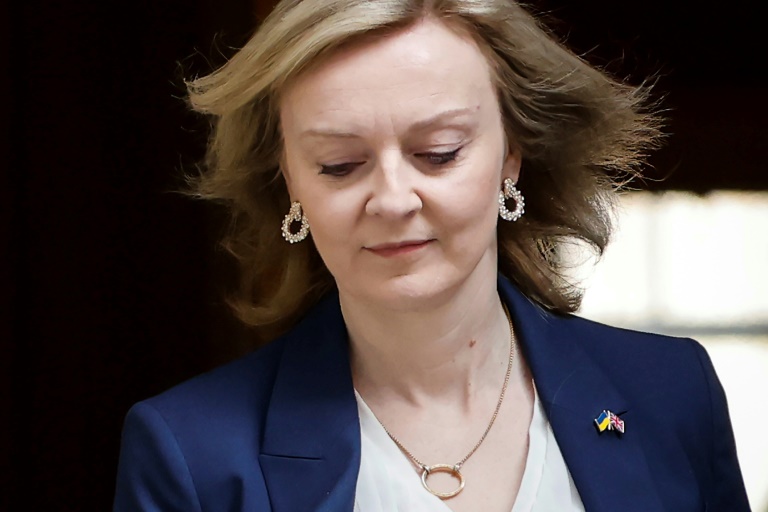
The UK will have “no choice but to act” unless the European Union agrees to change post-Brexit trading arrangements in Northern Ireland, Foreign Secretary Liz Truss said on Thursday. 

Political tensions have risen in the UK province after elections last week saw pro-Irish nationalists Sinn Fein become the biggest party for the first time and now bid to lead a power-sharing executive.

But pro-UK unionists, who believe the Brexit deal’s Northern Ireland Protocol is driving a wedge between the province and mainland Great Britain, are refusing to join the executive in Belfast until it is changed.

Truss spoke to European Commission vice president Maros Sefcovic on Thursday, telling him that the situation was “a matter of internal peace and security for the United Kingdom.

If the EU does not “show the requisite flexibility to help solve those issues, then as a responsible government we would have no choice but to act,” she said. 

London has repeatedly said it is prepared to trigger the protocol’s Article 16 suspension clause unless the deal it signed up to is changed — a move the EU has warned could lead to a wider trade war.

Sefcovic responded by warning that any move by the UK ignore post-Brexit trade rules in Northern Ireland would be unacceptable and threaten the 1998 peace deal that ended decades of violence over British rule in the province.

“Unilateral action… is simply not acceptable,” Sefcovic said in a statement.

“This would undermine trust between the EU and UK as well as compromise our ultimate objective – to protect the Good Friday (Belfast) Agreement. 

“Upholding the rule of law and living up to international obligations is a necessity,” he added.

– ‘Two-tier system’ –

Either party can invoke Article 16 if it believes the protocol is leading to “serious economic, societal or environmental difficulties that are liable to persist”.

The UK government says that checks on goods heading from to Northern Ireland from England, Scotland and Wales are undermining peace in the province, with unionists protests already turning violent.

Separate trading arrangements for Northern Ireland, which bind the province bound to many European rules, were agreed because the province has the UK’s only land border with the EU. 

Keeping the border open with neighbouring Ireland, an EU member, was mandated in the Good Friday Agreement, given the frontier was a frequent flashpoint for violence.

But it means checks have to be done elsewhere, to prevent goods getting into the EU single market and customs union by the back door via Northern Ireland.

Unionists believe it has created a border in the Irish Sea which threatens Northern Ireland’s place as part of the wider UK, and makes a united Ireland more likely.  

Truss told Sefcovic that the UK’s priority was “to protect peace and stability in Northern Ireland”. 

“She also noted that the current situation was causing unacceptable disruption to trade and had created a two-tier system where people in Northern Ireland weren’t being treated the same as everyone else in the UK,” according to a read out of the phone call released by her office.

Truss added that the EU “bore a responsibility to show more pragmatism and ensure the Protocol delivered on its original objectives,” claiming that the government had proposed measures to remove trade barriers within the UK while protecting the EU single market.

Sefcovic said that the EU had already proposed “wide-ranging and impactful solutions” that would “substantially improve the way the protocol is implemented,” but that London had rejected them.
Global stocks slump on alarm over US inflation

World equities tanked Thursday as slowing US inflation failed to dent fears of rising global interest rates and sent oil prices diving on demand concerns.

The European single currency sank to a January 2017 low at $1.0422 as the greenback was lifted by its haven status.

Frankfurt, London and Paris stock markets each sank more than two percent in midday deals after heavy falls in Asia and on Wednesday in the United States.

Panic-stricken investors also sent virtual unit bitcoin tumbling to the lowest level since late 2020 after a dramatic collapse in some stablecoin cryptocurrencies.

US inflation slowed to 8.3 percent in April after a four-decade peak of 8.5 percent in March, data showed overnight.

– ‘Another cruel blow’ –

“While it will come as a relief that (US) inflation has finally peaked and the deceleration has started, the fact that it didn’t do so nearly as much as expected is just another cruel blow to households and the economy,” Oanda analyst Craig Erlam told AFP.

“Central banks are going to have to do more if (inflation) data does not drastically improve in the next few months.”

Investors had hoped the US consumer price data would lower pressure on the Federal Reserve to hike borrowing costs.

However April’s reading eclipsed market expectations of 8.1-percent inflation.

Interest rates are being hiked worldwide to tackle decades-high inflation, which is fuelled mostly by rocketing energy costs.

London’s stock market was slammed Thursday also by news that the UK economy shrank in March on fallout from soaring inflation, increasing the prospect of a recession — or two quarters of contraction in a row.

The data sent the pound sliding to a May 2020 low at $1.2166.

World markets have been volatile for much of 2022 owing to China’s Covid-19 lockdowns, Russia’s invasion of Ukraine, and as surging inflation weighed on consumer sentiment. 

US President Joe Biden called April’s overall slowdown “heartening” — but acknowledged inflation was still a major challenge.

“Bringing it down is my top economic priority,” he said.

– Key figures at around 1115 GMT –

London – FTSE 100: DOWN 2.1 percent at 7,195.76 points

Frankfurt – DAX: DOWN 2.0 percent at 13,550.53

Paris – CAC 40: DOWN 2.3 percent at 6,125.54

EURO STOXX 50: DOWN 2.2 percent at 3,567.30

Hong Kong – Hang Seng Index: DOWN 2.2 percent at 19,380.34 (close)  

Shanghai – Composite: DOWN 0.1 percent at 3,054.99 (close) 

Tokyo – Nikkei 225: DOWN 1.8 percent at 25,748.72 (close)

New York – Dow: DOWN 1.0 percent at 31,834.11 (close)

Brent North Sea crude: DOWN 1.3 percent at $106.15 per barrel

West Texas Intermediate: DOWN 1.3 percent at $104.34 per barrel

Euro/dollar: DOWN at $1.0442 from $1.0513 at 2100 GMT Wednesday

Pound/dollar: DOWN at $1.2211 from $1.2251

Euro/pound: DOWN at 85.53 pence from 85.81 pence

Dollar/yen: DOWN at 128.58 yen from 129.97 yen

burs-rfj/bcp/rl

UK recession risk gathers pace as economy shrinks in March

Britain’s economy shrank in March on fallout from soaring inflation, increasing the prospect of the country falling into recession.

Official first-quarter data on Thursday showed that following solid output in January, the UK economy posted zero growth the following month and contracted by 0.1 percent in March.

It comes after the Bank of England (BoE) last week warned that Britain risks falling into recession with UK inflation expected to top 10 percent, a four-decade high, by the end of the year.

Consumer prices are surging worldwide on supply strains as economies reopen from pandemic lockdowns — and in the wake of the Ukraine war that is aggravating already high energy costs.

Britain’s economy grew 0.8 percent overall in the January-March period, the slowest quarterly growth for a year, the Office for National Statistics (ONS) said in a statement.

It compared with gross domestic product expansion of 1.3 percent in the fourth quarter of last year.

– ‘Russia disruption’ –

Responding to Thursday’s data, finance minister Rishi Sunak said Britain’s economic recovery from the pandemic was “being disrupted by (Russian President Vladimir) Putin’s barbaric invasion of Ukraine and other global challenges”.

Sunak, however, added in a statement that UK “growth in the first few months of the year was strong, faster than the US, Germany and Italy”.

The UK economy grew for a fourth quarter in a row, and is above pre-pandemic levels.

Prime Minister Boris Johnson said he expected British growth to “return very strongly in the next couple of years”.

In an interview with LBC radio, he also refused to rule out a windfall tax on energy companies as surging oil and gas prices hit households hard.

“We’ll have to look at it,” said Johnson despite repeating his displeasure at such a levy.

“I don’t like them… I don’t think they’re the right way forward,” he said, adding that a windfall tax on the likes of BP and Shell would deter them from investing in greener energy.

Johnson’s comments came one week after his Conservative party lost control of key councils in local elections — an outcome blamed in part on the cost-of-living crisis.

Darren Morgan, director of economic statistics at the ONS, said declining output in the services and production sectors resulted in overall growth contracting in March.

– ‘Recession risk’ –

“The risk of recession has just risen,” said Paul Dales, chief UK economist at Capital Economics.

He noted that the GDP figures “suggest the economy had less momentum than we thought even before the full hit from the cost-of-living crisis has been felt”.

Dales said “strong price pressures will probably mean the BoE will raise interest rates further”.

The central bank last week raised its main interest rate by a quarter point to one percent to tackle runaway UK inflation.

It was the fourth straight increase by the BoE, while its key rate now stands at the highest level since the global financial crisis in 2009. 

Raised rates have lifted borrowing costs for consumers and businesses, further impacting spending.

Taiwan's Foxconn says impact from Chinese lockdowns limited

Taiwanese tech giant Foxconn on Thursday said the impact on production from Covid lockdowns in China was “limited” and most of its facilities in the country were operating normally.

Foxconn, also known as Hon Hai, is the world’s largest contract electronics maker and assembles Apple’s iPhones as well as gadgets for many top international brands. 

It employs more than one million workers across its vast network of factories in China, where a number of cities are struggling to curb virus outbreaks. 

Chairman Young Liu said China’s pandemic controls posed challenges for the company but most plants were unaffected as they operated in a bubble with food and accommodation arranged for the workers on-site.

“At present all of our major factories are operating normally except a few. The overall impact is limited,” he said during an investors’ conference. 

“Most of our facilities are under the ‘bubble-style’ management and we’ve made a lot of preparations. We believe the impact on us would be limited if the restrictions were to continue in the future.” 

Foxconn also on Thursday announced better-than-expected first-quarter earnings, which Liu attributed in part to the company being able to “minimise the impact” of the pandemic on the supply chain.

For the January-March period, net profit grew five percent to Tw$29.45 billion ($985.5 million), while revenue rose four percent to more than Tw$1.4 trillion from a year earlier.

The firm in March halted operations in the Chinese tech hub of Shenzhen due to Covid restrictions before “fundamental operations” were resumed late that month.

In April, the company said its plant in central China’s Zhengzhou, dubbed “iPhone City”, continued to operate despite a lockdown of the area.

“The pandemic situation can change very quickly, plus there are other uncertainties involving geopolitics and inflation… We are closely monitoring these factors,” Liu said.

SoftBank reports record loss as tech shares tank

Japanese investment giant SoftBank Group on Thursday logged a record annual net loss after a bruising year that saw its assets hit by a US tech share rout and a regulatory crackdown in China.

SoftBank’s big stakes in global tech giants and volatile new ventures have made for unpredictable earnings, and the latest tumble comes with tech shares tanking as the United States hikes interest rates to tackle inflation.

The company reported losses of 1.71 trillion yen ($13.2 billion) in the year to March 2022 — a vertiginous plunge from its nearly five trillion yen net profit the previous year, when huge market rallies boosted results.

Reporting an eye-watering investment loss of 3.4 trillion yen, SoftBank said its tech-focused Vision Fund suffered falls “due to a decline in the share prices of most listed portfolio companies”.

In the past six months, the tech-rich US Nasdaq index has lost more than 28 percent of its value.

The Japanese group’s losses were deepened by the many shares it holds in Chinese ride-hailing giant Didi Chuxing and e-commerce group Alibaba, which have been hit by a crackdown by Beijing on the country’s private sector.

And the icing on the cake was the falling yen, which has recently hit 20-year lows as the gap widens between US tightening and Japan’s ultra-loose monetary policy.

– ‘Ups and downs’ –

In 2019-20, SoftBank Group reported a then-record net loss of 961.6 billion yen, as the emergence of Covid-19 compounded woes caused by its investment in troubled office-sharing start-up WeWork.

But its earnings rebounded in 2020-21 — when it reported Japan’s biggest-ever annual net profit — after people moved their lives online during the pandemic, sending tech stocks soaring.

In February, SoftBank said the $40 billion sale of its microchip powerhouse Arm to Nvidia had collapsed because of “significant regulatory challenges” over competition concerns, and it now plans to take the unit public.

Nvidia is one of the world’s largest and most valuable computing companies, while British company Arm’s tech dominates the global smartphone market.

SoftBank had announced the deal in 2020, when it was valued at $40 billion, although the sum would have been higher now thanks to a rise in Nvidia’s share price.

Amir Anvarzadeh of Asymmetric Advisors said “all hopes” were now on Arm going public, but warned that a very high price would eventually prove damaging.

“We suspect anything more than $30 billion for Arm will leave it overvalued and vulnerable to a likely sell-off soon after.”

The IPO faces headwinds, including the current market slump which makes a hefty valuation for Arm unlikely, and SoftBank CEO Masayoshi Son conceded the move could be delayed if conditions seemed unfavourable.

Hideki Yasuda, senior analyst at Toyo Securities, told AFP that while the tech sector SoftBank is focused on is not doing well now, it is worth taking the long view.

“It’s important for investors to think about what might happen in 20 years,” he said before the earnings announcement.

“They must accept ups and downs in the short run,” Yasuda said, noting that it took years for Alibaba to become a viable investment for SoftBank.

Son, who has been criticised for an investment strategy seen by some as overly optimistic, sounded an unusually cautious note in a presentation Thursday.

“When it comes to new investments, we are being more selective,” he said.

“As the world is in chaos, we want to make sure that we have plenty of cash… instead of making new investments randomly.”

Low French rainfall adds new cloud to global food market

French farmer Robin Lachaux is worried about his wheat. In normal years, it flowers and bulks up in May thanks to regular spring rainfall, but this year hot and dry conditions risk stunting its progress.

“If we don’t water it today, we’ll lose 50 percent of our output,” the young farmer in an orange cap and sweatshirt from Sully-sur-Loire in central France told AFP.  

“We wouldn’t normally water at this time of the year but the dry periods are coming earlier and earlier,” he added as he positioned his pressure hoses and irrigation equipment.

France is Europe’s agricultural powerhouse, the biggest grain producer in the 27-country bloc and the world’s fourth or fifth biggest wheat exporter.

Its annual production influences global prices which are already at record levels because the war in Ukraine looks set to wipe out a chunk of the country’s production, leading to fears of a global hunger crisis.

On Monday, the French agricultural ministry warned about the impact of an unseasonably hot and dry stretch which “will have an impact on cereal production” in France following lower-than-average rainfall over the winter period.

As well as wheat, other crops sown in winter such as barley are in a key development stage in May, while corn and sunflower production over the summer could also be hit.

“There’s not a region that’s not affected,” the head of French farmers’ union FNSEA, Christiane Lambert, told AFP.

“Each day that passes, we’re seeing the ground cracking more… if it carries on like this, those that can irrigate will be okay, but the others will have dramatic decreases in production.”

The French national weather service said the country was in the grip of a hot spell that is “notable for its timing, its duration and its geographical spread”, with a 20-percent drop in rainfall between September 2021 and April 2022.

– Record highs – 

World food prices hit an all-time high in March following Russia’s invasion of Ukraine, which accounted for 20 percent of global wheat and maize exports over the past three years, according to the UN’s Food and Agriculture Organization.

Ukrainian ports are blockaded by Russian naval vessels and French data analysis firm Kayrrosa recently calculated that the area planted with wheat had been reduced by a third this year because of the conflict, according to satellite imagery.

Production could fall by as much as 50 percent this year, according to government and industry forecasts, with some farmers abandoning their fields to join the army.

The strains on global markets have led to warnings from NGOs and the United Nations that hunger or even famine could strike vulnerable import-dependent countries across Africa and the Middle East.

With top wheat-producing states in the United States such as Kansas and Oklahoma also suffering from drought-like conditions, poor French yields could be particularly significant in 2022.

“We already had markets that were very nervous. This is adding to tensions,” Nathan Cordier, a grain market analysts at agricultural consultancy Agritel, told AFP. “France is one of the major players in the wheat market and people are counting on it.

“The question is whether export volumes will be enough.”

– Hunger – 

Current wheat prices in Europe are at a record 400 euros a tonne ($420), up from an already high level of around 260 euros a tonne at the start of the year before Russia’s invasion of Ukraine.

The high prices are expected to stimulate more planting in the United States and the FAO has forecast that higher yields in Canada and Russia, as well as Pakistan and India could help compensate below-average harvests in western Europe.

Some of the recent price rises are down to short-term shortages caused by the sudden end to Ukrainian supplies, as well as some farmers holding back from selling their produce in anticipation of higher prices going forward.

“As prices are very high, with wheat at more than 400 euros a tonne for delivery in September, they’re waiting,” Edward de Saint-Denis, a commodities trader at Plantureux and Associates, a French brokerage.

But as traders and farmers scan the weather forecasts and devise their trading strategies, aid groups warn that lives are at risk in some of the most vulnerable places on earth such as war-wracked Yemen or countries in the arid Sahel region of northern Africa.

“According to our research, food price rises caused by Russia’s invasion of Ukraine mean that some local communities in developing countries are already spending more than triple what they were previously paying for food, causing families to skip meals and take their children out of school,” Teresa Anderson from ActionAid, a British charity, told AFP.

A prolonged drought in France could make that much worse.

“It would deepen hunger, poverty and debt for low-income families in Africa, Asia and Latin America, making an already desperate situation much worse,” she said.   

Crisis-hit Sri Lanka set for new PM, unity government

Sri Lanka’s president was set to name a new premier Thursday to replace his brother, who was banned from leaving the country after his supporters launched violent attacks on a protest against the country’s dire economic crisis. 

The mooted new premier, Ranil Wickremesinghe, has already served in the office five times — but it remains unclear if he will be able to get any legislation through parliament.

In a televised address to the nation on Wednesday night, President Gotabaya Rajapaksa stopped short of yielding to weeks of nationwide protests calling for him to resign over the country’s worst downturn since independence.

But in a bid to win over opposition lawmakers demanding he quit before agreeing to any new government, the 72-year-old pledged to give up most of his executive powers and set up a new cabinet this week.

“I will name a prime minister who will command a majority in parliament and the confidence of the people,” Rajapaksa said.

Mahinda Rajapaksa, the president’s brother, resigned as prime minister on Monday after his supporters attacked anti-government supporters who had been protesting peacefully for weeks.

This marked a turning point and unleashed several days of chaos and violence that killed at least nine people and injured more than 200, with dozens of Rajapaksa loyalist homes set on fire.

Mahinda has since fled the capital Colombo and taken refuge at the Trincomalee naval base on the country’s east coast.

A court banned him, his politician son Namal, and more than a dozen allies from leaving the country on Thursday after ordering an investigation into the violence.

Security forces patrolling in armoured personnel carriers with orders to shoot looters on sight have largely restored order.

A curfew was lifted Thursday morning — only to be reimposed after a six-hour break allowing Sri Lanka’s 22 million people to stock up on essentials.

– Opposition split –

Sri Lankans have suffered months of severe shortages of food, fuel and medicines and long power cuts after the government, short on foreign currency to pay its debts, halted many imports.

The South Asian island nation’s central bank chief warned Wednesday that the economy will “collapse beyond redemption” unless a new government was urgently appointed.

Wickremesinghe, 73, is seen as a pro-West free-market reformist, potentially making bailout negotiations with the International Monetary Fund and others smoother.

The main opposition SJB party was initially invited to lead a new government, but its leader Sajith Premadasa insisted that the president should first step down.

In recent days the party has split, with a dozen MPs from the SJB now pledging support to Wickremesinghe.

With many from Rajapaksa’s party having defected in recent months, no group in the 225-member assembly has an absolute majority, making parliamentary approval of the unity government’s legislation potentially tricky.

Rajapaksa was set to meet with party leaders on Thursday as more names have been suggested for the post of prime minister, an official close to the negotiations told AFP. 

But Wickremesinghe has already been working closely with Rajapaksa to shake up the finance ministry and the central bank to make sweeping fiscal and monetary policy changes, the source said.

– ‘We can’t wait’ –

The central bank almost doubled key interest rates and announced a default on Sri Lanka’s $51-billion external debt as part of the policy shift, officials said. 

Front-line opposition legislator Harin Fernando from the SJB said he decided to remain neutral because the party’s leader refused to form a government as long as Rajapaksa remained president. 

“We can’t be imposing conditions that cannot be fully met. First, we must address the economic crisis. We need at least $85 million a week to finance essential imports. We must collectively find a way to raise this money urgently,” Fernando said. 

He said he expected a unity government to be formed on either Thursday or Friday. “We can’t wait any longer,” he added.

How Sri Lanka's economy went into a tailspin

Sri Lanka is suffering its worst economic crisis since its independence from Britain in 1948. 

Months of lengthy blackouts and acute shortages of food, fuel and medicines have infuriated the public, with huge protests demanding the government’s resignation turning violent this week.

AFP reviews the origins of the snowballing economic calamity in the South Asian island nation:

– White elephants – 

Sri Lanka has spent big on questionable infrastructure projects backed by Chinese loans that added to its already unsustainable debt.

In southern Hambantota district, a massive deep-sea port haemorrhaged money from the moment it began operations, losing $300 million in six years.

Nearby are other Chinese-backed extravagances: a huge conference centre, largely unused since it opened, and a $200 million airport that at one point was unable to earn enough money to pay its electricity bill. 

The projects were pushed by the powerful Rajapaksa family, which has dominated Sri Lanka’s politics for much of the past two decades.

– Unsustainable tax cuts –

President Mahinda Rajapaksa was voted out of office in 2015 partly due to a backlash against his government’s infrastructure drive, which was mired in graft claims.

His younger brother Gotabaya succeeded him four years later, promising economic relief and tough action on terrorism after the island’s deadly 2019 Easter Sunday attacks.

Days after taking office, Gotabaya appointed Mahinda prime minister and unveiled the biggest tax cuts in Sri Lanka’s history, worsening chronic budget deficits.

Ratings agencies soon downgraded the country out of concern that the public debt was spiralling out of control, making it harder for the government to secure new loans.

– Pandemic hit –

The tax cuts were spectacularly ill-timed: just a few months later, the coronavirus began spreading around the world.

International tourist arrivals dropped to zero and remittances from Sri Lankans working abroad dried up — two economic pillars the government relied upon to service its debt.

Without these sources of overseas cash, the Rajapaksa administration began using its stockpiles of foreign exchange to make loan repayments.

– Fertiliser ban – 

Sri Lanka was soon burning through its foreign reserves at an alarming rate, prompting authorities in 2021 to ban several imports including — critically — fertiliser and agricultural chemicals farmers need to grow their crops.

The government sold this policy as part of an effort for Sri Lanka to become the world’s first completely organic farming nation, but its effects were disastrous.

As much as a third of the country’s agricultural fields were left fallow by farmers and the resulting drop in yields hit the production of tea — a vital export earner.

The policy was eventually abandoned at the end of 2021 after protests from agricultural workers and skyrocketing food prices.

– Shortages and blackouts –

By late 2021, Sri Lanka’s reserves had shrunk to $2.7 billion, down from $7.5 billion when Rajapaksa took office two years earlier.

Traders began struggling to source foreign currency to buy imported goods.

Food staples such as rice, lentils, sugar and milk powder began disappearing from shelves, forcing supermarkets to ration them.

Then gas stations started running out of petrol and kerosene, and utilities could not purchase enough oil to meet the demand for electricity.

Long queues now form each day around the country by people waiting hours to buy scant supplies of fuel, while blackouts keep much of the capital Colombo in darkness each night.

– Debt and default –

President Rajapaksa appointed a new central bank chief in April, who soon announced that Sri Lanka would default on its $51 billion foreign debt to save money for essential imports. 

The move failed to shore up Sri Lanka’s deteriorating finances, and it only had around $50 million in useable foreign exchange at the start of May.

The country is now in negotiations for an International Monetary Fund bailout.

Mahinda Rajapaksa, the prime minister, resigned on Monday in an effort to placate the public after weeks of protests over government mismanagement.

But central bank chief Nandalal Weerasinghe said Wednesday that unless a new administration took charge soon, the country was facing an imminent economic collapse. 

“No one will be able to save Sri Lanka at that stage,” he said.

Asian, European stocks down as inflation fears churn markets

Asian and European equities slumped on Thursday following Wall Street’s lead, after a key US report renewed fears of inflation and a tightening of monetary policies.

Stocks have been volatile for much of 2022, fuelled by China’s Covid-19 lockdowns, Russia’s invasion of Ukraine, and surging inflation that has dampened consumer sentiment. 

Investors had been looking to the April US consumer price report in hopes that easing inflation would lower pressure on the Federal Reserve to hike interest rates, but the rise of 8.3 percent was higher than expected.

“Wall Street thought it was going to be done with inflation rearing its ugly head, but that does not appear to be the case,” said Edward Moya, senior market analyst at OANDA. 

“Inflation is still expected to decelerate over the next few months, but it won’t be sharp given the rising prices on gas, hotel, airfares, and possibly a wide range of goods that will be impacted by China’s Covid lockdowns.”

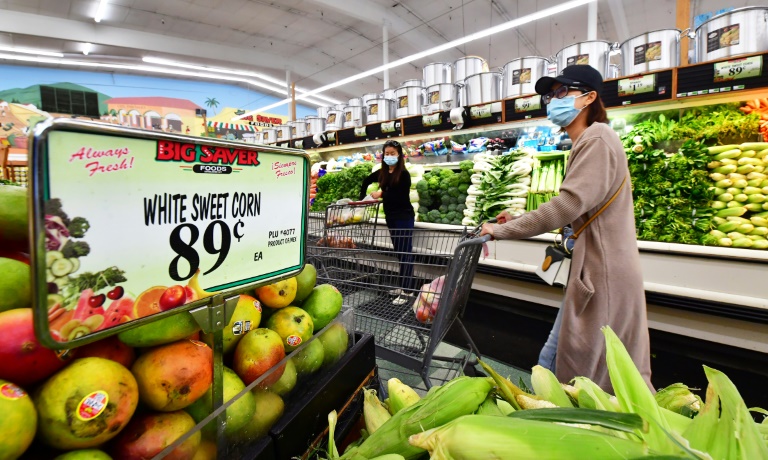
Americans have felt the pinch of rising food prices, including big increases in dairy and cereal products.

The index for meat, poultry, fish and eggs surged 14.3 percent — the biggest gain since May 1979.

US President Joe Biden called April’s overall slowdown “heartening” — March saw a peak of 8.5 percent — but acknowledged inflation was still a major challenge.

“Bringing it down is my top economic priority,” he said.

After the release of the report, US stocks see-sawed through the day and ended with losses.

All three major indices finished firmly in the red. The tech-rich Nasdaq slumped 3.2 percent, weighed by big losses for Apple and Meta.

The mood filtered through to Asia. Sydney, Tokyo, Seoul and Hong Kong closed lower, with the Hang Seng suffering the deepest cut — a 2.2 percent drop.

In Europe, London, Paris and Frankfurt traded in the negatives.

“We’re seeing the beginning of the capitulation and the great reset, if you want, in pricing,” Virginie Maisonneuve, global chief investment officer for equity at Allianz Global Investors UK, told Bloomberg.

– ‘Choppy’ crude prices –

Oil prices jumped around five percent before paring some of those gains as concerns persisted about Russian energy supplies.

Ukraine said Russia had halted gas supplies through a key transit hub in the east of the country, fuelling fears that Moscow’s invasion could worsen an energy crisis in Europe.

The “choppy” nature of crude prices is also due to uncertainty about “the timing of an EU ban on Russian oil imports”, said Michael Hewson at CMC Markets.

The lockdowns in China also affected sentiment.

Millions in the world’s second-largest economy have been under lockdown since April, including in its economic engine Shanghai. The restrictions have stopped up ports and snarled supply chains around the world. 

China’s zero-Covid policy “will continue crimping growth, but it won’t be immune from the Ukraine/Russia stagflationary wave either”, said Jeffrey Halley, senior market analyst at OANDA.

– Key figures at around 0830 GMT –

Hong Kong – Hang Seng Index: DOWN 2.2 percent at 19,380.34 (close)  

Shanghai – Composite: DOWN 0.1 percent at 3,054.99 (close) 

London – FTSE 100: DOWN 2.0 percent at 7,200.17

Tokyo – Nikkei 225: DOWN 1.8 percent at 25,748.72 (close)

West Texas Intermediate: DOWN 2.3 percent at $103.27 per barrel

Brent North Sea crude: DOWN 2.1 percent at $105.30 per barrel

Euro/dollar: DOWN at $1.0451 from $1.0515 at 2050 GMT Wednesday 

Pound/dollar: DOWN at $1.2196 from $1.2248

Euro/pound: DOWN at 85.68 pence from 85.84 pence

Dollar/yen: DOWN at 128.55 yen from 130.00 yen

New York – Dow: DOWN 1.0 percent at 31,834.11 (close)

— Bloomberg News contributed to this story —

The 1997 chess game that thrust AI into the spotlight

With his hand pushed firmly into his cheek and his eyes fixed on the table, Garry Kasparov shot a final dark glance at the chessboard before storming out of the room: the king of chess had just been beaten by a computer.

May 11, 1997 was a watershed for the relationship between man and machine, when the artificial intelligence (AI) supercomputer Deep Blue finally achieved what developers had been promising for decades. 

It was an “incredible” moment, AI expert Philippe Rolet told AFP, even if the enduring technological impact was not so huge. 

“Deep Blue’s victory made people realise that machines could be as strong as humans, even on their territory,” he said.

Developers at IBM, the US firm that made Deep Blue, were ecstatic with the victory but quickly refocused on the wider significance. 

“This is not about man versus machine. This is really about how we, humans, use technology to solve difficult problems,” said Deep Blue team chief Chung-Jen Tan after the match, listing possible benefits from financial analysis to weather forecasting. 

Even Chung would have struggled to comprehend how central AI has now become — finding applications in almost every field of human existence.

“AI has exploded over the last 10 years or so,” UCLA computer science professor Richard Korf told AFP. 

“We’re now doing things that used to be impossible.”

– ‘One man cracked’ –

After his defeat, Kasparov, who is still widely regarded as the greatest chess player of all time, was furious.

He hinted there had been unfair practices, denied he had really lost and concluded that nothing at all had been proved about the power of computers. 

He explained that the match could be seen as “one man, the best player in the world, (who) has cracked under pressure”.

The computer was beatable, he argued, because it had too many weak points. 

Nowadays, the best computers will always beat even the strongest human chess players. 

AI-powered machines have mastered every game going and now have much bigger worlds to conquer.

Korf cites notable advances in AI that have helped make self-driving cars a reality. 

Yann LeCun, head of AI research at Meta/Facebook, told AFP there had been “absolutely incredible progress” in recent years. 

LeCun, one of the founding fathers of modern AI, lists among the achievements of today’s computers an ability “to translate any language into any language in a set of 200 languages” or “to have a single neural network that understands 100 languages”. 

It is a far cry from 1997, when Facebook didn’t even exist. 

– Machines ‘not the danger’ –

Experts agree that the Kasparov match was important as a symbol but left little in the way of a technical legacy.

“There was nothing revolutionary in the design of Deep Blue,” said Korf, describing it as an evolution of methods that had been around since the 1950s.

“It was also a piece of dedicated hardware designed just to play chess.”

Facebook, Google and other tech firms have pushed AI in all sorts of other directions.

They have fuelled increasingly powerful AI machines with unimaginable amounts of data from their users, serving up remorselessly targeted content and advertising and forging trillion-dollar companies in the process. 

AI technology now helps to decide anything from the temperature of a room to the price of vehicle insurance. 

Devices from vacuum cleaners to doorbells come with arrays of sensors to furnish AI systems with data to better target consumers. 

While critics bemoan a loss of privacy, enthusiasts believe AI products just make everyone’s lives easier. 

Despite his painful history with machines, Kasparov is largely unfazed by AI’s increasingly dominant position. 

“There is simply no evidence that machines are threatening us,” he told AFP last year. 

“The real danger comes not from killer robots but from people — because people still have a monopoly on evil.”

Close Bitnami banner
Bitnami