AFP

Hoppy and glorious: brewery bets on queen's jubilee beer rush

Draught horses Albert and Ivan trot down the streets of Windsor, hauling a barrel-laden cart as pubs stock up on beer ahead of Queen Elizabeth II’s Platinum Jubilee and a hoped-for influx of visitors.

The two Shire breeds with black coats and feathered hooves stop to unload their cart, which later this month is set to carry Castle Hill, a beer created specially to mark the queen’s 70 years on the throne.

“We call it Castle Hill because when the queen first came to the throne, the ascension was announced on the Castle Hill at Windsor,” explains Will Calvert, director of the Windsor & Eton brewery, which is bathed in the sweet smell of malt and hot water.

Brewed with barley from the royal farm and hops from England and New Zealand — the two extremes of the Commonwealth which the queen heads — Castle Hill is “a very nice refreshing beer for drinking outdoors in the summer for the Jubilee” he says.

Calvert’s brewery has been honoured with the “royal warrant”, meaning they supply the royal household, and will start distributing their one-off Jubilee brew closer to the festivities.

The United Kingdom will mark the reign of its longest-serving monarch from June 2-5, with street parties, concerts and parades.

Britons will get two days off work and pubs will be allowed to stay open longer.

In Windsor, just west of London, a parade, fireworks and a giant picnic within the famed castle’s park are planned. The town centre is bedecked with British Union flags and banners announcing the festivities.

“I think we’re going to be very busy especially if the sun is shining,” said Denisa Hucinova, 35, who manages The Boatman pub on the banks of the River Thames, just below the castle.

“We expect to have lots and lots of tourists and every local person will come here.”

“We’re looking forward to that. This is a great celebration. 70 years — it’s amazing, isn’t it? I’m glad that this day comes and that we can all witness it,” she said, after putting the barrels away and patting the horses.

For the town’s shops and pubs, the four days of festivities should provide plenty of business after the lean years of the pandemic.

“The years of Covid were difficult for our business as they were for anybody in hospitality in the UK and around the world,” said Calvert.

“Occasions like this are good for us, because they give us a chance to trade and showcase our beers and get out to the world.”

– ‘More customers’ –

Tourists have returned to Windsor, but with less money, laments Muthucumara Samy Kesavan, manager of the House of Gifts souvenir shop, perfectly positioned just metres (yards) from the castle.

“Business after the pandemic is slightly picking up, it is not normal yet. It is still very quiet,” he said, hoping the jubilee will bring in a wave of customers. 

“The spending is not normal yet but we hope it will improve. Especially in a month or so.”

Inside his shop, the queen’s face is printed on tea towels, cloth bags, T-shirts and tea cups. 

Mugs honouring the queen’s grandson Harry, who married Meghan Markle at Windsor in 2018, are on sale at a reduced price, unwanted by customers since he left royal life and moved to the United State.

The queen remains by far the most popular royal, according to opinion polls and souvenir shop sales.

“I like her very much. I love her,” said Kesavan. 

“And I saw her a few times, once in Windsor and a couple of times in London”.

The British public still adores the queen, in the twilight of her reign, despite scandals that have engulfed her family, including her son Andrew’s association with deceased paedophile Jeffrey Epstein.

“She’s marvellous, she’s built a whole life for the country and the people of the country,” said Sandra Pinder, 61. “She worked so hard, there is nobody like her.”

“All the tours she’s done to promote the country and she does bring a lot for tourism,” said Pinder, accompanying her granddaughter to see the Changing of the Guard at Windsor.

“We love the queen. We all love the queen in the family… She’s 96 years old now. The proof is in the pudding, as we say in England.”
Asian markets rise as Fed eases fears over huge rate hike

Asian markets rallied Thursday following a Wall Street surge after the Federal Reserve played down chances of a huge interest rate hike in the near future, while oil extended gains as the European Union moved to ban imports from Russia.

US central bank officials announced an expected half-point lift in borrowing costs — the biggest since 2000 — as part of its battle to rein in inflation, while unveiling a timetable to offload its vast bond holdings.

However, traders were given some much-needed cheer when boss Jerome Powell said a 75 basis-point rise, which had been flagged by many observers, was not “not something the committee is actively considering”.

While he flagged more 50-point hikes to come, the news fuelled a rally on Wall Street, where all three main indexes piled on around three percent thanks to a surge in tech firms, which are most susceptible to higher rates.

“This was a reflection of relief, as investors came into the meeting fearful that the committee would be overly aggressive in tightening monetary policy,” said Clara Cheong, of JP Morgan Asset Management.

She added that if inflation began showing signs of slowing, it could allow the Fed to be less aggressive as it treads a fine line between containing prices and nurturing the pandemic economic recovery.

“It remains to be seen if the Fed can pull off this fine balancing act and orchestrate a soft landing, but for now we believe that the US economy is in a strong enough position to weather higher rates,” Cheong said.

“There is still, however, a risk that an overly aggressive approach can run the risk of tipping the economy into a mild recession in 2023.”

The gains in New York filtered through to Asia, where Shanghai advanced after returning from a long break while Hong Kong, Sydney, Singapore, Taipei, Manila and Wellington were also up.

“Removing some of the uncertainty is helpful in getting some of the cash that has been on the sideline back into the markets, whether it’s bonds or equities,” Erin Gibbs, of Main Street Asset Management, told Bloomberg Television.

The Fed hike was the latest by a central bank around the world and comes ahead of an expected lift by the Bank of England later Thursday.

Still, analysts warned there was only so much banking officials could do to bring inflation under control as the spike was also being fuelled by supply chain problems caused by China’s Covid-related lockdowns and surging energy costs, particularly oil.

And crude extended Wednesday’s big gains after the European Commission proposed a gradual ban on Russian crude over Moscow’s invasion of Ukraine.

That was compounded by data showing stockpiles shrinking and a weaker dollar caused by lower expectations for US rate hikes.

“The oil market will remain tight going forward, and now that a peak in the dollar is in place, crude prices should have extra support here,” said OANDA’s Edward Moya. 

– Key figures at around 0230 GMT –

Hong Kong – Hang Seng Index: UP 1.1 percent at 21,094.52 

Shanghai – Composite: UP 0.7 percent at 3,067.58

Tokyo – Nikkei 225: Closed for a holiday

Brent North Sea crude: UP 0.1 percent at $110.27 per barrel

West Texas Intermediate: UP 0.1 percent at $107.91 per barrel

Euro/dollar: DOWN at $1.0619 from $1.0625 on Wednesday

Pound/dollar: DOWN at $1.2623 from $1.2632

Euro/pound: UP at 84.13 pence from 84.06 pence

Dollar/yen: UP at 129.23 yen from 129.05 yen

New York – Dow: UP 2.8 percent at 34,061.06 (close)

London – FTSE 100: DOWN 0.9 percent at 7,493.45 (close)

BoE set for fresh rate hike as inflation soars

The Bank of England is on Thursday expected to raise interest rates for a fourth time in a row to contain runaway inflation that is causing a cost-of-living crisis. 

Economists widely forecast that the BoE will hike its main borrowing cost by a quarter point to one percent — which would be the highest level since the global financial crisis in 2009 — at a regular policy meeting.

The decision comes as Britons on Thursday head to the polls in local elections, seen as a mid-term test for embattled Prime Minister Boris Johnson.

It also follows the US Federal Reserve’s decision Wednesday to raise interest rates by half a percentage point to contain inflation on the other side of the pond.

Central banks worldwide are raising rates, with inflation sitting at the highest levels in decades.

Prices are soaring as economies reopen from pandemic lockdowns, and in the wake of the Ukraine war that is fuelling already high energy costs.

“A 25 basis-point rate hike from the Bank of England’s Monetary Policy Committee (MPC) on Thursday looks like a foregone conclusion, and so investors’ focus will be on any hints about further increases in borrowing costs in the upcoming meetings,” noted City Index analyst Fawad Razaqzada.

– Recession risk –

BoE Governor Andrew Bailey insists that the central bank is seeking to tackle high inflation while avoiding Britain falling into recession.

He recently warned that an erosion to workers’ salaries owing to high inflation would cause a slowdown in growth.

Britain’s annual inflation rate stands at the highest level in three decades.

It surged to 7.0 percent in March from 6.2 percent in February, official data showed.

And the Bank of England has predicted that UK annual inflation could reach double figures by the end of the year.

“If there’s an advanced economy that’s more at risk of falling into a recession, it’s the UK,” noted Deutsche Bank economist Sanjay Raja.

“Limited fiscal support to offset record-breaking energy price rises, tax rises, and a sizeable cost-of-living crisis shrinking real disposable incomes at a historic rate, all mean that the MPC will want to carefully calibrate its next moves going forward.”

Britons’ cost-of-living has soared further in recent weeks following a tax hike on UK workers and businesses in addition to a fresh surge in domestic energy bills.

The UK economy is set to grow by 3.7 percent this year, the International Monetary Fund recently forecast.

That was sharply down on an IMF estimate of 4.7 percent given in January, one month before Russia’s invasion of Ukraine.

As the Covid-19 pandemic began in early 2020, the BoE slashed its key interest rate to a record-low 0.1 percent and also pumped massive sums of new cash into the economy.

OPEC+ eye modest supply boost as demand dented by China Covid rules

OPEC+ members meeting on Thursday are expected to agree a marginal increase in oil production, bolstered by risks to demand amid coronavirus restrictions in China. 

Russia’s invasion of Ukraine has also added to supply concerns, which have increased with Europe’s announced moves on a potential Russian oil embargo.

Prices soared on Wednesday, with Brent North Sea crude closing above $110 a barrel, its highest level in two and a half weeks. 

But analysts said the new surge would not shake the 13 members of the Organization of Petroleum Exporting Countries (OPEC), led by Riyadh, and their 10 partners led by Moscow. 

“It is likely that OPEC will stick with its plan despite ongoing instability relating to the Russia-Ukraine conflict,” XTB analyst Walid Kudmani told AFP, citing “prospects of falling demand due to widespread lockdowns seen in China as a result of rising Covid cases”. 

As in previous months, the cartel is likely to open the taps at 432,000 barrels per day for June, a strategy begun in the spring of 2021 when the economy began recovering after the drastic cuts imposed amid the shock of the pandemic. 

The talks will begin with technical discussions at the ministerial committee meeting at 1100 GMT in Vienna, the headquarters of the cartel. 

– China, grounds for ‘caution’ –

Largely spared for two years, China in recent weeks has been battling its worst coronavirus outbreak since the spring of 2020 which has strained its zero-Covid strategy. 

Beijing on Wednesday closed dozens of metro stations and residents fear their city will be locked down, as is already the case in Shanghai, the country’s largest city with 25 million people. 

“The slowing activity in China is certainly a factor that will justify their decision to stay pat, faced with the mounting international pressure to increase production to address the worsening global energy crisis,” Ipek Ozkardeskaya, an analyst at Swissquote bank, told AFP.

This is “a reason to remain cautious,” said Fawad Razaqzada, analyst at City Index and Forex.com.

As for the new economic sanctions planned against Russia, they are not expected to move the needle for the moment. 

In its sixth package of sanctions, the European Commission calls for a ban on all Russian oil, crude and refined, transported by sea and pipeline by the end of 2022, European Commission President Ursula von der Leyen told the European Parliament.

– ‘Huge impact’ –

That prospect threatens supply in an already tense European market.

While unanimity among the 27 EU member states is required for the sanctions to go forward, Hungary, which is highly dependent on Russian deliveries, rejected the project in its current form.

“If it (the EU) manages to convince its members to ratify the plan… then this will have a huge impact on Russian oil exports,” Razaqzada said.

But once again the OPEC+ alliance, anxious to remain united and avoid upsetting Moscow, will “certainly not save the day,” Ozkardeskaya said.

“The cartel made clear that the Ukraine war — that impacts the Russian exports — is not cause for concern,” she said.

Stephen Innes, an analyst at SPI Asset Management, said OPEC+’s wait-and-see approach was “increasingly untenable” and “contrary to its mission statement”.

“(It’s) why they have fallen under constant criticism for being slow and technically unprepared to react to recent developments in global markets,” he said.

But does OPEC+ really hold the key to price stabilisation? Between a lack of investment in oil infrastructure in some member countries and operational problems, the cartel regularly fails to meet its production quotas.

EU eyes Russian oil import ban amid new bid to evacuate Mariupol

The European Commission on Wednesday proposed a ban within the year on Russian oil imports in its toughest move yet over the invasion of Ukraine, as Moscow said it was offering a new ceasefire to evacuate a steel plant in devastated Mariupol.

The EU also pledged to “significantly increase” its support for Ukraine’s neighbour Moldova, which has seen a series of attacks in a Moscow-backed separatist region, sparking fears the conflict could spread.

European Commission chief Ursula von der Leyen said the bloc would “phase out Russian supply of crude oil within six months, and refined products by the end of the year”.

If approved, the oil ban would be the EU’s strongest move yet against Russia’s strategic energy sector that helps the Kremlin finance its war, but will still not touch its huge gas exports.

But within hours, Hungary — whose populist leader Viktor Orban is one of Putin’s few EU partners — said it could not support the plan “in this form”, as it would “completely destroy” the security of its energy supply.

Ukrainian Foreign Minister Dmytro Kuleba hit back that EU countries blocking an oil embargo would be “complicit” in Russia’s crimes in Ukraine.

The EU is also mulling moves against Russia’s biggest bank, Sberbank, and against Patriarch Kirill, the head of the Russian Orthodox Church and an outspoken promoter of Putin.

Ukraine’s allies have sent money and, increasingly, heavy weapons to Kyiv to help it defend itself in a war US President Joe Biden has framed as a historic battle for democracy.

Biden said Wednesday he was “open” to imposing more sanctions on Russia and would be discussing measures with allies from the Group of Seven democracies in the coming days.

– Fighting in Azovstal –

After failing to sack Kyiv, Russia’s more than two-month military campaign has shifted to seeking to unite separatist pro-Russian areas in the east with Crimea, which Moscow seized in 2014.

The strategic southern port of Mariupol has become an emblem of the suffering of the war, with an untold number of dead and basic supplies cut off as Moscow carried out a scorched-earth campaign to wrest control.

The last Ukrainian soldiers are holding out at the Azovstal steelworks where Mariupol’s mayor, Vadym Boichenko, said there was heavy fighting Wednesday.

Russia was attacking with heavy artillery, tanks, planes and ships off the coast, he told Ukrainian television.

“There are local residents there, civilians — hundreds of them there,” he added. “There are children waiting for rescue. There are more than 30 kids.”

Russia’s defence ministry announced a daytime ceasefire for three days beginning Thursday to evacuate civilians from the plant.

In Washington, State Department spokesman Ned Price voiced scepticism about the ceasefire, saying that Moscow has repeatedly resumed shelling after announcing pauses.

Price called on Russia to show that the latest effort is “motivated by genuine humanitarian concern and not the desire on the part of the Russian Federation to achieve a PR victory”.

Denys Prokopenko, the commander of the nationalist Azov regiment, vowed never to surrender the plant.

“The situation is extremely hard. However, we will continue carrying out the order to keep up our defences no matter what,” he said in a video.

– ‘We thought everyone forgot’ –

Some 344 people have been evacuated in two rounds from Mariupol and surrounding areas and brought to Ukrainian-controlled Zoporizhzhia, President Volodymyr Zelensky said.

“They will all receive the necessary help, they will all receive the most attentive care from the government,” Zelensky said in a video address.

The civilians, some only with the clothes on their backs, arrived in a caravan of white buses organised by the United Nations and Red Cross.

“We are so thankful for everyone who helped us,” evacuee Anna Zaitseva said, holding her six-month-old baby in her arms. “There was a moment we lost hope, we thought everyone forgot about us.”

Apart from the steelworks, Mariupol was now largely calm, AFP journalists observed during a recent press tour organised by Russian forces. Remaining locals were emerging from hiding to a ruined city.

Ukraine’s military intelligence accused Russia of planning to hold a parade in Mariupol on May 9 to celebrate victory over the Nazis in World War II.

In a briefing on the army’s plan for May 9, Russian Defence Minister Sergei Shoigu made no mention of a celebratory march in Mariupol.

In the eastern Lugansk region, meanwhile, governor Sergiy Gaiday said two people had died in the past day and that there was “no safe place”. 

– Attacks in the west –

Russian attacks periodically stray close to Ukraine’s western border with the EU.

Both sides on Wednesday reported Russian strikes on infrastructure sites around the western city of Lviv, near Poland, and Transcarpathia, a region bordering Hungary.

Russia’s defence ministry said Wednesday that its air- and sea-based weapons had destroyed six electrical substations near railways including around Lviv, near Odessa to the south and near Dnipropetrovsk to the southeast.

It said Ukrainian troops in the eastern Donbas region had used the railway stations to transport weapons and ammunition from the West.

In Ukraine’s western neighbour Moldova, there are fears the conflict will spill over the border.

Visiting the tiny ex-Soviet republic Wednesday, European Council President Charles Michel offered the EU’s “full solidarity” and support, including in the areas of logistics and cyber defence.

“This year we plan to significantly increase our support to Moldova by providing its armed forces with additional military equipment,” he told a press conference with President Maia Sandu.

Ukraine has accused Russia of wanting to destabilise Moldova’s separatist region of Transnistria to create a pretext for a military intervention.

The war in Ukraine has killed thousands of people and displaced more than 13 million, creating the worst refugee crisis in Europe since World War II.

burs-ar-sct/sw

US stocks rally, dollar retreats as Fed lifts interest rates

Wall Street stocks rallied and the dollar retreated Wednesday after the Federal Reserve announced a large 50 basis points interest rate increase but ruled out an even bigger hike for the foreseeable future.

The decision — which follows weeks of anticipation and speculation as Fed officials have vowed a tough response to inflation — came as European officials proposed a gradual ban on Russian crude, lifting oil prices.

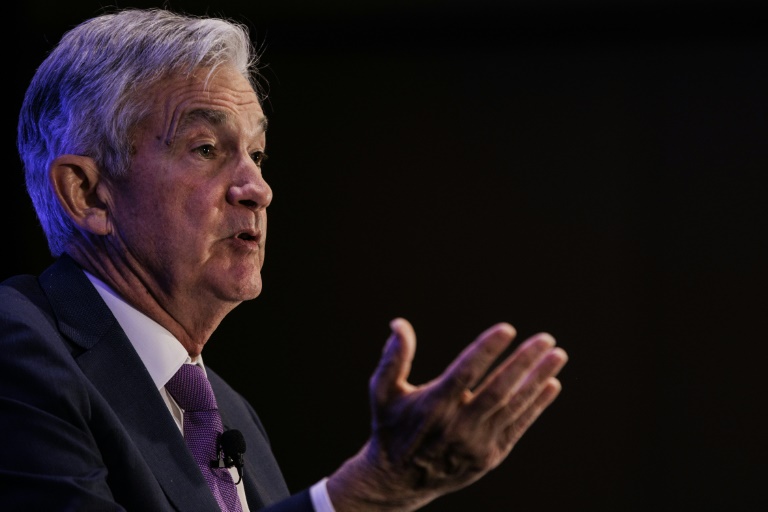
With inflation at the highest rate in four decades, Federal Reserve Chair Jerome Powell sent a message directly to the American people, expressing concern for the pain caused by rising prices, and pledging to use all available tools to bring them down.

Wednesday’s interest rate hike, the biggest since 2000, was coupled with a move to begin reducing the central bank’s bond holdings from June 1, marking the Fed’s most aggressive steps so far to counter inflation.

Powell said half-percentage point increases “should be on the table at the next couple of meetings,” but added that a three-quarter point increase “is not something the committee is actively considering.”

Stocks rallied off the remarks as Powell also expressed confidence the US central bank could engineer a “soft landing” that tames inflation without sending the economy into a recession.

Major US indices powered about three percent higher, while the dollar retreated against the euro and other currencies.

Art Hogan, strategist at National Securities, said the Fed’s decision met expectations but contained “no hawkish surprise,” adding that stocks could push higher in the coming sessions.

Some analysts have viewed the stock market as positioned for a potential rally after suffering deep losses in April amid worries over the Fed.

The central bank’s announcement followed data showing slowing growth in the US services sector and lackluster private-sector hiring that reflected limited labor capacity. The report comes ahead of Friday’s closely-watched government jobs data.

In earlier trading, European stocks closed down, after a broadly downbeat session in Asia, although key bourses including Shanghai and Tokyo remained shut.

Oil prices rebounded sharply after the European Commission proposed a gradual ban on Russian crude over Moscow’s invasion of Ukraine.

The Fed announcement is due one day before the Bank of England is also predicted to deliver a hike.

India’s central bank unexpectedly ramped up its key rate by 40 basis points to 4.4 percent on Wednesday.

Policymakers are seeking to tackle runaway prices but risk damaging global economic recovery from the pandemic.

Investor sentiment also remains dogged by the fallout from Russia’s ongoing Ukraine invasion, which has fueled bumper gains for many raw materials including crude.

– Key figures at around 2100 GMT –

New York – Dow: UP 2.8 percent at 34,061.06 (close)

New York – S&P 500: UP 3.0 percent at 4,300.17 (close)

New York – Nasdaq: UP 3.2 percent at 12,964.86 (close)

London – FTSE 100: DOWN 0.9 percent at 7,493.45 (close)

Frankfurt – DAX: DOWN 0.5 percent at 13,970.82 (close) 

Paris – CAC 40: DOWN 1.2 percent at 6,395.68 (close)  

EURO STOXX 50: DOWN 1.0 percent at 3,724.99 (close) 

Hong Kong – Hang Seng Index: DOWN 1.1 percent at 20,869.52 (close)

Tokyo – Nikkei 225: Closed for a holiday

Shanghai – Composite: Closed for a holiday

Brent North Sea crude: UP 4.9 percent at $110.14 per barrel

West Texas Intermediate: UP 5.3 percent at $107.81 per barrel

Euro/dollar: UP at $1.0625 from $1.0521 on Tuesday

Pound/dollar: UP at $1.2632 from $1.2499

Euro/pound: DOWN  at 84.06 pence from 84.18 pence

Dollar/yen: DOWN at 129.05 yen from 130.14 yen

US Fed makes biggest rate increase since 2000 to fight inflation

The Federal Reserve on Wednesday announced its biggest rate hike since 2000, with a half percentage point increase as it works to crush soaring US inflation.

With inflation at the highest rate in four decades, Federal Reserve Chair Jerome Powell sent a message directly to the American people, expressing concern for the pain caused by rising prices, and pledging to use all available tools to bring them down.

But he told reporters he remains confident the economy is strong enough to withstand rate increases without tipping into a recession.

After a quarter-point hike in March, the US central bank’s policy-setting Federal Open Market Committee (FOMC) pushed the benchmark interest rate above 0.75 percent as it works to cool the economy, and confirmed more increases “will be appropriate.”

The hike will raise the costs of all types of borrowing, from mortgages to credit cards to car loans, cooling demand and business activity.

Inflation has become an overriding concern after the world’s largest economy saw annual consumer prices surge 8.5 percent over the 12 months to March — the biggest jump since December 1981.

Policymakers continue to believe inflation will gradually return to the Fed’s two-percent target as it raises borrowing costs, but in a statement following the conclusion of its two-day meeting, the FOMC said it will be “highly attentive to inflation risks.”

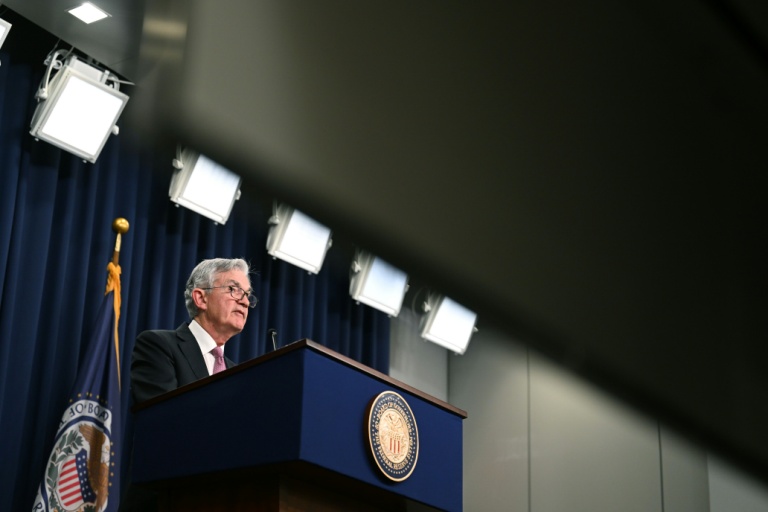
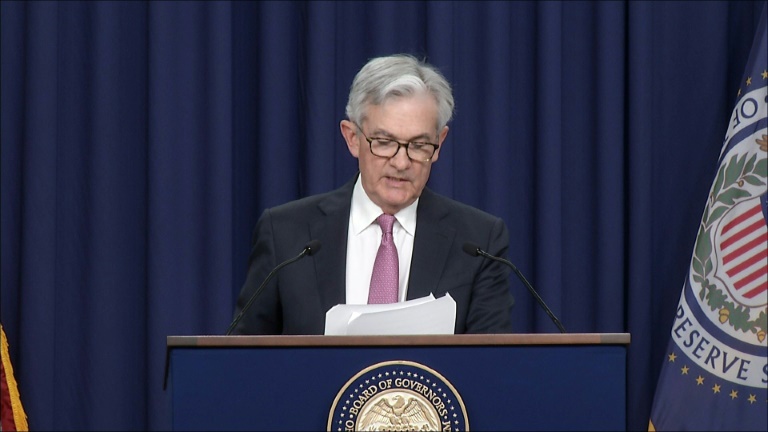
In an unusual move, Powell opened his news conference speaking to the American people.

“Inflation is much too high. And we understand the hardship that is causing,” he said, promising to use all tools available to bring it down “expeditiously.”

He acknowledged that higher interest rates also bring their share of pain, but “everyone would be better off if we can get this job done. The sooner, the better.”

To achieve that aim, he said “additional 50-basis point increases should be on the table at the next couple of meetings,” however, a more aggressive three-quarter point hike is not under consideration.

The Fed’s goal is to engineer a “soft landing,” reining in inflation while avoiding a contraction in economic activity, and Powell said that outcome is likely.

“It’s a strong economy, and nothing about it suggested… that it’s close to or vulnerable to a recession,” he said.

– Ukraine war impact –

But with China’s pandemic lockdowns worsening global supply snarls and the war in Ukraine pushing commodity prices higher, analysts fear factors beyond the central bank’s control could undermine that goal, and perhaps plunge the US economy into a recession.

The FOMC acknowledged the “highly uncertain” impact of Russia’s invasion of Ukraine and Western sanctions on Moscow, which are “creating additional upward pressure on inflation and are likely to weigh on economic activity.” 

In addition, Covid lockdowns in China “are likely to exacerbate supply chain disruptions,” the statement said. 

– Offloading bonds –

Though it contracted in the first quarter, Powell said the economy was healthy enough to withstand higher rates, and pointed to robust job gains and strong household and business spending.

However, central bankers cannot engineer a solution for the worker shortages that have challenged businesses and raised fears of a wage-price spiral, when employees demand higher salaries and fuel price increases. 

Powell downplayed those concerns, saying some of the inflation is due to price shocks, while Fed policy can help address the “imbalance” in the labor market.

On Wednesday, payroll services firm ADP reported private employers added a weaker-than-expected 247,000 workers in April, a sign that companies are struggling to find available labor, while government data released Tuesday showed there are nearly two openings for every job seeker.

The FOMC also said it would begin reducing its massive bond holdings starting June 1, beginning at the pace of $47.5 billion a month, and then doubling after three months, also aimed at removing stimulus from the economy.

The decision was widely expected, and many economists believe the FOMC will again hike rates by a half-point in June, though Ian Shepherdson of Pantheon Economics said, “After that we think all bets are off, given the likelihood of a steep, sustained drop in inflation, a clear softening in manufacturing, and a meltdown in housing market activity.”

Stock markets cheered the Fed move, closing sharply higher, with big gains in interest-sensitive tech shares.

Shareholder sues Netflix over subscriber slip

A Netflix shareholder is seeking class action status for a lawsuit accusing the streaming television titan of not making it clear that subscriber numbers were in peril.

A disclosed drop of just 200,000 users — less than 0.1 percent of its total customer base — was enough to send shares plunging after Netflix announced quarterly earnings in April.

The company anticipates a much larger drop in the current quarter — of around two million net subscribers.

The suit filed Tuesday in federal court in San Francisco accuses top executives at Netflix of not telling investors that subscriber growth was slowing due to people sharing accounts and competition ramping up in the market.

“Defendants’ positive statements about the company’s business, operations, and prospects were materially false and/or misleading and/or lacked a reasonable basis,” read the suit filed by lawyers at Glancy Prongay & Murray on behalf of a shareholder.

Netflix did not immediately reply to a request for comment.

Executives at the company said on an earnings call that they are focused on combating the 100 million households who watch Netflix for free thanks to shared passwords.

“When we were growing fast, it wasn’t the high priority to work on,” co-founder Reed Hastings admitted. “And now we’re working super hard on it.”

Chief operating officer Gregory Peters said Netflix wasn’t trying to shut down sharing, “but we’re going to ask you to pay a bit more to be able to share.”

In March, Netflix put out word that it is testing charging a fee to subscribers who share their accounts with people who don’t live in the same home.

Competition in the streaming television market meanwhile has intensified, particularly from Disney+, with the cost of producing coveted original shows climbing as well.

To attract viewers, Netflix is preparing cheaper subscriptions that include advertisements — which it expects to roll out in the next couple years.

The Los Gatos, California-based company has long defended its no-ads model, which set it apart from competitors such as Disney+, HBO Max and Apple.

For Pivotal analyst Jeff Wlodarczak, streaming “appears nearly fully penetrated globally post-Covid,” and the companies now must set their sights on converting pirates into subscribers, gaining greater market share from each other and driving up prices.”

The suit filed Tuesday is seeking to represent everyone who owned Netflix shares in the six months ending April 19, 2022, and is asking for unspecified cash damages as well as compensation for financial losses.

Mexico enlists private sector to help tame inflation

Mexico announced Wednesday an agreement with members of the private sector aimed at maintaining prices of staple foods in the face of the highest inflation in two decades.

“This is not about price controls. It’s an agreement, an alliance to guarantee that the basic food basket is priced fairly,” President Andres Manuel Lopez Obrador told reporters.

The non-binding pact is designed to keep prices of basic foods stable for at least six months, Finance Minister Rogelio Ramirez de la O said.

Mexico’s influential Business Coordinating Council said it was ready to help maintain the prices of 24 staple foods. 

Baked goods giant Bimbo pledged to maintain the price of white bread.

Telmex, the communications giant owned by tycoon Carlos Slim, also threw its weight behind the plan, promising not to raise telephone and internet prices this year.

But not all Mexicans were convinced.

“I don’t think it’s going to work,” said Javier Ramirez, a 40-year-old programmer waiting to buy groceries at a market in the capital.

“Everything’s more expensive and salaries aren’t rising at the same rate as inflation,” added Ramirez, who said he had cut back on avocado and fish due to the high prices.

Javier Espinosa, a 53-year-old shopkeeper, called the plan a “joke” because the prices of many other goods not covered by the agreement are likely to keep rising.

“The truth is I don’t feel like it helps at all,” he said.

“What you have to do is invest — in the countryside, in tourism, everywhere” to generate more incomes and jobs, Espinosa added.

Like many countries, Mexico is facing a sharp rise in consumer prices that is pushing up the cost of living.

Mexican inflation hit 7.45 percent in March, well above the central bank’s target of around 3.0 percent.

Mexico already subsidizes fuel, using money generated by its oil and gas industry, without which inflation would be around 10 percent, Ramirez de la O said.

The measures presented by the government also aim to boost production of corn, rice and beans to prevent shortages.

Two million more tons of fertilizer — a product facing a supply squeeze because of the war in major producer Ukraine — will be distributed to the agricultural sector.

The government said it would boost road security to prevent food theft and pledged not to increase tolls and rail transport fees.

The Mexican central bank has raised its benchmark interest rate at seven consecutive meetings, to 6.5 percent, in an attempt to rein in soaring consumer prices.

With concerns mounting about inflation and weaker US growth, the Bank of Mexico downgraded its economic outlook in March, forecasting growth of 2.4 percent this year.

Drone swarms can now fly autonomously through thick forest

A swarm of 10 bright blue drones lifts off in a bamboo forest in China, then swerves its way between cluttered branches, bushes and over uneven ground as it autonomously navigates the best flight path through the woods.

The experiment, led by scientists at Zhejiang University, evokes scenes from science fiction — and the authors in fact cite films such as “Star Wars,” “Prometheus” and “Blade Runner 2049” in the opening of their paper published Wednesday in the journal Science Robotics.

“Here, we take a step forward (to) such a future,” wrote the team, led by Xin Zhou.

In theory, there are myriad real world applications, including aerial mapping for conservation and disaster relief work. But the technology has needed to mature so that flying robots can adapt to new environments without crashing into one another or objects, thus endangering public safety.

Drone swarms have been tested in the past, but either in open environments without obstacles, or with the location of those obstacles programmed in, Enrica Soria, a roboticist at the Swiss Federal Institute of Technology Lausanne, who was not involved in the research, told AFP.

“This is the first time there’s a swarm of drones successfully flying outside in an unstructured environment, in the wild,” she said, adding the experiment was “impressive.”

The palm-sized robots were purpose-built, with depth cameras, altitude sensors and an on-board computer. The biggest advance was a clever algorithm that incorporates collision avoidance, flight efficiency and coordination within the swarm.

Since these drones do not rely on any outside infrastructure, such as GPS, swarms could be used during natural disasters. 

For example, they could be sent into earthquake-hit areas to survey damage and identify where to send help, or into buildings where it’s unsafe to send people.

It’s certainly possible to use single drones in such scenarios, but a swarm approach would be far more efficient, especially given limited flight times. 

Another possible use is having the swarm collectively lift and deliver heavy objects.

There’s also a darker side: swarms could be weaponized by militaries, just as remote-piloted single drones are today. The Pentagon has repeatedly expressed interest and is carrying out its own tests.

“Military research is not shared with the rest of the world just openly, and so it’s difficult to imagine at what stage they are with their development,” said Soria.

But advances shared in scientific journals could certainly be put to military use.

– Coming soon? –

The Chinese team tested their drones in different scenarios — swarming through the bamboo forest, avoiding other drones in a high-traffic experiment, and having the robots follow a person’s lead.

“Our work was inspired by birds that fly smoothly in a free swarm through even very dense woods,” wrote Zhou in a blog post.

The challenge, he said, was balancing competing demands: the need for small, lightweight machines, but with high-computational power, and plotting safe trajectories without greatly prolonging flight time.

For Soria, it’s only a matter of a few years before we see such drones deployed in real-life work. First, though, they will need to be tested in ultra-dynamic environments like cities, where they’ll constantly come up against people and vehicles. 

Regulations will also need to catch up, which takes additional time.

Close Bitnami banner
Bitnami