AFP

Costa Rica president-elect says will not ratify environment treaty

Costa Rican President-elect Rodrigo Chaves said Tuesday that his government would not ratify the Escazu Agreement that establishes protection for environmentalists.

The treaty was the first in the world to contain specific measures to protect the human rights of environmental defenders and Costa Rica had been the driving force behind it.

Outgoing President Carlos Alvarado had asked lawmakers to ratify the agreement, but Chaves said the treaty was unnecessary and could harm the economy.

“The private sector should be reassured that the Escazu Agreement is not on the government’s agenda,” the right-wing economist said at a press conference where he also announced several of his future ministers.

“I don’t think it would be beneficial for the country,” added the former World Bank official, who will take office on May 8.

Costa Rica, a regional leader in environmental protection, hosted the signing of the Escazu Agreement in 2018.

In addition to protections for campaigners, the treaty also guarantees public involvement in the environmental decision-making processes, especially those that may impact health.

But with the economy struggling, Chaves termed it “worrying” that the agreement could “delay (investment projects) in an unjustified and possibly arbitrary way.”

The treaty has been signed by 24 countries and ratified by half of them, which guarantees its validity despite Costa Rica’s now-likely lack of ratification.

Chaves also said the treaty was superfluous.  

“Our legislation already includes everything in the Escazu Agreement,” he said.

Sri Lanka tea exports lowest in 23 years

Crisis-struck Sri Lanka’s vital tea exports have dropped to their lowest level in 23 years, official figures showed Wednesday, hit by a fertiliser ban and the war in Ukraine.

Tea is the island nation’s biggest export commodity, bringing in about $1.3 billion annually before the current economic downturn, the worst since independence in 1948.

But a bungled ban on fertiliser imports last year — introduced in a doomed effort to save foreign currency and avoid a debt default — hit growers hard, with production falling 18 per cent on-year for the period from November 2021 to February 2022.

Customs data showed that first-quarter exports in 2022 correspondingly plunged to 63.7 million kilos (140 million pounds), down from 69.8 million kilos in the January-March period last year. 

The tally was the lowest since the first quarter of 1999, when the country shipped out 60.3 million kilos of tea.

Export earnings for the first quarter also declined, to $287 million from $338 million.

Tea brokering firm Asia Siyaka blamed the drop on the agro chemical ban, which was portrayed by the government as a push to turn Sri Lankan farming 100-percent organic.

The ban was lifted by October following backlash from the industry, but farmers were left unable to access imported fertiliser as the country simultaneously ran out of dollars.

Industry officials added that about 10 percent of Sri Lanka’s tea exports had also been affected by Russia’s invasion of Ukraine. Both countries are top buyers of the island’s aromatic black tea.

The country of 22 million lacks enough foreign currency to finance even the most essential imports such as food, fuel and medicines. 

Dire shortages and galloping inflation have led to widespread protests calling for President Gotabaya Rajapaksa to step down. 

Asian markets drop ahead of key Fed rate decision

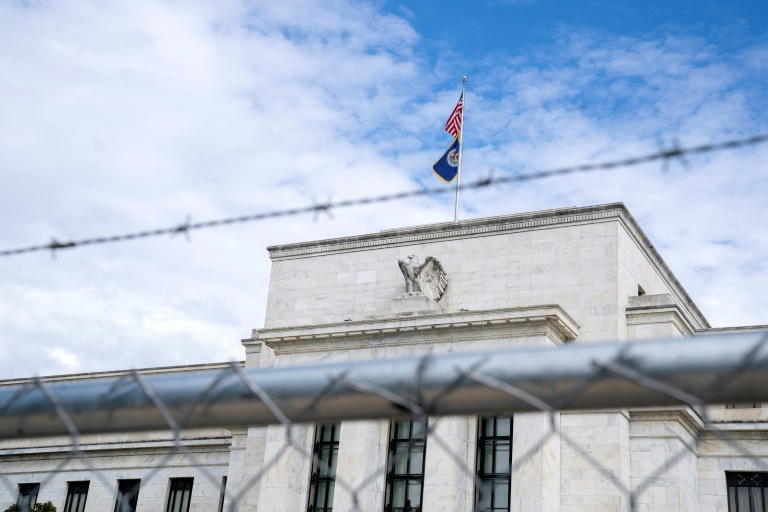
Equities fell in Asian trade Wednesday as traders nervously awaited what is expected to be the biggest Federal Reserve interest rate hike in more than two decades.

With inflation showing little sign of easing from its 40-year highs, the US central bank has set itself on a hawkish course of tightening this year, sending shivers through world markets.

The prospect of higher borrowing costs has been compounded by a range of crises including the war in Ukraine, elevated oil prices and China’s Covid lockdowns that have strangled crucial global supply chains.

The Fed now has to walk a fine line between getting control of surging prices and making sure it does not knock the recovery in the world’s top economy off course.

“The Fed remains very focused on bringing inflation down, however, any further hawkish pivots will likely be tempered to some extent by the desire to achieve a soft landing,” said Blerina Uruci at T. Rowe Price.

The Fed is expected to announce a 50 percentage point lift Wednesday — its biggest since 2000 — but boss Jerome Powell’s post-meeting news conference will be closely watched for an idea about future hikes.

Speculation was swirling that 75 points could be on the table at some point this year.

“Powell will fall back to ‘we are not on pre-set rate hikes’ or something along those lines — ‘we go in with an open mind each meeting and will talk it over and we’ll see where we go from there’,” said Tony Farren, managing director at Mischler Financial Group.

“The market would take that as hawkish. For his comments to seem dovish, he’d have to shut down the talk of 75 basis points. And while I don’t think he’ll endorse it, I don’t think he’ll shut it down.”

– Russian oil ban –

After a broadly positive lead from Wall Street, Asian markets struggled in holiday-thinned trade.

Hong Kong, Sydney, Seoul, Mumbai and Singapore slipped but Taipei and Manila rose while Wellington was flat.

Tokyo, Shanghai, Jakarta, Kuala Lumpur and Bangkok were closed.

London, Paris and Frankfurt rose in the opening minutes.

Oil prices rose after European Commission president Ursula von der Leyen on Wednesday said the European Union would impose a gradual Russian oil ban in retaliation for the war in Ukraine.

The news offset the expected hit to demand from China’s coronavirus lockdowns, including in the country’s biggest city Shanghai.

A huge release of crude from reserves by dozens of countries including the United States has also helped keep prices tempered.

Investors are waiting for a meeting Thursday of OPEC and other major producers including Russia, where they will discuss whether or not to lift output more than expected.

– Key figures at around 0720 GMT –

Hong Kong – Hang Seng Index: DOWN 1.2 percent at 20,856.96 

London – FTSE 100: UP 0.1 percent at 7,565.78

Tokyo – Nikkei 225: Closed for a holiday

Shanghai – Composite: Closed for a holiday

Euro/dollar: DOWN at $1.0512 from $1.0519 on Tuesday

Pound/dollar: DOWN at $1.2486 from $1.2491

Euro/pound: UP at 84.18 pence from 84.17 pence

Dollar/yen: UP at 130.15 yen from 130.14 yen

West Texas Intermediate: UP 1.4 percent at $103.79 per barrel

Brent North Sea crude: UP 1.2 percent at $106.19 per barrel

New York – Dow: UP 0.2 percent at 33,128.79 (close)

Volkswagen trains sights on US as profits jump

Volkswagen’s first-quarter net profit almost doubled as the German automaker looked anew to the North American market to drive growth after years of muted presence there over “dieselgate”, company results showed Wednesday.

Over the first three months of the year, Volkswagen raked in a net profit of 6.7 billion euros ($7 billion), up from 3.4 billion euros in the same period last year.

The Wolfsburg-based group had shown “resilience” in the face of supply bottlenecks which have tormented automakers over the past year, CEO Herbert Diess said in a statement. 

Volkswagen was able to “mitigate” the impact of supply bottlenecks for parts, such as semiconductors, by redistributing production across its global network of factories, Diess said.

The reduced availability of the chips, a key component in both conventional and electric vehicles made scarce by the coronavirus pandemic, forced intermittent stoppages at the carmaker last year.

Russia’s invasion of Ukraine has added to supply chain disruptions, limiting the availability of cables produced in the region.

“Even in a more polarized world, Volkswagen is firmly committed to expanding its global footprint,” Diess said. 

At the centre of the strategy was North America, where the world’s second-largest automotive group is aiming to more than double its market share to 10 percent by 2030

Volkswagen recorded its first profit in years in the region in 2021, overcoming the 2015 dieselgate emissions-cheating scandal, after which the group had scaled back its US operation.

The group — whose 12 brands include Audi, Porsche and Skoda — announced in March it was pumping $7.1 billion into its North American production facilities, while Diess has lavished attention on the region, promoting the reimagined ID.Buzz camper.

The electric mini-van, with its iconic place in American pop culture, was designed with the market in mind and reflects battery-powered vehicles’ “central” role, according to the group.

Volkswagen otherwise confirmed preliminary figures, which saw its operating profit rise to 8.5 billion euros in the first quarter, up from 4.8 billion euros last year.

The group’s first-quarter result was supported by a shift towards “higher equipped vehicles” with chunkier margins, chief financial officer Arno Antlitz said.

The changed emphasis enabled the auto giant to boost is figures despite delivering over 20 percent fewer cars, while bottlenecks have limited production.

Asian markets drift ahead of key Fed rate decision

Investors shifted cautiously in Asian trade Wednesday as they nervously awaited what is expected to be the biggest Federal Reserve interest rate hike in more than two decades.

With inflation showing little sign of easing from its 40-year highs, the US central bank has set itself on a hawkish course of tightening this year, sending shivers through world markets.

The prospect of higher borrowing costs has been compounded by a range of crises including the war in Ukraine, elevated oil prices and China’s Covid lockdowns that have strangled crucial global supply chains.

The Fed now has to walk a fine line between getting control of surging prices and making sure it does not knock the recovery in the world’s top economy off course.

“The Fed remains very focused on bringing inflation down, however, any further hawkish pivots will likely be tempered to some extent by the desire to achieve a soft landing,” said Blerina Uruci at T. Rowe Price.

The Fed is expected to announce a 50 percentage point lift Wednesday — its biggest since 2000 — but boss Jerome Powell’s post-meeting news conference will be closely watched for an idea about future hikes.

Speculation was swirling that 75 points could be on the table at some point this year.

“Powell will fall back to ‘we are not on pre-set rate hikes’ or something along those lines — ‘we go in with an open mind each meeting and will talk it over and we’ll see where we go from there’,” said Tony Farren, managing director at Mischler Financial Group.

“The market would take that as hawkish. For his comments to seem dovish, he’d have to shut down the talk of 75 basis points. And while I don’t think he’ll endorse it, I don’t think he’ll shut it down.”

After a broadly positive lead from Wall Street, Asian markets were mixed in holiday-thinned trade.

Hong Kong, Singapore and Manila slipped but Sydney, Seoul, Taipei and Wellington dropped.

Tokyo, Shanghai, Jakarta, Kuala Lumpur and Bangkok were closed.

Oil prices enjoyed gains after another drop on Tuesday fuelled by the expected hit to demand from China’s coronavirus lockdowns, including in the country’s biggest city Shanghai.

The measures have offset supply concerns caused by the Ukraine war and bans on imports of Russian fuel, even as the European Union discusses following US and British embargoes.

A huge release of crude from reserves by dozens of countries including the United States has also helped keep prices tempered.

Investors are waiting for a meeting Thursday of OPEC and other major producers including Russia, where they will discuss whether or not to lift output more than expected.

– Key figures at around 0230 GMT –

Hong Kong – Hang Seng Index: DOWN 0.8 percent at 20,943.01 

Tokyo – Nikkei 225: Closed for a holiday

Shanghai – Composite: Closed for a holiday

Euro/dollar: UP at $1.0528 from $1.0519 on Tuesday

Pound/dollar: UP at $1.2494 from $1.2491

Euro/pound: UP at 84.28 pence from 84.17 pence

Dollar/yen: DOWN at 130.09 yen from 130.14 yen

West Texas Intermediate: UP 1.0 percent at $103.43 per barrel

Brent North Sea crude: UP 0.9 percent at $105.93 per barrel

New York – Dow: UP 0.2 percent at 33,128.79 (close)

London – FTSE 100: UP 0.2 percent at 7,561.33 (close)

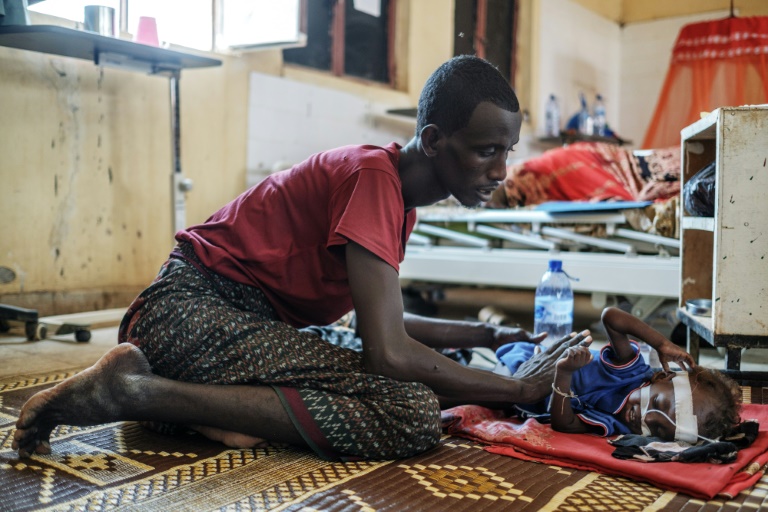
Worst drought in decades devastates Ethiopia's nomads

There has hardly been a drop of rain in Hargududo in 18 months. Dried-up carcasses of goats, cows and donkeys litter the ground near the modest thatched huts in this small village in the Somali region of southeastern Ethiopia.

The worst drought to hit the Horn of Africa in decades is pushing 20 million people towards starvation, according to the UN, destroying an age-old way of life and leaving many children suffering from severe malnutrition as it rips families apart.

April is meant to be one of the wettest months of the year in this region. But the air in Hargududo is hot and dry and the earth dusty and barren.

Many of the animals belonging to the 200 semi-nomadic herder families in the village have perished. 

Those who had “300 goats before the drought have only 50 to 60 left. For some people… none have survived,” 52-year-old villager Hussein Habil told AFP.

The tragic story is playing out across whole swathes of southern Ethiopia and in neighbouring Kenya and Somalia.

In Ethiopia, the eyes of the world have largely focused on the humanitarian crisis in the north caused by the war between government forces and the Tigray People’s Liberation Front (TPLF) that has left nine million people in need of emergency food aid.

But the UN Office for the Coordination of Humanitarian Affairs (OCHA) estimates that up to 6.5 million people in Ethiopia — more than six percent of the population — are also severely food insecure because of drought.

Lack of rain has killed nearly 1.5 million head of livestock, around two-thirds of them in the Somali region, said OCHA, showing “how alarming the situation has become”. 

Herds provide the nomadic or semi-nomadic populations of this arid and hostile region with food and income as well as their savings.

But the surviving animals have deteriorated so much that their value has plummeted, reducing the buying power of the increasingly vulnerable households, OCHA warned.

– Society ‘disintegrating’ –

“We were pure nomads before this drought, depending on the animals for meat, milk” and money, said 50-year-old Tarik Muhamad, a herder from Hargududo, 50 kilometres (30 miles) from Gode, the main town in the Shabelle administrative zone. 

“But nowadays most of us are settling down in villages… There is no longer a future in pastoralism because there are no animals to be herded.”

An entire society is disintegrating as the loss of livestock threatens the herders’ very way of life: villagers forced to leave their homes to find work in the city, families divided, children neglected as their parents focus on trying to save their animals, essential for their survival.

“Our nomadic life is over,” Muhamad said bitterly.

The alternating dry and rainy seasons — a short one in March-April followed by a longer period between June and August — have always set the rhythm of herders’ lives.

“Before this catastrophic drought, we used to survive difficult times thanks to the grasses from earlier rains,” the herder said.

But none of the last three rainy seasons have come. And the fourth one, expected since March, is likely to fail too.

“We usually have droughts, it’s a cyclical thing… previously it used to be every 10 years but now it’s coming more frequently than before,” said Ali Nur Mohamed, 38, from British charity Save the Children.

– Even camels lose their humps –

In East Africa, the frequency of drought has doubled from once every six years to once every three since 2005, according to the latest UN Intergovernmental Panel on Climate Change (IPCC) report. 

“Several prolonged droughts have occurred predominantly within the arid and semi-arid parts of the region over the past three decades.”

As early as 2012, a study by US development agency USAID found that southern regions of Ethiopia were receiving 15 to 20 percent less rainfall than in the 1970s. And those areas that did get the 500 millimetres of annual rainfall needed for viable agriculture and livestock farming were shrinking. 

Drought will be high on the agenda of the UN Convention to Combat Desertification (UNCCD), which begins in Abidjan on Monday.

Herders trying to recover from a drought are being “hit by a second drought”, said Save the Children’s Mohamed. 

“So it makes it impossible for them to recover quickly from the previous shocks.” The droughts come “so close that these pastoralists are unable to be resilient.”

The herders AFP met in the Somali region say they have lost between 80 and 100 percent of their livestock. The few herds of cows or goats we spotted were emaciated.

Even many dromedaries have lost their humps, the vital stores of fat that enable them to survive for long periods without food. 

– ‘Walked for five days’ – 

Many herders have moved to camps that have sprung up to house the vast numbers of people displaced by what they describe as the worst drought they have ever seen. 

In the morning light in Adlale, not far from Gode, dozens of women in coloured veils emerge from clouds of ochre dust to collect emergency food aid distributed by the UN’s World Food Programme (WFP). 

“We walked for five days to come here,” said Habiba Hassan Khadid, a 47-year-old mother of 10. “All of our livestock perished because of the drought.”

Ahado Jees Hussein, 45, a widowed mother of seven, arrived in Adlale carrying her 15-year-old disabled son on her back. She tells a similar story of losing all her goats and pack donkeys.

“I have never before experienced such a drought,” she said. “I came here with nothing.”

About 2,700 families are living in the camp known as Farburo 2, which was set up three months ago. 

Small huts made of branches and patchworks of fabric provide some shelter from the searing heat, with temperatures close to 40 degrees Celsius (104 Fahrenheit). 

“The living conditions are alarming,” said camp coordinator Ali Mohamed Ali, as most of the families scrape by on what they get from relatives or from local residents.

– ‘Way of life can’t continue’ –

In his tiny hut, Abdi Kabe Adan, a sturdy and proud 50-year-old, weeps uncontrollably and prays to Allah for the rains to come.

“Before, rain fell elsewhere in the region, so we moved with our animals to watered pastures, even if it took several days. 

“But this time the drought is everywhere… Wells have run out of water, no pastures for animals to graze. I don’t think it’s possible for our way of life to continue,” he sobbed. 

“I have seen goats eating their own faeces, camels eating other camels. I have never seen that in my life.”

There are few men in the camp. Some have stayed with the last of the cattle in the hunt for elusive grass, but many have left in search of work in town.

Others have simply fled, unable to face the shame or the questions about the future from their anxious wives.

The drought has also damaged the social structure of these communities. 

“Before, the men had honoured chores like milking the animals, buying food and goods for the family. These roles have disappeared along with our livestock,” said Halima Harbi, a 40-year-old mother of nine. 

Solidarity in the face of diversity has given way to rivalry, she said. “When the water trucks arrive, the old and vulnerable receive nothing because competition is fierce.”

– ‘No time to care for children’ – 

Children are paying the highest price as the disaster worsens.

UNICEF executive director Catherine Russell said 10 million children across Ethiopia, Kenya, Somalia and Djibouti needed urgent life-saving support.

As well as a malnutrition crisis, “children are forced to drink contaminated water, putting them at risk of cholera and other killer diseases,” said Russell, who visited the Somali region last week. 

Another heartbreaking consequence of drought, she said, is an increase in child marriage “as families marry off their daughters in the hope they will be better fed and protected as well as to earn dowries.”

“People don’t even have time to look after their children,” said Ali Nur Mohamed of Save The Children.

“You can understand the magnitude of the problem… (when) a mother forgets to take her (sick) child to the nearest hospital … because she is preoccupied with her other children or trying to save her livestock.”

Save the Children staff do the rounds in the communities, identifying children at risk and taking them for treatment to health centres, such as the hospital in Gode.

In the stifling air of the hospital’s nutrition unit, mothers sit on iron-framed beds, using their veils to try to keep themselves and their painfully thin children cool and repel the flies.

Hospital director Dr Mahamed Shafi Nur said children in the region are already on the verge of malnutrition, so if they get sick, they cross the danger line.   

Most are treated on an outpatient basis, given ready-to-eat peanut-based nutritional pastes. Those who suffer complications — about 15 percent — are hospitalised. 

Paediatrician Dr Mahamad Abdi Omar says mothers often find themselves alone with their offspring as the father hunts for food for their animals. So by the time they are able to bring a sick child to hospital, there are added complications.

– Heart-wrenching choices – 

Baby Samiya had been suffering from diarrhoea and vomiting for a week before her mother Rokiya Adan Mahad, 39, finally brought her into the clinic. 

Falis Hassen’s son has been suffering from canker sores for two months, preventing him from suckling. 

The 38-year-old said she came to the hospital without telling her husband. “He wouldn’t have let me leave, there is so much to do.”

Abdullahi Gorane’s son, his hair discoloured by malnutrition, had been suffering from diarrhoea and vomiting for weeks. 

“I was taking care of the livestock, I didn’t have time for my child,” said 30-year-old Abdullahi — the only father present — who decided to bring in his son only when the drought took most of his herd. 

Ahmed Nur, a health worker at the Kelafo clinic about 100 kilometres (60 miles) from Gode, said one of the issues is a lack of “exclusive breastfeeding” — mothers give their newborns water or sugar instead so the babies do not get enough milk.

But the situation has been aggravated by the drought.

“Every month, the number of malnourished kids is increasing,” he said.

Parents like Ayan Ibrahim Haroun, 45, are confronted with terrible choices: treating their child can mean risking the loss of their livestock.

She said her two-year-old daughter Sabirin Abdi had been sick for a month — constant coughing and swellings on her little body (a possible symptom of severe malnutrition) — when she finally resolved to bring her to Kelafo. 

“I had 10 goats, but I lost four in the 11 days I was at the hospital,” she said.

Sudan's electric rickshaws cut costs, help environment

Sudanese entrepreneur Mohamed Samir watches proudly as workers assemble garishly coloured rickshaws, unique in the North African nation because they run on electricity in a bid to tackle soaring costs.

In Sudan, three-wheeler vehicles — tuk-tuk rickshaws for passengers, and motorbike tricycles with a trailer attached for carrying goods — have long been a popular and affordable transport. Tens of thousands ply the streets of the capital Khartoum alone.

But with Sudan gripped by a dire economic crisis made worse by political unrest following a military coup last October, the cost of running petrol-oil engines has soared.

“People who use the fuel-run rickshaws are in pain, and they know the value of what we are offering,” 44-year-old engineer Samir said at the factory in North Khartoum. 

“We want to offer solutions.”

There is a critical environmental impact too.

Smoky petrol-powered vehicles, aside from fuelling climate change, cause “significant noise and air pollution”, the United Nations Environment Programme warned in a report from 2020.

“Emissions from the three-wheelers reduce visibility, cause damage to vegetation and lead to respiratory illnesses in people,” it added.

Samir says the new electric vehicles check three boxes of the UN’s sustainable development goals: the fight against poverty, protection of health and protection of the environment.

“It also makes much less noise,” he added.

– ‘Daily income doubled’ –

Samir faced years of grinding challenges to get his factory up and running, but once he opened, business has been brisk, selling over 100 goods tricycles and 12 passenger rickshaws since last year.

Fuel costs have more than doubled since the coup. On top of that, repeated fuel shortages have left drivers queueing up for hours outside filling stations to top up their tanks.

Drivers complain of earning less than they spend.

That was the key reason fruit seller Bakry Mohamed sold his old petrol-powered tuk-tuk and bought an electric tricycle last year.

“It used to cost more than it brought in,” said Mohamed, who uses his vehicle to carry a stall of fruits through the streets. “Plus, I had to worry about where to find fuel, and where to change the engine oil.”

Mohamed speaks proudly of his new electric tricycle.

“It has been extremely cost efficient,” Mohamed said. “Now, there are no more fuel queues. I charge it once, and it keeps running the entire week. My daily income doubled.”

Some drivers struggle when they first make the switch, but Samir said there have been no major complaints — and the electric batteries require less maintenance than fuel-run engines.

“It’s new, and they are not used to electric-run vehicles,” he said.

– Sunshine power –

The three-wheelers take about eight hours to be fully charged, with a tuk-tuk tricycle able to cover 80-100 kilometres (50 to 60 miles), while a rickshaw’s range is even further, between 100 and 120 kilometres.

But amid the economic crisis, Sudan’s electricity supplies have suffered too, with frequent power cuts.

In January, the government hiked electricity prices, with households seeing an increase of about 500 percent in the bills.

Yet Samir said the electric rickshaws are still more efficient and far cheaper to run than alternatives.

“The cost of charging the battery remains less than that of the fuel,” Samir said, with a single electric charge costing less than half a litre of fuel.

Others, looking skywards to Sudan’s year-round sunshine, have freed themselves from dependency on the power grid too.

Amjad Hamdan Hameidan, who bought several electric-powered rickshaws, powers his three-wheeler on the go.

“I use flexible solar panels,” Hameidan said. “We place them on top of the rickshaw while driving, and it keeps the batteries charged.”

Samir argues his factory is helping Sudan keep pace in a fast-developing world.

“Everything run by fuel will be replaced with electricity sooner or later,” Samir said. “We have the opportunity now to keep up with the rest of the world.”

Can pee help feed the world?

“Go pee on the rhubarb!”

Engineer Fabien Esculier has never forgotten his grandmother’s unconventional approach to gardening — in fact, it has inspired his career. 

Human urine may seem like a crude way of fertilising plants in the era of industrial agriculture, but as researchers look for ways to reduce reliance on chemicals and cut environmental pollution, some are growing increasingly interested in the potential of pee.    

Plants need nutrients — nitrogen, phosphorus and potassium — and we ingest these through food, before “excreting them, mostly through urine”, said Esculier, who runs the OCAPI research programme in France looking at food systems and human waste management. 

This presents an opportunity, scientists think. 

Fertilisers using synthetic nitrogen, in use for around a century, have helped drive up yields and boost agricultural production to feed a growing human population.

But when they are used in large quantities, they make their way into river systems and other waterways, causing choking blooms of algae that can kill fish and other aquatic life. 

Meanwhile, emissions from this agricultural ammonia can combine with vehicle fumes to create dangerous air pollution, according to the United Nations. 

Chemical fertilisers also create emissions of the potent greenhouse gas nitrous oxide, contributing to climate change. 

But the pollution does not just come directly from the fields. 

“Modern-day sanitation practices represent one of the primary sources of nutrient pollution,” said Julia Cavicchi, of the United States Rich Earth Institute, adding that urine is responsible for around 80 percent of the nitrogen found in wastewater and more than half of the phosphorus.  

To replace chemical fertilisers, you would need many times the weight in treated urine, she said.

But she added: “Since the production of synthetic nitrogen is a significant source of greenhouse gases, and phosphorus is a limited and non-renewable resource, urine diverting systems offer a long-term resilient model for human waste management and agricultural production.” 

One 2020 study by UN researchers found that global wastewater has the theoretical potential to offset 13 percent of the world’s demand for nitrogen, phosphorus and potassium in agriculture.

But pee diversion is easier said than done. 

– ‘Very radical’ – 

In the past, urban excrement was transported to agricultural fields to be used as fertiliser along with animal manure, before chemical alternatives began to displace them.

But now if you want to collect urine at source, you need to rethink toilets and the sewage system itself. 

A pilot project to do just that began in Sweden in the early 1990s in a selection of eco-villages. 

Now there are projects in Switzerland, Germany, the US, South Africa, Ethiopia, India, Mexico and France. 

“It takes a long time to introduce ecological innovations and especially an innovation such as urine separation which is very radical,” said Tove Larsen, a researcher at Switzerland’s Eawag aquatic research institute. 

She said the early urine-diverting toilets were considered unsightly and impractical, or raised concerns about unpleasant odours. 

But she hopes a new model — developed by the Swiss company Laufen and Eawag — should solve these difficulties, with a design that funnels urine into a separate container. 

Once the pee is collected it needs to be processed. 

Urine is not normally a major carrier of disease, so the World Health Organization recommends leaving it for a period of time, although it is also possible to pasteurise it. 

Then there are various techniques for concentrating or even dehydrating the liquid, reducing its volume and the cost of transporting it to the fields. 

– ‘Surprise’ –

Another challenge is overcoming public squeamishness. 

“This subject touches on the intimate,” said Ghislain Mercier, of the publicly-owned planning authority Paris et Metropole Amenagement. 

It is developing an eco-district in the French capital with shops and 600 housing units, which will use urine collection to fertilise green spaces in the city. 

He sees significant potential in large buildings like offices, as well as houses not connected to mains drainage.  

Even restaurants. Also in Paris is the 211 restaurant, equipped with waterless toilets that collect urine. 

“We have had quite positive feedback,” said owner Fabien Gandossi.

“People are a little surprised, but they see little difference compared to a traditional system.”

But are people ready to go to the next level and eat urine-fertilised foods? 

One study on the subject highlighted found differences from country to country. The acceptance rate is very high in China, France and Uganda for example, but low in Portugal and Jordan. 

– Water works – 

Prices of synthetic fertilisers are currently soaring because of shortages caused by Russia’s invasion of Ukraine, which has also spurred countries to consider shoring up their food security.

That could be an opportunity help “make the subject more visible”, said Mercier. 

Marine Legrand, an anthropologist working with Esculier at the OCAPI network, said that there are still “obstacles to overcome”.

But she believes that water shortages and increased awareness of the toll of pollution will help change minds.

“We are beginning to understand how precious water is,” she told AFP.  

“So it becomes unacceptable to defecate in it.” 

Markets on edge as Fed prepares renewed salvo against inflation

Wall Street has grown nervous as the Federal Reserve is set to make its biggest rate hike in more than two decades to crush inflation that has reached levels not seen since the 1980s.

The central bank’s policy setting Federal Open Market Committee (FOMC) wraps up its two-day meeting on Wednesday and is expected to announce a half-percentage point rate hike, taking the key borrowing rate above 0.75 percent after sitting at zero from the start of the pandemic through 2021, even as inflation picked up speed.

The expected hike is part of what the Fed has billed as a tightening cycle likely to continue throughout this year and into 2023, with the goal of taking the steam out an inflation wave that has pushed consumer prices to the highest levels in four decades.

The US central bank hiked rates by a quarter percentage point in March, the first increase since 2018, but top officials including Fed Chair Jerome Powell have said officials will move quickly and front-load the increases. 

While Wall Street sentiment has showed signs of improving this week, the central bank’s hawkish posture played a role in the equity bloodletting seen in recent weeks.

April was the worst month for the S&P 500 since the pandemic, while the Nasdaq’s tech stocks, which are particularly sensitive to higher interest rates, suffered their biggest loss since October 2008.

The Fed’s goal is to engineer a “soft landing,” reining in inflation but avoiding a contraction in economic activity.

But with China’s pandemic lockdowns worsening global supply snarls and the war in Ukraine pushing commodity prices higher, analysts fear factors beyond the central bank’s control could undermine that goal, and perhaps plunge the world’s largest economy into a recession.

“We don’t know if a recession will be realized; it will depend critically upon what the Fed does and how quickly the Ukrainian situation is resolved,” Robert Eisenbeis of Cumberland Advisors said in a note. 

He warned, “Near-term probabilities are not favorable and suggest caution.”

– Many shocks –

Interest rate hikes are aimed at dampening demand, to take the steam out of consumer prices that jumped 8.5 percent over the 12 months to March, the biggest annual jump since December 1981, caused in part by consumers spending more for scarce goods.

Fed officials have signaled they view the economy as healthy enough to withstand higher rates, since unemployment has retreated almost to where it was before the pandemic, and recent data has shown strong consumer and business spending, even though the economy fell in the first quarter.

However, in addition to the external factors, central bankers cannot engineer a solution for the worker shortages that have challenged businesses and raised fears of a wage-price spiral, when employees demand higher salaries and fuel price increases. 

Powell, who will speak following the FOMC meeting — the announcement is scheduled for 1800 GMT — and could provide more insight on the Fed’s thinking.

The policy committee also is expected to provide details on the plans for shedding its massive holdings of bonds built up during the pandemic, a strategy to keep credit flowing through the economy. 

That also could unsettle financial markets and act as a brake on activity.

Kathy Bostjancic of Oxford Economics said that for the moment, signals point to “relatively low but rising odds of a recession in the next 12 months” but she warned the chances will increase if the factors driving inflation worsen.

Marvel's 'Doctor Strange' tests appeal of movie 'multiverse'

After 27 box office-shattering blockbusters, the Marvel superhero films have no more worlds to conquer — so they are headed off to parallel universes instead.

The highly anticipated “Doctor Strange in the Multiverse of Madness,” out Friday, sends Benedict Cumberbatch’s sorcerer hopping between colorful, creepy and downright bizarre new dimensions, with the help of teenager America Chavez (Xochitl Gomez).

It explores the “multiverse” concept popularized by superhero comic books, in which infinite universes — and infinite versions of each hero and villain — exist side-by-side.

“Oh yeah, we crack that door wide open,” said Cumberbatch at this week’s Los Angeles world premiere.

“And I’ll tell you one thing about it. It’s beautiful. It’s very, very beautiful.”

But for a Hollywood franchise that has thrived by making the sometimes arcane world of comic-book lore accessible to the broadest possible audiences, is it all getting a little too complicated? 

“Multiverse of Madness” — the second standalone “Doctor Strange” movie — is packed with references not just to films that preceded it, but also to Disney+ television series “WandaVision” and “Loki.”

A review from The Hollywood Reporter says the parallel universes concept — on top of Marvel films’ previous time-travel forays — “starts to look like a franchise-sustaining crutch.”

Marvel films already contain “a practically infinite number of weird characters and unlikely events” without the “rapidly aging plot device” of parallel universes, wrote reviewer John Defore.

Variety’s Owen Gleiberman said Marvel is already “the kind of place that even the most ardent comic-book fans have to dedicate themselves to keeping up with.”

Gleiberman called the film “a ride, a head trip… a what-is-reality Marvel brainteaser and, at moments, a bit of an ordeal.”

“It’s a somewhat engaging mess, but a mess all the same.”

– ‘Perfect time’ –

Still, recent history has taught Hollywood watchers to never underestimate the allure of the “Marvel Cinematic Universe” (MCU).

The franchise turned conventional wisdom about attention spans of Gen Z teens upside-down with hits like 2019’s “Avengers: Endgame” — the culmination of more than 20 interconnected movies and storylines going back to the original “Iron Man” (2008).

It earned almost $2.8 billion at the global box office, briefly becoming the highest grossing film of all time.

“Marvel are the epitome of success in Hollywood right now,” said Jeff Bock, senior analyst at Exhibitor Relations.

“And that’s why when we talk about $150 million, $200 million openings, nobody blinks an eye anymore.”

Kevin Feige, the president of Marvel Studios, said last week that planning for “the next decade” of the superhero films is well underway.

And the concept of multiple versions of beloved characters has already been successful, including December’s smash hit “Spider-Man: No Way Home.”

“Characters have come out of other universes into our own in the last Spider-Man picture,” said director Sam Raimi at Monday’s premiere.

“But this will be the first time that characters from our MCU journey out into other universes.”

Beyond the Marvel franchise, the recent, critically adored indie sci-fi hit “Everything Everywhere All at Once” also explores the idea of parallel universes.

“I think ‘Doctor Strange’ actually hits at the perfect time because everybody’s still talking about how great this multiverse concept is — it’s not played out,” said Bock.

– ‘Opening a box’ –

So far, “Multiverse of Madness” has a highly respectable — if below the Marvel average — 79 percent on review aggregator website Rotten Tomatoes.

IndieWire called the movie a “a violent, wacky, drag-me-to-several-different-hells at once funhouse of a film.”

“We are opening a box. And there’s going to be a lot of opportunities for storytelling moving forward,” said Elizabeth Olsen, who reprises her role as Wanda Maximoff.

“I’m looking forward to seeing what we do with that.”

Close Bitnami banner
Bitnami