AFP

Israel to top up shrinking Sea of Galilee with desalinated water

Israel, a leader in making seawater drinkable, plans to pump excess output from its desalination plants into the Sea of Galilee, depleted by overuse and threatened by climate change.

Irregular rainfall, rising temperatures and intensive pumping have overtaxed the world’s lowest freshwater lake, which for decades has served as the Jewish state’s main sweetwater reservoir.

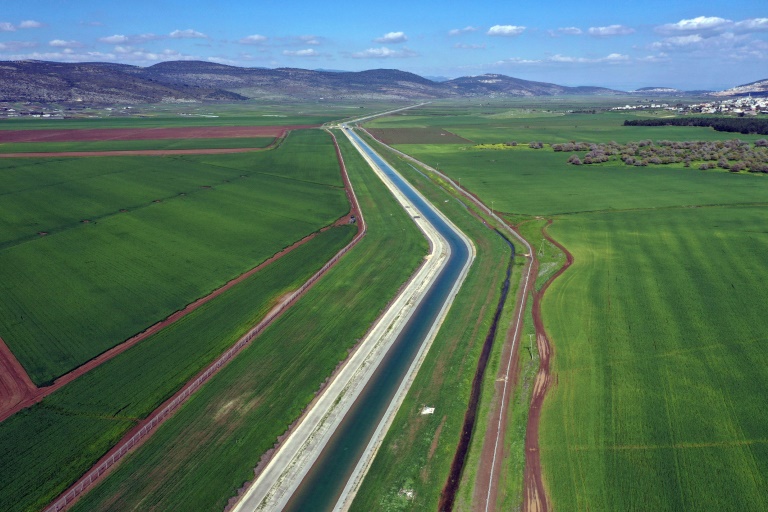
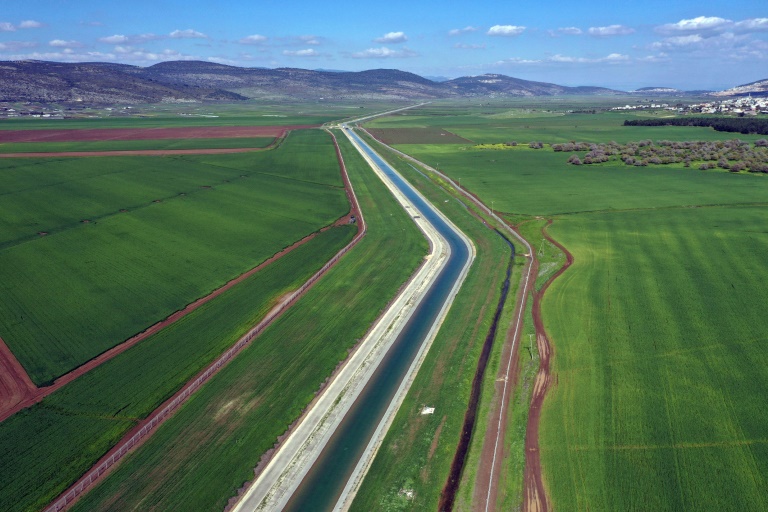
Israel now plans to tackle the challenge by reversing the water flow through its vast network of pumps, pipes and tunnels dating to the 1960s, the National Water Carrier.

Authorities hail the project as a showcase for Israel’s cutting-edge desalination and water management technology, which can also help deepen ties with arid Arab states.

Critics charge that Israel has long short-changed Palestinians out of their fair share of water, leaving much of the occupied West Bank and the Gaza Strip facing severe water stress.

And environmentalists note that the more Israel relies on fossil fuels to power its desalination plants, the more its carbon emissions will worsen climate change.

For now however, experts say, urgent action is needed to brace the country for global warming coupled with rapid population growth.

Israel’s average temperature has risen by two degrees Celsius over the past two decades, said Noam Halfon, a researcher at the Israel Meteorological Service.

A wet winter has just topped up the lake, but its level dipped substantially in the drought years of 2014-2018, a potential harbinger of worse to come.

“Some models predict we will have less precipitation overall, a reduction of 10 or 15 percent in the second half of the 21st century,” Halfon said.

Israel’s rapidly growing population adds to the need for the new water infrastructure project, he said.

“Every 30 years we double the population. Without this project, it would be an awful situation.”

– ‘Scarcity to abundance’ – 

Ziv Cohen, an engineer at Israeli water company Mekorot, was overlooking a work site in northern Israel where a crane was lowering water pipe segments into trenches. 

The verdant hillsides were scattered with blooming spring flowers, but Cohen said appearances are deceiving.

“In recent years, we have all felt a decrease in rainfall” in the lake’s catchment area, he told AFP.

Cohen said the one-billion-shekel (over $300-million) project will, by the end of the year, reverse the flow of the system which previously delivered lake water to areas across the country. 

“The minute water flows through the pipeline, bringing excess water from desalination plants in the centre, we can raise the level of the Sea of Galilee, and it will become an operational reservoir,” he said.

About an hour’s drive away on the Mediterranean coast, David Muhlgay poured himself a glass of water made by the Hadera Desalination Plant, one of five in Israel.

“Israel has gone from water as a scarce product to an abundance of water in 15 years, which is phenomenal,” said Muhlgay, CEO of OMIS Water Ltd.

His plant produces 137 million cubic metres a year — 16 percent of Israel’s drinking water supply — with the capacity to produce 160 million cubic metres. 

“We are ready to go” and connect to the new system, he said.

The seaside plant sits beside the coal and gas-fired plant that powers it, underscoring the contradictions in adapting to the climate crisis through energy-intensive desalination. 

“Electricity needs to be sourced,” Muhlgay said, arguing that for now only fossil fuels can do the job. 

“It cannot only rely, for the moment, on renewable sources.”

– ‘Lots of interest’-

Israel’s desalination expertise has opened new diplomatic avenues in the water-scarce Middle East, where it has established ties with the United Arab Emirates, Bahrain and Morocco. 

Israel, Jordan and the UAE last year agreed in principle on a plan for Jordan to exchange solar power for Israeli water, which authorities told AFP would come from the Galilee. 

Muhlgay said his plant had hosted visitors from Morocco, and the plant operator’s parent company IDE had sent a vice president to visit the UAE.

“There’s lots of interest in the Israeli technology,” Muhlgay said. 

“If everybody is short of water, bringing water can solve a few problems.”

The situation for Palestinians has however scarcely budged despite the new technologies, said Ayman Rabi, executive director of the Palestinian Hydrology Group. 

Israel exercises tight control over water resources in the occupied West Bank, with Palestinians granted limited access to an underground aquifer.

Under the terms of a 1990s peace agreement, Israel sells water back to Palestinians, but allocations have not kept pace with population growth. 

To cope, Rabi said, Palestinians have begun planting crops that require less water, and made a concerted effort to catch rainwater. 

“Of course (Israelis) are marketing themselves as water exporters,” he told AFP. “I don’t think this will impact the Palestinians.” 

Israel to top up shrinking Sea of Galilee with desalinated water

Israel, a leader in making seawater drinkable, plans to pump excess output from its desalination plants into the Sea of Galilee, depleted by overuse and threatened by climate change.

Irregular rainfall, rising temperatures and intensive pumping have overtaxed the world’s lowest freshwater lake, which for decades has served as the Jewish state’s main sweetwater reservoir.

Israel now plans to tackle the challenge by reversing the water flow through its vast network of pumps, pipes and tunnels dating to the 1960s, the National Water Carrier.

Authorities hail the project as a showcase for Israel’s cutting-edge desalination and water management technology, which can also help deepen ties with arid Arab states.

Critics charge that Israel has long short-changed Palestinians out of their fair share of water, leaving much of the occupied West Bank and the Gaza Strip facing severe water stress.

And environmentalists note that the more Israel relies on fossil fuels to power its desalination plants, the more its carbon emissions will worsen climate change.

For now however, experts say, urgent action is needed to brace the country for global warming coupled with rapid population growth.

Israel’s average temperature has risen by two degrees Celsius over the past two decades, said Noam Halfon, a researcher at the Israel Meteorological Service.

A wet winter has just topped up the lake, but its level dipped substantially in the drought years of 2014-2018, a potential harbinger of worse to come.

“Some models predict we will have less precipitation overall, a reduction of 10 or 15 percent in the second half of the 21st century,” Halfon said.

Israel’s rapidly growing population adds to the need for the new water infrastructure project, he said.

“Every 30 years we double the population. Without this project, it would be an awful situation.”

– ‘Scarcity to abundance’ – 

Ziv Cohen, an engineer at Israeli water company Mekorot, was overlooking a work site in northern Israel where a crane was lowering water pipe segments into trenches. 

The verdant hillsides were scattered with blooming spring flowers, but Cohen said appearances are deceiving.

“In recent years, we have all felt a decrease in rainfall” in the lake’s catchment area, he told AFP.

Cohen said the one-billion-shekel (over $300-million) project will, by the end of the year, reverse the flow of the system which previously delivered lake water to areas across the country. 

“The minute water flows through the pipeline, bringing excess water from desalination plants in the centre, we can raise the level of the Sea of Galilee, and it will become an operational reservoir,” he said.

About an hour’s drive away on the Mediterranean coast, David Muhlgay poured himself a glass of water made by the Hadera Desalination Plant, one of five in Israel.

“Israel has gone from water as a scarce product to an abundance of water in 15 years, which is phenomenal,” said Muhlgay, CEO of OMIS Water Ltd.

His plant produces 137 million cubic metres a year — 16 percent of Israel’s drinking water supply — with the capacity to produce 160 million cubic metres. 

“We are ready to go” and connect to the new system, he said.

The seaside plant sits beside the coal and gas-fired plant that powers it, underscoring the contradictions in adapting to the climate crisis through energy-intensive desalination. 

“Electricity needs to be sourced,” Muhlgay said, arguing that for now only fossil fuels can do the job. 

“It cannot only rely, for the moment, on renewable sources.”

– ‘Lots of interest’-

Israel’s desalination expertise has opened new diplomatic avenues in the water-scarce Middle East, where it has established ties with the United Arab Emirates, Bahrain and Morocco. 

Israel, Jordan and the UAE last year agreed in principle on a plan for Jordan to exchange solar power for Israeli water, which authorities told AFP would come from the Galilee. 

Muhlgay said his plant had hosted visitors from Morocco, and the plant operator’s parent company IDE had sent a vice president to visit the UAE.

“There’s lots of interest in the Israeli technology,” Muhlgay said. 

“If everybody is short of water, bringing water can solve a few problems.”

The situation for Palestinians has however scarcely budged despite the new technologies, said Ayman Rabi, executive director of the Palestinian Hydrology Group. 

Israel exercises tight control over water resources in the occupied West Bank, with Palestinians granted limited access to an underground aquifer.

Under the terms of a 1990s peace agreement, Israel sells water back to Palestinians, but allocations have not kept pace with population growth. 

To cope, Rabi said, Palestinians have begun planting crops that require less water, and made a concerted effort to catch rainwater. 

“Of course (Israelis) are marketing themselves as water exporters,” he told AFP. “I don’t think this will impact the Palestinians.” 

Get this straight: Curls bounce back in Cairo

“Shaggy,” “messy,” “unprofessional”. Natural curls were once looked down upon in Egypt, where Western beauty standards favoured sleek, straight locks. Now, things are changing.

For Rola Amer and Sara Safwat, their curls were once a career-hindering nuisance. Now part of an aesthetic liberation movement sweeping Egypt in recent years, they own a curly hair salon that caters to women and men like them.

Amer used to spend hours straightening her bouncy curls, she told AFP as she began her day at the Curly Studio, which became Egypt’s first natural hair salon in 2018.

“Curly hair takes a lot longer to cut than straight hair,” Amer said, meticulously snipping her way through a client’s curly mane in an affluent suburb of Cairo.

Three hours later, she can finally show the result to her client, and both are delighted as the salon buzzes around them.

It’s a far cry from Amer’s own experience a few years ago. “If I ever left my hair curly, I’d feel shaggy, like I wasn’t taking care of myself,” she said.

In this rare type of salon in Cairo, the final product fits each client’s curl pattern, and rollers have replaced straightening irons to prevent heat damage.

Safwat, 38, explained the dangers of straightening, adjusting her curly bangs as she spoke.

“One time, a mother brought her three-year-old daughter. She had tried a chemical treatment to straighten her hair, and now it was falling out,” she said. 

The obsession with straight hair, rooted in what Safwat calls “completely false beauty ideals,” compelled generations of women to burn their hair to a crisp using chemical treatments and excessive heat damage.

– A marked change –

With her curls considered “unprofessional” Safwat says that, before she became a hairdresser, she would often be asked in job interviews: “Will you be coming in to work like this?”

In the early 2000s, Lebanese singer Myriam Fares was one of the first curly-haired icons in the Middle East. 

Halfway across the world, Black women in the United States were increasingly embracing their curls in a natural hair care movement. Many of the biggest brands built by Black women at the time would eventually find their way onto the shelves of curly salons in Cairo.

In 2012, Egyptian actress Dina el-Sherbiny became one of the first to break the taboo on screen, flaunting her chestnut curls in hit TV series “Hekayat Banat” (Girls’ Stories).

Ten years later, curly heads feature in TV shows, movies and the billboards that line Cairo’s highways, a marked change in pop culture.

In Hollywood, Egyptian-Palestinian actress May Calamawy even shows off her curls in Marvel’s latest series, “Moon Knight,” helmed by Egyptian director Mohamed Diab.

“There has been a real social movement,” Doaa Gawish told AFP. In 2016, Gawish launched a Facebook group called The Hair Addict to help women give their hair a break from harsh chemicals and blow dryers.

Within months, the online forum had grown from 5,000 to more than 80,000 members, as the local cosmetics market grew by 18 percent, according to Euromonitor International. 

Two years later, Gawish launched her eponymous haircare company.

“A lot of big cosmetics companies started releasing products for curly hair, because they could see it was an essential customer base,” Gawish told AFP.

This base is steadily growing in Egypt’s sizable cosmetics market. With a population of 103 million, the country has about 500,000 salons and more than three million employees, as estimated in 2020 by Mahmoud el-Degwy, head of the hairdressers’ division at the Cairo Chamber of Commerce.

Teacher and natural hair influencer Mariam Ashraf has seen the market’s potential firsthand. Only a hobby at first, her Instagram videos quickly became “a real source of income”, she told AFP before filming a new clip for her 90,000-plus followers.

“Brands are contacting me more and more to showcase curly hair products,” the 26-year-old explained. “And now modelling agencies are contacting me for advertisements.”

– ‘Fragile masculinity’ –

But the world of natural hair care is not accessible to everyone.

While the average monthly income in Egypt is 6,000 pounds ($325), a haircut at the Curly Studio can cost up to one-tenth of that.

Since he inadvertently discovered his curls during Covid-19 lockdown, cybersecurity expert Omar Rahim has been gladly paying to maintain his style.

Today, he maintains an intricate regimen, despite jeers from his friends in a conservative and patriarchal society.

“We have a problem with fragile masculinity; people think a man shouldn’t take care of his hair or buy products,” he told AFP.

“I want people to understand that this is normal, but I’m not ready to fight this fight just yet.”

Ship stranded off US delights curious, worries environmentalists

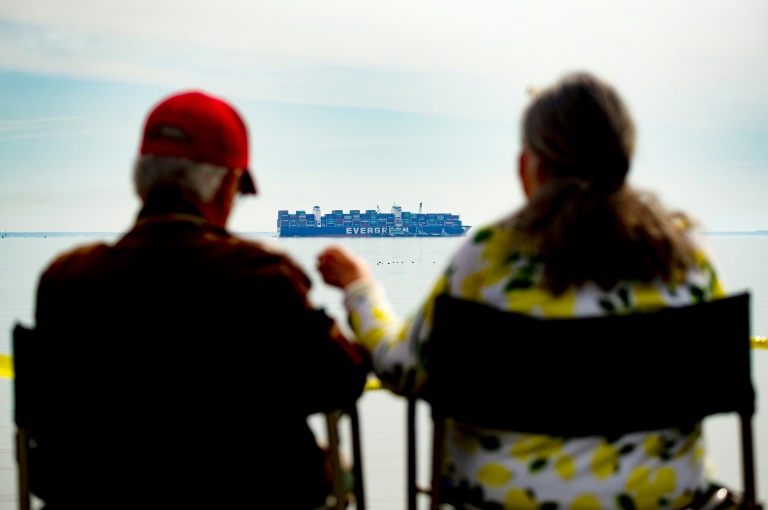
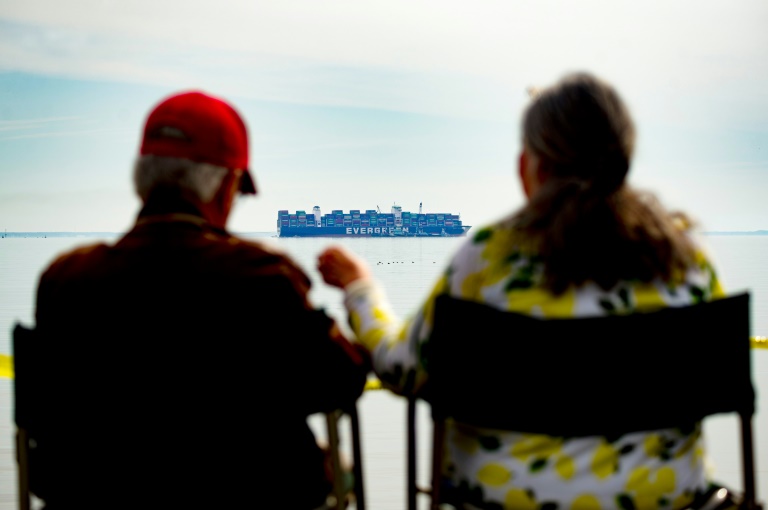
Holding binoculars and toting folding chairs the sightseers are laser-focused: the objective is to see the massive container ship Ever Forward, which has been stranded for a month in the mud of the US East Coast’s Chesapeake Bay.

Some bring their families, while others come with friends, popping a squat at the best vantage point around — a park in the city of Pasadena, Maryland which offers an easy view of the vessel that is lodged in some 20 feet (six meters) of muck a few hundred yards from shore.

“Even with the storms we get here in the bay, we don’t get ships grounding like this,” said Frederick Schroeder, a retiree who traveled from nearby Baltimore with his camera and telephoto lens to document the spectacle, which he called “a once in a lifetime thing.”

The hulking vessel, owned by the Taiwan-based company Evergreen, became stuck on the night of March 13 after missing a turn into deeper water. 

The ship, measuring approximately 1,100 feet long and capable of carrying nearly 12,000 containers, is one of many that ply the heavily trafficked waters of the Chesapeake, a gigantic estuary whose banks harbor both the city of Baltimore and Port of Virginia, the second- and third-most substantial ports on the US East Coast.

– Tugs and dredge boats –

The Ever Forward’s misadventure in the Chesapeake is reminiscent of that of the similarly named Ever Given, another Evergreen container ship which famously became stuck in a sandbank in the Suez Canal in March 2021, blocking traffic for almost a week.

The US Coast Guard has been at work trying to dislodge the Ever Forward for more than three weeks, assisted by tugs and dredge boats, but so far without success.

In recent days, cranes have surrounded the ship, laboring to unburden it of as many containers as possible to make the vessel lighter.

Asked by AFP, the Coast Guard said that a total of more than 130 containers had been unloaded so far, but that even more would be removed before a new attempt to refloat the boat — the date for which is still to be determined.

“The skipper who ran aground, he must be beyond embarrassment to do such a thing,” said John Zeglin, a nearly 80-year-old retiree who traveled to see the Ever Forward from Bethesda, Maryland, a Washington suburb about an hour’s drive from the ship.

– ‘Osprey abundance’ –

Doug Myers, a scientist with the Chesapeake Bay Foundation, an environmental association, told AFP he was alarmed at the possibility of a hull breach, potentially releasing hundreds of gallons of fuel.

“Anytime a vessel is aground, you do have that risk,” said Myers, who says he has a lot of experience with oil spills, particularly from having worked in Texas in the 1990s.

Myers also worries the ship could list and lose containers in the bay during dredging operations.

“There has been damage just by the ship running aground in shallow water — these shallow sandbars and oyster bars contain the clams and worms and other really important fish habitats,” he said.

Birds are the most vulnerable animals to an oil spill after those that live in the water, and the Ever Forward became stuck just as migrating birds stop by the bay and even nest there for summer.

“The bay is kind of the epicenter of osprey abundance,” said Myers, who worries about these fish-eating birds of prey.

He said that authorities have not yet taken into account the environmental risks and wants a containment boom — a type of protective barrier — to be placed around the Ever Forward to prevent any oil leaks from spreading.

Even if the danger is not imminent, such a leak could reach both sides of the bay in an hour or more, he said.

“This bay is everything to Marylanders,” Myers said.

“So many people make their living either directly or indirectly because of the bay, whether it be tourism, whether it be fishing, whether it be you know, just the waterfront property.”

Ship stranded off US delights curious, worries environmentalists

Holding binoculars and toting folding chairs the sightseers are laser-focused: the objective is to see the massive container ship Ever Forward, which has been stranded for a month in the mud of the US East Coast’s Chesapeake Bay.

Some bring their families, while others come with friends, popping a squat at the best vantage point around — a park in the city of Pasadena, Maryland which offers an easy view of the vessel that is lodged in some 20 feet (six meters) of muck a few hundred yards from shore.

“Even with the storms we get here in the bay, we don’t get ships grounding like this,” said Frederick Schroeder, a retiree who traveled from nearby Baltimore with his camera and telephoto lens to document the spectacle, which he called “a once in a lifetime thing.”

The hulking vessel, owned by the Taiwan-based company Evergreen, became stuck on the night of March 13 after missing a turn into deeper water. 

The ship, measuring approximately 1,100 feet long and capable of carrying nearly 12,000 containers, is one of many that ply the heavily trafficked waters of the Chesapeake, a gigantic estuary whose banks harbor both the city of Baltimore and Port of Virginia, the second- and third-most substantial ports on the US East Coast.

– Tugs and dredge boats –

The Ever Forward’s misadventure in the Chesapeake is reminiscent of that of the similarly named Ever Given, another Evergreen container ship which famously became stuck in a sandbank in the Suez Canal in March 2021, blocking traffic for almost a week.

The US Coast Guard has been at work trying to dislodge the Ever Forward for more than three weeks, assisted by tugs and dredge boats, but so far without success.

In recent days, cranes have surrounded the ship, laboring to unburden it of as many containers as possible to make the vessel lighter.

Asked by AFP, the Coast Guard said that a total of more than 130 containers had been unloaded so far, but that even more would be removed before a new attempt to refloat the boat — the date for which is still to be determined.

“The skipper who ran aground, he must be beyond embarrassment to do such a thing,” said John Zeglin, a nearly 80-year-old retiree who traveled to see the Ever Forward from Bethesda, Maryland, a Washington suburb about an hour’s drive from the ship.

– ‘Osprey abundance’ –

Doug Myers, a scientist with the Chesapeake Bay Foundation, an environmental association, told AFP he was alarmed at the possibility of a hull breach, potentially releasing hundreds of gallons of fuel.

“Anytime a vessel is aground, you do have that risk,” said Myers, who says he has a lot of experience with oil spills, particularly from having worked in Texas in the 1990s.

Myers also worries the ship could list and lose containers in the bay during dredging operations.

“There has been damage just by the ship running aground in shallow water — these shallow sandbars and oyster bars contain the clams and worms and other really important fish habitats,” he said.

Birds are the most vulnerable animals to an oil spill after those that live in the water, and the Ever Forward became stuck just as migrating birds stop by the bay and even nest there for summer.

“The bay is kind of the epicenter of osprey abundance,” said Myers, who worries about these fish-eating birds of prey.

He said that authorities have not yet taken into account the environmental risks and wants a containment boom — a type of protective barrier — to be placed around the Ever Forward to prevent any oil leaks from spreading.

Even if the danger is not imminent, such a leak could reach both sides of the bay in an hour or more, he said.

“This bay is everything to Marylanders,” Myers said.

“So many people make their living either directly or indirectly because of the bay, whether it be tourism, whether it be fishing, whether it be you know, just the waterfront property.”

Elon Musk launches hostile takeover bid for Twitter

Tesla chief Elon Musk launched a hostile takeover effort for Twitter on Thursday, insisting the platform needs to be transformed but acknowledging his $43-billion bid may fail.

The proposal faces uncertainty on multiple fronts, including possible rejection and the challenge of assembling the cash, but could have wide-reaching impacts on the social media service if consummated.  

Musk cited the promotion of freedom of speech on Twitter as a key reason for what he called his “best and final offer,” and which the firm’s board said it was reviewing.

“My strong intuitive sense is that having a public platform that is maximally trusted and broadly inclusive is extremely important to the future of civilization,” he said in his first spoken comments after the offer was revealed in a regulatory filing.

The world’s richest person offered $54.20 a share, which values the social media firm at some $43 billion, in a filing with the Securities and Exchange Commission made public on Thursday.

Musk told a conference in Canada that he was “not sure” he would succeed and acknowledged a “plan B” but refused to elaborate, though in the filing he noted a rejection would make him consider selling his shares.

Musk last week disclosed a purchase of 73.5 million shares — or 9.2 percent — of Twitter’s common stock, an announcement that sent its shares soaring more than 25 percent.

– ‘Stockholders best interest’ –

Twitter’s board said it would carefully review what it termed Musk’s “unsolicited, non-binding” offer and decide on a course of action that was “in the best interest of the company and all Twitter stockholders.”

Musk said he “could technically afford” the buyout while offering no information on financing, though he would likely need to borrow money or part with some of his mountain of Tesla or SpaceX shares. 

Despite saying he wanted to take the company private, he said the firm would keep up to 2,000 investors — the maximum allowed.

Some investors have already spoken against the proposal, including businessman and Saudi Prince Alwaleed bin Talal.

“I don’t believe that the proposed offer by @elonmusk ($54.20) comes close to the intrinsic value of @Twitter given its growth prospects,” he tweeted.

Morningstar Research analysts echoed that perspective, saying, “While the board will take the Tesla CEO’s offer into consideration, we believe the probability of Twitter accepting it is likely below 50 percent.”

Twitter stock closed down nearly two percent for the day.

Musk’s move throws another curve into the roller-coaster ride of his volatile relationship with the global social media service, and raises many questions about what comes next.

He was offered a seat on the board but turned it down over the weekend.

Musk went on to use Twitter as a stage to ask whether the social media network was “dying” and to call out users such as singer Justin Bieber, who are highly followed but rarely post.

– ‘Twists and turns’ –

“Most of these ‘top’ accounts tweet rarely and post very little content,” the Tesla boss wrote, captioning a list of the 10 profiles with the most followers — which includes himself at number eight, with over 81 million followers.

In other weekend tweets, Musk joked about dropping the “w” from Twitter’s name and about converting its San Francisco headquarters to a homeless shelter “since no one shows up anyway.”

He also suggested removing ads, Twitter’s main source of revenue.

“He is such an entitled, privileged man, I am not sure the Twitter he has in mind is a platform that will ultimately serve a majority of the people on it today,” said Creative Strategies analyst Carolina Milanesi.

Musk has mused on Twitter about giving verified account check marks to everyone paying for premium subscription accounts, which cost $3 monthly.

“I invested in Twitter as I believe in its potential to be the platform for free speech around the globe, and I believe free speech is a societal imperative for a functioning democracy,” Musk said in his filing.

Musk breaks the mold as a business figure, even in the Silicon Valley world known for disrupting markets and changing lifestyles.

The serial entrepreneur’s endeavors include driving a shift to electric vehicles with Tesla, private space exploration and linking computers with brains.

His behavior, however, has raised eyebrows, prompted laughs and sometimes drawn condemnation or even litigation.

“It’s get out the popcorn time as we expect many twists and turns in the weeks ahead as Twitter and Musk walk down this marriage path,” Wedbush analysts said in a note to investors.

N.Korea-tied hackers executed $620 mn crypto heist: FBI

North Korean-tied hackers were responsible for a $620-million cryptocurrency heist last month targeting players of the popular Axie Infinity game, US authorities said Thursday.

The hack was one of the biggest to hit the crypto world, raising huge questions about security in an industry that only recently burst into the mainstream thanks to celebrity promotions and promises of untold wealth.

Last month’s theft from the makers of Axie Infinity, a game where players can earn crypto through game play or trading their avatars, came just weeks after thieves made off with around $320 million in a similar attack.

“Through our investigations we were able to confirm Lazarus Group and APT38, cyber actors associated with (North Korea), are responsible for the theft,” the FBI said in a statement.

Lazarus Group gained notoriety in 2014 when it was accused of hacking into Sony Pictures Entertainment as revenge for “The Interview,” a satirical film that mocked North Korean leader Kim Jong Un.

North Korea’s cyber-program dates back to at least the mid-1990s, but has since grown to a 6,000-strong cyber-warfare unit, known as Bureau 121, that operates from several countries including Belarus, China, India, Malaysia and Russia, according to a 2020 US military report.

John Bambenek, a threat analyst with digital security firm Netenrich, said North Korea is “unique” in employing groups dedicated to cryptocurrency theft. 

“As North Korea is highly-sanctioned, cryptocurrency thefts are also a national security interest for them,” he said. 

North Korean hackers stole around $400 million-worth of cryptocurrency through cyberattacks on digital currency outlets last year, blockchain data platform Chainalysis said in January. 

In the case of the Axie Infinity heist, attackers exploited weaknesses in the set-up put in place by the Vietnam-based firm behind the game, Sky Mavis.

The company had to solve a problem: the ethereum blockchain, where transactions in the ether cryptocurrency are logged, is relatively slow and expensive to use.

To allow Axie Infinity players to buy and sell at speed, the firm created an in-game currency and a sidechain with a bridge to the main ethereum blockchain.

The result was faster and cheaper — but ultimately less secure.

The attack targeting its blockchain netted 173,600 ether and $25.5 million-worth of stablecoin, a digital asset pegged to the US dollar.

Former UK Coca-Cola boss caught taking £1.5m in bribes

A former Coca-Cola boss in the UK on Thursday avoided jail despite taking more than £1.5 million ($1.95 million, 1.8 million euros) in bribes in return for channeling lucrative contracts to favoured companies.

Noel Corry, 56, provided companies with confidential information to give them an advantage over rivals when bidding for electrical services contracts for bottling plants in the UK.

In return, he received payments through “bogus” contracts for work at Coca-Cola Enterprises that was never carried out, or overpaying for work done and pocketing the difference, prosecutors said.

At London’s Southwark Crown Court on Thursday, he was given a 20-month suspended sentence, while two directors of the other companies involved in the scheme, which ran between 2004 and 2013, were each given a 12-month suspended sentence.

“Corry had established a corrupt culture in the procurement exercise, awarding contracts to those companies whose senior managers were prepared to bribe him for doing so,” said Alistair Dickson of the Crown Prosecution Service. 

“Coca-Cola Enterprises were wholly unaware of Corry’s corrupt actions to enrich himself.

Germany seizes world's largest yacht owned by Russian oligarch

Germany has officially confiscated the world’s largest superyacht owned by Russian oligarch Alisher Usmanov, as part of sanctions against Moscow following the outbreak of war in Ukraine, police sources said Thursday.

The 156-metre (1,680-feet) long “Dilbar” has an estimated value of $600 million ((555 million euros) according to Forbes magazine.

Since last October the boat has been docked for repairs in a Hamburg shipyard.

German customs had been eyeing the superyacht for several weeks, but could not formally seize it earlier due to a legal imbroglio over its ownership.

Eventually the German Federal Judicial Police indicated that they had succeeded “after lengthy investigations, and in spite of concealment via offshore companies, in identifying the owner of the M/S Dilbar and it is Gulbakhor Ismailova, the sister of Alisher Usmanov”.

“The luxury yacht is now under the sanctions regime and so could be confiscated in Hamburg,” police added on Twitter.

The Russian billionaire and his sister are both targeted by European sanctions against Russian oligarchs as well as members of their families.

Usmanov, 68, was ranked sixth in the Sunday Times’ list of the richest people in the UK in 2021.

He is one of dozens of Russian oligarchs hit by Western sanctions since Moscow launched its invasion of Ukraine.

On Wednesday, English Premier League football club Everton suspended its sponsorship agreements with several companies in which Usmanov held shares.  

The confiscation of the “Dilbar” is just the latest in a string of seizures of Russian superyachts under the Western sanctions. 

Haulage strike paralyzes Argentina's farming exports

A four-day-old strike by Argentine grain transporters, demanding higher freight rates in the face of rising diesel prices due to war in Ukraine, has paralyzed farming exports, industry sources said Thursday.

Thousands of trucks that haul grain and its derivatives have parked along the side of the road in the South American country, which is the world’s largest exporter of soybean flour and oil, and one of the main suppliers of wheat, soybean and corn.

“The entire agricultural export complex is paralyzed. The Argentine economy cannot afford this luxury,” said Gustavo Idigoras, president of the Ciara-CEG oil and grain exporters chamber, in a statement.

Haulage companies are unhappy with the amount they are being paid to transport grain since their fuel costs have shot up in recent months due to Russia’s invasion of Ukraine.

“Agricultural businesses are denying the real price of diesel that haulage companies are paying,” said the Argentine Haulage Federation FETRA.

“With this cost, we have to stop because we cannot work anymore,” said Ariel Juarez, a FETRA representative parked along a road near the city of Victoria, 300 kilometers (180 miles) north of Buenos Aires.

The official price of diesel in gas stations is 110 pesos ($0.93) per liter, but FETRA says truckers are being charged 191 pesos ($1.60) due to shortages.

The strike comes during full harvest time in Argentina’s farming industry.

“The strike is causing losses of about $100 million a day. About 200 tons (of produce) have been left unloaded at port terminals. We have 50 boats waiting,” said Idigoras.

Whereas there are normally 3,000 to 4,000 trucks a day arriving at Argentina’s ports, currently there are only around a dozen, he said.

Idigoras also said there was not enough diesel for tractors to harvest the grain in fields.

Argentina’s grain industry was worth $35 billion in 2021.

Close Bitnami banner
Bitnami