AFP

French Greens face crisis after failed presidential bid

France’s Greens were facing a financial and political crisis on Monday after a deeply disappointing presidential election saw their candidate finish sixth and struggle to put climate change on the national agenda

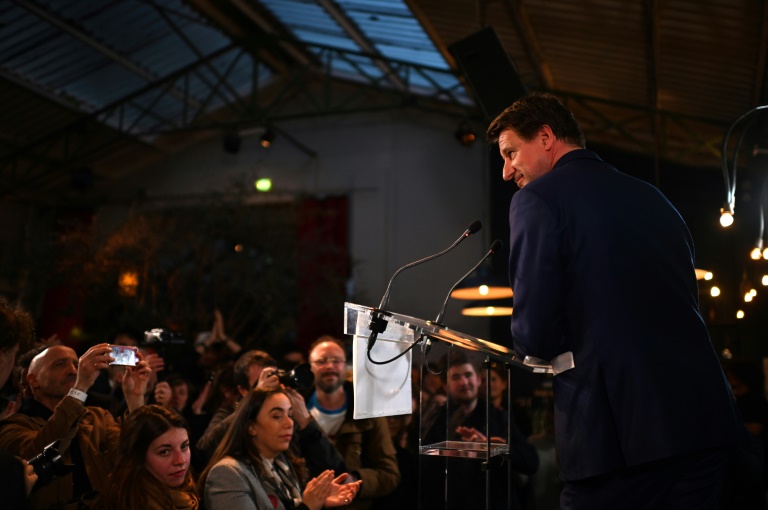
Yannick Jadot from the Europe Ecology-The Greens party (EELV) was eliminated in Sunday’s first round with a score of around 4.6 percent, following a campaign that never gathered momentum.

Under French campaign financing rules, only candidates who score above 5.0 percent have their expenses reimbursed by the state, leaving the Greens with a huge hole in their accounts.

“The situation is critical and the fact that we came below the bar of five percent puts us in a very, very difficult situation,” national secretary Julien Bayou told France Inter radio on Monday.

He appealed for donations from those who backed the party, as well as others “who would have liked to vote for Yannick Jadot and perhaps voted for another candidate.”

“We need this support to be able to continue to ensure the ecology movement lives on,” Bayou added.

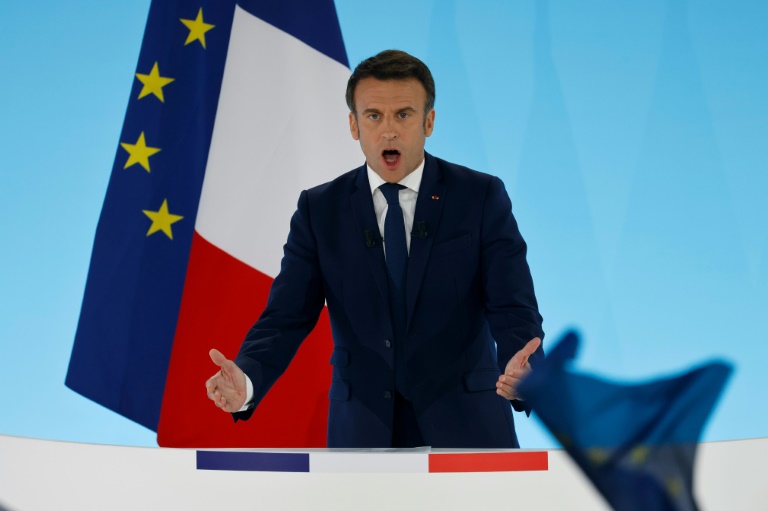
President Emmanuel Macron finished top in Sunday’s vote on around 27.6 percent followed by far-right leader Marine Le Pen on 23.4 percent, with the pair set to contest a run-off vote scheduled for April 24.

EELV was not the only party appealing for financial help on Monday, with the once-mighty right-wing Republicans also facing a 7.0-million-euro ($7.6 million) hole in their finances after their candidate, Valerie Pecresse, scored just under 5.0 percent on Sunday.

The performance from Jadot, a former Greenpeace executive, spelled bitter disappointment for his party which was hoping to build on successes in local elections last year which saw them sweep major cities from Lyon to Bordeaux. 

Germany’s historically more powerful Green party entered government after elections last year and controls several ministries and key posts in the cabinet, including the foreign minister role. 

– ‘Enormous disappointment’ –

Adding to tensions, the office of the EELV in the western city of Nantes was attacked during election night by individuals who threw projectiles at the windows and daubed the word “traitors” on the door.

Jadot after the election urged supporters to vote for Macron against Le Pen in the run-off and had also refused to give way in the campaign to allow hard-left candidate Jean-Luc Melenchon a better chance of making the final round.

Jadot scored slightly better than the last ecologist candidate to stand — Eva Joly with 2.3 percent in 2012 — but less well than Noel Mamere in 2002 who secured 5.25 percent despite the stakes for the planet being much higher in 2022.

In a concession speech on Sunday night, Jadot said his programme sought to respond to the challenges posed by climate change, as well as growing economic inequalities in France.

“It’s an understatement to say that these vital challenges — vital for our country, vital for us and our children — were largely ignored in a campaign that was confiscated,” he said.

The Covid-19 pandemic overshadowed the start of campaigning before Russia’s invasion of Ukraine changed the dynamic completely, making foreign policy and the rocketing cost of living key issues for voters.

Jadot was also eclipsed by Melenchon, who put a big emphasis on the environment during his campaign.

Remi Lefebvre, a French political scientist at the University of Lille in northern France, told AFP before the vote that the Greens had been “the enormous disappointment of this campaign.”

“The problem with the greens is its social base,” he explained. “They can’t reach working-class people because the greens are not seen as reassuring.”

Low-income families often see their pitch as boiling down to “they’re going to ask us to tighten our belts even more”, Lefebvre said, while the educated, urban middle classes tended to vote for Macron.

Jadot, calling on his 1.5 million voters on Sunday to back Macron in the second round to bar the far-right from power, pointed out his differences with the president.

He said the vote “is not approval for your responsibility in the fracturing of the country due to your inaction on the climate, your social failures, conformism and democratic contempt.”
French bank Societe Generale to sell Russia unit to oligarch

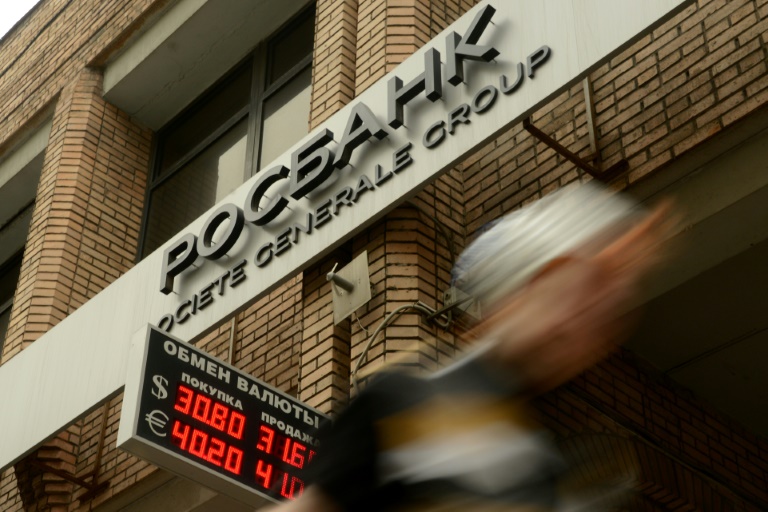
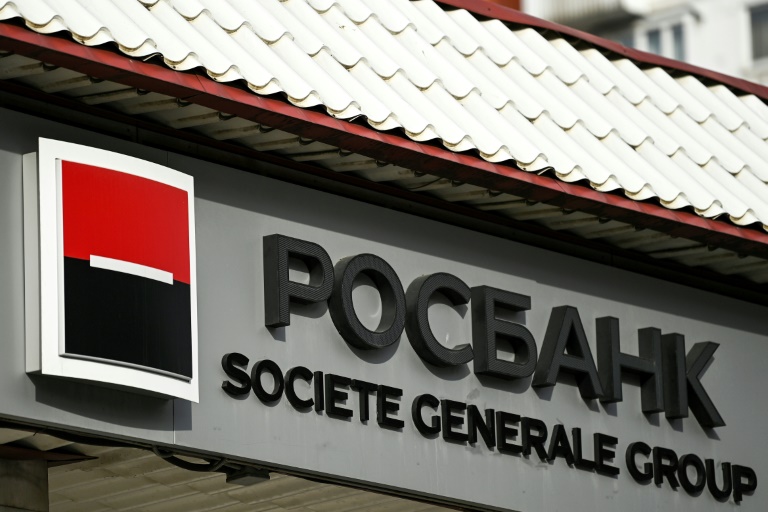
French banking group Societe Generale said on Monday it was ceasing activities in Russia and selling its Rosbank unit to an investment firm founded by an oligarch close to the Kremlin.

The exit will cost the firm 3.1 billion euros ($3.4 billion).

Hundreds of foreign companies, from financial firms to fast-food restaurants, have pulled out of Russia since the February 24 invasion of Ukraine.

But French firms, which are the biggest foreign employers in Russia, have been among the slowest to withdraw, prompting Ukrainian President Volodymyr Zelensky to urge them to leave during an address to the French parliament on March 23.

Societe Generale is heavily involved in Russia, with exposure of 18.6 billion euros. Of that, 15.4 billion euros was linked to Rosbank, a heavyweight in the Russian banking sector, in which Societe General is the main shareholder.

Shares in Societe Generale ended the day 5.0 percent higher.

“Societe Generale ceases its banking and insurance activities in Russia,” the firm said in a statement.

It also announced “the signing of a sale and purchase agreement to sell its entire stake in Rosbank and the Group’s Russian insurance subsidiaries” to Interros Capital, an investment firm founded by one of Russia’s richest oligarchs, Vladimir Potanin.

Potanin, who is close to President Vladimir Putin, is also the co-owner of Russian mining giant Norilsk Nickel.

“With this agreement, concluded after several weeks of intensive work, the group would exit in an effective and orderly manner from Russia, ensuring continuity for its employees and clients,” Societe Generale said.

The bank said it expected the deal to be completed in the coming weeks and that it was subject to approval from regulators.

The bank said it would write off some two billion euros of the net book value of the divested activities and take a further 1.1-billion-euro non-cash hit.

“One could criticise the decision to sell to this type of buyer but on the other hand there weren’t many people queuing up to buy,” an expert who declined to be identified told AFP.

He said the conditions under which the sale had taken place had been “very complicated” and “limited to candidates already in situ”.

Societe Generale had held talks with other prospective buyers, a source close to the bank told AFP.

– ‘Great resistance’ –

In a separate statement, Interros said that “the conditions for the deal have been approved by the government commission on control over foreign investment in the Russia Federation”.

“Interros intends to do the maximum efforts to develop Rosbank,” Potanin said in his company’s statement.

“The main objective is to maintain the stability of Rosbank, as well as create new opportunities for its clients and partners,” he said.

In a statement, Rosbank said it was “certain” that the firm would maintain its stability thanks to its “expertise” and reliance on “international expertise”.

The Russian bank said it built “great resistance” to economic turmoil due to its “well-thought-out risk policy” as well as its balanced loan portfolio and diversified liquidity base.

Meanwhile, Societe Generale’s auto leasing subsidiary, ALD, said it would not enter into new commercial transactions in Russia, Kazakhstan and Belarus.

Since Zelensky’s speech to the French parliament, auto giant Renault suspended operations at its Moscow factory and hinted that it might divest its majority stake in domestic car giant AvtoVAZ, while French sports retailer Decathlon halted sales at its stores in Russia.

Another major French company singled out by Zelensky, supermarket chain Auchan, has decided to stay, citing the “human” cost of leaving.

The Western exodus followed the invasion and a slew of Western sanctions on Russia, including the freezing of $300 billion of the country’s foreign currency reserves abroad.

Russia has since faced the risk of defaulting on its debt.

24 dead in Philippines landslides, flooding

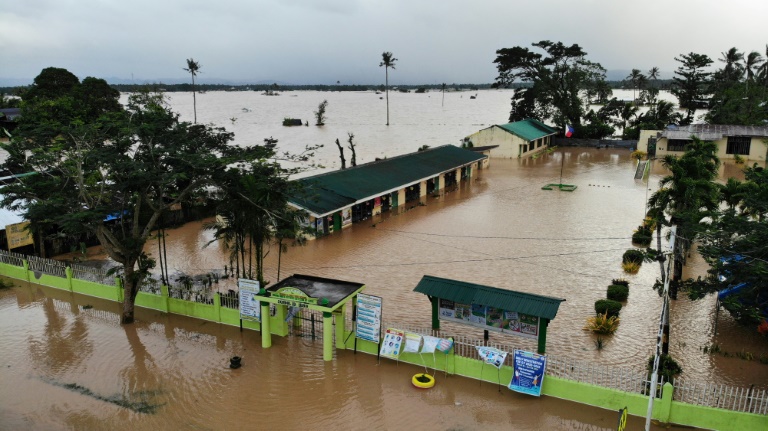
At least 24 people have been killed in landslides and flooding across central and southern Philippines, authorities said Monday, after tropical storm Megi dumped heavy rain and disrupted travel ahead of the Easter holidays.

More than 13,000 people fled to emergency shelters as the storm pounded the region Sunday, the national disaster agency said, flooding houses, inundating fields, cutting off roads and knocking out power.

The central province of Leyte was among the hardest hit, with landslides leaving 21 people dead in four villages, Baybay City disaster officer Rhyse Austero told AFP. 

Leyte’s death toll adds to another three people killed on the main southern island of Mindanao, the national disaster agency said. 

Photos posted on Facebook and verified by AFP show several houses buried in mud up to the rooftops in Bunga, one of the affected villages in Leyte.

“Yesterday the rain was so hard, it was non-stop for more than 24 hours,” resident Hannah Cala Vitangcol told AFP. 

The 26-year-old teacher fled with her family to a hotel Monday after waking to find nearby homes had been covered in an avalanche of mud.

“I was crying because I know the people buried there and I was also scared because there were mountains behind our house,” she said.

Baybay City council member Mark Unlu-cay posted photos on Facebook showing survivors from another village, Kantagnos, being treated in hospital.

“It seems like the entire community… was badly hit by the landslide and the riverflow,” he said.

Unlu-cay said he feared the death toll could rise after receiving reports that other villages had also been inundated by the waves of earth and mud.

Philippine Coast Guard and police personnel rescued people from their homes in the flooded town of Abuyog, carrying residents onto orange stretchers laid on floating boats. 

– First major storm in 2022 –

Tropical storm Megi — known in the Philippines by its local name Agaton — is the first major storm to hit the disaster-prone country this year. 

Whipping up seas, it forced dozens of ports to suspend operations and stranded nearly 6,000 people at the start of one of the busiest travel periods of the year.

The Philippines re-opened to fully vaccinated tourists from most countries in February after lifting most Covid-19 restrictions, and Easter is a popular holiday for domestic tourists.

The storm comes four months after a super typhoon devastated swathes of the archipelago nation, killing more than 400 people and leaving hundreds of thousands homeless.

Rai, the strongest typhoon to hit the Philippines last year, intensified faster than expected, officials said previously. 

Scientists have long warned that typhoons are strengthening more rapidly as the world becomes warmer because of human-driven climate change.

The Philippines — ranked among the most vulnerable nations to its impacts — is hit by an average of 20 storms every year.

In 2013, Typhoon Haiyan was the strongest storm ever to have made landfall, leaving over 7,300 people dead or missing. 

Indian software provider TCS sees strong earnings, record orders

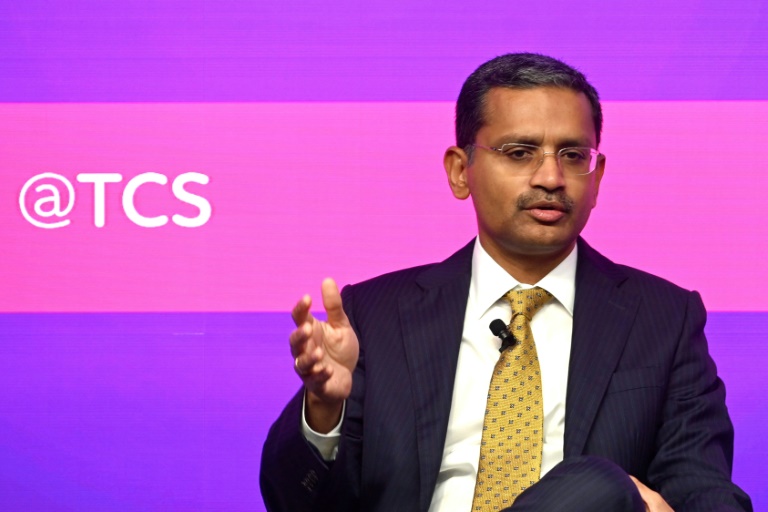
India’s largest software exporter Tata Consultancy Services reported strong quarterly earnings on Monday as demand for digital services brought in orders worth a record $11.3 billion.

Net profit at the IT giant rose to 99.26 billion rupees ($1.3 billion) in the three months ending March 31, which was 7.4 percent higher than in the same period last year.

Sustained demand across business segments pushed revenues 15.8 percent higher year-on-year to 505.91 billion rupees, crossing 500 billion for the first time.

“It’s been a very strong year and we are quite happy about the way we have executed this rebound post-pandemic,” chief executive and managing director Rajesh Gopinathan said in a media briefing.

“One of the biggest positives in this quarter has been the total volume of deals signed,” Gopinathan added.

The Mumbai-headquartered company said the value of its order book stood at $11.3 billion at the end of March, its highest ever.

This includes two large deals worth more than $1 billion each, Gopinathan told reporters.

The company — one of India’s largest private employers — hired more than 35,000 employees in the quarter to help meet demand and combat high attrition.

TCS was at the forefront of an IT boom that saw India become a back office to the world as firms in North America and Europe subcontracted work, taking advantage of a skilled English-speaking workforce.

The company earns more than 80 percent of its revenues from Western markets.

Its overseas growth in the quarter was led by North America, which contributed half of its business and saw revenue growth of 18.7 percent year-on-year.

“North America is the big story of the year,” Gopinathan said, adding that Britain, continental Europe and Latin America also clocked double-digit revenue growth.

TCS, India’s second-most valuable firm by market size, announced a final dividend of 22 rupees per share.

Shares in the firm closed 0.26 percent higher in Mumbai ahead of the release of the results.

French bank Societe Generale to sell Russia unit to oligarch

French banking group Societe Generale said Monday it was ceasing activities in Russia and selling its Rosbank unit to an investment firm founded by an oligarch close to the Kremlin.

The exit will cost the firm 3.1 billion euros ($3.4 billion).

Hundreds of foreign companies, ranging from financial firms to retailers and fast-food restaurants, have pulled out of Russia since the February 24 invasion.

But French firms, which are the biggest foreign employers in Russia, have been among the slowest to withdraw, prompting Ukrainian President Volodymyr Zelensky to urge them to leave during an address to the French parliament on March 23.

“Societe Generale ceases its banking and insurance activities in Russia,” the firm said in a statement.

It also announced “the signing of a sale and purchase agreement to sell its entire stake in Rosbank and the Group’s Russian insurance subsidiaries” to Interros Capital, an investment firm founded by one of Russia’s richest oligarchs, Vladimir Potanin.

Potanin, who is close to President Vladimir Putin, is also the co-owner of Russian mining giant Norilsk Nickel.

“With this agreement, concluded after several weeks of intensive work, the Group would exit in an effective and orderly manner from Russia, ensuring continuity for its employees and clients,” Societe Generale said.

The bank said it expects the deal to be completed in the coming weeks and that it was subject to approval from regulators.

Societe Generale shares fell following the announcement but bounced back later in the day. 

The bank said it would write off some two billion euros of the net book value of the divested activities and take a further 1.1-billion-euro non-cash hit.

– ‘Great resistance’ –

In a separate statement, Interros said that “the conditions for the deal have been approved by the government commission on control over foreign investment in the Russia Federation”.

“Interros intends to do the maximum efforts to develop Rosbank,” Potanin said in his company’s statement.

“The main objective is to maintain the stability of Rosbank, as well as create new opportunities for its clients and partners,” he said.

In a statement, Rosbank said it was “certain” that the firm would maintain its stability thanks to its “expertise” and reliance on “international expertise”.

The Russian bank said it built “great resistance” to economic turmoil due to its “well-thought-out risk policy” as well as its balanced loan portfolio and diversified liquidity base.

Meanwhile, Societe Generale’s auto leasing subsidiary, ALD, said it would not enter into new commercial transactions in Russia, Kazakhstan and Belarus.

Since Zelensky’s speech to the French parliament, auto giant Renault suspended operations at its Moscow factory and hinted that it might divest its majority stake in domestic car giant AvtoVAZ, while French sports retailer Decathlon halted sales at its stores in Russia.

Another major French company singled out by Zelensky, supermarket chain Auchan, has decided to stay, citing the “human” cost of leaving.

The Western exodus followed the invasion and a slew of Western sanctions on Russia, including the freezing of $300 billion of the country’s foreign currency reserves abroad.

Russia has since faced the risk of defaulting on its debt.

Paris stocks, euro gain on Macron vote result

The Paris stock market and the euro rose on Monday, with investors soothed by French President Emmanuel Macron’s election performance.

Frankfurt and London equities however followed Asian exchanges lower, with sentiment souring on flat UK economic growth.

Wall Street opened on the downside as traders looked ahead to inflation data due out on Tuesday, growth worries and the prospect of more aggressive US interest rate hikes.

Oil prices tumbled more than five percent at one point on Chinese demand fears arising from Covid lockdowns, and on dimming hope of a European embargo on Russian crude, dealers said.

“It is above all the bad news from China that is weighing on prices, as the number of Covid cases continues to surge,” said Commerzbank analyst Barbara Lambrecht.

Shanghai eased restrictions on some neighbourhoods on Monday after mounting outcry over China’s inflexible Covid-19 rules, which locked down 25 million people.

“The lockdowns that are slowing oil demand in the world’s second-largest consumer country threaten to persist for even longer,” added Lambrecht.

– ‘Solid result’ –

Macron topped France’s first-round presidential vote on Sunday, leading far-right rival Marine Le Pen by a larger-than-expected margin.

Emmanuel Macron won 27.85 percent of votes in the first round of France’s presidential election, while far-right leader Marine Le Pen scored 23.15 percent, according to final results.

“A solid result for incumbent Emmanuel Macron … has helped to allay fears of a Le Pen presidency,” said economist Jessica Hinds at research consultancy Capital Economics. 

“But the latest polls still point to a very tight race.”

Investors had fretted about the implications of a victory for Le Pen in the midst of the war in Ukraine, given her long-standing sympathies for Russia.

“All attention will now turn to the second round on April 24, and the big question for that will be where the supporters of the defeated first-round candidates go,” wrote Deutsche Bank analysts in a client note.

On the downside, London stocks slid on official data showing that the UK economy had ground to a near halt in February, growing by just 0.1 percent.

– Dollar eyes 2002 yen peak –

Elsewhere, the dollar hit a 2015 high at 125.77 yen on expectations of more US Federal Reserve interest rate hikes, in contrast with the Bank of Japan’s loose policy.

That was not far from the greenback’s two-decade peak of 125.86 yen.

The Fed has recently taken a hawkish tone as it embarks on an aggressive tightening path to counter runaway inflation.

In China, factory-gate inflation was higher than expected in March, official data showed, as Russia’s war on Ukraine pushes up oil prices while a domestic Covid-19 resurgence strains food supplies and consumer costs.

The producer price index — measuring the cost of goods at the factory gate — grew 8.3 percent on-year, National Bureau of Statistics (NBS) figures showed.

In Jakarta, Indonesia’s biggest tech firm GoTo soared on its debut after a billion-dollar IPO — the world’s fifth-biggest this year.

– Key figures at around 1330 GMT –

Paris – CAC 40: UP 0.3 percent at 6,568.02 points

London – FTSE 100: DOWN 0.5 percent at 7,630.80

Frankfurt – DAX: DOWN 0.8 percent at 14,173.79

EURO STOXX 50: UP 0.5 percent at 3,840.26

New York – Dow: DOWN 0.3 percent at 34,632.54

Tokyo – Nikkei 225: DOWN 0.61 percent at 26,821.52 (close)

Hong Kong – Hang Seng Index: DOWN 3.03 percent at 21,208.30 (close)

Shanghai – Composite: DOWN 2.61 percent at 3,167.13 (close)

Euro/dollar: UP at $1.0893 from $1.0877 late Friday

Pound/dollar: UP at $1.3032 from $1.3025

Euro/pound: UP at 83.59 pence from 83.51 pence

Dollar/yen: UP at 125.59 yen from 124.34 yen

Brent North Sea crude: DOWN 3.5 percent at $99.14 per barrel

West Texas Intermediate: DOWN 3.8 percent at $94.56 per barrel

burs-rl/gil

French Greens face crisis after failed presidential bid

France’s Green party were facing a financial and political crisis on Monday after a deeply disappointing presidential election saw their candidate finish sixth and struggle to put climate change on the national agenda.

Yannick Jadot from the Europe Ecology-The Greens party (EELV) was eliminated in Sunday’s first round with a score of around 4.6 percent, following a campaign that never gathered momentum.

Under French campaign financing rules, only candidates who score above 5.0 percent have their expenses reimbursed by the state, leaving the Greens with a huge hole in their accounts.

“The situation is critical and the fact that we came below the bar of five percent puts us in a very, very difficult situation,” national secretary Julien Bayou told France Inter radio on Monday.

He appealed for donations from those who backed the party, as well as others “who would have liked to vote for Yannick Jadot and perhaps voted for another candidate.”

“We need this support to be able to continue to ensure the ecology movement lives on,” Bayou added.

President Emmanuel Macron finished top in Sunday’s vote on around 27.6 percent followed by far-right leader Marine Le Pen on 23.4 percent, with the pair set to contest a run-off vote scheduled for April 24.

EELV was not the only party appealing for financial help on Monday, with the once-mighty right-wing Republicans also facing a 7.0-million-euro ($7.6 million) hole in their finances after their candidate, Valerie Pecresse, scored just under 5.0 percent on Sunday.

The performance from Jadot, a former Greenpeace executive, spelled bitter disappointment for his party which was hoping to build on successes in local elections last year which saw them sweep major cities from Lyon to Bordeaux. 

Germany’s historically more powerful Green party entered government after elections last year and controls several ministries and key posts in the cabinet, including the foreign minister role. 

– ‘Enormous disappointment’ –

Jadot scored slightly better than the last ecologist candidate to stand — Eva Joly with 2.3 percent in 2012 — but less well than Noel Mamere in 2002 who secured 5.25 percent despite the stakes for the planet being much higher in 2022.

In a concession speech on Sunday night, Jadot said his programme sought to respond to the challenges posed by climate change, as well as growing economic inequalities in France.

“It’s an understatement to say that these vital challenges — vital for our country, vital for us and our children — were largely ignored in a campaign that was confiscated,” he said.

The Covid-19 pandemic overshadowed the start of campaigning before Russia’s invasion of Ukraine changed the dynamic completely, making foreign policy and the rocketing cost of living key issues for voters.

Jadot was also eclipsed by hard-left candidate Jean-Luc Melenchon, who put a big emphasis on the environment during his campaign and finished third, only narrowly missing out on a place in the run-off.

Remi Lefebvre, a French political scientist at the University of Lille in northeast France, told AFP before the vote that the Greens had been “the enormous disappointment of this campaign.”

“The problem with the greens is its social base,” he explained. “They can’t reach working-class people because the greens are not seen as reassuring.”

Low-income families often see their pitch as boiling down to “they’re going to ask us to tighten our belts even more”, Lefebvre said, while the educated, urban middle classes tended to vote for Macron.

Jadot called on his 1.5 million voters on Sunday to back Macron in the second round to bar the far-right from power, while pointing out his differences with the president.

He said the vote “is not approval for your responsibility in the fracturing of the country due to your inaction on the climate, your social failures, conformism and democratic contempt.”
Tesla China exports only 60 cars in March as Covid hits auto sector

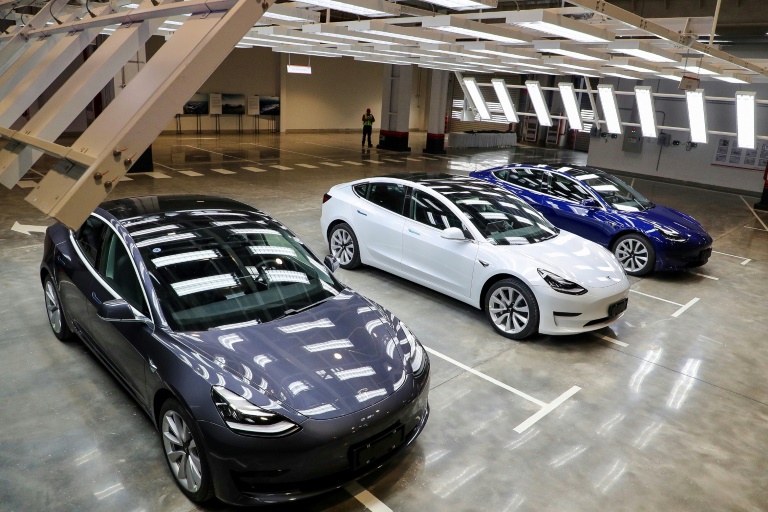
Tesla exported only 60 China-made cars in March, a trade body said Monday, with the domestic market absorbing most of its production while virus curbs in areas like Shanghai and Jilin hurt deliveries in the auto industry.

Shanghai is home to Tesla’s multibillion-dollar “giga-factory”, which the company calls its main export hub and has the capacity to produce hundreds of thousands of vehicles per year.

But the factory — like much of the country’s auto industry — has been hit by pandemic-related disruptions.

While Tesla China delivered 65,814 cars at its factory last month, only 60 were exported, the China Passenger Car Association (CPCA) said Monday, without giving further details.

In comparison, the company had exported 33,315 vehicles in February. 

Tesla’s slump is part of a wider trend across China, which saw car sales fall 10.5 percent from a year ago to 1.6 million vehicles on the back of strict measures to curb renewed virus flare-ups that have hit logistics and retail sales.

However, the new-energy sector appears to be the rare bright spot, with deliveries of the vehicles jumping 137.6 percent, compared to March 2021, and reaching 445,000 units, the CPCA said. 

Despite a chip shortage and high lithium prices, CPCA’s secretary-general Cui Dongshu said China’s share of the world’s auto market has “reached a new high of 36 percent” in the first two months of the year.

All eyes will be on Tesla’s numbers in April, given that its Shanghai factory has reportedly suspended production since March 28 amid the city’s virus lockdowns.

Beijing’s zero-Covid policy to stamp out clusters has been increasingly strained as the country battles its worst wave of infections since the start of the pandemic

Chinese electric vehicle maker Nio said Saturday it has suspended vehicle production due to hard lockdowns across the country, and warned of delays in making deliveries.

Indonesia tech giant GoTo soars on market debut

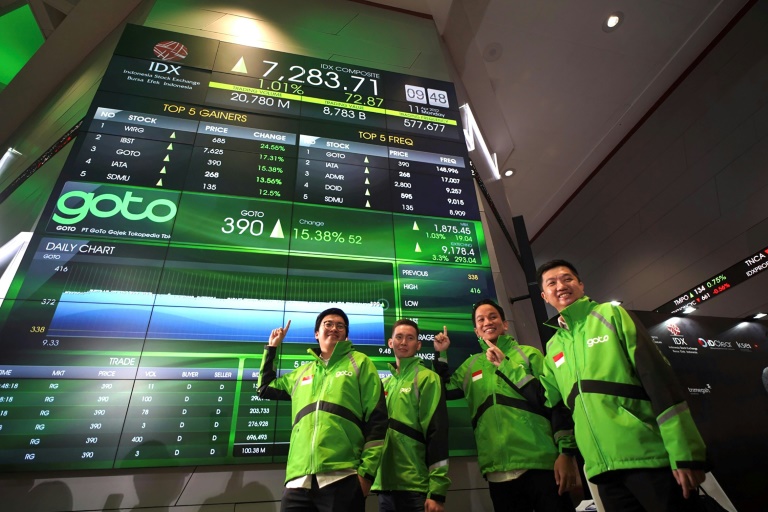
Indonesia’s biggest tech firm soared on its market debut Monday after a billion-dollar IPO that was the world’s fifth-biggest this year, defying recent heavy weather for Asian tech stocks.

GoTo, the largest digital ecosystem in the archipelago nation of 270 million people, was formed by the merger of ride-hailing company Gojek and e-commerce platform Tokopedia in May 2021.

Clad in the signature black-and-green jacket of a Gojek driver, GoTo CEO Andre Soelistyo pressed the 9:00 am opening bell at the Jakarta stock exchange.

“Despite global market volatility, investor interest has been strong, reflecting the rapidly growing demand in Southeast Asia for our on-demand, e-commerce and financial technology services, as well as confidence in GoTo’s position as the largest digital ecosystem in Indonesia,” he said in a press release.

GoTo shares jumped as much as 23 percent in early trade before closing 13.02 percent higher at 382 rupiah. Overall, Jakarta stocks ended down 0.10 percent.

The company raised about $1.1 billion in its IPO that concluded last week, priced at 338 rupiah a share, representing a market value of about $28 billion, it announced.

It has sold shares for $954.7 million (13.7 trillion rupiah) plus $146.3 million from treasury shares for the purpose of over-allotment.

Based on the total funds raised, GoTo’s IPO is the third-largest in Asia and fifth-largest in the world this year, it said.

The company announced last week it would distribute shares worth about $21.6 million to hundreds of thousands of its drivers.

One of the lucky drivers was Ryan Supriandi, who has been a Gojek driver for nearly seven years. 

Supriandi was pleasantly surprised to receive a mobile notification saying the company had granted him 4,000 shares, worth about $90.

“I was happy and confused at the same time — what am I going to do with it? Many drivers don’t understand shares or markets,” the 34-year-old told AFP. 

– US listing planned –

President Joko Widodo congratulated GoTo on its debut.

“I hope GoTo IPO will motivate Indonesian youth to give new energy for the leap of our country’s economic development,” Widodo said.

But Reza Priyambada, a stock market analyst from CSA Research Institute, said that while it was still too early to judge how GoTo would perform, investors should proceed cautiously.

“While they do claim to be the biggest marketplace in Indonesia, they are still suffering losses at the moment,” Priyambada said.

“Right now investors are still under a euphoria, but we don’t know if they really understand how GoTo works, what are their prospects and how the management is run.”

GoTo has not published profits yet. The exchange reported that from January to July 2021 the company posted more than $556 million in net losses.

Last year, another Indonesian unicorn, Bukalapak, launched the biggest initial offering in the history of the country’s stock market, raising more than $1.5 billion.

However, shares in the online marketplace have since dropped by around 60 percent, instilling doubts in the Southeast Asian tech sector.

A successful IPO for GoTo could open the door to a string of listings in the country as several tech firms — including Traveloka, LinkAja, J&T Express, Tiket and Blibli — are also set to make their market debut, according to local media.

GoTo, whose main competitors in the region are SEA and Grab, has said previously that it was also planning a US listing.

In November it said it had raised $1.3 billion from various investors including Google, Singapore’s Temasek and China’s Tencent.

French bank Societe Generale to exit Russia

French banking group Societe Generale said Monday it was ceasing activities in Russia and selling its majority stake in Rosbank, weeks after Ukraine’s leader urged French firms to leave over Moscow’s invasion of the country.

Hundreds of foreign companies, ranging from financial firms to retailers and fast-food restaurants, have pulled out of Russia since the February 24 invasion.

But French firms, which are the biggest foreign employers in Russia, have been among the slowest to withdraw, prompting Ukrainian President Volodymyr Zelensky to urge them to leave during an address to the French parliament on March 23.

Societe Generale said in a statement that its withdrawal from Russia would cost it 3.1 billion euros ($3.4 billion).

“Societe Generale ceases its banking and insurance activities in Russia,” the firm said in a statement.

It also announced “the signing of a sale and purchase agreement to sell its entire stake in Rosbank and the Group’s Russian insurance subsidiaries” to Interros Capital, an investment firm founded by one of Russia’s richest oligarchs, Kremlin confidant Vladimir Potanin.

“With this agreement, concluded after several weeks of intensive work, the Group would exit in an effective and orderly manner from Russia, ensuring continuity for its employees and clients,” Societe Generale said.

The bank said it expects the deal to be completed in the coming weeks and that it was subject to approval from regulators.

Societe Generale shares were down by almost six percent following the announcement.

– ‘Great resistance’ –

In a separate statement, Interros said that “the conditions for the deal have been approved by the government commission on control over foreign investment in the Russia Federation”.

“Interros intends to do the maximum efforts to develop Rosbank,” Potanin said in his company’s statement.

“The main objective is to maintain the stability of Rosbank, as well as create new opportunities for its clients and partners,” he said.

In a statement, Rosbank said it was “certain” that the firm would maintain its stability thanks to its “expertise” and reliance on “international expertise”.

The Russian bank said it built “great resistance” to economic turmoil due to its “well-thought-out risk policy” as well as its balanced loan portfolio and diversified liquidity base.

Meanwhile, Societe Generale’s auto leasing subsidiary, ALD, said it would not enter into new commercial transactions in Russia, Kazakhstan and Belarus.

Since Zelensky’s speech to the French parliament, auto giant Renault suspended operations at its Moscow factory and hinted that it might divest its majority stake in domestic car giant AvtoVAZ, while French sports retailer Decathlon halted sales at its stores in Russia.

Another major French company singled out by Zelensky, supermarket chain Auchan, has decided to stay, citing the “human” cost of leaving.

The Western exodus followed the invasion and a slew of Western sanctions on Russia, including the freezing of $300 billion of the country’s foreign currency reserves abroad.

Russia has since faced the risk of defaulting on its debt.

Close Bitnami banner
Bitnami