AFP

In 'project of the century', Swiss seek to bury radioactive waste

Storing radioactive waste above ground is a risky business, but the Swiss think they have found the solution: burying spent nuclear fuel deep underground in clay.

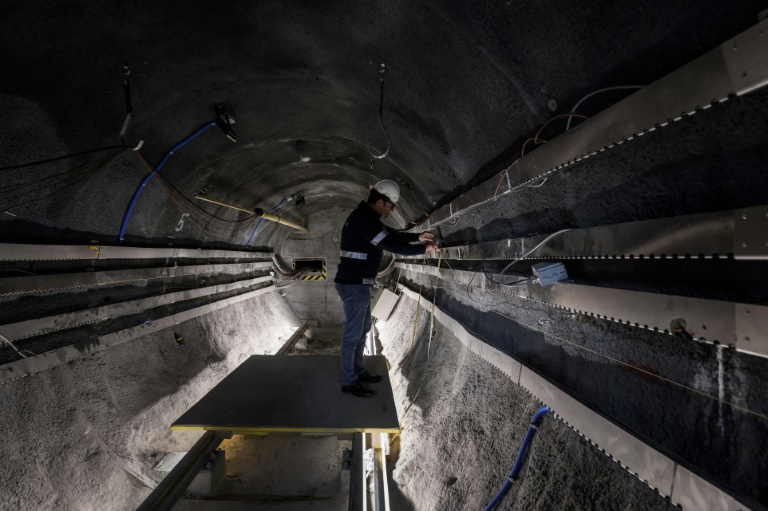
The Mont Terri international laboratory was built to study the effects of burying radioactive waste in clay which sits 300 metres (985 feet) below the surface near Saint-Ursanne in the northwestern Jura region.

The underground laboratory stretches across 1.2 kilometres (0.7 miles) of tunnels. Niches along the way, each around five metres high, are filled with various storage simulations, containing small quantities of radioactive material monitored by thousands of sensors.

More than 170 experiments have been carried out to simulate the different phases of the process — positioning the waste, sealing off the tunnels, surveillance — and to reproduce every imaginable physical and chemical effect.

According to experts, it takes 200,000 years for the radioactivity in the most toxic waste to return to natural levels.

Geologist Christophe Nussbaum, who heads the laboratory, said researchers wanted to determine what the possible effects could be “on storage that needs to last for nearly one million years.”

That “is the duration that we need to ensure safe confinement,” he said, adding that so far, “the results are positive.”

– Potential sites identified –

Three prospective sites in the northeast, near the German border, have been identified to receive such radioactive waste. 

Switzerland’s nuclear plant operators are expected to choose their preferred option in September.

The Swiss government is not due to make the final decision until 2029, but that is unlikely to be the last word as the issue would probably go to a referendum under Switzerland’s famous direct democracy system.

Despite the drawn-out process, environmental campaigners Greenpeace say Switzerland is moving too fast.

“There are a myriad of technical questions that have not been resolved,” Florian Kasser, in charge of nuclear issues for the environmental activist group, told AFP.

For starters, he said, it remains to be seen if the systems in place can “guarantee there will be no radioactive leakage in 100, 1,000 or 100,000 years.”

“We are putting the cart before the horse, because with numerous questions still unresolved, we are already looking for sites” to host the storage facilities, he said.

Kasser said Switzerland also needed to consider how it will signal where there sites are to ensure they are not forgotten, and that people many centuries from now remain aware of the dangers.

Swiss nuclear power plants have been pumping out radioactive waste for more than half a century.

Until now, it has been handled by the National Cooperative for the Disposal of Radioactive Waste, or NAGRA, founded in 1972 by the plant operators in conjunction with the state.

For now, the waste is being stored in an “intermediary depot” in Wurenlingen, some 15 kilometres from the German border.

– Horizon 2060 –

Switzerland hopes to join an elite club of countries closing in on deep geological storage.

So far, only Finland has built a site, in granite, and Sweden gave the green light in January to build its own site for burying spent nuclear fuel in granite. 

Next up is France, whose Cigeo project, led by the National Agency for Radioactive Waste Management (ANDRA), plans to store radioactive waste underground in clay.

“We are awaiting the declaration of public utility but in the meantime we will submit a request for a construction permit,” said ANDRA spokeswoman Emilie Grandidier during a visit to Mont Terri.

Following the 2011 nuclear accident at the Fukushima power station in Japan, Switzerland decided to phase out nuclear power gradually: its reactors can continue for as long as they remain safe.

A projected 83,000 cubic metres of radioactive waste, including some high activity waste, will have to be buried.

This volume corresponds to a 60-year operating life of the Beznau, Gosgen and Leibstadt nuclear power plants, and the 47 years that Muhleberg was in operation before closing in 2019.

Filling in the underground nuclear waste tombs should begin by 2060.

“It’s the project of the century: we have carried out the scientific research for 50 years, and we now have 50 years for the authorisation and the realisation of the project,” said Nagra spokesman Felix Glauser.

The monitoring period will span several decades before the site is sealed some time in the 22nd century.

Rising petrol prices fuel uncertainty at oil giant Petrobras

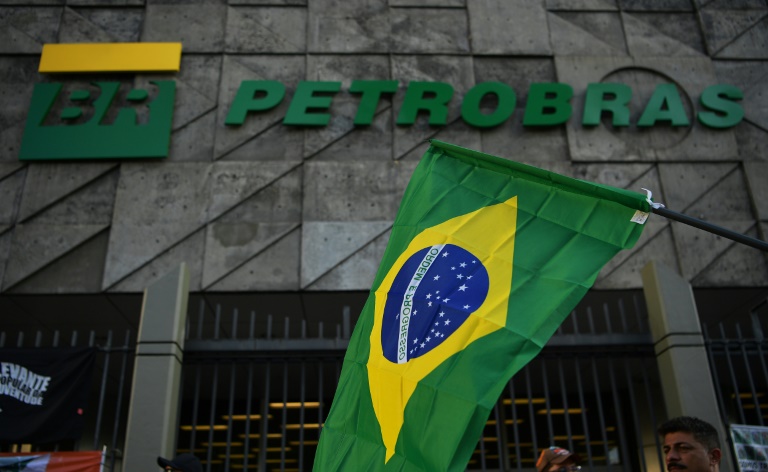
Brazil’s state-run oil company Petrobras is once again in crisis: caught in a political tug of war over rising fuel costs.

Far-right President Jair Bolsonaro, seeking re-election in October, is widely blamed by voters for double-digit inflation, polls show, on the back of skyrocketing fuel prices.

Feeling the heat, Bolsonaro last week fired Petrobras CEO Joaquim Silva e Luna, saying the petrol price was “unaffordable” and amounted to a “crime” against Brazilians.

Tied to international market movement, fuel prices in Brazil rose 33 percent in the past year even as the economy recovers from the effects of the coronavirus pandemic.

Russia’s war in Ukraine has led to a spike in crude prices in recent weeks, adding to the pressure.

“Manipulating tariff policy is like manipulating the law of gravity,” Silva e Luna said after his firing last week.

Inflation in Brazil, meanwhile, rose more than 11 percent in a year, and opinion polls show that three-quarters of Brazilians blame Bolsonaro for their thinning wallets.

Bolsonaro’s main rival, leftist former president Luiz Inacio Lula da Silva, has also vowed to “Brazilianize the fuel price” — meaning to adapt it to the reality on the ground.

Lula, a former trade unionist and popular ex-leader, is the polled favorite ahead of October’s vote.

– Sacrificial firing –

With the fuel price in both men’s crosshairs, the future of Petrobras — which determines the price of petrol at the pump — depends very much on the outcome of October’s elections.

The company has hardly had time to settle after the 2014-2021 Operation Car Wash corruption probe that saw several top politicians and business executives convicted for embezzlement of billions of dollars from the oil giant.

After a tough year in 2020 due to the coronavirus pandemic freezing global travel, Petrobras posted a record net profit of nearly $20 billion in 2021.

But the results were not enough to satisfy the political bosses.

According to economist Gesner Oliveira, Silva e Luna was sacrificed by Bolsonaro “to satisfy his electorate”. 

Silva e Luna’s predecessor, Roberto Castello Branco, was fired by the president a year earlier for similar reasons.

But replacing the latest CEO has turned out to be more difficult than foreseen.

Bolsonaro’s pick, economist Adriano Pires, withdrew his name from the race this week due to a possible conflict of interest over his other role as head of an energy consulting firm.

Another nominee of the president, Rodolfo Landim, also withdrew to concentrate his attention on the Flamengo football club of which he is president.

Several other possible candidates had declined the job, according to the Brazilian press.

Then on Wednesday, the government nominated Jose Mauro Coelho, who was in charge of oil issues at the Ministry of Mines and Energy. 

His appointment could be approved at a shareholders’ meeting on April 13, making him the 40th Petrobras CEO in 68 years.

– ‘Complex economic problem’ –

Whoever is at the helm, the pressure from the top will be intense.

“This is a position exposed to very strong political pressure, and each dismissal is an easy political response to a complex economic problem,” Adriano Laureno of consulting firm Prospectiva told AFP.

Analysts say that internal regulations at Petrobras, which is listed on the New York and Sao Paulo stock exchanges, as well as Brazil’s reliance on imported oil, prevent any drastic change in pricing policy.

“A stabilization fund could be set up to mitigate price fluctuations, but it is not possible to change the tariff policy in depth,” said Oliveira.

Petrobras is also under threat of privatization, a move favored by Bolsonaro and several of his top political backers.

Rising petrol prices fuel uncertainty at oil giant Petrobras

Brazil’s state-run oil company Petrobras is once again in crisis: caught in a political tug of war over rising fuel costs.

Far-right President Jair Bolsonaro, seeking re-election in October, is widely blamed by voters for double-digit inflation, polls show, on the back of skyrocketing fuel prices.

Feeling the heat, Bolsonaro last week fired Petrobras CEO Joaquim Silva e Luna, saying the petrol price was “unaffordable” and amounted to a “crime” against Brazilians.

Tied to international market movement, fuel prices in Brazil rose 33 percent in the past year even as the economy recovers from the effects of the coronavirus pandemic.

Russia’s war in Ukraine has led to a spike in crude prices in recent weeks, adding to the pressure.

“Manipulating tariff policy is like manipulating the law of gravity,” Silva e Luna said after his firing last week.

Inflation in Brazil, meanwhile, rose more than 11 percent in a year, and opinion polls show that three-quarters of Brazilians blame Bolsonaro for their thinning wallets.

Bolsonaro’s main rival, leftist former president Luiz Inacio Lula da Silva, has also vowed to “Brazilianize the fuel price” — meaning to adapt it to the reality on the ground.

Lula, a former trade unionist and popular ex-leader, is the polled favorite ahead of October’s vote.

– Sacrificial firing –

With the fuel price in both men’s crosshairs, the future of Petrobras — which determines the price of petrol at the pump — depends very much on the outcome of October’s elections.

The company has hardly had time to settle after the 2014-2021 Operation Car Wash corruption probe that saw several top politicians and business executives convicted for embezzlement of billions of dollars from the oil giant.

After a tough year in 2020 due to the coronavirus pandemic freezing global travel, Petrobras posted a record net profit of nearly $20 billion in 2021.

But the results were not enough to satisfy the political bosses.

According to economist Gesner Oliveira, Silva e Luna was sacrificed by Bolsonaro “to satisfy his electorate”. 

Silva e Luna’s predecessor, Roberto Castello Branco, was fired by the president a year earlier for similar reasons.

But replacing the latest CEO has turned out to be more difficult than foreseen.

Bolsonaro’s pick, economist Adriano Pires, withdrew his name from the race this week due to a possible conflict of interest over his other role as head of an energy consulting firm.

Another nominee of the president, Rodolfo Landim, also withdrew to concentrate his attention on the Flamengo football club of which he is president.

Several other possible candidates had declined the job, according to the Brazilian press.

Then on Wednesday, the government nominated Jose Mauro Coelho, who was in charge of oil issues at the Ministry of Mines and Energy. 

His appointment could be approved at a shareholders’ meeting on April 13, making him the 40th Petrobras CEO in 68 years.

– ‘Complex economic problem’ –

Whoever is at the helm, the pressure from the top will be intense.

“This is a position exposed to very strong political pressure, and each dismissal is an easy political response to a complex economic problem,” Adriano Laureno of consulting firm Prospectiva told AFP.

Analysts say that internal regulations at Petrobras, which is listed on the New York and Sao Paulo stock exchanges, as well as Brazil’s reliance on imported oil, prevent any drastic change in pricing policy.

“A stabilization fund could be set up to mitigate price fluctuations, but it is not possible to change the tariff policy in depth,” said Oliveira.

Petrobras is also under threat of privatization, a move favored by Bolsonaro and several of his top political backers.

Space tourism: the arguments in favor

To its many detractors, space tourism amounts to nothing more than joy-rides for the global super rich that will worsen the planet’s climate crisis. 

But the nascent sector also has supporters, who, while not rejecting the criticism outright, argue the industry can bring humanity benefits too.

– More research opportunities –

The first argument is that private spaceflights, in addition to their customers, can send to space scientific experiments that require microgravity environments.

In the past, national agencies “it used to take quite a long time to work within government grant channels, get approval, get the funding, get picked to be among the very select few that could go,” Ariel Ekblaw, of the MIT Space Exploration Initiative told AFP.

By contrast, it took Ekblaw just six months from signing a contract to sending her research project to the International Space Station on board the private Ax-1 mission, which blasted off Friday thanks to the private entrepreneurs paying for the trip.

Her experiment, called TESSERAE, involves smart tiles that form a floating robotic swarm that can self-assemble into space architecture — which might be how future space stations are built.

An earlier prototype was flown to space for a few minutes aboard a Blue Origin suborbital spaceflight, paving the way for the new test.

“The proliferation of these commercial launch providers does allow us to do riskier, faster and more innovative projects,” said Ekblaw.

Virgin Galactic, for its part, has announced plans to take scientists on future flights.

– Better space technology – 

Space tourism, and the private space sector overall, also acts as an innovation driver for getting better at doing all things related to space.

Government agencies, which operate with taxpayers’ money, move cautiously and are deeply-averse to failure — while companies like Elon Musk’s SpaceX don’t mind blowing up prototype rockets until they get them right, speeding up development cycles.

Where NASA focuses on grand exploration goals, private companies seek to improve the rate, profitability and sustainability of launches, with reusable vessels — and in the case of Blue Origin, rockets that emit only water vapor.

For now, spaceflight remains a risky and expensive endeavor. 

“The more we go to space, the better we become at space, the more an industry base arises to support space technology,” said Mason Peck, an aeronautics professor at Cornell University who previously served as NASA’s chief technologist.

A parallel can be drawn with the early era of aviation, when flying was limited to the privileged few.

“We started out with lots of accidents, and lots of different companies with different kinds of ideas for how to build airplanes,” explained George Nield, former associate administrator for the Federal Aviation Administration (FAA) office of commercial space transportation.

“But gradually, we learned what works, what doesn’t work.” Today, commercial air travel is statistically the safest mode of transport.

But what will safer, more efficient spaceflight actually achieve?

According to experts, it is currently difficult to imagine the future impact space will have on transport.

“Just in the next 10 years, I’m pretty confident that we’re going to see companies that have systems that can have people take off from one point on the Earth, and travel to the other side of the Earth, in like an hour,” said Nield, who was on BlueOrigin’s last flight. 

Such point-to-point travel would probably eventually happen anyway, but space tourism is speeding up its advent, he added.

– Environmental benefit? –

The last argument, paradoxically, has to do with the climate. 

Many of those who have observed Earth from outer space have reported feeling deeply moved by how fragile the planet appears, and overwhelmed by a desire to protect it.

The phenomenon was dubbed the “overview effect” by space philosopher Frank White.

“It gives you a sense of urgency about needing to be part of the solution,” stressed Jane Poynter, co-founder of Space Perspective.

Her company plans to start flying tourists on a giant high-altitude balloon to observe the Earth’s curvature from a capsule with panoramic views.

The vessel was developed precisely for its minimal environmental impact, unlike some highly-polluting rockets. 

The overall contribution to climate change from rockets is currently minimal, but could become problematic if the number of launches increases.

Increased activity in space can also help the planet in more concrete, less philosophical ways, say industry advocates.

“Because of the advances in space technology, terrestrial solar cells have become more efficient over the years,” said Peck.

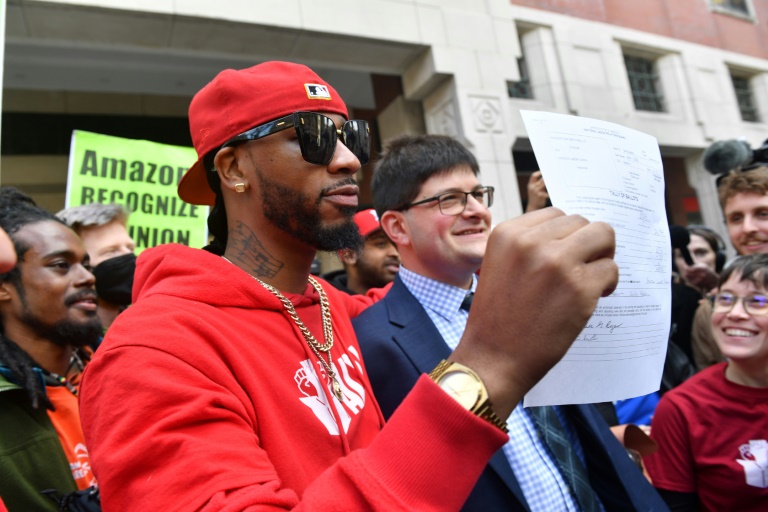
Amazon labor leader eyes national push after New York win

Leaders of the Amazon unionization campaign have heard from workers at some 100 other company facilities following last week’s upset election win in New York, the union’s president said Friday.

“We are witnessing a revolution,” Christian Smalls, president of Amazon Labor Union, said a week after the election at the JFK8 warehouse in Staten Island established the first union at a US Amazon facility.

Friday’s 90-minute event — part pep rally, part press conference — had a celebratory feel as Smalls and other leaders of the upstart union dismissed Amazon’s objections to the Staten Island vote and cheered a nascent campaigns at other Amazon facilities.

“All 50 states have contacted us, even overseas,” said Smalls, who plans a national conference call in May to share election tips with workers from other sites.

“We’re going to help them,” Smalls said. “I don’t know what that looks like, but we’re going to try.”

Amazon has signaled plans to fight the Staten Island result, telling the National Labor Relations Board it will file “substantial” objections to last week’s election based on alleged problematic election conduct on the part of the union and the board’s officials. 

The union has dismissed the Amazon statements as a stall tactic, with Smalls calling the allegations “trash.”

Smalls said he and other leaders in the New York campaign were willing to travel to other parts of the United States to assist organization and election drives.

He cited Starbucks as an example for growing a national movement. 

More than 180 Starbucks cafes have seen unionization campaigns after a pair of cafes in upstate New York voted to unionize in December. 

On Friday, three more Starbucks cafes in upstate New York voted to unionize, taking the national total to 16.

US stocks pressured amid interest rate angst as euro gyrates

Wall Street stocks mostly fell Friday amid lingering unease over tightening US monetary policy, while the euro gyrated ahead of France’s presidential election.

Both the S&P 500 and Nasdaq retreated as the yield on the 10-year US Treasury note climbed above 2.7 percent, a signal markets are preparing for more Federal Reserve monetary tightening.

All three major US indices notched losses for the week.

“Uneasiness and trepidation appeared to drive a relatively quiet session as investors continued to weigh the potential implications of a highly aggressive Fed monetary policy tightening cycle,” Charles Schwab investment bank said in a note.

The euro sank as low to $1.0837 before bouncing back, a reflection of uncertainty ahead of Sunday’s first-round French presidential vote.

The single currency has also been dented by European officials’ reticence to move as aggressively as the Fed on tackling soaring inflation.

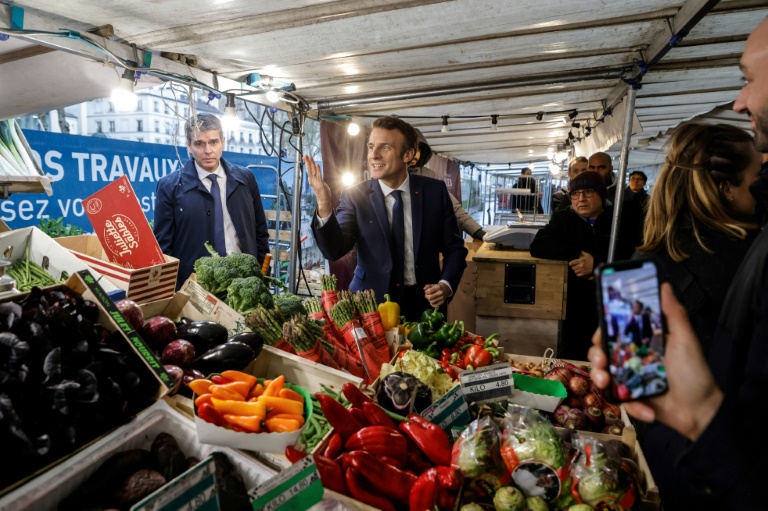
The volatility in the euro comes as polls show a tight race by French President Emmanuel Macron and his main election rival, far-right leader Marine Le Pen.

The president is projected to come out on top in Sunday’s first round of voting, but far short of the majority needed to avoid a run-off between the top two candidates on April 24 — and with Le Pen close behind.

The euro would experience a “knee-jerk” drop of about 1.5 percent in its value against the dollar if Le Pen ultimately is elected, and then will “continue falling,” Wells Fargo bank said in a note.

“Even if Le Pen wins the presidency, her party is very unlikely to garner a working parliamentary majority, but ousting or even weakening Macron could be a blow to EU integration and economic policy,” Wells Fargo said.

The lower euro helped boost bourses in Paris and Frankfurt, both of which rose more than one percent.

“Today’s positive session for European markets appears to have more to do with the fact that the strength of the US dollar has pushed both the pound and the euro lower, with the pound falling to its lowest levels since November 2020,” CMC Markets analyst Michael Hewson said.

– Key figures around 2050 GMT –

New York – Dow: UP 0.4 percent at 34,721.12 (close)

New York – S&P 500: DOWN 0.3 percent at 4,488.28 (close)

New York – Nasdaq: DOWN 1.3 percent at 13,711.00 (close)

London – FTSE 100: UP 1.6 percent at 7,669.56 (close)

Frankfurt – DAX: UP 1.5 percent at 14,283.67 (close)

Paris – CAC 40: UP 1.3 percent at 6,548.22 (close)

EURO STOXX 50: UP 1.4 percent at 3,858.37 (close)

Tokyo – Nikkei 225: UP 0.4 percent at 26,985.80 (close)

Hong Kong – Hang Seng Index: UP 0.3 percent at 21,872.01 (close)

Shanghai – Composite: UP 0.5 percent at 3,251.85 (close)

Euro/dollar: DOWN at $1.0878 from $1.0879 late Thursday

Pound/dollar: DOWN at $1.3036 from $1.3075

Euro/pound: UP at 83.43 pence from 83.20 pence

Dollar/yen: UP at 124.30 yen from 123.95 yen

Brent North Sea crude: UP 2.2 percent at $102.78 per barrel

West Texas Intermediate: UP 2.3 percent at $98.26 per barrel

burs-jmb/cs

Russia's ruble stages rebound despite Western sanctions

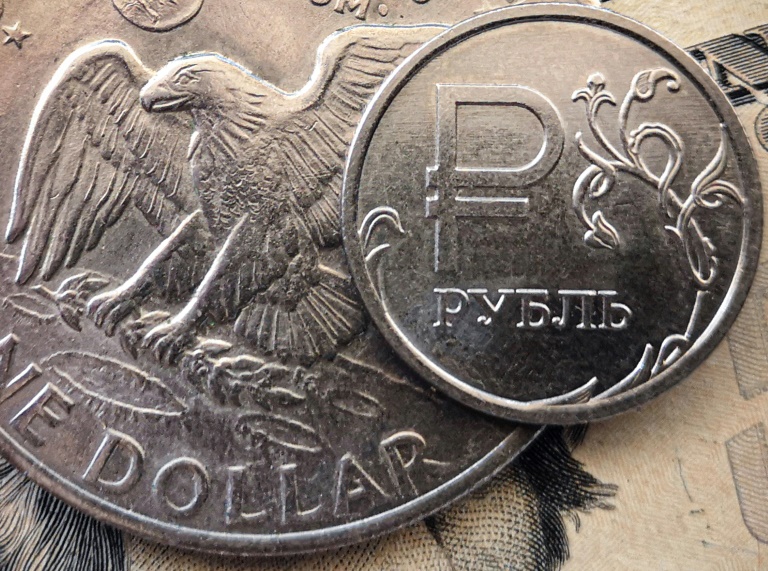
After a historic collapse in the wake of Russia’s military offensive in Ukraine, the ruble has staged a spectacular bounceback, supported by strict capital controls and energy exports. 

But analysts say that success is in many ways artificial and does not bode well for the health of the Russian economy.

The February 24 military operation triggered unprecedented Western sanctions on Moscow, sending the ruble into free-fall and accelerating already high inflation. 

Four days after President Vladimir Putin sent troops into the pro-Western country, the central bank more than doubled its key interest rate to 20 percent to prop up the financial system. 

In a surprise move on Friday, the central bank lowered the rate to 17 percent, saying risks to financial stability had “ceased to increase” for now.

“It’s clear that the Central Bank of Russia assesses that Russia’s economy is now emerging from the most acute phase of its crisis and that such restrictive monetary conditions are no longer warranted,” said Liam Peach, emerging Europe economist at Capital Economics.

The ruble’s return to levels last seen before the start of Moscow’s military campaign is a sign that the economy may be adjusting to the sanctions, economists say.

– ‘Exports are solid’ – 

Sofya Donets, chief economist at Renaissance Capital, said the ruble recovery has been aided by an unprecedented trade surplus amid high energy prices.

“There has been a decline in imports, partly because of sanctions, partly because of uncertainty and logistical disruptions,” she told AFP.

“But exports are solid, and with commodity prices high we expect a historically high account surplus of $20-25 billion in March.”

Oil and gas, Russia’s main exports, keep flowing abroad, filling Russia’s coffers. 

The United States has banned Russian oil imports and the EU adopted a ban on Russian steel imports but those penalties have largely spared key Russian exports.

“It only affects five percent of Russian exports, so it’s not that much,” said Donets.

Robust exports have been supplemented by harsh capital controls introduced by the central bank.

The West froze some $300 billion of Russia’s foreign currency reserves abroad, a move that Foreign Minister Sergei Lavrov has described as “theft”.

To counter the sanctions, exporting companies were forced to sell 80 percent of their export earnings to buy rubles. 

Russians have also been barred from withdrawing more than $10,000 in foreign currency or taking more than that amount out of the country, and foreign investors have been banned from selling Russian assets.

Late Friday the central bank relaxed some curbs, saying that from April 18 it was scrapping the ban on buying dollars and euros introduced in early March.

 – ‘PR campaign’ – 

The rapid ruble recovery does not equal a strong economy, however, analysts said.

“Russian equities and the ruble currently remain decoupled from global macro factors and news flow due to capital controls,” Alfa Bank said in a note.

The lender estimates that the ruble will be trading at around 80-85 to the dollar in the near future. 

Economists believe that the worst economic impact of the sanctions is still to come and expect Russia, which has relied heavily on imports of manufacturing equipment and consumer goods, to plunge into a deep recession.

Russia’s inflation rate reached 16.7 percent year-on-year in March, the state statistics agency said on Friday, a level not seen since 2015, while food prices have risen even more steeply.

Capital Economics pointed out that the 7.6 percent month on month rise in consumer prices in Russia in March was “the highest monthly increase since the 1990s.”

Renaissance Capital analysts predict that annual inflation will peak at 24 percent this summer.

Donets said that “the market is destroyed in a sense.”

“We have a closed financial system now,” she added.

“Where would the ruble rate be if there were no capital controls? It’s very hard to say, there has been no precedent.”

Timothy Ash, an emerging markets strategist at BlueBay Asset Management, was more blunt, saying the Bank of Russia was “heavily managing/manipulating this.”

“It’s not a liquid market,” he told AFP in emailed comments.

“This is a PR campaign by the Central Bank of Russia as a tool of the Kremlin.”

Crisis-hit Sri Lanka hikes rates as protests spiral

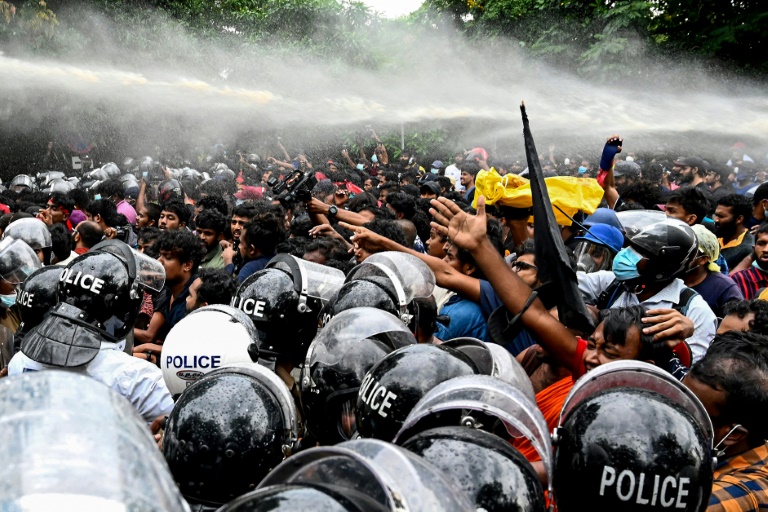
Cash-strapped Sri Lanka’s central bank hiked interest rates by a record 700 basis points Friday as police fired tear gas at hundreds of students protesting over the economic crisis.

Severe shortages of food and fuel, alongside lengthy electricity blackouts, have led to weeks of widespread anti-government demonstrations — with calls for President Gotabaya Rajapaksa to resign.

The latest protests saw students try to march Friday to the national parliament, and police used water cannons in efforts to disburse the angry crowds.

Monks, who had largely rallied the Sinhala-Buddhist majority to elect Rajapaksa at the November 2019 polls, were also seen joining demonstrations in the capital Colombo, where some defiantly stood opposite police wearing gas masks and holding riot shields.

Demonstrators nationwide carried placards saying “Gota go home”, demanding Rajapaksa and his administration step down over the country’s worst economic crisis since independence in 1948.

– Damage control –

The Central Bank of Sri Lanka said its benchmark lending rate had been raised to 14.5 percent to “stabilise the exchange rate” after the rupee tumbled over 35 percent in a month.

The rate for deposits was also increased by seven percentage points to 13.5 percent as reports said Sri Lanka’s rupee was the worst-performing currency in the world, edging out the Russian ruble.

The bank’s newly appointed governor, Nandalal Weerasinghe, said attempts to control foreign exchange markets and keep interest rates artificially low in the past year had contributed to the unprecedented economic chaos.

“We are now in damage control mode,” Weerasinghe said at his first press conference since replacing Ajith Cabraal, who was virtually forced out Monday with the country facing bankruptcy.

“We would not have had to make such a sharp increase if rates had been raised incrementally over a period of time,” Weerasinghe said, vowing to relax exchange controls introduced by his predecessor.

The bank said the shock-treatment rate hike was due to its belief that the embattled island’s inflation, already at record levels, could get worse.

The Colombo Consumer Price Index rose 18.7 percent in March while food inflation topped 25 percent, but private analysts placed inflation at over 50 percent in the month.

International rating agencies have downgraded Sri Lanka as fears grow it could default on its $51 billion external debt.

This week, Rajapaksa appointed a panel of experts to organise a restructuring of foreign debt.

His government is preparing for bailout negotiations with the International Monetary Fund, and finance ministry officials said the panel will prepare a programme for sovereign bond-holders and other creditors to take a haircut.

“What Sri Lanka is keen to do is avoid a hard default,” a source from the ministry who requested anonymity told AFP. 

“It will be a negotiated restructuring of the debt with the help of the IMF.”

Meetings with the IMF are set to begin by next week but finance minister Basil Rajapaksa, the president’s brother, resigned Sunday along with nearly the entire cabinet. 

The country is still without a replacement, with his successor Ali Sabry quitting after just one day in office. Sabry told parliament Friday he was still in the job because no one was willing to accept the finance portfolio.

– European push –

Colombo-based diplomats from European Union member states, which form a key export market for Sri Lanka, on Friday asked the government to immediately begin reforms to revive the economy.

“We stress the extreme urgency of the situation, which requires the authorities to start in-depth discussions with the International Monetary Fund,” the diplomats said in a joint statement.

Public anger is at fever pitch, and on Saturday thousands of people are expected to take part in what likely will be the biggest protest since the crisis began.

Opposition parties have rejected a presidential overture to form a unity administration and instead joined calls for Rajapaksa to step down.

The shortages of essentials have been caused by a wide-ranging import ban as Sri Lanka seeks to conserve its meagre foreign currency reserves to pay its debts.

In recent years the vital tourism sector has also been hit hard by Islamist bomb attacks in 2019 and the coronavirus pandemic, which dried up remittances from Sri Lankans abroad.

Economists say the crisis has been exacerbated by government mismanagement, years of accumulated borrowing and ill-advised tax cuts.

UN seeks $80 mn to avert 'imminent' Yemen oil spill

The United Nations said Friday it is seeking nearly $80 million for an emergency operation to prevent a catastrophic oil spill in the Red Sea off war-ravaged Yemen.

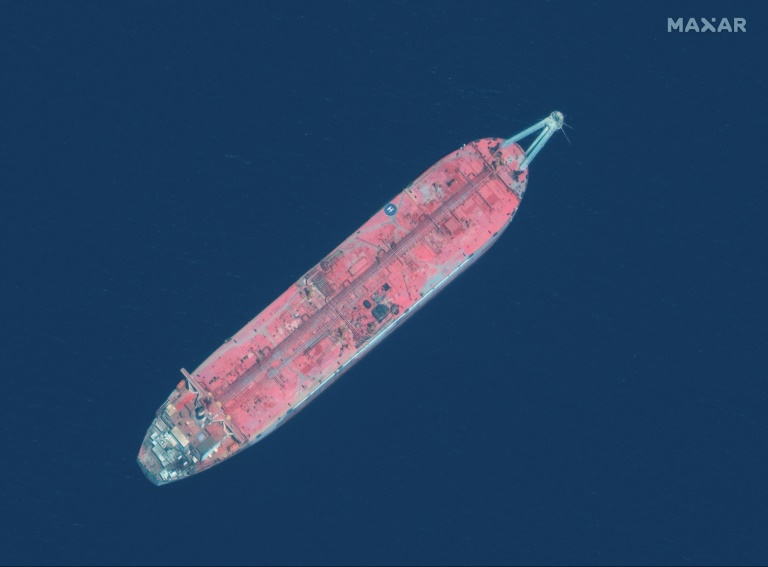
The 45-year-old tanker FSO Safer, long used as a floating oil storage platform with 1.1 million barrels of crude on board, has been moored off the rebel-held Yemeni port of Hodeida since 2015, without being serviced.

“The Safer is at imminent risk of a major spill, which would create a humanitarian and ecological catastrophe centred on a country already decimated by more than seven years of war,” the United Nations said in a statement. 

“International support – including funding – is needed now to implement the UN-coordinated plan to address the threat before it is too late.”

The UN said that the emergency part of a two-stage operation would see the toxic cargo pumped from the storage platform to a temporary replacement vessel at a cost of $79.6 million.

In a second phase, a replacement platform would be installed.

At a press conference in New York, the UN humanitarian coordinator for Yemen, David Gressly, said recourse to another ship would cost around $25 million.

“We need to finish this operation by the end of September to avoid the turbulent winds and currents that start in October, November, December, increasing the risk in conducting any operation,” Gressly said. 

The UN stressed that “the plan cannot begin without donor funding,” adding that the Netherlands will host a donor meeting. 

It said “rapid donor commitments of funds” were needed to begin work by the second half of May. 

Yemen’s Huthi rebels already agreed a “framework for cooperation” with the United Nations on the issue last month. 

The UN has said an oil spill could destroy ecosystems, shut down the fishing industry and close the lifeline port of Hodeida for six months.

US jury convicts ex-Goldman banker in 1MDB scandal

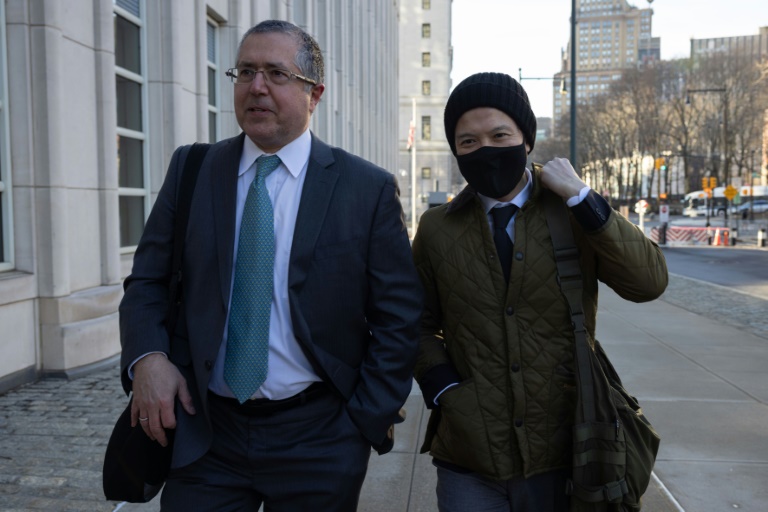
A New York jury on Friday convicted a former Goldman Sachs banker for his role in propagating a massive bribery and money laundering scheme involving a state-owned Malaysian investment fund.

The jury found Roger Ng, a managing director at Goldman from 2005 to 2014, guilty on all three counts connected to the massive 1MDB bribery scheme, which involved the embezzlement of billions of dollars of funds originally raised by investment bank.

The 1MDB fund was set up to promote the Malaysian economy, but was spectacularly looted in a scandal that roiled the country’s politics and marred Goldman’s reputation.

Ng and his co-conspirators paid more than $1 billion in bribes to government officials to secure three bond large transactions for Goldman with 1MDB, according to the US Department of Justice.

The conspirators laundered billions of dollars in funds from 1MDB, including some of the funds from the Goldman transactions. 

Some of the money went to luxury items, such as a $51 million Jean-Michael Basquiat painting and millions of dollars in Hermes handbags, the Justice Department said.

The eight-week trial included testimony from Timothy Leissner, a former Goldman partner who has pleaded guilty in the case and testified at length on his role and that of Ng in the scheme.

Attorneys for Ng had argued that Leissner’s testimony should be discounted in light of his plea and that Ng was a pawn in the larger conspiracy.

Ng faces up to a 30-year sentence following his conviction, a department spokesman said.

“Today’s verdict is a victory for not only the rule of law, but also for the people of Malaysia for whom the fund was supposed to help,” US Attorney Breon Peace said. 

“With today’s verdict, a powerful message has been delivered to those who commit financial crimes motivated by greed,” Peace said. “You will be caught, prosecuted and convicted, like Ng, and face a long prison sentence.”

The Goldman Sachs bond deals raised $6.5 billion, yielding the prestigious New York investment bank $600 million in fees and revenue, while Ng garnered some $35 million in kickbacks, the Justice Department said.

In October 2020, Goldman agreed to pay $2.9 billion in penalities in a DOJ settlement that included a guilty plea in US court by a Malaysian unit of the bank. 

Close Bitnami banner
Bitnami