AFP

Scottish town welcomes banking lifeline

Donna Corrigan pops into her local supermarket to pay OneBanks a visit, laden with a heavy box of coins to deposit into her bank account.

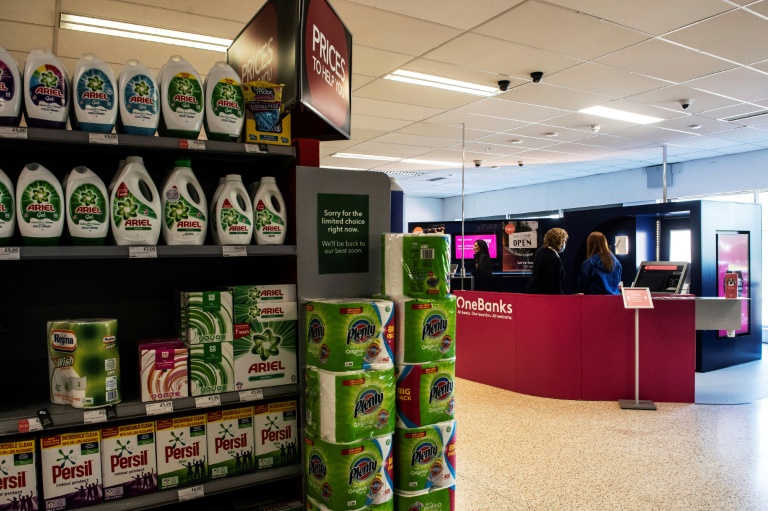
After the closure of its last bank branch in 2018, the Scottish town of Denny has welcomed a hi-tech startup offering everyday banking services inside the town’s Co-op grocery store.

Looking onto shelves filled with Heinz baked beans and Kinder Surprise chocolate eggs, OneBanks’ kiosk — comprising staffed counter services, a cash machine and two computer tablets — opened in late 2020.

The kiosk offers Denny’s 8,000 inhabitants an alternative to traditional bank branches after the rise of online banking allowed lenders battered by the global financial crisis more than a decade ago to save costs by permanently closing outlets.

This is continuing to occur in big numbers.

Among Britain’s biggest banks, HSBC and Lloyds last month said they would close a further 129 branches combined as customers increasingly switched to online banking during the pandemic.

OneBanks, which has raised around five million pounds ($6.6 million, six million euros) from various investors, acts as a go-between for more than 30 banks and their customers.

– ‘Like a regular bank’ –

The OneBanks kiosk “can do everything — it’s like a regular bank for me”, Corrigan, 40, told AFP.

“I’m not a business, I’m just a normal customer who just wants to withdraw cash. So it’s useful for me.”

Behind the counter, a staff member drops spare change into a money-counting machine while making small talk.

OneBanks gives customers physical access to banking services for free. Banks subscribe to the startup’s services to connect with their clients.

Customers can deposit or withdraw cash and pay bills, while advisors provide help to the less tech-savvy.

The disappearance of Denny’s banks left inhabitants with a 20-minute drive to the nearest branches in Cumbernauld, Falkirk or Stirling near to Glasgow.

British consumer group Which? predicts about 5,000 UK bank branches, around half the total, will have disappeared between 2015 and 2022, with Scotland worst affected.

– Dependent on cash –

Swathes of Britain’s population remain dependent on cash, despite the surging popularity of both internet use and contactless payments during the coronavirus pandemic.

The Royal Society of Arts charity estimates almost 20 percent of Britons — particularly the elderly and those in rural areas — would find it hard to cope without cash.

Yet in Denny’s neighbouring town of Bridge of Allan, there is not a branch in sight.

The last bank “closed about four years ago”, said hardware store manager Jennifer Wilson.

“A lot of our customers prefer to pay in cash to keep an eye on what they’re spending,” she added.

Wilson takes 40 percent of payments in cash.

– ‘Cold and sterile’ –

Retired university professor Richard Kilborn laments the lack of human contact now that Bridge of Allan’s three branches have vanished.

“As a member of the older generation, you get used to certain changes, but I also actually relished the person-to-person contact within the bank,” he told AFP.

“Now things have become cold and sterile.”

OneBanks hopes to change that with plans to roll out about 15 additional UK banking kiosks by the end of the year, on top of the three that it has in Scotland.

The group also has international ambitions.

“The problem that banks have — in terms of needing to close branches but also still needing to have some sort of physical presence — is a global problem,” OneBanks founder and chief executive Duncan Cockburn told AFP.

“And therefore I really do see OneBanks as a global solution.”

The broader UK finance sector is working towards addressing the problem.

Top lenders like Barclays, HSBC, Lloyds and NatWest have agreed to fund alternative solutions.

The industry tested various options including OneBanks kiosks. It also wants to improve post office facilities and has trialled banking hub services in conjunction with lenders.

Watchmakers tinker with new materials to draw new buyers

Lab-made diamonds, recycled plastic and 3D printing: this year’s Geneva watch fair was teeming with timepieces crafted from new materials, aimed at seducing a new generation of luxury watch connoisseurs.

H. Moser, a niche brand producing 2,000 watches a year for wealthy collectors, this year presented a watch covered in Vantablack, a super-black coating that absorbs nearly all light.

Perched against a black background, the watch, which is still in the concept stage, creates the illusion of a black hole, with only the coloured hands visible to the naked eye.

The material, consisting of carbon nanotubes and made by NanoSystems, is considered the darkest pigment in the world.

“I wanted to bring something different than what will be on display in shop windows three months from now,” company chief Edouard Meylan told AFP at the Watches and Wonders fair.

“I wanted to show the future of materials,” he said adding that he had aimed to provide a view to how the watch industry might look five years down the line. 

While the luxury brand has already used Vantablack in its clock faces, this exhibit model is completely covered.

For now, it cannot be touched since the material could lose its properties. More work is needed before it can actually be worn.

– Handcrafted technology –

Black is in high demand this year with new luxury virtuosos, according to Vincent Gregoire, who heads men’s fashion and accessories for the Parisian fashion consultancy NellyRodi.

“This is a clientele that wants beauty, hyper-luxury, with materials of the future, full of technology, but expertly handcrafted,” he said.

Their taste evokes the “Anish Kapoor universe”, he said, referring to the British sculptor who sparked a scandal in 2016 when he bought the exclusive right to use Vantablack in the art field.

A new generation of luxury lovers is emerging, Gregoire said, including a category of “agitators” who are fans of street culture and salvaging, and who want to use their purchasing power for “activist action”.

At a stand dedicated to innovation, the Oris brand is showing off how it recycles plastic waste, shredding it to make a material that resembles multi-coloured marble for its clock faces.

– Lab diamonds-

Tag Heuer, owned by French luxury group LVMH, has meanwhile broken an industry taboo by, for the first time, using diamonds made in a laboratory in one of its flagship models.

These diamonds, crafted from chemical deposits, have not been used to replace their shiny, mine-derived peers.

Instead, they have been chosen to explore how the new technology, which can produce uniquely shaped stones, can provide the dial with a new light-catching texture.

The brand hopes this new technology will allow it to explore new possibilities while remaining firmly anchored in high-end luxury. 

This watch carries a price tag of 350,000 Swiss francs ($380,000, 345,000 euros).

“Lab diamonds have a place in the market,” said Tobias Kormind, head of online jewellery retailer 77Diamonds, enthusing over the watch displayed on Tag Heuer’s website.

“People buy lab diamonds for many reasons, some for affordability reasons, some for environmental reasons,” he said.

He stressed though that “over the long term, natural diamonds are the ones that remain rare and investable.”

Cartier’s stand certainly sparkles with plenty of natural diamonds.

But the jeweller, owned by Richemont, has also dabbled in new technologies this year.

Using 3D printing, it has created a new collection called “Coussin”, with a casing that cedes slightly to pressure before plumping back to its initial shape, like the cushion it is named after.

Oil extends rally on Russia sanctions bets, stocks edge higher

Oil prices extended gains Tuesday on the prospect of further sanctions on Russia for alleged “atrocities” in some occupied Ukrainian cities, while equities edged up after a rally in New York and Europe.

European Union officials were discussing new measures against Moscow after reports — denied by the Kremlin — that troops had executed civilians.

Among the punishments could be a ban on imports of Russian crude, following a similar move by the United States and Britain.

White House National Security Advisor Jake Sullivan also signalled more US sanctions were on the way this week.

While Europe’s economy — particularly Germany’s — relies heavily on energy from Russia, the possibility of an embargo sent both main contracts sharply higher Monday, and they continued their rise in Asia, putting on more than one percent.

That pared some of the sharp losses seen Friday in reaction to a pledge by Washington and other major economies to unleash millions of barrels from their stockpiles to keep a lid on prices, which are fanning already high inflation.

It also offset an expected hit to demand in China from lockdowns in parts of the country — including Shanghai, the biggest city — sparked by a wave of Omicron outbreaks.

“In the wake of ‘Russian atrocities’ claims and the ensuing public outrage, there is a strong chance we could see another layer of sanctions on Russian energy,” said SPI Asset Management’s Stephen Innes. 

“The receptiveness on the part of Europe (including Germany) to refrain from importing Russian gas has put a bid under and should keep energy prices supported.”

The continued uncertainty caused by the war in Ukraine, and the blow to the global economy it is expected to deal, was unable to prevent another healthy performance on Wall Street, where the Nasdaq’s surge led all three main indexes higher.

“Despite all the concerns, equities remain the best bet to achieve returns above today’s elevated inflation,” said markets strategist Louis Navellier.

Trade was tepid in Asia, with Hong Kong, Shanghai and Taipei closed for holidays but most markets rose.

Tokyo, Sydney, Seoul, Singapore, Jakarta, Bangkok and Wellington were slightly up, though Mumbai and Manila dropped.

London, Paris and Frankfurt all opened on the front foot.

Traders will be keeping a close eye on the release this week of minutes from the Federal Reserve’s most recent policy meeting, hoping for an insight into officials’ thinking over monetary policy.

After last month’s expected 0.25 percentage point interest rate hike, there are increasing bets on a half-point lift in May in light of soaring inflation and strong jobs data that suggest the economy remains robust enough to absorb higher borrowing costs.

And National Australia Bank’s Tapas Strickland added: “Profit reporting season in the US kicks off next week and it will be interesting to see how firms are interpreting the tea leaves, and whether earnings guidance is revised down.”

– Key figures around 0720 GMT –

Tokyo – Nikkei 225: UP 0.2 percent at 27,787.98 (close)

Hong Kong – Hang Seng Index: Closed for a holiday

Shanghai – Composite: Closed for a holiday

London – FTSE 100: UP 0.1 percent at 7,567.98

Brent North Sea crude: UP 1.6 percent at $109.20 per barrel

West Texas Intermediate: UP 1.6 percent at $104.93 per barrel

Euro/dollar: UP at $1.0984 from $1.0978 late Monday

Pound/dollar: UP at $1.3142 from $1.3114

Euro/pound: DOWN at 83.56 pence from 83.65 pence

Dollar/yen: DOWN at 122.66 yen from 122.78 yen

New York – Dow: UP 0.3 percent at 34,921.88 (close)

Ecuador banana industry slips over war in Ukraine

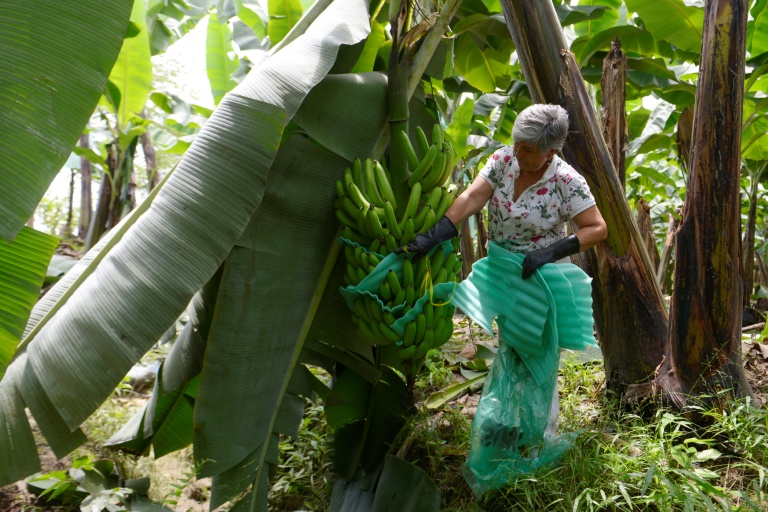
Until recently, the incessant bustle of Ecuadoran banana plantations provided evidence of the industry’s robust export business. But from one week to the next, the groves have fallen silent — trade victims to a conflict half a world away.

Ecuador is the world’s largest banana exporter, but the sector has been hammered by the war in Ukraine. Now, with nowhere to send them, containers of the rotting fruit are piling up not far from where they were originally harvested.

“One in every five bananas produced in Ecuador goes to Ukraine and Russia,” said Franklin Torres, president of Ecuador’s FENABE banana producers federation.

“This war really affected us in that sense.”

The vast majority of that portion goes to Russia, where banana sales are worth $698 million a year to Ecuador, which usually sends almost two million boxes of bananas a week to the eastern European neighbors.

But due to international transport sanctions over its invasion of Ukraine, Russia is not receiving its cargos of bananas.

The conflict has put the brakes on production in El Triunfo, close to Guayaquil, the site of Ecuador’s main port..

“The banana producers are finished, I have not processed a single box for three weeks,” said Mireya Carrera, 62, the owner of the Thalia banana plantation.

“The staff are leaving on their own without being fired because I cannot pay them.”

She used to fill three containers with 3,000 20-kilogram (43-pound) boxes of bananas from her 28 hectare plantation.

“Now I have 7,000 bunches with no buyer,” she told AFP.

– ‘Price crisis’ –

The industry had already been hit by falling prices.

Torres said it costs $5.50 to produce a box of bananas, and even though the internal sales price is $6.25, “right now we’re receiving less than $2 for each box of bananas, we’re receiving $1 or $1.20.

“Truly it’s an insult to any type of business. What we’re receiving is shameful and it’s not even worth picking them.”

He said the industry has lost “more than $10 million in three weeks.”

“Every year we have the problem of low prices, but now it has become impossible to get a contract for bananas. I prefer to give them away,” said Carrera.

Seeing Ecuador’s surplus of bananas, other markets “have started reducing their price offers,” said Richard Salazar, president of the ACORBANEC association for banana commercialization and export.

According to Jose Antonio Hidalgo, director of the AEBE association of banana exporters, within a week of the war starting, the bananas destined for Russia and Ukraine needed a new market, “causing a price crisis.”

Around a million boxes have remained unsold in the last month.

Faced with the prospect of a surplus sending the domestic price plummeting, the banana business union decided to donate them to local food programs.

Ecuador has 160,000 hectares of banana plantations that in 2021 generated almost $3.5 billion in sales around the world.

The South American country has more than 260 banana exporters.

– Unrealistic utopia –

The banana industry generates 50,000 direct jobs and 250,000 indirect ones in Ecuador.

The war has already cost around 6,000 permanent employees their jobs, according to ACORBANEC.

The difficulties have also impacted he El Porvenir plantation in neighboring Puerto Inca, which neighbors Guayaquil.

Having sold a container with more than 1,000 boxes “what we received is to pay salaries,” said the plantation’s administrator Lourdes Cedeno.

El Porvenir already had to halve salaries in March as it was.

Banana producers, who protested in Guayaquil last week, want the government to help them out by buying their fruit for its food programs.

President Guillermo Lasso said that “is not realistic. We need to place them in other markets in the world.”

But for Salazar, “Putting them in other markets is utopian. There’s no other market in the world that can buy as much as Russia,” he said.

Oil extends rally on Russia sanctions bets, stocks wobble

Oil prices extended gains Tuesday on the prospect of further sanctions on Russia for alleged “atrocities” in some occupied Ukraine cities, while equities struggled to build on a rally in New York and Europe.

European Union officials were discussing new measures against Moscow after reports — denied by the Kremlin — that troops had executed civilians.

Among the punishments could be a ban on imports of Russian crude, following a similar move by the United States and Britain.

White House National Security Advisor Jake Sullivan also signalled more US sanctions were on the way this week.

While Europe’s economy relies heavily on energy from Russia, the possibility of an embargo sent both main contracts sharply higher Monday, and they continued their rise in Asia, putting on more than one percent.

That pared some of the sharp losses seen Friday in reaction to a pledge by Washington and other major economies to unleash millions of barrels from their stockpiles to keep a lid on prices, which are fanning already high inflation.

It also offset an expected hit to demand in China from lockdowns in parts of the country — including Shanghai, the biggest city — sparked by a wave of Omicron outbreaks.

The continued uncertainty caused by the war in Ukraine, and the blow to the global economy it is expected to deal, was unable to prevent another healthy performance on Wall Street, where the Nasdaq’s surge led all three main indexes higher.

“Despite all the concerns, equities remain the best bet to achieve returns above today’s elevated inflation,” said markets strategist Louis Navellier.

However, trade was tepid in Asia, with Hong Kong, Shanghai and Taipei closed for holidays.

Tokyo, Sydney, Singapore, Jakarta and Wellington were slightly up, while Seoul and Manila dropped.

Traders will be keeping a close eye on the release this week of minutes from the Federal Reserve’s most recent policy meeting, hoping for an insight into officials’ thinking over monetary policy.

After last month’s expected 0.25 percentage point interest rate hike, there are increasing bets on a half-point lift in May in light of soaring inflation and strong jobs data that suggest the economy remains robust enough to absorb higher borrowing costs.

And National Australia Bank’s Tapas Strickland added: “Profit reporting season in the US kicks off next week and it will be interesting to see how firms are interpreting the tea leaves, and whether earnings guidance is revised down.”

– Key figures around 0200 GMT –

Tokyo – Nikkei 225: UP 0.1 percent at 27,756.54

Hong Kong – Hang Seng Index: Closed for a holiday

Shanghai – Composite: Closed for a holiday

Brent North Sea crude: UP 1.7 percent at $109.31 per barrel

West Texas Intermediate: UP 1.7 percent at $105.00 per barrel

Euro/dollar: DOWN at $1.0969 from $1.0978 late Monday

Pound/dollar: UP at $1.3117 from $1.3114

Euro/pound: DOWN at 83.62 pence from 83.65 pence 

Dollar/yen: DOWN at 122.60 yen from 122.78 yen

New York – Dow: UP 0.3 percent at 34,921.88 (close)

London – FTSE 100: UP 0.3 percent at 7,558.92 (close)

Colombian researchers seek safety for bees in urban jungle

Far from the flowery fields that are their natural home, honey bees imperiled by pesticides in rural Colombia are finding sanctuary on university campuses in the bustling capital Bogota.

Even though hives are banned from the city due to the risk the insects’ stings can pose to humans, universities enjoy an exemption for research purposes.

At the University of Rosario, biologist Andre Riveros very carefully feeds a bee some sugar water, watching attentively as it stretches its straw-like tongue, or proboscis, towards the sweet liquid.

The university boasts a rooftop apiary in a bamboo structure some six meters (nearly 20 feet) high, surrounded by trees and flowers.

Here, Riveros and his team study a colony of bees in the hopes of developing a food supplement that will offer the critical crop pollinators protection from insecticides

“Pesticides end up affecting some (neurological) regions that, for example, affect learning and memory and (the bees) end up with damage very similar to Alzheimer’s,” Riveros told AFP.

“We are trying to find a solution for the problem of bee disappearances,” he added. “We seek to shield the bees, in essence.”

The team’s work focuses on the Apis mellifera, or Western Honey Bee, one of about 20,000 known species worldwide.

Hundreds of hives have been killed off in Colombia in recent years, and investigations into the cause have pointed to fipronil, an insecticide banned in Europe and restricted in the United States and China.

Fipronil has been widely used in a profitable avocado and citrus boom in Colombia, though the Latin American country suspended its use in some crops for six months last year.

– ‘Fleeing the fields’ –

Elsewhere in Bogota, the EAN University boasts its own hives, perched on a six-story building overlooking the city of eight million people.

Beekeeper Gino Cala extracts honey from the hives as part of his work to instruct and assist universities in the management of urban apiaries.

But Cala told AFP Colombia’s bees “are fleeing the fields” partly due to the “indiscriminate use of agrochemicals.”

“These insects are extremely relevant and important… because they help guarantee part of the food security of Colombia and the world,” he added.

From the EAN University grounds, Cala’s bees help to pollinate plants in surrounding areas.

About 1.4 billion jobs and three-quarters of all crops around the world, according to a 2016 study, depend on pollinators — mainly bees — which provide free fertilization services worth billions of dollars.

In recent years, bees in North America, Europe, Russia, South America and elsewhere have started dying off from “colony collapse disorder,” a mysterious scourge blamed partly on pesticides but also on mites, viruses and fungi.

The UN warns that nearly half of insect pollinators, particularly bees and butterflies, risk global extinction.

Despite the city ban, there are private beekeepers in Bogota who sell products such as honey, pollen or beeswax.

The fire department of Bogota says it attends to eight bee sting-related emergencies on average every day.

In a southern US capital, an unending water crisis

Every morning, 180 students at a school in Jackson, Mississippi have to board a bus to be taken to another nearby school. The reason? Their school lacks the water pressure needed to flush its own toilets.

Cheryl Brown, the principal at Wilkins Elementary — where 98 percent of the 400 students are African American and most come from underprivileged backgrounds — doesn’t hide her frustration.

“It’s hard. It’s very hard,” she told AFP. 

“It’s taxing on the boys and girls,” who spend much of the day at the other school before heading back to Wilkins in the afternoon. “It’s taxing on the staff members,” she said.

Jackson is undergoing a severe water crisis — despite its status as a state capital in one of the richest countries in the world.

Late last year, President Joe Biden signed into law a $1 trillion package to address badly deteriorated infrastructure like Jackson’s.

The city’s water system has suffered “significant deficiencies” since 2016, reports from the southern state’s health department found.

Both the causes and symptoms of the crisis are clear: water flows from old and unmaintained treatment plants — one is 100 years old — through leaking, century-old pipes. When it comes out of city taps, it’s sometimes rust-brown — and always contaminated with lead.  

“The distribution lines are aging, and a master plan for pipe replacement… is not being implemented,” the US Environmental Protection Agency (EPA) wrote in a 2020 report.

It said the city loses as much as 50 percent of its water — a stunning amount — through the decrepit system.

As a result, “three local hospitals have drilled their own wells… to have access to reliable sources of drinking water.”

– No isolated case –

Jackson, a city of 155,000, is not the only US city to face such a crisis.

One of the worst US public health scandals in years came when the details of poor water quality management were exposed in the northern industrial city of Flint, Michigan.

A budget crisis prompted that city to change its water source, leaving thousands of residents exposed to dangerously high lead levels. 

Both Flint and Jackson are majority Black, which for many observers confirms the existence of “environmental racism” — with African Americans disproportionately affected by pollution.

Brown, the Wilkins principal, does not like to dwell on the issue. 

But after relying for weeks on portable toilets — forcing students to stand in long lines to wait their turn — she now worries that the daily bus trips to another school are cutting into instruction time. 

Charles Williams, who will be retiring as Jackson public works director this month after a long, wearying battle with the water crisis, told AFP the problems facing Jackson are complex.

“This didn’t happen overnight,” he said. “This was delayed maintenance and lack of funding.”

He estimated the cost of updating the city’s water system at $3 billion to $5 billion — no small sum for a medium-sized city. 

How much help Jackson might get from the big US infrastructure package is not yet clear, though the EPA has encouraged “communities such as Jackson with critical water infrastructure needs” to apply.

A lengthy investigative article in the Mississippi Free Press by journalist Nick Judin identified two problems underlying Jackson’s woes: a past drop in EPA funding for local water projects and a population exodus from the city to the suburbs.

Having lost a fourth of its population since 1980, Jackson’s tax base has dropped accordingly.

Judin also blames the sometimes chaotic administration of the water system, which has resulted in some residents receiving bills intermittently while “some people don’t get billed at all.”

– ‘This is not normal’ –

In late 2012, the city contracted with German technology company Siemens to install new water meters, update the billing system and complete infrastructure work. 

But early in 2020, the group agreed to reimburse the city $90 million after the city said Siemens had failed to ensure its water meters and software system were compatible.

An unusually cold winter then resulted in the main water treatment plant shutting down and numerous old water pipes bursting. 

Since then, things have gotten no better, local residents told AFP.

“We haven’t drunk the (city) water in about 12 years,” said Priscilla Sterling, standing on the sidewalk of Farish Street in a once-prosperous Black business district. 

“You’re still taking a chance when you bathe in it.”

Barbara Davis works in a Jackson church. She turns on a tap to show the rust-brown water flowing out.

“This is not how you’re supposed to live,” she said. “You know, this is not normal. It’s not normal at all.”

In one hard-hit neighborhood, an NGO called 501CTHREE has brought in a water filtration device where residents can fill jugs with clean water.

“Everybody can’t go to the store and buy water,” said Terun Moore, who works with a local NGO, Strong Arms of Jackson. 

The city, for its part, insists that Jackson water, brown though it may be, is safe — except for pregnant women and children.

Not one local resident interviewed by AFP said they trust assessment.

Fly less? Go vegan? How people can take climate action

Individuals along with economy-wide efficiencies can make a major difference in the drive to avert the worst of global warming, UN climate experts say, estimating that sharp cuts to demand for energy-guzzling services could slash emissions up to 70 percent by 2050.   

Avoiding airplanes, eating less meat, insulating your home could all make a dent, particularly when broad swathes of societies embrace change, says the United Nations Intergovernmental Panel on Climate Change.  

While research often focuses on cutting emissions in the supply of goods and services — energy generation, transport, agriculture, construction — the IPCC has for the first time dedicated a whole chapter of its climate solutions report to the demand that drives these industries.  

“Having the right policies, infrastructure and technology in place to enable changes to our lifestyles and behaviours can result in a 40-70 percent reduction in greenhouse gas emissions by 2050,” said Priyadarshi Shukla co-chair of IPCC working group that produced the 3,000 page report.

But where can “this untapped potential”, as Shukla calls it, be found?

– Day-to-day choices –

“Avoid, shift, improve” — these are the key ways to curb demand, the report says. 

You can avoid energy-intensive behaviour, switch to low-carbon technologies and improve the efficiency of existing tech. 

In general, there are plenty of opportunities for improvement in the ways people travel from point A to point B. 

You can change an internal combustion engine car to an electric one (“improve”), or even “shift” your daily commute to cycling or walking.   

The biggest potential for avoidance is reducing long-haul flights. If people took fewer long distance flights and took the train where possible, overall aviation emissions could be reduced by 10 to 40 percent by 2040. 

Meanwhile, increasing energy efficiency in homes and other buildings takes first place in the “improve” category. 

And the most important “shift” you can make is to adopt a plant-based diet. But becoming a vegetarian or even vegan would have less of an emissions impact than cutting out one long-haul flight a year. 

The report also highlights the need to reduce all types of waste, from energy or food for example. 

“Choosing low-carbon options, such as car-free living, plant-based diets without or very little animal products, low-carbon sources of electricity and heating at home as well as local holiday plans,” can reduce an individual’s carbon footprint by up to nine tonnes of CO2 equivalent, says the IPCC. 

– Unequal –

Most people in the world never take long-haul flights in the first place and do not have access to nutritious food. 

Billions of people have a carbon footprint far below nine tonnes of CO2 equivalent.  

For example, the average carbon footprint per inhabitant in Afghanistan is less than one tonne, according to the report, while in most western developed nations it is well over 10 tonnes. 

And within countries there can also be an enormous split between the lavish energy consumption of the rich and the meagre carbon footprint of poorer people. 

In fact, about half of the world’s emissions can be attributed to the consumption of the richest 10 percent of the global population, the report said.

At the bottom of the wealth pyramid, the poorest half of the world contributes around 10 percent of consumption emissions.  

“Wealthy individuals contribute disproportionately to higher emissions and have a high potential for emissions reductions while maintaining decent living standards and well-being,” the report said. 

– Beyond behaviour – 

The responsibility for transforming the world’s energy use and economic system to deal with climate change cannot be borne on the shoulders of individuals alone, the report stresses. 

While people can make a difference with their lifestyle choices, the IPCC says transformative change involves more than just individuals’ consumption choices. 

There also need to be shifts in culture and social norms, business investment, political drivers from institutions, and changes in infrastructure. 

Starbucks interim CEO Schultz to suspend share buyback program

The newly installed interim chief executive of Starbucks Howard Schultz announced Monday he will suspend a share repurchase program as the chain navigates a challenging landscape amid a growing unionization push.

“Starting immediately, we are suspending our share repurchasing program,” the 68-year-old billionaire said in a letter to employees after he resumed leadership of the coffee giant he ran two times previously.

“This decision will allow us to invest more profit into our people and our stores — the only way to create long-term value for all stakeholders.”

Shares fell sharply on the news.

Buyback programs are popular with investors and generally have an appreciative impact on share price. 

But the buybacks have been a target of company critics, including union backers, who say they demonstrate the company’s indifference towards workers. 

Starbucks announced in October 2021 that it was reinstating its buyback program, planning $20 billion in repurchases and dividends over the next years, and as recently as last month confirmed the plans were still in place as it announced Schultz’s appointment as interim CEO and the departure of Kevin Johnson from the company’s helm.

Starbucks has struggled of late to manage rising costs, a tight labor market and supply chain problems caused by the ongoing Covid-19 pandemic.

– Rising union movement –

The company has largely been viewed positively by many political progressives in the United States for its stance on gay marriage, race relations, the environment and other issues. 

But the firm has struggled to find an effective response to the campaign by organized labor, which picked up momentum in December when two stores in upstate New York became the first in the United States to vote to unionize. 

The movement — which has been propelled by mostly younger staff frustrated over pandemic working conditions and seeking more say — has now spread to more than 150 stores.

“We are overworked, exhausted and still being asked to pick up the slack,” workers at a Boston store wrote in a letter to Schultz that announced a unionization campaign and was posted on Twitter by Starbucks Workers United.

“You and your company have said and written a lot about how much you care about your employees, and your vision for a company that does everything through the lens of humanity,” the letter read. “We simply want to help you make that vision a reality.”

Labor backers have also complained of illegal firings of union supporters.

Progressive Senator Bernie Sanders, who has criticized the share buybacks, slammed “union busting” at Starbucks and last month called for the company to recognize a “unionized workforce that can collectively bargain for better wages, better benefits, safer working conditions and reliable schedules.”

The coffee chain has said it respects the right of workers to organize, but that the issues raised by workers do not justify a union. It has also defended the company’s right to speak out against unionization.

Schultz, who grew Starbucks from a small Seattle coffee chain into a global juggernaut in his two prior stints as chief executive, did not mention the union in his missive, but said he would work to improve employee morale.

“My first work is to spend lots of time with partners. To lift up voices,” Schultz said as he called “for us each to be transparent with one another and become accountable for building the future of our company.”

A note from Briefing.com described Schultz’ announcement on buybacks as a “surprise” that “is leaving a bad taste in shareholders’ mouths today.”

Shares closed 3.7 percent lower at $88.09.

Twitter shares take wing, oil prices rebound

Stock markets were relatively subdued on Monday while oil prices rose as Western nations eyed more sanctions on Russia, but Twitter stood out as its shares soared after Elon Musk purchased a major stake in the social network.

Twitter’s stock soared more than 25 percent after news of the Tesla boss’s investment.

According to a document filed with the US Securities and Exchange Commission, Musk acquired nearly 73.5 million Twitter shares — a 9.2-percent stake in the company. 

While Twitter is not large enough in terms of capitalization to impact the wider market, market analyst Patrick O’Hare said the move has bolstered sentiment.

“What the market is really responding to is the timing of Musk’s purchase and the supposition that it is an encouraging signal that longer-term investment opportunities might be availing themselves now in former high-flying stocks,” he said.

European stock markets closed with modest gains, while Wall Street also forged higher.

The tech-rich Nasdaq had an especially buoyant session, climbing nearly two percent behind strong gains in Amazon, Apple and other tech giants.

The EU said it is urgently discussing a new round of sanctions on Russia as it condemned “atrocities” reported in Ukrainian towns that have been occupied by Moscow’s troops, while White House National Security Advisor Jake Sullivan signaled more US sanctions would also be announced this week.

“Even fresh sanctions talk does not appear to be having much of an effect, as the market learns to look past the immediate hit to earnings,” said analyst Chris Beauchamp at online trading platform IG.

“The strength of Friday’s payrolls report remains a motivating factor too, even if it has also emboldened Fed policy makers to think more seriously about a 50 basis point hike next time they meet,” he added.

The world’s top economy added 431,000 jobs in March while the US unemployment rate fell to just slightly above pre-pandemic levels, official data showed Friday. 

Oil prices rallied after falling last week on concerns about demand given Covid lockdowns in China and the 31-nation International Energy Agency agreeing to tap its vast reserves to offset the removal of Russian exports.

“Oil prices have rebounded after last week’s big falls with US prices recovering back above $100 a barrel, in the wake of renewed calls for further sanctions against Russian oil and gas imports,” said market analyst Michael Hewson at CMC Markets.

“This appears to be outweighing concerns over Chinese demand after the whole of Shanghai, a city of 25 million people, was put into a Covid lockdown,” he added.

– Key figures around 2115 GMT –

New York – Dow: UP 0.3 percent at 34,921.88 (close)

New York – S&P 500: UP 0.8 percent at 4,582.64 (close)

New York – Nasdaq: UP 1.9 percent at 14,532.55 (close)

London – FTSE 100: UP 0.3 percent at 7,558.92 (close)

Frankfurt – DAX: UP 0.5 at 14,518.16 (close)

Paris – CAC 40: UP 0.7 percent at 6,731.37 (close)

EURO STOXX 50: UP 0.8 percent at 3,951.12 (close)

Tokyo – Nikkei 225: UP 0.3 percent at 27,736.47 (close)

Hong Kong – Hang Seng Index: UP 2.1 percent at 22,502.31 (close)

Shanghai – Composite: Closed for a holiday

Brent North Sea crude: UP 3.0 percent at $107.53 per barrel

West Texas Intermediate: UP 4.0 percent at $103.28 per barrel

Euro/dollar: DOWN at $1.0978 from $1.1043 late Friday

Pound/dollar: FLAT at $1.3114

Euro/pound: DOWN at 83.65 pence from 84.21 pence 

Dollar/yen: UP at 122.78 yen from 122.52 yen

Close Bitnami banner
Bitnami