AFP

Stocks wobble as solid US jobs data points to rate hike

Stock markets wavered on Friday as a solid US jobs report raised expectations of an aggressive US interest rate hike to tame runaway inflation.

Oil prices, meanwhile, fell slightly, with the US benchmark WTI contract dipping under $100 as US allies agreed to tap their emergency stockpiles again in a bid to calm the market.

While Russia’s war in Ukraine remains at the forefront of investor concerns, they were also tracking the latest US jobs picture as it serves as a barometer of the health of the world’s biggest economy.

The United States added 431,000 jobs in March and the unemployment rate fell to 3.6 percent, bringing the labour market closer to where it was before the Covid-19 pandemic began, according to official data.

The figures also fed into expectations of the next move by the US Federal Reserve, which has begun to raise interest rates in a bid to rein in a surge in inflation that has threatened to derail the economic recovery from the pandemic.

Higher rates, however, can also put the brakes on economic growth.

Analysts said they now expect the Fed to enact a half-point rate hike in May, higher than the quarter-point increase decided at its last meeting.

“The employment report showed strong jobs growth, a lower unemployment rate, and sustained wage inflation — a recipe for the Fed to issue a 50-basis-point hike next month,” market analysis firm Briefing.com said in a note.

Wall Street fell in midday trading after opening on a high note, but European equities finished the day in positive territory while Asian markets were mixed to end the week.

“This continues to be a very headline-driven market and they’re coming thick and fast,” said Craig Erlam, senior market analyst at OANDA foreign exchange platform.

“Talks between Ukraine and Russia are progressing well, it seems, but things can change rapidly, for better or worse. Until we see a deal, the situation will continue to feel precariously balanced and investors will remain on edge as a result,” he said.

Fallout from the war sent consumer prices in the eurozone surging by a record 7.5 percent, EU statistics agency Eurostat said heading into the weekend.

– IEA emergency meeting –

In a bid to ease oil prices, the 31-nation International Energy Agency agreed to tap emergency oil reserves again at an emergency ministerial meeting following a pledge to release over 60 million barrels.

The IEA, whose members include the United States, European countries, Japan and other nations allied to Washington, said it would make the new amount public early next week.

US President Joe Biden said that the countries had agreed to release “tens of millions of additional barrels of oil onto the market”.

“The IEA Ministers reiterated their concerns about the energy security impacts of the egregious actions by Russia and voiced support for sanctions imposed by the international community in response,” the group said in a statement.

The announcement came a day after Biden announced a record release of oil onto the market — one million barrels of US government oil every day for six months in a bid to ease prices.

Biden described the move as a “wartime” measure that will defuse Russia’s leverage as an energy power.

Washington has pressed the OPEC+ group of oil producing countries, led by Saudi Arabia and Russia, to boost its output but the group on Thursday agreed on another modest increase instead.

The war has driven oil prices to near record heights over concerns about supplies as Russia is the world’s second biggest exporter of crude after Saudi Arabia.

– Key figures around 1630 GMT –

New York – Dow: DOWN 0.2 percent at 34,609.91 points

London – FTSE 100: UP 0.3 percent at 7,537.90 (close)

Frankfurt – DAX: UP 0.2 percent at 14,446.48 (close)

Paris – CAC 40: UP 0.4 percent at 6,684.31 (close)

EURO STOXX 50: UP 0.6 percent at 3,927.44

Tokyo – Nikkei 225: DOWN 0.6 percent at 27,665.98 (close)

Hong Kong – Hang Seng Index: UP 0.2 percent at 22,039.55 (close)

Shanghai – Composite: UP 0.9 percent at 3,282.72 (close)

Brent North Sea crude: DOWN 0.5 percent at $104.20 per barrel

West Texas Intermediate: DOWN 1.0 percent at $99.26 per barrel

Euro/dollar: DOWN at $1.1046 from $1.1067 late Thursday

Pound/dollar: DOWN at $1.3111 from $1.3143

Euro/pound: UP at 84.25 pence from 84.20 pence

Dollar/yen: UP at 122.60 yen from 121.69 yen
New era for Zara empire as Ortega heiress takes helm

Marta Ortega on Friday took the reins of Zara-owner Inditex, the group founded by her father, and faces an immediate challenge after the fashion giant closed shops in Russia, its second biggest market.

With neither fanfare nor ceremony, the 38-year-old daughter of multibillionaire Amancio Ortega took over the world’s biggest fashion retailer and its 6,500 shops. 

“I begin this stage…with a deep sense of responsibility,” Ortega wrote in a letter to the 174,000 employees of the group, which has eight brands including Massimo Dutti, Bershka and Stradivarius. 

“I ask for your support and patience while I continue to learn from everyone every day,” she added.

The youngest of Ortega’s three children, she was in charge of design and product launches across all of Inditex’s brands before becoming chairwoman on Friday, taking over from Pablo Isla who had run the group since her father retired in 2011. 

As her father’s right hand, Isla oversaw Inditex’s massive international expansion over the past decade. 

Marta Ortega’s promotion has been on the cards for several years but was only announced at the end of November as part of a reorganisation engineered by her father, now 86.

“We’ve been preparing for this transition for a while,” said Isla at the time. “Marta has been working in the company for 15 years … she knows it very well”.

– ‘Very well prepared’ – 

Described as discreet and reserved, Marta Ortega was born on January 10, 1984 to the billionaire and his second wife Flora Perez, growing up in La Coruna in northwestern Spain with her half-sister Sandra and half-brother Marcos.

After attending a Swiss boarding school and graduating in 2007 from the European Business School in London, she briefly worked on the shop floor at a Zara store in the British capital to understand how things operate.

Although she never said she was the Inditex owner’s daughter, her colleagues told El Pais newspaper they quickly figured it out after noticing her Rolex watch.

“The first week, I thought I was not going to survive. But then you get kind of addicted to the store” she told The Wall Street Journal in a rare interview in August 2021. 

When her appointment was initially announced in November, it caused concern in the business community, triggering a fall in the company’s share price but such fears appear to have evaporated. 

Although she has never held an executive role at Inditex, she is “well prepared” and will be “surrounded by good people” said Alfred Vernis, professor at Spain’s ESADE business school and a former Inditex executive.

Working with her is Oscar Garcia Maceiras, who recently took over as chief executive of Inditex barely a year after joining the group from Spanish banking giant Santander.

“He will be the one who takes executive decisions,” said Vernis. 

– A difficult moment –

The change at the top comes at a pivotal time for the Galicia-based company which has chalked up record profits in recent years but is now facing one of its most difficult moments. 

Worth some 62 billion euros, Inditex nearly tripled its profits last year to 3.2 billion euros, but its outlook for 2022 has been overshadowed by Russia’s invasion of Ukraine. 

At the start of March, the retail giant suspended all retail activity in Russia, its biggest market after Spain, shutting its 502 shops and suspending all online transactions. 

The move is likely to have a significant impact on its results, with the Russian market accounting for nearly 10 percent of sales. 

“The current financial year promises to be very complex, due to Inditex’s exposure in Russia and the rest of Europe” and “rising production costs” caused by record inflation, Credit Suisse said in a note.

Founded in 1985 by Amancio Ortega, Inditex must also strengthen its online offering in the face of stiff competition from other retailers. 

Above all it must step up its “green transition” in order to reduce its environmental impact, which is huge. 

“Pablo Isla was doing it but not enough,” said Vernis, indicating such an essential step “would cost” the company. 

Shares in Inditex closed up 1.67 percent at 20.11 euros.

Ukraine eyes Romanian port for key farm exports

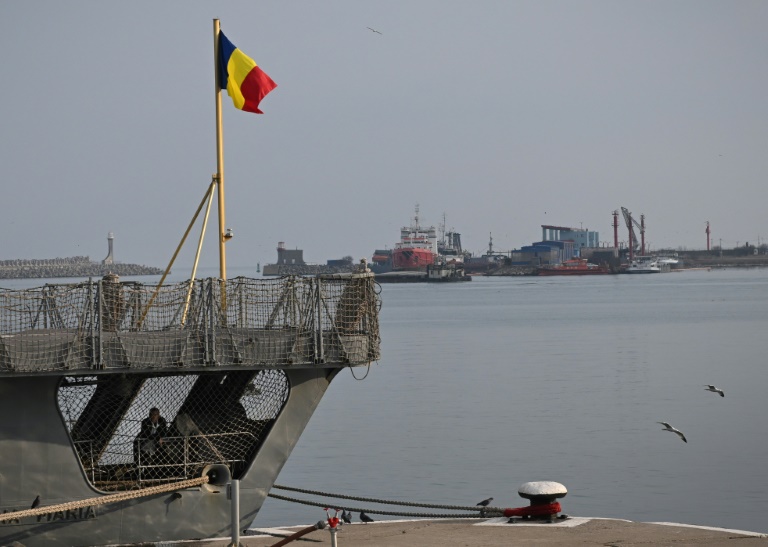
Faced with a Russian blockade of its own ports, Ukraine is seeking to export the farm goods that many countries depend on via the Romanian Black Sea port of Constanta.

The solution is crucial both to Ukraine’s economy and to entire populations that rely heavily on its wheat and sunflower oil.

Bucharest has confirmed that discussions are underway with Kyiv, pointing out that Constanta already handles some imports to Ukraine and exports from it.

Before the war, Ukraine accounted for 12 percent of global wheat exports, 15 percent of maize and 50 percent of world sunflower oil.

“We and our partners are looking for alternative logistical routes to export our goods via European ports, including Constanta,” Ukrainian Agricultre Minister Mykola Solsky said recently.

– Ukraine ports blockaded –

The presence of Russian battleships and mines in Ukrainian waters renders commercial shipping there nearly impossible.

Since the start of the war, Russian forces have been blocking access to the southeastern Ukrainian ports of Berdiansk and Mariupol on the Sea of Azov, which opens into the Black Sea.

In the southwest, the crucial Black Sea port of Odessa lies perilously close to the frontline at Mykolaiv.

Odessa handles 90 million tonnes of shipments a year — 60 percent of the country’s total port traffic — and is in the Krelmin’s sights.

The Marine Traffic website, which tracks the position of all seagoing vessels, clearly shows the de facto blockade of these waters. 

Commercial ships have been absent from the zone since missile attacks on vessels sent their insurance premiums rocketing.

According to the agriculture ministry, Ukraine is currently losing $1.5 billion (1.4 billion euros) a month because of the stranglehold on port exports.

Meanwhile countries that depend on Ukrainian farm exports, particularly on the southern coasts of the Mediterranean, are seeing a food crisis start to develop.

Kyiv says it has sufficient stocks to meet Ukraine’s own food needs for the next two years. But it is equally keen to ensure exports continue as normal.

“Ukraine wants to show it is defending its export markets as well as its territory and is conscious of its importance as a supplier of both foodstuffs and industrial goods,” said Paul Tourret, head of France’s Isemar Institute, which specialises in the maritime economy.

– Alternative options – 

Kyiv is seeking to increase grain exports to Poland, Romanian and Slovakia by rail and, to a lesser extent, by lorry.

The Romanian and Ukrainian rail companies are discussing ways of cooperating, the Bucharest government said.

The goal is to export 600,000 tonnes per month, which nonetheless remains “marginal” compared to the export capacity of Ukraine’s sea ports, said Agritel analyst Gautier Le Molgat.

Tourret said Constanta represents the best option. Romania is a member of NATO, meaning its waters are protected. And as the EU’s second largest wheat exporter after France, it has the necessary infrastructure.

Constanta is the largest port on the Black Sea. It handled more than 67 million tonnes of exports in 2021, including more than 25 million tonnes of grains. It has a total capacity of 100 million tonnes.

The port is in a position to accept Ukrainian stocks because by this time of year, Romanian grain shipments have already left for their destinations.

However, if the blockade of Ukraine’s own ports were to last until the forthcoming harvests, Constanta’s storage capacity could be stretched to the limit.

“Romania also has something to gain from this … a moral benefit,” Romanian Defence Minister Vasile Dincu said recently.

The speaker of the Romanian parliament and the transport ministry announced earlier this week that new investments were planned for Constanta port.

– Getting to Constanta –

The crucial element is getting merchandise out of Ukraine and into Constanta.

There are several potential routes, Tourret said.

The most dangerous option is to transport goods by lorry from Odessa, along the Black Sea coast as far as the Danube river port of Galati and then by boat to the canal which links the river to Constanta. That takes one or two days.

A second possibility is to transport goods via Moldova, avoiding the border region of Transdniestr, which seceded in 1990 and hosts a Russian military base. 

Avoiding this region under de facto Russian control can involve a detour of several hundred kilometres, depending on the starting point.

The third choice is the longest but currently the least hazardous. It entails crossing Ukraine’s western border, the area least affected by the war, straight into northern Romania.

This route is currently used, in the other direction, to supply Ukraine with essential goods.

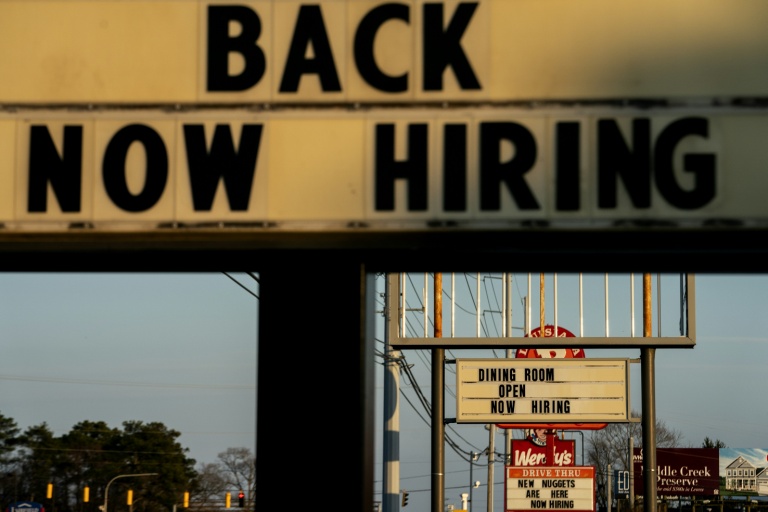
US labor market nears full recovery after strong March hiring

The US labor market has almost recovered from the mass joblessness caused by the pandemic, adding hundreds of thousands of positions last month and sending the unemployment rate nearly to where it was before Covid-19 broke out nationwide.

The Labor Department reported Friday that the unemployment rate fell more than analysts had predicted in March to 3.6 percent, a hair above its February 2020 level of 3.5 percent, while the economy added 431,000 jobs in the month.

Though the hiring total was slightly below analysts’ forecasts, it was nonetheless a strong figure that underscored how far the economy has come since the pandemic started two years ago.

The economy has “gone from being on the mend to being on the move,” President Joe Biden said at the White House, as his administration grapples with low approval ratings driven in part by inflation that has hit record levels under his presidency.

The economy has also added millions of jobs since Biden took office last year, but analysts said they doubted that the robust pace of hiring could be maintained.

“Today’s job report is great news as it means the economy has almost fully recovered from the blow caused by the pandemic,” Mark Zandi of Moody’s Analytics wrote on Twitter. 

“But it is somewhat disquieting in that the job market must cool off quickly, or inflation, our number one economic problem, will soon be a much bigger one.”

The data was released as the Federal Reserve undergoes the delicate process of fighting the price increases by raising interest rates from the zero level they held them at when the pandemic was at its worst, while simultaneously trying not to harm the recovery.

Ian Shepherdson of Pantheon Macroeconomics said the report contains signs that wage growth — a driver of the price increases — is moderating, while workforce participation is increasing, trends that could convince the Fed to be less aggressive in tightening policy.

“Rates still need to rise substantially, but the Fed won’t need to go overboard this year if the labor market is normalizing,” he said.

– Back to normal –

The latest report showed key markers of labor market health had made a full recovery after the catastrophe brought on by the pandemic, which cost more than 20 million people their jobs and sent the unemployment rate up to 14.7 percent in April 2020.

Last month, the number of unemployed people fell to six million, just above its 5.7 million level before the pandemic, while the number of people whose employment ended involuntarily or who completed a temporary job came in at 1.4 million, close to where it was in February 2020.

The Labor Department also revised upwards the healthy jobs gains reported in January and February, saying they were a combined 95,000 higher than first reported.

A wide range of industries hired last month, including leisure and hospitality, the sector encompassing the bars and restaurants hit hardest by the pandemic’s layoffs. 

That industry added 112,000 positions, while professional and business services firms gained 102,000 jobs in March, retailers added 49,000 positions and manufacturing employment rose by 38,000.

The labor force participation rate, indicating the share of people employed or looking for work, ticked up slightly to 62.4 percent, a post-pandemic high but still a percentage point below February 2020.

– Tightening to come –

Nonetheless, there was still ground to be recovered. The number of employed people was still 1.6 million short of its pre-pandemic level, the data said, while employment in leisure and hospitality is 1.5 million jobs lower than before the pandemic.

The recovery was also not being felt equally, with unemployment for white workers hitting 3.2 percent in March, but coming in at 6.2 percent for Black Americans and 4.2 percent for Hispanic workers, though the rates for each group decreased from the month prior.

Economists viewed the data as reinforcing the Fed’s committment to raise interest rates by half a percentage point at its meeting next month, double the increase it announced when it began hiking in March.

“Looking ahead, we expect job creation will settle into a slower but still healthy pace later this year as the economy feels the pinch from soaring inflation and tighter financial conditions,” Kathy Bostjancic of Oxford Economics said.

Smoke signals: US House to vote for cannabis decriminalization

US lawmakers were expected to vote Friday to decriminalize marijuana nationwide, eliminating punishments for providing or possessing the drug in a major step towards bringing federal laws in line with the states.

The Marijuana Opportunity Reinvestment and Expungement (MORE) Act would remove its categorization alongside heroin and cocaine as a dangerous controlled narcotic under federal laws mandating tough sentences.

The administration in Washington is out of line with three-quarters of states that have legalized marijuana for medical use and a third, like Colorado and Washington, that have freed it for recreational use, too.

“If states are the laboratories of democracy, it is long past time for the federal government to recognize that this experiment in legalization has been a resounding success,” House Judiciary Committee Chairman Jerry Nadler, one of the bill’s sponsors, said.

Analysts expect the bill to clear the House, but are more skeptical about its prospects in the Senate, where Democrats would need 10 Republicans to overcome a 60-vote hurdle.

Cannabis is one of the fastest-growing industries in the United States, with sales hitting $25 billion in 2021, according to influential cannabis website Leafly, and projected to reach $40.5 billion by 2025.

A report released in February by the Seattle-based company said the legalized cannabis industry provides work for more than 400,000 Americans and created some 280 new jobs a day last year.

California, the first state to legalize medical marijuana in 1996, made $1 billion in tax revenue in the first two years after expanding to full recreational use in 2018.

But it remains illegal under federal law, posing significant hurdles for businesses that find themselves barred from accessing financial services and unable to secure loans or open bank accounts.

– Huge popular support –

The MORE Act would provide loans to help small businesses “owned and controlled by socially and economically disadvantaged individuals,” the bill reads.

Many people arrested for marijuana use would see their records expunged, and those jailed on federal cannabis charges would have their sentences reviewed. 

A federal tax would begin at five percent, with proceeds funding substance abuse treatment and legal counseling for the overwhelmingly Black communities harmed by the war on drugs.

The reform is hugely popular among Americans. A Pew Research poll found last year that 91 percent of adults think marijuana should be legal, either medically, recreationally or both.

But Republicans argue that decriminalization will increase use and create another layer of bureaucracy in the Treasury Department.

A similar bill passed the House in 2020 in a vote divided largely along party lines — but went nowhere in the then-Republican majority Senate.

“There is a high probability that Republicans will control the House next year. This debate will be a chance to see how many support legalization even if they object to the MORE Act,” Cowen analyst Jaret Seiberg said in a note last week reported by Bloomberg. 

“This would be especially relevant if the House goes Republican but Democrats manage to keep control of the Senate. It would mean there would be a path for cannabis legislation next year.”

There are signs of increasing sympathy for liberalization even in the Senate, however, which unanimously passed a bill last week that would expand research of marijuana.

“Current rules and regulations make it hard for researchers to study how marijuana and marijuana-derived medications can best be used to treat various conditions,” said it Democratic co-sponsor Dianne Feinstein. 

EU warns China against backing Russia's Ukraine war

Top EU officials warned China’s leader Xi Jinping at a virtual summit Friday that any attempt to aid Russia’s war in Ukraine could hurt business ties between the two economic superpowers. 

The EU and US worry that Beijing’s failure to condemn the invasion means it could be willing to help the Kremlin sidestep the impact of sanctions or even supply hardware to aid the war effort.

“No European citizen would understand any support to Russia’s ability to wage war. Moreover, it would lead to a major reputational damage for China here in Europe,” European Commission chief Ursula von der Leyen said. 

“The business sector is watching very closely the events and evaluating how countries are positioning themselves. This is a question of trust, of reliability and of course of decisions on long-term investments.”

Von der Leyen insisted that “China has an influence on Russia and therefore we expect China to take its responsibility to end this war and that Russia comes back to a peaceful negotiations solution”.

The talks with President Xi — initially intended to focus on issues like trade and climate change — were overshadowed by Western fears of Chinese support for Moscow in its attack on Ukraine.

Chinese state media reported that Xi told the EU the two sides should “play a constructive role on China-EU relations and major issues concerning global peace and development, as well as provide some stabilising factors to a turbulent world”.

“We hope that the EU can form its own perception of China, pursue its own independent policy towards China,” Xi was reported to have said. 

A Chinese foreign ministry official said after a first round of talks involving premier Li Keqiang that the two sides “agreed to work together to maintain peace, stability and prosperity in the world”.

– Frozen trade pact –

The EU’s relations with its largest trading partner had already been battered by tensions ahead of Moscow’s assault on Ukraine and the annual summit was skipped last year as ties frayed.

The exchange of tit-for-tat sanctions over the plight of China’s Uyghur minority, followed by Beijing’s trade coercion of EU-member Lithuania over Taiwan, soured the mood.

The downgrade in relations came surprisingly quickly after the EU and China secured the investment deal in late 2020 long sought by Germany.

Human rights concerns, and US pressure on the EU, sapped momentum, sowing distrust and sinking diplomatic ties.

– ‘No limits’ –

The tensions over Russia’s war on Ukraine now threaten to hit relations harder — even if the EU for now is shying off threatening sanctions on Beijing if its helps the Kremlin.

In a meeting with Russian counterpart Sergei Lavrov, Chinese Foreign Minister Wang Yi on Wednesday said that “China-Russia cooperation has no limits”, repeating a line used by Presidents Vladimir Putin and Xi.

European Council boss Charles Michel, who was also on the virtual summit, warned that the talks were not “business as usual”.

“Any attempts to circumvent sanctions or provide aid to Russia would prolong the war. This would lead to more loss of life and greater economic impact,” he said.

“This is not in anyone’s long-term interest. We will also remain vigilant on any attempts to aid Russia financially or militarily.”

But experts say the EU remains reluctant to go too far in pressuring Beijing as it fears hitting its mammoth trade ties at a time when soaring energy prices and inflation are already causing major economic pain.

“The idea of detaching China from Russia is a pipe dream,” said Sylvie Bermann, a former French ambassador to both Moscow and Beijing.

Falkland islanders, UK veterans look back and to the future

Tom Herring knows exactly what he was doing on April 2, 1982. He was 31, a member of the 3rd Battalion The Parachute Regiment, and on weekend leave before Easter.

Then Argentinian troops invaded the Falkland Islands and he was called back to barracks. “Four days later we were boarding a ship in Southampton,” he said.

Forty years on, the memories for military veterans are strong, as too is the conviction that the islands — nearly 13,000 kilometres (8,000 miles) from London — are British.

“Our job was to protect our citizens and we felt very good about that because we wanted to make sure they were OK,” the former sergeant told reporters in London.

“It was British sovereign territory,” he said at the National Army Museum, where a new exhibition has opened about the conflict and its impact on the islands.

In Britain and the Falklands, the anniversary of the start of the conflict is muted. Islanders in particular see Argentina’s invasion as nothing to celebrate.

But a year-long series of events are taking place to mark the 40th anniversary, including on June 14 to mark Liberation Day — a public holiday on the islands.

– Public consciousness –

In Britain in 1982, few people knew much about the Falklands. 

“They thought it was near us, in Scotland,” said Herring, who is chairman of the South Atlantic Medal Association, a group for British veterans.

At the time, prime minister Margaret Thatcher was driving through unpopular economic reforms. Unemployment was sky-high and her position was under threat.

But her high-risk deployment of nearly 30,000 troops — and their swift victory — hoisted the remote archipelago of 770 islands to public consciousness.

The task force returned from the South Atlantic to a sea of Union Jacks, giving a declining Britain a patriotic boost — and ensuring Thatcher a landslide re-election in 1983.

But veterans charity Help for Heroes said last week the conflict risks becoming a “forgotten war”, and many younger people were “clueless” about its details.

Not for Herring, who also served three tours of Northern Ireland.

He visited the islands in 2012, meeting an Argentinian officer with whom he is still in contact.

“He still believes in the islands being part of their country. We believe it’s British,” he said, but added: “We don’t argue about that.

“We talk about military esprit de corps. There are friendly relationships. It’s only the governments that seem to be at loggerheads.”

– Grateful –

The islanders too have moved on, thankful for their past liberation but with an eye on a more prosperous future.

Just 3,200 people live on the Falklands, most of them in the capital, Stanley. But with an average age of 38, many were not even born when the conflict began.

“Us islanders born in the aftermath of the conflict are all grateful to the veterans,” said Tamsin McLeod, a Falkland islander now at university in Britain.

“I can’t say that enough,” she added.

The operation claimed the lives of 255 British servicemen and three female civilians, along with 649 Argentinians.

The self-governing authorities in the Falklands are keen to push how much the islands have been transformed since the war.

They point to how it is financially self-sufficient, relying on the UK only for defence, and how it is now a hub for scientific research and biodiversity.

The thousands of landmines that were laid during the war, making swathes of the islands no-go areas, were finally cleared in late 2020.

Its main industries are fishing, agriculture and tourism, including to see its population of more than one million breeding penguins, whales and dolphins.

– Democratic rights –

UK government support for the Falklands under Thatcher’s successors has been unwavering, despite Argentina’s steadfast territorial claims.

“We will continue to defend the Falkland Islanders’ democratic rights and celebrate the modern, diverse community they have built,” said Amanda Milling, minister for UK overseas territories.

“This is an important reminder that all peoples have the right to determine their own future.”

Leona Roberts, a member of the Falklands legislative assembly, is thankful to the veterans and to Thatcher for her “incredibly decisive” action.

“We’ve seen how far we’ve come 40 years since,” said Roberts, who aged 10 in 1982 cowered from the sound of gunfire under a kitchen table and an overturned sofa.

“We built the country from nothing. It (the conflict) allowed us to move on.”

First audio recorded on Mars reveals two speeds of sound

The first audio recordings on Mars reveal a quiet planet with occasional gusts of wind where two different speeds of sound would have a strange delayed effect on hearing, scientists said Friday.

After NASA’s Perseverance rover landed on Mars in February last year, its two microphones started recording, allowing scientists to hear what it is like on the Red Planet for the first time.

In a study published in the Nature journal on Friday, the scientists gave their first analysis of the five hours of sound picked up by Perseverance’s microphones.

The audio revealed previously unknown turbulence on Mars, said Sylvestre Maurice, the study’s main author and scientific co-director of the shoebox-sized SuperCam mounted on the rover’s mast which has the main microphone.

The international team listened to flights by the tiny Ingenuity helicopter, a sister craft to Perseverance, and heard the rover’s laser zap rocks to study their chemical composition — which made a “clack clack” sound, Maurice told AFP.

“We had a very localised sound source, between two and five metres (six to 16 metres) from its target, and we knew exactly when it was going to fire,” he said.

The study confirmed for the first time that the speed of sound is slower on Mars, travelling at 240 metres per second, compared to Earth’s 340 metres per second.

This had been expected because Mars’ atmosphere is 95 percent carbon dioxide — compared to Earth’s 0.04 percent — and is about 100 times thinner, making sound 20 decibels weaker, the study said.

– ‘I panicked’ –

But the scientists were surprised when the sound made by the laser took 250 metres a second — 10 metres faster than expected.

“I panicked a little,” Maurice said. “I told myself that one of the two measurements was wrong because on Earth you only have one speed of sound.”

They had discovered there are two speeds of sound on the surface of Mars — one for high-pitched sounds like the zap of the laser, and another for lower frequencies like the whir of the helicopter rotor.

This means that human ears would hear high-pitched sounds slightly earlier.

“On Earth, the sounds from an orchestra reach you at the same speed, whether they are low or high. But imagine on Mars, if you are a little far from the stage, there will be a big delay,” Maurice said.

“All of these factors would make it difficult for two people to have a conversation only five metres (16 feet) apart”, the French CNRS research institute said in a statement.

– ‘Scientific gamble’ pays off –

It was otherwise so quiet on Mars that the scientists repeatedly feared something was wrong, the CNRS said, possibly provoking memories of two failed previous attempts in 1999 and 2008 to record sound there.

“There are few natural sound sources with the exception of the wind,” the scientists said in a statement linked to the study. 

The microphones did pick up numerous “screech” and “clank” sounds as the rover’s metal wheels interacted with rocks, the study said.

The recording could also warn about problems with the rover — like how drivers sense something’s wrong when their car starts making strange noises.

Maurice said he felt the “scientific gamble” of taking microphones to Mars was a success. 

Thierry Fouchet of the Paris Observatory, who was also involved in the research, said that listening to turbulence, such as vertical winds known as convection plumes, will “allow us to refine our numerical models for predicting climate and weather”.

Future missions to Venus or Saturn’s moon Titan could also now come equipped with microphones.

And Perseverance is far from done eavesdropping. While its core mission lasts just over two years, it could remain operational well beyond that — the Curiosity rover is still kicking nine years into a planned two-year stint.

Stocks rise, oil steady before US jobs data, IEA meet

The world’s major stock markets mostly rose and oil prices steadied Friday as investors awaited US jobs data for an update on the world’s biggest economy, faced with soaring global inflation. 

Also Friday, the International Energy Agency was holding an emergency meeting on possible new measures to calm oil prices fuelled by the reopening of economies post pandemic lockdowns and following the invasion of Ukraine by major crude producer Russia.

Fallout from the war sent consumer prices in the eurozone surging by a record 7.5 percent, EU statistics agency Eurostat said heading into the weekend.

“Investor concerns have persisted about the continuing conflict in Ukraine and its inflationary effect on prices and, of course, the  Federal Reserve’s response,” noted Stephen Innes of SPI Asset Management.

“Fed rate hike expectations should react asymmetrically to any surprises in Friday’s US employment report for March.” 

The Fed has joined other central banks in hiking interest rates to combat decades-high inflation that is curbing economic growth.

Stock markets were slightly upbeat Friday after their worst quarter since the early days of the pandemic.

Traders are struggling to ascertain the outlook for the next three months, largely owing to uncertainty over energy prices.

The second quarter of 2022 “is going to start as messily as the first quarter has finished, with markets buffeted by a multitude of strong winds from various directions, with the outcome no clearer for the future than ever”, said Jeffrey Halley, analyst at OANDA, a foreign exchange firm.

The upcoming earnings season will be closely watched to see what impact higher inflation and the war has had on firms’ bottom line and their forecasts for the year ahead.

On Thursday, US President Joe Biden announced a record release of oil onto the market — one million barrels of US government oil every day for six months.

Biden described the move as a “wartime” measure that will defuse Russia’s leverage as an energy power.

However, while the move to ease a global supply crisis was welcomed, commentators warned it would only be a stopgap and could not be a long-term solution.

“It is worth keeping in mind that 180 million barrels is approximately nine days of US demand,” said Innes.

“And while one million barrels per day is better than nothing and can help balance the four million a day lost from Russia for about six months, what happens after?”

US oil prices briefly dropped under $100 on Friday.

– Key figures around 1100 GMT –

London – FTSE 100: UP 0.1 percent at 7,526.49 points

Frankfurt – DAX: UP 0.3 percent at 14,459.17

Paris – CAC 40: UP 0.5 percent at 6,692.75

EURO STOXX 50: UP 0.6 percent at 3,925.83

Tokyo – Nikkei 225: DOWN 0.6 percent at 27,665.98 (close)

Hong Kong – Hang Seng Index: UP 0.2 percent at 22,039.55 (close)

Shanghai – Composite: UP 0.9 percent at 3,282.72 (close)

New York – Dow: DOWN 1.6 percent at 34,678.35 (close)

Brent North Sea crude: UP 0.3 percent at $104.97 per barrel

West Texas Intermediate: DOWN 0.1 percent at $100.20 per barrel

Euro/dollar: DOWN at $1.1063 from $1.1067 late Thursday

Pound/dollar: UP at $1.3144 from $1.3143

Euro/pound: DOWN at 84.15 pence from 84.20 pence

Dollar/yen: UP at 122.39 yen from 121.69 yen

Ukraine war pushes eurozone inflation to new record

Spiralling energy bills and disruptions caused by the war in Ukraine caused consumer prices in the eurozone to surge by a new record of 7.5 percent, EU statistics agency Eurostat said Friday.

Last month’s rise marked a further acceleration in inflation from February, which at 5.9 percent year-on-year was already a eurozone record, it said.

The surge has been fuelled by a 44.7-percent hike in energy prices over the year as Europe found itself caught in an oil and gas crunch due to tensions with Russia over its invasion of Ukraine.

European Central Bank (ECB) president Christine Lagarde warned Wednesday that a prolonged Ukraine conflict will keep energy prices and the cost of living spiralling, blighting a post-Covid recovery.

Similar leaps in inflation have been seen in the United States where the Federal Reserve is committed to a long series of interest hikes to cool the economy and stem the price hikes.

But the ECB is reluctant for now to take similar measures, convinced that the rise in the cost of living is linked to the war as well as lingering disruptions to the global supply chains brought on by the coronavirus pandemic.

But given inflation’s relentless pace, analysts said Lagarde would soon have no choice but to rethink her policy.

“With euro-zone inflation rising even further above the ECB’s forecast, and likely to remain very high for the rest of the year, we think it won’t be long before the Bank starts raising interest rates,” said Jack Allen-Reynolds at Capital Economics.

– ‘No painless options’ –

Of particular concern for policy makers is core inflation, which strips out volatile components such as energy and food. It soared to 3.0 percent in March, Eurostat said.

This is a full percentage point on top of the ECB’s target of two percent and will give armour to critics that argue for interest hikes to face down inflation.

“The inflation data speak for themselves,” said Joachim Nagel, the central bank governor from Germany, Europe’s biggest economy that traditionally wants stronger medicine against higher prices.

“Monetary policy should not pass up the opportunity for timely countermeasures,” he said.

But economists warn that raising interest rates would put the brakes on the post pandemic recovery, with officials already warning that current forecasts for growth in Europe are certain to take a hit due to the war.

“The question is whether the worst is behind us now and that seems doubtful,” said Bert Colijn of ING bank.

“The ECB is running out of painless options to battle current economic problems, so we expect it to tread carefully,” he added.

Close Bitnami banner
Bitnami