AFP

Australia orders 200,000 to flee floods moving towards Sydney

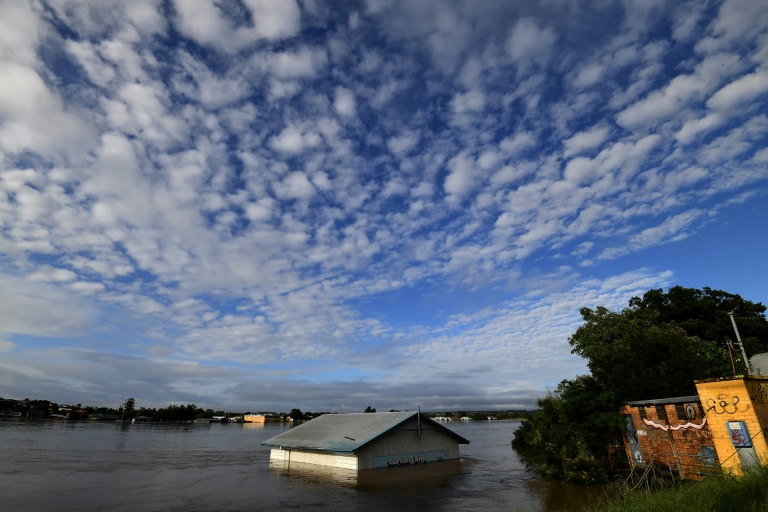
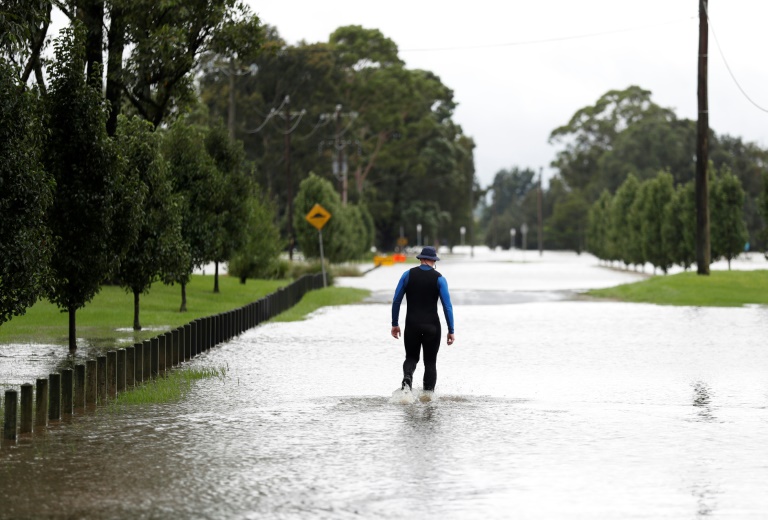
Australia’s emergency services ordered 200,000 people to flee from the path of a wild storm that lurched towards Sydney Thursday after killing 13 people in more than a week of record-setting floods along the east coast.

Authorities issued severe rain and wind warnings for a 400-kilometre (250-mile) stretch of coast as water levels rose rapidly — including in suburbs around Sydney, Australia’s largest city and home to five million people.

The unpredictable storm front has crawled southwards along the east coast from Queensland to New South Wales, creating havoc as rivers and reservoirs broke their banks with water swamping homes up to their roofs.

“Many people are waking up today to see much of our state underwater,” New South Wales Premier Dominic Perrottet said.

“If you are subject to one of those evacuation orders, please get out,” he told a news conference. “Things will get worse before they get better.”

Authorities have ordered 200,000 people to evacuate their homes, and warned another 300,000 may soon have to join them.

The Warragamba Dam in southwestern Sydney, which supplies 80 percent of the city’s water, has been spilling over since the early hours of Wednesday, accelerating the flooding in some areas.

-‘Devastating scenes’ –

New South Wales meteorologist Dean Narramore predicted the storm would dump 50-150 millimetres of rain during the day in areas including in and around Sydney, possibly more in areas struck by thunderstorms.

“That could lead to dangerous and life-threatening flash flooding,” he warned.

Meteorologist Ben Domensino of Weatherzone said the storm was being fuelled by an “atmospheric river” — a long stream of airborne moisture.

Scientists say climate change is making Australia’s floods, bushfires, cyclones and droughts more frequent and more intense.

“Australia is at the forefront of severe climate change,” said environmental expert Hilary Bambrick of the Queensland University of Technology.

“Temperatures are rising faster in Australia than the global average, and higher temperatures mean the atmosphere holds more moisture, meaning rainfall events are becoming more extreme.”

In New South Wales, emergency services chief Carlene York said the storm was “difficult to predict” as she warned of a tough day across Sydney and other parts of the state.

– ‘Drought, fires, floods’ –

Taronga Zoo, located along Sydney Harbour, prepared for an influx of injured wildlife from torrential rainfall and flooding.

The first fear was for young wildlife, small animals –- including echidnas and bandicoots -– and birds unable to escape surging floodwaters. 

Heavy downpours can make birds’ feathers so waterlogged they are unable to fly, a spokeswoman told AFP. 

As the floodwaters recede, concern will turn to the animals living in fresh water, including platypuses.

Across New South Wales, flood levels have climbed to the highest level in decades.

In towns such as Lismore in the state’s northeast, which is now cleaning up as floods recede, people had clambered onto their rooftops, sometimes waiting many hours to be rescued from rising waters.

New South Wales said it was sending an extra 400 personnel to that region to help people on the “very, very long road” to cleaning up and recovering.

“Many people today in the Northern Rivers and over the last 24 hours have returned home, and they have returned home to devastating scenes,” state premier Perrottet said. “My message is we will be with you.”

He added that the state of more than eight million residents have been through a difficult three years of “drought, fires, floods, floods again on top of the pandemic”.  

“But our people have stood tall,” Perrottet said. 
Ford unveils new structure as it speeds electric car push

Ford announced Wednesday it is creating separate businesses for its conventional and electric-auto operations, as it accelerates its build-out of emission-free vehicles.

Under the plan, which sent Ford shares sharply higher, the conventional internal combustion operations will be known as “Ford Blue,” while the electric vehicle (EV) products will be run through “Ford Model e.” 

The reorganization, while significant, keeps both operations under the same corporate roof and avoids a potential spin-off that had generated speculation on Wall Street.

“Our legacy organization has been holding us back,” said Chief Executive Jim Farley. “We had to change.”

Ford said the intention is to give the EV venture “the focus and speed of a start-up,” while the conventional business will try to excel at the challenges of a mature business, “relentlessly attacking costs, simplifying operations and improving quality.”

The two ventures will each have distinct executive leadership and report their own financial results. Both companies will continue to be headquartered in the midwestern state of Michigan.

The move is the latest announcement by a conventional automaker as the industry pivots hard to pursue EVs following the success of Elon Musk’s Tesla.

– No IPO –

Farley, in remarks last month, had described operating the EV and internal combustion units as “fundamentally different” in terms of supply chain, product development, even business “rhythm.”

Those comments generated speculation of a possible spin-off. But Ford opted against an initial public offering in part because the company already has enough access to capital and did not need extra funds from an IPO, Farley said.

“No we are not spinning off Model e,” Farley said. “That’s because the structures we set up actually make it stronger than a spin-off.”

Executives said the EV company would benefit from access to industrial know-how, while the conventional business would prosper from newer technologies. 

A third division, Ford Pro, will serve commercial customers.

Amid the shift to EVs, Mercedes has divested its truck division, while Volkswagen announced plans to list its Porsche business on stock markets to finance its electrification strategy.

Renault has said it will present in the fall a new structure, with its EV division in France, apart from its division overseeing internal combustion, which will be located in another country.

Ford’s big US rival, General Motors, has also announced massive new investments in EV models, but has so far not unveiled a similar revamp of its corporate structure.

“This move represents the dual nature of every traditional automaker as they transition from internal combustion drivetrains to electric vehicles,” said Karl Brauer, analyst at iSeeCars.com.

The company’s vision is to garner the benefits of both units, but “knowing when to combine these divisions and when to keep them separate will be key,” Brauer said. “And with separate profit and loss statements, we’ll all be watching.”

– Spending more –

Executives signaled more aggressive spending on EVs, projecting spending $50 billion between 2022 and 2026, compared with a prior plan to invest $30 billion between 2021 and 2025.

Ford also raised some of its operating and financial targets. The company now expects to produce two million EVs by 2026, about one third of global volumes, rising to half by 2030.

In February, Ford said EVs would account for at least 40 percent of its product mix by 2030.

Shares of Ford jumped 8.3 percent to $18.09 in afternoon trading.

Army of cyber hackers rise up to back Ukraine

An army of volunteer hackers is rising up in cyberspace to defend Ukraine, though internet specialists are calling on geeks and other “hacktivists” to stay out of a potentially very dangerous computer war. 

According to Livia Tibirna, an analyst at cyber security firm Sekoia, nearly 260,000 people have joined the “IT Army” of volunteer hackers, which was set up at the initiative of Ukraine’s digital minister Mykhailo Fedorov.

The group, which can be accessed via the encrypted messaging service Telegram, has a list of potential targets in Russia, companies and institutions, for the hackers to target.

It’s difficult to judge the effect the cyber-army is having.

The actions reported so far seem to be limited to “denial of service” (DOS) attacks, where multiple requests are sent to a website in a coordinated manner to saturate it and bring it down. Defacement actions, in which the targeted site displays a hacked page, have also been briefly observed on Russian sites.

The “cyber-army” could also ask hackers to try to identify vulnerabilities of certain Russian sites, and send that info to more seasoned specialists capable of carrying out more sophisticated intrusive actions, such as data theft or destruction, explains Clement Domingo, co-founder of the “Hackers Without Borders” group.

But he and other specialists consulted by AFP warned the hackers against participating in the activities of the “IT Army”, or other cyber mavericks like Anonymous.

– ‘Too much risk’ – 

“I strongly advise against joining these actions,” says Damien Bancal, who is well-versed in the opaque world of cybercrime. “There are plenty of other ways to help Ukrainians who are suffering”, if only by relaying the testimonies that are flourishing on social networks, he adds.

For SwitHak, a cybersecurity researcher, the maverick hackers are taking “too much risk”. 

“There are legal risks, for example,”  he said, Attempting to attack a website or penetrate a server or network is “computer crime”.

For Domingo there is also a real risk of “hack back,” a destructive counterattack by Russian operatives, 

He is particularly appalled to see that a number of candidate hackers have obviously not taken the trouble to create a special Telegram account to participate in the IT Army, at the risk of being identified by the Russian side. 

In cyberspace, and in particular on forums and other discussion groups on Telegram or Discord, “you don’t know who’s who”, insists Felix Aime, another researcher at Sekoia. 

Inexperienced hackers can find themselves caught up with infiltrators from the opposite camp, and end up working for the very opponent they wanted to fight, he warns.

Between the experienced hackers, who carry out ransomware attacks, the fight is on.

The Conti ransomware group, which declared its support for Russia, saw one of its pro-Ukrainian members publish more than a year’s worth of its internal communications in retaliation, offering a treasure trove of information to the world’s cyber security researchers, police and spy specialists. 

The forums where cybercriminals meet “try to stay away from any debate” on the Russian-Ukrainian war to avoid attracting the attention of state services, says Sekoia analyst Tibirna.

UN takes 'historic' step toward global treaty on plastic trash

The United Nations on Wednesday agreed to start negotiating a world-first global treaty on plastic pollution in what has been hailed as a watershed moment for the planet.

Nearly 200 nations at the UN Environment Assembly in Nairobi unanimously agreed to create an intergovernmental committee to negotiate and finalise a legally binding plastics treaty by 2024.

UNEA chair Espen Barthe Eide declared the resolution passed with a strike of the gavel — itself made from recycled plastic — as the assembly hall erupted into cheers and applause.

“We are making history today. You should all be proud,” said Eide, who is Norway’s climate and environment minister. 

Negotiators have been given a broad and robust mandate to target plastic trash in all its forms.

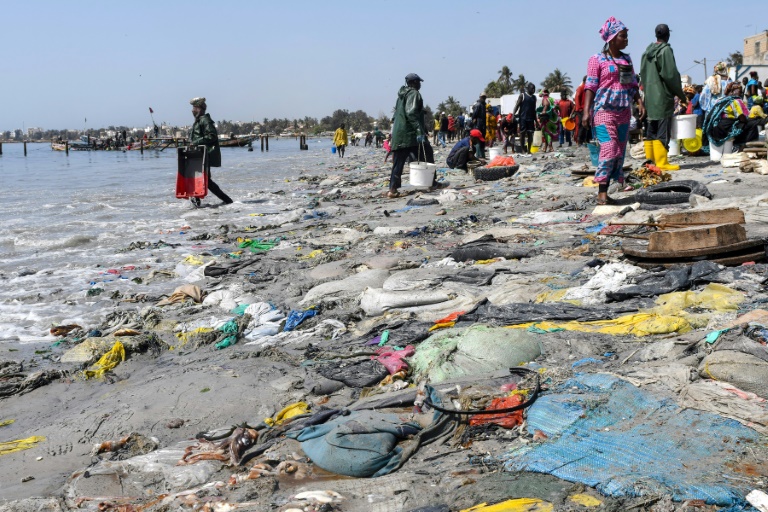
It addresses not just the bottles, straws and shopping bags floating in rivers and oceans, but invisible microplastics found in the deepest oceans and highest mountains, and within the air, soil and food chain.

– ‘Historic crossroad’ –

Supporters described the commitment as the most important environmental decision taken by the UN in years.

“We stand at a crossroad in history when ambitious decisions taken today can prevent plastic pollution from contributing to our planet’s ecosystem collapse,” said Marco Lambertini from WWF.

The broad treaty framework approved by 193 UN nations — among them major plastic producers like the United States and China — does not spell out specific measures but leaves particulars to negotiations.

But the scope covers pollution “from source to sea” — a key demand of many nations — and could for the first time introduce caps on the production of new plastic from fossil fuels.

Other regulations could require that industry redesign products to make recycling easier and stem the torrent of trash created by single-use items.

Less than 10 percent of plastic is recycled. Most of the 460 million tonnes of plastic produced in 2019 wound up in landfill and oceans.

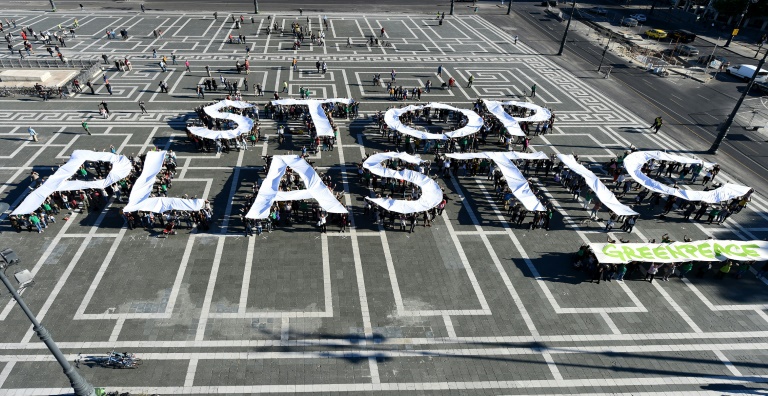
“This is a clear acknowledgement that the entire life cycle of plastic, from fossil fuel extraction to disposal, creates pollution that is harmful to people and the planet,” said Graham Forbes from Greenpeace.

– ‘Landmark’ decision –

The amount of plastic entering the oceans is forecast to triple by 2040, and governments have been under pressure to unite against the trash “epidemic”.

The rate of plastic production has also grown faster than any other material and is expected to double within two decades without urgent action.

By some estimates, a garbage truck’s worth of plastic is dumped into the sea every minute.

Large pieces of plastic are a notorious peril for sea birds, whales and other marine animals. But at the microscopic level, particles of plastic can also enter the food chain, eventually joining the human diet.

To address the urgency, talks toward concluding the treaty are being fast-tracked and the first round is slated for later this year.

Diplomats and conservationists cautioned that the strength of the treaty would be determined by the level of political will shown in these negotiations.

Setting targets, ensuring accountability, and monitoring success or otherwise could prove sticking points, said UN environment chief Inger Andersen.

Negotiators will need to establish what measures are binding or voluntary, and some countries are pushing for flexibility in setting their own goals through national action plans.

“There will be a number of thorny issues as there always is when we start a negotiation,” said Andersen, head of the UN Environment Programme.

Big corporations had expressed support for a binding agreement and negotiators were urged to engage industry players in the process.

Dozens of major businesses had called for a common set of rules around plastic to create a level playing field for competition.

“This is a landmark decision by UN member states,” said Richard Slater, chief research and development officer at British consumer goods group Unilever.

Trade group Plastics Europe said its products played a vital role in society and industry was doing its part to bolster recycling and invest in solutions.

“The UNEA resolution represents a major step towards the creation of a waste free future which is critical to achieving our collective climate ambitions,” said Plastics Europe president Markus Steilemann.

UN agrees to create 'historic' global treaty on plastic trash

The United Nations on Wednesday agreed to start negotiating a world-first global treaty on plastic pollution in what has been hailed a watershed moment for the planet.

Nearly 200 nations at the UN Environment Assembly in Nairobi unanimously agreed to create an intergovernmental committee to negotiate and finalise a legally binding plastics treaty by 2024.

UNEA chair Espen Barthe Eide declared the resolution passed with a strike of the gavel as the assembly hall erupted into cheers and applause.

“We are making history today. You should all be proud,” said Eide, who is Norway’s climate and environment minister. 

Negotiators have been given a broad mandate to target plastic trash in all its forms -– not just bottles and straws in the ocean, but invisible microplastics polluting the air, soil and food chain.

– ‘Historic crossroad’ –

Supporters described the commitment to take united action on the plastic crisis as the most important environmental decision taken by the UN in years.

“We stand at a crossroad in history when ambitious decisions taken today can prevent plastic pollution from contributing to our planet’s ecosystem collapse,” said Marco Lambertini from WWF.

The broad treaty framework approved by nations — among them major plastic producers like the United States and China — does not spell out specific policies, with particulars to be negotiated later.

But the scope covers the entire life cycle of plastic — a key demand of nations, businesses and environment groups — and could for the first time introduce new rules on the production of new plastic.

It also allows for the negotiation of new rules around the design of plastic products — which are made from oil and gas — to make recycling easier, encourage sustainable use, and spur better waste disposal.

“This is a clear acknowledgement that the entire life cycle of plastic, from fossil fuel extraction to disposal, creates pollution that is harmful to people and the planet,” said Graham Forbes from Greenpeace.

The mandate allows for binding and voluntary measures, and the setting of global targets and obligations, the development of national action plans, and mechanisms for tracking progress and ensuring accountability.

It also calls for financial assistance to help poorer countries take action.

– ‘Landmark’ decision –

The amount of plastic trash entering the oceans is forecast to triple by 2040, and governments have been under pressure to unite behind a global response to the crisis.

The rate of plastic production has grown faster than any other material and is expected to double within two decades, the UN says.

But less than 10 percent is recycled and most winds up in landfill or oceans creating what Eide called an “epidemic” of plastic trash.

By some estimates, a garbage truck’s worth of plastic is dumped into the sea every minute.

Large pieces of plastic are a notorious peril for sea birds, whales and other marine animals. But at the microscopic level, particles of plastic can also enter the food chain, eventually joining the human diet.

Environment groups are buoyed by the broad scope given to negotiators but say the strength of the treaty is yet to be determined.

The first round of negotiations is set for the second half of this year. 

Big corporations have expressed support for a treaty that creates a common set of rules around plastic and a level playing field for competition.

“This is a landmark decision by UN member states. A legally binding treaty that addresses the full life cycle of plastic will make a dramatic difference in the fight against plastic pollution,” said Richard Slater, chief research and development officer at British consumer goods group Unilever.

Big plastic makers have underscored the importance of plastic in construction, medicine and other vital industries and warned that banning certain materials would cause supply chain disruptions.

Two years into the pandemic, is the end in sight?

Two years after the official start of the pandemic, some countries are now trying to “live with Covid”, however scientists warn that potential new variants and unequal vaccination rates threaten any long-awaited return to normality.

When US global health researcher Christopher Murray wrote “Covid-19 will continue but the end of the pandemic is near”, in The Lancet medical journal in late January, he summed up the hopes of many national health authorities around the world.

In the weeks leading up to the two-year anniversary of the World Health Organization declaring a pandemic in March 2020, countries such as Britain and Denmark lifted all legal Covid restrictions. Many US states also relaxed mask and other rules.

British Prime Minister Boris Johnson said the change marked the beginning of learning “to live with Covid”, as the global death toll falls after the more transmissible though less severe Omicron variant swept the world.

The WHO has said that the “acute phase” of the pandemic could end by the middle of this year — if around 70 percent of the world is vaccinated.

– From pandemic to endemic? –

Spain has been among the nations calling for approaching Covid as having transitioned to an “endemic” phase, meaning it has milder seasonal outbreaks that humanity can live with, such as the flu. 

However some scientists worry governments could use the somewhat vague term to justify lifting life-saving measures.

University of Oxford evolutionary virologist Aris Katzourakis said “the word ‘endemic’ has become one of the most misused of the pandemic.”

“A disease can be endemic and both widespread and deadly,” he wrote in the journal Nature last week, pointing out that malaria killed more than 600,000 people in 2020, while 1.5 million died of tuberculosis.

There are also other options than just pandemic or endemic. The British government’s scientific advisory body SAGE has laid out four potential scenarios for the years to come.

Under the “reasonable best-case” scenario, there will be smaller regional or seasonal outbreaks, as the higher Covid numbers lead to fewer flu cases.

Under the worst-case scenario, new unpredictable variants build into repeated damaging virus waves, requiring the return of harsh restrictions.

The different outcomes hinge on two key uncertainties: the possible emergence of new variants, and the ability of vaccines to protect against the disease in the long term.

– The new variant threat –

When it comes to vaccines, Omicron has served as both a warning and a test.

Many epidemiologists say that simply letting Covid spread unchecked gives it a greater chance of mutating into new strains.

And there is no guarantee that such new variants will be less deadly.

“There is a widespread, rosy misconception that viruses evolve over time to become more benign,” Katzourakis said.

“This is not the case: there is no predestined evolutionary outcome for a virus to become more benign,” he said, pointing out that the Delta variant was deadlier than the first strain that emerged in Wuhan, China.

Omicron also partly evades protection from the currently available vaccines.

But they are very effective in preventing severe disease and death — particularly third booster shots which have been rolled out across the world.

– Vaccines to the rescue? – 

Countries such as Israel and Sweden have started administering fourth doses, but experts fear that an endless number of booster shots is a short-sighted strategy. An Israeli trial in January also found that a fourth dose was less effective against Omicron.

Pharma giants have raced to develop a vaccine that specifically targets Omicron, but none seem close to becoming available.

Several recent preliminary results of tests carried out on animals and not peer reviewed have suggested the targeted vaccines are no more effective against Omicron than their predecessors.

But there could be another way: broadening rather than narrowing the scope of the vaccine.

Three researchers including Anthony Fauci — US President Joe Biden’s chief medical adviser — have called for a “universal coronavirus vaccine” that would protect not just against Covid but also against future coronaviruses that could spread from animals and trigger another pandemic.

“We must now prioritise development of broadly protective vaccines,” the researchers wrote in the New England Journal of Medicine over the weekend.

However such a vaccine faces major hurdles and the first efforts have only just begun trials on humans.

In the meantime, the WHO emphasises that the best way to end the acute phase of the pandemic is for rich countries to share their doses rather than boost their populations again.

Only 13 percent of Africans had been fully vaccinated as of late last month, according to the WHO — far below the 70 percent target needed by mid-year. 

On land and sea, climate change causing 'irreversible' losses: UN

Climate change has already caused “irreversible losses” for Nature, UN experts have said, warning that if emissions are not cut quickly, warming could trigger chain reactions with potentially catastrophic effects for all species, including humans. 

All forms of life on Earth are linked together by a vast web of causes and consequences, the Intergovernmental Panel on Climate Change (IPCC) said in a new report on the impacts of global warming published this week. 

Those effects are severe and wide ranging across the world’s natural habitats.  

“Climate change has caused substantial damages, and increasingly irreversible losses, in terrestrial, freshwater and coastal and open marine ecosystems,” the IPPC says in its key Summary for Policymakers.  

And “unsustainable development” is only increasing the vulnerability to danger.  

– ‘Tipping point’ –

Many natural systems have already reached or are close to the limit of their ability to cope with the effects of a warming planet. 

The oceans have absorbed huge quantities of carbon dioxide from the atmosphere as emissions have grown, but this has come at the cost of changing the water chemistry — ocean acidification — that harms sea life. 

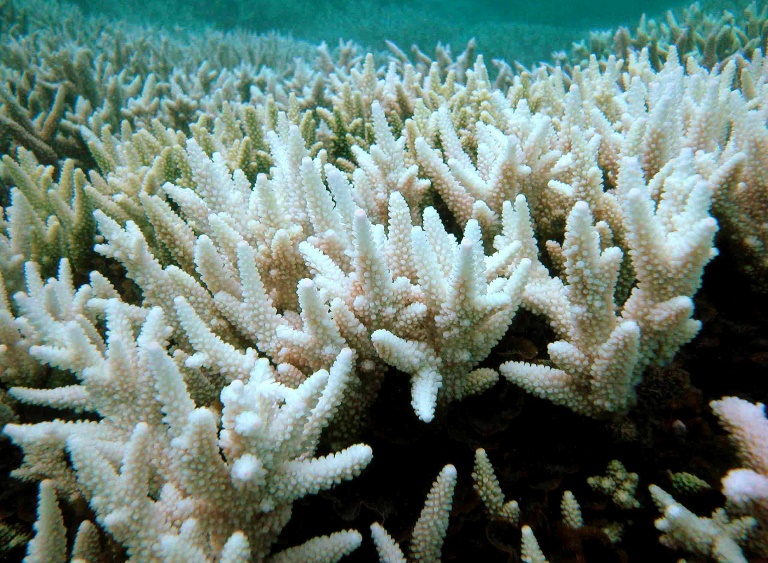
Warming is also linked to an increasing number of powerful marine heatwaves that drive harmful algal blooms, kill fish and cause coral bleaching.

Coral reefs are home to at least a quarter of all marine animals and plants.    

But battered by repeated marine heatwaves, the world’s shallow water corals are “unlikely to last the century”, the IPCC said, if global warming continues without a dramatic reduction in emissions. 

Forests, tropical or boreal, are also particularly threatened by rising temperatures, drought and fire. 

Mortality increases of 20 percent have been recorded for trees in some areas. 

At four degrees Celsius of warming, the IPCC report said, half of the Amazon could reach a “tipping point”, becoming a savannah and starting to release its vast store of C02, further accelerating warming.

At just 2C, the world’s permafrost could begin to thaw, releasing immense quantities of methane, a greenhouse gas much more powerful over the short term than CO2.

While the Paris agreement goal is to limit warming at 1.5C above pre-industrial levels, current international plans and pledges would see temperatures rise up to 2.7C. 

– Extinctions – 

The Earth is already believed to be entering its sixth mass extinction, driven by humanity’s overconsumption and comprehensive destruction of species and habitats. 

And global warming is increasingly adding to that threat, with two species —  the Golden Toad of Costa Rica and the Australian rodent Bramble Cays Melomys — recognised as extinct because of climate change, the IPCC said. 

A best case scenario is that nine percent of all the world’s species will likely be “at high risk” of extinction with 1.5C of warming, the IPCC said. 

At 4C the most pessimistic scenario is 39 percent imperilled.   

Even the very lowest estimates are a thousand times higher than the natural rate of extinctions.  

– Protection call –

On land or sea, for animal or plant, the threat is everywhere.

But the IPCC said only 15 percent of land, 21 percent of freshwater and eight percent of oceans are protected, throwing its weight behind calls to effectively safeguard 30 to 50 percent of the planet to maintain the “resilience of biodiversity and ecosystem services at a global scale”. 

That is because protecting nature is a virtuous circle: trees store carbon and provide shade, wetlands reduce flooding and protect coasts from erosion, insects participate in pollination. 

Conversely, enabling destruction multiplies the dangers.

“Exploitation of wildlife and degradation of natural habitats have increased opportunities for ‘spill over’ of pathogens from wildlife to human populations and increased emergence of zoonotic disease epidemics and pandemics,” the IPCC notes. 

Many of these risks are now unavoidable in the short term, regardless of the trajectory of emissions of greenhouse gases, warns the report. 

So the IPCC emphasises the need to fight global warming both by reducing emissions and preparing for its impacts. 

And “the best way to achieve this is to let nature do the job,” UN Environment Programme chief Inger Andersen told a press conference this week.  

“We need large scale ecosystem restoration from ocean to mountain top.”

UN to take first step towards 'historic' plastic treaty

The United Nations is to launch formal negotiations on Wednesday for a global treaty to address the planet’s “epidemic” of plastic trash, a moment that supporters describe as historic.

The UN Environment Assembly (UNEA), convening in Nairobi, is poised to adopt a resolution creating an intergovernmental committee to negotiate and finalise a legally binding agreement by 2024.

“This is a day for the history books,” said Norway’s climate and environment minister, Espen Barth Eide, who chairs UNEA.

“We are about to embark on an extremely important process of negotiating a solid treaty to ban plastic pollution.” 

The framework for a comprehensive accord also has the approval of major plastic-producing nations, including the US and China.

Officials say it gives negotiators a strong and broad mandate to consider new rules to target plastic pollution, ranging from the phase of raw material to product design and use and, finally, disposal.

This could include limits on making new plastic, which is mainly derived from oil and gas, although policy specifics will only be determined during later talks.

The mandate provides for the negotiation of binding global targets with monitoring mechanisms, the development of national plans and financing for poorer countries. 

Negotiators also have the scope to consider all aspects of pollution — not just plastic in the ocean but tiny particles in the air, soil and food chain — a key demand of many countries.

– ‘Monumental decisions’ –

The amount of plastic trash entering the oceans is forecast to triple by 2040, and governments have been under pressure to unite behind a global response to the crisis.

“Today, no area on the planet is left untouched by plastic pollution –- from deep sea sediment, to Mount Everest,” said UN Deputy Secretary-General Amina Mohammed. 

“The planet deserves a truly multilateral solution to this scourge that affects us all.”

The rate of plastic production has grown faster than any other material and is expected to double within two decades, the UN says.

But less than 10 percent is recycled and most winds up in landfill or oceans creating what Eide called an “epidemic” of plastic trash.

By some estimates, a garbage truck’s worth of plastic is dumped into the sea every minute.

Large pieces of plastic are a notorious peril for sea birds, whales and other marine animals. But at the microscopic level, particles of plastic can also enter the food chain, eventually joining the human diet.

“The world is demanding action on plastic pollution,” said Inger Andersen, the head of the UN Environment Programme (UNEP), which is hosting the talks.

“Decisions that you take today will be monumental.”

But she cautioned that after this “crucial step” would come the hard work of negotiating a strong and binding treaty.

Environment groups are buoyed by the broad scope given to negotiators but say the strength of the treaty is yet to be determined.

The first round of negotiations is set for the second half of this year, according to sources involved in the process. 

Big corporations have expressed support for a treaty that creates a common set of rules around plastic and a level playing field for competition.

Big plastic makers have underscored the importance of plastic in construction, medicine and other vital industries and warned that banning certain materials would cause supply chain disruptions.

In Cameroon's arid north, climate stress boosts ethnic strife

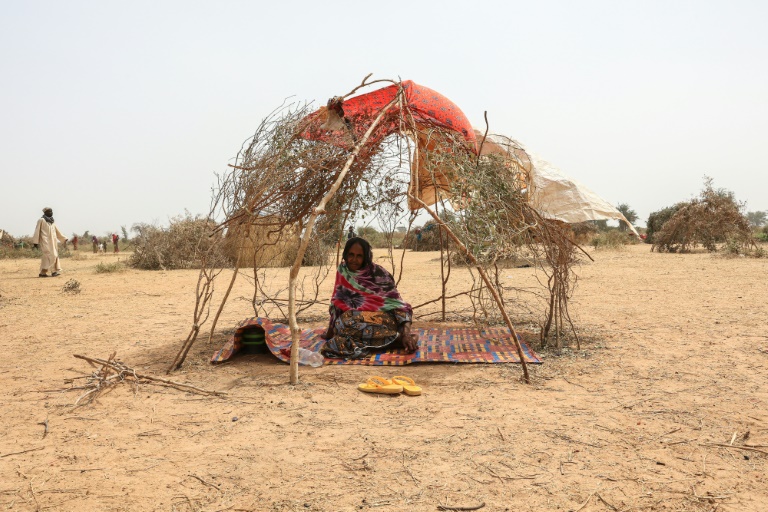
Their homes are a scattering of huts made of branches and dry leaves that seem to almost dissolve into the arid landscape.

A group of men sit on a rug, conversing in the shade of a tree, while women perching on stones under the scorching Sahel sun prepare a meal with the few ingredients they have to hand, as children play nearby.

These are some of the 4,000 ethnic Arabs in a makeshift camp at Bogo in Cameroon’s Far North region.

They fled after violence erupted near Kousseri, a river town about 100 kilometres (60 miles) from Lake Chad.

The fighting flared in August, then again in December, pitting Choa Arab herders against Mousgoum fishermen in a fight over access to water, a precious but dwindling resource in this region.

The Mousgoum dig pools to capture water and keep fish — a practice that often causes friction with Arab herders seeking water points for cattle, but which this time spiralled out of control.

At least 67 people died and hundreds were injured, the town’s cattle market was destroyed and around 100,000 people fled.

Many crossed into neighbouring Chad or headed towards Maroua, the Far North’s capital, lying more than 800 kilometres (500 miles) northeast of the capital Yaounde. 

Mahamat Sale, 60, is the leader of the group in Bogo, who say they walked some 175 kilometres (110 miles) to reach a place they consider safe. They have lost everything.

“We prefer to stay here rather than go back,” said Sale. “Here, we are tolerated. Over there, the Mousgoums consider us to be invaders.”

– Climate stress –

Rising temperatures and scarcer, more unpredictable rainfall are acknowledged factors in inflaming ancestral tensions in the Lake Chad area.

In a 2019 report, the Europe-based think tank Adelphi warned of “a feedback loop” — a vicious circle, in non-technical speech — between climate change and conflict dynamics.

Climate stress increases pressure on communities, which undermines their ability to cope.

This in turn makes those communities more vulnerable to climate impacts and heightens competition for resources.

Armel Sambo, a professor of history at the University of Maroua, said “When the economic situation deteriorates, people fall back on their ethnicity, religion and identity issues,” inflaming the risk of violence.

“Historically, the Mousgoums are the natives and the Arabs are nomadic herders, regarded as people who come along and occupy the land as intruders.”

Lake Chad is an expanse of shallow water and swamps that at one time was the size of Lake Erie, extending its shores to four countries — Cameroon, Chad, Niger and Nigeria.

But it has lost more than 90 percent of its surface area in six decades, reduced from 26,000 square kilometres (10,000 square miles) in 1963 to less than 1,500 square kilometres today.

Increased irrigation and human demand for freshwater, along with less rainfall, have driven the shinkage.

The lake basin and its countless islets have also become the main haven for jihadist fighters from Nigeria’s Boko Haram and its dissident branch, the Islamic State in West Africa Province (ISWAP), but the Kousseri area has thus far been spared from their attacks.

– Solutions –

At a village near Kousseri, Mahamat Djidda Mahamat, a 20-year-old resident, said the situation had calmed down after last year’s clashes.

“I don’t know if it’s over. I lost my father, my house, loved ones… I just want to live in peace,” he said, adding that he avoided the Arabs.

“People are going home. We have secured the area,” said Bakari Midjiyawa, the governor of the Far North region.

But, said Sambo, what was needed was a long-term system of water allocation and mediation so that disputes between herders and fishermen did not turn bloody.

“Efforts are being made but are not enough,” he said.

“Seasonal livestock trails should be marked out, water points should be created for each community and there should be monitoring to ensure proper application of these measures,” he said.

“The government must become more involved, ensure the safety of movements of people in this region and promote mediation by traditional chiefs.”

More widely, the disappearance of Lake Chad — a hypothesis deemed credible by experts — would deprive millions of water needed to survive through fishing, agriculture, livestock and trade.

“The effects of global warming and the problems of access to water have catalysed tensions,” said Xavier Bourgois, spokesperson for UNHCR, the UN’s refugee agency. 

“Now we must bring all the players around the table to find the roots of the problem and put in place solutions for adapting.”

Hundreds of thousands at risk as Australian floods spread to Sydney

Emergency services ordered some Sydney residents to prepare to flee Wednesday as heavy rainfall barrelled down Australia’s east coast, burying towns in floodwater, killing 13 and putting hundreds of thousands at risk.

A week-long torrential downpour has swollen rivers and reservoirs past bursting point, causing chaos in an area 800 kilometres (500 miles) long.

From Brisbane to Sydney, more than 30 evacuation warnings are in place and several dams are overflowing, with some near Sydney under threat of bursting.

Terrified residents have sought refuge on higher ground, in make-shift evacuation centres, or by clambering into attics or onto rooftops praying for rescue by boat or helicopter.

In the hard-hit town of Lismore, Lucy Wise said the floods came much quicker and much higher than expected.

“The rain just wouldn’t stop and the water was just coming up so fast” she told AFP.

She huddled at home as the waters rose through the night before grabbing her sleeping two-year-old son, cloaking him in a lifejacket and scrambling into the roof space of their house for safety.

“We were just lying there, silently, and the rain was just pouring down. I’d never heard such heavy rain in my life.”

From outside neighbours watched as the house went under water.

“It was a few hours that I couldn’t move. I could barely breathe. I was just taking it one breath at a time.”

Wise and her family were eventually rescued by boat, but authorities say the floods have already claimed the lives of 13 others in Queensland and New South Wales.

The focus has now shifted to Sydney, Australia’s largest city and home to more than five million people.

The Warragamba Dam, which supplies 80 percent of the city’s water, began to spill over in the early hours of Wednesday.

Several western suburbs are under major flood and evacuation warnings, and authorities have told residents across the city to stop all “non-essential travel.”

“There are quite a few hundred thousand people affected by these warnings that we are putting out now,” said State Emergency Services commissioner Carlene York.

A La Nina weather pattern has caused Sydney to experience its wettest summer in 30 years. 

Meteorologist Ben Domensino of @Weatherzone described the current storm system as an “atmospheric river” featuring a “long area of airborne moisture that is going in one direction.”

Scientists say climate change is making Australia’s floods, bushfires, cyclones and droughts more frequent and more intense.

“Despite decades of warnings from scientists about climate change, Australia is unprepared for the supercharged weather that it is now driving, such as the current floods,” said environmental expert Hilary Bambrick of the Queensland University of Technology.

“Australia is at the forefront of severe climate change. Temperatures are rising faster in Australia than the global average, and higher temperatures mean the atmosphere holds more moisture, meaning rainfall events are becoming more extreme.”

– Long road back –

As the cleanup begins in northern areas which were hit first by the floods, many, like Mullumbimby resident Casey Whelan, predict a “long recovery” that could “take years.”

Whelan fled his home as the flooding worsened, but as water levels stabilised he used a kayak that had floated by and a broomstick as an oar to return. He found it “just destroyed.”

Water had risen up to the height of the kitchen bench, their furniture was submerged.

“Lots of people in my street can’t get flood insurance. Some insurers will quote $30,000 (US$22,000) a year… they will just be ruined. They will have no way to rebuild,” he said.

Fifty-three year-old farmer James Clark said it would take weeks just to assess the damage.

“I lost tools, I lost equipment, I have got farm machinery that’s underwater. I didn’t get it high enough. I guessed how high the flood was going to come and got gear up, but didn’t get it up enough,” he said.

“After a flood it could take months before things get back to normal. It’s weeks even before you can walk around without, without sort of things being too wet underfoot.”

Close Bitnami banner
Bitnami