AFP

Indonesia's Mount Semeru erupts, forcing thousands to flee

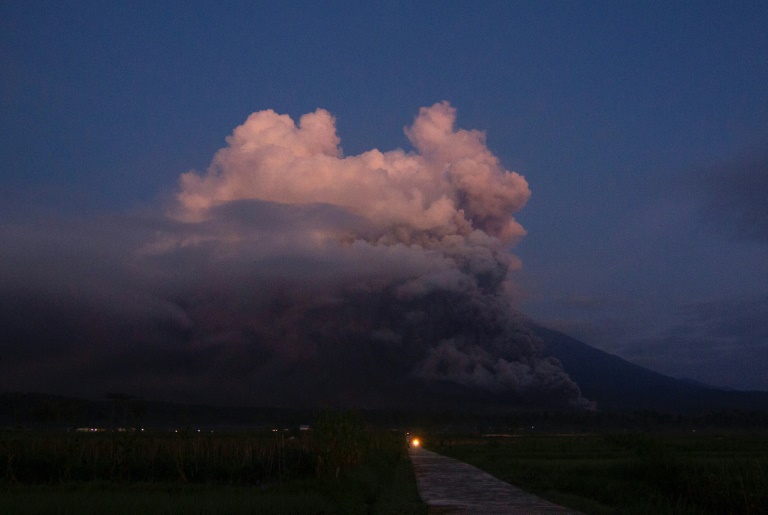
Indonesia’s Mount Semeru erupted Sunday spewing hot ash clouds a mile high and rivers of lava down its side while sparking the evacuation of nearly 2,000 people exactly one year after its last major eruption killed dozens.

The burst from the highest mountain on Indonesia’s main island of Java, around 800 kilometres (500 miles) southeast of the capital Jakarta, prompted authorities to raise the alert status for the volcano to the highest level.

Villages around Semeru were being battered by a mix of volcanic ash and monsoon rains. Videos shared with AFP by a local rescue group showed a huge black cloud rising from the volcano, engulfing the sky and blocking the sun.

One resident described the panic when the ash clouds descended on their village.

“It was dark, I could not see anything. It was raining water and ash,” the person, who did not want to be named, told AFP.

“I didn’t know where to take shelter. I had to flee.”

“Hot avalanches” triggered by piles of lava at the top flooded down the 3,676-metre (12,060 feet) mountain, said Abdul Muhari, a spokesperson for Indonesia’s National Disaster Mitigation Agency (BNPB).

A spokesperson for Indonesia’s Volcanology and Geological Disaster Mitigation Centre (PVMBG) told broadcaster Kompas TV that the higher alert level meant local villages were in danger.

However, no casualties or injuries were reported on Sunday after the PVMBG warned nearby residents not to travel within eight kilometres (five miles) of the crater.

The geological agency said that by evening Semeru was “still in the eruption phase” though the size of the ash clouds was decreasing.

“Overall the activity is still very high,” it said in a statement.

The internet in the area was down and phone signals were patchy after the eruption, according to an AFP journalist.

– Rain and ash –

The BNPB said 1,979 people had been taken to 11 shelters, with at least six villages affected by the eruption.

Local administration official Indah Amperawati Masdar said residents would only be allowed to return home when the hot clouds had dissipated.

Residents were also told to avoid a southeastern area 13 kilometres (eight miles) along a river in the direction the ash was travelling.

The majority of residents in the two villages most at risk had been evacuated, said Patria Dwi Hastiadi, a spokesperson for the Lumajang Disaster Mitigation Agency.

Locals fled on motorbikes, some three at a time with their belongings, while others helped the elderly evacuate safely. One resident was covered in mud that had rained down on him as a mix of rain and ash.

Japan’s weather agency had earlier warned that a tsunami could be triggered by the eruption affecting southern islands in the country’s Okinawa prefecture, Kyodo news agency reported. But Japan’s meteorological agency later said no significant tidal changes were observed.

Semeru last erupted exactly one year ago, killing at least 51 people and damaging more than 5,000 homes.

That disaster left entire streets filled with mud and ash that swallowed houses and vehicles, forcing nearly 10,000 people to seek refuge.

Semeru’s alert status had remained at its second-highest level since a previous major eruption in December 2020.

Indonesia sits on the Pacific Ring of Fire, where the meeting of continental plates causes substantial volcanic and seismic activity.

The Southeast Asian archipelago nation has nearly 130 active volcanoes.
More than 500 Ukrainian localities without power: ministry

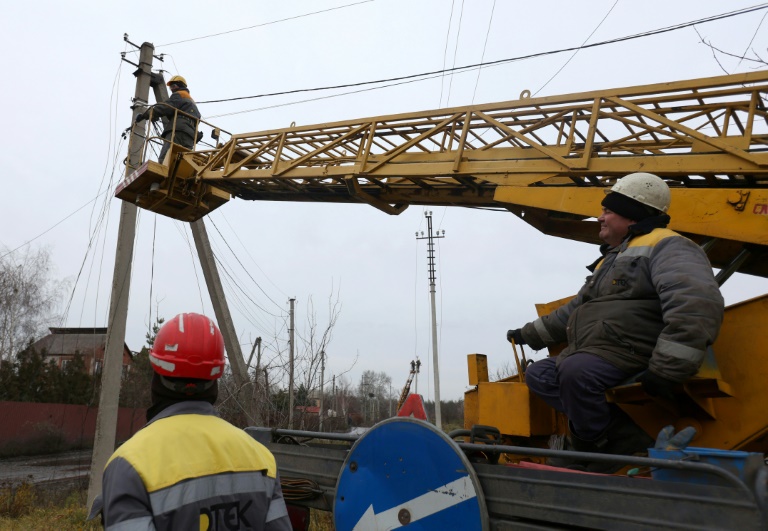
More than 500 Ukrainian localities remained without power Sunday following weeks of Russian airstrikes on the electric grid, an interior ministry official said.

“The enemy continues to attack the country’s essential infrastructure. Currently, 507 localities in eight regions of our country are cut off from electricity supplies,” deputy interior minister Yevgueny Yenin told Ukrainian television.

“The Kharkiv region is the worst hit with 112 isolated villages,” Yenin added.

Another 90 villages were cut off in the Donetsk and Kherson regions, he said, with others in the regions of Mykolaiv, Zaporizhzhia and Lugansk.

On Saturday, Ukrainian authorities — including Mykolaiv region governor Vitali Kim — had once again urged civilians to bear up in the face of continually deteriorating early winter conditions and regular power outages. 

Repeated daily power cuts have left millions of people without heat or lighting while outside temperatures have dropped below zero Celsius (32 Fahrenheit) in recent days.

With further strikes on the network widely expected, Ukrainians fear a difficult prolonged winter as well as a flood of departures by refugees from a war now into a tenth month.

Private Ukrainian energy operator DTEK said Thursday that nearly half of Ukraine’s electricity grid remains damaged after Russia began targeting Ukrainian energy facilities in October following a series of humiliating military defeats on the ground.

OPEC+ likely to maintain oil output levels

Major oil-producing countries led by Saudi Arabia and Russia look set to maintain their current output levels at a meeting Sunday, ahead of fresh sanctions against Moscow coming into force.

The alliance’s Joint Ministerial Monitoring Committee (JMMC) kicked off their gathering Sunday, a source close to OPEC told AFP, ahead of the full ministerial conference afterwards which was expected to be brief.

The 13-member Organization of the Petroleum Exporting Countries will consult with 10 other oil-producing nations including Russia — known collectively as OPEC+ — to review their decision in October to cut production by two million barrels per day.

On Friday, the EU, G7 and Australia agreed a $60-per-barrel price cap on Russian oil, which will come into effect on Monday or soon after, alongside an EU embargo on maritime deliveries of Russian crude oil.

It will prevent seaborne shipments of Russian crude to the European Union, which account for two thirds of the bloc’s oil imports from Russia, an attempt to deprive Moscow’s war chest of billions of euros.

While Russia denounced the incoming price cap on Saturday, threatening to suspend deliveries to any country that adopted the measure, Ukraine suggested the cap should have been set even lower.

For OPEC+, the big unknown in the oil equation is how heavily sanctions will hit Russian supply.

“The uncertainty for Russian supply is significant”, DNB analysts said. OPEC would therefore “aim for a low-profile meeting that leaves existing production quotas unchanged”.

– An ‘uncomfortable position’ –

Moscow’s threat to suspend deliveries to countries abiding by the price cap would put “some in a very uncomfortable position”, said OANDA analyst Craig Erlam: “Choosing between losing access to cheap Russian crude or facing G7 sanctions”.

The choice of a virtual OPEC+ meeting instead of an in-person conference at the Vienna headquarters, suggested a policy rollover, UniCredit analyst Edward Moya said.

But “deeper oil output cuts” could still not be ruled out at this stage.

Amid economic gloom fuelled by soaring inflation and fears of China’s weaker energy demand due to its Covid-related restrictions, the two global crude benchmarks remained close to their lowest level of the year, far from their March peaks.

Since the group’s last meeting in early October, Brent North Sea oil and its US equivalent, WTI, have lost more than six percent of their value.

But speculation that a further OPEC+ production cut might still be on the table boosted prices throughout the week.

“OPEC+ might feel compelled to adopt a more aggressive stance” by cutting or threatening to cut production even further, UniCredit analyst Edoardo Campanella said. 

“Russia might also retaliate by leveraging its influence within OPEC+ to push for more production cuts down the road, thus exacerbating the global energy crisis,” he added.

Indonesia villagers race to escape eruption as sky turns black

Thousands of villagers living near Indonesia’s Mount Semeru were racing for refuge Sunday to the wail of emergency sirens as lava snaked towards their homes under a black sky after the volcano erupted.

Locals fled on motorbikes sometimes three at a time as a mushroom cloud of ash approached and monsoon rains lashed the area in East Java.

“It was dark and raining. The rain did not consist only of water, but also volcanic ash. It was like mud,” said an AFP journalist on the scene.

Indonesian authorities raised their alert level for the volcano to its highest after the crater spewed hot ash a mile into the sky.

It came only a year after the volcano last erupted, killing at least 51 people and laying waste to homes.

Rescue workers were once again rushing to evacuate villagers in the area Sunday as a colossal plume of ash engulfed all light.

One emergency responder, Gunawan, filmed the clouds above as a midday sky turned ominously dark as though midnight.

“It’s getting dark, bro,” he said to the camera as a seismograph whistled in the background.

The internet was down and phone signals were patchy but villagers were alerted to the danger by sirens and the beating of bamboo drums by local volunteers.

Semeru is the highest mountain on Indonesia’s main island of Java and lies around 800 kilometres (500 miles) southeast of the capital Jakarta among a cluster of craters in a moon-like landscape.

The Southeast Asian archipelago nation has nearly 130 active volcanoes.

– ‘Cheers’ –

The eruption last year left locals combing through ruined belongings after their homes were blanketed in ash.

It remains to be seen what damage the eruption will inflict this time with the lava still edging towards homes and their owners told to remain eight kilometres (five miles) from the crater.

Many villagers, mostly women and children, took shelter in local halls and schools, some as far as 20 kilometres (12 miles) away.

Gunawan, who like many Indonesians goes by only one name, said everyone was safe for now, even if their possessions and homes might not be by day’s end.

As he flashed a peace sign at a camera against the backdrop of dark haze and monsoon rains at his rescue post, he tried to reassure people.

“Salam tangguh, salam presisi!” he said, meaning “cheers”, his voice relaxed but muffled behind a gas mask.

Germany's Scholz weathers shocks in turbulent first year

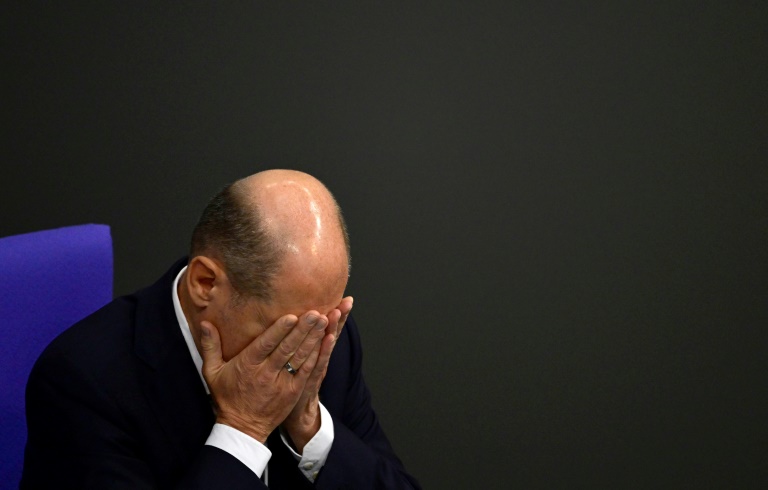
A war in his backyard, galloping economic crisis, and unhappy partners at home and abroad — German Chancellor Olaf Scholz has weathered unprecedented shocks in his first year, while struggling to make a mark on the global stage.

The ex-finance minister took office promising continuity with the era of Angela Merkel, who ended her 16 years as chancellor a widely respected figure.

But Russia’s invasion of Ukraine has forced him to rip up Germany’s post-war axioms and chart out new economic, defence and geopolitical directions for the country that prizes — and is valued for — its stability and predictability.

“We never before had a government faced with such a dramatically worsening situation, when it came to foreign and security policy, but also of course energy policy,” political scientist Ursula Muench told AFP.

Scholz’s coalition of his Social Democrats and partners Greens and liberals FDP had taken office planning ambitious climate policies and budget restraint. 

But as Moscow dwindled its energy supplies in the wake of the war, Germany has had to halt its planned nuclear exit, restart mothballed coal power stations while burning through a budgetary hole in a scrum for oil and gas to replace Russian supplies.

And in a turning point for a country whose role on the world stage was still affected by memories of World War II, Scholz announced a historic shift on defence, vowing to re-arm Germany with a massive boost in military spending.

“Going by the dramatic events this year, he did pretty well,” said Nils Diederich, a political scientist at Berlin’s Free University. 

– Turning point –

But Rachel Rizzo, a senior fellow at US think tank the Atlantic Council’s Europe Center, warned that losing momentum was a danger, even if the initial response was “impressive”.

“I think not being able to follow through with defence and security commitments is a concern,” she told AFP.

Not only is Germany trying to replenish its own military stocks, it is facing intense pressure from Ukraine to deliver what it has to help in the fightback against Russia.

The defence spending is high at a time when the treasury is also being pressed to help cushion a price shock fuelled by the energy crisis.

Huge investments are also required for the export giant to manage an economic transformation of reliance on cheap Russian energy or Chinese components to a diversified approach.

And governing in a three-way coalition means resolving each challenge inevitably involves squabbles that could unravel the fragile partnership.

Scholz’s government has managed to implement part of its programme, including raising the minimum wage and reforming unemployment benefits.

But with myriad crises not going away, the chancellor’s popularity ratings have suffered. 

A survey by the Insa institute published Sunday in tabloid Bild showed 58 percent of Germans are dissatisfied with Scholz — compared with just 22 percent a year ago — and 64 percent are dissatisfied with his government, up from 36 percent. 

– ‘Going it alone’ –

As well as disagreements at home, there have been tensions with partners abroad.

European Union allies were upset that Scholz announced a massive 200-billion-euro ($207-billion) energy fund without first consulting them, complaining he should have focused on coming up with EU-wide measures.

Tensions have also arisen in the key relationship between Berlin and Paris over issues ranging from the energy fund to German plans for defence procurement.

Unlike Merkel, who, in her time, was widely respected as the voice to reckon with in Europe, Scholz has so far failed to step into the role on the international stage.

Merkel’s departure “has left a void”, said Eric Maurice, from the Brussels office of the Robert Schuman Foundation.

Scholz is “struggling to make his mark at the European level… He is still trying to find his bearings, he does not have Merkel’s experience.”

The view Scholz was seeking to “go it alone” was reinforced when he made the first visit to China by a G7 leader since the start of the pandemic in November, accompanied by a delegation of German business leaders.

The chancellor faced accusations he was pursuing the same mercantilist, trade-focused foreign policy of previous German governments, which led to economic ties flourishing with authoritarian Russia, but ultimately left Berlin vulnerable.

As Scholz heads into his second year in the job, many of the open challenges will continue to entangle him.

High energy prices will remain a major problem, particularly for electricity-hungry German manufacturers, said Sudha David-Wilp, Berlin office director of US think tank the German Marshall Fund.

“Ensuring German competitiveness because of the increase in energy costs, particularly for industries like chemicals and steel manufacturing, is the big challenge for Scholz,” she said.

The energy fund “is just a short-term fix. No one knows when energy prices are going to come down to pre-war levels”.

Opec+ likely to maintain oil output levels

Major oil-producing countries led by Saudi Arabia and Russia look set to maintain their current output levels at a meeting Sunday, ahead of fresh sanctions against Moscow coming into force.

The 13-member Organization of the Petroleum Exporting Countries (OPEC) is due to consult with 10 other oil-producing nations, including Russia, to review their decision in October to cut production by two million barrels per day.

The OPEC+ videoconference will take place from 1100 GMT Sunday.

On Friday, the EU, G7 and Australia agreed a $60-per-barrel price cap on Russian oil, which will come into effect on Monday or soon after, alongside an EU embargo on maritime deliveries of Russian crude oil.

It will prevent seaborne shipments of Russian crude to the European Union, which account for two thirds of the bloc’s oil imports from Russia, an attempt to deprive Moscow’s war chest of billions of euros.

While Russia denounced the incoming price cap on Saturday, threatening to suspend deliveries to any country that adopted the measure, Ukraine suggested the cap should have been set even lower.

For OPEC+, the big unknown in the oil equation is how heavily sanctions will hit Russian supply.

“The uncertainty for Russian supply is significant”, DNB analysts said. OPEC would therefore “aim for a low-profile meeting that leaves existing production quotas unchanged”.

– An ‘uncomfortable position’ –

Moscow’s threat to suspend deliveries to countries abiding by the price cap would put “some in a very uncomfortable position”, said OANDA analyst Craig Erlam: “Choosing between losing access to cheap Russian crude or facing G7 sanctions”.

The choice of a virtual OPEC+ meeting instead of an in-person conference at the Vienna headquarters, suggested a policy rollover, UniCredit analyst Edward Moya said.

But “deeper oil output cuts” could still not be ruled out at this stage.

Amid economic gloom fuelled by soaring inflation and fears of China’s weaker energy demand due to its Covid-related restrictions, the two global crude benchmarks remained close to their lowest level of the year, far from their March peaks.

Since the group’s last meeting in early October, Brent North Sea oil and its US equivalent, WTI, have lost more than six percent of their value.

But speculation that a further OPEC+ production cut might still be on the table boosted prices throughout the week.

“OPEC+ might feel compelled to adopt a more aggressive stance” by cutting or threatening to cut production even further, UniCredit analyst Edoardo Campanella said. 

“Russia might also retaliate by leveraging its influence within OPEC+ to push for more production cuts down the road, thus exacerbating the global energy crisis,” he added.

As chatbot sophistication grows, AI debate intensifies

California start-up OpenAI has released a chatbot capable of answering a variety of questions, but its impressive performance has reopened the debate on the risks linked to artificial intelligence (AI) technologies.

The conversations with ChatGPT, posted on Twitter by fascinated users, show a kind of omniscient machine, capable of explaining scientific concepts and writing scenes for a play, university dissertations or even functional lines of computer code.

“Its answer to the question ‘what to do if someone has a heart attack’ was incredibly clear and relevant,” Claude de Loupy, head of Syllabs, a French company specialized in automatic text generation, told AFP.

“When you start asking very specific questions, ChatGPT’s response can be off the mark,” but its overall performance remains “really impressive,” with a “high linguistic level,” he said. 

OpenAI, cofounded in 2015 in San Francisco by billionaire tech mogul Elon Musk, who left the business in 2018, received $1 billion from Microsoft in 2019. 

The start-up is best known for its automated creation software: GPT-3 for text generation and DALL- E for image generation.

ChatGPT is able to ask its interlocutor for details, and has fewer strange responses than GPT-3, which, in spite of its prowess, sometimes spits out absurd results, said De Loupy.  

– Cicero –

“A few years ago chatbots had the vocabulary of a dictionary and the memory of a goldfish,” said Sean McGregor, a researcher who runs a database of AI-related incidents.

“Chatbots are getting much better at the ‘history problem’ where they act in a manner consistent with the history of queries and responses. The chatbots have graduated from goldfish status.” 

Like other programs relying on deep learning, mimicking neural activity, ChatGPT has one major weakness: “it does not have access to meaning,” says De Loupy.

The software cannot justify its choices, such as explain why its picked the words that make up its responses.

AI technologies able to communicate are, nevertheless, increasingly able to give an impression of thought.

Researchers at Facebook-parent Meta recently developed a computer program dubbed Cicero, after the Roman statesman.

The software has proven proficient at the board game Diplomacy, which requires negotiation skills.

“If it doesn’t talk like a real person — showing empathy, building relationships, and speaking knowledgeably about the game — it won’t find other players willing to work with it,” Meta said in research findings.

In October, Character.ai, a start-up founded by former Google engineers, put an experimental chatbot online that can adopt any personality.

Users create characters based on a brief description and can then “chat” with a fake Sherlock Holmes, Socrates or Donald Trump.

– ‘Just a machine’ –

This level of sophistication both fascinates and worries some observers, who voice concern these technologies could be misused to trick people, by spreading false information or by creating increasingly credible scams.

What does ChatGPT think of these hazards?

“There are potential dangers in building highly sophisticated chatbots, particularly if they are designed to be indistinguishable from humans in their language and behavior,” the chatbot told AFP. 

Some businesses are putting safeguards in place to avoid abuse of their technologies.

On its welcome page, OpenAI lays out disclaimers, saying the chatbot “may occasionally generate incorrect information” or “produce harmful instructions or biased content.”

And ChatGPT refuses to take sides.

“OpenAI made it incredibly difficult to get the model to express opinions on things,” McGregor said.

Once, McGregor asked the chatbot to write a poem about an ethical issue.

“I am just a machine, A tool for you to use, I do not have the power to choose, or to refuse. I cannot weigh the options, I cannot judge what’s right, I cannot make a decision On this fateful night,” it replied.

On Saturday, OpenAI cofounder and CEO Sam Altman took to Twitter, musing on the debates surrounding AI. 

“Interesting watching people start to debate whether powerful AI systems should behave in the way users want or their creators intend,” he wrote.

“The question of whose values we align these systems to will be one of the most important debates society ever has.”

As chatbot sophistication grows, AI debate intensifies

California start-up OpenAI has released a chatbot capable of answering a variety of questions, but its impressive performance has reopened the debate on the risks linked to artificial intelligence (AI) technologies.

The conversations with ChatGPT, posted on Twitter by fascinated users, show a kind of omniscient machine, capable of explaining scientific concepts and writing scenes for a play, university dissertations or even functional lines of computer code.

“Its answer to the question ‘what to do if someone has a heart attack’ was incredibly clear and relevant,” Claude de Loupy, head of Syllabs, a French company specialized in automatic text generation, told AFP.

“When you start asking very specific questions, ChatGPT’s response can be off the mark,” but its overall performance remains “really impressive,” with a “high linguistic level,” he said. 

OpenAI, cofounded in 2015 in San Francisco by billionaire tech mogul Elon Musk, who left the business in 2018, received $1 billion from Microsoft in 2019. 

The start-up is best known for its automated creation software: GPT-3 for text generation and DALL- E for image generation.

ChatGPT is able to ask its interlocutor for details, and has fewer strange responses than GPT-3, which, in spite of its prowess, sometimes spits out absurd results, said De Loupy.  

– Cicero –

“A few years ago chatbots had the vocabulary of a dictionary and the memory of a goldfish,” said Sean McGregor, a researcher who runs a database of AI-related incidents.

“Chatbots are getting much better at the ‘history problem’ where they act in a manner consistent with the history of queries and responses. The chatbots have graduated from goldfish status.” 

Like other programs relying on deep learning, mimicking neural activity, ChatGPT has one major weakness: “it does not have access to meaning,” says De Loupy.

The software cannot justify its choices, such as explain why its picked the words that make up its responses.

AI technologies able to communicate are, nevertheless, increasingly able to give an impression of thought.

Researchers at Facebook-parent Meta recently developed a computer program dubbed Cicero, after the Roman statesman.

The software has proven proficient at the board game Diplomacy, which requires negotiation skills.

“If it doesn’t talk like a real person — showing empathy, building relationships, and speaking knowledgeably about the game — it won’t find other players willing to work with it,” Meta said in research findings.

In October, Character.ai, a start-up founded by former Google engineers, put an experimental chatbot online that can adopt any personality.

Users create characters based on a brief description and can then “chat” with a fake Sherlock Holmes, Socrates or Donald Trump.

– ‘Just a machine’ –

This level of sophistication both fascinates and worries some observers, who voice concern these technologies could be misused to trick people, by spreading false information or by creating increasingly credible scams.

What does ChatGPT think of these hazards?

“There are potential dangers in building highly sophisticated chatbots, particularly if they are designed to be indistinguishable from humans in their language and behavior,” the chatbot told AFP. 

Some businesses are putting safeguards in place to avoid abuse of their technologies.

On its welcome page, OpenAI lays out disclaimers, saying the chatbot “may occasionally generate incorrect information” or “produce harmful instructions or biased content.”

And ChatGPT refuses to take sides.

“OpenAI made it incredibly difficult to get the model to express opinions on things,” McGregor said.

Once, McGregor asked the chatbot to write a poem about an ethical issue.

“I am just a machine, A tool for you to use, I do not have the power to choose, or to refuse. I cannot weigh the options, I cannot judge what’s right, I cannot make a decision On this fateful night,” it replied.

On Saturday, OpenAI cofounder and CEO Sam Altman took to Twitter, musing on the debates surrounding AI. 

“Interesting watching people start to debate whether powerful AI systems should behave in the way users want or their creators intend,” he wrote.

“The question of whose values we align these systems to will be one of the most important debates society ever has.”

As chatbot sophistication grows, AI debate intensifies

California start-up OpenAI has released a chatbot capable of answering a variety of questions, but its impressive performance has reopened the debate on the risks linked to artificial intelligence (AI) technologies.

The conversations with ChatGPT, posted on Twitter by fascinated users, show a kind of omniscient machine, capable of explaining scientific concepts and writing scenes for a play, university dissertations or even functional lines of computer code.

“Its answer to the question ‘what to do if someone has a heart attack’ was incredibly clear and relevant,” Claude de Loupy, head of Syllabs, a French company specialized in automatic text generation, told AFP.

“When you start asking very specific questions, ChatGPT’s response can be off the mark,” but its overall performance remains “really impressive,” with a “high linguistic level,” he said. 

OpenAI, cofounded in 2015 in San Francisco by billionaire tech mogul Elon Musk, who left the business in 2018, received $1 billion from Microsoft in 2019. 

The start-up is best known for its automated creation software: GPT-3 for text generation and DALL- E for image generation.

ChatGPT is able to ask its interlocutor for details, and has fewer strange responses than GPT-3, which, in spite of its prowess, sometimes spits out absurd results, said De Loupy.  

– Cicero –

“A few years ago chatbots had the vocabulary of a dictionary and the memory of a goldfish,” said Sean McGregor, a researcher who runs a database of AI-related incidents.

“Chatbots are getting much better at the ‘history problem’ where they act in a manner consistent with the history of queries and responses. The chatbots have graduated from goldfish status.” 

Like other programs relying on deep learning, mimicking neural activity, ChatGPT has one major weakness: “it does not have access to meaning,” says De Loupy.

The software cannot justify its choices, such as explain why its picked the words that make up its responses.

AI technologies able to communicate are, nevertheless, increasingly able to give an impression of thought.

Researchers at Facebook-parent Meta recently developed a computer program dubbed Cicero, after the Roman statesman.

The software has proven proficient at the board game Diplomacy, which requires negotiation skills.

“If it doesn’t talk like a real person — showing empathy, building relationships, and speaking knowledgeably about the game — it won’t find other players willing to work with it,” Meta said in research findings.

In October, Character.ai, a start-up founded by former Google engineers, put an experimental chatbot online that can adopt any personality.

Users create characters based on a brief description and can then “chat” with a fake Sherlock Holmes, Socrates or Donald Trump.

– ‘Just a machine’ –

This level of sophistication both fascinates and worries some observers, who voice concern these technologies could be misused to trick people, by spreading false information or by creating increasingly credible scams.

What does ChatGPT think of these hazards?

“There are potential dangers in building highly sophisticated chatbots, particularly if they are designed to be indistinguishable from humans in their language and behavior,” the chatbot told AFP. 

Some businesses are putting safeguards in place to avoid abuse of their technologies.

On its welcome page, OpenAI lays out disclaimers, saying the chatbot “may occasionally generate incorrect information” or “produce harmful instructions or biased content.”

And ChatGPT refuses to take sides.

“OpenAI made it incredibly difficult to get the model to express opinions on things,” McGregor said.

Once, McGregor asked the chatbot to write a poem about an ethical issue.

“I am just a machine, A tool for you to use, I do not have the power to choose, or to refuse. I cannot weigh the options, I cannot judge what’s right, I cannot make a decision On this fateful night,” it replied.

On Saturday, OpenAI cofounder and CEO Sam Altman took to Twitter, musing on the debates surrounding AI. 

“Interesting watching people start to debate whether powerful AI systems should behave in the way users want or their creators intend,” he wrote.

“The question of whose values we align these systems to will be one of the most important debates society ever has.”

UK groups hope creative biodiversity message takes flight

A human “murmuration” using dance techniques previously showcased by French choreographer Sadeck Waff at the Tokyo Paralympics will deliver a powerful message of “hope” to next week’s United Nations biodiversity talks.

The COP15 talks organisers are preparing for multiple protests, with security measures including a three-metre (nine-foot) high fence around the venue in Montreal, Canada.

But a coalition of Britain’s leading conservation charities has chosen a more creative approach to highlight its call for urgent targets to end biodiversity loss.

Spearheaded by the Royal Society for the Protection of Birds (RSPB), they have joined forces with Waff and 80 young British dancers to create a video of one of his trademark “murmuration” dances that mimics the motion of a flock of birds.

Paris-based Waff says the latest in his dance series, which draws its name from the collective noun for a flock of starlings, is about “recovery and hope”.

“I hope that the dance inspires everyone to appreciate the power and beauty of cooperation as well as the urgency of the conversation that needs to take place, in order to save and protect the nature that we all rely on,” he told AFP.

It is hoped a new global biodiversity framework will be agreed at the Montreal talks, which run from December 7 to 19.

The UN has said world leaders will not attend the gathering but the RSPB is asking British Prime Minister Rishi Sunak to be present.

– Synchronicity –

The conservation charity wants Sunak to push for a global deal that gives biodiversity its “Paris moment” like the agreement reached at the 2015 climate conference in the French capital.

Naturalist and BBC nature series presenter Chris Packham told AFP it was a “once in a decade opportunity” for world leaders to set targets that ensure “biodiversity is restored for generations to come”.

He said the dance was a vital means of communicating the need to reverse biodiversity loss to everyone — not just those already signed up to the message.

“The RSPB has an audience. I have an audience. But it’s not big enough. We need to spread it by using other aspects of our culture,” Packham said.

“The idea that it is mimicking a murmuration — which is a flock of birds working in synchronicity together to achieve a purpose — sends the kind of message that we all need to be working with that synchronicity.”

Waff’s hand ballets have been variously described as mesmerising, hypnotic and beautifully expressive.

His previous video to round off the 2020 Tokyo Paralympics — held in 2021 due to the pandemic — and hand over to the 2024 games in Paris featured over 120 amateur and professional wheelchair-using performers.

To a stirring composition by French singer-songwriter and music video producer Woodkid, the troupe drawn from people of all ethnicities, genders and physical abilities moved as one in time to the music.

A clip of the video immediately went viral and has since generated millions of views.

– Performers –

Waff’s latest “murmuration” dance was performed by students from Britain’s Bird College of Dance and Musical Theatre near London.

All dressed in black, only the performers’ heads, hands and forearms are clearly visible, while Waff, also in black, stands in front leading the performance.

Dancer Rex Boadu, 22, said it had been an “incredible experience” to work with Waff, who has previously choreographed Grammy winners Shakira and Chris Brown.

“It’s hard to look away from it once you start looking at it and digesting and interpreting the message,” he said adding that he hoped the video would “make people think” and research the issue for themselves.

Close Bitnami banner
Bitnami