AFP

Activists file legal challenge over Finnish climate inaction

Environmental organisations in Finland on Monday filed a legal challenge accusing the government of breaking its own commitments to protect the climate, the first challenge of its kind in the country.

In July, Finland passed the Climate Change Act, which aims to make the country carbon-neutral by 2035. 

But the environmental groups say the government had ignored its own laws by failing to protect the Nordic nation’s carbon sinks.

Carbon sinks are natural systems, such as forests, that absorb carbon from the atmosphere and store it in, for example, vegetation and soil.

“The government has violated its own Climate Change Act by not taking a decision on additional measures to meet Finland’s climate targets,” Hanna Aho, Policy Officer for the Finnish Association for Nature Conservation (FANC), told AFP.

“As a result, it seems very unlikely that climate targets will be met,” Aho said.

The FANC and Greenpeace, which jointly mounted the legal challenge, say carbon sinks in Finland have “collapsed” due to an increase in logging and to slower tree growth. 

The most recent chance for the government to address the issue was its Annual Climate Report in October but that still lacked the necessary “assessment on measures to protect the sinks”, Aho said.

“Logging has not been restricted, even though it is known to be the most important factor affecting the size of carbon sinks,” she added.

The organisations petitioned the country’s Supreme Administrative Court to overrule the government’s decision to submit the report without “additional measures to enhance carbon sinks”.

The groups said the report should be sent back to the drawing board because it was not in line with the Climate Change Act.

“Prime Minister Sanna Marin’s government’s inaction is in stark contrast to the obligations of the Climate Change Act,” Aho said.

It will be up to the court to decide whether or not to hear the case.

In recent years, Finland has struggled to balance its climate ambitions with its forestry industry, which is an important part of its economy.

In 2020, Finnish foresty product exports were worth 10.4 billion euros, amounting to 18 percent of the country’s total exports. 

A growing number of organisations and individuals around the world have turned to the courts to challenge what they see as government inaction on the climate.

More than 600 activists in neighbouring Sweden, including Greta Thunberg, filed a lawsuit on Friday accusing the state of climate inaction, also a first in the country.
Equities, oil prices slide on China unrest

Stocks and oil prices slid Monday on concerns about protests across China calling for political freedoms and an end to the government’s hardline zero-Covid policy, fuelling uncertainty in the world’s number-two economy.

“Unrest in major cities in China has destabilised risk-on markets including oil which is under pressure, pushing BP and Shell towards the bottom of the UK index,” noted Victoria Scholar, head of investment at Interactive Investor.

China-linked stocks took the brunt of selling in Asia, with Hong Kong’s Hang Seng Index closing down more than one percent and Shanghai off 0.8 percent. The yuan slipped more than one percent.

Europe’s main stock markets were all lower nearing the half-way stage.

“Sentiment has turned sour as unrest across China grows,” said SPI Asset Management’s Stephen Innes. 

“Risk of the situation escalating from here and short-term volatility remains high.”

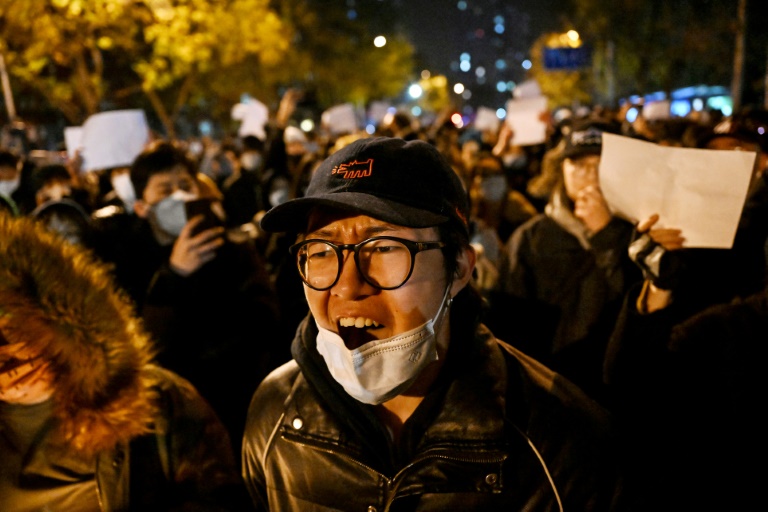
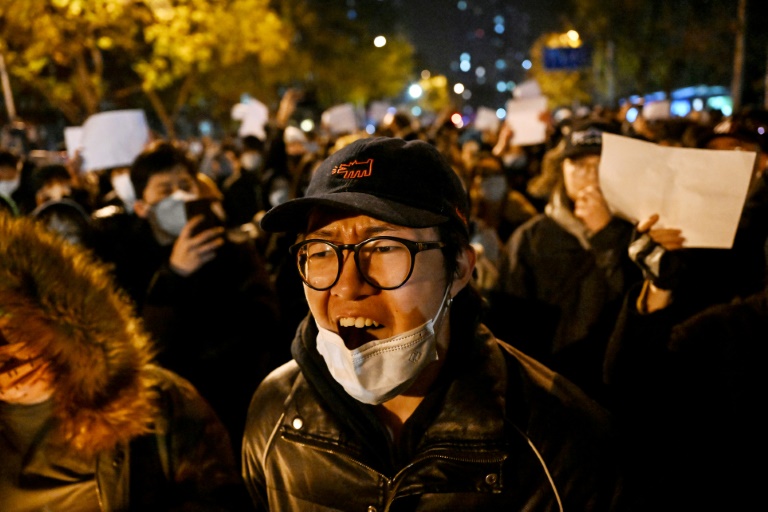
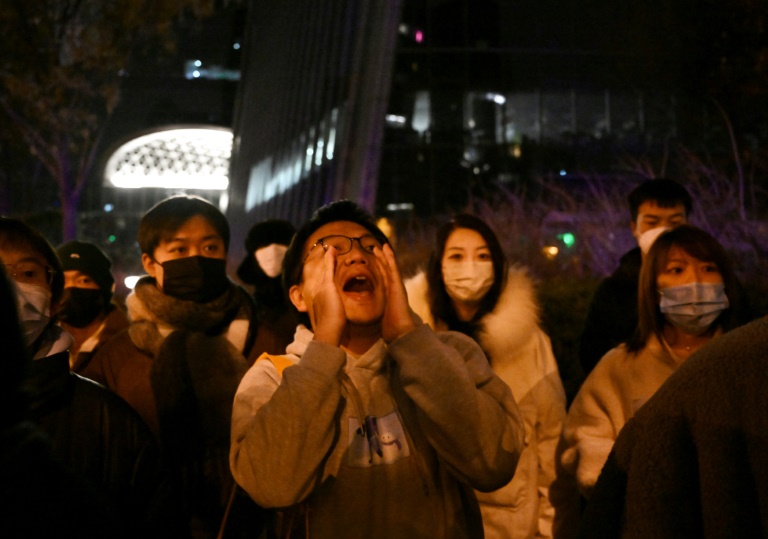
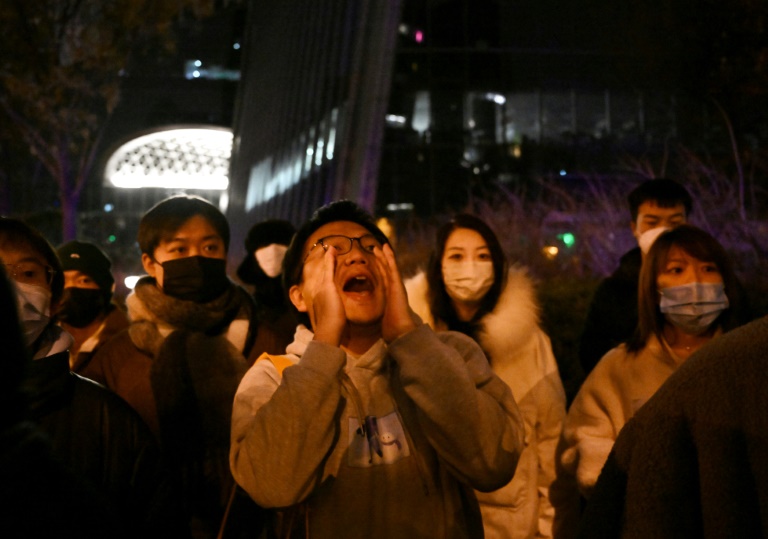
Hundreds of people took to the streets in China at the weekend in the country’s biggest demonstrations since pro-democracy rallies in 1989 were crushed.

A deadly fire in the Xinjiang region Thursday served as the catalyst for the public anger, with many blaming virus lockdowns for hampering rescue efforts.

People have taken to the streets in Beijing, Shanghai, Guangzhou and Chengdu calling for an end to lockdowns, after an easing of some measures had fuelled hopes of a lighter pandemic approach.

Some demonstrators were even demanding the resignation of China’s President Xi Jinping, who was recently re-appointed to a precedent-breaking third term as the country’s leader.

The latest targeted containment measures have been introduced as the country sees record-high infections.

The prospect of a hit to demand in the world’s biggest crude importer hammered oil prices, with both main contracts down around three percent.

The selling has taken a bit out of recent gains across markets sparked by hopes of a slowdown in the Federal Reserve’s interest rate hikes, with inflation finally showing signs of softening.

However, some observers said the protests could provide long-term benefits as they could force President Xi to shift away from his strict, economically damaging measures sooner.

Investors were also looking ahead to the release of US jobs data at the end of the week, which could provide clues about the Fed’s next moves, while speeches by central bank boss Jerome Powell and other key policymakers will also be pored over.

– Key figures around 1130 GMT –

London – FTSE 100: DOWN 0.3 percent at 7,461.60 points

Frankfurt – DAX: DOWN 0.8 percent at 14,419.04

Paris – CAC 40: DOWN 0.8 percent at 6,656.50

EURO STOXX 50: DOWN 0.7 percent at 3,933.93

Tokyo – Nikkei 225: DOWN 0.4 percent at 28,162.83 (close)

Hong Kong – Hang Seng Index: DOWN 1.6 percent at 17,297.94 (close)

Shanghai – Composite: DOWN 0.8 percent at 3,078.55 (close)

New York – Dow: UP 0.5 percent at 34,347.03 (close)

Euro/dollar: UP at $1.0495 from $1.0403 on Friday

Dollar/yen: DOWN at 137.85 yen from 139.03 yen

Pound/dollar: UP at $1.2098 from $1.2087

Euro/pound: UP at 86.72 pence from 86.03 pence

West Texas Intermediate: DOWN 3.1 percent at $73.94 per barrel

Brent North Sea crude: DOWN 3.0 percent at $81.14 per barrel

Equities, oil prices slide on China unrest

Stocks and oil prices slid Monday on concerns about protests across China calling for political freedoms and an end to the government’s hardline zero-Covid policy, fuelling uncertainty in the world’s number-two economy.

“Unrest in major cities in China has destabilised risk-on markets including oil which is under pressure, pushing BP and Shell towards the bottom of the UK index,” noted Victoria Scholar, head of investment at Interactive Investor.

China-linked stocks took the brunt of selling in Asia, with Hong Kong’s Hang Seng Index closing down more than one percent and Shanghai off 0.8 percent. The yuan slipped more than one percent.

Europe’s main stock markets were all lower nearing the half-way stage.

“Sentiment has turned sour as unrest across China grows,” said SPI Asset Management’s Stephen Innes. 

“Risk of the situation escalating from here and short-term volatility remains high.”

Hundreds of people took to the streets in China at the weekend in the country’s biggest demonstrations since pro-democracy rallies in 1989 were crushed.

A deadly fire in the Xinjiang region Thursday served as the catalyst for the public anger, with many blaming virus lockdowns for hampering rescue efforts.

People have taken to the streets in Beijing, Shanghai, Guangzhou and Chengdu calling for an end to lockdowns, after an easing of some measures had fuelled hopes of a lighter pandemic approach.

Some demonstrators were even demanding the resignation of China’s President Xi Jinping, who was recently re-appointed to a precedent-breaking third term as the country’s leader.

The latest targeted containment measures have been introduced as the country sees record-high infections.

The prospect of a hit to demand in the world’s biggest crude importer hammered oil prices, with both main contracts down around three percent.

The selling has taken a bit out of recent gains across markets sparked by hopes of a slowdown in the Federal Reserve’s interest rate hikes, with inflation finally showing signs of softening.

However, some observers said the protests could provide long-term benefits as they could force President Xi to shift away from his strict, economically damaging measures sooner.

Investors were also looking ahead to the release of US jobs data at the end of the week, which could provide clues about the Fed’s next moves, while speeches by central bank boss Jerome Powell and other key policymakers will also be pored over.

– Key figures around 1130 GMT –

London – FTSE 100: DOWN 0.3 percent at 7,461.60 points

Frankfurt – DAX: DOWN 0.8 percent at 14,419.04

Paris – CAC 40: DOWN 0.8 percent at 6,656.50

EURO STOXX 50: DOWN 0.7 percent at 3,933.93

Tokyo – Nikkei 225: DOWN 0.4 percent at 28,162.83 (close)

Hong Kong – Hang Seng Index: DOWN 1.6 percent at 17,297.94 (close)

Shanghai – Composite: DOWN 0.8 percent at 3,078.55 (close)

New York – Dow: UP 0.5 percent at 34,347.03 (close)

Euro/dollar: UP at $1.0495 from $1.0403 on Friday

Dollar/yen: DOWN at 137.85 yen from 139.03 yen

Pound/dollar: UP at $1.2098 from $1.2087

Euro/pound: UP at 86.72 pence from 86.03 pence

West Texas Intermediate: DOWN 3.1 percent at $73.94 per barrel

Brent North Sea crude: DOWN 3.0 percent at $81.14 per barrel

Equities and crude drop as China hit by protests

Stocks and oil prices sank Monday on concerns about protests across China calling for political freedoms and an end to the government’s hardline zero-Covid policy, fuelling uncertainty in the world’s number-two economy.

Hundreds of people took to the streets at the weekend in the country’s biggest demonstrations since pro-democracy rallies in 1989 were crushed.

A deadly fire in the Xinjiang region on Thursday served as the catalyst for the public anger, with many blaming virus lockdowns for hampering rescue efforts.

People have taken to the streets in Beijing, Shanghai, Guangzhou and Chengdu calling for an end to lockdowns, after an easing of some measures had fuelled hopes of a lighter pandemic approach.

Some demonstrators were even demanding the resignation of China’s President Xi Jinping, who was recently re-appointed to a precedent-breaking third term as the country’s leader.

The latest targeted containment measures have been introduced as the country sees record-high infections.

China-linked stocks took the brunt of selling, with Hong Kong’s Hang Seng Index down more than one percent and Shanghai off 0.8 percent. The yuan slipped more than one percent.

There were also losses in Tokyo, Sydney, Seoul, Singapore, Taipei, Jakarta, Bangkok and Wellington.

London, Paris and Frankfurt opened with losses.

“Sentiment has turned sour as unrest across China grows,” said SPI Asset Management’s Stephen Innes. “Protest of this extent is rare in the country and raises many uncertainties.

“The best scenario is further easing and reopening, but the speed (of) how things deteriorated over the weekend suggests the government needs to act fast. The risk of the situation escalating from here and short-term volatility remains high.”

Ken Cheung of Mizuho Bank added: “It appears that the zero-Covid policy is reaching its tipping point. More easing or refinement on the Covid measures will be needed to curb discontent.”

The prospect of a hit to demand in the world’s biggest crude importer hammered oil prices, with both main contracts down more than two percent.

The selling has taken a bit out of recent gains across markets sparked by hopes of a slowdown in the Federal Reserve’s interest rate hikes, with inflation finally showing signs of softening.

However, some observers said the protests could provide long-term benefits as they could force President Xi Jinping to shift away from his strict, economically damaging measures sooner.

Teneo Holdings’ Gabriel Wildau said: “I don’t expect Xi to publicly admit error or show weakness, but this wave of protests could cause the leadership to decide privately that the exit needs to proceed more quickly than previously planned.”

Investors are now looking ahead to the release of US jobs data at the end of the week, which could provide clues about the Fed’s next moves, while speeches by central bank boss Jerome Powell and other key policymakers will also be pored over.

“While the likes of Federal Reserve Governor Christopher Waller can talk about the fact that the (policy board) is not going to react based on one consumer price index print from October — when the headline number came in below expectations at 7.7 percent — the inescapable fact remains that US CPI has been rising at a slower rate since June,” said Michael Hewson of CMC Markets.

– Key figures around 0710 GMT –

Tokyo – Nikkei 225: DOWN 0.4 percent at 28,162.83 (close)

Hong Kong – Hang Seng Index: DOWN 1.6 percent at 17,297.94 (close)

Shanghai – Composite: DOWN 0.8 percent at 3,078.55 (close)

London – FTSE 100: DOWN 0.6 percent at 7,439.90

Euro/dollar: DOWN at $1.0387 from $1.0403 on Friday

Dollar/yen: DOWN at 138.22 yen from 139.03 yen

Pound/dollar: DOWN at $1.2065 from $1.2087

Euro/pound: UP at 86.12 pence from 86.03 pence

West Texas Intermediate: DOWN 2.5 percent at $74.40 per barrel

Brent North Sea crude: DOWN 2.4 percent at $81.67 per barrel

New York – Dow: UP 0.5 percent at 34,347.03 (close)

Equities and crude drop as China hit by protests

Stocks and oil prices sank Monday on concerns about protests across China calling for political freedoms and an end to the government’s hardline zero-Covid policy, fuelling uncertainty in the world’s number-two economy.

Hundreds of people took to the streets at the weekend in the country’s biggest demonstrations since pro-democracy rallies in 1989 were crushed.

A deadly fire in the Xinjiang region on Thursday served as the catalyst for the public anger, with many blaming virus lockdowns for hampering rescue efforts.

People have taken to the streets in Beijing, Shanghai, Guangzhou and Chengdu calling for an end to lockdowns, after an easing of some measures had fuelled hopes of a lighter pandemic approach.

Some demonstrators were even demanding the resignation of China’s President Xi Jinping, who was recently re-appointed to a precedent-breaking third term as the country’s leader.

The latest targeted containment measures have been introduced as the country sees record-high infections.

China-linked stocks took the brunt of selling, with Hong Kong’s Hang Seng Index down more than one percent and Shanghai off 0.8 percent. The yuan slipped more than one percent.

There were also losses in Tokyo, Sydney, Seoul, Singapore, Taipei, Jakarta, Bangkok and Wellington.

London, Paris and Frankfurt opened with losses.

“Sentiment has turned sour as unrest across China grows,” said SPI Asset Management’s Stephen Innes. “Protest of this extent is rare in the country and raises many uncertainties.

“The best scenario is further easing and reopening, but the speed (of) how things deteriorated over the weekend suggests the government needs to act fast. The risk of the situation escalating from here and short-term volatility remains high.”

Ken Cheung of Mizuho Bank added: “It appears that the zero-Covid policy is reaching its tipping point. More easing or refinement on the Covid measures will be needed to curb discontent.”

The prospect of a hit to demand in the world’s biggest crude importer hammered oil prices, with both main contracts down more than two percent.

The selling has taken a bit out of recent gains across markets sparked by hopes of a slowdown in the Federal Reserve’s interest rate hikes, with inflation finally showing signs of softening.

However, some observers said the protests could provide long-term benefits as they could force President Xi Jinping to shift away from his strict, economically damaging measures sooner.

Teneo Holdings’ Gabriel Wildau said: “I don’t expect Xi to publicly admit error or show weakness, but this wave of protests could cause the leadership to decide privately that the exit needs to proceed more quickly than previously planned.”

Investors are now looking ahead to the release of US jobs data at the end of the week, which could provide clues about the Fed’s next moves, while speeches by central bank boss Jerome Powell and other key policymakers will also be pored over.

“While the likes of Federal Reserve Governor Christopher Waller can talk about the fact that the (policy board) is not going to react based on one consumer price index print from October — when the headline number came in below expectations at 7.7 percent — the inescapable fact remains that US CPI has been rising at a slower rate since June,” said Michael Hewson of CMC Markets.

– Key figures around 0710 GMT –

Tokyo – Nikkei 225: DOWN 0.4 percent at 28,162.83 (close)

Hong Kong – Hang Seng Index: DOWN 1.6 percent at 17,297.94 (close)

Shanghai – Composite: DOWN 0.8 percent at 3,078.55 (close)

London – FTSE 100: DOWN 0.6 percent at 7,439.90

Euro/dollar: DOWN at $1.0387 from $1.0403 on Friday

Dollar/yen: DOWN at 138.22 yen from 139.03 yen

Pound/dollar: DOWN at $1.2065 from $1.2087

Euro/pound: UP at 86.12 pence from 86.03 pence

West Texas Intermediate: DOWN 2.5 percent at $74.40 per barrel

Brent North Sea crude: DOWN 2.4 percent at $81.67 per barrel

New York – Dow: UP 0.5 percent at 34,347.03 (close)

Celebrated Greek cheesemakers brought low by inflation

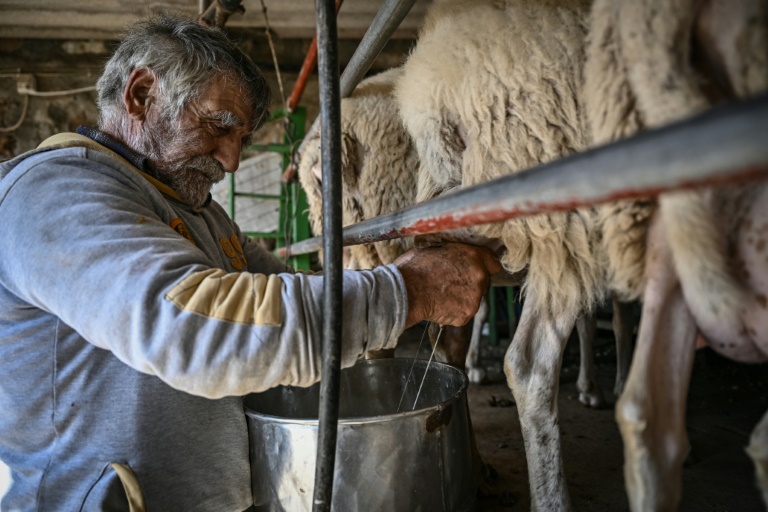
On his bougainvillaea-covered farm on the Greek island of Naxos, Yannis Karganis milks his sheep, wondering anxiously how he will cope with soaring costs and keep his cheesemaking business afloat.

After the war in Ukraine sparked an inflationary spiral in the price of cereals, fuel and other goods, farmers on Naxos and across the country have been left fearing for their survival.

“I earn nothing from my cheeses,” says the septuagenarian, who makes Naxos graviera, a hard yellow cheese popular throughout Greece and beyond.

“I work day and night and despite this, I still cannot live.”

Inflation in Greece rose to 12 percent in September before dropping to 9.1 percent in October. 

Even though the government announced nearly 280 million euros ($291 million) in support benefits for young farmers earlier this year, there is still heavy pressure on the country’s agricultural sector which employs 11 percent of the workforce.

“Last year, a bag of feed cost 14 euros. This year it’s 21 euros. Gasoline has skyrocketed to 2.30 euros per litre at the moment,” the greying Karganis sighs, stirring a large cauldron to make cheese in his small kitchen.

– Social stress –

Throughout the country, social pressure is rising in the face of soaring energy prices. 

In November, a general strike on the issue paralysed Greece.

Dimitris Kapounis, head of the union of Naxos agricultural cooperatives, warns that if nothing changes “in the medium term, there will be no more milk on the Greek market, no meat, potatoes, or anything else.”

Naxos graviera — made from 80 percent cow’s milk and 20 percent sheep or goat’s milk — is one of Greece’s most popular cheeses. 

The Greeks like it sprinkled on pasta, fried or as a table cheese.

But even carrying the vaunted European Protected Designation of Origin label, and exporting to a dozen countries including the United States and Germany, hasn’t helped stem the slide in output as costs ramp up.

This year, the usual annual production of more than 1,250 tons has already fallen by 130 tons, the cooperative said.

– Lack of milk –

The squeeze on animal feed and fuel has resulted in a fall in milk production, explains local shepherd Yannis Vavoulas.

“We can’t maintain feeding them properly,” the 42-year-old says. 

“We feed them two or three times (a day) with little food,” which means the animals produce less milk. 

The crisis is so acute that some farmers have had to slaughter part of their herd, further reducing milk production.

Yorgos Margaritis, who owns 250 cows, is one of the local farmers to have already made this painful decision.

He gestures to some of his nearby animals which he says would normally have been inseminated by now for producing calves.

“(Instead), they will be slaughtered,” he says.

The cost of transporting goods from the Greek mainland is also becoming prohibitive — it takes more than five hours by boat to get from the main Greek port of Piraeus to Naxos.

In an act of desperation, the Naxos cooperative in April went as far as neighbouring Bulgaria to buy animal feed, where prices are lower.

“If the milk producers are not helped… then we are all lost,” warns Yannis Kavouras, head of the largest cheese factory in Naxos.

And as the EU’s protected status regulations permit only the use of local milk, shipping it in from elsewhere is not an option either.

“If the producers don’t bring any more milk, what am I going to use — water?” wonders Kavouras.

UK start-up behind algae-based packaging bids for Earthshot glory

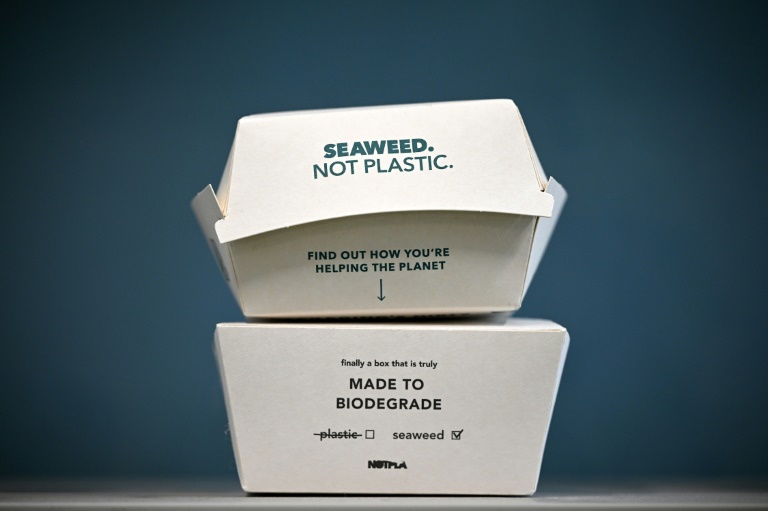
A British start-up founded by two ex-students from France and Spain, crafting biodegradable packaging from marine plants, is aiming to seal royal approval this week when Prince William unveils his latest Earthshot prizes.

Notpla — whose mantra is “we make packaging disappear” — is competing with 14 other firms for five prestigious awards, to be dished out by the prince and a star-studded cast at a ceremony in US city Boston on Friday.

In its second year, the initiative to reward innovative efforts to combat climate change will then be broadcast on UK and US television on Sunday and Monday, respectively, as well as online.

The five winners will each receive a £1 million ($1.2 million) grant. 

The co-creator of Notpla, which rather than using environmentally damaging plastics makes various naturally degrading — and even edible — packaging from seaweed and other marine plants, says they have already felt the competition’s benefits.

“Just being there is a massive boost to our visibility,” French co-founder Pierre Paslier, 35, told AFP.

“So that’s already a huge asset to be part of the finalists and I think that if we win, it’s just going to be that on a much larger scale.”

Together with fellow former Royal College of Art student and co-founder Rodrigo Garcia Gonzalez, 38, the duo began their eco-business adventure in a small London kitchen. 

They were intent on finding natural alternatives to petrochemicals-based packaging, sampling a variety of materials from tapioca seeds to other starches. 

– Seaweed ‘family’ –

“Eventually, we found seaweed,” explained Paslier, a former packaging engineer at French cosmetics giant L’Oreal who created Notpla with Gonzalez in 2014. 

“Now we have a flexible film, we make seaweed paper, we have rigid materials. So it’s really the beginning of a family of seaweed-based technologies that hopefully can help us stop using so much plastic.”

He said their early kitchen exploits had eventually led to the secretly-formulated “Ooho” creation.

An edible bubble membrane made from seaweed — holding water, sports drinks or other flavoured liquids including cocktails and sauces — it is marketed as a replacement for single-use plastic cups, bottles and sachets. 

Tasting like a gelatinous candy, it can be consumed whole — like a cherry tomato — or from a larger sachet, making it ideal at sporting events and festivals.

It has been widely used at marathons across the UK, including the 2019 London run.

Viral online interest has helped attract the attention of investors, with Notpla expanding rapidly to boast more than 60 employees and finding itself on the verge of manufacturing its products on an industrial scale.

Production of “Ooho” takes place at the firm’s offices in a large warehouse, a stone’s throw from the Queen Elizabeth Olympic Park in east London. 

Notpla’s growing young team also has laboratories there as it continues to develop new algae-based products.

– ‘Very renewable’ –

Among the more recent results: a naturally biodegradable coating protecting takeaway food boxes from grease and liquids. 

The company now supplies industry giant Just Eat in Britain and five other European countries. 

It also provided the packaging for all the food sold during the final of the women’s European football championships at London’s Wembley Stadium in July. 

Another of its new innovations is a transparent package for dry goods, such as pasta. 

Paslier noted that although his products may currently cost more than plastic alternatives, the latter’s sales price fails to account for “the impact on societal ecosystems, health for humans or for marine life”.

“This is basically going to be paid for [by] the next generations and that doesn’t come into the price of plastic that you buy on the market today,” he added.

“So what we want is to be the most affordable, sustainable packaging solution that takes into account its whole lifetime costs.”

Paslier believes seaweed can become the most affordable packaging option, in large part due to its fast growth rate which can top one metre (3.3 feet) a day in the lab.

“It’s a very, very renewable resource,” he added, noting it doesn’t require any fresh water or fertilisers.

Its emergence is undoubtedly timely.

A recent OECD report found, at the current rate, worldwide plastic waste will triple by 2060 to one billion tonnes per year, much of which will pollute the oceans and threaten many species. 

China Covid lockdowns shut delivery workers out of their homes

Overworked, underpaid and thoroughly fed up, Wang’s troubles deepened even further when authorities abruptly locked down the delivery driver’s Beijing apartment block earlier this month.

Officials in the Chinese capital have doubled down on the country’s hallmark zero-Covid policy in recent weeks, one of an array of cities to impose sweeping shutdowns, mass testing and teleworking mandates as caseloads have hit all-time highs.

Wang is not alone in feeling frustrated.

The ruling Communist Party’s uncompromising zero-Covid strategy — now in force for about three years — has stoked anger and resentment, with widespread and sometimes violent protests kicking off across China’s major cities.

Pandemic fatigue has been on the rise for some time, as a recent lightening of virus curbs has coincided with record infection tallies, prompting a patchwork of onerous restrictions in multiple major cities.

China is the last major economy wedded to a zero-Covid strategy, but maintaining relatively low numbers of cases and deaths has constrained its economic recovery, disrupted supply chains and hammered employment.

– ‘I have no choice’ –

Demand for deliveries has soared under the tightening curbs as millions of housebound urbanites have turned to an army of low-paid couriers — mostly migrants from other provinces — to supply takeaway lunches and grocery orders.

But this time the restrictions have crept deep into places where drivers live, shutting many inside without pay and forcing others to choose between having a place to sleep and earning enough money to survive.

Wang, who scoots back and forth across a wealthy financial district delivering food orders for internet giant Meituan, said his housing compound was cordoned off on November 7 after two Covid cases were discovered.

Desperate not to lose his income — about 250 yuan ($34) a day — the 20-year-old broke lockdown rules by vaulting a fence to make his shifts, sneaking back in under cover of darkness.

“I have no choice. If I don’t make money, I can’t pay rent,” said the native of the industrial northern province of Shanxi.

“Lots of delivery guys don’t have anywhere to live at the moment,” he told AFP outside a deserted office block on a cold winter afternoon last week.

“I’m really dissatisfied with the Chinese government, because other countries aren’t strict about Covid any more,” he said.

“We’re going to such great lengths… and I don’t feel it’s necessary, because nobody is dying from it.”

AFP withheld Wang’s full name to protect him from potential repercussions for breaking lockdown and criticising the state.

– Sleeping rough –

When a shutdown loomed over Gu Qiang’s housing compound last week, the Meituan driver chose to sleep in his car.

“Spending 30 yuan to keep the engine running all night is still cheaper than getting a hotel,” the gruff northeast China native said.

“Some of my friends are living outside — they dare not go home.”

Several couriers interviewed by AFP described heavier workloads in recent weeks as lockdowns have left their companies short of labour.

While some said they were happy to take on money-spinning extra orders, most said they had endured longer working hours, extra stress and more negative interactions with customers.

They also said they had not received any additional support from Meituan or the companies to which delivery services have been outsourced.

Authorities last year launched an investigation into food delivery platforms following claims of exploitative labour practices including algorithms that effectively forced couriers to drive dangerously to meet tight delivery times.

Meituan did not respond to an AFP request for comment prior to publication.

But the company told the state-run China Daily newspaper last week that it had paid for hotel rooms for some stranded workers and welcomed calls for help from couriers in similar situations.

China Covid lockdowns shut delivery workers out of their homes

Overworked, underpaid and thoroughly fed up, Wang’s troubles deepened even further when authorities abruptly locked down the delivery driver’s Beijing apartment block earlier this month.

Officials in the Chinese capital have doubled down on the country’s hallmark zero-Covid policy in recent weeks, one of an array of cities to impose sweeping shutdowns, mass testing and teleworking mandates as caseloads have hit all-time highs.

Wang is not alone in feeling frustrated.

The ruling Communist Party’s uncompromising zero-Covid strategy — now in force for about three years — has stoked anger and resentment, with widespread and sometimes violent protests kicking off across China’s major cities.

Pandemic fatigue has been on the rise for some time, as a recent lightening of virus curbs has coincided with record infection tallies, prompting a patchwork of onerous restrictions in multiple major cities.

China is the last major economy wedded to a zero-Covid strategy, but maintaining relatively low numbers of cases and deaths has constrained its economic recovery, disrupted supply chains and hammered employment.

– ‘I have no choice’ –

Demand for deliveries has soared under the tightening curbs as millions of housebound urbanites have turned to an army of low-paid couriers — mostly migrants from other provinces — to supply takeaway lunches and grocery orders.

But this time the restrictions have crept deep into places where drivers live, shutting many inside without pay and forcing others to choose between having a place to sleep and earning enough money to survive.

Wang, who scoots back and forth across a wealthy financial district delivering food orders for internet giant Meituan, said his housing compound was cordoned off on November 7 after two Covid cases were discovered.

Desperate not to lose his income — about 250 yuan ($34) a day — the 20-year-old broke lockdown rules by vaulting a fence to make his shifts, sneaking back in under cover of darkness.

“I have no choice. If I don’t make money, I can’t pay rent,” said the native of the industrial northern province of Shanxi.

“Lots of delivery guys don’t have anywhere to live at the moment,” he told AFP outside a deserted office block on a cold winter afternoon last week.

“I’m really dissatisfied with the Chinese government, because other countries aren’t strict about Covid any more,” he said.

“We’re going to such great lengths… and I don’t feel it’s necessary, because nobody is dying from it.”

AFP withheld Wang’s full name to protect him from potential repercussions for breaking lockdown and criticising the state.

– Sleeping rough –

When a shutdown loomed over Gu Qiang’s housing compound last week, the Meituan driver chose to sleep in his car.

“Spending 30 yuan to keep the engine running all night is still cheaper than getting a hotel,” the gruff northeast China native said.

“Some of my friends are living outside — they dare not go home.”

Several couriers interviewed by AFP described heavier workloads in recent weeks as lockdowns have left their companies short of labour.

While some said they were happy to take on money-spinning extra orders, most said they had endured longer working hours, extra stress and more negative interactions with customers.

They also said they had not received any additional support from Meituan or the companies to which delivery services have been outsourced.

Authorities last year launched an investigation into food delivery platforms following claims of exploitative labour practices including algorithms that effectively forced couriers to drive dangerously to meet tight delivery times.

Meituan did not respond to an AFP request for comment prior to publication.

But the company told the state-run China Daily newspaper last week that it had paid for hotel rooms for some stranded workers and welcomed calls for help from couriers in similar situations.

Asian markets, crude drop on China unrest

Stocks and oil prices sank Monday on concerns about protests across China calling for political freedoms and an end to the government’s hardline zero-Covid policy, fuelling uncertainty in the world’s number-two economy.

Hundreds of people took to the streets at the weekend in the country’s biggest demonstrations since pro-democracy rallies in 1989 were crushed.

A deadly fire in the Xinjiang region on Thursday served as the catalyst for the public anger, with many blaming virus lockdowns for hampering the rescue effort.

People have taken to the streets in Beijing, Shanghai, Guangzhou and Chengdu calling for an end to lockdowns, after an easing of some measures had fuelled hopes of a lighter pandemic approach.

China-linked stocks took the brunt of selling, with Hong Kong’s Hang Seng Index down two percent and Shanghai off one percent. The yuan was off more than one percent.

There were also losses in Tokyo, Sydney, Seoul, Singapore, Taipei, Jakarta, Bangkok and Wellington.

“Sentiment has turned sour as unrest across China grows,” said SPI Asset Management’s Stephen Innes. “Protest of this extent is rare in the country and raises many uncertainties.

“The best scenario is further easing and reopening, but the speed at how things deteriorated over the weekend suggests the government needs to act fast. The risk of the situation escalating from here and short-term volatility remains high.”

Ken Cheung of Mizuho Bank added: “It appears that the zero-Covid policy is reaching its tipping point. More easing or refinement on the Covid measures will be needed to curb discontent.”

The prospect of a hit to demand in the world’s biggest crude importer hammered oil prices, with both main contracts down more than two percent.

The selling has taken a bit out of recent gains across markets sparked by hopes of a slowdown in the Federal Reserve’s interest rate hikes as inflation finally shows signs of softening.

However, some observers said the protests could provide long-term benefits as they could force President Xi Jinping to shift away from his strict, economically damaging measures sooner.

Teneo Holdings’ Gabriel Wildau said: “I don’t expect Xi to publicly admit error or show weakness, but this wave of protests could cause the leadership to decide privately that the exit needs to proceed more quickly than previously planned.”

Investors are now looking ahead to the release of US jobs data at the end of the week, which could provide clues about the Fed’s next moves, while speeches by central bank boss Jerome Powell and other key policymakers will also be pored over.

– Key figures around 0410 GMT –

Tokyo – Nikkei 225: DOWN 0.4 percent at 28,159.58

Hong Kong – Hang Seng Index: DOWN 2.0 percent at 17,225.41 (break)

Shanghai – Composite: DOWN 1.0 percent at 3,069.66 (break)

Euro/dollar: DOWN at $1.0357 from $1.0403 on Friday

Dollar/yen: DOWN at 138.65 yen from 139.03 yen

Pound/dollar: DOWN at $1.2049 from $1.2087

Euro/pound: DOWN at 85.96 pence from 86.03 pence

West Texas Intermediate: DOWN 2.8 percent at $74.17 per barrel

Brent North Sea crude: DOWN 2.8 percent at $81.39 per barrel

New York – Dow: UP 0.5 percent at 34,347.03 (close)

London – FTSE 100: UP 0.3 percent at 7,486.67 (close)

Close Bitnami banner
Bitnami