AFP

Fears of fresh China Covid curbs rattle stocks, oil prices

Oil prices plunged to lows unseen since January and global stocks mostly fell on Monday as renewed concerns about harsh coronavirus curbs in China rattled investor sentiment.

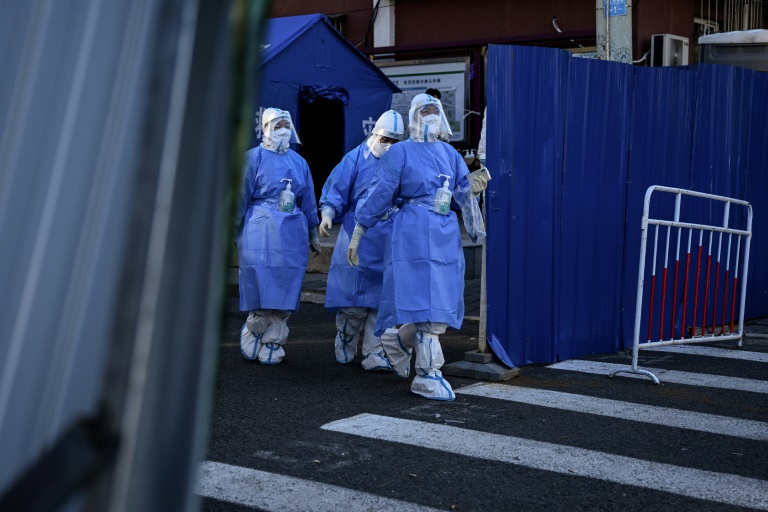
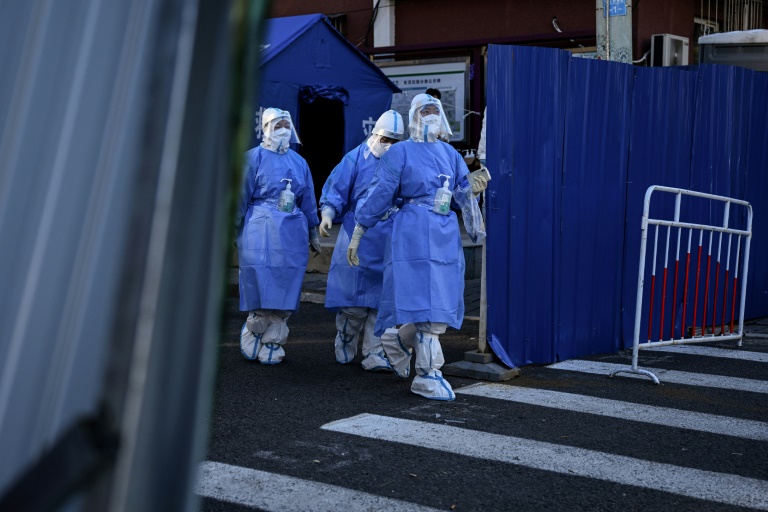
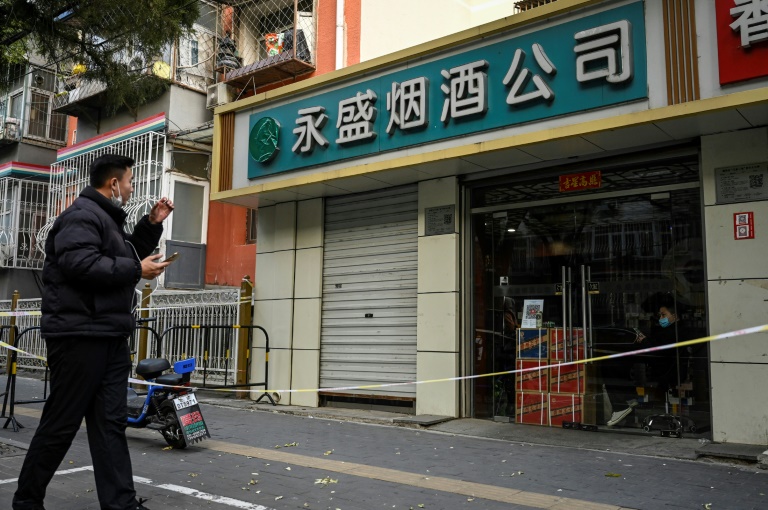
China’s first coronavirus death in six months sparked fears officials would reimpose strict, economically painful restrictions to fight outbreaks across the world’s second-biggest economy.

Brent North Sea crude slumped 5.5 percent to $82.84 per barrel and WTI shed 5.7 percent to $75.55 in mid-afternoon trading on fears over Chinese energy demand. 

Paris, London, Frankfurt and Milan all ended in the red on Monday while Wall Street also lost ground.

The fall in European and US stocks came after most Asian markets including Hong Kong’s Hang Seng Index and Shanghai ended lower, although Bangkok, Tokyo and Wellington were up.

The death of an 87-year-old man in Beijing on Sunday came as infections across China spiked, testing authorities’ plans to loosen their grip by lowering quarantine times for foreigners and cancelling mass tests.

Two further Covid deaths were recorded on Monday, both elderly residents from Beijing.

The news threw a spanner in the works for investors who had grown hopeful of a gradual reopening of China’s economy.

“Crude oil prices have slipped back sharply on the back of concerns over weakening Chinese demand, as well as reports that Saudi Arabia supports the idea of a production increase,” noted Michael Hewson, chief market analyst at CMC Markets UK.

“No one can tell whether (Chinese President) Xi Jinping would pull back from the reopening plans, which would be another disaster for the Chinese stocks, and for the investor confidence,” said Ipek Ozkardeskaya, senior analyst at Swissquote Bank. 

Nevertheless, global markets have enjoyed a broadly healthy November thanks to signs of China easing and indications of slowing US inflation that fanned optimism the Federal Reserve would start to slow its pace of interest rate hikes.

But several officials soon lined up to warn that more needed to be done to get inflation back down from four-decade highs to more bearable levels.

Markets are meanwhile expected to stay relatively quiet for the rest of the week, with many US investors taking time off for Thanksgiving.

“Traders are also concerned by continued weakness in crypto prices in the wake of FTX’s collapse,” added market analyst Fawad Razaqzada.

“With this also being a quiet day and week in terms of macro data, they are understandably keen to proceed with caution.”

– Key figures around 1630 GMT –

London – FTSE 100: DOWN 0.1 percent at 7,376.85 points (close)

Paris – CAC 40: DOWN 0.2 percent at 6,634.45 (close)

Frankfurt – DAX: DOWN 0.4 percent at 14,379.93 (close)

EURO STOXX 50: DOWN 0.4 percent at 3,909.28

New York – Dow: DOWN 0.3 percent at 33,644.55

Tokyo – Nikkei 225: UP 0.2 percent at 27,944.79 (close)

Hong Kong – Hang Seng Index: DOWN 1.9 percent at 17,655.91 (close)

Shanghai – Composite: DOWN 0.4 percent at 3,085.04 (close)

Euro/dollar: DOWN at $1.0247 from $1.0325 on Friday

Dollar/yen: UP at 141.90 yen from 140.37 yen

Pound/dollar: DOWN at $1.1799 from $1.1890

Euro/pound: UP at 86.84 pence from 86.34 pence

West Texas Intermediate: DOWN 5.7 percent at $75.51 per barrel

Brent North Sea crude: DOWN 5.8 percent at $82.51 per barrel

Markets rattled by fears of fresh Covid curbs in China

Asian and European stocks mostly fell Monday, with investor sentiment hit by renewed Covid concerns in China amid warnings that markets would remain lacklustre for some time.

Shares headed lower as China’s first coronavirus death in six months sparked fears officials would reimpose strict, economically painful restrictions to fight outbreaks across the country.

“The bear market is not over, in our view,” Goldman Sachs strategist Peter Oppenheimer said.

“The conditions that are typically consistent with an equity trough have not yet been reached. We would expect lower valuations (consistent with recessionary outcomes), a trough in the momentum of growth deterioration, and a peak in interest rates before a sustained recovery begins.”

Oil prices also slid on fears over energy demand in China, the world’s second biggest economy.

“There are concerns China may tighten Covid curbs further after the first Covid-related death in almost six months was reported, and a city near Beijing enforced a slew of restrictions,” said market analyst Fawad Razaqzada.

“Traders are also concerned by continued weakness in crypto prices in the wake of FTX’s collapse,” he said.

The death of an 87-year-old man in Beijing on Sunday came as infections across the country spiked, testing authorities’ plans to loosen their grip by lowering quarantine times for foreigners and cancelling mass tests.

Two further Covid deaths were recorded on Monday, both elderly residents from Beijing.

The news threw a spanner in the works for investors who had grown hopeful of a gradual reopening of China’s economy.

Hong Kong’s Hang Seng Index fell nearly two percent, extending a sell-off at the end of last week.

Shanghai was also down along with most Asian markets, but Bangkok, Tokyo and Wellington ended higher.

Nevertheless, global markets have enjoyed a broadly healthy November thanks to signs of China easing and indications of slowing US inflation that fanned optimism the Federal Reserve would start to slow its pace of interest rate hikes.

But several officials soon lined up to warn that more needed to be done to get inflation back down from four-decade highs to more bearable levels.

Markets are meanwhile expected to stay relatively quiet for the rest of the week, with many US investors taking time off for Thanksgiving.

– Key figures around 1430 GMT –

London – FTSE 100: DOWN 0.2 percent at 7,373.98 points

Paris – CAC 40: DOWN 0.3 percent at 6,626.94

Frankfurt – DAX: DOWN 0.4 percent at 14,379.97

EURO STOXX 50: DOWN 0.4 percent at 3,909.67

New York – Dow: DOWN by less than 0.1 percent at 33,735.28

Tokyo – Nikkei 225: UP 0.2 percent at 27,944.79 (close)

Hong Kong – Hang Seng Index: DOWN 1.9 percent at 17,655.91 (close)

Shanghai – Composite: DOWN 0.4 percent at 3,085.04 (close)

Euro/dollar: DOWN at $1.0240 from $1.0325 on Friday

Dollar/yen: UP at 141.48 yen from 140.37 yen

Pound/dollar: DOWN at $1.1809 from $1.1890

Euro/pound: UP at 86.71 pence from 86.34 pence

West Texas Intermediate: DOWN 3.7 percent at $77.16 per barrel

Brent North Sea crude: DOWN 3.7 percent at $84.36 per barrel

Markets rattled by fears of fresh Covid curbs in China

Asian and European stocks mostly fell Monday, with investor sentiment hit by renewed Covid concerns in China amid warnings that markets would remain lacklustre for some time.

Shares headed lower as China’s first coronavirus death in six months sparked fears officials would reimpose strict, economically painful restrictions to fight outbreaks across the country.

“The bear market is not over, in our view,” Goldman Sachs strategist Peter Oppenheimer said.

“The conditions that are typically consistent with an equity trough have not yet been reached. We would expect lower valuations (consistent with recessionary outcomes), a trough in the momentum of growth deterioration, and a peak in interest rates before a sustained recovery begins.”

Oil prices also slid on fears over energy demand in China, the world’s second biggest economy.

“There are concerns China may tighten Covid curbs further after the first Covid-related death in almost six months was reported, and a city near Beijing enforced a slew of restrictions,” said market analyst Fawad Razaqzada.

“Traders are also concerned by continued weakness in crypto prices in the wake of FTX’s collapse,” he said.

The death of an 87-year-old man in Beijing on Sunday came as infections across the country spiked, testing authorities’ plans to loosen their grip by lowering quarantine times for foreigners and cancelling mass tests.

Two further Covid deaths were recorded on Monday, both elderly residents from Beijing.

The news threw a spanner in the works for investors who had grown hopeful of a gradual reopening of China’s economy.

Hong Kong’s Hang Seng Index fell nearly two percent, extending a sell-off at the end of last week.

Shanghai was also down along with most Asian markets, but Bangkok, Tokyo and Wellington ended higher.

Nevertheless, global markets have enjoyed a broadly healthy November thanks to signs of China easing and indications of slowing US inflation that fanned optimism the Federal Reserve would start to slow its pace of interest rate hikes.

But several officials soon lined up to warn that more needed to be done to get inflation back down from four-decade highs to more bearable levels.

Markets are meanwhile expected to stay relatively quiet for the rest of the week, with many US investors taking time off for Thanksgiving.

– Key figures around 1430 GMT –

London – FTSE 100: DOWN 0.2 percent at 7,373.98 points

Paris – CAC 40: DOWN 0.3 percent at 6,626.94

Frankfurt – DAX: DOWN 0.4 percent at 14,379.97

EURO STOXX 50: DOWN 0.4 percent at 3,909.67

New York – Dow: DOWN by less than 0.1 percent at 33,735.28

Tokyo – Nikkei 225: UP 0.2 percent at 27,944.79 (close)

Hong Kong – Hang Seng Index: DOWN 1.9 percent at 17,655.91 (close)

Shanghai – Composite: DOWN 0.4 percent at 3,085.04 (close)

Euro/dollar: DOWN at $1.0240 from $1.0325 on Friday

Dollar/yen: UP at 141.48 yen from 140.37 yen

Pound/dollar: DOWN at $1.1809 from $1.1890

Euro/pound: UP at 86.71 pence from 86.34 pence

West Texas Intermediate: DOWN 3.7 percent at $77.16 per barrel

Brent North Sea crude: DOWN 3.7 percent at $84.36 per barrel

Markets rattled by fears of fresh Covid curbs in China

Asian and European stocks mostly fell Monday, with investor sentiment hit by renewed Covid concerns in China amid warnings that markets would remain lacklustre for some time.

Shares headed lower as China’s first coronavirus death in six months sparked fears officials would reimpose strict, economically painful restrictions to fight outbreaks across the country.

“The bear market is not over, in our view,” Goldman Sachs strategist Peter Oppenheimer said.

“The conditions that are typically consistent with an equity trough have not yet been reached. We would expect lower valuations (consistent with recessionary outcomes), a trough in the momentum of growth deterioration, and a peak in interest rates before a sustained recovery begins.”

Oil prices also slid on fears over energy demand in China, the world’s second biggest economy.

“There are concerns China may tighten Covid curbs further after the first Covid-related death in almost six months was reported, and a city near Beijing enforced a slew of restrictions,” said market analyst Fawad Razaqzada.

“Traders are also concerned by continued weakness in crypto prices in the wake of FTX’s collapse,” he said.

The death of an 87-year-old man in Beijing on Sunday came as infections across the country spiked, testing authorities’ plans to loosen their grip by lowering quarantine times for foreigners and cancelling mass tests.

Two further Covid deaths were recorded on Monday, both elderly residents from Beijing.

The news threw a spanner in the works for investors who had grown hopeful of a gradual reopening of China’s economy.

Hong Kong’s Hang Seng Index fell nearly two percent, extending a sell-off at the end of last week.

Shanghai was also down along with most Asian markets, but Bangkok, Tokyo and Wellington ended higher.

Nevertheless, global markets have enjoyed a broadly healthy November thanks to signs of China easing and indications of slowing US inflation that fanned optimism the Federal Reserve would start to slow its pace of interest rate hikes.

But several officials soon lined up to warn that more needed to be done to get inflation back down from four-decade highs to more bearable levels.

Markets are meanwhile expected to stay relatively quiet for the rest of the week, with many US investors taking time off for Thanksgiving.

– Key figures around 1430 GMT –

London – FTSE 100: DOWN 0.2 percent at 7,373.98 points

Paris – CAC 40: DOWN 0.3 percent at 6,626.94

Frankfurt – DAX: DOWN 0.4 percent at 14,379.97

EURO STOXX 50: DOWN 0.4 percent at 3,909.67

New York – Dow: DOWN by less than 0.1 percent at 33,735.28

Tokyo – Nikkei 225: UP 0.2 percent at 27,944.79 (close)

Hong Kong – Hang Seng Index: DOWN 1.9 percent at 17,655.91 (close)

Shanghai – Composite: DOWN 0.4 percent at 3,085.04 (close)

Euro/dollar: DOWN at $1.0240 from $1.0325 on Friday

Dollar/yen: UP at 141.48 yen from 140.37 yen

Pound/dollar: DOWN at $1.1809 from $1.1890

Euro/pound: UP at 86.71 pence from 86.34 pence

West Texas Intermediate: DOWN 3.7 percent at $77.16 per barrel

Brent North Sea crude: DOWN 3.7 percent at $84.36 per barrel

Recession-hit UK needs more migrant labour: business lobby

Britain needs more migrant labour to boost productivity as it faces a toxic mix of soaring inflation and shrinking growth, the country’s main business lobby group warned Monday.

The verdict from the Confederation of British Industry came at its annual gathering in Birmingham, Britain’s second biggest city.

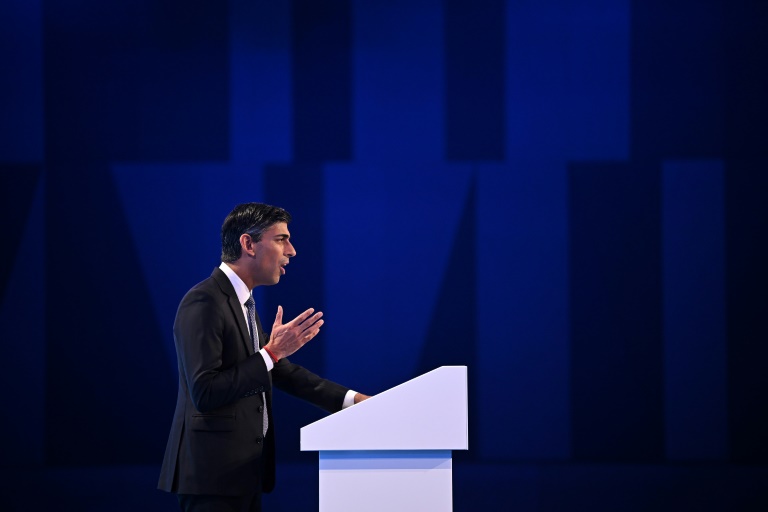
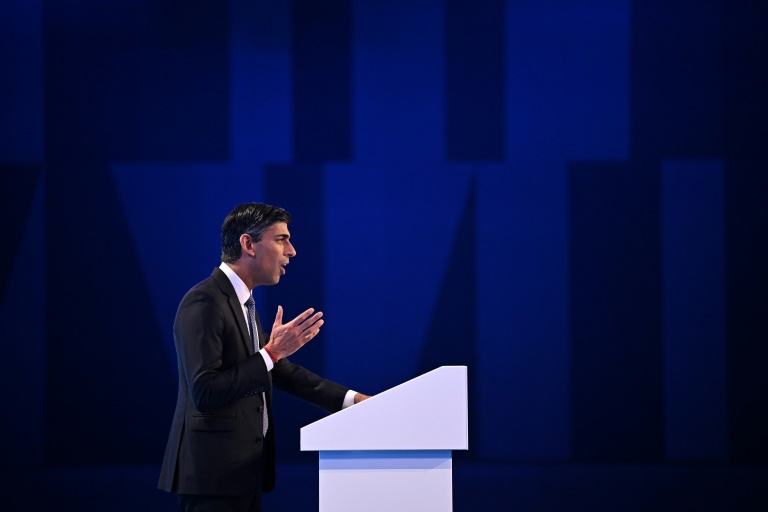
The CBI conference comes after the government of Prime Minister Rishi Sunak slashed spending and hiked taxes in a budget, despite admitting that the inflation-wracked economy had fallen into recession.

“We come together, once more in extraordinary times,” CBI director-general Tony Danker told delegates in Birmingham, central England.

“Britain is in the middle of stagflation — rocketing inflation and negative growth — for the first time that probably most of us can remember.

“We know how to fight inflation. We know how to fight recession. But we don’t really know how to fight them together.”

Sunak, who also addressed the CBI on Monday, took office one month ago after predecessor Liz Truss delivered an unfunded tax-slashing mini-budget that tanked the pound and sent UK borrowing costs soaring.

UK inflation sits at a 41-year peak of 11.1 percent on rocketing food and energy costs in the wake of the Ukraine war.

Consumer prices have also raced higher as demand rebounds following the lifting of pandemic lockdowns.

That has worsened a cost-of-living crisis for businesses and individuals, hit also by soaring interest rates as the Bank of England seeks to cool runaway inflation.

The UK has forecast the economy to shrink 1.4 percent next year, hit also by fallout from Brexit which has resulted in foreign workers returning home.

“When you look at the (growth) data, the only thing holding it up, actually, is higher hours worked due to higher immigration,” Danker added on Monday.

“People are arguing against immigration — but it’s the only thing that has increased our growth potential since March.

“Let’s be honest — we don’t have the people we need, nor do we have the productivity.”

– Focus on illegal immigration –

Sunak, addressing the conference later on Monday, ducked the CBI’s call for more legal migrant labour — and stressed that he was focussed on curbing illegal migration.

“The country’s number one priority right now, when it comes to migration, is tackling illegal migration,” he said.

“When people see that happening, it undermines trust in the system, it doesn’t seem fair that people are able to break the rules.

“That’s what I’m absolutely determined to fix.”

He also told CBI delegates that last week’s budget sought “to grip inflation and balance the books”.

“The best way to help people is by stopping mortgages, rents and food prices from spiralling out of control,” Sunak said.

“Re-establishing stability is the critical first step. But there is so much more we need to do,” he added, stressing he wants to see more business innovation to boost economic activity.

No backsliding on Brexit, says UK PM

British Prime Minister Rishi Sunak on Monday denied that his government was seeking to row back on the UK’s EU withdrawal deal, despite an apparent growing backlash against Brexit.

Brexit-supporter Sunak told business leaders that life outside the European Union was “already delivering enormous benefits and opportunities”.

He touted greater curbs on immigration — a key plank of the Brexit deal — and closer trade ties with Asia.

But he added: “Let me be unequivocal about this: under my leadership, the United Kingdom will not pursue any relationship with Europe that relies on alignment with EU laws.”

The UK left the EU in full in January 2021, after years of political wrangling since the divisive referendum n 2016 to split from the bloc.

Brexit saw the UK withdraw from the European single market and customs union, while free movement between member states and the jurisdiction of European courts ended.

But a deal between London and Brussels maintained largely tariff-free trade with its remaining 27 members.

Sunak’s comments follow a Sunday Times report that “senior government figures” were planning to “put Britain on the path towards a Swiss-style relationship” with the EU.

Switzerland has far closer ties with the bloc through bilateral agreements allowing access to the single market, a high degree of free movement and by paying into EU coffers.

The report, and comments last week by finance minister Jeremy Hunt, who voted to remain in the EU, that he was eager to remove the “vast majority” of trade barriers with the EU.

That has sparked unease among eurosceptic members of the ruling Conservative party.

“The government has got to focus on what it needs to do, rather than trying to reopen a settled debate about Europe,” former Tory leader Iain Duncan Smith told The Sun. 

– Bad deals? –

The backlash stirred memories of the febrile aftermath of the referendum about how best to deliver Brexit.

Former prime minister Boris Johnson, a staunch critic of his predecessor Theresa May’s plan for Swiss-style ties, eventually won the argument with his harder version of Brexit.

He won a landslide election victory in December 2019 on a vow to “get Brexit done”, having negotiated his own 2019 divorce deal.

However, three years on, the UK is in a deep economic crisis and criticism of both Johnson’s agreement and the whole Brexit project is increasing.

Amid decades-high inflation and forecasts of its longest ever recession, a new YouGov poll last week suggested 56 percent of people now think it was wrong to leave the EU.

Some 32 percent were still in favour.

The Office for Budget Responsibility watchdog assessed that Brexit had had a “significant adverse impact” on UK trade, in comments backed by the Bank of England.

The OBR blamed Brexit for reducing overall trade volumes and denting trading relationships with the bloc.

The gloomy economic news was compounded by London losing its prized status as the biggest European stock market to Paris.

Brexiteers promised to strike trade deals around the world, including with the potentially lucrative United States market.

But an agreement with Washington is unlikely anytime soon.

Accords London has struck with other countries — negotiated by Sunak’s short-lived predecessor Liz Truss as trade minister — are also being lambasted.

Former environment minister George Eustice said last week that the agreement he helped finalise with Australia almost a year ago was “not actually a very good deal for the UK”.

“Overall, the truth of the matter is that the UK gave away far too much, for far too little in return,” he told MPs in parliament, citing liberalisation of beef and sheep markets.

In Brussels, the European Commission said: “Our relationship with the United Kingdom is based on the Withdrawal Agreement and the Trade and Cooperation Agreement.”

A temporary deal for food and agricultural products was “the only Swiss-style deal or offer on the table as far as we’re concerned”, a spokesman told reporters.

No backsliding on Brexit, says UK PM

British Prime Minister Rishi Sunak on Monday denied that his government was seeking to row back on the UK’s EU withdrawal deal, despite an apparent growing backlash against Brexit.

Brexit-supporter Sunak told business leaders that life outside the European Union was “already delivering enormous benefits and opportunities”.

He touted greater curbs on immigration — a key plank of the Brexit deal — and closer trade ties with Asia.

But he added: “Let me be unequivocal about this: under my leadership, the United Kingdom will not pursue any relationship with Europe that relies on alignment with EU laws.”

The UK left the EU in full in January 2021, after years of political wrangling since the divisive referendum n 2016 to split from the bloc.

Brexit saw the UK withdraw from the European single market and customs union, while free movement between member states and the jurisdiction of European courts ended.

But a deal between London and Brussels maintained largely tariff-free trade with its remaining 27 members.

Sunak’s comments follow a Sunday Times report that “senior government figures” were planning to “put Britain on the path towards a Swiss-style relationship” with the EU.

Switzerland has far closer ties with the bloc through bilateral agreements allowing access to the single market, a high degree of free movement and by paying into EU coffers.

The report, and comments last week by finance minister Jeremy Hunt, who voted to remain in the EU, that he was eager to remove the “vast majority” of trade barriers with the EU.

That has sparked unease among eurosceptic members of the ruling Conservative party.

“The government has got to focus on what it needs to do, rather than trying to reopen a settled debate about Europe,” former Tory leader Iain Duncan Smith told The Sun. 

– Bad deals? –

The backlash stirred memories of the febrile aftermath of the referendum about how best to deliver Brexit.

Former prime minister Boris Johnson, a staunch critic of his predecessor Theresa May’s plan for Swiss-style ties, eventually won the argument with his harder version of Brexit.

He won a landslide election victory in December 2019 on a vow to “get Brexit done”, having negotiated his own 2019 divorce deal.

However, three years on, the UK is in a deep economic crisis and criticism of both Johnson’s agreement and the whole Brexit project is increasing.

Amid decades-high inflation and forecasts of its longest ever recession, a new YouGov poll last week suggested 56 percent of people now think it was wrong to leave the EU.

Some 32 percent were still in favour.

The Office for Budget Responsibility watchdog assessed that Brexit had had a “significant adverse impact” on UK trade, in comments backed by the Bank of England.

The OBR blamed Brexit for reducing overall trade volumes and denting trading relationships with the bloc.

The gloomy economic news was compounded by London losing its prized status as the biggest European stock market to Paris.

Brexiteers promised to strike trade deals around the world, including with the potentially lucrative United States market.

But an agreement with Washington is unlikely anytime soon.

Accords London has struck with other countries — negotiated by Sunak’s short-lived predecessor Liz Truss as trade minister — are also being lambasted.

Former environment minister George Eustice said last week that the agreement he helped finalise with Australia almost a year ago was “not actually a very good deal for the UK”.

“Overall, the truth of the matter is that the UK gave away far too much, for far too little in return,” he told MPs in parliament, citing liberalisation of beef and sheep markets.

In Brussels, the European Commission said: “Our relationship with the United Kingdom is based on the Withdrawal Agreement and the Trade and Cooperation Agreement.”

A temporary deal for food and agricultural products was “the only Swiss-style deal or offer on the table as far as we’re concerned”, a spokesman told reporters.

Lufthansa launches hiring drive as recovery gathers pace

Lufthansa on Monday launched a drive to hire 20,000 employees, as the German airline giant recovers strongly from the coronavirus pandemic and seeks to tackle staffing shortages. 

The airline made huge losses when the virus brought global air travel to a halt but a rebound in demand has helped it return to profit this year.

Lufthansa said it was seeking the new hires in Germany, Switzerland, Austria and Belgium, with roles ranging from pilots and flight attendants to technicians and IT specialists. 

A spokesman said some of the roles were being newly created while some were replacements for people who had left. 

“In order to be at the forefront of the industry, we need dedicated and motivated employees for a variety of tasks and challenges,” said personnel chief Michael Niggemann.

According to figures published in October, Lufthansa had 108,000 employees at the end of September. It had 138,000 at the end of 2019, prior to the pandemic.

The airline industry in Europe is scrambling to hire new staff to cope with the rebound in demand, after many quit or were let go during the pandemic.  

Lufthansa, which cut thousands of staff during the pandemic, faced strike action by pilots and ground staff over the summer, due to worker shortages but also rising inflation. 

The airline group subsequently agreed to pay hikes for staff in several different areas.

In the third quarter, the airline group — which also includes Eurowings, Austrian, Swiss and Brussels Airlines — reported a healthy profit, and declared it had “left the pandemic behind”.

Lufthansa made huge losses in 2020 and 2021, and had to be bailed out by the German government, but it reported that its finances stabilised earlier than expected. 

Markets mainly drop on fresh China Covid fears

Asian and European stocks mostly fell Monday, with investor sentiment hit by renewed Covid concerns in China.

Shares headed lower as China’s first coronavirus death in six months sparked fears officials would reimpose strict, economically painful restrictions to fight outbreaks across the country.

Oil prices also slid on fears over energy demand in China, the world’s second biggest economy.

Investors “had been pinning hopes on a Chinese reopening to help ease global supply-chain problems and kickstart growth” in the Asian economic giant, said AJ Bell investment director Russ Mould.

“However, renewed outbreaks of Covid have seen some restrictions return and helped dampen sentiment, with oil prices also lower,” he added.

The death of an 87-year-old man in Beijing on Sunday came as infections across the country spiked, testing authorities’ plans to loosen their grip by lowering quarantine times for foreigners and cancelling mass tests.

The news threw a spanner in the works for investors who had grown hopeful of a gradual reopening of China’s economy.

“It feels like one step forward, two steps back,” said Forsyth Barr Asia analyst Willer Chen.  

“It is super hard to reopen in the short term, given winter is coming and cases are at a super high level and spreading across the whole country.”

The measures dealt a particular blow to Hong Kong’s Hang Seng Index, which fell nearly two percent, extending a sell-off at the end of last week.

Shanghai was also down along with most Asian markets, but Bangkok, Tokyo and Wellington ended higher.

Nevertheless, global markets have enjoyed a broadly healthy November thanks to signs of China easing and indications of slowing US inflation that fanned optimism the Federal Reserve would start to slow its pace of interest rate hikes.

But several officials soon lined up to warn that more needed to be done to get inflation back down from four-decade highs to more bearable levels.

Markets are meanwhile expected to stay relatively quiet for the rest of the week, with many US investors taking time off for Thanksgiving.

– Key figures around 1115 GMT –

London – FTSE 100: DOWN 0.1 percent at 7,380.96 points

Paris – CAC 40: DOWN 0.2 percent at 6,629.85

Frankfurt – DAX: DOWN 0.6 percent at 14,342.54

EURO STOXX 50: DOWN 0.5 percent at 3,906.26

Tokyo – Nikkei 225: UP 0.2 percent at 27,944.79 (close)

Hong Kong – Hang Seng Index: DOWN 1.9 percent at 17,655.91 (close)

Shanghai – Composite: DOWN 0.4 percent at 3,085.04 (close)

New York – Dow: UP 0.6 percent at 33,745.69 (close)

Euro/dollar: DOWN at $1.0244 from $1.0325 on Friday

Dollar/yen: UP at 141.43 yen from 140.37 yen

Pound/dollar: DOWN at $1.1809 from $1.1890

Euro/pound: UP at 86.75 from 86.34 pence

West Texas Intermediate: DOWN 0.5 percent at $79.70 per barrel

Brent North Sea crude: DOWN 0.7 percent at $87.03 per barrel

Markets mainly drop on fresh China Covid fears

Asian and European stocks mostly fell Monday, with investor sentiment hit by renewed Covid concerns in China.

Shares headed lower as China’s first coronavirus death in six months sparked fears officials would reimpose strict, economically painful restrictions to fight outbreaks across the country.

Oil prices also slid on fears over energy demand in China, the world’s second biggest economy.

Investors “had been pinning hopes on a Chinese reopening to help ease global supply-chain problems and kickstart growth” in the Asian economic giant, said AJ Bell investment director Russ Mould.

“However, renewed outbreaks of Covid have seen some restrictions return and helped dampen sentiment, with oil prices also lower,” he added.

The death of an 87-year-old man in Beijing on Sunday came as infections across the country spiked, testing authorities’ plans to loosen their grip by lowering quarantine times for foreigners and cancelling mass tests.

The news threw a spanner in the works for investors who had grown hopeful of a gradual reopening of China’s economy.

“It feels like one step forward, two steps back,” said Forsyth Barr Asia analyst Willer Chen.  

“It is super hard to reopen in the short term, given winter is coming and cases are at a super high level and spreading across the whole country.”

The measures dealt a particular blow to Hong Kong’s Hang Seng Index, which fell nearly two percent, extending a sell-off at the end of last week.

Shanghai was also down along with most Asian markets, but Bangkok, Tokyo and Wellington ended higher.

Nevertheless, global markets have enjoyed a broadly healthy November thanks to signs of China easing and indications of slowing US inflation that fanned optimism the Federal Reserve would start to slow its pace of interest rate hikes.

But several officials soon lined up to warn that more needed to be done to get inflation back down from four-decade highs to more bearable levels.

Markets are meanwhile expected to stay relatively quiet for the rest of the week, with many US investors taking time off for Thanksgiving.

– Key figures around 1115 GMT –

London – FTSE 100: DOWN 0.1 percent at 7,380.96 points

Paris – CAC 40: DOWN 0.2 percent at 6,629.85

Frankfurt – DAX: DOWN 0.6 percent at 14,342.54

EURO STOXX 50: DOWN 0.5 percent at 3,906.26

Tokyo – Nikkei 225: UP 0.2 percent at 27,944.79 (close)

Hong Kong – Hang Seng Index: DOWN 1.9 percent at 17,655.91 (close)

Shanghai – Composite: DOWN 0.4 percent at 3,085.04 (close)

New York – Dow: UP 0.6 percent at 33,745.69 (close)

Euro/dollar: DOWN at $1.0244 from $1.0325 on Friday

Dollar/yen: UP at 141.43 yen from 140.37 yen

Pound/dollar: DOWN at $1.1809 from $1.1890

Euro/pound: UP at 86.75 from 86.34 pence

West Texas Intermediate: DOWN 0.5 percent at $79.70 per barrel

Brent North Sea crude: DOWN 0.7 percent at $87.03 per barrel

Close Bitnami banner
Bitnami