AFP

FTX working to secure assets after 'unauthorized' transactions

The new CEO of troubled cryptocurrency platform FTX said Saturday the company was making “every effort to secure all assets” following unauthorized transactions potentially worth hundreds of thousands of dollars.

“Unauthorized access to certain assets has occurred,” CEO John Ray said in a statement posted to Twitter by FTX’s general counsel, Ryne Miller.

FTX officials did not detail the quantity of unauthorized transactions made, but cryptocurrency analysis firm Elliptic said in a report published Saturday that “$477 million is suspected to have been stolen.”

More than “$663 million in various tokens” had been drained from FTX’s wallets only 24 hours after it filed for bankruptcy, Elliptic said, with the difference “believed to have been moved into secure storage by FTX themselves.”

FTX US and FTX.com “continue to make every effort to secure all assets, wherever located,” Ray, who specializes in corporate turnarounds, said in the statement.

The announcement comes a day after FTX filed for bankruptcy, part of a stunning collapse that has reverberated through the relatively young sector, sending other cryptocurrencies plummeting and drawing scrutiny from government regulators.

Additionally, the platform’s chief executive, 30-year-old Sam Bankman-Fried, once considered a star in the freewheeling cryptocurrency world, resigned.

As recently as 10 days ago, FTX was considered the world’s second-largest cryptocurrency platform, at one point valued at $32 billion.

But the company is now left trying to reassure a skeptical public.

– Fall from grace –

“Among other things, we are in the process of removing trading and withdrawal functionality and moving as many digital assets as can be identified to a new cold wallet custodian,” Ray said in the statement.

“Cold storage” refers to moving cryptocurrency assets to a hardware “wallet” unconnected to the Internet — to assure its security. 

Ray added that “an active fact review and mitigation exercise was initiated immediately in response” to the unauthorized transactions.

Overnight, Miller had tweeted about an investigation into anomalies and other unclear movements, and by Saturday morning indicated that “unauthorized transactions” had occurred.

FTX’s troubles first surfaced amid press reports that its Alameda Research trading house was involved in a risky financial arrangement with FTX.com that appeared to involve grave conflicts of interest. 

Financial media reported that FTX executives knew the platform was using billions in customer funds to prop up Alameda.

Adding to the drama, Binance, the world’s largest crypto exchange, agreed to buy FTX.com on Tuesday — before scrapping the takeover just a day later. 

FTX is being investigated by both the US Securities and Exchange Commission (SEC) and the New York state Justice Department, according to the New York Times, which cited sources close to those probes.

The fall from grace even stretched to the world of sports, where the Miami Heat announced its FTX Arena is set for a rename and the Mercedes Formula One team said it had suspended a sponsorship deal with FTX and removed the company’s logos from its cars ahead of this weekend’s Sao Paulo Grand Prix.


FTX working to secure assets after 'unauthorized' transactions

The new CEO of troubled cryptocurrency platform FTX said Saturday the company was making “every effort to secure all assets” following unauthorized transactions potentially worth hundreds of thousands of dollars.

“Unauthorized access to certain assets has occurred,” CEO John Ray said in a statement posted to Twitter by FTX’s general counsel, Ryne Miller.

FTX officials did not detail the quantity of unauthorized transactions made, but cryptocurrency analysis firm Elliptic said in a report published Saturday that “$477 million is suspected to have been stolen.”

More than “$663 million in various tokens” had been drained from FTX’s wallets only 24 hours after it filed for bankruptcy, Elliptic said, with the difference “believed to have been moved into secure storage by FTX themselves.”

FTX US and FTX.com “continue to make every effort to secure all assets, wherever located,” Ray, who specializes in corporate turnarounds, said in the statement.

The announcement comes a day after FTX filed for bankruptcy, part of a stunning collapse that has reverberated through the relatively young sector, sending other cryptocurrencies plummeting and drawing scrutiny from government regulators.

Additionally, the platform’s chief executive, 30-year-old Sam Bankman-Fried, once considered a star in the freewheeling cryptocurrency world, resigned.

As recently as 10 days ago, FTX was considered the world’s second-largest cryptocurrency platform, at one point valued at $32 billion.

But the company is now left trying to reassure a skeptical public.

– Fall from grace –

“Among other things, we are in the process of removing trading and withdrawal functionality and moving as many digital assets as can be identified to a new cold wallet custodian,” Ray said in the statement.

“Cold storage” refers to moving cryptocurrency assets to a hardware “wallet” unconnected to the Internet — to assure its security. 

Ray added that “an active fact review and mitigation exercise was initiated immediately in response” to the unauthorized transactions.

Overnight, Miller had tweeted about an investigation into anomalies and other unclear movements, and by Saturday morning indicated that “unauthorized transactions” had occurred.

FTX’s troubles first surfaced amid press reports that its Alameda Research trading house was involved in a risky financial arrangement with FTX.com that appeared to involve grave conflicts of interest. 

Financial media reported that FTX executives knew the platform was using billions in customer funds to prop up Alameda.

Adding to the drama, Binance, the world’s largest crypto exchange, agreed to buy FTX.com on Tuesday — before scrapping the takeover just a day later. 

FTX is being investigated by both the US Securities and Exchange Commission (SEC) and the New York state Justice Department, according to the New York Times, which cited sources close to those probes.

The fall from grace even stretched to the world of sports, where the Miami Heat announced its FTX Arena is set for a rename and the Mercedes Formula One team said it had suspended a sponsorship deal with FTX and removed the company’s logos from its cars ahead of this weekend’s Sao Paulo Grand Prix.

Making New York – new play tells tale of ruthless powerbroker

Was he a visionary or a corrupt racist with a god complex? The troubled legacy of Robert Moses, the master builder who shaped New York, comes under scrutiny this fall in a new play starring Ralph Fiennes.

Robert Moses was an urban planner who, despite never holding elected office, launched building projects in the early 20th century which transformed New York and inspired cities across the United States. 

While his vision lives on in New York’s vast network of parks, roads and bridges, Moses’ name became synonymous with the racist undertones of “urban renewal.” 

The city’s ambivalence about Moses gets a fresh airing in “Straight Line Crazy,” a two-act dramatization of Moses’ decades-long tenure atop the New York power jungle.

Fiennes depicts a Moses who cajoles politicians, outmaneuvers opponents, and shrugs off doubters in his insatiable quest to fulfill his ambitious vision for the city. 

“Our job is to lead, not to follow,” Moses tells an underling who worries about pleasing the public. “People don’t know what they want until they have it.”

– Corruption of power? –

Written by the British playwright David Hare, “Straight Line Crazy” was originally presented in London.

It marks the latest effort to reckon with Moses, who amassed unparalleled authority from holding posts on as many as a dozen municipal bodies simultaneously in a career that spanned four decades.

Moses was celebrated for much of his professional life for his building projects and the leading role he played in bringing the United Nations to New York and in developing the Lincoln Center.

But in 1974, the journalist Robert Caro lifted the veil on the underside of Moses’ imperial-like reign in a book that won the Pulitzer Prize.

He depicted him as a ruthless and corrupt dictator who held grudges, smeared opponents and hoodwinked allies while running a municipal machine of monumental proportions.  

Caro exposed how Moses marshaled massive public funds to favor suburban elites.

Poorer, non-white communities were displaced from condemned neighborhoods and suffered from Moses’ lack of support for public transit as he promoted mammoth highway projects that championed the car.

Hare has called Caro the authoritative expert on Moses, but views his subject differently.

“Caro believes that… what corrupted Moses was power and that he became sort of crazed with power,” Hare said at a panel discussion at The Shed theater, where the show runs through December 18. 

However, Hare believes his life “was about pursuit of an idea that was too rigid.”

Compared with Caro’s monster-like figure, the play humanizes Moses, while still zeroing in on significant character flaws.

Dan Doctoroff, a former deputy mayor for economic development and rebuilding and a board member of the Shed, said Moses’ story offers some clues for policy makers on how to tackle ambitious projects, such as the need to back up a vision with detailed plans.

“He did magnificent things. He did terrible things, and the reality is you’re never going to get everything right,” Doctoroff said during the panel conversation. “But at the end of the day, his disdain for the common person tarnishes the legacy forever.” 

– What ‘democracy couldn’t deliver’ –

The play, based on real events but with invented dialogue and some fictionalized characters, spotlights two moments in Moses’ career, riffing on a rise-and-fall narrative arc.

In the first act, he casually flouts governance norms as he outwits Long Island gentry to push through the construction of the Jones Beach State Park in 1926.

However, Moses meets his match in the second act, when grassroots opponents mobilize in 1955 to ultimately derail his plan for an expressway in lower Manhattan.

A longtime aide warns of waning patience with Moses’ autocratic style and calls out his favoritism of “clean people… well-off people… white people.”

But Moses says he knows that “people may not like me, but they need me.”

“Now, of course, it’s suddenly fashionable to dislike me, because I’m the dirty bastard who pushed through the things democracy needed but which democracy couldn’t deliver.” 

GMO skeptics still distrust big agriculture's climate pitch

As a changing climate intensifies extreme weather, agricultural multinationals are hyping the ability of genetically modified crops to boost yields when facing drought, heat or even heavy rainfall.

But skeptics of engineered foods, or genetically modified organisms (GMOs), still aren’t buying it.

“I don’t see why we should evolve our views when they’re still doing the same things,” said Bill Freese, science director at the non-profit Center for Food Safety, criticizing the “dramatically increased toxic herbicide use” following the proliferation of GMOs.

Seeds designed to thrive in specific local conditions have been developed for centuries through conventional breeding, by crossing together plants with relevant characteristics and selecting the desired offspring.

But as more severe weather creates hostile growing conditions for conventional seeds, companies such as Bayer/Monsanto, Corteva and Syngenta are promoting GMOs as more efficient.

And newer technologies can reduce development times for these heartier varieties “by many years” compared with traditional crop modification techniques, according to a spokesperson for Germany’s Bayer.

“Drought tolerance is a complex trait involving many genes,” the spokesperson said. “Therefore, the ability to develop drought-tolerant traits through classic breeding methods such as crossbreeding is limited.”

Longtime GMO critics say they are open to new approaches but are not sold on the latest industry pitch, viewing conventional seed products as safer and with fewer environmental drawbacks.

“How many times have we read that we won’t be able to feed the world by 2050 unless we have GMOs?” said Freese, referring to the argument of GMO proponents that genetically modified crops will be necessary to produce enough food for a growing population on a warming planet. 

But for Freese, that  claim is “just a really effective smoke screen put on by the pesticide and seeds conglomerates to put a good face on this new technology.”

US company Corteva said it, too, is focused on “new breeding technologies such as gene editing” to “take advantage of the genetic diversity that already exists within the plant’s DNA” when it comes to creating new seed types. 

Such GMO products can help normalize a crop’s performance, even if extreme moisture from rain or flooding promotes the spread of fungus or pests, companies say.

In July, the World Economic Forum highlighted the potential for GMOs to help reduce greenhouse gas emissions by creating breeds that remove more carbon dioxide than conventionally grown crops.

– Safety, environmental concerns –

Many American growers favor GMO options because, while more costly, they require less human labor, Freese said.

More than 90 percent of the corn, cotton and soybeans grown in the United States is currently genetically modified to withstand herbicides and/or insects, according to US government figures.

Farmers have been growing corn meant to tolerate drought since 2011. Whether or not this trait is acheived with traditional breeding or with GMO seeds, the resulting plants are then usually combined with GMOs that can withstand herbicides.

“They told us in the ’70s and ’80s that GMOs were going to be more nutritious, fix the nitrogen level, withstand everything,” said Michael Hansen, a senior scientist at Consumer Reports. “What did we see? Mainly herbicide-tolerant crops.” 

Dana Perls, senior food and agricultural program manager at environmental network Friends of the Earth, said GMOs “go hand in hand with harsh chemicals that perpetuate pesticide pollution,” harming insect populations, soil health and water quality.

Perls acknowledged “incredible advances” in mapping and manipulating genetic material, but said scientists “are still quite limited in our understanding of the functioning of the incredible complexity of life, both within a single organism and within ecosystems.” 

For now, she advocates for regulatory oversight of new GMO technology “rooted in a precautionary approach.”

Andrew Smith of Rodale Institute said using GMOs to help crops withstand droughts and other extreme conditions is “nearsighted” unless the health of the soil is ensured.

Smith favors agricultural practices such as rotating crops, limiting chemical inputs and reducing soil tillage. Such techniques, known as regenerative agriculture, leads to healthier soil able to retain more water. 

“It’s a strategy to mitigate climate change,” said Smith.

GMO skeptics still distrust big agriculture's climate pitch

As a changing climate intensifies extreme weather, agricultural multinationals are hyping the ability of genetically modified crops to boost yields when facing drought, heat or even heavy rainfall.

But skeptics of engineered foods, or genetically modified organisms (GMOs), still aren’t buying it.

“I don’t see why we should evolve our views when they’re still doing the same things,” said Bill Freese, science director at the non-profit Center for Food Safety, criticizing the “dramatically increased toxic herbicide use” following the proliferation of GMOs.

Seeds designed to thrive in specific local conditions have been developed for centuries through conventional breeding, by crossing together plants with relevant characteristics and selecting the desired offspring.

But as more severe weather creates hostile growing conditions for conventional seeds, companies such as Bayer/Monsanto, Corteva and Syngenta are promoting GMOs as more efficient.

And newer technologies can reduce development times for these heartier varieties “by many years” compared with traditional crop modification techniques, according to a spokesperson for Germany’s Bayer.

“Drought tolerance is a complex trait involving many genes,” the spokesperson said. “Therefore, the ability to develop drought-tolerant traits through classic breeding methods such as crossbreeding is limited.”

Longtime GMO critics say they are open to new approaches but are not sold on the latest industry pitch, viewing conventional seed products as safer and with fewer environmental drawbacks.

“How many times have we read that we won’t be able to feed the world by 2050 unless we have GMOs?” said Freese, referring to the argument of GMO proponents that genetically modified crops will be necessary to produce enough food for a growing population on a warming planet. 

But for Freese, that  claim is “just a really effective smoke screen put on by the pesticide and seeds conglomerates to put a good face on this new technology.”

US company Corteva said it, too, is focused on “new breeding technologies such as gene editing” to “take advantage of the genetic diversity that already exists within the plant’s DNA” when it comes to creating new seed types. 

Such GMO products can help normalize a crop’s performance, even if extreme moisture from rain or flooding promotes the spread of fungus or pests, companies say.

In July, the World Economic Forum highlighted the potential for GMOs to help reduce greenhouse gas emissions by creating breeds that remove more carbon dioxide than conventionally grown crops.

– Safety, environmental concerns –

Many American growers favor GMO options because, while more costly, they require less human labor, Freese said.

More than 90 percent of the corn, cotton and soybeans grown in the United States is currently genetically modified to withstand herbicides and/or insects, according to US government figures.

Farmers have been growing corn meant to tolerate drought since 2011. Whether or not this trait is acheived with traditional breeding or with GMO seeds, the resulting plants are then usually combined with GMOs that can withstand herbicides.

“They told us in the ’70s and ’80s that GMOs were going to be more nutritious, fix the nitrogen level, withstand everything,” said Michael Hansen, a senior scientist at Consumer Reports. “What did we see? Mainly herbicide-tolerant crops.” 

Dana Perls, senior food and agricultural program manager at environmental network Friends of the Earth, said GMOs “go hand in hand with harsh chemicals that perpetuate pesticide pollution,” harming insect populations, soil health and water quality.

Perls acknowledged “incredible advances” in mapping and manipulating genetic material, but said scientists “are still quite limited in our understanding of the functioning of the incredible complexity of life, both within a single organism and within ecosystems.” 

For now, she advocates for regulatory oversight of new GMO technology “rooted in a precautionary approach.”

Andrew Smith of Rodale Institute said using GMOs to help crops withstand droughts and other extreme conditions is “nearsighted” unless the health of the soil is ensured.

Smith favors agricultural practices such as rotating crops, limiting chemical inputs and reducing soil tillage. Such techniques, known as regenerative agriculture, leads to healthier soil able to retain more water. 

“It’s a strategy to mitigate climate change,” said Smith.

'We are Ukraine': Locals hail Russian retreat from Kherson

Ukrainians on Saturday hailed Russia’s retreat from Kherson, as Kyiv said it was working to de-mine the strategic southern city, record Russian crimes and restore power across the region.

Kherson was one of four regions in Ukraine that Russian President Vladimir Putin claimed to have annexed in September. 

But weeks later, the Russian retreat from the city of Kherson has boosted Ukrainian resistance after nearly nine months of fighting and hardship.

In the formerly occupied village of Pravdyne, outside Kherson, returning locals embraced their neighbours, with some unable to hold back tears.

“Victory, finally!” said Svitlana Galak, who lost her eldest daughter in the war. 

“Thank god we’ve been liberated and everything will now fall into place,” the 43-year-old told AFP.

“We are Ukraine,” added her husband, Viktor, 44.

Several disabled anti-tank mines as well as grenades could be seen in the settlement that is home to a Polish Roman Catholic church and a number of damaged buildings.

Speaking from Kherson city center, Yaroslav Yanushevych, head of the regional state administration, said everything was being done to “return normal life” to the area. 

While de-mining is carried out, a curfew has been put in place and movement in and out of the city has been limited, Yanushevych explained in a video posted to social media, in which people could be seen celebrating in the background.

Images distributed by the Ukrainian military showed Kherson residents dancing around a bonfire singing “Chervona Kalyna”, a patriotic song.

“All of us are elated,” Ukrainian President Volodymyr Zelensky said on Saturday after declaring the day before that the Black Sea city was back in Kyiv’s hands.

Kherson city was the first major urban hub to fall after Russia invaded in February.

“Before fleeing Kherson, the occupiers destroyed all critical infrastructure — communication, water supply, heat, electricity,” Zelensky said, adding that nearly 2,000 explosives had been removed. 

He said Ukraine’s forces had established control over more than 60 settlements in the Kherson region.

After an eight-month Russian occupation, Ukrainian television resumed broadcasting in the city and the region’s energy provider said it was working to restore power supplies.

Ukraine’s police chief Igor Klymenko said around 200 officers were erecting roadblocks and recording “crimes of the Russian occupiers”.

He urged Kherson residents to watch out for possible landmines laid by the Russian troops, saying one policeman had been wounded while de-mining an administrative building.

A woman and two children were taken to hospital with injuries after an explosive device went off near their car in Mylove, a regional village, police said.

In Berislav district of the Kherson region, Ukrainian police said Russian shelling left “dead and wounded”, without providing further details.

– Nuclear hint –

On Saturday, an increasingly isolated Putin spoke by phone with Iranian President Ebrahim Raisi, pledging to intensify political and trade cooperation, the Kremlin said.

Russia’s former president Dmitry Medvedev hinted again that Moscow could use nuclear weapons.

“For reasons that are obvious to all reasonable people, Russia has not yet used its entire arsenal of possible means of destruction,” Medvedev said on messaging app Telegram.

“There is a time for everything.”

Ukrainian Foreign Minister Dmytro Kuleba said Kyiv and the West were on their way to “joint victory”.

“This is coming, and our victory will be our joint victory,” Kuleba said, as he met US Secretary of State Antony Blinken on the sidelines of a Southeast Asian summit in Cambodia.

Kherson’s full recapture would open a gateway for Ukraine to the entire Kherson region, with access to both the Black Sea in the west and Sea of Azov in the east.

– ‘Remarkable courage’ –

Blinken hailed the “remarkable courage” of Ukraine’s military and people and vowed US support “will continue for as long as it takes” to defeat Russia.

In London, British Defence Secretary Ben Wallace said Russia’s “strategic failure” in Kherson could prompt ordinary Russians to question the war. 

“Ordinary people of Russia must surely ask themselves: ‘What was it all for?'”

Kuleba warned, however, that Russia is still “mobilising more conscripts and bringing more weapons to Ukraine” and called for the Western world’s continued support. 

The Kremlin has insisted that Kherson remains part of Russia.

“This is a subject of the Russian Federation. There are no changes in this and there cannot be changes,” spokesman Dmitry Peskov told reporters.

A Ukrainian recapture of the whole Kherson region would disrupt a land bridge for Russia between its mainland and the Crimean peninsula, which Moscow annexed in 2014.

bur-video-as/bfm/sw

Alec Baldwin files cross-complaint in fatal movie-set shooting

American actor Alec Baldwin has filed a lawsuit against four people involved in the Western film “Rust,” saying they were negligent in providing him with a gun that discharged, killing the movie’s cinematographer.

The death on October 21, 2021 of Halyna Hutchins sent shock waves through Hollywood and gave rise to a series of civil suits. 

The 64-year-old Baldwin is suing the film’s armorer and props assistant, Hannah Gutierrez-Reed; assistant director David Halls; props master Sarah Zachry; and Seth Kenney, who supplied guns and ammunition to the film set, according to a filing Friday in a Los Angeles court.

Baldwin’s complaint follows a suit filed against him and others on the set last year by script supervisor Mamie Mitchell over their alleged role in the shooting that caused her great emotional distress. 

In his suit, Baldwin accuses Gutierrez-Reed of failing to verify that a Colt revolver he was using in rehearsal was safe. The suit also states that Halls failed to check the weapon before he declared it safe and handed it to Baldwin, and that Zachry failed to ensure that weapons used on the New Mexico set were safe.

All those named in the suit have denied any culpability.

The gun Baldwin was holding during rehearsal — meant to be loaded only with blanks — instead discharged a live round, killing the 42-year-old Hutchins and wounding director Joel Souza.

Baldwin last month reached a civil settlement with Hutchins’ family, details of which have not been disclosed. A judge has not yet approved the settlement.

Baldwin, who was a producer as well as the star of “Rust,” has previously said he did not pull the trigger, though an FBI report determined the gun could not have gone off otherwise.

Production on the movie will resume in January, filmmakers have said, with Hutchins’ husband Matthew Hutchins taking on the role of executive producer.

“I have no interest in engaging in recriminations or attribution of blame,” Hutchins said in an earlier statement. “All of us believe Halyna’s death was a terrible accident.”

Investigators in New Mexico have filed no criminal charges, but have not ruled them out.

In August, Baldwin said he did not believe he would be charged.

While there has never been any doubt that the gun was in Baldwin’s hands when it went off, it remains unclear how it came to be loaded with a live round.

Gutierrez-Reed has sued the film’s ammunition supplier, accusing him of leaving real bullets among the dummy cartridges.

The incident led to calls in Hollywood for guns to be permanently banned from sets. 

Ukraine police work to de-mine Kherson after Russian retreat

Ukrainian authorities said Saturday they were working to de-mine Kherson, record Russian crimes and restore power across the region one day after declaring the southern city had been liberated following months of Russian occupation.

Ukraine’s president on Friday declared that the Black Sea city was back in Kyiv’s hands after Moscow said it pulled back more than 30,000 troops from what was the first major urban hub to fall to Russia after the February invasion.

Kherson was one of four regions in Ukraine that Russian President Vladimir Putin claimed to have annexed in September. But weeks later, the Russian retreat came as a huge boost to Ukrainians suffering from nearly nine months of fighting.

Ukrainians in Kherson danced around a bonfire and sang “Chervona Kalyna”, a patriotic song, in the dark, in images distributed by the Ukrainian military.

After an eight-month Russian occupation, Ukrainian television resumed broadcasting in the city and the region’s energy provider said it was working to restore power supplies.

Ukraine’s police chief Igor Klymenko said around 200 officers were erecting roadblocks and recording “crimes of the Russian occupiers”.

He urged Kherson residents to watch out for possible landmines laid by the Russian troops, saying one policeman had been wounded while de-mining an administrative building.

A woman and two children were taken to hospital with injuries after an explosive device went off near their car in the region’s village of Mylove, police said.

In Berislav district of the Kherson region, Ukrainian police said Russian shelling left “dead and wounded,” without providing further details.

– Nuclear hint –

On Saturday, Russia’s former president Dmitry Medvedev hinted again that Moscow could use nuclear weapons.

“For reasons that are obvious to all reasonable people Russia has not yet used its entire arsenal of possible means of destruction,” Medvedev said on messaging app Telegram.

“There is a time for everything.”

Ukraine’s Foreign Minister Dmytro Kuleba said Kyiv and the West were on their way to “joint victory” over Moscow after Russia’s February 24 invasion.

“This is coming, and our victory will be our joint victory,” Kuleba said as he met US Secretary of State Antony Blinken on the sidelines of a Southeast Asian summit in Cambodia.

“A victory of all peace-loving nations across the world.”

Kherson’s full recapture would open a gateway for Ukraine to the entire Kherson region, with access to both the Black Sea in the west and Sea of Azov in the east.

In Ukraine’s capital, the news was met with joy late Friday.

Wrapped in flags, popping champagne corks and belting out the national anthem, residents of Kherson living in Kyiv celebrated in the central Maidan square.

– ‘Best surprise’ –

“I didn’t believe it at first, I thought it was going to take weeks and months, a few hundred metres at a time, and now we see them arrive in Kherson in one day, it’s the best surprise,” said Artem Lukiv, 41, originally from Kherson.

Blinken hailed the “remarkable courage” of Ukraine’s military and people and vowed US support “will continue for as long as it takes” to defeat Russia.

“It’s a big moment and it’s due to the incredible tenacity and skill of the Ukrainians, backed by the relentless and united support of the United States and our allies,” added US National Security Advisor Jake Sullivan.

In London, British Defence Secretary Ben Wallace said Russia’s “strategic failure” in Kherson could prompt ordinary Russians to question the war. 

“Ordinary people of Russia must surely ask themselves: ‘What was it all for?'”

Kuleba warned, however, that Russia is still “mobilising more conscripts and bringing more weapons to Ukraine” and called for the Western world’s continued support. 

The Kremlin has insisted that Kherson remains part of Russia.

“This is a subject of the Russian Federation. There are no changes in this and there cannot be changes,” spokesman Dmitry Peskov told reporters.

A full Ukrainian recapture of the Kherson region would disrupt a land bridge for Russia between its mainland and the Crimean peninsula, which Moscow annexed in 2014.

Marinakis, the fiery Greek mogul at war with the PM

Evangelos Marinakis, the shipping tycoon, football boss and media mogul, is not just one of the most powerful and controversial figures in Greece, he is waging open warfare against Prime Minister Kyriakos Mitsotakis.

The battle between two of the most powerful men in the country is rooted in stunning allegations of widespread state surveillance, which have rocked the conservative government since the summer. 

Marinakis, the 55-year-old owner of English Premier League club Nottingham Forest and Greece’s most successful football club Olympiacos, was named in the media last week as one of the targets of the surveillance.

A weekly newspaper put Marinakis on a list of 33 people, including cabinet ministers, some of their wives and ex-prime minister Antonis Samaras, targeted illegally by spyware known as Predator and technology employed by state intelligence. 

Mitsotakis and the government swiftly denied the report in the Documento newspaper and have denied for months any involvement in illegal wiretaps.

But an incensed Marinakis has mobilised his media empire — he purchased the country’s top media group DOL in 2017 and leading channel Mega in 2019 — to hit back hard.

Two days after the Documento report, the Ta Nea daily owned by Marinakis reported that there were allegedly more than 100 people under surveillance.

“Only those involved in non-institutional surveillance and the underworld resort to such means,” said Marinakis in a statement. 

– Close family ties –

“The prime minister must find the courage, move heaven and earth, to clarify this sordid case and bring the culprits to justice,” he added, slamming the scandal as a “corruption of democracy.”

The prime minister hours earlier had fanned the flames in a televised interview in which he appeared to take direct aim at Marinakis.

“Some people are confusing their roles,” he told Antenna TV.

“Just because they own a team or control certain media or possibly both, they think they can blackmail, dictate the government’s course of action,” he said.

The public spat is even more unprecedented given close and longstanding family ties between the two men.

Decades ago, Marinakis’s father was a lawmaker for the ruling conservative New Democracy party and a friend of Mitsotakis’s father Constantinos, himself a former prime minister.

Marinakis was best man at the 1998 wedding of Mitsotakis’s sister Dora, who is herself a former foreign minister of Greece and former mayor of Athens.

During a decade of economic slump in Greece, the tycoon estimated to be worth $600 million, took advantage of the crisis to expand his sphere of influence.

Ranked 47th most influential person on the shipping industry’s Lloyd’s List in 2021, Marinakis has been a city councillor in Piraeus since 2014, exerting influence on the management of one of the Mediterranean’s main ports. 

His company Capital Maritime and affiliated firms operate a total fleet of 98 ships.

– ‘Patronage and cronyism’ –

He further padded his image as a public benefactor by funding intensive care units during the Covid-19 pandemic.

He also a signed a partnership between Unicef and Olympiacos, which he has owned since 2010.

Olympiacos ownership gives Marinakis not just prestige, but the unwavering support of legions of Greek football fans.

Giannis Zaimakis, from the department of sociology at the University of Crete, summed it up as a “relationship of patronage and cronyism in the image of Greek society”.

Elected in June by fellow club owners to head the top-flight Super League, Marinakis is currently locked in a bitter dispute with the Greek football federation. 

He recently threatened to pull his team from the championship race over refereeing issues.

He has also had several brushes with the justice system.

Acquitted of match-fixing in 2018 after a lengthy probe, he remains under investigation for alleged involvement in the “Noor 1” affair, a cargo ship held in 2014 while carrying 2.1 tons of heroin. 

Marinakis has denied any involvement.

Thousands protest in Berlin over price rises

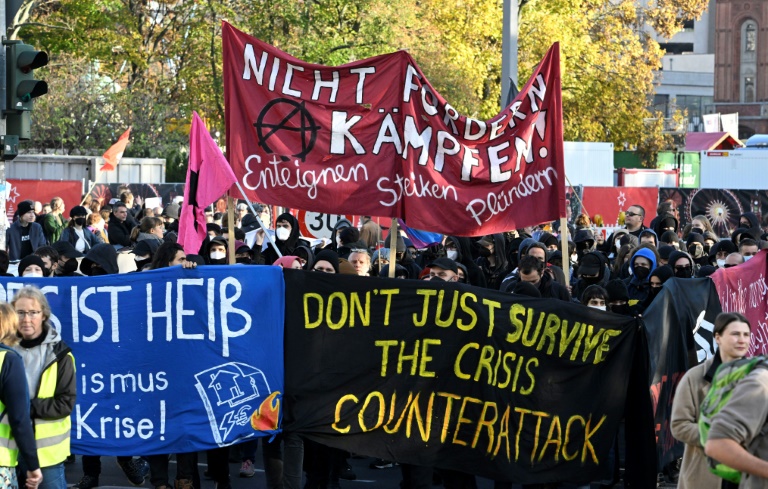
Thousands of people demonstrated in Berlin on Saturday calling for food prices to be controlled and for the rich to face higher taxes as Germany faces a cost of living crisis.

Marching behind banners, one of which was emblazoned with the demand “Redistribute!”, the demonstrators marched through the German capital after a call by left-wing organisations to protest against soaring prices and rents.

Both police and organisers said at least 3,000 people took part in the protest which took place to the backdrop of rising inflation caused in part by the war in Ukraine which has hit energy and food supplies.

Other banners said the current economic order “puts profits over people’s needs”.

Inflation in Germany is at its highest level in more than 70 years and reached 10.4 percent in October, according to figures released on Friday.

The price rises are hitting household budgets as well as industry in the eurozone’s largest economy.

The government, which is forecasting a 0.4 percentage point contraction in GDP next year, has sought mitigate surging energy prices, imposing a partial cap on the price of gas and electricity that will come into force in 2023.

Most of the other mitigating measures, including subsidised rail travel, have already ended.

German economic experts on Wednesday proposed raising taxes on higher earners to help households struggling with soaring energy bills, but the suggestion was immediately shot down by the country’s finance minister. 

Close Bitnami banner
Bitnami