AFP

Winter power shortages won't worry off-grid Swiss valley

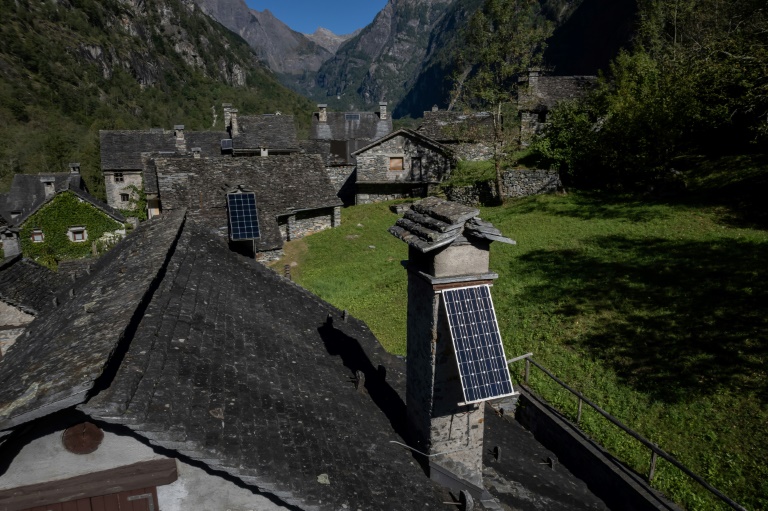
While people across Europe are being urged to save energy this coming winter to avert power shortages, Switzerland’s Bavona Valley is unfazed, having never been plugged into the power network.

Located in the Italian-speaking Ticino region of southern Switzerland, the remote, glacially-carved valley following the Bavona river is one of the steepest in the Alps.

But there are 12 hamlets made up of stone dwellings scattered along the rugged valley which are home to a few dozen inhabitants for most of the year, except in winter when fewer than 10 stay on.

Eleven of the hamlets are not connected to the power grid, despite the area producing lots of electricity thanks to dams located high up near the mountain tops.

They were built after World War II to provide electricity for the German-speaking region of Switzerland over on the northern side of the Alps, said Romano Dado, a former local councillor in Cevio, the village at the lower end of the valley on which the hamlets depend.

Bringing power down into the valley would have required transformers, but “the people here didn’t have the money for that,” he told AFP. Only the last hamlet at the very top of the valley could afford this luxury.

As the decades passed, the valley’s population shrank from around 500 to fewer than 50 now, according to Dado, and the inhabitants learned to get by without being on the electricity grid, making do with their fireplaces and installing solar panels on the roofs from as early as the 1980s.

– Oil lamps and candles –

Residents also use gas canisters, candles and oil lamps. To wash their clothes, “we go to the river, as always”, said Tiziano Dado, Romano’s stonemason brother.

The narrow valley, around 10 kilometres long (six miles) and flanked by towering slopes reaching more than 2,500 metres in altitude, has seen sometimes-fatal avalanches, floods and landslides throughout the centuries.

Seasonal migration to the summer pastures persisted in the area until the 1970s. 

Families went up the valley with their animals from March until the end of December, coming back down for Christmas, said Sonia Fornera, from Orrizonti Alpini, a group of experts in Alpine history and culture.

“It was a hard life but a simple life,” said Bice Tonini, 88, warming herself by the fireplace in her house.

Despite her age, she continues to live there from spring to October thanks to her solar panels.

“There is so much wastage of electricity” in modern society, she lamented.

At night, there are no street lights to prevent her from admiring the stars — and she enjoys the nightly show far more than watching television, which is a rare sight in the valley.

– Museum or dream? –

“We are used to living in a very simple way and we’re not afraid of making savings” in terms of energy, said Ivo Dado, 81, who proudly had solar panels installed in 1987.

The former farmer — no immediate relation to the Dado brothers — is delighted that some cities are giving up on their traditional festive illuminations this December.

“This Christmas will be as before, with less light. It will be beautiful again!” he said.

This sparing attitude towards electricity is not to everyone’s taste.

“Solar panels are a partial solution,” Martino Giovanettina, a writer and owner of one of the few restaurants in the valley, told AFP.

He believes the lack of electricity, plus the stringent rules for renovating old buildings, are contributing to depopulating the valley, turning it into an open-air “museum” of the past, instead of orientating towards tourism, as neighbouring valleys have done.

The Bavona Valley has no set-up for tourists at all, apart from a cable car from the last hamlet up to the dams, and the parking of motorhomes is banned.

Doris Femminis, a 2020 Swiss Prize for Literature winner, grew up in the valley and raised goats there during her 20s. Now she recounts the story of the Bavona Valley in her books.

Now living in the Jura mountains in western Switzerland, she returns every two months to this “wonderful place of one’s childhood”.

“In Switzerland, we like the idea of still having a corner of wild nature,” she said, but acknowledged that such places are not suited to modern life.

“It’s a place of the past,” she told AFP.

“Nobody wants to live there anymore; it’s just a dream.”
Equities drop on recession fears as inflation data looms

Markets mostly fell Tuesday as investors grow increasingly fearful that more big interest rate hikes will tip economies into deep recessions, with the mood also darkened by the worsening Ukraine war and worries over China’s outlook.

With the focus on inflation, analysts said consumer price index data released later this week will be crucial to the direction of risk assets — another big reading could spark a fresh equity selloff and surge in the dollar.

Investors had hoped that a series of bumper rate increases by the US Federal Reserve this year would begin to drag on the economy and slow runaway prices, allowing policymakers to slow down their pace of monetary tightening.

But a forecast-beating jobs report on Friday highlighted the tough work the central bank has in bringing inflation down from four-decade highs, and many observers warn a recession is virtually inevitable.

World Bank chief David Malpass said there was a “real danger” of a global contraction next year, adding that the surge in the dollar was weakening the developing nations’ currencies and pushing their debt to “burdensome” levels.

And JP Morgan boss Jamie Dimon told CNBC that while the US economy was holding up now, it faced several headwinds including rising rates, surging inflation, Fed tightening and the Ukraine war.

He added that he saw a US recession in six to nine months, and that the S&P 500 could fall another 20 percent.

Barings strategist Christopher Smart said: “It’s little wonder investors enter the week in a dreary mood, especially with headlines from Ukraine signalling a further escalation in geopolitical tensions.

“Of course, markets are meant to look ahead, but it’s hard not to see the next few quarters bringing more of the same.”

After another round of losses in New York, Asia again struggled.

Chip manufacturers globally took a pounding from new US export controls aimed at restricting China’s ability to buy and make high-end chips with military applications.

The Philadelphia Stock Exchange Semiconductor Index saw its lowest close since late 2020, while Bloomberg News reported that $240 billion had been slashed from companies’ market values worldwide.

– ‘Volatility ahead’ –

Taipei led the losses in Asia — diving more than four percent — as chip giant TSMC plunged 8.3 percent, while a hefty selloff in Samsung Electronics dragged Seoul down 1.6 percent. Tokyo was also sharply lower owing to a hit to tech firms.

All three markets had been closed Monday and were reacting to Friday’s US announcement for the first time.

Hong Kong fell more than two percent to below 17,000 points for the first time since late 2011, while Sydney, Singapore, Mumbai, Bangkok and Jakarta were also lower.

Shanghai, Wellington and Manila edged up slightly on bargain-buying.

London, Paris and Frankfurt also fell at the open.

“There is growing pessimism in the markets now and with some big data points to come from the US this week, not to mention the start of earnings season… investors should probably brace for more volatility ahead,” said OANDA’s Craig Erlam.

There was a glimmer of optimism for investors in comments from Fed vice chair Lael Brainard, who appeared to hint at a more cautious tone for policy as the hikes already announced work through the economy.

But SPI Asset Management’s Stephen Innes said traders were likely to be guarded in their reaction to the remarks.

“With the market in ‘fool me once, shame on me, fool me twice, shame on you’ mode, investors should be 100 percent defensive, erring to classical risk-off strategies as local conversations defer to risk-off,” he said in a commentary.

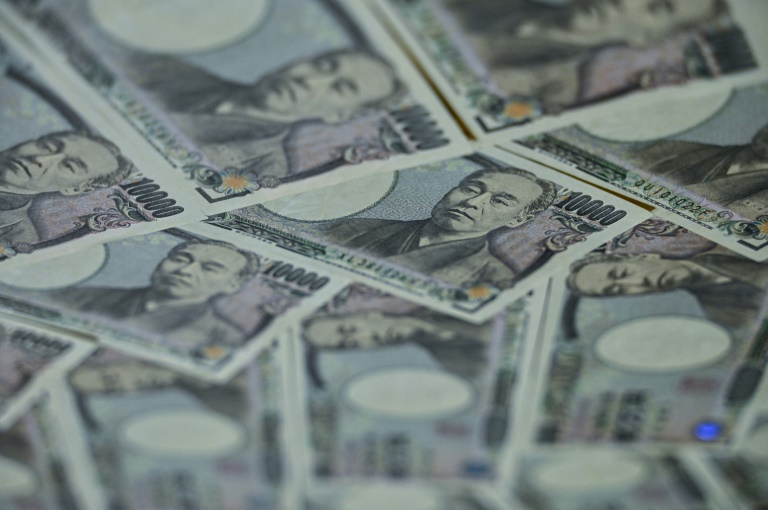
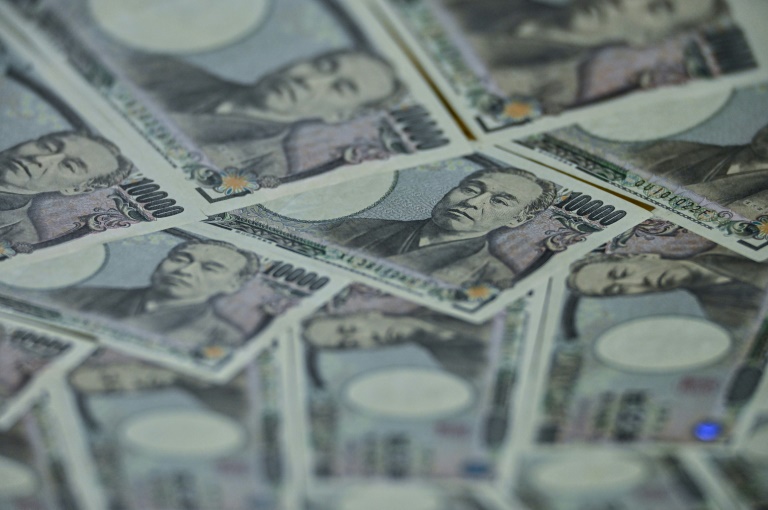
On currency markets, the dollar remained king as the United States lead the monetary tightening drive, and eyes are on the reaction in Tokyo as the yen drops towards the 145.90 level that last month saw massive government intervention.

The pound was also still under pressure, despite the Bank of England unveiling fresh measures to calm markets rocked by a UK budget, saying it would extend purchases of government bonds.

The news came as official data revealed British unemployment fell to a near 50-year low at 3.5 percent, although wages continue to be eroded by sky-high inflation.

– Key figures around 0810 GMT –

Tokyo – Nikkei 225: DOWN 2.6 percent at 26,401.25 (close)

Hong Kong – Hang Seng Index: DOWN 2.2 percent at 16,832.36 (close)

Shanghai – Composite: UP 0.2 percent at 2,979.79 (close)

London – FTSE 100: DOWN 0.8 percent at 6,902.56

Pound/dollar: DOWN at $1.1020 from $1.1059 on Monday

Euro/dollar: DOWN at $0.9699 from $0.9708

Euro/pound: UP at 88.00 pence from 87.76 pence

Dollar/yen: DOWN at 145.62 yen from 145.72 yen

West Texas Intermediate: DOWN 0.2 percent at $90.91 per barrel

Brent North Sea crude: DOWN 0.1 percent at $96.11 per barrel

New York – Dow: DOWN 0.3 percent at 29,202.88 (close)

Equities drop on recession fears as inflation data looms

Markets mostly fell Tuesday as investors grow increasingly fearful that more big interest rate hikes will tip economies into deep recessions, with the mood also darkened by the worsening Ukraine war and worries over China’s outlook.

With the focus on inflation, analysts said consumer price index data released later this week will be crucial to the direction of risk assets — another big reading could spark a fresh equity selloff and surge in the dollar.

Investors had hoped that a series of bumper rate increases by the US Federal Reserve this year would begin to drag on the economy and slow runaway prices, allowing policymakers to slow down their pace of monetary tightening.

But a forecast-beating jobs report on Friday highlighted the tough work the central bank has in bringing inflation down from four-decade highs, and many observers warn a recession is virtually inevitable.

World Bank chief David Malpass said there was a “real danger” of a global contraction next year, adding that the surge in the dollar was weakening the developing nations’ currencies and pushing their debt to “burdensome” levels.

And JP Morgan boss Jamie Dimon told CNBC that while the US economy was holding up now, it faced several headwinds including rising rates, surging inflation, Fed tightening and the Ukraine war.

He added that he saw a US recession in six to nine months, and that the S&P 500 could fall another 20 percent.

Barings strategist Christopher Smart said: “It’s little wonder investors enter the week in a dreary mood, especially with headlines from Ukraine signalling a further escalation in geopolitical tensions.

“Of course, markets are meant to look ahead, but it’s hard not to see the next few quarters bringing more of the same.”

After another round of losses in New York, Asia again struggled.

Chip manufacturers globally took a pounding from new US export controls aimed at restricting China’s ability to buy and make high-end chips with military applications.

The Philadelphia Stock Exchange Semiconductor Index saw its lowest close since late 2020, while Bloomberg News reported that $240 billion had been slashed from companies’ market values worldwide.

– ‘Volatility ahead’ –

Taipei led the losses in Asia — diving more than four percent — as chip giant TSMC plunged 8.3 percent, while a hefty selloff in Samsung Electronics dragged Seoul down 1.6 percent. Tokyo was also sharply lower owing to a hit to tech firms.

All three markets had been closed Monday and were reacting to Friday’s US announcement for the first time.

Hong Kong fell more than two percent to below 17,000 points for the first time since late 2011, while Sydney, Singapore, Mumbai, Bangkok and Jakarta were also lower.

Shanghai, Wellington and Manila edged up slightly on bargain-buying.

London, Paris and Frankfurt also fell at the open.

“There is growing pessimism in the markets now and with some big data points to come from the US this week, not to mention the start of earnings season… investors should probably brace for more volatility ahead,” said OANDA’s Craig Erlam.

There was a glimmer of optimism for investors in comments from Fed vice chair Lael Brainard, who appeared to hint at a more cautious tone for policy as the hikes already announced work through the economy.

But SPI Asset Management’s Stephen Innes said traders were likely to be guarded in their reaction to the remarks.

“With the market in ‘fool me once, shame on me, fool me twice, shame on you’ mode, investors should be 100 percent defensive, erring to classical risk-off strategies as local conversations defer to risk-off,” he said in a commentary.

On currency markets, the dollar remained king as the United States lead the monetary tightening drive, and eyes are on the reaction in Tokyo as the yen drops towards the 145.90 level that last month saw massive government intervention.

The pound was also still under pressure, despite the Bank of England unveiling fresh measures to calm markets rocked by a UK budget, saying it would extend purchases of government bonds.

The news came as official data revealed British unemployment fell to a near 50-year low at 3.5 percent, although wages continue to be eroded by sky-high inflation.

– Key figures around 0810 GMT –

Tokyo – Nikkei 225: DOWN 2.6 percent at 26,401.25 (close)

Hong Kong – Hang Seng Index: DOWN 2.2 percent at 16,832.36 (close)

Shanghai – Composite: UP 0.2 percent at 2,979.79 (close)

London – FTSE 100: DOWN 0.8 percent at 6,902.56

Pound/dollar: DOWN at $1.1020 from $1.1059 on Monday

Euro/dollar: DOWN at $0.9699 from $0.9708

Euro/pound: UP at 88.00 pence from 87.76 pence

Dollar/yen: DOWN at 145.62 yen from 145.72 yen

West Texas Intermediate: DOWN 0.2 percent at $90.91 per barrel

Brent North Sea crude: DOWN 0.1 percent at $96.11 per barrel

New York – Dow: DOWN 0.3 percent at 29,202.88 (close)

France threatens to break refinery blockades in strike standoff

The French government on Tuesday threatened to forcibly break blockades of refineries and oil depots, which have been paralysed by striking workers, as motorists continued to besiege petrol stations in the hope of filling their tanks.

Around a third of France’s service stations were still low on, or out of, petrol as strike action at energy giant TotalEnergies and other oil majors entered its third week and wage negotiations were stalling.

Government ministers and President Emmanuel Macron have urged a negotiated resolution to the crisis, but on Tuesday government spokesman Olivier Veran threatened force to end the blockades which have paralysed several of France’s refineries and oil depots.

If strikers failed to reestablish access “immediately”, Veran told the RTL broadcaster, “we will step in, which means we could intervene to lift them”.

The government could then “requisition qualified personnel” to ensure that the situation can go “back to normal”, he said.

He said ongoing action by the hard-left CGT union at TotalEnergies installations was “excessive and out of line”.

The oil giant’s management “is right to demand that blockades be lifted before there can be negotiations”, Veran said.

Once access to refineries and depots was free, it would take around two weeks for the fuel situation to be back to normal, Veran said.

Stoppages continued at several refineries Tuesday, including at France’s biggest near Le Havre in the north of the country after the CGT renewed its strike call and widened strike action to more than a dozen service stations along French motorways.

Unions at the French branch of Esso-ExxonMobil on Tuesday also renewed their strike call, rejecting a pay offer by management.

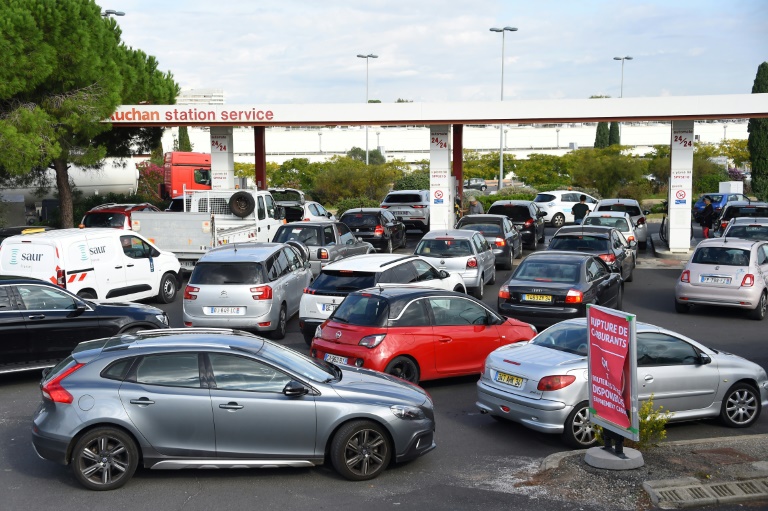
Motorists formed long queues outside petrol stations early Tuesday. In central Paris, traffic slowed as waiting cars blocked roads, cycling paths and pedestrian crossings, hoping to be served before the pumps went dry.

Many used social media to exchange tips. One post in a Facebook group Monday said that a local BP service station would be resupplied “at 2:30 pm”. Another replied: “It’s now 2:37 pm and they’re out of diesel.” Another user reacted: “What a mess.”

The petrol crisis comes at a time of high energy prices and inflation that are sapping French households’ purchasing power.

The left-wing opposition coalition Nupes has called for a “March against a high cost of living” in Paris and elsewhere on Sunday.

At the weekend, several prominent French people came out in support of the initiative, including this year’s winner of the Nobel Prize for Literature, Annie Ernaux.

burs-jh/

Silicon Valley billionaire Milner renounces Russian citizenship

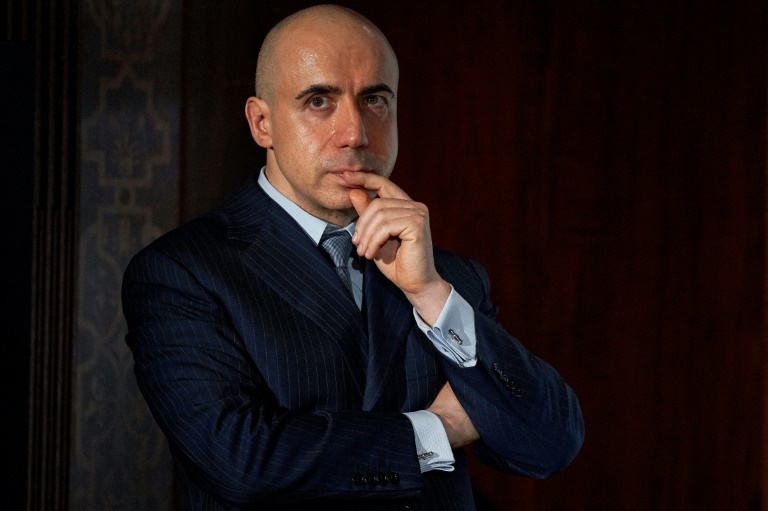
Billionaire Silicon Valley investor Yuri Milner said Monday he had renounced his Russian citizenship.

“My family and I left Russia for good in 2014, after the Russian annexation of Crimea. And this summer, we officially completed the process of renouncing our Russian citizenship,” the Moscow-born Milner tweeted.

Milner, founder of the internet investment firm DST Global and one of the original investors in Facebook, has been an Israeli citizen since 1999, DST Global said in a fact sheet on its website.

The venture capitalist and physicist has no assets in Russia and 97 percent of his wealth was created elsewhere, it said.

“Yuri has never met Vladimir Putin, either individually or in a group,” it said.

Milner’s non-profit Breakthrough Prize Foundation has condemned the Russian invasion of Ukraine.

“As the terrible war in Ukraine continues, with casualties and atrocities mounting, the Breakthrough Prize Foundation strongly condemns Russia’s invasion of Ukraine and its unprovoked and brutal assaults against the civilian population,” it said in a statement in March.

Milner’s foundations have donated at least $11 million to help refugees from Ukraine and scientists forced to flee the country, according to DST Global.

Milner and the late British cosmologist Stephen Hawking in 2016 announced an ambitious space initiative for a mission to Alpha Centauri, the nearest star system to Earth, using tiny light-propelled, ultra-light space vehicles, or “nanocraft”.

The pair also teamed up to launch a massive search for intelligent extraterrestrial life in a $100-million, 10-year project to scan the heavens, funded by Milner. 

BoE widens action on 'UK financial stability' fears

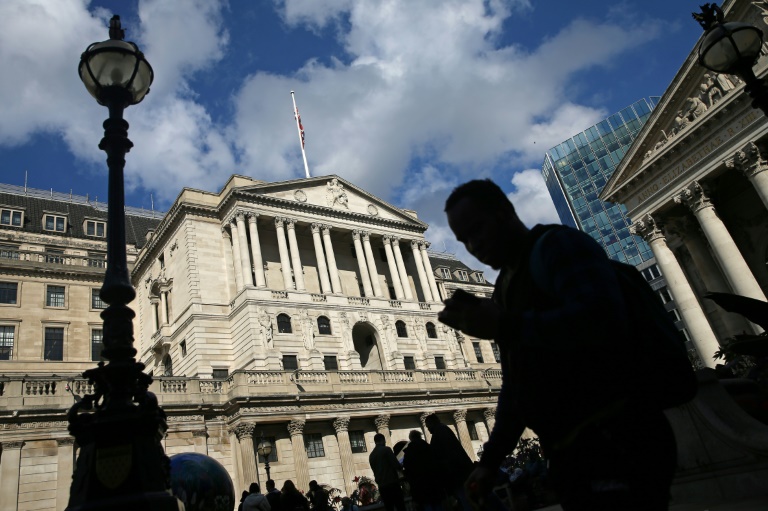
The Bank of England on Tuesday unveiled yet more measures aimed at calming markets rocked by a UK budget as it warned over risks to the nation’s financial stability.

The week had already seen action taken by the BoE and UK government aimed at bringing calm to bond markets in particular as state borrowing soars.

The moves are a response to soaring UK bond yields and after the pound tumbled to a record low against the dollar since the government of new Prime Minister Liz Truss unveiled debt-fuelled tax cuts in a budget last month.

A day after it launched a temporary facility aimed at easing liquidity pressures, the central bank Tuesday said it was widening the scope of daily purchases of UK government bonds, or gilts, until Friday.

In a statement, the BoE said the latest action would “act as a further backstop to restore orderly market conditions”. 

It noted that “the beginning of this week has seen a further significant repricing of UK government debt, particularly index-linked gilts”, which the central bank will now purchase under its wider operation of bond purchases.

“Dysfunction in this market, and the prospect of self-reinforcing ‘fire sale’ dynamics pose a material risk to UK financial stability,” it added.

In more positive news, official data Tuesday revealed British unemployment fell to a near 50-year low at 3.5 percent.

Wages, however, continue to be eroded by sky-high inflation.

The British government on Monday brought forward key economic forecasts to Halloween, hoping not to spook markets further.

Finance minister Kwasi Kwarteng will unveil debt-reduction plans and independent economic predictions on October 31 rather than in late November.

It comes after Chancellor of the Exchequer Kwarteng was already forced to axe a tax cut for the richest earners, in the face of outrage as millions of Britons face a cost-of-living crisis with UK inflation around 10 percent.

– ‘Painful cuts’ –

Britain meanwhile faces “big and painful” cuts in public spending to fix state finances should it decide against more U-turns over tax cuts, a leading think tank warned Tuesday.

“With a weaker economy, getting government finances on a sustainable path without cancelling tax cuts could force… big and painful spending cuts,” the Institute for Fiscal Studies said in a study.

Reducing debt “through spending cuts alone, without actually specifying which budgets would be cut, risks stretching credulity to breaking point”, it added.

The budget was widely criticised, including by the International Monetary Fund, over fears that government debt would balloon to pay for the tax cuts, including on salaries of all UK workers.

Fitch last week lowered the outlook on its credit rating for British government debt to negative from stable.

The BoE has piled on further pressure by hiking its main interest rate to a 14-year high of 2.25 percent in a bid to cool inflation — and is expected to go even stronger on tightening next month.

This in turn has seen retail banks ramp up interest rates on mortgages, with analysts predicting heavy price falls for property.

New Zealand outlines plans to tax livestock burps, farts

New Zealand on Tuesday unveiled plans to tax the greenhouse gas emissions from farm animals, in a controversial proposal designed to tackle climate change.

Prime Minister Jacinda Ardern said the levy would be the first of its kind in the world.

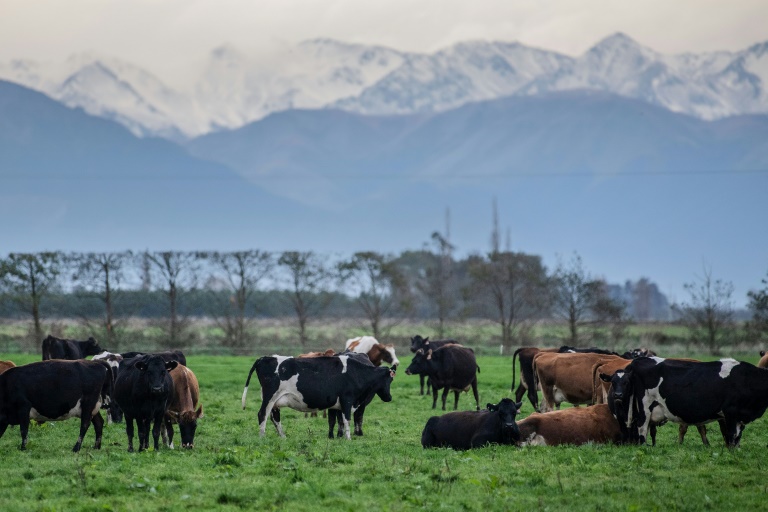
Gases naturally emitted by New Zealand’s 6.2 million cows are among the country’s biggest environmental problems.

The scheme would see farmers pay for gas emissions from their animals, such as methane gas in the farts and burps from cows, and nitrous oxide in the urine of livestock.

Ardern told farmers they should be able to recoup the cost by charging more for climate-friendly products.

She said the “pragmatic proposal” would reduce agricultural emissions while making produce more sustainable by enhancing New Zealand’s “export brand”.

The government hopes to sign off the proposal by next year and the tax could be introduced in just three years’ time.

But with New Zealand going to the polls in the next 15 months, the proposal could cost Ardern rural votes as farmers quickly condemned the plan.

Andrew Hoggard, president of the Federated Farmers lobby group, said the scheme would “rip the guts out of small-town New Zealand”.

He argued the tax could push farmers into growing trees on fields currently used to rear livestock.

Beef + Lamb New Zealand, representing the country’s sheep and cattle farmers, said the plan failed to take into account rural measures already in place to counter greenhouse gases.

“New Zealand farmers have more than 1.4 million hectares of native forest on their land which is absorbing carbon,” said chairman Andrew Morrison.

“It’s only fair this is appropriately recognised in any framework from day one.”

Asian chipmakers plunge after US unveils China export controls

Chipmakers plunged in Asian trade Tuesday over new US measures to limit China’s access to high-end semiconductors with military uses, a move that wiped billions from companies’ valuations worldwide.

The announcement on Friday marked the latest volley in a long-running standoff between the two superpowers that has seen them face off over a range of issues including technology, trade, Hong Kong, Taiwan and human rights.

The US Department of Commerce said the measures include export restrictions on some chips used in supercomputing, and toughen requirements on the sale of semiconductor equipment.

The decision hammered chip manufacturers, with the Philadelphia Stock Exchange Semiconductor Index seeing its lowest close since late 2020, while Bloomberg News reported that $240 billion had been slashed from companies’ market values globally.

Taipei, Seoul and Tokyo markets were closed for holidays on Monday, and when trading resumed Tuesday, chipmakers sank.

Taipei-listed firms were among the worst hit with the Taiex stock index shedding more than four percent.

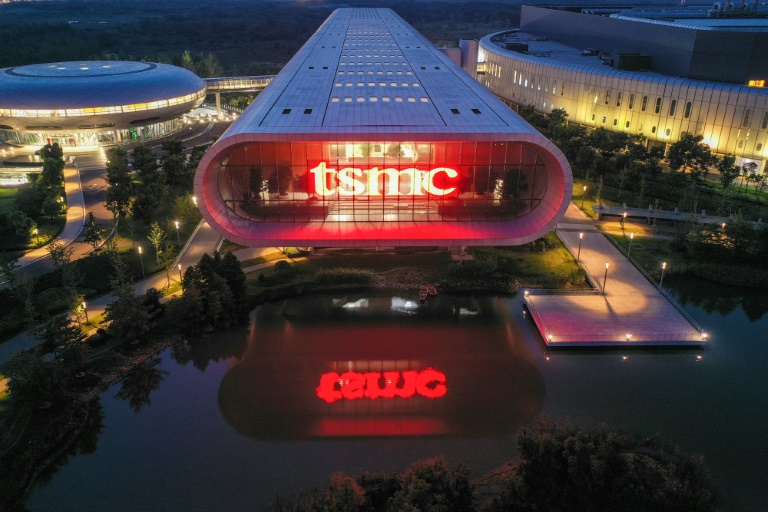
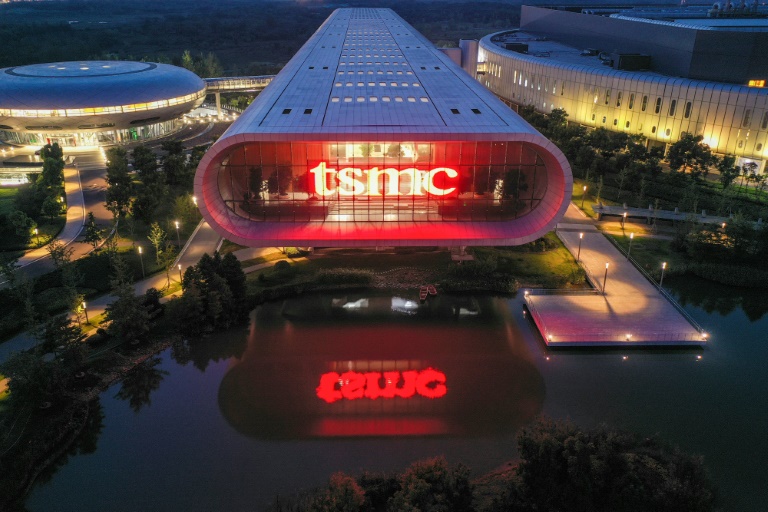
Taiwan Semiconductor Manufacturing Co. shed 8.3 percent and ASE Technology plunged nine percent, while United Microelectronics shed seven percent.

South Korean tech titan Samsung Electronics, a major semiconductor maker, fell more than one percent in Seoul where DB Hitek was off more than three percent.

And in Tokyo, Renesas Electronics shed almost six percent, with Tokyo Electron losing a similar amount.

The US measures are likely to complicate Beijing’s push to further its own semiconductor industry and develop advanced military systems.

They came days ahead of a major Communist Party congress in China at which President Xi Jinping is expected to secure a historic third term.

The rules were also announced just days after the Pentagon added 13 more Chinese firms including drone manufacturer DJI and surveillance firm Zhejiang Dahua Technology to a blacklist of Chinese military-linked companies.

“With the latest measure, it would become difficult for China to manufacture and develop semiconductors because most semiconductor equipment is dominated by the US and its allies,” said Chae Minsook, of Korea Investment & Securities.

“It is impossible to maintain the chip industry without adopting advanced equipment.”

Asian chipmakers plunge after US unveils China export controls

Chipmakers plunged in Asian trade Tuesday over new US measures to limit China’s access to high-end semiconductors with military uses, a move that wiped billions from companies’ valuations worldwide.

The announcement on Friday marked the latest volley in a long-running standoff between the two superpowers that has seen them face off over a range of issues including technology, trade, Hong Kong, Taiwan and human rights.

The US Department of Commerce said the measures include export restrictions on some chips used in supercomputing, and toughen requirements on the sale of semiconductor equipment.

The decision hammered chip manufacturers, with the Philadelphia Stock Exchange Semiconductor Index seeing its lowest close since late 2020, while Bloomberg News reported that $240 billion had been slashed from companies’ market values globally.

Taipei, Seoul and Tokyo markets were closed for holidays on Monday, and when trading resumed Tuesday, chipmakers sank.

Taipei-listed firms were among the worst hit with the Taiex stock index shedding more than four percent.

Taiwan Semiconductor Manufacturing Co. shed 8.3 percent and ASE Technology plunged nine percent, while United Microelectronics shed seven percent.

South Korean tech titan Samsung Electronics, a major semiconductor maker, fell more than one percent in Seoul where DB Hitek was off more than three percent.

And in Tokyo, Renesas Electronics shed almost six percent, with Tokyo Electron losing a similar amount.

The US measures are likely to complicate Beijing’s push to further its own semiconductor industry and develop advanced military systems.

They came days ahead of a major Communist Party congress in China at which President Xi Jinping is expected to secure a historic third term.

The rules were also announced just days after the Pentagon added 13 more Chinese firms including drone manufacturer DJI and surveillance firm Zhejiang Dahua Technology to a blacklist of Chinese military-linked companies.

“With the latest measure, it would become difficult for China to manufacture and develop semiconductors because most semiconductor equipment is dominated by the US and its allies,” said Chae Minsook, of Korea Investment & Securities.

“It is impossible to maintain the chip industry without adopting advanced equipment.”

'Dream come true': Japan reopens to tourists

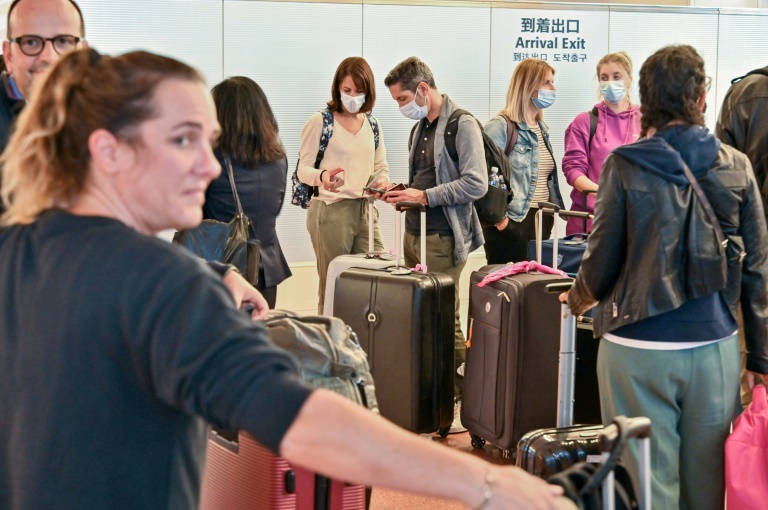
Japan reopened its doors to tourists Tuesday after two-and-a-half years of tough Covid-19 restrictions, with officials hoping an influx of travellers enticed by a weak yen will boost the economy.

By mid-morning, tourists from Israel, France and Britain were already pouring in, including Chris Irwin, 38, on his first trip to Japan.

“We have always wanted to come to Japan, and it seemed like the stars just aligned,” said Irwin, who arrived at Haneda airport from Britain with his wife.

Adi Bromshtine, a 69-year-old retiree from Israel, said she had been “planning before Covid and waiting and waiting” for the chance to visit Japan.

“It’s a long, long dream come true,” she told AFP.

Japan slammed its borders shut early in the pandemic, at one point even barring foreign residents from returning, and has only recently begun cautiously reopening.

In June, it began allowing tourists to visit in groups accompanied by guides, a requirement that was further relaxed to include self-guided package tours.

From Tuesday, visa-free entry resumed for travellers from 68 countries and territories.

Japan also lifted a cap on the number of arrivals and ended the package tour requirement.

Tourists must still present either proof of vaccination or a negative coronavirus test taken three days before departure.

In 2019, a record 31.9 million foreign visitors came to Japan, putting the country on track for its goal of 40 million by 2020, when Tokyo was supposed to host the Summer Olympics.

But in 2021, the figure plummeted to just 250,000.

– Demand soaring –

In Japan, tourists will find a country that is still adhering to many of the health guidelines that helped it keep pandemic deaths to around 45,500, far lower than many other developed economies.

Masks are ubiquitous, and though not mandated by law, parliament is set to pass legislation allowing hotels to deny service to customers who refuse to wear one or flout other health rules.

Masks are worn not only indoors and on public transport, but outdoors as well, despite the government saying they are not necessary outside in uncrowded settings.

There is hand sanitiser at the entrance of most businesses, and plastic dividers are still often used in restaurants.

Many arriving tourists seemed unfazed by the rules though.

“We’re more excited to see Japan than we will be annoyed by the masks, so we’ll be fine with it,” said British traveller Irwin.

Another major change for tourists will be the weakness of the yen, which is hovering around 145 to the dollar, a level not seen for two decades.

The government has already had to intervene once to prop up the currency, and government spokesman Hirokazu Matsuno on Tuesday said officials are hoping rebounding tourism “will lead to recovery after the Covid pandemic and the revitalisation of communities.”

There is certainly no shortage of demand, according to Antoine Chanthavong, of Paris-based travel agency Destination Japan.

Since the reopening announcement, “we’ve been absolutely drowning, we don’t have enough time to deal with all the requests,” he told AFP.

Japanese carrier ANA has said reservations for international flights to the country surged five-fold after the reopening was announced.

For now, tickets are not coming cheap, with fuel prices soaring and airlines forced to take circuitous routes to avoid Russian airspace.

Itay Galili, a 22-year-old student arriving from Israel, said he wasn’t put off by the cost.

“As soon as I heard it was going to reopen on the 11th, I started planning. Tickets were expensive… but no price (is) too heavy,” he told AFP.

For all the rebound in demand though, there is little expectation that tourist numbers will quickly reach their 2019 levels.

Before the pandemic, travellers from Hong Kong and mainland China made up 37 percent of all foreign visitors to Japan, and 44 percent of tourism income.

But tough Covid restrictions in China make it unlikely visitors from there will be flocking back to Japan anytime soon.

Close Bitnami banner
Bitnami