AFP

No longer a Mystery Incorporated: Scooby-Doo's Velma is gay

After decades of rumor and innuendo, one of animation’s worst kept secrets has finally been confirmed: Scooby-Doo’s Velma is lesbian.

Clips from Halloween special “Trick or Treat Scooby-Doo,” released this week, show the brainy sleuth’s glasses fogging up and her cheeks reddening when she first meets villainous costume designer Coco Diablo.

“OK, who am I kidding? I’m crushing big time Daphne! What do I do? What do I say?” she asks her friend in another scene.

The gang of amateur detectives in “Scooby Doo” have been solving mysteries since 1969, delighting generations of children as they unmask a villain who invariably declares he “would have gotten away with it, if it weren’t for you pesky kids.”

The titular oversized dog, who will do anything for a “Scooby snack,” stumbles through crimes discovering clues with the help of friends, Shaggy, Daphne, Fred and Velma, who collectively make up “Mystery Incorporated.”

Fans have long agreed that Velma is queer, but the new movie marks the first definitive confirmation.

Producers of the franchise’s various series and movies have previously spoken about Velma Dinkley’s sexuality, even if they were not able to make it explicit on screen.

In 2020 producer Tony Cervone posted an Instagram photo of Velma and another female character against a rainbow-themed Pride backdrop.

“We made our intentions as clear as we could ten years ago,” he wrote in the caption at the time.

“Most of our fans got it. To those that didn’t, I suggest you look closer.”

Audie Harrison, director of the new movie, told NPR he did not expect Velma’s same-sex attraction to be “so groundbreaking,” and that he had “just set out to have fun with the comedy of an awkward teenage crush.”

He added: “That being said, it does feel great to be a part of normalizing representation, especially with such a well-known franchise like Scooby-Doo!”

Fans took to social media to celebrate the news.

“OMG LESBIAN VELMA FINALLY CANON CANON IN THE MOVIES LETS GOOOOOO,” said one tweet which received well over 200,000 likes.

“LET’S GO LESBIANS #Velma” wrote another.

Biden tours Florida hurricane clean-up zone — and opponent's territory

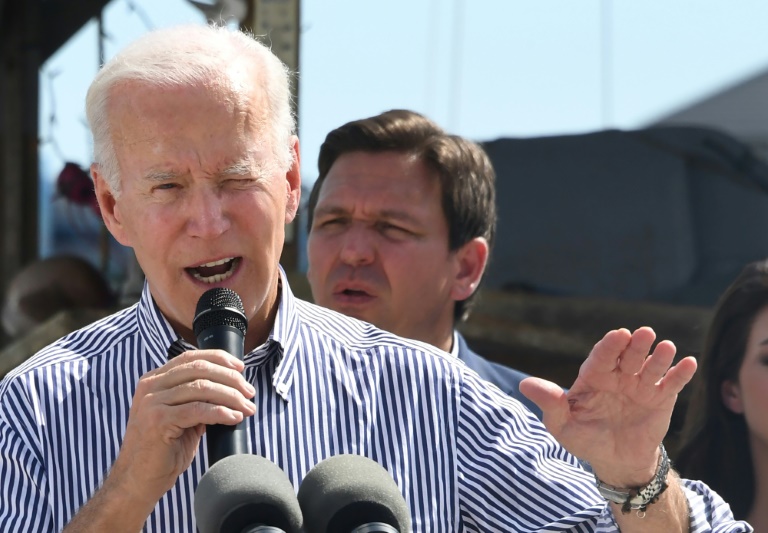
US President Joe Biden flew over the devastation left by Hurricane Ian in Florida on a politically charged trip Wednesday that marked a truce with bitter Republican critic and potential 2024 opponent, Governor Ron DeSantis.

The Democrat, accompanied by First Lady Jill Biden, boarded a helicopter at Fort Myers for an aerial inspection of the havoc wreaked in one of the worst storms ever to hit the country.

“Everything — this historic and titanic, unimaginable storm ripped it to pieces,” Biden said in a speech after witnessing the destruction. “You’ve got to start from scratch.”

Authorities say at least 93 people — more than 100 according to US television networks citing local officials — died in Hurricane Ian.

The Category 4 storm flattened whole neighborhoods on the Sunshine State’s west coast, knocking out power for millions of people, and then weakened before tearing into South Carolina and up the East Coast.

For Biden, who visited hurricane-hit Puerto Rico on Monday, the Florida trip also had an inescapable political dimension, taking him into the stronghold of both DeSantis and Biden’s scandal-plagued predecessor in the White House, Donald Trump.

The Democrat, who says he wants to seek a second term despite already being the oldest man ever in the job at 79, could realistically end up facing a rematch with Trump in two years or a challenge from the up-and-coming DeSantis.

DeSantis has been a caustic critic, as he builds his brand of muscular right-wing politics in a bid to replace Trump as the biggest name in the Republican party. Biden has returned fire, painting DeSantis as part of what he says is an increasingly extreme right.

The hurricane, however, has prompted a ceasefire, with phone calls between the two men and acknowledgement from DeSantis that the federal government was quick to provide assistance.

“Mr President, welcome to Florida. We appreciate working together,” DeSantis said at the damaged waterfront neighborhood of Fisherman’s Pass.

Biden returned the warm words, saying DeSantis had “done a good job.”

“We have very different political philosophies, but we’ve worked hand in glove.”

– ‘Above politics’ — for now –

Biden’s main goal, White House Press Secretary Karine Jean-Pierre said, is to check that “the people of Florida have what they need.”

In addition to getting briefings from federal emergency management chief Deanne Criswell and DeSantis, Biden met small business owners and local storm survivors.

In his remarks, he emphasized togetherness — something rarely celebrated in today’s gladiatorial Democrat vs Republican politics.

“This is the United States,” he said in his remarks, stressing the word “united.”

Biden’s visit to Puerto Rico earlier in the week covered similar ground, although there he was updated on recovery from Hurricane Fiona, which hit the island last month.

Again, Biden stressed the unity message, telling the Caribbean territory — which often feels overlooked by the mainland and the federal government — that “all of America’s with you.”

The disagreements with DeSantis, however, are many and will likely resurface as soon as Floridians recommence a semblance of their previous lives.

DeSantis opposed Biden on his Covid-19 policies during the pandemic, accusing the president of overreach. He has likewise made himself the standard bearer of the conservative backlash to growing tolerance for LGBT issues — something Biden has championed.

Another right-wing Florida Republican who often comes under fire from Biden, Senator Rick Scott, was also present for the visit. But again, Biden held his tongue.

The visit was “above politics,” Jean-Pierre said.

“There will be plenty of times, plenty of time to discuss differences between the president and the governor. Now is not the time.”

Biden tours Florida hurricane clean-up zone — and opponent's territory

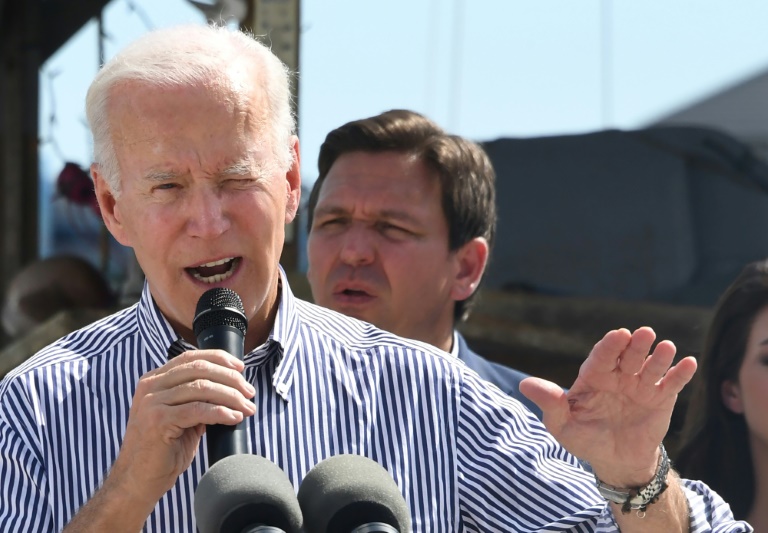
US President Joe Biden flew over the devastation left by Hurricane Ian in Florida on a politically charged trip Wednesday that marked a truce with bitter Republican critic and potential 2024 opponent, Governor Ron DeSantis.

The Democrat, accompanied by First Lady Jill Biden, boarded a helicopter at Fort Myers for an aerial inspection of the havoc wreaked in one of the worst storms ever to hit the country.

“Everything — this historic and titanic, unimaginable storm ripped it to pieces,” Biden said in a speech after witnessing the destruction. “You’ve got to start from scratch.”

Authorities say at least 93 people — more than 100 according to US television networks citing local officials — died in Hurricane Ian.

The Category 4 storm flattened whole neighborhoods on the Sunshine State’s west coast, knocking out power for millions of people, and then weakened before tearing into South Carolina and up the East Coast.

For Biden, who visited hurricane-hit Puerto Rico on Monday, the Florida trip also had an inescapable political dimension, taking him into the stronghold of both DeSantis and Biden’s scandal-plagued predecessor in the White House, Donald Trump.

The Democrat, who says he wants to seek a second term despite already being the oldest man ever in the job at 79, could realistically end up facing a rematch with Trump in two years or a challenge from the up-and-coming DeSantis.

DeSantis has been a caustic critic, as he builds his brand of muscular right-wing politics in a bid to replace Trump as the biggest name in the Republican party. Biden has returned fire, painting DeSantis as part of what he says is an increasingly extreme right.

The hurricane, however, has prompted a ceasefire, with phone calls between the two men and acknowledgement from DeSantis that the federal government was quick to provide assistance.

“Mr President, welcome to Florida. We appreciate working together,” DeSantis said at the damaged waterfront neighborhood of Fisherman’s Pass.

Biden returned the warm words, saying DeSantis had “done a good job.”

“We have very different political philosophies, but we’ve worked hand in glove.”

– ‘Above politics’ — for now –

Biden’s main goal, White House Press Secretary Karine Jean-Pierre said, is to check that “the people of Florida have what they need.”

In addition to getting briefings from federal emergency management chief Deanne Criswell and DeSantis, Biden met small business owners and local storm survivors.

In his remarks, he emphasized togetherness — something rarely celebrated in today’s gladiatorial Democrat vs Republican politics.

“This is the United States,” he said in his remarks, stressing the word “united.”

Biden’s visit to Puerto Rico earlier in the week covered similar ground, although there he was updated on recovery from Hurricane Fiona, which hit the island last month.

Again, Biden stressed the unity message, telling the Caribbean territory — which often feels overlooked by the mainland and the federal government — that “all of America’s with you.”

The disagreements with DeSantis, however, are many and will likely resurface as soon as Floridians recommence a semblance of their previous lives.

DeSantis opposed Biden on his Covid-19 policies during the pandemic, accusing the president of overreach. He has likewise made himself the standard bearer of the conservative backlash to growing tolerance for LGBT issues — something Biden has championed.

Another right-wing Florida Republican who often comes under fire from Biden, Senator Rick Scott, was also present for the visit. But again, Biden held his tongue.

The visit was “above politics,” Jean-Pierre said.

“There will be plenty of times, plenty of time to discuss differences between the president and the governor. Now is not the time.”

Judge says Twitter-Musk trial still on track

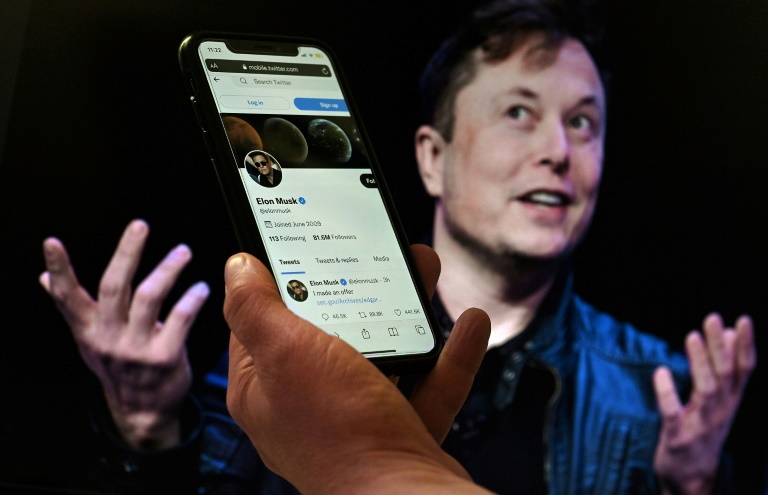
The judge presiding over Twitter’s legal battle to hold Elon Musk to his $44-billion buyout deal said Wednesday the case was still on course for trial — despite the billionaire’s apparent U-turn.

Neither Twitter nor Musk have asked the court to put the case on hold, so “I, therefore, continue to press on toward our trial” set to start on October 17, Judge Kathaleen McCormick said in a ruling.

McCormick ruled on motions regarding efforts by Twitter to get hold of messages, documents or depositions that could be used as trial evidence in Delaware’s Chancery Court.

McCormick said in the ruling that Musk’s side had failed to provide Twitter with copies of all the messages he exchanged about the buyout deal, and “likely” let some Slack messages be automatically deleted.

“If Defendants deleted documents after they were under a duty to preserve, some remedy is appropriate, but the appropriate remedy is unclear to me at this stage,” McCormick said in her ruling.

She added that she will reserve judgement on the matter until after the trial, when she has “a fuller understanding of the record.”

Musk on Tuesday offered to push through with his buyout of Twitter at the original agreed price, as the trial over his efforts to withdraw from the deal loomed.

The Tesla founder said in a filing with the Securities and Exchange Commission that he sent Twitter a letter vowing to honor the contract.

Conditions of his offer included halting the litigation, but McCormick made it clear she had received no such request.

Given that Musk has already tried to walk away from the deal once, the judge is expected to seek assurances that he will keep to his word this time around.

Judge says Twitter-Musk trial still on track

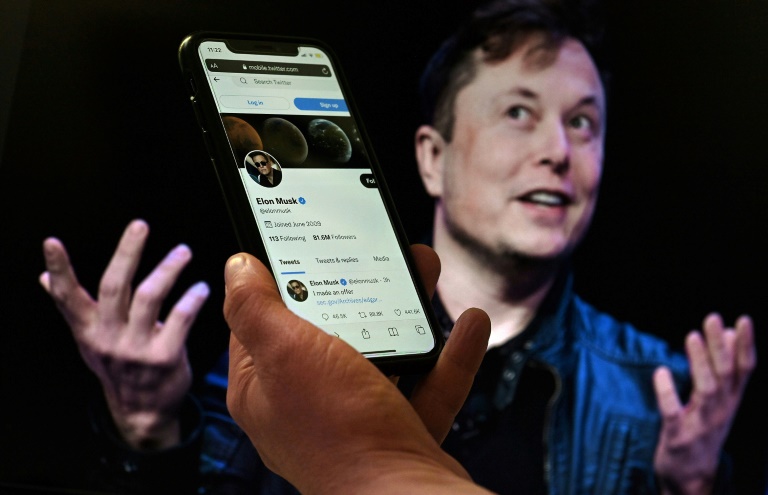
The judge presiding over Twitter’s legal battle to hold Elon Musk to his $44-billion buyout deal said Wednesday the case was still on course for trial — despite the billionaire’s apparent U-turn.

Neither Twitter nor Musk have asked the court to put the case on hold, so “I, therefore, continue to press on toward our trial” set to start on October 17, Judge Kathaleen McCormick said in a ruling.

McCormick ruled on motions regarding efforts by Twitter to get hold of messages, documents or depositions that could be used as trial evidence in Delaware’s Chancery Court.

McCormick said in the ruling that Musk’s side had failed to provide Twitter with copies of all the messages he exchanged about the buyout deal, and “likely” let some Slack messages be automatically deleted.

“If Defendants deleted documents after they were under a duty to preserve, some remedy is appropriate, but the appropriate remedy is unclear to me at this stage,” McCormick said in her ruling.

She added that she will reserve judgement on the matter until after the trial, when she has “a fuller understanding of the record.”

Musk on Tuesday offered to push through with his buyout of Twitter at the original agreed price, as the trial over his efforts to withdraw from the deal loomed.

The Tesla founder said in a filing with the Securities and Exchange Commission that he sent Twitter a letter vowing to honor the contract.

Conditions of his offer included halting the litigation, but McCormick made it clear she had received no such request.

Given that Musk has already tried to walk away from the deal once, the judge is expected to seek assurances that he will keep to his word this time around.

Under-fire UK PM Truss fails to calm markets with growth pledge

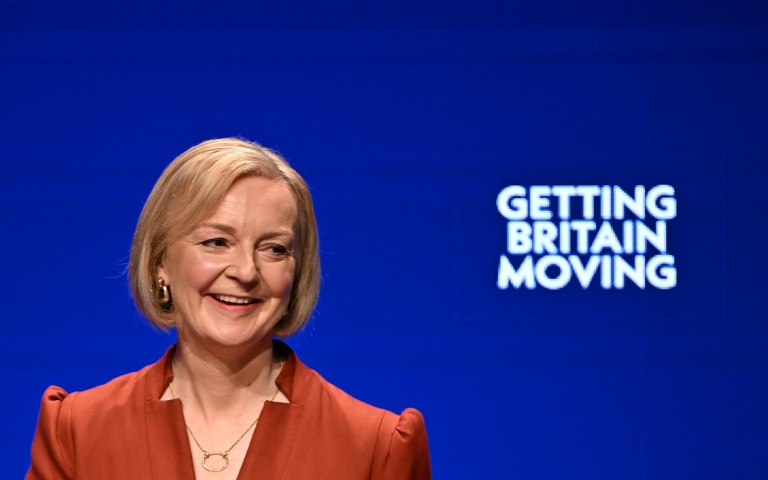
Prime Minister Liz Truss vowed to steer the UK “through the tempest” as she closed her party’s tumultuous annual conference on Wednesday, making an unapologetic pitch for economic “growth, growth, growth”.

Since succeeding Boris Johnson, Truss has alienated voters, financial markets and many in the ruling Conservative party with a crash programme of debt-fuelled tax cuts to boost Britain’s stagnant economy.

But she argued in her speech that the status quo was not an option, despite the botched rollout of her fiscal plan leading to a humiliating U-turn on a pledge to cut income tax for the highest earners.

“In these tough times, we need to step up,” she told delegates, taking aim at what she said was an “anti-growth coalition” holding back attempts to revive the economy.

“I’m determined to get Britain moving, to get us through the tempest and put us on a stronger footing as a nation,” she added, mentioning the word “growth” 27 times during the speech.

But her failure to flesh out her economic plan did not calm the jittery markets, and the pound slid 2.01 percent against the dollar, falling to as low as $1.1241. Early Thursday it traded at 1.1336.

“She may have hoped that her triple promise of growth would have calmed markets further but with nothing new to offer the table, her words have not had the desired effect so far,” said Susannah Streeter, an analyst at Hargreaves Landsdown.

Global ratings agency Fitch on Wednesday lowered its outlook for British government debt from stable to negative, warning of “a significant increase in fiscal deficits over the medium term”. 

– Protest –

Despite only being leader for exactly a month, Truss’s calamitous start, with a 10-day hiatus because of the death of Queen Elizabeth II, has already seen her fighting to keep her job.

Former minister Grant Shapps, who supported Truss’s leadership rival Rishi Sunak, said she could face a no-confidence vote by MPs if the keynote speech fails to start reviving the party’s dismal standing in opinion polls.

“In the end, I don’t think members of parliament, Conservatives, if they see the polls continue as they are, are going to sit on their hands,” he told Times Radio.

“A way would be found to make that change.”

The speech wasn’t without its hiccups, with Greenpeace protesters holding a banner saying “who voted for this?” until they were ejected.

Truss’s critics, including allies of Johnson, have accused her of lacking a national mandate for her unpopular reforms after she won the Tory leadership.

But she insisted Britain needed to “do things differently”, with no time for “more drift and delay”.

“Whenever there is change, there is disruption. Not everyone will be in favour. 

“But everyone will benefit from the result — a growing economy and a better future,” she said. 

– ‘Keep faith’ –

It remains to be seen whether the speech has the effect 10 Downing Street wants. 

Truss’s media interviews in the build-up to Wednesday focussed unrelentingly on the U-turn she and Chancellor of the Exchequer Kwasi Kwarteng were forced to stage on the signature element of their reform overhaul.

Cabinet splits emerged in Birmingham on indications that despite the impact of the crisis on the poor, the pair will next cut welfare benefits.

Truss denied she had lost control of her cabinet after putting on a show of unity with the beleaguered Kwarteng on a visit to a construction site in Birmingham on Tuesday.

But there was little team spirit on display from Home Secretary Suella Braverman, who accused party critics of seeking to stage a “coup” against Truss.

Dissident ringleader Michael Gove was one of Braverman’s targets. But he kept up his running criticism of Truss, stressing all Conservative MPs had been elected on Johnson’s manifesto of 2019.

“We’ve got to keep faith with what Boris wanted,” Gove said, underlining the point that Truss has yet to face the UK electorate herself.

But asked by reporters if Truss would survive beyond the end of the year, the former minister said: “Yes.”

Foreign minister James Cleverly also distanced himself from Braverman’s comments, though he did urge colleagues to air their disagreements in Cabinet.

Opinion polls have shown the main opposition Labour party breaching 50 percent as the Tories slump under Truss, fraying nerves in Birmingham over the four days of the conference.

“Polls do move up and down,” Kwarteng said Tuesday, stressing the two years remaining to the next election was an “eternity in politics”. 

Nobel winner's ingenious chemistry could lead to cancer breakthroughs

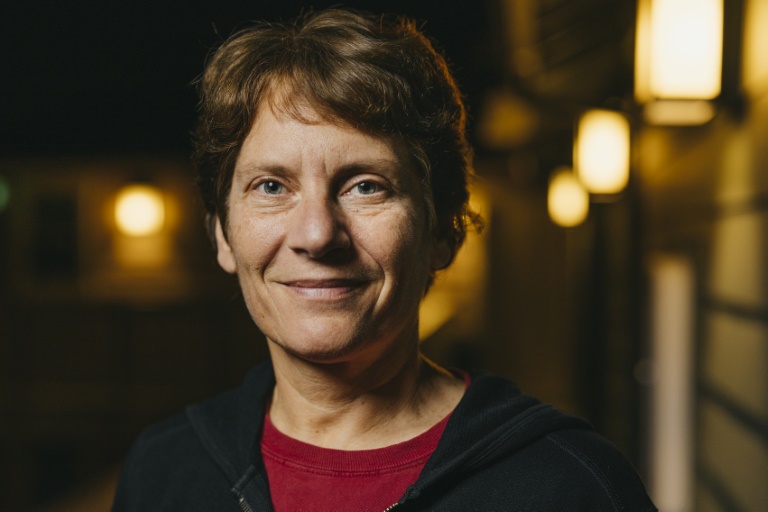
“All kinds of crazy things” is how Carolyn Bertozzi, a 2022 Nobel laureate, describes her life’s work. Actually performing “chemistry in cells and in people.”

When she started her research in 1997, the Stanford professor was aiming only to observe the evolution of certain molecules on the surface of cancer cells. 

Today, thanks to her discoveries, at least two companies — including one she co-founded — are developing innovative cancer treatments.

The multitude of applications made possible by her findings are impressive: delivering treatments with extreme precision, understanding better how drugs act inside the body, visualizing certain bacteria, to name a few.

“I can’t even really enumerate them. The vast majority of those applications I would never have foreseen,” she told AFP in an interview.

The Nobel Prize committee recognized Bertozzi’s pioneering advances on Wednesday, making her only the eighth woman to win the chemistry prize, at just 55 years old.

– Lego pieces –

Her journey began when she found she had a passion for organic chemistry, while taking pre-medicine courses at Harvard. 

The subject is notoriously — many say fiendishly — difficult, but she credits an “amazing professor,” the late David Evans, for bringing it to life — and changing the course of her life.

“I said, forget the med school thing. I’m going to be a chemist,” said Bertozzi, whose sister is a professor of applied mathematics, and father a retired professor of physics.

After completing her post-doctorate and joining the faculty at UC Berkeley, she wanted to take a closer look at glycans: complex carbohydrates, or sugars, located on the surface of cells, which “go through structural changes” when they become cancerous.

At the time, “there was no tool to image sugars, like in a microscope, for example,” she said.

She had an idea that would require two chemical substances that fit together perfectly, like pieces of lego.

The first lego is fed to cells via a sugar. The cell metabolizes it and places it on the tip of the glycan. The second piece of lego, a fluorescent molecule, is injected into the body.

The two lego pieces click together, and voila: hidden glycans reveal themselves under a microscope.

This technique is inspired by “click chemistry” developed independently by Denmark’s Morten Meldal and American Barry Sharpless — Bertozzi’s co-winners. But their discoveries relied on using copper as a catalyst, which is toxic to the body. 

One of Bertozzi’s great leaps was achieving the same type of ultra-efficient reaction without copper.

The other tour de force: making it all happen without wreaking havoc with other processes in the body.

“The beauty of it is that you can take the two Legos and click them together, even if they’re surrounded by millions of other very similar plastic toys,” she explained.

She coined the term “bioorthogonal chemistry,” meaning a reaction that doesn’t interfere with other biochemical processes. Perfecting the technique took 10 years.

– ‘Cycle of science’ –

Researchers are now leveraging these breakthroughs to develop cancer treatments. 

Glycans on cancer cells “are able to hide the cancer cell from the immune system — and so your body can’t fight it, it can’t see it,” she explains.

Using bioorthogonal chemistry, “we made a new type of medicine, which basically acts like a lawnmower,” says Bertozzi.

The first lego attaches to the cancer cell’s surface, and the second, which clips onto it, is equipped with an enzyme that “mows off the sugars as if they’re just grass, it cuts the grass and the sugars fall off,” she says with a smile.

The drug is currently being tested in the early stages of a clinical trial.

Another company is seeking to use bioorthogonal chemistry to better target cancer treatment. The first lego piece is injected into a tumor, then a second, which carries the drug, attaches itself and acts only on its target.

“So that allows the oncologist to treat the tumor and kill the tumor without exposing the person’s entire body to a toxic chemical,” she says.

“What the future holds is hopefully an impact in human health,” says Bertozzi. “But the people who decide that more so than myself, are the students and postdocs that join my lab.”

Hundreds of them, current and former, filled her email box with messages of congratulations this morning.

“That really is the cycle of science —  it’s being mentored and then mentoring” she adds. And “mentoring students gives you an opportunity to amplify the impact of your science.”

Click chemistry, Nobel-winning science that may 'change the world'

The Nobel Chemistry Prize was awarded to three scientists on Wednesday for their work on click chemistry, a way to snap molecules together like Lego that experts say will soon “change the world”.

But how exactly does it work?

Imagine two people walking through a mostly empty room towards each other then shaking hands. 

“That’s how a classical chemical reaction is done,” said Benjamin Schumann, a chemist at Imperial College London.

But what if there was lots of furniture and other people clogging up the room?

“They might not meet each other,” Schumann said.

Now imagine those people were molecules, tiny groups of atoms that form the basis of chemistry.

“Click chemistry makes it possible for two molecules that are in an environment where you have lots of other things around” to meet and join with each other, he told AFP.

The way click chemistry snaps together molecular building blocks is also often compared to Lego.

But Carolyn Bertozzi, who shared this year’s chemistry Nobel with Barry Sharpless and Morten Meldal, said it would take a very special kind of Lego.

Even if two Legos were “surrounded by millions of other very similar plastic toys” they would only click in to each other, she told AFP.

– ‘Changed the playing field’ – 

Around the year 2000, Sharpless and Meldal separately discovered a specific chemical reaction using copper ions as a catalyst which “changed the playing field” and became “the cream of the crop”, said Silvia Diez-Gonzalez, a chemist at Imperial College London.

Copper has many advantages, including that reactions could involve water and be done at room temperature rather than at high heat which can complicate matters.

This particular way of connecting molecules was far more flexible, efficient and targeted than had ever been possible before.

Since its discovery, chemists have been finding out all the different kinds of molecular architecture they can build with their special new Lego blocks.

“The applications are almost endless,” said Tom Brown, a British chemist at Oxford University that has worked on DNA click chemistry.

But there was one problem with using copper as a catalyst. It can be toxic for the cells of living organisms — such as humans.

So Bertozzi built on the foundations of Sharpless and Meldal’s work, designing a copperless “way of using click chemistry with biological systems without killing them”, Diez-Gonzalez said.

Previously the molecules clicked together in a straight flat line — like a seat belt — but Bertozzi discovered that forcing them “to be a bit bent” made the reaction more stable, Diez-Gonzalez said.

Bertozzi called the field she created bioorthogonal chemistry — orthogonal means intersecting at right angles.

– ‘Tip of the iceberg’ –

Diez-Gonzalez said she was “a bit surprised” that the field had been awarded with a Nobel so soon, because “there are not that many commercial applications out there yet”.

But the future looks bright.

“We’re kind of at the tip of the iceberg,” said American Chemical Society President Angela Wilson, adding that this “chemistry is going to change the world.”

Bertozzi said that there are so many potential uses for click chemistry, that “I can’t even really enumerate them”.

One use is for developing new targeted medicines, some of which could involve “doing chemistry inside human patients to make sure that drugs go to the right place,” she told the Nobel conference. 

Her lab has started research on potential treatments for severe Covid, she added.

Another hope is that it can lead to a more targeted way to diagnose and treat cancer, as well make chemotherapy have fewer, less severe side effects.

It has even created a way to make the bacteria that causes Legionnaires’ disease become fluorescent so it is easier to spot in water supplies. 

Already, click chemistry has been used “to create some very, very durable polymers” that protect against heat, as well as in forms of glue in nano-chemistry, Meldal told AFP.

Wilson said other future applications include personalised medicines, antibacterial and antiviral drugs, brightening agents and more.

“I think it’s going to completely revolutionise everything from medicine to materials,” she said.

Putin says war to 'stabilise', Ukraine presses counterattack

Russian President Vladimir Putin said Wednesday that he expected the situation to “stabilise” in Ukrainian regions annexed by the Kremlin after Moscow suffered military setbacks and lost several key towns to Kyiv.

He also ordered his government to seize control over Europe’s largest nuclear power plant in the Russian-controlled region of Zaporizhzhia, with IAEA head Rafael Grossi en route to Kyiv for consultations on the facility.

Ukraine earlier claimed victories over Russian troops in the eastern region of Lugansk, as the Kremlin vowed to recapture territory lost in a lightning Ukrainian counteroffensive.

In recent weeks, Ukraine’s forces — bolstered by Western weapons — have wrested Russian troops out of a string of towns and villages in the southern Kherson region and the eastern separatist strongholds of Lugansk and Donetsk.

And Ukrainian President Volodymyr Zelensky late Wednesday said his forces had recaptured three villages in the Kherson region from Russian troops. 

“We are working on the assumption that the situation in the new territories will stabilise,” Putin told Russian teachers during a televised video call.

Just hours earlier, the Ukrainian-appointed head of Lugansk Sergiy Gaiday announced that the “de-occupation of the Lugansk region has already officially started”.

A senior Russian lawmaker called on military officials to tell the truth about developments on the ground in Ukraine following the string of bruising defeats.

“We need to stop lying,” the chairman of the lower house of parliament’s defence committee, Andrei Kartapolov, told a journalist from state-run media.

“The reports of the defence ministry do not change. The people know. Our people are not stupid. This can lead to loss of credibility.”

– Regions to be ‘Russian forever’ –

Putin on Wednesday signed into legislation his annexation of four Ukrainian territories — including Lugansk — as the European Union agreed a new round of sanctions against Moscow in response.

Kremlin spokesman Dmitry Peskov said Moscow would take back land it lost to Kyiv within the annexed regions, vowing they would be “Russian forever and will not be returned”.

Putin initially inked agreements with the Moscow-installed leaders of the four regions to become subjects of the Russian Federation, despite condemnation from Kyiv and the West.

The four territories — Donetsk, Kherson, Lugansk and Zaporizhzhia — create a land corridor between Russia and the Crimean peninsula, which was annexed by Moscow in 2014.

Together, the five regions make up around 20 percent of Ukraine.

The Kremlin annexed the territories after hastily conducting referendums, denounced as void by Kyiv and its Western allies, but has yet to confirm what areas exactly of those regions are being annexed.

Russian forces do not have full control over Kherson or Zaporizhzhia and recently lost control of several settlements in Donetsk.

The latest battlefield maps from Moscow showed that Russian troops had left many areas in Kherson, including along the west bank of the Dnipro River.

– ‘Lived like rats’ –

In Kharkiv, the maps indicated that Moscow’s forces had almost entirely abandoned the east bank of the Oskil River, potentially giving the Ukrainians space to shell key Russian troop transportation and supply corridors.

While Russian authorities remain largely silent about the extent of the setbacks, war correspondents of pro-Kremlin media admitted that troops were in trouble. 

“There won’t be any good news in the near future. Not from the Kherson front nor from Lugansk,” newspaper journalist Alexander Kots wrote on his Telegram channel with more than 640,000 followers.

In the town of Lyman, Ukrainian police officers were moving back into the station used until last week by the Russian occupation force.

“They lived like rats,” said the town’s police chief, Igor Ugnivenko, returning to his pre-invasion office and surveying the debris.

In front of the central administration building, queues of mainly elderly residents built up for two ambulances distributing meagre humanitarian aid.

“I don’t know if the situation is better or worse,” said 62-year- old Tatiana Slavuta of the town’s recapture by Ukrainian forces.

“All the shops are closed, we don’t have money, we don’t have light. Nothing.

“We don’t see any change,” she said before correcting herself and brightening.

– ‘Now there’s silence’ –

“At least now there’s silence — no shelling.”

Putin’s decision to wrest control of the Zaporizhzhia plant comes after months of tensions around the facility, with both sides blaming each other for strikes that had raised fears of a radiation disaster.

On Tuesday, US President Joe Biden told Zelensky that another $625 million in military assistance was on the way.

The new batch includes more HIMARS multiple rocket launchers, which have allowed Ukraine to strike Russian command depots and arms stockpiles far behind the frontline.

In a powerful show of solidarity, Ukraine was added to the joint bid of Spain and Portugal to host the World Cup in 2030.

Zelensky called this “more than a symbol of faith in our joint victory”.

“Ukraine will endure, prevail and be rebuilt thanks to the solidarity of its partners,” Zelensky said on Twitter.


Climate change made 2022 drought 'at least 20 times likelier'

Human-caused climate change made this summer’s drought across the Northern Hemisphere at least 20 times more likely, according to a rapid analysis released Wednesday that warns such extreme dry periods will become increasingly common with global heating. 

The three months from June-August were the hottest in Europe since records began, and the exceptionally high temperatures led to the worst drought the continent has witnessed since the Middle Ages. 

Crops withered in European breadbaskets, as the historic dry spell drove record wildfire intensity and placed severe pressure on the continent’s power grid. 

Successive heatwaves between June and July, which saw temperatures top 40 degrees Celsius (104 degrees Fahrenheit) in Britain for the first time, saw some 24,000 excess deaths in Europe.

China and North America also experienced unusually high temperatures and exceptionally low rainfall over the period.

An international team of climate scientists have determined the warming caused by human activity made such extreme weather significantly more likely than it would have been at the dawn of the industrial age. 

The World Weather Attribution service calculated that the agricultural and ecological drought over the Northern Hemisphere was at least 20 times likelier thanks to global heating. 

“The 2022 summer has shown how human-induced climate change is increasing the risks of agricultural and ecological droughts in densely populated and cultivated regions of the North Hemisphere,” said Sonia Seneviratne, a professor at the Institute for Atmospheric and Climate Science at ETH Zurich in Switzerland and one of the study contributors.

– ‘Faster than expected’ –

To quantify the effect of human-caused climate change on soil moisture levels, the team analysed weather data and computer simulations to compare the real climate as it is today — that is, some 1.2C hotter than pre-industrial levels — with a climate absent of any human-induced heating.

They found that western and central Europe experienced particularly severe drought and substantially reduced crop yields.

Moisture in the top 7cm of soil across the Northern Hemisphere was made five times likelier to experience severe drought due to climate change, the study found. 

For the top one metre of soil — known as the root zone — this summer’s dryness was made at least 20 times likelier due to global heating.

“Really what is most relevant for agriculture and ecological impacts is the top one metre of the soil because that’s where plants have their roots,” said Seneviratne.

Overall, a Northern Hemisphere drought such as this summer’s was now likely to occur once every 20 years in today’s climate, compared to once every 400 years in the mid eighteenth century.

Producers in Europe and China have warned of significantly lower than expected harvests in crop staples due to the dry spell, after food prices spiked to multi-year highs following Russia’s invasion of Ukraine in February.

Friederike Otto, senior lecturer in climate science at the Imperial College London, called the crop shortfall “particularly worrying”.

“It followed a climate change-fuelled heatwave in South Asia that also destroyed crops, and happened at a time when global food prices were already extremely high due to the war in Ukraine,” she said.

Otto said the Northern Hemisphere in general was showing a “pure climate change signal” in its overall warming trends. 

Maarten van Aalst, director of the Red Cross Red Crescent Climate Centre and professor of climate and disaster resilience at University of Twente, said governments needed to do far more to prepare for future heat and drought shocks, which will become ever more frequent as temperatures rise. 

“We’re talking tens of thousands of people killed by these phenomena and one thing that we’re seeing is the impacts compounding and cascading across regions and sectors,” he said. 

“It’s playing out in front of our eyes even faster than we might have expected.”

Close Bitnami banner
Bitnami