AFP

Hurricane Ian leaves Cuba without power, takes aim at Florida

Powerful Hurricane Ian left a trail of destruction and caused a widespread blackout in Cuba on Tuesday, while Florida residents braced for a direct hit from the “extremely dangerous” storm that is already pummeling the US state with high winds.

Ian hit Cuba’s western regions for more than five hours early Tuesday morning, before moving out over the warm waters of the Gulf of Mexico, the Insmet meteorological institute said.

The storm damaged Cuba’s power network and plunged the island into darkness, leaving it “without electrical service,” state electricity company Union Electrica said on Twitter.

Only the few people with gasoline-powered generators had access to electricity on the island of more than 11 million people. Others had to make do with flashlights or candles at home, and lit their way with cell phones as they walked the streets.

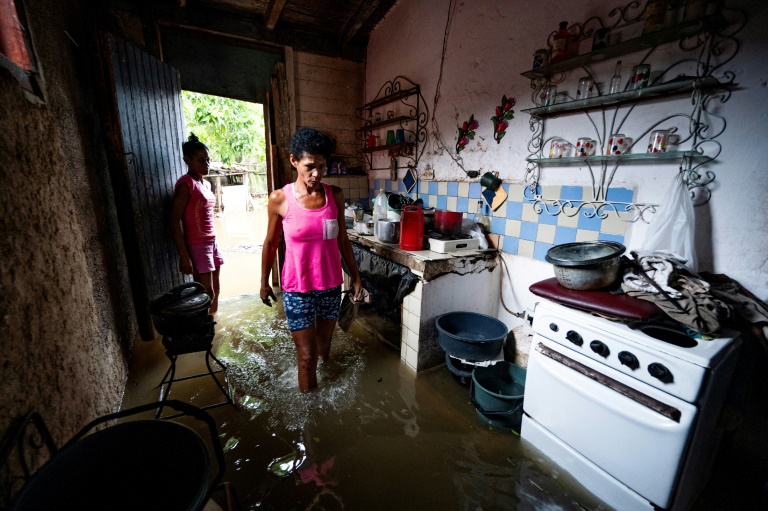
In the western city of Pinar del Rio, AFP footage showed downed power lines, flooded streets and a scattering of damaged rooftops.

“Desolation and destruction. These are terrifying hours. Nothing is left here,” a 70-year-old resident of the city was quoted as saying in a social media post by his journalist son, Lazaro Manuel Alonso.

About 40,000 people were evacuated across Pinar del Rio province, which bore the brunt of the storm, local authorities said.

The US National Hurricane Center (NHC) said it expects Ian to gain strength before hitting the west coast of Florida on Wednesday as an “extremely dangerous” major hurricane.

Calls to heed evacuation warnings were echoed from local Florida officials on up to US President Joe Biden, who said Ian “could be a very severe hurricane, life-threatening and devastating in its impact.”

In its latest bulletin, the NHC said to be prepared for “life-threatening storm surge, catastrophic winds and flooding” in the Florida peninsula.

Tropical-storm-force winds are already battering the Florida Keys, the chain of islands off the southern tip of the state’s mainland, the NHC said.

– ‘Apocalyptic’ –

In Cuba, authorities are just beginning to assess the damage, but residents described “destruction” and posted images on social media of flooded streets and felled trees.

At the time of impact, the NHC reported Ian’s maximum wind speeds at 125 miles (205 kilometers) per hour, making it a Category 3 storm on the Saffir-Simpson scale. Wind speeds have since dropped slightly to 120 miles per hour.

No deaths or injuries have yet been reported.

In Consolacion del Sur, southwest of Havana, Caridad Fernandez, 65, said her roof was seriously damaged and water came through her front door.

“Everything we have is damaged,” she said. “But we’ll get through this, we’ll just keep moving forwards.”

In San Juan y Martinez, a growing hub for Cuba’s vital cigar industry, “it was apocalyptic, a real disaster,” Hirochi Robaina, from the Robaina tobacco plantation, said on Facebook.

– ‘Life and death’ –

In Florida, Governor Ron DeSantis said 2.5 million people were under evacuation orders as officials scrambled to prepare for the storm’s landfall.

DeSantis warned that although Ian’s exact path was still uncertain “the impacts will be far far broader.”

“When you have five to ten feet (1.5 to 3 meters) of storm surge that is not something that you want to be a part of. Mother Nature is a very fearsome adversary,” DeSantis said.

White House Press Secretary Karine Jean-Pierre said Biden spoke with DeSantis — a potential 2024 election challenger — on Tuesday evening to discuss preparations for the storm.

The NHC warned that “widespread catastrophic flash, urban, and river flooding is expected across central and west Florida beginning midweek.”

Thirty-year-old Chelsea Thompson, who was helping her parents board up their home in a mandatory evacuation zone southwest of Tampa, said that “the closer it gets, obviously with the unknown, your anxiety gets a little higher.” 

The Pentagon said 3,200 national guardsmen had been called up in Florida, with an additional 1,800 coming later.

Authorities in several municipalities, including Miami, Fort Lauderdale and Tampa, were distributing free sandbags to help residents protect their homes from flooding.

And Tampa International Airport suspended operations from Tuesday at 5:00 pm (2100 GMT).

Biden has preemptively approved emergency aid in Florida through the Federal Emergency Management Agency (FEMA), while even NASA on the state’s east coast took precautions, rolling back its massive Moon rocket into a storage hanger for protection.

Like DeSantis, FEMA administrator Deanne Criswell highlighted the danger of storm surge, saying it was the agency’s “biggest concern.”

“If people are told to evacuate by their local officials, please listen to them. The decision you choose to make may be the difference between life and death,” she said.

The Caribbean and parts of eastern Canada are still counting the cost of powerful storm Fiona, which tore through last week, claiming several lives.

Half a million residents in the US territory of Puerto Rico were still without power, according to a tracking website.
Hurricane Ian leaves Cuba without power, takes aim at Florida

Powerful Hurricane Ian left a trail of destruction and caused a widespread blackout in Cuba on Tuesday, while Florida residents braced for a direct hit from the “extremely dangerous” storm that is already pummeling the US state with high winds.

Ian hit Cuba’s western regions for more than five hours early Tuesday morning, before moving out over the warm waters of the Gulf of Mexico, the Insmet meteorological institute said.

The storm damaged Cuba’s power network and plunged the island into darkness, leaving it “without electrical service,” state electricity company Union Electrica said on Twitter.

Only the few people with gasoline-powered generators had access to electricity on the island of more than 11 million people. Others had to make do with flashlights or candles at home, and lit their way with cell phones as they walked the streets.

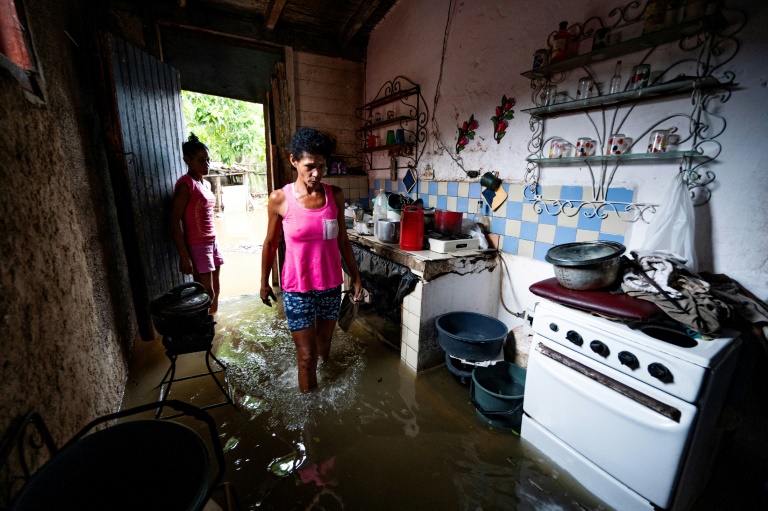
In the western city of Pinar del Rio, AFP footage showed downed power lines, flooded streets and a scattering of damaged rooftops.

“Desolation and destruction. These are terrifying hours. Nothing is left here,” a 70-year-old resident of the city was quoted as saying in a social media post by his journalist son, Lazaro Manuel Alonso.

About 40,000 people were evacuated across Pinar del Rio province, which bore the brunt of the storm, local authorities said.

The US National Hurricane Center (NHC) said it expects Ian to gain strength before hitting the west coast of Florida on Wednesday as an “extremely dangerous” major hurricane.

Calls to heed evacuation warnings were echoed from local Florida officials on up to US President Joe Biden, who said Ian “could be a very severe hurricane, life-threatening and devastating in its impact.”

In its latest bulletin, the NHC said to be prepared for “life-threatening storm surge, catastrophic winds and flooding” in the Florida peninsula.

Tropical-storm-force winds are already battering the Florida Keys, the chain of islands off the southern tip of the state’s mainland, the NHC said.

– ‘Apocalyptic’ –

In Cuba, authorities are just beginning to assess the damage, but residents described “destruction” and posted images on social media of flooded streets and felled trees.

At the time of impact, the NHC reported Ian’s maximum wind speeds at 125 miles (205 kilometers) per hour, making it a Category 3 storm on the Saffir-Simpson scale. Wind speeds have since dropped slightly to 120 miles per hour.

No deaths or injuries have yet been reported.

In Consolacion del Sur, southwest of Havana, Caridad Fernandez, 65, said her roof was seriously damaged and water came through her front door.

“Everything we have is damaged,” she said. “But we’ll get through this, we’ll just keep moving forwards.”

In San Juan y Martinez, a growing hub for Cuba’s vital cigar industry, “it was apocalyptic, a real disaster,” Hirochi Robaina, from the Robaina tobacco plantation, said on Facebook.

– ‘Life and death’ –

In Florida, Governor Ron DeSantis said 2.5 million people were under evacuation orders as officials scrambled to prepare for the storm’s landfall.

DeSantis warned that although Ian’s exact path was still uncertain “the impacts will be far far broader.”

“When you have five to ten feet (1.5 to 3 meters) of storm surge that is not something that you want to be a part of. Mother Nature is a very fearsome adversary,” DeSantis said.

White House Press Secretary Karine Jean-Pierre said Biden spoke with DeSantis — a potential 2024 election challenger — on Tuesday evening to discuss preparations for the storm.

The NHC warned that “widespread catastrophic flash, urban, and river flooding is expected across central and west Florida beginning midweek.”

Thirty-year-old Chelsea Thompson, who was helping her parents board up their home in a mandatory evacuation zone southwest of Tampa, said that “the closer it gets, obviously with the unknown, your anxiety gets a little higher.” 

The Pentagon said 3,200 national guardsmen had been called up in Florida, with an additional 1,800 coming later.

Authorities in several municipalities, including Miami, Fort Lauderdale and Tampa, were distributing free sandbags to help residents protect their homes from flooding.

And Tampa International Airport suspended operations from Tuesday at 5:00 pm (2100 GMT).

Biden has preemptively approved emergency aid in Florida through the Federal Emergency Management Agency (FEMA), while even NASA on the state’s east coast took precautions, rolling back its massive Moon rocket into a storage hanger for protection.

Like DeSantis, FEMA administrator Deanne Criswell highlighted the danger of storm surge, saying it was the agency’s “biggest concern.”

“If people are told to evacuate by their local officials, please listen to them. The decision you choose to make may be the difference between life and death,” she said.

The Caribbean and parts of eastern Canada are still counting the cost of powerful storm Fiona, which tore through last week, claiming several lives.

Half a million residents in the US territory of Puerto Rico were still without power, according to a tracking website.

Leaders blame Russia-Europe pipeline leaks on sabotage

Sabotage is the most likely cause of leaks in two Baltic Sea gas pipelines between Russia and Europe, European leaders said Tuesday, after seismologists reported explosions around the Nord Stream pipelines.

EU chief Ursula Von der Leyen said “sabotage” caused the leaks. She threatened the “strongest possible response” to any deliberate disruption of European energy infrastructure.

The Nord Stream 1 and 2 pipelines have been at the centre of geopolitical tensions in recent months as Russia cut gas supplies to Europe in suspected retaliation against Western sanctions following its invasion of Ukraine.

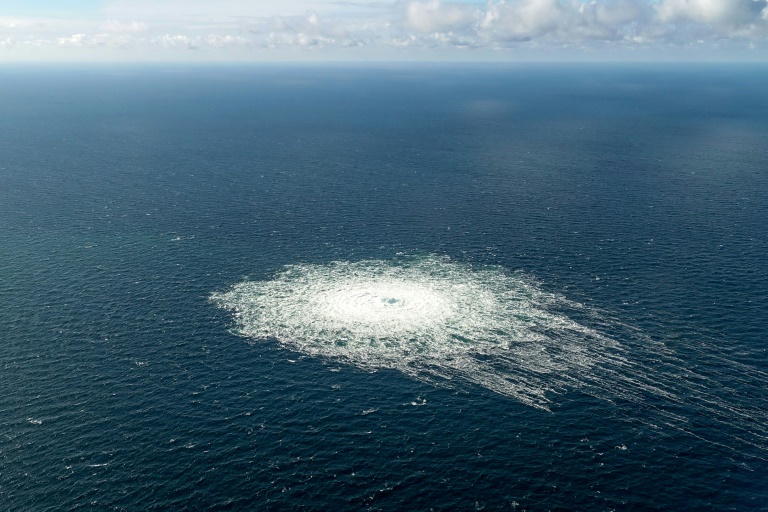
Photos taken by the Danish military showed large areas of bubbles on the surface of the water, emanating from the three leaks in Sweden and Denmark’s economic zones north of Poland, from 200 to 1,000 metres (656 feet to 0.62 miles) in diameter.

Danish Prime Minister Mette Frederiksen described them as “deliberate acts”, saying: “We are not talking about an accident”.

Polish Prime Minister Mateusz Morawiecki said the leaks were an act of sabotage that “probably marks the next step of escalation of the situation in Ukraine”.

And Sweden’s outgoing Prime Minister Magdalena Andersson said “there have been detonations”, although foreign minister Ann Linde said they would not “speculate on motives or actors”.

The United States was looking at reports that the leaks were “the result of an attack or some kind of sabotage,” US Secretary of State Antony Blinken said. National Security Adviser Jake Sullivan said Washington “is supporting efforts to investigate and we will continue our work to safeguard Europe’s energy security”.

Copenhagen expects the leaks at the pipelines, which are full of gas but not operational, to last “at least a week” — until the methane escaping from the underwater pipes runs out.

Like Denmark, the Swedish government said it does not consider this as an act of aggression against it, given that the events took place outside its territorial waters, in the exclusive economic zones.

Two “massive releases of energy” were recorded by the Swedish National Seismic Network shortly before the gas leaks near their locations off the coast of the Danish island of Bornholm, Uppsala University seismologist Peter Schmidt told AFP.

“With energy releases this big there isn’t much else than a blast that could cause it,” he added. 

Russia said earlier that it was “extremely concerned” about the leaks. 

Asked by reporters whether it could be an act of sabotage, Kremlin spokesman Dmitry Peskov said that at the moment “it is impossible to exclude any options”.

But Ukraine said it was “nothing more than a terrorist attack planned by Russia and an act of aggression towards the EU”.

– ‘Extremely rare’ –

The pipelines are operated by a consortium majority-owned by Russian gas firm Gazprom.

One of the leaks on Nord Stream 1 occurred in the Danish economic zone and the other in the Swedish economic zone, while the Nord Stream 2 leak was in the Danish economic zone.

A leak was first reported on Nord Stream 2 on Monday.

Two Danish military vessels have been dispatched to the area, while Sweden’s government called an emergency meeting on Tuesday.

Neighbouring Norway, an oil producer, on Tuesday said it had “heightened emergency preparedness” related to the Norwegian Continental Shelf. “Some of the background are reports of increased drone activity,” a government statement said.

Navigational warnings have been issued for a distance of five nautical miles and a flight height of 1,000 metres (3,280 feet) around the Baltic Sea leaks.

“Gas pipeline leaks are extremely rare and we therefore see a reason to increase the level of preparedness following the incidents we have witnessed over the past 24 hours,” Danish Energy Agency director Kristoffer Bottzauw said in a statement.

A Nord Stream spokesperson told AFP they had not been able to assess the damage but conceded that “an incident where three pipes experience difficulties at the same time on the same day is not common”.

Built in parallel to the Nord Stream 1 pipeline, Nord Stream 2 was intended to double the capacity for Russian gas imports to Germany.

But Berlin blocked newly completed Nord Stream 2 in the days before the war.

Germany, which has been highly dependent on imports of fossil fuels from Russia to meet its energy needs, has since come under acute stress as Moscow’s supplies dwindle.

Gazprom progressively reduced the volumes of gas being delivered via Nord Stream 1 until it shut the pipeline completely at the end of August, blaming Western sanctions for the delay of necessary repairs to the pipeline. 

Germany has rebuffed Gazprom’s technical explanation for the cut, instead accusing Moscow of wielding energy as a weapon over the war in Ukraine.

Taiwan's pangolins suffer surge in feral dog attacks

In most of its habitats, the heavily trafficked pangolin’s biggest threat comes from humans. But in Taiwan, the scaly mammals brave a different danger: a surging feral dog population.

Veterinarian Tseng Shao-tung, 28, has seen firsthand what a dog can do to the gentle creatures during his shifts at a hospital in Hsinchu.

Last month he worked to save the life of a male juvenile pangolin who had been lying in the wild for days with half of its tail chewed off. 

“It has a big open wound on its tail and its body tissue has decayed,” Tseng said as he carefully turned the sedated pangolin to disinfect the gaping injury.

It was the fifth pangolin Tseng and his fellow veterinarians had saved this year, all from suspected dog attacks.

Chief veterinarian Chen Yi-ru said she had noticed a steady increase of pangolins with trauma injuries in the last five years — most of them with severed tails.

Pangolins are covered in hard, overlapping body scales and curl up into a ball when attacked. The tail is the animal’s most vulnerable part.

“That’s why when attacked, the tail is usually the first to be bitten,” Chen explained.

Wildlife researchers and officials said dog attacks, which account for more than half of all injuries since 2018, have become “the main threat to pangolins in Taiwan” in a report released last year.

– Most trafficked mammal –

Pangolins are described by conservationists as the world’s most trafficked mammal, with traditional Chinese medicine being the main driver. 

Although their scales are made of keratin — the substance that makes up our fingernails and hair — there is huge demand for them among Chinese consumers because of the unproven belief that they help lactation in breastfeeding mothers.

That demand has decimated pangolin populations across Asia and Africa despite a global ban and funded a lucrative international black market trade.

All eight species of pangolins on both continents are listed as endangered or critically endangered.

Taiwan has been a comparative conservation success story, transforming itself from a place where pangolins went from near-extinct to protected and thriving.

Chan Fang-tse, veterinarian and researcher at the official Taiwan Endemic Species Research Institute, said the 1950s to 1970s saw massive hunting. 

“Sixty thousand pangolins in Taiwan were killed for their scales and hides during that period,” he told AFP. 

A 1989 wildlife protection law ended the industry, while rising conservation awareness led the public to start embracing their scaly neighbours as something to be cherished, rather than a commodity.

The population of the Formosan or Taiwanese pangolin, a subspecies of the Chinese pangolin, has since bounced back with researchers estimating that there are now between 10,000 to 15,000 in the wild.

But the island’s growing feral dog population — itself a consequence of a 2017 government policy not to cull stray animals — is hitting pangolins hard, Chan warned. 

“Pangolins are most affected because they have a big overlap of roaming area and pangolins don’t move as fast as other animals,” Chan said.

– Picky eaters –

Pangolins are also vulnerable because of how few offspring they have.

The solitary Formosan pangolins mate once a year and only produce one offspring after 150 days of pregnancy. Captivity breeding programmes have had little success. 

“It may be more difficult to breed pangolins than pandas,” Chan said.

The rise in injured pangolins has created another challenge for animal doctors: finding enough ants and termites to feed the picky eaters who often reject substitute mixtures of larvae. 

Piling into a truck with three other vets, Tseng headed to a tree to retrieve an ant nest he had recently spotted.

“We have to be constantly on the lookout and go search for ants nests every couple of days now because we have more pangolins to feed,” Tseng said.

A pangolin can eat an ant nest the size of a football each day. 

The government has also called for residents to report nest locations to help feed the pangolins until they can be released back into the wild.

But the injured pangolin in Tseng’s care will likely have to be sent to a zoo or government facility for adoption after it recovers.

“It will have difficulty climbing up trees and won’t be able to roll itself into a ball shape,” Tseng said.

“It has lost the ability to protect itself in the wild.”

Stocks and oil drop as dollar gains on recession, Ukraine fears

Equities and crude prices fell, while the dollar held at multi-year highs Wednesday as recession fears mount, while traders are also growing increasingly concerned about tensions with Russia after it declared victory in controversial Ukraine annexation polls.

Investors are also keeping a close eye on London, after new finance minister Kwasi Kwarteng’s tax-cutting mini-budget last week sent shock waves through markets, pushing the pound to a record low and leading to dire warnings for Britain’s economy.

While Asia saw small gains Tuesday, New York and Europe ended mostly in the red again, with Wall Street jolted by data showing a surprise improvement in US consumer confidence — likely because of a dip in petrol prices — and a jump in home sales.

The figures pointed to resilience in the world’s top economy despite three successive bumper Federal Reserve rate hikes — and expectations for another in November — as it tries to tame four-decade-high inflation.

Several Fed officials have lined up this week to reassert their determination to keep hiking until prices are brought under control, even at the cost of a recession.

Observers are now betting that borrowing costs will top out at around 4.75 percent next year, and some policymakers have suggested they could remain elevated for some time.

The prospect of such tight monetary policy has battered equities, as US 10-year Treasury yields — a gauge of future rates — approach four percent for the first time since 2010.

The Dow and S&P 500 ended down Tuesday, though the Nasdaq enjoyed a slight uptick. 

Asia resumed its downtrend, with Tokyo, Hong Kong and Seoul all down more than two percent, while Shanghai, Sydney, Singapore, Wellington, Taipei, Manila and Jakarta were also off.

– Russia nuclear warning –

And the dollar remains the go-to unit as the Fed leads the way in central bank tightening.

“The fact we have such a strong increase in US yields is attracting flows into the US dollar,” said Nannette Hechler-Fayd’herbe, of Credit Suisse Group AG.

“As long as monetary and fiscal policy worldwide are really not coming to strengthen their own currencies, we should be anticipating a very strong dollar.”

The greenback rose against sterling, with the British currency battered by concerns that Kwarteng’s spending plan would ramp up borrowing just as the Band of England was trying to hike rates to fight inflation, causing consternation among many observers.

The dollar was also approaching 145 yen, having sunk from a high close to 146 yen after the Japanese government intervened last week to support its currency. 

Sentiment was also rattled by worries about developments in Ukraine, after Kremlin-installed authorities in four regions under Russian control claimed victory in annexation votes, with Moscow warning it could use nuclear weapons to defend the territories.

Ukraine and its allies have denounced the so-called referendums as a sham, saying the West would never recognise the results of the ballots.

But former Russian leader Dmitry Medvedev — an ally of President Vladimir Putin and now deputy chairman of the country’s security council — issued a stark warning that Moscow was ready to act decisively.

“I want to remind you — the deaf who hear only themselves: Russia has the right to use nuclear weapons if necessary,” he said on social media.

On crude markets both main contracts were down more than one percent on recession worries and as Bloomberg quoted sources as saying that US inventories increased more than four million barrels last week.

The drop comes despite a report that Moscow is calling on OPEC and other major groups to slash output by a million barrels a day when they meet next week.

– Key figures at around 0230 GMT –

Tokyo – Nikkei 225: DOWN 2.2 percent at 25,984.51 (break)

Hong Kong – Hang Seng Index: DOWN 2.4 percent at 17,433.43

Shanghai – Composite: DOWN 0.8 percent at 3,069.22

Pound/dollar: DOWN at $1.0663 from $1.0730 on Tuesday

Euro/dollar: DOWN at $0.9551 from $0.9595

Euro/pound: UP at 89.71 pence from 89.39 pence 

Dollar/yen: UP at 144.83 yen from 144.81 yen

West Texas Intermediate: DOWN 1.9 percent at $76.99 per barrel

Brent North Sea crude: DOWN 1.9 percent at $84.67 per barrel

New York – Dow: DOWN 0.4 percent at 29,134.99 (close)

London – FTSE 100: DOWN 0.5 percent at 6,984.59 (close)

Stocks and oil drop as dollar gains on recession, Ukraine fears

Equities and crude prices fell, while the dollar held at multi-year highs Wednesday as recession fears mount, while traders are also growing increasingly concerned about tensions with Russia after it declared victory in controversial Ukraine annexation polls.

Investors are also keeping a close eye on London, after new finance minister Kwasi Kwarteng’s tax-cutting mini-budget last week sent shock waves through markets, pushing the pound to a record low and leading to dire warnings for Britain’s economy.

While Asia saw small gains Tuesday, New York and Europe ended mostly in the red again, with Wall Street jolted by data showing a surprise improvement in US consumer confidence — likely because of a dip in petrol prices — and a jump in home sales.

The figures pointed to resilience in the world’s top economy despite three successive bumper Federal Reserve rate hikes — and expectations for another in November — as it tries to tame four-decade-high inflation.

Several Fed officials have lined up this week to reassert their determination to keep hiking until prices are brought under control, even at the cost of a recession.

Observers are now betting that borrowing costs will top out at around 4.75 percent next year, and some policymakers have suggested they could remain elevated for some time.

The prospect of such tight monetary policy has battered equities, as US 10-year Treasury yields — a gauge of future rates — approach four percent for the first time since 2010.

The Dow and S&P 500 ended down Tuesday, though the Nasdaq enjoyed a slight uptick. 

Asia resumed its downtrend, with Tokyo, Hong Kong and Seoul all down more than two percent, while Shanghai, Sydney, Singapore, Wellington, Taipei, Manila and Jakarta were also off.

– Russia nuclear warning –

And the dollar remains the go-to unit as the Fed leads the way in central bank tightening.

“The fact we have such a strong increase in US yields is attracting flows into the US dollar,” said Nannette Hechler-Fayd’herbe, of Credit Suisse Group AG.

“As long as monetary and fiscal policy worldwide are really not coming to strengthen their own currencies, we should be anticipating a very strong dollar.”

The greenback rose against sterling, with the British currency battered by concerns that Kwarteng’s spending plan would ramp up borrowing just as the Band of England was trying to hike rates to fight inflation, causing consternation among many observers.

The dollar was also approaching 145 yen, having sunk from a high close to 146 yen after the Japanese government intervened last week to support its currency. 

Sentiment was also rattled by worries about developments in Ukraine, after Kremlin-installed authorities in four regions under Russian control claimed victory in annexation votes, with Moscow warning it could use nuclear weapons to defend the territories.

Ukraine and its allies have denounced the so-called referendums as a sham, saying the West would never recognise the results of the ballots.

But former Russian leader Dmitry Medvedev — an ally of President Vladimir Putin and now deputy chairman of the country’s security council — issued a stark warning that Moscow was ready to act decisively.

“I want to remind you — the deaf who hear only themselves: Russia has the right to use nuclear weapons if necessary,” he said on social media.

On crude markets both main contracts were down more than one percent on recession worries and as Bloomberg quoted sources as saying that US inventories increased more than four million barrels last week.

The drop comes despite a report that Moscow is calling on OPEC and other major groups to slash output by a million barrels a day when they meet next week.

– Key figures at around 0230 GMT –

Tokyo – Nikkei 225: DOWN 2.2 percent at 25,984.51 (break)

Hong Kong – Hang Seng Index: DOWN 2.4 percent at 17,433.43

Shanghai – Composite: DOWN 0.8 percent at 3,069.22

Pound/dollar: DOWN at $1.0663 from $1.0730 on Tuesday

Euro/dollar: DOWN at $0.9551 from $0.9595

Euro/pound: UP at 89.71 pence from 89.39 pence 

Dollar/yen: UP at 144.83 yen from 144.81 yen

West Texas Intermediate: DOWN 1.9 percent at $76.99 per barrel

Brent North Sea crude: DOWN 1.9 percent at $84.67 per barrel

New York – Dow: DOWN 0.4 percent at 29,134.99 (close)

London – FTSE 100: DOWN 0.5 percent at 6,984.59 (close)

Stocks and oil drop as dollar gains on recession, Ukraine fears

Equities and crude prices fell, while the dollar held at multi-year highs Wednesday as recession fears mount, while traders are also growing increasingly concerned about tensions with Russia after it declared victory in controversial Ukraine annexation polls.

Investors are also keeping a close eye on London, after new finance minister Kwasi Kwarteng’s tax-cutting mini-budget last week sent shock waves through markets, pushing the pound to a record low and leading to dire warnings for Britain’s economy.

While Asia saw small gains Tuesday, New York and Europe ended mostly in the red again, with Wall Street jolted by data showing a surprise improvement in US consumer confidence — likely because of a dip in petrol prices — and a jump in home sales.

The figures pointed to resilience in the world’s top economy despite three successive bumper Federal Reserve rate hikes — and expectations for another in November — as it tries to tame four-decade-high inflation.

Several Fed officials have lined up this week to reassert their determination to keep hiking until prices are brought under control, even at the cost of a recession.

Observers are now betting that borrowing costs will top out at around 4.75 percent next year, and some policymakers have suggested they could remain elevated for some time.

The prospect of such tight monetary policy has battered equities, as US 10-year Treasury yields — a gauge of future rates — approach four percent for the first time since 2010.

The Dow and S&P 500 ended down Tuesday, though the Nasdaq enjoyed a slight uptick. 

Asia resumed its downtrend, with Tokyo, Hong Kong and Seoul all down more than two percent, while Shanghai, Sydney, Singapore, Wellington, Taipei, Manila and Jakarta were also off.

– Russia nuclear warning –

And the dollar remains the go-to unit as the Fed leads the way in central bank tightening.

“The fact we have such a strong increase in US yields is attracting flows into the US dollar,” said Nannette Hechler-Fayd’herbe, of Credit Suisse Group AG.

“As long as monetary and fiscal policy worldwide are really not coming to strengthen their own currencies, we should be anticipating a very strong dollar.”

The greenback rose against sterling, with the British currency battered by concerns that Kwarteng’s spending plan would ramp up borrowing just as the Band of England was trying to hike rates to fight inflation, causing consternation among many observers.

The dollar was also approaching 145 yen, having sunk from a high close to 146 yen after the Japanese government intervened last week to support its currency. 

Sentiment was also rattled by worries about developments in Ukraine, after Kremlin-installed authorities in four regions under Russian control claimed victory in annexation votes, with Moscow warning it could use nuclear weapons to defend the territories.

Ukraine and its allies have denounced the so-called referendums as a sham, saying the West would never recognise the results of the ballots.

But former Russian leader Dmitry Medvedev — an ally of President Vladimir Putin and now deputy chairman of the country’s security council — issued a stark warning that Moscow was ready to act decisively.

“I want to remind you — the deaf who hear only themselves: Russia has the right to use nuclear weapons if necessary,” he said on social media.

On crude markets both main contracts were down more than one percent on recession worries and as Bloomberg quoted sources as saying that US inventories increased more than four million barrels last week.

The drop comes despite a report that Moscow is calling on OPEC and other major groups to slash output by a million barrels a day when they meet next week.

– Key figures at around 0230 GMT –

Tokyo – Nikkei 225: DOWN 2.2 percent at 25,984.51 (break)

Hong Kong – Hang Seng Index: DOWN 2.4 percent at 17,433.43

Shanghai – Composite: DOWN 0.8 percent at 3,069.22

Pound/dollar: DOWN at $1.0663 from $1.0730 on Tuesday

Euro/dollar: DOWN at $0.9551 from $0.9595

Euro/pound: UP at 89.71 pence from 89.39 pence 

Dollar/yen: UP at 144.83 yen from 144.81 yen

West Texas Intermediate: DOWN 1.9 percent at $76.99 per barrel

Brent North Sea crude: DOWN 1.9 percent at $84.67 per barrel

New York – Dow: DOWN 0.4 percent at 29,134.99 (close)

London – FTSE 100: DOWN 0.5 percent at 6,984.59 (close)

Kremlin proxies claim victory in 'sham' annexation votes

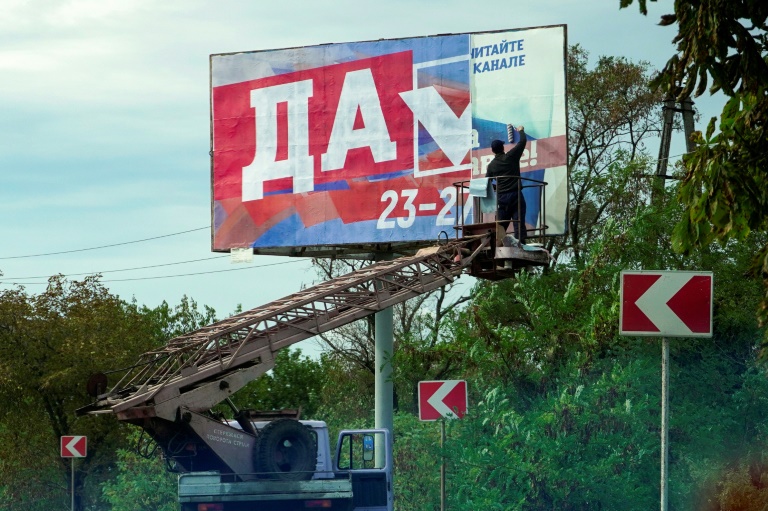
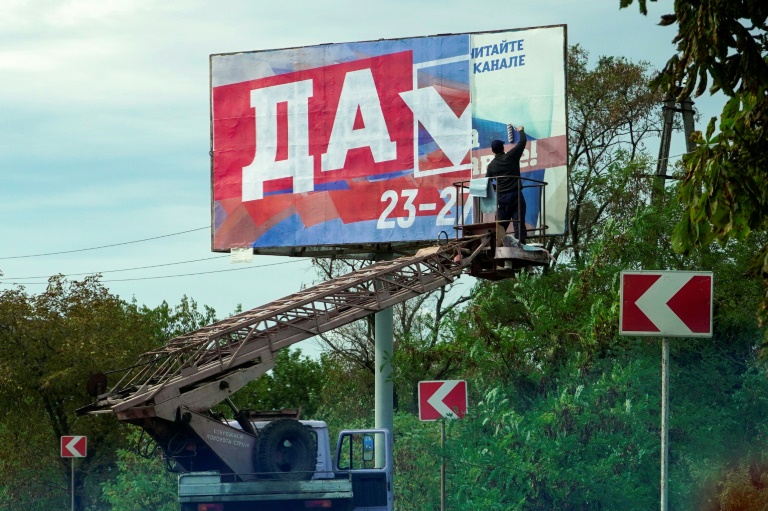
Kremlin-installed authorities in four Ukrainian regions under Russian control claimed victory Tuesday in annexation votes, drawing global outrage, as Moscow warned it could use nuclear weapons to defend the territories.

Ukraine and its allies have denounced the so-called referendums as a sham, saying the West would never recognise the results of the ballots, which have dramatically ratcheted up the stakes of Russia’s seven-month invasion.

Pro-Russian authorities in Zaporizhzhia said 93.11 percent of voters backed joining Russia, according to preliminary results on Tuesday evening.

In Kherson, another Moscow-occupied region in southern Ukraine, officials said more than 87.05 percent of electors supported the move after all the ballots were counted.

In the eastern Lugansk region controlled by pro-Russia separatists, local authorities said more than 98.42 percent voted in favour of annexation, according to local authorities.

Officials in the Moscow-held Donetsk region claimed victory as well, with the local poll body saying 99.23 percent of the vote was for annexation.

“Saving people in the territories where this referendum is taking place… is the focus of the attention of our entire society and of the entire country,” Russian President Vladimir Putin said earlier during a televised meeting with officials.

His spokesman Dmitry Peskov said the votes would have “radical” legal implications and that the so-called referendums “will also have consequences for security”, referring to Moscow’s threats to use nuclear weapons to defend its territory.

– ‘Nothing to talk about’ –

Ukraine’s President Volodymyr Zelensky vowed Tuesday that Kyiv would defend its citizens in Moscow-held regions and rejected the referendums as a “farce”.

He said the votes mean Kyiv will not negotiate with Moscow.

“There is nothing to talk about with (the) current Russian president,” Zelensky said.

Russian forces this month have suffered serious setbacks in Ukraine’s east and south, which observers say pushed Putin to rush ahead with the vote to cement Moscow’s authority there.

Putin said Russia would use all available means to defend its territory, implying that after annexation, Moscow could deploy nuclear weapons to repulse Ukrainian attempts to retake the territory.

“I want to remind you — the deaf who hear only themselves: Russia has the right to use nuclear weapons if necessary,” former leader Dmitry Medvedev — a Putin ally who is now deputy chairman of Russia’s security council — said on social media Tuesday.

Pentagon spokesman Brigadier General Patrick Ryder said the United States was taking the reiterated threat “seriously” but had seen nothing to cause Washington to change its nuclear posture.

NATO chief Jens Stoltenberg said that “Russia must know that the nuclear war cannot be won and must never be fought.”

The four Russian-occupied regions of Ukraine announced that they would hold the elections just days before voting began last Friday. 

Together, they form a crucial land connection for the Kremlin between Russia and the Crimean peninsula, which Moscow annexed in 2014 and is otherwise only connected to the mainland by bridge.

– ‘Diabolical scheme’ –

US Secretary of State Antony Blinken vowed that the West would never recognise Russian annexations of the territories, threatening Moscow with “additional swift and severe costs” for its “diabolical scheme”.

French Foreign Minister Catherine Colonna, in Kyiv for a surprise visit to meet Zelensky, called the polls a “masquerade” that would trigger further Western sanctions.

At the United Nations, top official Rosemary DiCarlo told a meeting of the Security Council the body “remains fully committed” to Ukraine’s territorial integrity “within its internationally recognised borders.” 

The United States intends to submit a resolution urging UN member states “not to recognise any altered status of Ukraine and obligating Russia to withdraw its troops from Ukraine,” said US envoy Linda Thomas-Greenfield.

However, there is no chance of the Security Council reaching a united stance on the annexation move.

Vassily Nebenzia, Russia’s UN ambassador, made clear Russia would wield its Security Council veto again, criticising the move as “temper tantrums of the Western delegations.”

“The referendums were conducted exclusively transparently, with upholding of all the electoral norms,” Nebenzia argued, adding that the West’s only aim was to “weaken and bleed dry Russia as much as possible”.

Polling stations were open in Crimea for people who fled fighting after the Russian invasion in February.

“With my voice I want to try to make a small contribution to stopping the war,” 63-year-old Galina Korsakova from Donetsk told AFP. 

“I really want to go home.”

The so-called referendums follow a pattern that Moscow utilised in Crimea after nationwide street demonstrations saw Ukraine’s Kremlin-friendly president ousted.

As in Crimea, observers saw the outcome as a foregone conclusion. Election officials brought ballot boxes door-to-door, in many cases accompanied by armed Russian forces.

According to Russian state media, the next step is for Russia’s parliament, the State Duma, to approve an annexation bill formally incorporating the four regions into Russian territory. This could happen Wednesday and would be followed by Russian upper house approval.

Putin is then expected on Friday to formally declare the Ukrainian regions part of Russia, according to Russian news agencies.

Ukrainian forces are pursuing their counter-offensive in the east.

The governor of the eastern Kharkiv region announced Tuesday its forces had recaptured Kupiansk-Vuzlovyi, “one of the largest logistical and railway junctions” in the region. It is not participating in this week’s vote. 

Large Wall Street firms fined $1.8 bn in US over lax recordkeeping

Large Wall Street firms agreed to pay $1.8 billion in fines over failures to keep electronic records such as text messages between employees on personal mobile phones, US authorities announced Tuesday.

Barclays, Bank of America, Deutsche Bank and Goldman Sachs were among the firms that agreed to fines over “longstanding failures” to maintain and preserve electronic communications that must be available to regulators in the course of oversight, the Securities and Exchange Commission (SEC) said in a statement.

The SEC announced a total of $1.1 billion in fines on 16 institutions in all. The 16 firms listed included some companies such as Morgan Stanley with affiliated firms also covered by the agreement.

In a parallel action, the Commodity Futures Trading Commission announced it reached settlements totaling $710 million from the same group of financial institutions over the same offenses.

“Finance, ultimately, depends on trust. By failing to honor their recordkeeping and books-and-records obligations, the market participants we have charged today have failed to maintain that trust,” SEC Chair Gary Gensler said in a statement. “Since the 1930s, such recordkeeping has been vital to preserve market integrity.

“As technology changes, it’s even more important that registrants appropriately conduct their communications about business matters within only official channels, and they must maintain and preserve those communications.”

An SEC investigation uncovered “pervasive off-channel communications” involving a range of senior and junior investment bankers and traders — omissions that “likely” deprived it of communications in agency probes, it said.

Bank of America was fined a total of $225 million under the two settlements.

Financial giants agreeing to $200 million in settlements were Barclays, Citigroup, Credit Suisse, Deutsche Bank, Goldman Sachs, Morgan Stanley and UBS.

Nomura, Jefferies and  Cantor Fitzgerald will pay respectively $100, $80 and $16 million

The SEC in December 2021 fined JPMorgan Chase $125 million for the offense, spurring an industry-wide regulatory crackdown on poor recordkeeping, the SEC said.

Large Wall Street firms fined $1.8 bn in US over lax recordkeeping

Large Wall Street firms agreed to pay $1.8 billion in fines over failures to keep electronic records such as text messages between employees on personal mobile phones, US authorities announced Tuesday.

Barclays, Bank of America, Deutsche Bank and Goldman Sachs were among the firms that agreed to fines over “longstanding failures” to maintain and preserve electronic communications that must be available to regulators in the course of oversight, the Securities and Exchange Commission (SEC) said in a statement.

The SEC announced a total of $1.1 billion in fines on 16 institutions in all. The 16 firms listed included some companies such as Morgan Stanley with affiliated firms also covered by the agreement.

In a parallel action, the Commodity Futures Trading Commission announced it reached settlements totaling $710 million from the same group of financial institutions over the same offenses.

“Finance, ultimately, depends on trust. By failing to honor their recordkeeping and books-and-records obligations, the market participants we have charged today have failed to maintain that trust,” SEC Chair Gary Gensler said in a statement. “Since the 1930s, such recordkeeping has been vital to preserve market integrity.

“As technology changes, it’s even more important that registrants appropriately conduct their communications about business matters within only official channels, and they must maintain and preserve those communications.”

An SEC investigation uncovered “pervasive off-channel communications” involving a range of senior and junior investment bankers and traders — omissions that “likely” deprived it of communications in agency probes, it said.

Bank of America was fined a total of $225 million under the two settlements.

Financial giants agreeing to $200 million in settlements were Barclays, Citigroup, Credit Suisse, Deutsche Bank, Goldman Sachs, Morgan Stanley and UBS.

Nomura, Jefferies and  Cantor Fitzgerald will pay respectively $100, $80 and $16 million

The SEC in December 2021 fined JPMorgan Chase $125 million for the offense, spurring an industry-wide regulatory crackdown on poor recordkeeping, the SEC said.

Close Bitnami banner
Bitnami