AFP

Human development set back 5 years by Covid, other crises: UN report

A United Nations report published Thursday argues that an unprecedented array of crises, chiefly among them Covid-19, has set human progress back five years and fueled a global wave of uncertainty.

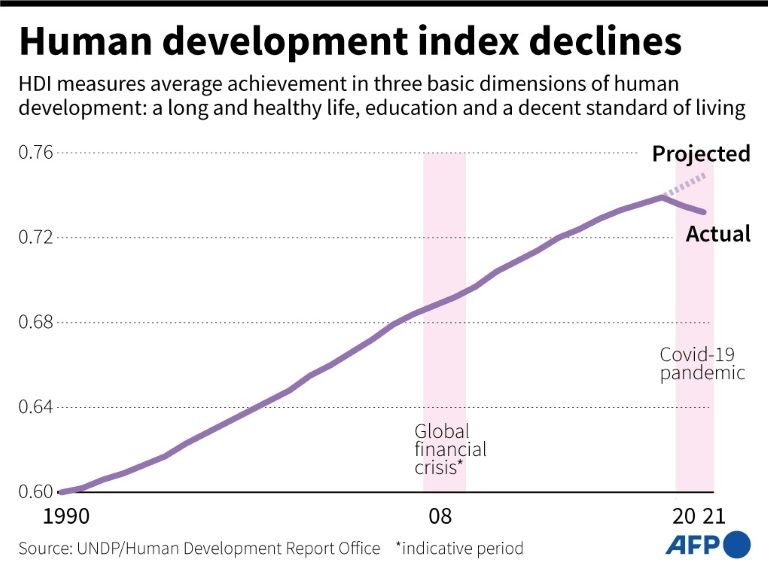
The UN Development Program (UNDP) announced that for the first time since it was created over 30 years ago, the Human Development Index — a measure of countries’ life expectancies, education levels, and standards of living — has declined for two years straight, in 2020 and 2021.

“It means we die earlier, we are less well educated, our incomes are going down,” UNDP chief Achim Steiner told AFP in an interview.

“Just under three parameters, you can get a sense of why so many people are beginning to feel desperate, frustrated, worried about the future,” he said.

The Human Development Index has steadily risen for decades, but began sliding in 2020 and continued its fall in 2021, erasing the gains of the preceding five years, the paper says.

Titled “Uncertain times, unsettled lives,” the report points to the Covid-19 pandemic as a major driver of the global reversion, but also says that a compounding number of crises — political, financial and climate-related — have not allowed time for populations to recover.

“We’ve had disasters before. We’ve had conflicts before. But the confluence of what we’re facing right now is a major setback to human development,” said Steiner.

The setback is truly global, impacting more than 90 percent of countries around the world, according to the study.

Switzerland, Norway and Iceland all retain their spots at the top of the list, while South Sudan, Chad and Niger sit at the bottom.

And while some countries had begun to recover from the pandemic, many others in Latin America, sub-Saharan Africa, South Asia and the Caribbean had not yet turned the corner before a new crisis hit: the war in Ukraine.

– ‘Lost trust’ –

While the fallout from Russia’s invasion of Ukraine on food and energy security has not yet been calculated into this year’s index, “without any doubt, the outlook for 2022 is grim,” Steiner said.

A large contributor to the Human Development Index’s recent decline is a global drop in life expectancy, down from 73 years in 2019 to 71.4 years in 2021.

The report’s lead author, Pedro Conceicao, described the decrease as an “unprecedented shock,” noting that some countries — the United States included — had drops of two years or more.

The report also describes how transformational forces, such as climate change, globalization and political polarization, present humanity with a complex level of uncertainty “never seen in human history,” leading to rising feelings of insecurity.

“People have lost trust in one another,” said Steiner.

“Never mind in institutions, our neighbor now becomes sometimes the greatest threat, whether literally speaking in the community, or globally by nations, that is paralyzing us.”

“We can’t continue with the playbook of the last century,” Steiner argued, preferring a focus on economic transformation rather than a reliance on growth as a panacea.

“Frankly speaking, the transformations we now need require us to introduce the metrics of the future: low carbon, less inequality, greater sustainability.”

The report strikes a positive note as well, saying that improvements could be made by focusing on three main areas: investments in renewable energy and preparation for future pandemics, insurance to absorb shocks, and innovations to strengthen the capacity to cope with future crises.

Steiner also called for a reversal in the recent downward trend of development assistance to the most vulnerable countries.

Continuing down that road would be a grave error, said Steiner, and “underestimates the impact it has on our ability to work together as nations.”
Human development set back 5 years by Covid, other crises: UN report

A United Nations report published Thursday argues that an unprecedented array of crises, chiefly among them Covid-19, has set human progress back five years and fueled a global wave of uncertainty.

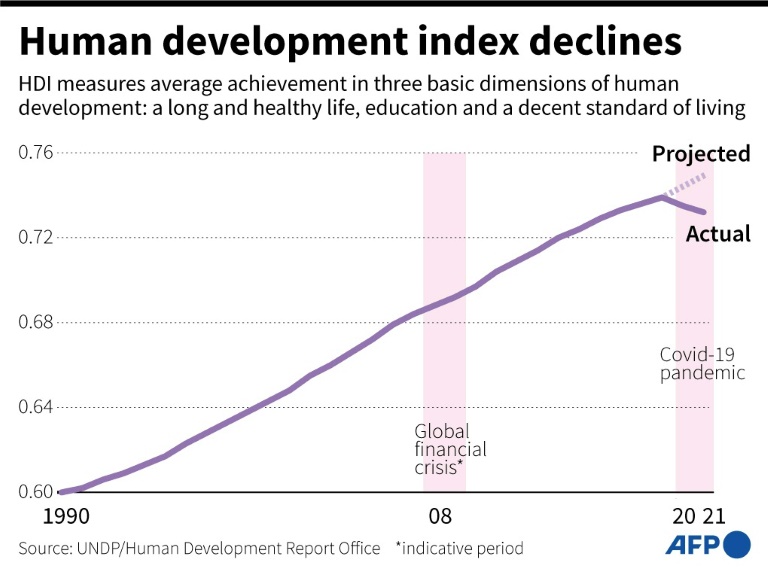
The UN Development Program (UNDP) announced that for the first time since it was created over 30 years ago, the Human Development Index — a measure of countries’ life expectancies, education levels, and standards of living — has declined for two years straight, in 2020 and 2021.

“It means we die earlier, we are less well educated, our incomes are going down,” UNDP chief Achim Steiner told AFP in an interview.

“Just under three parameters, you can get a sense of why so many people are beginning to feel desperate, frustrated, worried about the future,” he said.

The Human Development Index has steadily risen for decades, but began sliding in 2020 and continued its fall in 2021, erasing the gains of the preceding five years, the paper says.

Titled “Uncertain times, unsettled lives,” the report points to the Covid-19 pandemic as a major driver of the global reversion, but also says that a compounding number of crises — political, financial and climate-related — have not allowed time for populations to recover.

“We’ve had disasters before. We’ve had conflicts before. But the confluence of what we’re facing right now is a major setback to human development,” said Steiner.

The setback is truly global, impacting more than 90 percent of countries around the world, according to the study.

Switzerland, Norway and Iceland all retain their spots at the top of the list, while South Sudan, Chad and Niger sit at the bottom.

And while some countries had begun to recover from the pandemic, many others in Latin America, sub-Saharan Africa, South Asia and the Caribbean had not yet turned the corner before a new crisis hit: the war in Ukraine.

– ‘Lost trust’ –

While the fallout from Russia’s invasion of Ukraine on food and energy security has not yet been calculated into this year’s index, “without any doubt, the outlook for 2022 is grim,” Steiner said.

A large contributor to the Human Development Index’s recent decline is a global drop in life expectancy, down from 73 years in 2019 to 71.4 years in 2021.

The report’s lead author, Pedro Conceicao, described the decrease as an “unprecedented shock,” noting that some countries — the United States included — had drops of two years or more.

The report also describes how transformational forces, such as climate change, globalization and political polarization, present humanity with a complex level of uncertainty “never seen in human history,” leading to rising feelings of insecurity.

“People have lost trust in one another,” said Steiner.

“Never mind in institutions, our neighbor now becomes sometimes the greatest threat, whether literally speaking in the community, or globally by nations, that is paralyzing us.”

“We can’t continue with the playbook of the last century,” Steiner argued, preferring a focus on economic transformation rather than a reliance on growth as a panacea.

“Frankly speaking, the transformations we now need require us to introduce the metrics of the future: low carbon, less inequality, greater sustainability.”

The report strikes a positive note as well, saying that improvements could be made by focusing on three main areas: investments in renewable energy and preparation for future pandemics, insurance to absorb shocks, and innovations to strengthen the capacity to cope with future crises.

Steiner also called for a reversal in the recent downward trend of development assistance to the most vulnerable countries.

Continuing down that road would be a grave error, said Steiner, and “underestimates the impact it has on our ability to work together as nations.”
China's Chengdu extends Covid lockdown

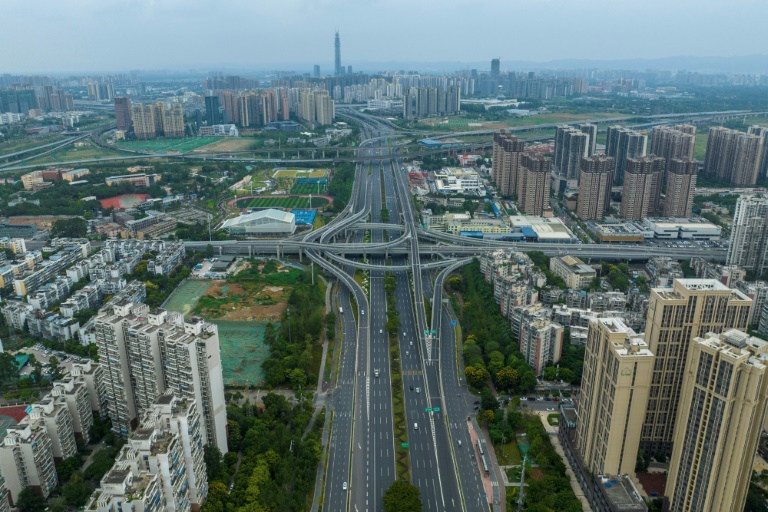
The Chinese megacity of Chengdu has extended a Covid-19 lockdown in most areas, maintaining curbs that have ground business to a halt and confined the majority of its 21 million residents to their homes.

China is the last major economy welded to a zero-Covid strategy, tamping down virus flare-ups through a combination of snap lockdowns, mass testing and lengthy quarantines.

Chengdu, the capital of southwestern Sichuan province, has been effectively under lockdown for a week since reporting several hundred Covid cases.

The measure was expected to be lifted on Wednesday, but the city government said in a notice that “the entire city will continue to deeply push forward our assault for zero community spread”.

Authorities would “strive hard for a week to realise the goal of zero community transmission in the whole city”, the government added.

“The fruits of the whole city’s anti-epidemic measures are beginning to become apparent, but the risk of community transmission still exists in some areas,” it said.

All residents under lockdown will be tested every day, and each household will be permitted to send out one person per day to purchase groceries and other supplies, according to the notice.

Chengdu logged 116 new local infections on Thursday, more than half of which showed no symptoms, according to figures from the provincial health commission.

Confined to their housing complexes, some residents were unable to flee when a strong earthquake in a nearby part of Sichuan reverberated through the city earlier this week, locals told AFP.

China’s government has shown few signs of backing away from a zero-Covid approach despite mounting criticism that it is harming growth in the world’s second-largest economy.

Businesses in Chengdu have been forced to temporarily close, with Swedish carmaker Volvo last week suspending production at a plant in the city that employs nearly 3,000 people.

Elsewhere, the southern business and technology hub of Shenzhen eased some curbs this week after a virus surge prompted authorities to order the city’s 18 million residents to refrain from leaving their homes.

Officials in Beijing have urged the capital to guard against a rebound in infections during the Mid-Autumn public holiday, which runs from Saturday to Monday and is a popular period for travel and social gatherings.

China reported 1,334 new domestic infections on Thursday, the majority of which were asymptomatic, according to the National Health Commission.

Asian markets bounce after sell-off, dollar closes on new highs

Most Asian markets enjoyed a rare advance on bargain-buying Thursday, tracking a Wall Street rally after a series of losses, though the dollar resumed its upward march with the Federal Reserve expected to announce another bumper interest rate hike.

Equities have been ravaged for weeks by fears that global central bank moves to rein in runaway inflation by ratcheting up borrowing costs will spark fresh recessions in some leading economies.

In turn, the greenback has moved ever higher against its major peers as investors flood into the currency hoping for better returns and as a safe-haven hedge against uncertainty and worldwide turmoil.

On Wednesday, the US unit hit a 37-year high against sterling, while it was also closing in on a 32-year peak above 147.60 yen owing to the Bank of Japan’s refusal to tighten its monetary policy, seen as the key driver of that rally.

Still, Japanese officials said they were tracking the price movements and hinted at possible action if things did not improve.

The euro is holding its own for now, ahead of a hefty expected rate hike by the European Central Bank later in the day.

While the dollar saw a brief moment of weakness Wednesday, observers are certain it will continue to attract strong interest for as long as the Fed keeps ramping up interest rates.

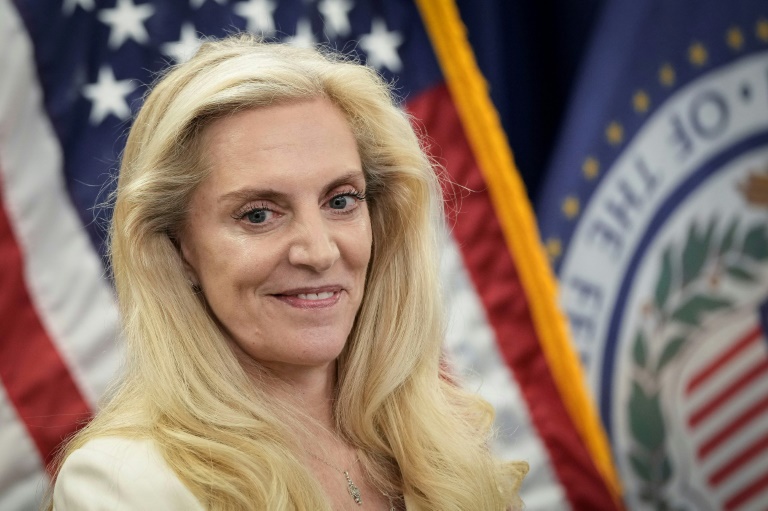
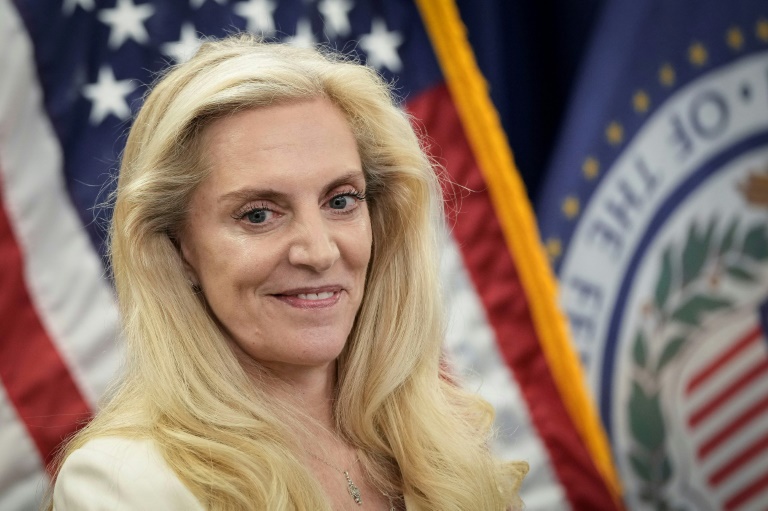
Those views were justified by Vice Chair Lael Brainard, who warned that policymakers will keep hiking rates until they have finally brought prices under control.

“We are in this for as long as it takes to get inflation down,” she said in comments prepared for a conference in New York, adding that she understood this would have a severe impact on families. 

The rate “will need to rise further” and “policy will need to be restrictive for some time to provide confidence that inflation is moving down to target”, she said.

The Fed holds its next policy meeting on September 21, with a third successive 75-basis-point lift forecast.

– Oil under pressure –

Equity traders mostly followed their US counterparts in returning to buying, with many believing the market had fallen too far too fast.

Tokyo led the gains, helped by data showing the Japanese economy performed better than initially thought in the second quarter, while there were also gains in Shanghai, Sydney, Seoul, Singapore, Wellington, Taipei, Manila and Jakarta.

Hong Kong bucked the trend.

Still, the mood on trading floors remains downbeat, with news that China had extended a lockdown in the megacity of Chengdu adding to worries about the world’s number two economy as officials stick rigidly to their growth-killing zero-Covid strategy.

The shutdowns in China, which have impacted tens of millions across the country, were adding to hefty oil sales as traders fret over the impact on demand.

The commodity was already under pressure owing to bets on a recession caused by bank rate hikes, with both main contracts down around $50 from the peaks seen in the immediate aftermath of Russia’s invasion of Ukraine. They are now around eight-month lows.

And while Brent and WTI rose Thursday, they were nowhere near recovering the previous day’s rout of more than five percent, which came despite Russian President Vladimir Putin warning he would cut off energy to Europe if it imposed price cap sanctions.

“Some bargain-hunting buying is to be expected after a dive like” Wednesday’s, said Vandana Hari at Vanda Insights. 

Still, she added that “the approach of the September 21 Fed meeting, where another 75-basis-point rate hike is expected”, could add headwinds to crude.

– Key figures at around 0230 GMT –

Tokyo – Nikkei 225: UP 2.1 percent at 27,992.25 (break)

Hong Kong – Hang Seng Index: DOWN 0.3 percent at 18,993.00

Shanghai – Composite: UP 0.1 percent at 3,249.99

Dollar/yen: UP at 144.12 yen from 143.79 yen on Wednesday

Euro/dollar: DOWN at $0.9989 from $1.0012 

Pound/dollar: DOWN at $1.1509 from $1.1535

Euro/pound: UP at 86.79 pence from 86.74 pence

West Texas Intermediate: UP 0.8 percent at $82.61 per barrel

Brent North Sea crude: UP 0.7 percent at $88.64 per barrel

New York – Dow: UP 1.4 percent at 31,581.28 (close)

London – FTSE 100: DOWN 0.9 percent at 7,237.83 (close)

Asian markets bounce after sell-off, dollar closes on new highs

Most Asian markets enjoyed a rare advance on bargain-buying Thursday, tracking a Wall Street rally after a series of losses, though the dollar resumed its upward march with the Federal Reserve expected to announce another bumper interest rate hike.

Equities have been ravaged for weeks by fears that global central bank moves to rein in runaway inflation by ratcheting up borrowing costs will spark fresh recessions in some leading economies.

In turn, the greenback has moved ever higher against its major peers as investors flood into the currency hoping for better returns and as a safe-haven hedge against uncertainty and worldwide turmoil.

On Wednesday, the US unit hit a 37-year high against sterling, while it was also closing in on a 32-year peak above 147.60 yen owing to the Bank of Japan’s refusal to tighten its monetary policy, seen as the key driver of that rally.

Still, Japanese officials said they were tracking the price movements and hinted at possible action if things did not improve.

The euro is holding its own for now, ahead of a hefty expected rate hike by the European Central Bank later in the day.

While the dollar saw a brief moment of weakness Wednesday, observers are certain it will continue to attract strong interest for as long as the Fed keeps ramping up interest rates.

Those views were justified by Vice Chair Lael Brainard, who warned that policymakers will keep hiking rates until they have finally brought prices under control.

“We are in this for as long as it takes to get inflation down,” she said in comments prepared for a conference in New York, adding that she understood this would have a severe impact on families. 

The rate “will need to rise further” and “policy will need to be restrictive for some time to provide confidence that inflation is moving down to target”, she said.

The Fed holds its next policy meeting on September 21, with a third successive 75-basis-point lift forecast.

– Oil under pressure –

Equity traders mostly followed their US counterparts in returning to buying, with many believing the market had fallen too far too fast.

Tokyo led the gains, helped by data showing the Japanese economy performed better than initially thought in the second quarter, while there were also gains in Shanghai, Sydney, Seoul, Singapore, Wellington, Taipei, Manila and Jakarta.

Hong Kong bucked the trend.

Still, the mood on trading floors remains downbeat, with news that China had extended a lockdown in the megacity of Chengdu adding to worries about the world’s number two economy as officials stick rigidly to their growth-killing zero-Covid strategy.

The shutdowns in China, which have impacted tens of millions across the country, were adding to hefty oil sales as traders fret over the impact on demand.

The commodity was already under pressure owing to bets on a recession caused by bank rate hikes, with both main contracts down around $50 from the peaks seen in the immediate aftermath of Russia’s invasion of Ukraine. They are now around eight-month lows.

And while Brent and WTI rose Thursday, they were nowhere near recovering the previous day’s rout of more than five percent, which came despite Russian President Vladimir Putin warning he would cut off energy to Europe if it imposed price cap sanctions.

“Some bargain-hunting buying is to be expected after a dive like” Wednesday’s, said Vandana Hari at Vanda Insights. 

Still, she added that “the approach of the September 21 Fed meeting, where another 75-basis-point rate hike is expected”, could add headwinds to crude.

– Key figures at around 0230 GMT –

Tokyo – Nikkei 225: UP 2.1 percent at 27,992.25 (break)

Hong Kong – Hang Seng Index: DOWN 0.3 percent at 18,993.00

Shanghai – Composite: UP 0.1 percent at 3,249.99

Dollar/yen: UP at 144.12 yen from 143.79 yen on Wednesday

Euro/dollar: DOWN at $0.9989 from $1.0012 

Pound/dollar: DOWN at $1.1509 from $1.1535

Euro/pound: UP at 86.79 pence from 86.74 pence

West Texas Intermediate: UP 0.8 percent at $82.61 per barrel

Brent North Sea crude: UP 0.7 percent at $88.64 per barrel

New York – Dow: UP 1.4 percent at 31,581.28 (close)

London – FTSE 100: DOWN 0.9 percent at 7,237.83 (close)

ECB to match historic inflation with bumper rate hike

European Central Bank policymakers could reach for a historically large interest rate hike at their meeting on Thursday as they seek to tame soaring inflation.

Steep increases in the price of energy in the wake of the Russian invasion of Ukraine have heaped pressure onto households and businesses.

Inflation hit 9.1 percent in August, an all-time high for the eurozone and more than four times the two-percent rate targeted by the ECB.

“We expect a 75-basis-points rate hike,” said Franck Dixmier, head of fixed income at Allianz Global Investors.

“Given the level of inflation and the uncertainties about its evolution, for the ECB, there is less risk in doing more than in doing less,” he said. 

If confirmed, that would be the largest regular interest rate hike in the history of the ECB since its founding in 1998.

At its last meeting in July the ECB exceeded expectations with a 50-basis-point increase in interest rates, its first hike in more than a decade.

The increase also brought an end to eight years of negative interest rates, leaving its key rates sitting in a range between zero and 0.75 percent.

– ‘Determination’ –

The July hike set the stage for policymakers to take a new “meeting-by-meeting” approach, with the ECB ditching so-called forward guidance, which had constrained its response to rising inflation.

The ECB’s chief economist Philip Lane has counselled his colleagues on the governing council to raise rates at a “steady pace” and to go “neither too slow nor too fast”.

But a growing chorus of voices from within the central bank have called on the bank to show greater “determination”, in the words of board member Isabel Schnabel. 

Speaking at the annual Jackson Hole central banking symposium at the end of August, Schnabel urged the central bank to respond “more forcefully to the current bout of inflation, even at the risk of lower growth and higher unemployment”.

August’s red-hot inflation reading called for a “strong rise in interest rates in September”, said Joachim Nagel, the influential head of the German central bank.

“Further interest rate steps are to be expected in the following months,” the Bundesbank president predicted.

The ECB is already playing catch-up with the US and British central banks that started raising rates harder and faster in response to inflation.

Meanwhile, a weak euro, which fell below $0.99 for the first time in 20 years this week, has bolstered the case for bigger interest rate hikes.

– Recession rising –

While needing to quickly tame inflation, the ECB is also faced with the quandary of a weakening economy that could speak against over-hiking rates. 

A updated set of economic forecasts for the eurozone is due to be unveiled Thursday that would guide the ECB’s monetary policy decisions.

In its last estimates, published in June, the ECB said it expected inflation to sit at 6.8 percent in 2022 before falling to 3.5 percent next year, while growth would slow from 2.8 percent this year to 2.1 in 2023.

The threat of a recession in Europe was “rising”, EU economic affairs commissioner Paolo Gentiloni said Wednesday.

“We may well be heading into one the most challenging winters in generations,” he added.

A more severe energy shock could push the eurozone into a “deeper winter recession” and hold growth to zero percent in 2023, said Frederik Ducrozet, head of macroeconomic research at Pictet.

At the same time, the soaring cost of energy would drive inflation close to double digits by the end of the year, he predicted.

The ECB had “no choice but to commit to faster monetary tightening as long as inflation keeps rising”, even as a recession looms, said Ducrozet.

Spielberg off to Toronto as film festival hails LGBTQ 'breakthrough year'

Steven Spielberg will lead a host of Hollywood A-listers across the border to Toronto this week for North America’s biggest film festival, which organizers say will celebrate a breakthrough year for LGBTQ cinema.

The Harry Styles-led drama “My Policeman,” about a closeted gay policeman, and Universal’s “Bros” starring Billy Eichner — the first major LGBTQ rom-com from a top Tinseltown studio — are among a starry and 200-strong feature film lineup for the festival starting Thursday.

Renowned for drawing large cinephile crowds to its glitzy premieres and red carpets, the Toronto International Film Festival was hit hard by the pandemic and is seeking to return to full scale after two muted and pared-back editions.

“Jurassic Park” and “Schindler’s List” director Spielberg often skips the film festival circuit entirely with his new releases, so landing the world premiere of his deeply personal “The Fabelmans” marks a major coup for TIFF.

“I think Steven Spielberg… and Universal know the power of the Toronto audience, in terms of how we respond to movies here,” festival CEO Cameron Bailey told AFP.

“The knowledge and the passion for movies that we bring here — I think that made a lot of sense to bring this into a festival, and to start here in Toronto.”

Based on Spielberg’s childhood in Arizona, the coming-of-age drama explores the family secrets of a young man with an early passion for filmmaking, and stars Michelle Williams, Paul Dano and Seth Rogen.

“This is a really unique story for him… he’s really shied away, for the most part, from being directly personal in his films, unlike so many other filmmakers,” said Bailey.

“But he’s gone there for the first time with ‘The Fabelmans.’ It’s powerful. If you know Spielberg’s films as an adult, to see how this artist was formed as a boy is fascinating.”

The Spielberg premiere on Saturday evening is one of several celebrating the significance of cinema itself, and the collective experience of watching movies together, along with “Empire of Light” by Sam Mendes.

The “American Beauty” and “1917” director will receive a career-honoring Tribute Award at a Sunday gala, before his latest movie about a romance at a beautiful old cinema in 1980s England premieres Monday.

– LGBTQ ‘breakthrough’

Elsewhere, stars expected to grace Toronto red carpets include Jessica Chastain and Eddie Redmayne in “The Good Nurse,” Jennifer Lawrence in “Causeway,” Viola Davis in “The Woman King,” and Nicolas Cage in “Butcher’s Crossing.”

Director Rian Johnson launches “Glass Onion: A Knives Out Mystery,” a whodunit sequel in which Daniel Craig’s sleuth meets a star-studded cast including Edward Norton, Ethan Hawke and Jada Pinkett Smith.

And in his first film since the 2018 best picture Oscar winner “Green Book,” Peter Farrelly brings “The Greatest Beer Run Ever,” starring Zac Efron.

But few are likely to draw more screaming fans and scrambling photographers to the carpet than Styles, whose high-profile arthouse film “My Policeman” premieres Sunday.

Emma Corrin and Rupert Everett also star in the film about a secretive affair between two men in 1950s England, at a time when homosexuality was still illegal.

Meanwhile “Bros” marks “the first time, in my knowledge anyhow, that a major Hollywood studio has made a film that is unapologetically and proudly queer,” said Bailey.

Other similarly themed films at TIFF include “The Inspection,” about a young Black man who enlists in the Marine Corps after being thrown out of his mother’s home for being gay.

“There’s a breakthrough this year… you’re seeing LGBTQ stories being told in maybe places that they haven’t been before, and in a much more mainstream way,” said Bailey. 

“The biggest companies that make films have often been the most cautious, shall we say, when it comes to this kind of representation,” he added.

“That seems to be changing.”

The festival kicks off Thursday with “The Swimmers” — the true story of sisters leaving Syria to pursue a new life in Europe and the chance to swim in the 2016 Summer Olympics — and ends September 18.

'Help wanted': businesses struggle to fill jobs

Germany has a shortage of plumbers. The United States needs more postal workers. Australia is lacking engineers. In Canada, hospitals are looking for more nurses. 

“The Great Resignation” that countries have experienced since Covid pandemic restrictions were eased is not over yet.

Michael Blume, chief executive of a software company in eastern Germany, said he had “a lot of difficulties finding workers”.

“Wherever we look, we are lacking qualified workers,” Blume, whose firm Currentsystem23 is based in eastern Germany, told AFP.

There were 887,000 job vacancies in Germany — Europe’s biggest economy — in August, some 108,000 openings more than last year.

“Help Wanted” signs are plastered in front of restaurants and other businesses in the United States, where there were more than 11 million job openings in late July, or two for every employment seeker.

“Vacancy rates are very high across the world. Surveys and firms are saying it is still very hard to fill positions,” said Ariane Curtis, a Toronto-based economist at research firm Capital Economics. 

Countries in Western Europe and North America are having a particularly tough time filling jobs, though the problem is also present in eastern Europe, Turkey and Latin America, Curtis said.

Vacancy-to-unemployed rates rose sharply in Australia, Canada and Britain in later 2021 compared to pre-pandemic levels, an OECD report said in July.

– Businesses closing early –

The shortages have persisted even as the world economy has begun to slow since Russia invaded Ukraine earlier this year.

It affects a broad range of sectors: from a lack of teachers in Texas to not enough staff in the hospitality industry in Italy or the Canadian health system.

The shortages have forced businesses to adapt.

Pharmacies in the US state of Wisconsin, services at hospitals in Canada’s province of Alberta and restaurants in Australia’s Sunshine Coast have had to close for parts of the day, according to local news reports.

White-collar workers are also in short supply.

Clement Verrier, who co-heads an executive recruiting firm in Paris, said it used to be difficult to find companies looking to hire. Now it’s the opposite. 

“We’re seeing an unprecedented number of candidates who disappear in the middle of the recruitment process, without calling back,” Verrier said.

– ‘Shift in mindset’ –

Aging populations were already starting to cause shortages before Covid, but the problem exploded with the pandemic.

There are multiple factors behind the phenomenon: some people have chosen to retire early, while others have struggled with long Covid symptoms. Others have simply had enough of poor working conditions or low salaries.

Other factors include a drastic drop in immigration due to lockdowns, people moving out of cities and workers seizing the moment to rethink their career choices.

“The pandemic drove a fundamental shift in mindset and priorities, and employers aren’t keeping pace with that change,” said Bonnie Dowling, expert associate partner at McKinsey, a global consultancy that conducted a study on the wave of resignations around the world.

To keep or woo workers, companies are offering higher salaries. Other benefits that have emerged include the option of working from home, “bonus” holidays and more personal days.

Some countries are easing their immigration rules to attract more workers.

Germany unveiled plans Wednesday to make it easier for people to hold multiple nationalities and make naturalisation of foreigners easier.

“The big question is if what we have seen in the last months will cool down or not,” said Mike Smith, CEO of Netherlands-based international recruiter Randstad Sourceright.

“From our position we don’t believe it is transitory,” he said.

“We think it is a structural change in the way employees are looking to interact with work. Trends continue to point to that. The shift in worker expectations is here to stay.”

'Help wanted': businesses struggle to fill jobs

Germany has a shortage of plumbers. The United States needs more postal workers. Australia is lacking engineers. In Canada, hospitals are looking for more nurses. 

“The Great Resignation” that countries have experienced since Covid pandemic restrictions were eased is not over yet.

Michael Blume, chief executive of a software company in eastern Germany, said he had “a lot of difficulties finding workers”.

“Wherever we look, we are lacking qualified workers,” Blume, whose firm Currentsystem23 is based in eastern Germany, told AFP.

There were 887,000 job vacancies in Germany — Europe’s biggest economy — in August, some 108,000 openings more than last year.

“Help Wanted” signs are plastered in front of restaurants and other businesses in the United States, where there were more than 11 million job openings in late July, or two for every employment seeker.

“Vacancy rates are very high across the world. Surveys and firms are saying it is still very hard to fill positions,” said Ariane Curtis, a Toronto-based economist at research firm Capital Economics. 

Countries in Western Europe and North America are having a particularly tough time filling jobs, though the problem is also present in eastern Europe, Turkey and Latin America, Curtis said.

Vacancy-to-unemployed rates rose sharply in Australia, Canada and Britain in later 2021 compared to pre-pandemic levels, an OECD report said in July.

– Businesses closing early –

The shortages have persisted even as the world economy has begun to slow since Russia invaded Ukraine earlier this year.

It affects a broad range of sectors: from a lack of teachers in Texas to not enough staff in the hospitality industry in Italy or the Canadian health system.

The shortages have forced businesses to adapt.

Pharmacies in the US state of Wisconsin, services at hospitals in Canada’s province of Alberta and restaurants in Australia’s Sunshine Coast have had to close for parts of the day, according to local news reports.

White-collar workers are also in short supply.

Clement Verrier, who co-heads an executive recruiting firm in Paris, said it used to be difficult to find companies looking to hire. Now it’s the opposite. 

“We’re seeing an unprecedented number of candidates who disappear in the middle of the recruitment process, without calling back,” Verrier said.

– ‘Shift in mindset’ –

Aging populations were already starting to cause shortages before Covid, but the problem exploded with the pandemic.

There are multiple factors behind the phenomenon: some people have chosen to retire early, while others have struggled with long Covid symptoms. Others have simply had enough of poor working conditions or low salaries.

Other factors include a drastic drop in immigration due to lockdowns, people moving out of cities and workers seizing the moment to rethink their career choices.

“The pandemic drove a fundamental shift in mindset and priorities, and employers aren’t keeping pace with that change,” said Bonnie Dowling, expert associate partner at McKinsey, a global consultancy that conducted a study on the wave of resignations around the world.

To keep or woo workers, companies are offering higher salaries. Other benefits that have emerged include the option of working from home, “bonus” holidays and more personal days.

Some countries are easing their immigration rules to attract more workers.

Germany unveiled plans Wednesday to make it easier for people to hold multiple nationalities and make naturalisation of foreigners easier.

“The big question is if what we have seen in the last months will cool down or not,” said Mike Smith, CEO of Netherlands-based international recruiter Randstad Sourceright.

“From our position we don’t believe it is transitory,” he said.

“We think it is a structural change in the way employees are looking to interact with work. Trends continue to point to that. The shift in worker expectations is here to stay.”

Indigenous community at center of stabbing no stranger to suffering

Isolated in the vast prairies of west-central Canada, the James Smith Cree Nation — epicenter of a deadly stabbing rampage — is a small Indigenous community that is no stranger to drama.

Like many other Indigenous communities in North America, it suffers from such problems as overcrowded housing, high unemployment, drug addiction and racial discrimination, researchers say.

– Small, isolated community

Located in a territory spanning more than 15,000 hectares (37,000 acres) the community’s central village is in a rural area where people live off farming and ranching. 

Some 3,400 members of the Cree tribe — one of Canada’s First Nations — live in this area including 2,000 in the village itself. 

On Sunday the community suffered inexplicable tragedy when nine people there were stabbed to death in an outburst of attacks whose motive remains unknown. Another person was killed in the nearby town of Weldon.

Two brothers were identified as the suspects. One was found dead Monday, and news reports said the second died of self inflicted wounds after being arrested on Wednesday, ending the manhunt.

Half of the Cree village’s population is less than 24 years of age and the jobless rate is 24 percent amid low living standards, according to figures from the 2016 census.

Housing is a huge problem: nearly two-thirds of the homes need major repairs and about a third are overcrowded.

– Violence, disasters – 

Almost a year ago to the day, the James Smith community was rocked by a shooting that left two people dead and one wounded.

Several times since 2012 hundreds of people have had to be evacuated from the reservation because of flooding.

In 2016, a leak from oil pipeline contaminated the river that provided the village’s water source. The people of the village sued the provincial and federation governments but nothing came of it.

– Trauma of residential schools- 

The village also included people who spent time at now-notorious schools for Indigenous children.

Between the late 19th century and the 1990s, some 150,000 Indigenous youths in Canada were forced to attend these schools, cut off from their families, languages and culture.

Many of them suffered physical or sexual abuse and thousands never came home from the schools, dying of sickness, malnutrition or negligence.

The Canadian government eventually labeled this cultural genocide and the scars from the tragedy still haunt many Indigenous Canadians.

In late April the archbishop of Canterbury, head of the Anglican Church, visited the James Smith Cree Nation to meet with people who survived their time at the schools. In the name of the church, the archbishop apologized for the abuse meted out at the schools.

Even today Indigenous people suffer from “overt, covert and systemic racism,” said Robert Henry, a professor of Indigenous studies at the University Saskatchewan. 

In 2020, the United Nations denounced what it called a broad range of abuse suffered by Indigenous people, such as problems accessing drinking water, discrimination against children living on reserves, disproportionate presence of Indigenous people in prison, and other woes.

– Drug problems – 

As in many Indigenous communities of Saskatchewan province, drug abuse is a problem, said Marie-Pierre Bousquet, director of the Indigenous studies program at the University of Montreal.

“These are rather big territories with not much of a presence by police who are often overwhelmed, and drugs flow pretty freely,” said Bousquet, adding that violence often comes hand in hand with drug trafficking.

The day after the stabbing attacks Bobby Cameron, the head of the Federation of Sovereign Indigenous Nations, blamed “harmful illegal drugs (that) invade our communities.”

Close Bitnami banner
Bitnami