AFP

Asian markets mostly rise as bargain-buying offsets fears over outlook

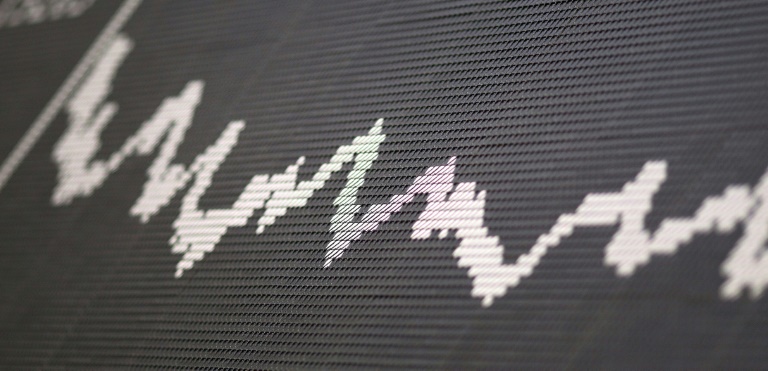
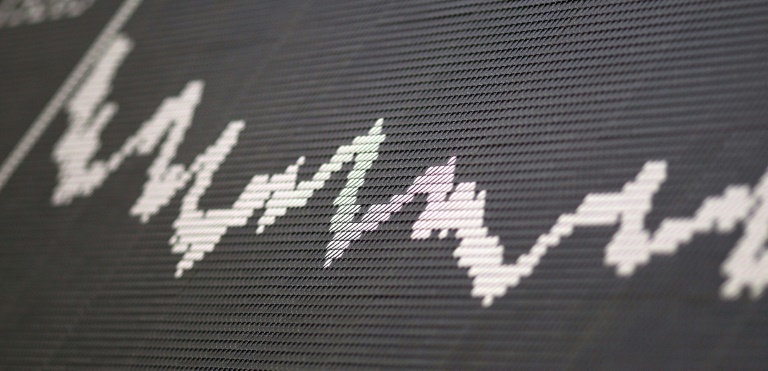
Asian investors squeezed out gains Tuesday as they tried to recover from the previous day’s losses, but they remain gripped by fears over Europe’s worsening energy crisis, China’s economic slowdown and central bank efforts to contain surging inflation.

The dollar lost some momentum, with the euro supported ahead of an expected European Central Bank interest rate hike and sterling lifted by reports that new UK Prime Minister Liz Truss will unveil plans to cut energy bills.

Russia’s decision not to resume gas supplies to Europe — in retaliation for sanctions over Ukraine — sent shock waves through trading floors Monday as it ramped up expectations of a painful recession in major economies.

“This shouldn’t have been a surprise to most people, given that it was widely expected that Putin would play this card at some point,” said CMC Markets analyst Michael Hewson. 

“Now that he has, Russia doesn’t really have anywhere else to go, and while natural gas prices did shoot higher, they closed well off the highs of the day.”

With Wall Street closed for a holiday, Asia had few new catalysts to drive buying.

Markets fluctuated between gains and losses in the morning but managed to clamber up as the day progressed.

Shanghai enjoyed a healthy bounce after China unveiled fresh economy-boosting measures. 

But analysts warned that while a stimulus was welcomed as growth dwindles, traders were only looking for signs of an easing in the country’s zero-Covid strategy, which has left millions in lockdown and threatens economic activity.

Singapore, Seoul, Taipei, Manila, Mumbai, Bangkok and Jakarta all rose, while Tokyo was marginally up and Hong Kong inched down. 

Sydney dipped after the Reserve Bank of Australia lifted interest rates to a near eight-year high and warned of more pain ahead. Wellington also slipped.

London, Paris and Frankfurt enjoyed small gains.

– Global recession risk –

“A lot of clients are asking, have we seen the bottom yet and are we going into a global recession?” Grace Tam, of BNP Paribas Wealth Management Hong Kong, told Bloomberg Television.

“We do think the risk of a global recession, especially next year, is actually quite high” and that the energy crisis “is not fully priced” into markets, she said.

The next key event for investors is the ECB rate decision Thursday, with some observers tipping a 75 basis point hike to bring down record-high inflation.

That is followed later in the month by the Federal Reserve’s meeting, where policymakers will debate a similar move, which would be the third rise in a row.

However, while central banks are lifting borrowing costs to fight surging prices, they have little power over the cost of oil, a key driver of the rises.

And on Monday, OPEC and other major producers announced a surprise cut in output, sending both main contracts rising. The move came after the crude market fell in recent months on demand fears caused by a possible recession.

“In absolute terms, the 100,000 barrels a day supply cut doesn’t matter that much to global supply balances,” said Noah Barrett of Janus Henderson Investors.

“However, in terms of signalling, the move is important as it indicates that OPEC+ is watching demand very closely and is trying to manage supply to keep a floor on oil prices.”

Several countries including the United States had earlier called for a rise in production, which was followed by a small lift of 100,000 barrels.

“The modest increase we got a month ago is now gone, so OPEC+ is clearly sending a message that they are not bowing to external demands,” said Barrett.

“We should expect continued volatility in oil prices, with global demand indicators driving price movements.”

Brent and WTI were both down from Monday’s levels.

– Key figures at around 0810 GMT –

Tokyo – Nikkei 225: FLAT at 27,626.51 (close)

Hong Kong – Hang Seng Index: DOWN 0.1 percent at 19,202.73 (close)

Shanghai – Composite: UP 1.4 percent at 3,243.45 (close)

London – FTSE 100: UP 0.3 percent at 7,305.39

Euro/dollar: UP at $0.9967 from $0.9921 on Monday

Pound/dollar: UP at $1.1568 from $1.1507

Dollar/yen: UP at 141.65 yen from 140.53 yen

Euro/pound: DOWN at 86.10 pence from 86.22 pence

West Texas Intermediate: DOWN 0.2 percent at $89.30 per barrel

Brent North Sea crude: DOWN 0.1 percent at $95.69 per barrel

New York – Dow: Closed for public holiday
Belarus exiles find home from home in 'travelling' bar

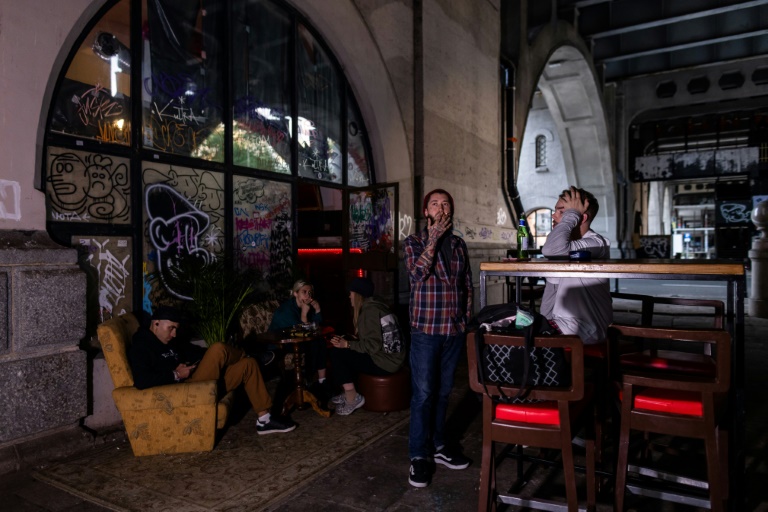
Tucked under a bridge in downtown Warsaw is a bar like no other. Over the years, Karma has relocated from Belarus to Ukraine and Poland, in the face of repression and war.

Along the way, the watering hole has become a home away from home where tattooed young people drink beer, roll cigarettes and mix and mingle in their mother tongue. 

“This bar never wanted to be a travelling bar… It was just to keep our community together,” said co-owner Gleb Kovalev, sporting a dark scraggly beard and inked from head to ankle.

“After things became much more political, we had to move and we had to stay together,” the hyperactive 31-year-old told AFP over a hotdog and a whiskey and coke.

The Belarusian regime staged a brutal crackdown on historic protests in 2020.

More recently, the country has served as a springboard for its ally Russia’s assault on Ukraine.

The events have led thousands of Belarusians and Ukrainians to take refuge in neighbouring Poland — a staunch critic of both the regime in Minsk and the Kremlin.

Some of the new arrivals end up at Karma.

Kovalev, who speaks seven languages, is sitting in a makeshift living room on the pavement behind the bar. There are a couple of armchairs, a tattered rug and potted plants.

It is a weekday and the night is young but already a dozen Belarusians are standing around with drinks, their laughter intermingling with the traffic overhead.  

“I was in every Karma bar,” said Anton Lutsevich, a 3D artist from the central town of Bobruisk, noting the familiar faces from the original location.

“Many of them are now here, many of them were in Kyiv… Karma is like a sitcom. You come here and you see the same characters,” the tall 23-year-old told AFP.

His friend Andrey Makarevich once hightailed it from riot police across a Minsk cemetery. 

“You know, your motherland is not a place — it’s the people from your country,” said Makarevich, a 27-year-old quality assurance engineer from the northeastern city of Vitebsk.

“So here I feel like I’m at home.” 

– Police ‘smashing faces’ – 

Karma first opened in the Belarusian capital in late 2017 as an art bar with music and free tattoos raffled off every Monday, a place to “make parties” as Kovalev puts it.

Then came August 9, 2020, when veteran strongman Alexander Lukashenko crushed the protests that erupted after allegations of fraud in his election to a sixth term.

“It was the night that changed everything in our lives… My bar was assaulted by riot police,” Kovalev said.

“I was inside hiding people and I saw police being out of control, just like smashing faces,” he added.

“I was like two metres from being arrested. So yeah, I decided to leave absolutely.”

Kovalev opened another Karma in the Ukrainian capital last year, before he was again forced to pack his bags when Russia invaded. 

The Warsaw edition of Karma has been up and running since June, mainly drawing Belarusians but also Ukrainians, Russian oppositionists, other foreigners and the occasional Pole.

“It’s pretty much a migrant bar now… We welcome everyone who shares our values,” Kovalev said.

“Like art, music, tattoos, a certain way of democracy and freedom that we didn’t have in the places we escaped, and also peace.”

Alex Chekonov, a regular, describes Karma as a safe place where “everybody will help you”. 

“It’s always happy, always joy. Always funny and everybody is beautiful here,” the 32-year-old IT guy told AFP. 

– ‘Russian roulette’ –

While young and cheerful, many in the crowd have a traumatic tale or two from back home. 

“I’m not going back because, yeah, I’m afraid,” said Veronika Lindorenko, 32, who wore white and carried flowers at women’s protests after the Belarusian election.

“There is a high risk of me being imprisoned, as I was quite active, and it’s like Russian roulette — you never know,” she said, firing with her thumb and index finger like a gun.

The start-up consultant has reason to be scared: she spent 10 days locked up after one tense run-in with police while supporting striking factory workers in court.

“I don’t want to remember all this stuff because for me it’s quite painful,” she told AFP.

Lindorenko left for Ukraine when she heard the powers-that-be wanted to interview her — and then again started from scratch in Poland. 

Kovalev has a theory about being an immigrant.  

“You know, it’s very hard to lose everything only for the first time. Then the second time, it’s fine. And the third,” he said. 

“It’s going to be even easier now because there are so many people who lost everything, like me.

“You just have to unite and recreate it.”

Typhoon kills one, leaves several missing in South Korea

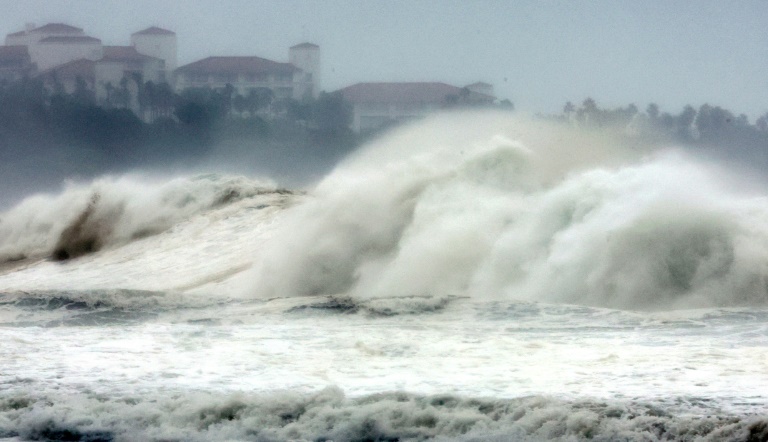
Typhoon Hinnamnor killed one person and left nine missing on Tuesday, before heading back to sea with few reports of major property damage. 

The typhoon, one of the most powerful to bear down on the country in decades, hit the southern island of Jeju overnight before making landfall near the port city of Busan, which was battered by huge waves and heavy rain which damaged beachfront roads and shops.

Early Tuesday in the eastern port city of Pohang, an elderly woman in her 70s was swept away in flooding and killed, the Central Disaster and Safety Countermeasures Headquarters said.

Death tolls could climb later in the day, authorities having identified at least nine people missing as of Tuesday afternoon, including seven people at a submerged underground parking lot in Pohang.

More than 60,000 households nationwide lost power because of the typhoon.

As a precaution, authorities closed more than 600 schools nationwide, and local carriers grounded some 250 domestic flights — but service gradually resumed Tuesday as Hinnamnor headed towards Japan.

North Korea had also been bracing for the storm, with leader Kim Jong-un overseeing a meeting in Pyongyang to assess the country’s preparedness, state media reported Tuesday.

Kim said boosting Pyongyang’s disaster response was crucial as “nothing is more precious… than the people’s life and safety”, news agency KCNA reported.

Experts say North Korea is particularly vulnerable to flooding and heavy rains due to deforestation and poor irrigation.

On Tuesday morning, the typhoon was over the Sea of Japan, known as the East Sea in Korea, 100 kilometres (62 miles) off Tsushima island, according to the Japan Meteorological Agency.

Bringing gusts of up to 180 kilometres per hour, it was moving northeast at a speed of 45 kph and was expected to bring heavy rains to western Japan on Tuesday.

More than 35,000 households were without power in Japan’s southwestern Kyushu region, Kyushu Electricity said in a statement.

Some of Japan’s bullet trains were suspended due to strong winds and rain, and many local trains also paused service, operator JR Kyushu said.

At least 120 flights departing and landing at Kyushu’s airport were cancelled, public broadcaster NHK reported.

School gardens a lifeline for hungry Cambodian children

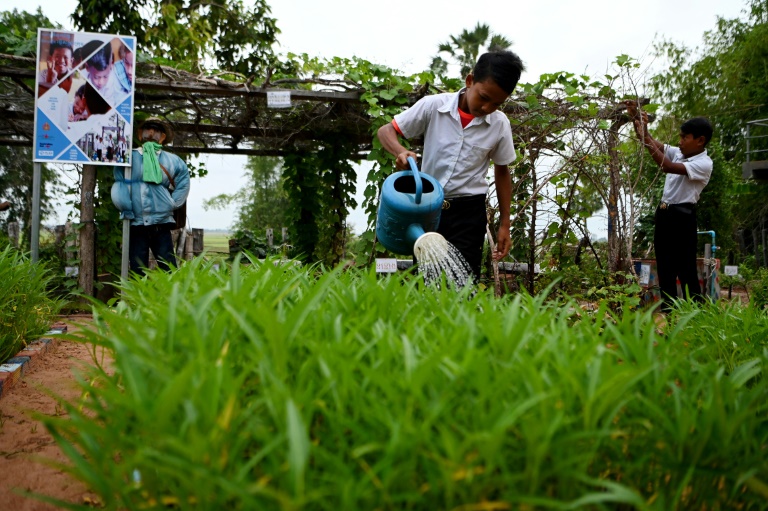
Among the spinach crops at a rural Cambodian school garden, children test their maths skills while weighing produce — but as food prices rise, the vegetable patch has become a safety net for struggling families.

Long before Covid restrictions ravaged the economy, malnutrition and poverty stalked Cambodia’s youth — the legacy of decades of conflict and instability following the Khmer Rouge’s genocidal rule in the 1970s.

Food insecurity has worsened since Russia’s invasion of Ukraine stoked global shortages and inflation. 

The World Food Programme (WFP) says the prices of local staples have shot up in the past year: duck eggs by more than 20 percent and cooking oil by almost 40 percent.

Noodle seller Chhon Puthy, 31, has lost half her income during the pandemic and worries about her children’s health.

“We parents had to reduce our rations sometimes,” said the mother-of-two from the village of Chroy Neang Nguon, about two hours from Siem Reap.

In recent months, her family has come to rely on the garden and free breakfast programme at her children’s school to ease the financial pressure.

“This community depends on the meal because every morning parents are busy with farming and could not cook for their kids,” she said.

– Garden lifeline –

Remote schools in Siem Reap province use the gardens to teach pupils life skills such as cultivation and cooking.

“I learn about growing vegetables, making organic fertiliser, how to work in soil,” 12-year-old Seyha told AFP, adding that the know-how has helped improve her family’s own vegetable patch.

More than 1,000 schools around Cambodia have meal programmes supported by the WFP, with around 50 learning gardens set up with help from global rights group Plan International.

Before each day’s lessons, students are served a free breakfast of rice and fish soup with vegetables grown in the garden.

Long Tov, principal of the school in Chroy Neang Nguon, said the garden and meal programme helped improve students’ concentration levels, memory and test results.

“It (also) hugely reduces the school dropout rate,” he told AFP.

Vireak, 12, said he was happy to eat at school with his classmates. 

“I feel stronger and smarter and I can learn things much easier than before,” he said.

– Impact –

Malnutrition costs the Cambodian economy more than $400 million a year — about 2.5 percent of GDP — according to a study backed by UNICEF.

The country has made progress on tackling the issue — chronic malnutrition in children under five fell from 32 percent in 2014 to 22 percent — but there are fears that inflation could stall momentum.

“Rising food prices are likely to exacerbate the already high levels of childhood malnutrition, just as the country started showing signs of recuperating from the pandemic’s economic impacts,” the United Nations Nutrition office in Cambodia said in a statement.

At Angkor Hospital for Children in Siem Reap, nutrition team leader Sroeu Phannsy told AFP that some poor families were being forced to water down infant milk formula, which can have devastating consequences for a baby’s health.

The fight against malnutrition takes her team of health workers into remote areas, where they treat children with ready-to-eat, energy-dense snacks.

“We worry about their growth in the future, particularly their brain development will be weakened as they prepare to go to school at the age of five or six,” she said.

Children and infants not receiving enough nutrients can go on to suffer low IQs, blindness, stunted growth and weak immune systems.

Back at the learning garden, a teacher shows a class, with full bellies after breakfast, when vegetables are ready to harvest.

“In the learning garden, we are happy and learn important skills… Back home I grow morning glory, cucumber, beans and tomatoes,” 12-year-old Vireak said.

Asian markets mixed as bargain-buying tempers fears over outlook

Asian investors struggled Tuesday to recover from the previous day’s losses on growing fears over Europe’s worsening energy crisis, China’s economic slowdown and central bank efforts to contain surging inflation.

However, the dollar lost some of its momentum against its major peers on profit-taking, with the euro finding some support ahead of an expected European Central Bank interest rate hike and sterling lifted by the election of a new prime minister.

Russia’s decision not to resume gas supplies to Europe — in retaliation for sanctions over Ukraine — sent shock waves through trading floors Monday as it ramped up expectations of a painful recession in major economies.

European bourses took the brunt of the selling, though they pared their earlier losses as commentators said the shutoff had been expected to come at some point.

With Wall Street closed for a holiday, Asia had few new catalysts to drive buying.

In early trade, markets fluctuated between gains and losses, with Hong Kong, Seoul and Wellington down, while Shanghai, Sydney, Singapore, Taipei and Jakarta edged up. Tokyo and Manila were flat.

“A lot of clients are asking, have we seen the bottom yet and are we going into a global recession?” Grace Tam, of BNP Paribas Wealth Management Hong Kong, told Bloomberg Television.

“We do think the risk of a global recession, especially next year, is actually quite high” and that the energy crisis “is not fully priced” into markets, she said.

The next key event for investors is the ECB rate decision Thursday, with some observers tipping a 75 basis point hike to bring down record-high inflation.

That is followed later in the month by the Federal Reserve’s meeting, where policymakers will debate a similar move, which would be the third rise in a row.

However, while central banks are lifting borrowing costs to fight surging prices, they have little power over the cost of oil, a key driver of the rises.

And on Monday OPEC and other major producers announced a surprise cut in output, sending both main contracts rising. The move came after the crude market fell in recent months on demand fears caused by a possible recession.

“In absolute terms, the 100,000 barrels a day supply cut doesn’t matter that much to global supply balances,” said Noah Barrett of Janus Henderson Investors.

“However, in terms of signalling, the move is important as it indicates that OPEC+ is watching demand very closely and is trying to manage supply to keep a floor on oil prices.”

Several countries including the United States had earlier called for a rise in production, which was followed by a small lift of 100,000 barrels.

“The modest increase we got a month ago is now gone, so OPEC+ is clearly sending a message that they are not bowing to external demands,” said Barrett.

“We should expect continued volatility in oil prices, with global demand indicators driving price movements.”

Brent and WTI were both down from Monday’s levels.

– Key figures at around 0230 GMT –

Tokyo – Nikkei 225: FLAT at 17,624.96 (break)

Hong Kong – Hang Seng Index: DOWN 0.3 percent at 19177.54

Shanghai – Composite: UP 0.4 percent at 3213.31

Euro/dollar: UP at $0.9960 from $0.9921 on Monday

Dollar/yen: DOWN at 140.40 yen from 140.53 yen

Pound/dollar: UP at $1.1587 from $1.1507

Euro/pound: DOWN at 85.96 pence from 86.22 pence

West Texas Intermediate: DOWN 1.0 percent at $88.54 per barrel

Brent North Sea crude: DOWN 1.0 percent at $94.80 per barrel

New York – Dow: Closed for public holiday
London – FTSE 100: UP 0.1 percent at 7,287.43 (close)

Asian markets mixed as bargain-buying tempers fears over outlook

Asian investors struggled Tuesday to recover from the previous day’s losses on growing fears over Europe’s worsening energy crisis, China’s economic slowdown and central bank efforts to contain surging inflation.

However, the dollar lost some of its momentum against its major peers on profit-taking, with the euro finding some support ahead of an expected European Central Bank interest rate hike and sterling lifted by the election of a new prime minister.

Russia’s decision not to resume gas supplies to Europe — in retaliation for sanctions over Ukraine — sent shock waves through trading floors Monday as it ramped up expectations of a painful recession in major economies.

European bourses took the brunt of the selling, though they pared their earlier losses as commentators said the shutoff had been expected to come at some point.

With Wall Street closed for a holiday, Asia had few new catalysts to drive buying.

In early trade, markets fluctuated between gains and losses, with Hong Kong, Seoul and Wellington down, while Shanghai, Sydney, Singapore, Taipei and Jakarta edged up. Tokyo and Manila were flat.

“A lot of clients are asking, have we seen the bottom yet and are we going into a global recession?” Grace Tam, of BNP Paribas Wealth Management Hong Kong, told Bloomberg Television.

“We do think the risk of a global recession, especially next year, is actually quite high” and that the energy crisis “is not fully priced” into markets, she said.

The next key event for investors is the ECB rate decision Thursday, with some observers tipping a 75 basis point hike to bring down record-high inflation.

That is followed later in the month by the Federal Reserve’s meeting, where policymakers will debate a similar move, which would be the third rise in a row.

However, while central banks are lifting borrowing costs to fight surging prices, they have little power over the cost of oil, a key driver of the rises.

And on Monday OPEC and other major producers announced a surprise cut in output, sending both main contracts rising. The move came after the crude market fell in recent months on demand fears caused by a possible recession.

“In absolute terms, the 100,000 barrels a day supply cut doesn’t matter that much to global supply balances,” said Noah Barrett of Janus Henderson Investors.

“However, in terms of signalling, the move is important as it indicates that OPEC+ is watching demand very closely and is trying to manage supply to keep a floor on oil prices.”

Several countries including the United States had earlier called for a rise in production, which was followed by a small lift of 100,000 barrels.

“The modest increase we got a month ago is now gone, so OPEC+ is clearly sending a message that they are not bowing to external demands,” said Barrett.

“We should expect continued volatility in oil prices, with global demand indicators driving price movements.”

Brent and WTI were both down from Monday’s levels.

– Key figures at around 0230 GMT –

Tokyo – Nikkei 225: FLAT at 17,624.96 (break)

Hong Kong – Hang Seng Index: DOWN 0.3 percent at 19177.54

Shanghai – Composite: UP 0.4 percent at 3213.31

Euro/dollar: UP at $0.9960 from $0.9921 on Monday

Dollar/yen: DOWN at 140.40 yen from 140.53 yen

Pound/dollar: UP at $1.1587 from $1.1507

Euro/pound: DOWN at 85.96 pence from 86.22 pence

West Texas Intermediate: DOWN 1.0 percent at $88.54 per barrel

Brent North Sea crude: DOWN 1.0 percent at $94.80 per barrel

New York – Dow: Closed for public holiday
London – FTSE 100: UP 0.1 percent at 7,287.43 (close)

Power outages, damage as Typhoon Hinnamnor hits South Korea

Typhoon Hinnamnor made landfall in South Korea early Tuesday, causing power outages and leaving one person missing, but with few early reports of major damage as it headed back to sea.

The typhoon, one of the most powerful to bear down on the country in decades, hit the country’s southern island of Jeju overnight before making landfall near the port city of Busan, which was battered by huge waves and heavy rain, damaging beachfront roads and shops.

The typhoon was moving at a speed of 43 metres per second when it made landfall, authorities said.

A 25-year-old man went missing after falling into a rain-swollen stream in the eastern coastal city of Ulsan, the Central Disaster and Safety Countermeasures Headquarters said.

As a precaution, authorities closed more than 600 schools nationwide, and local carriers grounded some 250 domestic flights — but service gradually resumed Tuesday as Hinnamnor headed towards Japan.

North Korea had also been bracing for the storm, with leader Kim Jong-un overseeing a meeting in Pyongyang to assess the country’s disaster response preparedness, official state media reported Tuesday.

Kim said boosting Pyongyang’s disaster response was crucial as “nothing is more precious… than the people’s life and safety,” the Korean Central News Agency said.

Experts say North Korea is particularly vulnerable to flooding and heavy rains due to deforestation and poor irrigation. 

On Tuesday morning, the typhoon was over the Sea of Japan, known as the East Sea in Korea, 100 kilometres (62 miles) off Tsushima island of Nagasaki prefecture in southwestern Japan, according to the Japan Meteorological Agency.

More than 35,000 households were without power in Japan’s southwestern Kyushu region, Kyushu Electricity said in a statement.

Packing gusts of up to 180 kilometres per hour, it was moving northeast at a speed of 45 kph and was expected to bring heavy rains to western Japan on Tuesday.

Some of Japan’s famed bullet trains were suspended due to strong winds and rain, and many local trains also paused service, operator JR Kyushu said.

At least 120 flights departing and landing at Kyushu’s airport were cancelled, public broadcaster NHK reported.

Gender identity gets starring role at Venice Film Festival

Transgender issues have taken centre stage at the Venice Film Festival this year, with Italian director Emanuele Crialese even using the platform to reveal he was born a woman as he presented his new film starring Penelope Cruz. 

The revelation by Crialese came at a press conference for his new film, “L’Immensita”, which is inspired by his difficult adolescence. 

“I am never going to be like any other man… I was born biologically a woman,” Crialese said. 

He added that, despite his transition, there was still a “huge part of my character that is female”. 

In the film, Cruz’s character attempts to protect her teenage daughter, who identifies as a boy, in a bourgeois household dominated by an abusive, unfaithful husband.

It is not alone at this year’s festival in embracing artists who reject traditional gender roles or tackle issues around sexual identity. 

Another film in the main competition, “Monica” by Italian director Andrea Pallaoro, stars a transgender actress in the leading role — a first in 79 editions of the festival. 

Trace Lysette, known for her role in Amazon Prime series “Transparent”, plays a transgender woman who returns to Ohio after a long absence to care for her dying mother. 

“It’s very rare that you see a script where there’s a trans character at the centre and the movie is told through her lens,” Lysette told reporters. 

“Usually trans characters are more a sidebar vehicle for someone else’s story.”

Besides exploring the title character’s emotional and psychological world, the movie reflects on “the precarious nature of each of our identities when faced with the need to survive and transform”, said Pallaoro.

– Struggling for decades –

Themes of gender identity are also the subject of various documentaries in the festival.

In “All the Beauty and the Bloodshed”, director Laura Poitras centres on the art and activism of US photographer Nan Goldin, whose early work focused on gay culture and volatile male-female relationships.

One of the breakout performances has been Quintessa Swindell, a non-binary actor, who stars alongside Sigourney Weaver and Joel Edgerton in “Master Gardener”, playing out of competition. 

Meanwhile, a documentary by French director Sebastien Lifshitz, “Casa Susanna”, recounts the story of a clandestine community of cross-dressers in conservative America of the 1950s and 1960s, relying on archival footage and surviving members of this “pre-queer” history.

“It’s been a struggle for decades to try to break out of the archetypes,” Lifshitz told AFP.  

Another French director, Florent Gouelou, presented “Three Nights a Week”, a film he described as “a declaration of love” to the art form of drag.

In the film, Baptiste, a man in a relationship with a woman, discovers the Parisian world of drag queens and falls in love with one of them, Cookie.

“Through the character of Baptiste you see my own fascination and through the character of Cookie, you see my own experience as a drag queen,” said Gouelou.

Irish data watchdog fines Instagram 405 mn euros over children

Ireland’s Data Protection Commission on Monday said it had fined Instagram a record 405 million euros ($402 million) for breaching regulations on the handling of children’s data.

“We adopted our final decision last Friday and it does contain a fine of 405 million euros,” the DPC said in a statement. Full details of the decision will be published next week, it added.

The DPC launched an investigation in late 2020 into concerns about how the image-sharing social media platform handles children’s personal data.

The probe centred on the “appropriateness” of Instagram profile and account settings for children, and the firm’s “responsibility to protect the data protection rights of children as vulnerable persons”.

It was conducted under the General Data Protection Regulation (GDPR) — the EU charter of data rights which came into effect in May 2018.

The GDPR gives data regulators the power to impose stiff fines for breaches.

As Instagram is owned by Meta, which has its European headquarters in Dublin, it falls to the DPC to enforce the regulations.

Last year, it fined WhatsApp, also owned by Meta, a then-record 225 million euros for breaking data protection rules. 

Meta, which also owns Facebook, was in March slapped with a 17-million-euro fine for 12 data breaches.

There was no immediate response from Meta when contacted by AFP.

But a company spokesperson was quoted by Irish state broadcaster RTE as saying the Instagram inquiry “focused on old settings that we updated over a year ago”.

“We’ve since released many new features to help keep teens safe and their information private,” they added.

“Anyone under 18 automatically has their account set to private when they join Instagram, so only people they know can see what they post, and adults can’t message teens who don’t follow them.”

The company disagreed with how the fine was calculated and plans to appeal, they added.

Germany puts two nuclear plants on standby in energy U-turn

Germany said Monday it would keep two nuclear plants on standby beyond the end of the year in a policy U-turn, as the shut-off of Russian gas supplies sends Europe scrambling for energy sources.

Following a new network stress test, two of the three remaining power plants would “remain available until mid-April 2023 in case needed”, Economy Minister Robert Habeck said in a statement.

The move partly delays a nuclear exit planned under former chancellor Angela Merkel.

The plants would be kept in reserve to potentially “make a further contribution to the electricity grid in southern Germany”, where the development of renewable power was lagging the north.

Habeck said such a crisis was still “extremely unlikely” and assured that Germany had a “very high security of supply”.

The Green minister also underlined that Germany was not wavering from its plan to move on from nuclear energy, with all plants being unplugged from the grid at the end of the year. 

“New fuel rods will not be put in and after mid-April 2023 it is also over for the reserve,” Habeck said.

An initial stress test in March had found that the remaining nuclear fleet was not needed to ensure energy security, leading to the conclusion that they could be phased out by year’s end as originally planned. 

But the electricity market has since been upended by Russia’s invasion of Ukraine, with power bills soaring in part because Moscow has slashed energy supplies to Europe.

“War and the climate crisis are having a very concrete impact,” Habeck said, referring to a summer drought that has dried up Germany’s rivers and impeded fuel transport.

– Pipeline cut –

Merkel spectacularly decided to ditch atomic energy in 2011 following the Fukushima nuclear disaster in Japan.

Extending the lifetime of the plants, which account for six percent of the country’s electricity output, has set off a heated debate in Germany, where nuclear power has been a source of controversy stretching back before Merkel’s decision.

The move is especially sensitive for Habeck, whose Green party has its roots in the anti-nuclear movement. 

But Germany has already moved to restart mothballed coal power plants and fill gas storage ahead of the winter to guard against an energy shortfall.

Last week, Russian energy giant Gazprom said it would not restart gas deliveries via the Nord Stream 1 pipeline Saturday as planned after a three-day maintenance, pinning the blame on Western sanctions. 

“Problems with pumping (gas) arose due to sanctions that were imposed against our country,” Kremlin spokesman Dmitry Peskov told reporters Monday.

Germany no longer takes Russian supplies into account in its energy security considerations, said Habeck, saying it was “not a surprise” that Moscow did not restart gas flows via Nord Stream 1.

“The only thing that is reliable from Russia is lies,” he said, adding that “we will have to solve our problems without consideration of (Russian President Vladimir) Putin’s erratic decisions, and that’s what we will do.” 

– Bill squeeze –

Swift government action meant Germany would “get through this winter” with the energy it needed, Chancellor Olaf Scholz said Sunday.

But soaring bills meant “rapid” changes were needed to the electricity market at a European level, he said at the unveiling of a 65-billion-euro ($65-billion) inflation relief package.

Hundreds of demonstrators rallied in the eastern city of Leipzig on Monday evening to protest what they see as the insufficiency of the government’s support measures.

The demonstrations called by the far-left Die Linke party could mark the start of a “hot autumn” of protest in Germany as bill payers feel the squeeze from rising prices.

Earlier Monday, Scholz spoke with French President Emmanuel Macron, who said France was ready to deliver more gas to Germany to allow Berlin to export more electricity.

France, which has long leaned on nuclear power, is itself struggling after a number of its reactors were shut down due to corrosion issues.

Other countries have re-evaluated their stance on nuclear energy in the wake of the Russian invasion, including disaster-struck Japan.

Japanese Prime Minister Fumio Kishida called at the end of August for a push to revive the country’s nuclear power industry, and build new atomic plants.

Close Bitnami banner
Bitnami