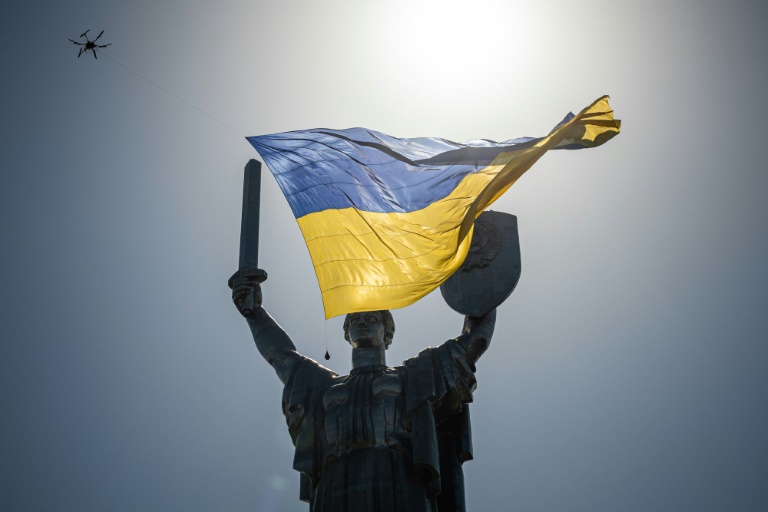
AFP

Russian-held nuclear plant cut from Ukraine grid as Putin orders troop boost

Ukraine’s Zaporizhzhia nuclear plant under occupation by Moscow’s troops was disconnected from the national power supply on Thursday, the state energy operator said, as President Vladimir Putin signed a decree to swell the ranks of Russia’s military.

The Zaporizhzhia plant — Europe’s largest nuclear facility — has been occupied by Russian troops in southern Ukraine since the opening weeks of the war, and remained on the frontlines ever since.

Recently Moscow and Kyiv have traded blame for shelling around the complex, a “highly volatile” development the International Atomic Energy Agency (IAEA) says “underlines the very real risk of a nuclear disaster”.

The development came on a day when Russian President Vladimir Putin signed a decree to increase the headcount of his country’s army to more than two million, including 1.15 million servicemen, from next January, according to the document published on a government portal. 

Putin last set the army headcount in 2017 at around 1.9 million people with 1.01 million soldiers.

Ukraine state operator Energoatom said the Zaporizhzhia plant was severed from the national network after a power line was twice disconnected by ash pit fires in an adjacent thermal power plant.

The three other power lines “were earlier damaged during terrorist attacks” by Russian forces, the operator said.

“The actions of the invaders caused a complete disconnection of the (Zaporizhzhia Nuclear Power Plant) from the power grid — the first in the history of the plant,” Energoatom added on Telegram.

It added that “start-up operations are under way to connect one of the reactors to the network”.

Kyiv officials have said they believe Moscow has seized the station in order to divert power to the Crimean peninsula annexed by Russia in 2014.

Energoatom could not be immediately reached for comment on whether the supply had been diverted, the cause of the ash pit fires, or the number of those without electricity.

However, the mayor of the city of Melitopol Ivan Fedorov said “Russian occupiers cut off the electricity in almost all occupied settlements of Zaporizhzhia”.

Earlier on Thursday Britain’s defence ministry said satellite imagery from the weekend “indicated that Russia maintained an enhanced military presence at the site”.

“The principal risks to reactor operations are likely to remain disruption to the reactors’ cooling systems, damage to its back-up power supply, or errors by workers operating under pressure,” the ministry added in a statement.

– Independence day deaths –

Meanwhile on Thursday the death toll from an air strike on a train station in central Ukraine rose to 25, as the EU warned those “responsible for Russian rocket terror will be held accountable”.

Russia issued a counter-claim saying it targeted soldiers and killed 200 Ukrainian servicemen in the attack Wednesday on a rail hub in Chaplyne city of the Dnipropetrovsk region. 

The attack struck six months to the day since Russia began its invasion of Ukraine and also on the day Ukraine celebrated its 1991 independence from the Soviet Union.

On Thursday, state rail operator Ukrainian Railways said the toll had risen overnight from 22 to 25, and included two children with a further 31 people injured.

Ukrainian President Volodymyr Zelensky had warned at the weekend Russia might do something “particularly cruel” to mark Ukraine’s independence celebrations.

In a daily press briefing, the defence ministry said the train was “en route to combat zones” in the eastern Donbas region of Ukraine, which Russia seeks to fully control.

But EU foreign policy chief Josep Borrell “strongly” condemned “another heinous attack by Russia on civilians”.

“Those responsible for Russian rocket terror will be held accountable,” he said on Twitter.

The UN humanitarian coordinator for Ukraine Denise Brown said the strike “is just one more example of the level of suffering that this war is causing the people of Ukraine”.

“In the six months since Russia’s invasion, Ukrainians have continued to see their loved ones killed, injured and traumatized, their families separated, and their homes, schools and hospitals attacked,” she said in a statement.

Meanwhile in Kyiv the city council renamed 102 streets in part of an ongoing effort to “de-Russify” public spaces.

Historic soviet and Russian road names have been replaced with titles lauding Ukrainian culture and commemorating patriots who have fought for the nation over the past six months.


Gas prices approach record peak on Russian supply fears

European natural gas prices climbed Thursday towards a record peak on heightened fears over Russian supplies, while equities rose on the eve of a key speech from Federal Reserve chair Jerome Powell.

Europe’s benchmark Dutch TTF gas contract advanced to 322 euros per megawatt hour, not far from the record high 345 euros struck in March shortly after key gas producer Russia invaded Ukraine.

Prices have spiked in recent days as a three-day halt in Russian deliveries to Germany via the Nord Stream 1 pipeline approaches amid fears that Moscow will not turn the taps back on afterwards.

At the same time, one-year forward contracts for electricity prices in both France and Germany surged on Thursday to record pinnacles on worries over a winter energy crunch.

– ‘Unstoppable march upwards’ –

“Gas is on a seemingly unstoppable march upwards again, a dramatic move which will intensify the energy crisis,” said Hargreaves Lansdown analyst Susannah Streeter.

“Already plans are being brought in to save energy which will darken streets across Germany and make public buildings colder, but much tougher measures may have to be enforced given dwindling gas reserves.”

In stock market trade, European equities mostly advanced, with Frankfurt drawing some strength from news that the German economy expanded by an anaemic 0.1 percent in the second quarter.

That was upgraded from the prior projection of zero growth, but analysts remain downbeat.

“I’m trying to find a reason to be optimistic on the back of that, but in reality it just means the economy may take a little longer to fall into recession,” warned OANDA analyst Craig Erlam.

“With the energy crisis unlikely to improve, this likely means another quarter of flat growth at best before the economy falls into recession later this year.”

Wall Street also pushed higher as traders looked to central bankers meeting in Jackson Hole in the US state of Wyoming this week.

All eyes are on Powell’s Friday speech for clues about the Federal Reserve’s plans to tame runaway inflation with higher borrowing costs.

Central banks around the world are trying to find a delicate balance between curbing inflation and avoiding recessions.

The challenge has been compounded this year by Russia’s invasion of Ukraine, which has sent energy and food prices skyrocketing.

There are concerns that the Fed’s fight against soaring inflation could lead to a recession in the United States, which could, in turn, hit a global economy that is still recovering from the Covid pandemic.

But the latest data out Thursday showed a continuing drop in first time claims to 243,000 last week, suggesting the US economy remains strong.

“A reading below 250,000 certainly indicates that labor market conditions remain tight, which means the potential for sticky wage-based inflation pressures also remains tight, and that is unlikely to be a comforting indication for Fed officials,” said Briefing.com analyst Patrick O’Hare.

US second-quarter GDP figures were also revised higher, to a 0.6-percent contraction from the initial estimate of a 0.9-percent contraction.

– China stimulus –

Asian indices rose after China unveiled fresh measures to boost its economy.

The moves to shore up the economy were announced by China’s State Council on Wednesday, including steps to encourage lending, consumption and investment, according to the official Xinhua news agency.

They also included support for electricity producers and agriculture, two sectors hit especially hard by the heatwave, though Xinhua’s readout of the State Council meeting did not mention the extreme weather.

– Key figures at around 1530 GMT –

New York – Dow: UP 0.1 percent at 33,001.63 points

EURO STOXX 50: UP 0.2 percent at 3,674.05

London – FTSE 100: UP 0.1 percent at 7,479.74 (close)

Frankfurt – DAX: UP 0.4 percent at 13,271.96 (close) 

Paris – CAC 40: DOWN less than 0.1 percent at 6,381.56 (close)

Tokyo – Nikkei 225: UP 0.6 percent at 28,479.01 (close)

Hong Kong – Hang Seng Index: UP 3.6 percent at 19,968.38 (close)

Shanghai – Composite: UP 1.0 percent at 3,246.25 (close)

Euro/dollar: UNCHANGED from Wednesday at $0.9970

Pound/dollar: UP at $1.1814 from $1.1799

Euro/pound: DOWN at 84.36 pence from 84.47 pence

Dollar/yen: UP at 136.71 yen from 136.36 yen

West Texas Intermediate: DOWN 0.6 percent at $94.30 per barrel

Brent North Sea crude: DOWN 0.4 percent at $100.83

burs-rl/kjm

Gas prices approach record peak on Russian supply fears

European natural gas prices climbed Thursday towards a record peak on heightened fears over Russian supplies, while equities rose on the eve of a key speech from Federal Reserve chair Jerome Powell.

Europe’s benchmark Dutch TTF gas contract advanced to 322 euros per megawatt hour, not far from the record high 345 euros struck in March shortly after key gas producer Russia invaded Ukraine.

Prices have spiked in recent days as a three-day halt in Russian deliveries to Germany via the Nord Stream 1 pipeline approaches amid fears that Moscow will not turn the taps back on afterwards.

At the same time, one-year forward contracts for electricity prices in both France and Germany surged on Thursday to record pinnacles on worries over a winter energy crunch.

– ‘Unstoppable march upwards’ –

“Gas is on a seemingly unstoppable march upwards again, a dramatic move which will intensify the energy crisis,” said Hargreaves Lansdown analyst Susannah Streeter.

“Already plans are being brought in to save energy which will darken streets across Germany and make public buildings colder, but much tougher measures may have to be enforced given dwindling gas reserves.”

In stock market trade, European equities mostly advanced, with Frankfurt drawing some strength from news that the German economy expanded by an anaemic 0.1 percent in the second quarter.

That was upgraded from the prior projection of zero growth, but analysts remain downbeat.

“I’m trying to find a reason to be optimistic on the back of that, but in reality it just means the economy may take a little longer to fall into recession,” warned OANDA analyst Craig Erlam.

“With the energy crisis unlikely to improve, this likely means another quarter of flat growth at best before the economy falls into recession later this year.”

Wall Street also pushed higher as traders looked to central bankers meeting in Jackson Hole in the US state of Wyoming this week.

All eyes are on Powell’s Friday speech for clues about the Federal Reserve’s plans to tame runaway inflation with higher borrowing costs.

Central banks around the world are trying to find a delicate balance between curbing inflation and avoiding recessions.

The challenge has been compounded this year by Russia’s invasion of Ukraine, which has sent energy and food prices skyrocketing.

There are concerns that the Fed’s fight against soaring inflation could lead to a recession in the United States, which could, in turn, hit a global economy that is still recovering from the Covid pandemic.

But the latest data out Thursday showed a continuing drop in first time claims to 243,000 last week, suggesting the US economy remains strong.

“A reading below 250,000 certainly indicates that labor market conditions remain tight, which means the potential for sticky wage-based inflation pressures also remains tight, and that is unlikely to be a comforting indication for Fed officials,” said Briefing.com analyst Patrick O’Hare.

US second-quarter GDP figures were also revised higher, to a 0.6-percent contraction from the initial estimate of a 0.9-percent contraction.

– China stimulus –

Asian indices rose after China unveiled fresh measures to boost its economy.

The moves to shore up the economy were announced by China’s State Council on Wednesday, including steps to encourage lending, consumption and investment, according to the official Xinhua news agency.

They also included support for electricity producers and agriculture, two sectors hit especially hard by the heatwave, though Xinhua’s readout of the State Council meeting did not mention the extreme weather.

– Key figures at around 1530 GMT –

New York – Dow: UP 0.1 percent at 33,001.63 points

EURO STOXX 50: UP 0.2 percent at 3,674.05

London – FTSE 100: UP 0.1 percent at 7,479.74 (close)

Frankfurt – DAX: UP 0.4 percent at 13,271.96 (close) 

Paris – CAC 40: DOWN less than 0.1 percent at 6,381.56 (close)

Tokyo – Nikkei 225: UP 0.6 percent at 28,479.01 (close)

Hong Kong – Hang Seng Index: UP 3.6 percent at 19,968.38 (close)

Shanghai – Composite: UP 1.0 percent at 3,246.25 (close)

Euro/dollar: UNCHANGED from Wednesday at $0.9970

Pound/dollar: UP at $1.1814 from $1.1799

Euro/pound: DOWN at 84.36 pence from 84.47 pence

Dollar/yen: UP at 136.71 yen from 136.36 yen

West Texas Intermediate: DOWN 0.6 percent at $94.30 per barrel

Brent North Sea crude: DOWN 0.4 percent at $100.83

burs-rl/kjm

Gas prices approach record peak on Russian supply fears

European natural gas prices climbed Thursday towards a record peak on heightened fears over Russian supplies, while equities rose on the eve of a key speech from Federal Reserve chair Jerome Powell.

Europe’s benchmark Dutch TTF gas contract advanced to 322 euros per megawatt hour, not far from the record high 345 euros struck in March shortly after key gas producer Russia invaded Ukraine.

Prices have spiked in recent days as a three-day halt in Russian deliveries to Germany via the Nord Stream 1 pipeline approaches amid fears that Moscow will not turn the taps back on afterwards.

At the same time, one-year forward contracts for electricity prices in both France and Germany surged on Thursday to record pinnacles on worries over a winter energy crunch.

– ‘Unstoppable march upwards’ –

“Gas is on a seemingly unstoppable march upwards again, a dramatic move which will intensify the energy crisis,” said Hargreaves Lansdown analyst Susannah Streeter.

“Already plans are being brought in to save energy which will darken streets across Germany and make public buildings colder, but much tougher measures may have to be enforced given dwindling gas reserves.”

In stock market trade, European equities mostly advanced, with Frankfurt drawing some strength from news that the German economy expanded by an anaemic 0.1 percent in the second quarter.

That was upgraded from the prior projection of zero growth, but analysts remain downbeat.

“I’m trying to find a reason to be optimistic on the back of that, but in reality it just means the economy may take a little longer to fall into recession,” warned OANDA analyst Craig Erlam.

“With the energy crisis unlikely to improve, this likely means another quarter of flat growth at best before the economy falls into recession later this year.”

Wall Street also pushed higher as traders looked to central bankers meeting in Jackson Hole in the US state of Wyoming this week.

All eyes are on Powell’s Friday speech for clues about the Federal Reserve’s plans to tame runaway inflation with higher borrowing costs.

Central banks around the world are trying to find a delicate balance between curbing inflation and avoiding recessions.

The challenge has been compounded this year by Russia’s invasion of Ukraine, which has sent energy and food prices skyrocketing.

There are concerns that the Fed’s fight against soaring inflation could lead to a recession in the United States, which could, in turn, hit a global economy that is still recovering from the Covid pandemic.

But the latest data out Thursday showed a continuing drop in first time claims to 243,000 last week, suggesting the US economy remains strong.

“A reading below 250,000 certainly indicates that labor market conditions remain tight, which means the potential for sticky wage-based inflation pressures also remains tight, and that is unlikely to be a comforting indication for Fed officials,” said Briefing.com analyst Patrick O’Hare.

US second-quarter GDP figures were also revised higher, to a 0.6-percent contraction from the initial estimate of a 0.9-percent contraction.

– China stimulus –

Asian indices rose after China unveiled fresh measures to boost its economy.

The moves to shore up the economy were announced by China’s State Council on Wednesday, including steps to encourage lending, consumption and investment, according to the official Xinhua news agency.

They also included support for electricity producers and agriculture, two sectors hit especially hard by the heatwave, though Xinhua’s readout of the State Council meeting did not mention the extreme weather.

– Key figures at around 1530 GMT –

New York – Dow: UP 0.1 percent at 33,001.63 points

EURO STOXX 50: UP 0.2 percent at 3,674.05

London – FTSE 100: UP 0.1 percent at 7,479.74 (close)

Frankfurt – DAX: UP 0.4 percent at 13,271.96 (close) 

Paris – CAC 40: DOWN less than 0.1 percent at 6,381.56 (close)

Tokyo – Nikkei 225: UP 0.6 percent at 28,479.01 (close)

Hong Kong – Hang Seng Index: UP 3.6 percent at 19,968.38 (close)

Shanghai – Composite: UP 1.0 percent at 3,246.25 (close)

Euro/dollar: UNCHANGED from Wednesday at $0.9970

Pound/dollar: UP at $1.1814 from $1.1799

Euro/pound: DOWN at 84.36 pence from 84.47 pence

Dollar/yen: UP at 136.71 yen from 136.36 yen

West Texas Intermediate: DOWN 0.6 percent at $94.30 per barrel

Brent North Sea crude: DOWN 0.4 percent at $100.83

burs-rl/kjm

Australia's 'Black Summer' fires affected ozone layer: study

Australia’s catastrophic “Black Summer” bushfires significantly affected the hole in the Earth’s ozone layer, according to a new report published Friday.

The report, which appeared in the Nature journal “Scientific Reports”, traced a link from the unprecedented smoke released by the fires to the ozone hole above Antarctica.

The fires, which burned through 5.8 million hectares of Australia’s east in late 2019 and early 2020, were so intense they caused dozens of smoke-infused pyrocumulonimbus clouds to form.

Pyrocumulonimbus clouds, referred to as the “fire-breathing dragon of clouds” by NASA, are so powerful they can affect the local weather, causing fire tornadoes and lightning storms.

During the “Black Summer”, these clouds shot more smoke high into the atmosphere than the previous record, set by the 2017 North American wildfires.

Around New Year 2019, uncontrolled fires along Australia’s east coast caused a pyrocumulonimbus event that stretched on for days.

The result was “millions of tonnes of smoke and associated gases being injected into the upper troposphere and lower stratosphere”, according to researchers from the University of Exeter and the University of Manchester.

A build-up of smoke particles, in turn, caused the lower stratosphere to warm to levels not seen since the eruption of Mount Pinatubo in 1991, they found.

Because of this stratospheric warming, the fires also prolonged the Antarctic ozone hole, which appears above Antarctica each spring and “reached record levels in observations in 2020”.

– Ozone gains threatened –

The hole was first created by human pollution — particularly the chlorofluorocarbons (CFCs) that were once emitted from many refrigerators — but in recent decades, global cooperation has given the ozone layer a chance to repair.

The Montreal Protocol, signed in 1987 and since ratified by 195 countries, sharply reduced the amount of CFCs in the atmosphere, and the ozone layer was expected to fully recover by 2060, according to United Nations modelling.

However, the researchers warn that because climate change will increase the frequency and intensity of bushfires, similar events — in which pyrocumulonimbus clouds shoot smoke high into the stratosphere –- will become more likely.

Professor James Haywood told AFP that climate change could “absolutely” stymie the gains made by the Montreal Protocol. 

“Our climate models suggest an increase in frequency and intensity of wildfires in the future under global warming. This may lead to more events like that in 2020, which could in turn lead to more ozone depletion,” he said. 

“So the considerable efforts that we’ve put in protecting the ozone hole could be thwarted by global warming.”

In US, student debt plan a relief to those struggling with loans

When Roman De La Cruz learned that some of his student debt could be forgiven, he breathed “a huge sigh of relief.”

The 27-year-old, who like millions of Americans borrowed heavily to finance his college education, worried he would have to live from one paycheck to another to pay back the $27,000 he owed.

But because he makes less than $125,000 a year, De La Cruz will see $10,000 wiped off his debt under a plan announced by US President Joe Biden on Wednesday.

“I was a little worried,” De La Cruz told AFP. “I was barely going to make it.”

The debt forgiveness is intended to ease the burden on tens of millions of young Americans. US universities can charge anywhere from $10,000 to $70,000 a year, leaving graduates with a heavy burden as they start their careers.

De La Cruz, who graduated from Appalachian State University in 2019 and is now a geologist living in suburban Washington, estimates that his college education cost him about $55,000.

“I was mainly worried that I was going to have to live paycheck by paycheck. And no one wants to live that way,” he said.

The proposed debt relief falls far short of some Democrats’ goal of securing complete forgiveness, but is opposed by Republicans who argue that shaving any amount from loans is unfair to those who have already spent years saving to pay off their own debts.

There was also immediate debate over whether effectively giving millions of people a cash injection will stoke already rampant inflation.

At Howard University in the US capital, students broadly welcomed Biden’s plan, but some want him to go further.

“I definitely think that college should be free,” said Amarie Betancourt, a 20-year-old journalism student.

– ‘Anxiety and hesitation’ –

Vivian Santos-Smith, who is studying political science, said debt weighs on students.

“It definitely does allow anxiety and hesitation,” the 20-year-old said. “I want to get a PhD, but on a side note, what I have to think about is how much money that education costs.”

Americans still in college are less directly affected by the debt forgiveness, but some could still benefit from it if their parents meet certain income requirements.

On Howard’s campus, talking about debt is common among students, Betancourt said.

“A lot of us are struggling to pay tuition. People set up GoFundMe, people have to drop out, take semesters off,” she said.

Without a scholarship, a year of study at the university costs $40,000. With such a high price tag, Theodora Nkwogu, 19, has to borrow $15,000 per year.

“You do all this education and you kind of want, like, some assurance that it’s not going to waste and that you’re not going to be, like, completely broke when you leave college,” said the second-year student.

“When you graduate, it’s like you got your certificate, your diploma and you’re… done, and you’re going on to a career and moving on in life, but with the student loan, you’re still tied back to here.”

Gas prices approach record peak on Russian supply fears

European natural gas prices climbed Thursday towards a record peak on heightened fears over Russian supplies, while equities marked time on the eve of a key speech from Federal Reserve chair Jerome Powell.

Europe’s benchmark Dutch TTF gas contract advanced to 318 euros per megawatt hour before paring gains.

That was not far from the record high 345 euros struck in March shortly after key gas producer Russia invaded Ukraine.

Prices have spiked in recent days as a three-day halt in Russian deliveries to Germany via the Nord Stream 1 pipeline approaches amid fears that Moscow will not turn the taps back on afterwards.

At the same time, one-year forward contracts for electricity prices in both France and Germany surged on Thursday to record pinnacles on worries over a winter energy crunch.

– ‘Unstoppable march upwards’ –

“Gas is on a seemingly unstoppable march upwards again, a dramatic move which will intensify the energy crisis,” said Hargreaves Lansdown analyst Susannah Streeter.

“Already plans are being brought in to save energy which will darken streets across Germany and make public buildings colder, but much tougher measures may have to be enforced given dwindling gas reserves.”

In stock market trade, European equities were broadly steady, with Frankfurt drawing some strength from news that the German economy expanded by an anaemic 0.1 percent in the second quarter.

That was upgraded from the prior projection of zero growth, but analysts remain downbeat.

“I’m trying to find a reason to be optimistic on the back of that, but in reality it just means the economy may take a little longer to fall into recession,” warned OANDA analyst Craig Erlam.

“With the energy crisis unlikely to improve, this likely means another quarter of flat growth at best before the economy falls into recession later this year.”

Wall Street opened mixed, with the Dow dipping, as traders looked to central bankers meeting in Jackson Hole in the US state of Wyoming this week.

All eyes are on Powell’s Friday speech for clues about the Federal Reserve’s plans to tame runaway inflation with higher borrowing costs.

Central banks around the world are trying to find a delicate balance between curbing inflation and avoiding recessions.

The challenge has been compounded this year by Russia’s invasion of Ukraine, which has sent energy and food prices skyrocketing.

There are concerns that the Fed’s fight against soaring inflation could lead to a recession in the United States, which could, in turn, hit a global economy that is still recovering from the Covid pandemic.

But the latest data out Thursday showed a continuing drop in first time claims to 243,000 last week, suggesting the US economy remains strong.

“A reading below 250,000 certainly indicates that labor market conditions remain tight, which means the potential for sticky wage-based inflation pressures also remains tight, and that is unlikely to be a comforting indication for Fed officials,” said Briefing.com analyst Patrick O’Hare.

US second quarter GDP figures were also revised higher, to a 0.6 percent contraction from the initial estimate of a 0.9 percent contraction.

– China stimulus –

Asian indices rose after China unveiled fresh measures to boost its economy.

Fresh measures to shore up the economy were announced by China’s State Council on Wednesday, including steps to encourage lending, consumption and investment, according to the official Xinhua news agency.

They also included support for electricity producers and agriculture, two sectors hit especially hard by the heatwave, though Xinhua’s readout of the State Council meeting did not mention the extreme weather.

– Key figures at around 1330 GMT –

London – FTSE 100: UP less than 0.1 percent at 7,478.02 points

Frankfurt – DAX: UP less than 0.1 percent at 13,230.34 

Paris – CAC 40: DOWN 0.2 percent at 6,373.08

EURO STOXX 50: DOWN 0.1 percent at 3,663.21

New York – Dow: DOWN less than 0.1 percent at 32,956.25

Tokyo – Nikkei 225: UP 0.6 percent at 28,479.01 (close)

Hong Kong – Hang Seng Index: UP 3.6 percent at 19,968.38 (close)

Shanghai – Composite: UP 1.0 percent at 3,246.25 (close)

Euro/dollar: DOWN at $0.9966 from $0.9970 on Wednesday

Pound/dollar: UP at $1.1807 from $1.1799

Euro/pound: DOWN at 84.42 pence from 84.47 pence

Dollar/yen: UP at 136.78 yen from 136.36 yen

West Texas Intermediate: UP 0.4 percent at $95.29 per barrel

Brent North Sea crude: UP 0.6 percent at $101.86

burs-rl/lth

Gas prices approach record peak on Russian supply fears

European natural gas prices climbed Thursday towards a record peak on heightened fears over Russian supplies, while equities marked time on the eve of a key speech from Federal Reserve chair Jerome Powell.

Europe’s benchmark Dutch TTF gas contract advanced to 318 euros per megawatt hour before paring gains.

That was not far from the record high 345 euros struck in March shortly after key gas producer Russia invaded Ukraine.

Prices have spiked in recent days as a three-day halt in Russian deliveries to Germany via the Nord Stream 1 pipeline approaches amid fears that Moscow will not turn the taps back on afterwards.

At the same time, one-year forward contracts for electricity prices in both France and Germany surged on Thursday to record pinnacles on worries over a winter energy crunch.

– ‘Unstoppable march upwards’ –

“Gas is on a seemingly unstoppable march upwards again, a dramatic move which will intensify the energy crisis,” said Hargreaves Lansdown analyst Susannah Streeter.

“Already plans are being brought in to save energy which will darken streets across Germany and make public buildings colder, but much tougher measures may have to be enforced given dwindling gas reserves.”

In stock market trade, European equities were broadly steady, with Frankfurt drawing some strength from news that the German economy expanded by an anaemic 0.1 percent in the second quarter.

That was upgraded from the prior projection of zero growth, but analysts remain downbeat.

“I’m trying to find a reason to be optimistic on the back of that, but in reality it just means the economy may take a little longer to fall into recession,” warned OANDA analyst Craig Erlam.

“With the energy crisis unlikely to improve, this likely means another quarter of flat growth at best before the economy falls into recession later this year.”

Wall Street opened mixed, with the Dow dipping, as traders looked to central bankers meeting in Jackson Hole in the US state of Wyoming this week.

All eyes are on Powell’s Friday speech for clues about the Federal Reserve’s plans to tame runaway inflation with higher borrowing costs.

Central banks around the world are trying to find a delicate balance between curbing inflation and avoiding recessions.

The challenge has been compounded this year by Russia’s invasion of Ukraine, which has sent energy and food prices skyrocketing.

There are concerns that the Fed’s fight against soaring inflation could lead to a recession in the United States, which could, in turn, hit a global economy that is still recovering from the Covid pandemic.

But the latest data out Thursday showed a continuing drop in first time claims to 243,000 last week, suggesting the US economy remains strong.

“A reading below 250,000 certainly indicates that labor market conditions remain tight, which means the potential for sticky wage-based inflation pressures also remains tight, and that is unlikely to be a comforting indication for Fed officials,” said Briefing.com analyst Patrick O’Hare.

US second quarter GDP figures were also revised higher, to a 0.6 percent contraction from the initial estimate of a 0.9 percent contraction.

– China stimulus –

Asian indices rose after China unveiled fresh measures to boost its economy.

Fresh measures to shore up the economy were announced by China’s State Council on Wednesday, including steps to encourage lending, consumption and investment, according to the official Xinhua news agency.

They also included support for electricity producers and agriculture, two sectors hit especially hard by the heatwave, though Xinhua’s readout of the State Council meeting did not mention the extreme weather.

– Key figures at around 1330 GMT –

London – FTSE 100: UP less than 0.1 percent at 7,478.02 points

Frankfurt – DAX: UP less than 0.1 percent at 13,230.34 

Paris – CAC 40: DOWN 0.2 percent at 6,373.08

EURO STOXX 50: DOWN 0.1 percent at 3,663.21

New York – Dow: DOWN less than 0.1 percent at 32,956.25

Tokyo – Nikkei 225: UP 0.6 percent at 28,479.01 (close)

Hong Kong – Hang Seng Index: UP 3.6 percent at 19,968.38 (close)

Shanghai – Composite: UP 1.0 percent at 3,246.25 (close)

Euro/dollar: DOWN at $0.9966 from $0.9970 on Wednesday

Pound/dollar: UP at $1.1807 from $1.1799

Euro/pound: DOWN at 84.42 pence from 84.47 pence

Dollar/yen: UP at 136.78 yen from 136.36 yen

West Texas Intermediate: UP 0.4 percent at $95.29 per barrel

Brent North Sea crude: UP 0.6 percent at $101.86

burs-rl/lth

Grain prices ease back but fertiliser costs a growing risk

Grain prices have dropped sharply from the record highs they reached following Russia’s invasion of Ukraine, but another menace to global food security remains: a shortage of fertiliser.

The conflict sparked fears of famine in poorer countries reliant on agricultural goods from Ukraine and Russia, two nations that were responsible for nearly a third of global wheat exports last year.

Wheat prices reached a peak of nearly 440 euros ($440) a tonne on the European market in mid-May, double the level of one year ago, as crucial Ukrainian shipments were stuck at port due to a Russian naval blockade in the Black Sea.

But prices have fallen to around 300 euros in August.

“The situation began to calm down at the end of May, beginning of June with the first reassuring harvest forecasts for Europe and the resumption of Ukrainian exports, first by road and rail, then by sea,” said Gautier Le Molgat, analyst at consultancy Agritel.

Kyiv and Moscow reached an agreement in July, brokered by the United Nations and Turkey, that allowed Ukraine to resume grain shipments in the Black Sea.

The agreement opened a shipping corridor for 20 million tonnes of maize, wheat and sunflower seed oil stocked in Ukraine. According to the Joint Coordination Centre which manages the sea corridor, more than 720,000 tonnes have already left Ukraine.

“Thanks to intensive international cooperation, Ukraine is on track to export as much as four million metric tonnes of agricultural products in August,” a senior US State Department official told AFP on Tuesday.

– Strong ruble –

In addition to more supplies reaching markets and helping lower prices, the deal has led to a drop in insurance premiums, reducing transport costs.

But the reduction in tensions is, for the moment, benefitting Ukraine more than Russia, which is expecting a bumper harvest of 88 million tonnes of wheat.

Russian wheat exports in July and August are running 27 percent lower than last year, according to estimates by the Russian market research firm SovEcon.

That is due to fierce competition on the international grain market, as well as the strong value of the ruble and a high Russian export tax. 

“As a result, farmers remain reluctant sellers,” said Andrei Sizov, SovEcon’s managing director. 

The low volume of Russian exports is one of the main reasons why wheat prices have remained so high, said Sizov.

– Fertiliser costs a growing problem –

One of the reasons prices have not come down further is the surge in energy prices, due to the post-pandemic recovery and the war.

Higher oil prices impact transportation costs, while natural gas is a feedstock for manufacturing the chemical fertilisers that most farmers now use.

“Fertiliser prices have tripled in the last 18 months and the hard part of my job is forecasting what they will do in the next 18 months,” Joel Jackson, a fertiliser analyst at BMO Capital Markets, said at an analyst conference in July in the United States.

With European gas prices soaring above 300 euros per megawatt hour, compared to an average of 20 euros over the past decades, “we’ve got a big problem as it’s untenable for ammonia manufacturers,” said Nicolas Broutin, head of the French subsidiary of Yara, the Norwegian firm which is Europe’s largest fertiliser producer. 

Yara announced Thursday it was reducing once again its production in Europe of ammonia, which is made using hydrogen obtained from natural gas and which provides the nitrogen in synthetic fertilisers.

The firm will only be using 35 percent of its production capacity in Europe. A number of other European manufacturers have either reduced or halted output.

Although fertilisers do not fall under international sanctions, farmers are also at risk of shortages of another major element of fertiliser — potassium or potash — as both Russia and Belarus are major producers. 

BMO Capital Markets’ Joel Jackson said fertiliser manufacturers worry that the high prices will prompt farmers to reduce or eliminate their use.

“We’re already seeing that throughout Europe,” said Yara’s Nicolas Broutin.

CyclOpe, a French-based commodities research firm, said “it’s in 2023-2024 that the rise in fertiliser prices and eventually their reduced use will be felt.”

Farmers will try to pass on higher fertiliser costs to consumers, driving up food costs.

Meanwhile, reduced fertiliser use will result in lower crop yields and harvests, which will also drive up food prices.

CyclOpe expects in particular “considerably reduced” output in Africa, where farmers and consumers are both more sensitive to prices.

Grain prices ease back but fertiliser costs a growing risk

Grain prices have dropped sharply from the record highs they reached following Russia’s invasion of Ukraine, but another menace to global food security remains: a shortage of fertiliser.

The conflict sparked fears of famine in poorer countries reliant on agricultural goods from Ukraine and Russia, two nations that were responsible for nearly a third of global wheat exports last year.

Wheat prices reached a peak of nearly 440 euros ($440) a tonne on the European market in mid-May, double the level of one year ago, as crucial Ukrainian shipments were stuck at port due to a Russian naval blockade in the Black Sea.

But prices have fallen to around 300 euros in August.

“The situation began to calm down at the end of May, beginning of June with the first reassuring harvest forecasts for Europe and the resumption of Ukrainian exports, first by road and rail, then by sea,” said Gautier Le Molgat, analyst at consultancy Agritel.

Kyiv and Moscow reached an agreement in July, brokered by the United Nations and Turkey, that allowed Ukraine to resume grain shipments in the Black Sea.

The agreement opened a shipping corridor for 20 million tonnes of maize, wheat and sunflower seed oil stocked in Ukraine. According to the Joint Coordination Centre which manages the sea corridor, more than 720,000 tonnes have already left Ukraine.

“Thanks to intensive international cooperation, Ukraine is on track to export as much as four million metric tonnes of agricultural products in August,” a senior US State Department official told AFP on Tuesday.

– Strong ruble –

In addition to more supplies reaching markets and helping lower prices, the deal has led to a drop in insurance premiums, reducing transport costs.

But the reduction in tensions is, for the moment, benefitting Ukraine more than Russia, which is expecting a bumper harvest of 88 million tonnes of wheat.

Russian wheat exports in July and August are running 27 percent lower than last year, according to estimates by the Russian market research firm SovEcon.

That is due to fierce competition on the international grain market, as well as the strong value of the ruble and a high Russian export tax. 

“As a result, farmers remain reluctant sellers,” said Andrei Sizov, SovEcon’s managing director. 

The low volume of Russian exports is one of the main reasons why wheat prices have remained so high, said Sizov.

– Fertiliser costs a growing problem –

One of the reasons prices have not come down further is the surge in energy prices, due to the post-pandemic recovery and the war.

Higher oil prices impact transportation costs, while natural gas is a feedstock for manufacturing the chemical fertilisers that most farmers now use.

“Fertiliser prices have tripled in the last 18 months and the hard part of my job is forecasting what they will do in the next 18 months,” Joel Jackson, a fertiliser analyst at BMO Capital Markets, said at an analyst conference in July in the United States.

With European gas prices soaring above 300 euros per megawatt hour, compared to an average of 20 euros over the past decades, “we’ve got a big problem as it’s untenable for ammonia manufacturers,” said Nicolas Broutin, head of the French subsidiary of Yara, the Norwegian firm which is Europe’s largest fertiliser producer. 

Yara announced Thursday it was reducing once again its production in Europe of ammonia, which is made using hydrogen obtained from natural gas and which provides the nitrogen in synthetic fertilisers.

The firm will only be using 35 percent of its production capacity in Europe. A number of other European manufacturers have either reduced or halted output.

Although fertilisers do not fall under international sanctions, farmers are also at risk of shortages of another major element of fertiliser — potassium or potash — as both Russia and Belarus are major producers. 

BMO Capital Markets’ Joel Jackson said fertiliser manufacturers worry that the high prices will prompt farmers to reduce or eliminate their use.

“We’re already seeing that throughout Europe,” said Yara’s Nicolas Broutin.

CyclOpe, a French-based commodities research firm, said “it’s in 2023-2024 that the rise in fertiliser prices and eventually their reduced use will be felt.”

Farmers will try to pass on higher fertiliser costs to consumers, driving up food costs.

Meanwhile, reduced fertiliser use will result in lower crop yields and harvests, which will also drive up food prices.

CyclOpe expects in particular “considerably reduced” output in Africa, where farmers and consumers are both more sensitive to prices.

Close Bitnami banner
Bitnami