AFP

Dutch farmer protests reap populist support

Dutch farmers’ rowdy protests against government climate plans have caused a stir at home and abroad, with populists worldwide jumping on the bandwagon and even former US president Donald Trump backing them.

“We take all the support that we can get,” says Jaap Kok, a 62-year-old cattle farmer standing in a meadow full of cows near Barneveld in the central Netherlands’ farming belt.

The farmers have wreaked havoc for weeks, dumping manure and garbage on highways, blockading supermarket warehouses with tractors and rallying noisily outside politicians’ houses.

They oppose plans to cut emissions of nitrogen in the Netherlands — the world’s second-biggest agricultural exporter after the United States — by reducing livestock and closing some farms.

While a small group has been blamed for much of the unrest, there have also been large protests involving thousands of tractors.

With the protests garnering global headlines, right-wing figures have been quick to voice support. As well as Trump, they include French far-right leader Marine Le Pen, and Dutch far-right politicians Geert Wilders and Thierry Baudet.

“I would have preferred that the support came from the left but from the right is fine too,” said Kok, whose own farm risks closure. 

“Farmers are always the scapegoat.”

– ‘Very angry’ –

The tiny Netherlands produces huge amounts of food thanks to industrialised farming — but at the cost of being one of Europe’s largest greenhouse gas emitters.

That is especially true of nitrogen, with much of this blamed on ammonia-based fertiliser and cattle-produced manure. Agriculture is responsible for 16 percent of all Dutch emissions.

Nitrogenous gases play an important role in global climate change. Nitrous oxide is a particularly potent greenhouse gas as it is over 300 times more effective at trapping heat in the atmosphere than carbon dioxide.

The Netherlands’ flat landscape sitting just above sea level makes it vulnerable to extreme weather. 

In July the Netherlands recorded its third-highest temperature since records began — 39.4C in the southern city of Maastricht.

Nitrogen-containing substances are also blamed for damage to plant and animal habitats.

Following a 2019 court ruling that the Netherlands was not doing enough to protect its natural areas from nitrogen pollution, the Dutch government said in June that the only way to meet climate goals by 2030 was “radical” cuts to farming. 

This would involve a reduction in particular of around 30 percent to the Netherlands’ herd of some four million cows.

The government has offered some 25 billion euros to help farmers adapt — but has also warned that some closures are possible.

“The farmers are very angry,” said Jos Ubels, vice president of the Farmers Defence Force (FDF), one of the groups coordinating the demonstrations.

“In history, every time there is a problem with a minority they have to shout really hard to be heard, so this is what we are doing.” 

Ubels said his group was not responsible for the roadblocks, saying that it was “just organised by local farmers — they are very angry because they are played with.”

Prime Minister Mark Rutte recently called the protests “life-threatening”, yet there is a groundswell of support.

– ‘Climate tyranny’ –

Upside-down Dutch flags — a symbol of the farmers’ movement — can be see hanging from many houses, lamposts and road bridges.

The Farmer-Citizen Movement (BBB), a centre-right party founded in 2019, would increase its current one seat in parliament to 19 according to latest opinion polls.

But their campaign is also going global.

The FDF’s Ubels was in Warsaw last week for talks with Agriculture Minister Henryk Kowalczyk, of Poland’s right-wing Law and Justice Party-led populist government.

“I will support the position of Dutch farmers in maintaining production… and I hope that their government will change its mind,” Kowalczyk said in a statement.

Trump’s backing has also been a boost.

“Farmers in the Netherlands of all places are courageously opposing the climate tyranny of the Dutch government,” Trump told a rally in Florida in July.

In the Netherlands, a recent farmers’ demo in Amsterdam brought also drew many conspiracy theorists and Covid-sceptics.

British comedian-turned-YouTuber Russell Brand recently told his 5.8 million followers that the Dutch farm plan was part of the “Great Reset” — a conspiracy theory alleging that world leaders orchestrated the pandemic.

The support “says a lot” and shows the government’s “absurd” plans “don’t hold water”, says Wim Brouwer, a farmer in Barneveld and local president of the main Dutch agricultural union LTO.

Brouwer admitted that farmers must do more to cut emissions, but said their sacrifices already far exceeded those made by the industrial and transport sectors.

“The biggest problem is that we have been innovating in agriculture for years, but it’s never enough,” he sighed.


Legendary MLB Dodgers broadcaster Scully dead at 94

Legendary Major League Baseball broadcaster Vin Scully, “voice” of the Los Angeles Dodgers for 67 years, died Tuesday at age 94, the club announced.

Scully, who retired in 2016, began as the Dodgers broadcaster in 1950 when the club was Brooklyn-based and followed them to Los Angeles when they moved to Southern California in 1958.

“We have lost an icon,” said Dodgers president Stan Kasten. “Vin Scully was one of the greatest voices in all of sports.

“He was a giant of a man, not only as a broadcaster but as a humanitarian. He loved people. He loved life. He loved baseball and the Dodgers. And he loved his family. His voice will always be heard and etched in all of our minds forever.

“Vin will be truly missed.”

His stay with the Dodgers was the longest by any US sports broadcaster with a single club. He covered 25 World Series and 12 no-hitters with a descriptive style and smooth vocal tone that became a trademark, delighting generations of listeners.

Scully also handled broadcast duties at NFL games and PGA Tour events in the 1970s and 1980s for CBS Sports telecasts.

The press box at Dodger Stadium has been named for Scully since 2001 and a street in the club’s Florida pre-season training complex is named Vin Scully Way.

Kansas votes to maintain abortion rights in US test case

Abortion rights advocates celebrated Tuesday as the Midwestern US state of Kansas voted to maintain the right to the procedure, the first major poll on the flashpoint issue since the Supreme Court overturned nationwide access in June.

Kansans rejected an amendment that would have scrapped language in the state constitution guaranteeing the right to the procedure and could have paved the way for stricter regulations or a ban.

The vote was widely seen as a test case for abortion rights nationwide, as Republican-dominated legislatures rush to impose strict bans on the procedure following the Supreme Court’s decision to overturn Roe v. Wade.

Pro-abortion rights campaigners and supporters celebrated the win for their side of the hotly contested US debate.

“I’m just beside myself,” campaign volunteer Anne Melia told AFP.

When polls closed at 7:00 pm (0000 GMT), Kansas Secretary of State Scott Schwab said turnout was as high as 50 percent on this referendum, local media reported, a number usually expected for a general election.

Poll worker Marsha Barrett said some 250 voters had come to a station in the Kansas City suburb of Olathe by noon — the same number it might see all day in a presidential election. 

“This election is crazy,” Barrett told AFP. “People are determined to vote.”

President Joe Biden also hailed the result. “Tonight, Kansans used their voices to protect women’s right to choose and access reproductive health care,” he said on Twitter.

“It’s an important victory for Kansas, but also for every American who believes that women should be able to make their own health decisions without government interference.”

In a separate statement, he urged Congress to “listen to the will of the American people” and pass a bill codifying the right to abortion.

Other states including California and Kentucky are set to vote on the hot-button issue in November, at the same time as Congressional midterm elections in which both Republicans and Democrats hope to use it to mobilize their supporters nationwide.

– ‘Remarkable’ result –

In Kansas, the ballot centered on a 2019 ruling by the state’s supreme court that guarantees access to abortion. 

In response, the Republican-dominated state legislature introduced an amendment known as “Value Them Both” that would have scrapped the constitutional right — with the stated aim of handing regulation of the procedure back to lawmakers.

In the opposing camp, activists said the campaign was a barely masked bid to clear the way for an outright ban — one state legislator had already introduced a bill that would ban abortion without exceptions for rape, incest or the mother’s life. 

For Ashley All, spokeswoman for pro-abortion rights campaign Kansans for Constitutional Freedom, the result of Tuesday’s referendum was “remarkable.”

“Kansans understood that this amendment would mandate government control over private medical decisions,” she said. 

But voter Sylvia Brantley, 60, told AFP earlier in the day she voted in favor of the change because she believes “babies matter, too.”

She said she wanted to see more regulations, in the hope that “Kansas will not be a marketplace for killing babies.”

Activists complained that the phrasing of the ballot question was counterintuitive and potentially confusing: voting “Yes” to the amendment meant abortion rights would be curbed, while people who wished to keep those rights intact had to vote “No.” 

– All eyes on Kansas –

While abortion rights advocates in Kansas could breathe a sigh of relief in their own state, they still are looking nervously to neighboring Oklahoma and Missouri, which are among at least eight states to have passed near-total bans — the latter making no exceptions for rape or incest — while Midwestern Indiana adopted its own rigid ban on Saturday.

Kansas Governor Laura Kelly tweeted her support for the amendment’s rejection. 

“Kansans stood up for fundamental rights today,” the Democrat said. 

“We rejected divisive legislation that jeopardized our economic future & put women’s health care access at risk.”

One voter in the town of Prairie Village, who declined to give her name, said she struggled to decide which way to vote. 

“I’ve gone back and forth the whole time,” she told AFP, saying she ultimately chose to vote “no.”

“I feel like women should have a choice, but I also don’t want full-term babies aborted,” she said. 

The outcome in Kansas means that abortion will remain permitted up to 22 weeks of pregnancy.

Kansas leans heavily toward the Republican Party, which favors stricter abortion regulations, but a 2021 survey from Fort Hays State University found that fewer than 20 percent of Kansas respondents agreed that abortion should be illegal even in cases of rape or incest.

Kansas votes to maintain abortion rights in US test case

Abortion rights advocates celebrated Tuesday as the Midwestern US state of Kansas voted to maintain the right to the procedure, the first major poll on the flashpoint issue since the Supreme Court overturned nationwide access in June.

Kansans rejected an amendment that would have scrapped language in the state constitution guaranteeing the right to the procedure and could have paved the way for stricter regulations or a ban.

The vote was widely seen as a test case for abortion rights nationwide, as Republican-dominated legislatures rush to impose strict bans on the procedure following the Supreme Court’s decision to overturn Roe v. Wade.

Results showed that votes in favor of keeping abortion in the state constitution far surpassed the votes against. This reflects that fact that a majority of Americans support abortion access, multiple studies have shown.

When polls closed at 7:00 pm (0000 GMT), Kansas Secretary of State Scott Schwab said turnout was as high as 50 percent on this referendum, local media reported, a number usually expected for a general election.

Poll worker Marsha Barrett said some 250 voters had come to a station in the Kansas City suburb of Olathe by noon — the same number it might see all day in a presidential election. 

“This election is crazy,” Barrett told AFP. “People are determined to vote.”

Other states including California and Kentucky are set to vote on the hot-button issue in November, at the same time as Congressional midterm elections in which both Republicans and Democrats hope to use it to mobilize their supporters nationwide.

In Kansas, the ballot centered on a 2019 ruling by the state’s supreme court that guarantees access to abortion. 

In response, the Republican-dominated state legislature introduced an amendment known as “Value Them Both” that would have scrapped the constitutional right — with the stated aim of handing regulation of the procedure back to lawmakers.

In the opposing camp, activists said the campaign was a barely masked bid to clear the way for an outright ban — one state legislator had already introduced a bill that would ban abortion without exceptions for rape, incest or the mother’s life. 

For Ashley All, spokeswoman for pro-abortion rights campaign Kansans for Constitutional Freedom, the amendment would have dealt a blow to “personal autonomy.”

But voter Sylvia Brantley, 60, said she voted in favor of the change because she believes “babies matter, too.”

She said she wants to see more regulations, in the hope that “Kansas will not be a marketplace for killing babies.”

Activists complained that the phrasing of the ballot question was counterintuitive and potentially confusing: voting “Yes” to the amendment meant abortion rights would be curbed, while people who wished to keep those rights intact must vote “No.” 

– All eyes on Kansas –

While abortion rights advocates in Kansas could breathe a sigh of relief in their own state, they still are looking nervously to neighboring Oklahoma and Missouri, which are among at least eight states to have passed near-total bans — the latter making no exceptions for rape or incest — while Midwestern Indiana adopted its own rigid ban on Saturday.

Voter Chris Ehly, in Prairie Village, said he voted “no” because his daughter and wife “are very adamant about the decision.”

“I want to respect them,” he said. 

Another Prairie Village voter, who declined to give her name, said she struggled to decide which way to vote. 

“I’ve gone back and forth the whole time,” she told AFP, saying she ultimately chose to vote “no.”

“I feel like women should have a choice, but I also don’t want full-term babies aborted,” she said. 

The outcome in Kansas means that abortion will remain permitted up to 22 weeks of pregnancy.

Kansas leans heavily toward the Republican Party, which favors stricter abortion regulations, but a 2021 survey from Fort Hays State University found that fewer than 20 percent of Kansas respondents agreed that abortion should be illegal even in cases of rape or incest.

Comanche warriors take spotlight in 'Predator' prequel 'Prey'

Having battled mighty heroes across time and space, the invisible extraterrestrial hunters of the “Predator” films have a new — or rather, old — foe in an 18th-century female Comanche warrior.

Prequel film “Prey,” out Friday on Hulu in the United States, is perhaps the most unlikely direction yet for the “Predator” franchise, which first hit screens with Arnold Schwarzenegger’s 1987 action classic.

Since then, the bloodthirsty trophy-hunting creatures have slaughtered humans in Central American rainforests, Los Angeles and faraway planets, even battling the monsters of the “Alien” franchise in two crossover films.

The latest installment is set centuries earlier, landing its predator in 1719 North America, where it takes up the trail of Comanche hunters, French fur-trappers and buffalo.

Director Dan Trachtenberg told a packed preview screening at Comic-Con in San Diego last month he had been inspired to make the film because “Native American and Comanche specifically have often been relegated to playing the sidekick or the villain, and never the hero.”

During the 19th century, Comanches clashed with Europeans and other Native American peoples across the Southern Plains of the modern-day United States, earning a reputation for fearsome military prowess.

Hollywood has mostly portrayed them as brutal enemies, such as in John Ford’s classic Western “The Searchers.”

In the new film, Amber Midthunder plays the heroine Naru, a young woman who must battle sexism within her own tribe as well as the film’s villain.

Disney-owned 20th Century Studios’ decision “to get behind a movie like this that has not just a female action hero, but an Indigenous female action hero… that’s something that I don’t recall seeing, maybe possibly ever,” she said.

The film’s setting is “a real time in history for us, that is not that long ago, (when) I had ancestors walking around doing cool stuff, you know?”

While “Prey” was shot in English, French and Comanche, its Native American actors later re-recorded their lines so that the whole movie can be played in Comanche — a first for a major studio film, according to producer Jhane Myers, who is herself Comanche.

For Midthunder, “what I really honestly thought about every day I came to work, was not wanting to let down Comanche people first and foremost, but specifically Indigenous people.”

“And that if it did work, and we did pull it off, then how great that would be for us — to have something where we feel like we can look at a movie and feel represented and reflected in a way that you’re proud of,” she said.

“Because we don’t often get that.”

Most Asian markets rise but Taiwan fears keep confidence in check

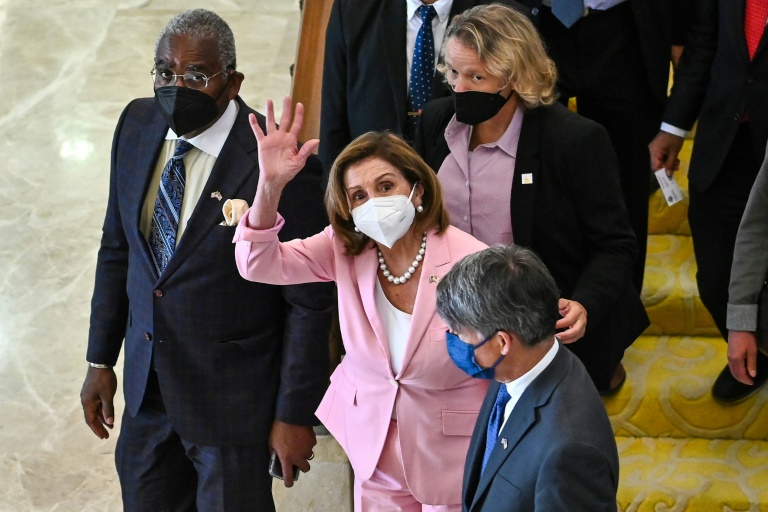
Asian markets mostly rose Wednesday after the previous day’s reverse, with focus on House Speaker Nancy Pelosi’s visit to Taiwan, which has further strained already tense China-US ties and raised concerns about the long-term impact on the global outlook.

The highest profile trip to the island in 25 years by a US politician was met with condemnation from Beijing, which warned of serious economic and military consequences.

Taiwan said more than 20 Chinese military aircraft had flown into the island’s air defence identification zone — an area wider than its territorial airspace that overlaps with part of China’s air defence zone. The People’s Liberation Army was also due to conduct a series of drills.

Beijing views the self-ruled island as part of its territory to be seized by force if necessary.

No one expected it would spark a conflict, but the crisis sent shivers through trading floors that were already on edge over a range of issues including the Ukraine war, surging inflation, rising interest rates and slowing economic growth.

However, ahead of a meeting between Pelosi and Taiwan President Tsai Ing-wen most markets saw a recovery, with Hong Kong and Shanghai among the best gainers.

Tokyo, Singapore, Seoul, Wellington and Manila were also up, though Taipei, Sydney and Jakarta edged down.

The “short-term implication may be ‘sell the rumour, buy the news’ as the official response so far remains much more restrained versus what the market has feared,” Xiadong Bao, at Edmond de Rothschild Asset Management, said.

“But the mid/long-term implication can be more significant, which may be currently overlooked by the market. The official return of the US influence in Asia-Pacific will inevitably accelerate US-China decoupling.”

Analysts are also keen to find out what the White House’s response will be, particularly ahead of mid-term elections in November with anti-China rhetoric playing well with voters, but with President Joe Biden keen not to further harm economic ties.

SPI Asset Management’s Stephen Innes added that the US administration was probably not likely to cut Trump-era tariffs before then.

The positive start to the day in Asia followed a drop on Wall Street, where the Taiwan crisis was compounded by a series of hawkish comments from Federal Reserve officials indicating more big interest rate hikes could still be in the pipeline.

Stocks rallied last week and Treasury yields dropped after boss Jerome Powell hinted the bank could begin slowing down, but the latest remarks suggest a hoped-for dovish pivot might not be coming just yet as inflation remains stubbornly high.

The latest developments have raised concerns that the volatility on markets would likely continue for some time.

“It’s hard to see any meaningful upside in equities right now,” said Xi Qiao, of UBS Group. “The market is going to trade pretty mixed, stay choppy until we have a little bit more certainty,” she told Bloomberg News.

– Key figures at around 0230 GMT –

Tokyo – Nikkei 225: UP 0.5 percent at 27,740.97 (break)

Hong Kong – Hang Seng Index: UP 0.9 percent at 19,864.26

Shanghai – Composite: UP 0.6 percent at 3,204.47

Taipei – TAIEX: DOWN 0.1 percent at 14,732.65

Dollar/yen: UP at 133.54 yen from 133.10 yen Tuesday

Euro/dollar: UP at $1.0174 from $1.0168

Pound/dollar: UP at $1.2165 from $1.2163

Euro/pound: UP at 83.64 pence from 83.57 pence

West Texas Intermediate: UP 0.1 percent at $94.50 per barrel

Brent North Sea crude: FLAT at $100.54 per barrel

New York – Dow: DOWN 1.2 percent at 32,396.17 (close)

London – FTSE 100: DOWN 0.1 percent at 7,409.11 (close)

Most Asian markets rise but Taiwan fears keep confidence in check

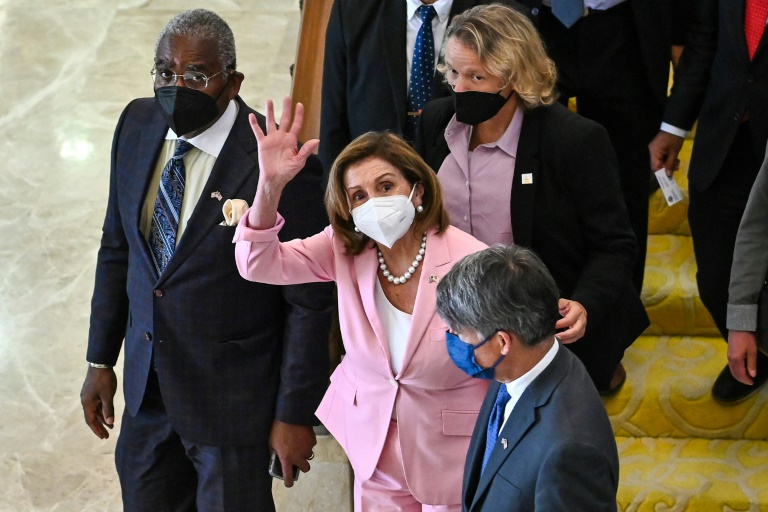
Asian markets mostly rose Wednesday after the previous day’s reverse, with focus on House Speaker Nancy Pelosi’s visit to Taiwan, which has further strained already tense China-US ties and raised concerns about the long-term impact on the global outlook.

The highest profile trip to the island in 25 years by a US politician was met with condemnation from Beijing, which warned of serious economic and military consequences.

Taiwan said more than 20 Chinese military aircraft had flown into the island’s air defence identification zone — an area wider than its territorial airspace that overlaps with part of China’s air defence zone. The People’s Liberation Army was also due to conduct a series of drills.

Beijing views the self-ruled island as part of its territory to be seized by force if necessary.

No one expected it would spark a conflict, but the crisis sent shivers through trading floors that were already on edge over a range of issues including the Ukraine war, surging inflation, rising interest rates and slowing economic growth.

However, ahead of a meeting between Pelosi and Taiwan President Tsai Ing-wen most markets saw a recovery, with Hong Kong and Shanghai among the best gainers.

Tokyo, Singapore, Seoul, Wellington and Manila were also up, though Taipei, Sydney and Jakarta edged down.

The “short-term implication may be ‘sell the rumour, buy the news’ as the official response so far remains much more restrained versus what the market has feared,” Xiadong Bao, at Edmond de Rothschild Asset Management, said.

“But the mid/long-term implication can be more significant, which may be currently overlooked by the market. The official return of the US influence in Asia-Pacific will inevitably accelerate US-China decoupling.”

Analysts are also keen to find out what the White House’s response will be, particularly ahead of mid-term elections in November with anti-China rhetoric playing well with voters, but with President Joe Biden keen not to further harm economic ties.

SPI Asset Management’s Stephen Innes added that the US administration was probably not likely to cut Trump-era tariffs before then.

The positive start to the day in Asia followed a drop on Wall Street, where the Taiwan crisis was compounded by a series of hawkish comments from Federal Reserve officials indicating more big interest rate hikes could still be in the pipeline.

Stocks rallied last week and Treasury yields dropped after boss Jerome Powell hinted the bank could begin slowing down, but the latest remarks suggest a hoped-for dovish pivot might not be coming just yet as inflation remains stubbornly high.

The latest developments have raised concerns that the volatility on markets would likely continue for some time.

“It’s hard to see any meaningful upside in equities right now,” said Xi Qiao, of UBS Group. “The market is going to trade pretty mixed, stay choppy until we have a little bit more certainty,” she told Bloomberg News.

– Key figures at around 0230 GMT –

Tokyo – Nikkei 225: UP 0.5 percent at 27,740.97 (break)

Hong Kong – Hang Seng Index: UP 0.9 percent at 19,864.26

Shanghai – Composite: UP 0.6 percent at 3,204.47

Taipei – TAIEX: DOWN 0.1 percent at 14,732.65

Dollar/yen: UP at 133.54 yen from 133.10 yen Tuesday

Euro/dollar: UP at $1.0174 from $1.0168

Pound/dollar: UP at $1.2165 from $1.2163

Euro/pound: UP at 83.64 pence from 83.57 pence

West Texas Intermediate: UP 0.1 percent at $94.50 per barrel

Brent North Sea crude: FLAT at $100.54 per barrel

New York – Dow: DOWN 1.2 percent at 32,396.17 (close)

London – FTSE 100: DOWN 0.1 percent at 7,409.11 (close)

US Senate passes act to help veterans with health issues from toxic burn pits

US senators on Tuesday approved benefits for veterans exposed to toxic burn pits, which President Joe Biden, who believes his son Beau died of such exposure, has called a “decisive and bipartisan win.”

Open trash fires have been commonly used by the US military in conflicts after the September 11, 2001 attacks, and are lit to get rid of everything from plastic bottles to human waste and old tires — all incinerated with jet fuel.

But the fumes from these holes in the ground are suspected of causing a range of illnesses among soldiers, from chronic respiratory ailments to a variety of cancers.

Biden believes the pits are at the root of the brain cancer that claimed the life of his son Beau, who served in Iraq in 2008.

By 86 votes to 11, the Senate passed the PACT Act, which expands the window of eligibility for free medical care and ensures that, for certain respiratory illnesses and cancers, veterans will get disability benefits without having to prove they were made sick by exposure to the pits. 

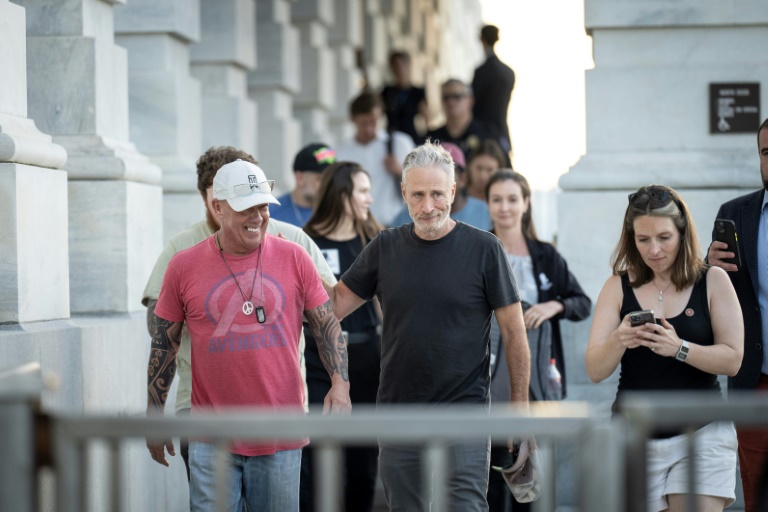
The passage came just days after Republican senators had rejected the bill, triggering withering condemnation from veterans groups and activists, including the outspoken comedian Jon Stewart, who had championed the cause.

Biden welcomed the approval of the act, saying, “While we can never fully repay the enormous debt we owe to those who have worn the uniform, today, the United States Congress took important action to meet this sacred obligation.”

He said the new law would be “the biggest expansion of benefits for service-connected health issues in 30 years and the largest single bill ever to comprehensively address exposure to burn pits.”

– ‘Proper care’ for exposure –

Vice President Kamala Harris said that “too many of our veterans and their families have long waited for this day. With today’s passage of the PACT Act, our veterans will finally see an expansion of their health benefits and proper care for burn pit exposure. They deserve it.”

The Department of Veterans Affairs estimates that some 3.5 million US service members were exposed to toxic smoke in Afghanistan, Iraq or other conflict zones, and more than 200,000 veterans have registered on lists of people who came into contact with burn pits.

The Pentagon funded a $10 million study in 2018 that concluded there was “a potential cause and effect relationship between exposure to emissions from simulated burn pits and subsequent health outcomes.”

Until now, nearly 80 percent of veterans’ requests to have suspected burn pit ailments acknowledged by the government were rejected, according to the Iraq and Afghanistan Veterans of America (IAVA).

A poll by the organization found that 82 percent of those questioned said they were exposed to burn pits or other airborne toxic chemicals. 

Of these people, 90 percent said they are or may be suffering from symptoms linked to that exposure.

Apple TV+ counts its 'Luck' as fallen 'Toy Story' exec makes comeback

Like all good animated family movies, “Luck” has a thoroughly optimistic premise: that no matter how hopeless or dire your circumstances may seem, something good will eventually come of it.

Apple TV+ will be hoping the same is true for John Lasseter, the former Pixar guru who resigned under a cloud of #MeToo harassment claims, and later became head of the new Skydance Animation.

“Luck” is that studio’s first film, available to stream Friday, which follows 18-year-old girl Sam and a talking black cat called Bob on their adventures in the fantastical Land of Luck.

In this land of perfect fortune, all the world’s good and bad luck is produced by magical creatures including leprechauns, dragons, unicorns and goblins, who then funnel it down to Earth.

The movie features a voice cast of Simon Pegg, Whoopi Goldberg and Jane Fonda, along with Broadway star Eva Noblezada in the lead role of Sam, the world’s unluckiest girl.

The cast could have been even starrier, had Emma Thompson not very publicly withdrawn in 2019 over the hiring of Lasseter, publishing her resignation letter in the Los Angeles Times.

It was a decision that other cast members have mulled over, with Pegg telling AFP he “initially” had qualms before deciding to proceed.

“It’s a dangerous thing to just write people off immediately, I think, if there’s some accountability, if there’s some acknowledgement and acceptance,” he told AFP.

– ‘Complicated’ –

Lasseter, who transformed Pixar from a small Lucasfilm graphics department into the world’s most successful animation studio with hits including “Toy Story,” was accused of misconduct at the 2017 height of the #MeToo movement.

The powerful studio president apologized to “anyone who has ever been on the receiving end of an unwanted hug,” and for “falling short” in ensuring a culture of “trust and respect.” 

The following year, he resigned, acknowledging in an internal memo that he had made staff feel “disrespected or uncomfortable.”

Multiple sources alleged that Lasseter was a heavy drinker at company social events who would try to kiss women, place his hands on their thighs and hug them in meetings. 

In her letter, Thompson said the case of Lasseter was “complicated.”

Upon his hiring by Skydance, Thompson wrote that “any Skydance employees who don’t want to give him a second chance have to stay and be uncomfortable or lose their jobs.”

For Pegg, it was important that Lasseter had “admitted accountability for the things that had been aimed at him.”

“We’re all doomed if we are banished for stuff that we regret and apologize for, and mean that apology. That’s the most important thing.”

Goldberg had a more succinct take: “Everybody steps in it sometime,” she told AFP.

– ‘Real-world stakes’ –

In the film, Sam — an orphan who has reached adulthood without finding a permanent foster home — follows Bob the cat (Pegg) into the Land of Luck in order to find a lucky penny.

She hopes this magical coin can help her young friend Hazel find the “forever family” she never had.

Of course, getting her hands on it is anything but straightforward, taking Sam on a physical journey through the realm’s whirring Rube Goldberg machines and glittering waterfalls — and an emotional one.

“I really love that element. It’s a film which is the most outrageous environments and concepts but paired with genuine real-world stakes about friendship,” said Pegg.

“Sometimes what appears to be bad luck can end up being good luck. Not least for Sam, who apparently lives an entire life of bad luck, only to go on this adventure and find exactly what she’s looking for.”

For the filmmakers, the withdrawal of Thompson led to the hiring of Oscar-winner and social campaigner Jane Fonda, playing an elegant dragon who is the CEO of the luck-making operation. 

“When Jane joined the cast, I looked to her as being such a legendary activist and feminist,” said Pegg.

“I felt like she was a great person to take the lead from. And it was her involvement in the film that cemented my decision to do it.”

Colombian deforestation policy 'failure' a headache for new government

Colombian President Ivan Duque’s environmental policies “failed” according to experts who dispute the outgoing right-wing government’s claims to have reduced deforestation.

With conservative Duque due to hand over to his left-wing successor Gustavo Petro on Sunday, the new government will have to find solutions to the problem.

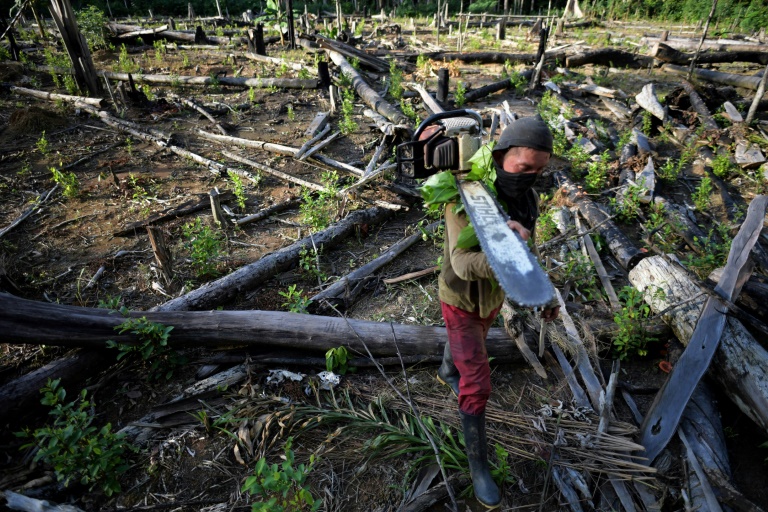
The South American country is one of the most biodiverse in the world, according to the United Nations, but between 2018 and 2021 it lost an area of forest larger than the size of the Gaza Strip (7,000 square kilometers, 2,700 square miles), according to official data.

The Duque government “focused on military and judicial operations” to tackle deforestation, particularly in the Amazon rainforest, but these “failed,” according to former environment minister Manuel Rodriguez (1991-96).

And even though the deforestation figure is worse than the previous four years, from 2014-2017 (6,500 square kilometers), the government has defended its record.

“This phenomena reduced by 34 percent compared to the trend model,” said environment minister Carlos Correa when presenting the 2021 deforestation figure of 1,741 square kilometers.

But instead of comparing that figure to the 1,717 square kilometers from 2020, the government contrasted it against a projection model based on the trend between 2008 and 2017, when deforestation was out of control.

“So, faced with a hypothetical catastrophic scenario, is losing 1,700 square kilometers of forest good? I don’t think so,” said Rodrigo Botero, director of the Conservation and Development Foundation.

Botero says the authorities’ own figures show that rainforest loss increased between 2019 and 2021.

“We are still at a very high point on the deforestation curve,” Botero told AFP.

“The fact that we have had three consecutive years of increase means that there is no control over the structural variables, it’s an alarming sign.”

Colombia is not the only South American country struggling to rein in the loss of forests.

Neighboring Brazil, which is home to the majority of the Amazon rainforest, saw a record amount lost in the first half of 2022.

The figure of 3,750 square kilometers topped the previous record for the first half of the year, set in 2021.

– ‘Modest’ government success –

President-elect Petro, who will be Colombia’s first ever left-wing leader, has said he will prioritize the fight against climate change and environmental protection.

Petro says he will suspend oil exploration to progressively move to clean energy and will restrict the expansion of farming in the Amazon.

He also aims to create environmental reserves where indigenous and peasant communities can develop sustainable projects.

But before then, the new president will need to decide what to do about his predecessor’s strategy.

In April 2019, eight months after coming to power, Duque launched the Artemisa military operation to fight deforestation using 23,000 soldiers.

Since then, around 100 people have been arrested and a similar number of pieces of machinery confiscated.

“Artemisa had 20 interventions, over four years that’s a pretty modest number,” said Rodriguez.

“You have to create a state presence in terms of education and the generation of employment.”

Peasants have complained that the military operation attacked the weakest links in the chain rather than the large-scale architects of deforestation.

Farming, land grabbing and the growing of drug crops are the main sources of deforestation.

As part of the Paris climate accords, Colombia committed to eliminate deforestation by 2030.

To do so, the environment ministry projects a reduction to 1,550 kilometers squared of lost forest in 2022 and just 1,000 square kilometers a year by 2025.

The government of Norway, which like Germany and the United Kingdom sends millions of dollars in aid to Colombia to preserve its forests, has expressed its alarm at the likelihood that Colombia will miss its first target.

And it could cost the country.

“We are not seeing a constant reduction in the rate of deforestation … the country could lose up to $260 million up to 2025 for not slowing it,” Ole Bergum, Norway’s climate and forests advisor in Colombia, told the El Tiempo newspaper. 

jss/vel/das/bc/jh

Close Bitnami banner
Bitnami