AFP

Alleged shooter of Lady Gaga's dog walker freed by mistake

US authorities were on Wednesday searching for the suspect accused of shooting Lady Gaga’s dog walker in 2021, months after he was accidentally released from custody.

James Howard Jackson, 19, is charged with shooting Ryan Fischer with a handgun near Sunset Boulevard in Los Angeles during an attempted kidnapping of the star’s valuable French bulldogs.

Jackson was released in April due to a “clerical error,” the US Marshals Service admitted, describing him as armed and dangerous.

It offered $5,000 for information about Jackson, one of three men charged with attempted murder and robbery over the attack.

Two of the suspects got out of a vehicle and demanded Fischer hand over the pets at gunpoint. Fisher was shot in a struggle before the men fled with two of the dogs, Koji and Gustav.

A third dog, Miss Asia, ran away during the encounter before returning to the badly-wounded Fischer.

Police said they don’t believe the suspects targeted the dogs because of their famous owner, but because they are a coveted breed that can sell for thousands of dollars.

A 50-year-old woman turned the two missing pets over to police two days after the theft.

At the time, the three were described by Los Angeles police as “documented gang members.” Lady Gaga had offered a $500,000 reward for their safe return.

Europe counts cost of heatwave as Spain PM says more than 500 died

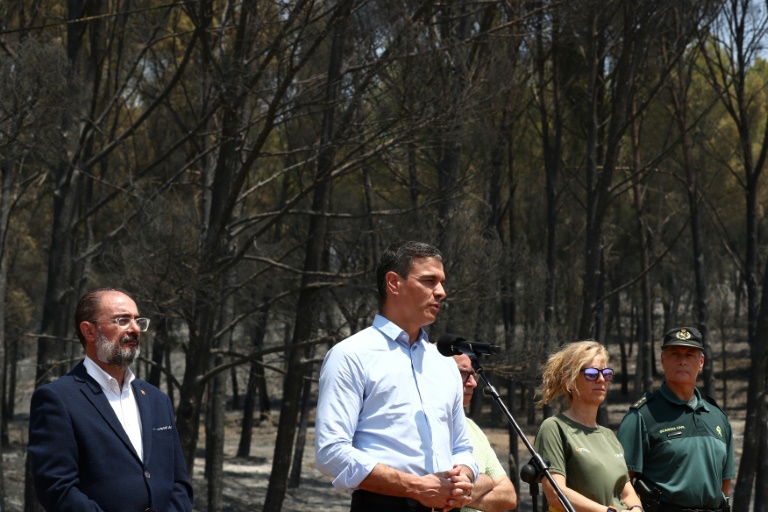
Spain’s prime minister said “more than 500 people died” during a 10-day heatwave as Europe counts the cost of a record period of extreme temperatures.

Climate change protesters warned the scorching weather should be a wake-up call for the continent.

Spanish Prime Minister Pedro Sanchez said the “climate emergency is a reality”.

Speaking against a backdrop of charred trees and burnt ground in the hard-hit northeastern Zaragoza region, he urged people to take “extreme caution”.

Sanchez cited figures released by the Carlos III Health Institute, which estimates the number of heat-related fatalities based on the number of excess deaths compared to the average in previous years.

The institute has stressed these figures are a statistical estimate and not a record of official deaths.

Meanwhile Greek firefighters gained the upper hand in a battle against a wildfire raging for a second day in mountainside suburbs north of Athens that had forced hundreds of people to flee, an official said.

“For the most part the fire is in decline,” fire department spokesman Yiannis Artopios told reporters.

Greece had been spared the blistering heatwave experienced in western Europe, but flames fanned by high winds were threatening the suburbs of Penteli, Pallini, Anthousa and Gerakas, home to tens of thousands of people.

“The fire was scorching our backs, we left in the nick of time. Had we stayed another 30 seconds it would have burned us,” a Pallini resident who lost his car and shed to the flames told ERT television. 

“The civil protection authority was late in alerting us,” he said.

In France, firefighters brought twin blazes near the southwestern city of Bordeaux under control. 

Temperatures of more than 40 degrees Celsius (104 degrees Fahrenheit) over previous days have spelled misery for millions and shattered heat records.

Cooler air swept in Wednesday, bringing relief to people from Portugal to Britain, but thousands of firefighters continued to tackle blazes that have broken out in multiple countries after months of drought-like conditions.

“Our assessment is generally positive. The situation improved overnight,” French fire service spokesman Arnaud Mendousse told AFP from the southwestern Gironde region where two huge blazes have engulfed 20,600 hectares (50,900 acres) of tinder-dry forest since last week.

– Heat records –

The heatwave saw a new all-time record for Britain where the national weather service clocked 40.3C in eastern England, surpassing the previous high set in 2019.

Grassland fires erupted on Tuesday on the edge of London, with one forcing the evacuation of 14 people as farm buildings, houses and garages were consumed by the flames.

Sixteen firefighters were injured around the capital with two taken to hospital, the London Fire Brigade said.

“Yesterday was the busiest day for the fire service in London since the Second World War,” the city’s mayor Sadiq Khan told Sky News on Wednesday, urging the public to remain vigilant despite temperatures now falling.

Khan also accused Conservative leadership candidates vying to succeed Prime Minister Boris Johnson of ignoring “the elephant in the room” of climate change.

Climate demonstrators triggered a lengthy tailback on Britain’s busiest motorway encircling London on Wednesday as they sought to highlight the need for greater action to reduce greenhouse gases responsible for global heating.

Members of the group Just Stop Oil climbed gantries over the M25 motorway, causing police to intervene.

“This is the moment when climate inaction is truly revealed in all its murderous glory for everyone to see: as an elite-driven death project that will extinguish all life if we let it,” the activist group said in a statement.

burs-adp/jh/bp/ds/lcm/imm

Mammals became warm-blooded later than thought: study

The ancestors of mammals started to become warm-blooded around 20 million years later than previously thought, researchers suggested Wednesday, after analysing inner-ear fossils hoping to solve “one of the great unsolved mysteries of palaeontology”.

Warm-bloodedness is one of the quintessential characteristics of mammals, along with fur, but exactly when they first evolved the feature has long been a subject of debate.

Previous research has indicated that the ancestors of mammals began evolving warm-bloodedness, or endothermy, around 252 million years ago — around the time of the Permian extinction, known as the “Great Dying”.

However figuring out the timeline has proved difficult.

“The problem is that you cannot stick thermometers in your fossils, so you cannot measure their body temperature,” said Ricardo Araujo of the University of Lisbon, one of the authors of a new study in the journal Nature.

He was part of an international team of researchers that found a new way to determine how body heat changed throughout time, by examining the semicircular canals in the inner ears of 56 extinct species of mammal ancestors.

Fluid runs through the tiny ear canals, which help animals keep their balance.

The researchers realised that as body temperatures warmed up, so did the ear fluid. 

Araujo gave the example of oil used to fry hot chips.

Before you warm the oil up, it is “very viscous, very dense,” he told AFP.

“But then when you heat it up, you’ll see that the oil is much runnier, it flows much more easily.”

The runnier ear fluid led to animals evolving narrower canals — which can be measured in fossils, allowing the researchers to track body temperature over time.

Unlike previous research on this subject, the team developed a model that not only works on extinct mammal ancestors, but also living mammals, including humans.

“It can look at your inner ear and tell you how warm-blooded you are — that’s how accurate the model is,” lead study author Romain David of London’s Natural History Museum told AFP.

Using the model, they traced the beginnings of warm-bloodedness to around 233 million ago, in the Late Triassic period. 

– ‘Not a gradual, slow process’ –

Michael Benton, a palaeontologist at Britain’s University of Bristol who was not involved in the study, said the new metric “seems to work well for a wide array of modern vertebrates”.

“It doesn’t just provide a yes-no answer, but actually scales the ‘degree’ of endothermy in terms of actual typical body setpoint temperature,” he told AFP.

Benton, whose previous research had given the 252 million years date, said the transition to warm-bloodedness likely took place in stages, and “there were several significant prior steps before this semicircular canal switch”.

Araujo said the new research suggested that warm-bloodedness came about simply and “very quickly in geological terms, in less than a million years”.

“It was not a gradual, slow process over tens of millions of years as previously thought”.

David said it seemed unlikely that warm-bloodedness would begin around the extinction event 252 million years ago, because global temperatures were extremely hot then. 

That would have been a disadvantage for warm-blooded animals — but they could have thrived as temperatures cooled in the following millions of years.

“Being an endotherm allows you to be more independent of the whims of the climate, to run faster, run longer, explore different habitats, explore the night, explore polar regions, make long migrations,” Araujo said.

“There were a lot of innovations at the time that started to define what a mammal is — but also ultimately what a human being would be.”

Why Biden's climate agenda has faltered

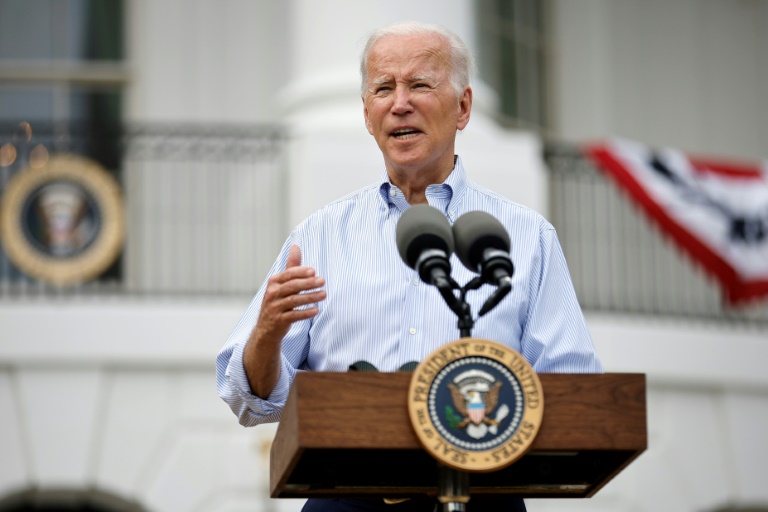
President Joe Biden ran for office on a pledge to tackle the global climate crisis. 

Instead, he has seen his legislative ambitions defeated by Congress, the Supreme Court has delivered a hammer blow to the federal government’s ability to regulate greenhouse gasses, and the Ukraine crisis has been a boon for fossil fuels.

As the Democrat is poised to announce a series of new executive measures, including additional funding to help protect communities from extreme heat and boosting wind production, here is an overview of his term so far.

– What’s at stake – 

Shortly after taking office, Biden announced he was targeting a 50-52 percent reduction from 2005 levels in US economy-wide net greenhouse gas pollution in 2030, before achieving net zero in 2050, as part of the country’s Paris Agreement goals.

“Biden has said he thinks that climate change is the existential issue of our time,” and has been more emphatic than any of his predecessors including Barack Obama, Paul Bledsoe of the Progressive Policy Institute told AFP.

The president has framed the issue as key to the economic and national security of the United States, as well as public safety — and climate scientists are sounding the alarm now more than ever.   

“I think that more and more people are realizing that we’re living through what could eventually cause us to lose everything in terms of habitability and everything that we value in life,” climate scientist Peter Kalmus told AFP.

Europe’s punishing heatwave serves as a timely reminder that warming won’t be an issue confined to the Global South, but instead threatens civilization as we know it, he added.

– Congress, the Supreme Court, and Ukraine –  

The main legislative plank of Biden’s agenda was to have been the Build Back Better bill, which would have plowed $550 billion into the clean energy and climate businesses — much coming from tax credits and incentives.

That effort is now in tatters after Democratic Senator Joe Manchin, a fossil fuel booster who wields outsized power in the evenly split Senate, walked away last week from the bill that he’d promised to back.

At the end of June, the conservative supermajority Supreme Court found that the federal Environmental Protection Agency cannot issue broad limits on greenhouse gasses, such as cap-and-trade schemes, without Congressional approval.

“So we’re on two strikes,” said Bledsoe, who served as a climate aide to former president Bill Clinton.

What’s more, the oil industry has pushed for more drilling in the wake of Russia’s invasion of Ukraine, casting the issue as one of energy security. 

A recent analysis by the Institute for Energy Research said that Biden’s government picked up the pace of drilling permits on public land from March onward “to mollify the political pressure rising along with pump prices.”

Biden had vowed to end new drilling on public lands, but his “pause” was overturned by a Trump-appointed judge in 2021.

On the other hand, there have been some partial wins: the administration has promulgated tighter emissions standards for vehicles, and toughened regulations on super-polluting methane emissions, said Bledsoe.

The bipartisan infrastructure law, passed last November, also contained some climate provisions, including $7.5 billion for a nationwide network of electric vehicle chargers and investments in carbon capture and hydrogen technologies.

– What’s next? – 

But without the big ticket items, the United States is falling far short of its goals. 

The Rhodium Group, an independent research firm, finds that “as of June 2022, we find that the US is on track to reduce emissions 24 percent to 35 percent below 2005 levels by 2030 absent any additional policy action.”

The White House has not ruled out declaring a “climate emergency,” which would grant Biden additional policy powers, but given a hostile judiciary, this would likely be subject to legal challenge.

Bledsoe said to achieve real change, Biden should instead push for broad public backing.

“Democrats should make popular consumer clean energy tax breaks a key election issue to gain seats in Congress, and pass the bill in January 2023.”

Why Biden's climate agenda has faltered

President Joe Biden ran for office on a pledge to tackle the global climate crisis. 

Instead, he has seen his legislative ambitions defeated by Congress, the Supreme Court has delivered a hammer blow to the federal government’s ability to regulate greenhouse gasses, and the Ukraine crisis has been a boon for fossil fuels.

As the Democrat is poised to announce a series of new executive measures, including additional funding to help protect communities from extreme heat and boosting wind production, here is an overview of his term so far.

– What’s at stake – 

Shortly after taking office, Biden announced he was targeting a 50-52 percent reduction from 2005 levels in US economy-wide net greenhouse gas pollution in 2030, before achieving net zero in 2050, as part of the country’s Paris Agreement goals.

“Biden has said he thinks that climate change is the existential issue of our time,” and has been more emphatic than any of his predecessors including Barack Obama, Paul Bledsoe of the Progressive Policy Institute told AFP.

The president has framed the issue as key to the economic and national security of the United States, as well as public safety — and climate scientists are sounding the alarm now more than ever.   

“I think that more and more people are realizing that we’re living through what could eventually cause us to lose everything in terms of habitability and everything that we value in life,” climate scientist Peter Kalmus told AFP.

Europe’s punishing heatwave serves as a timely reminder that warming won’t be an issue confined to the Global South, but instead threatens civilization as we know it, he added.

– Congress, the Supreme Court, and Ukraine –  

The main legislative plank of Biden’s agenda was to have been the Build Back Better bill, which would have plowed $550 billion into the clean energy and climate businesses — much coming from tax credits and incentives.

That effort is now in tatters after Democratic Senator Joe Manchin, a fossil fuel booster who wields outsized power in the evenly split Senate, walked away last week from the bill that he’d promised to back.

At the end of June, the conservative supermajority Supreme Court found that the federal Environmental Protection Agency cannot issue broad limits on greenhouse gasses, such as cap-and-trade schemes, without Congressional approval.

“So we’re on two strikes,” said Bledsoe, who served as a climate aide to former president Bill Clinton.

What’s more, the oil industry has pushed for more drilling in the wake of Russia’s invasion of Ukraine, casting the issue as one of energy security. 

A recent analysis by the Institute for Energy Research said that Biden’s government picked up the pace of drilling permits on public land from March onward “to mollify the political pressure rising along with pump prices.”

Biden had vowed to end new drilling on public lands, but his “pause” was overturned by a Trump-appointed judge in 2021.

On the other hand, there have been some partial wins: the administration has promulgated tighter emissions standards for vehicles, and toughened regulations on super-polluting methane emissions, said Bledsoe.

The bipartisan infrastructure law, passed last November, also contained some climate provisions, including $7.5 billion for a nationwide network of electric vehicle chargers and investments in carbon capture and hydrogen technologies.

– What’s next? – 

But without the big ticket items, the United States is falling far short of its goals. 

The Rhodium Group, an independent research firm, finds that “as of June 2022, we find that the US is on track to reduce emissions 24 percent to 35 percent below 2005 levels by 2030 absent any additional policy action.”

The White House has not ruled out declaring a “climate emergency,” which would grant Biden additional policy powers, but given a hostile judiciary, this would likely be subject to legal challenge.

Bledsoe said to achieve real change, Biden should instead push for broad public backing.

“Democrats should make popular consumer clean energy tax breaks a key election issue to gain seats in Congress, and pass the bill in January 2023.”

Biden to announce climate action as heatwave hits Europe

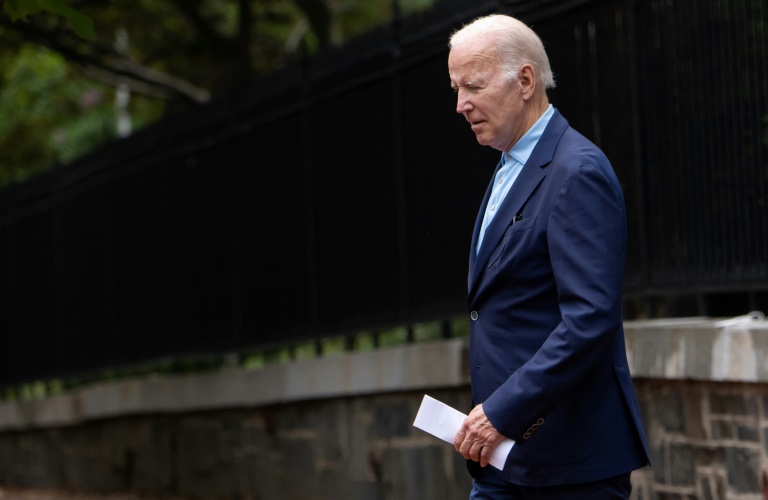
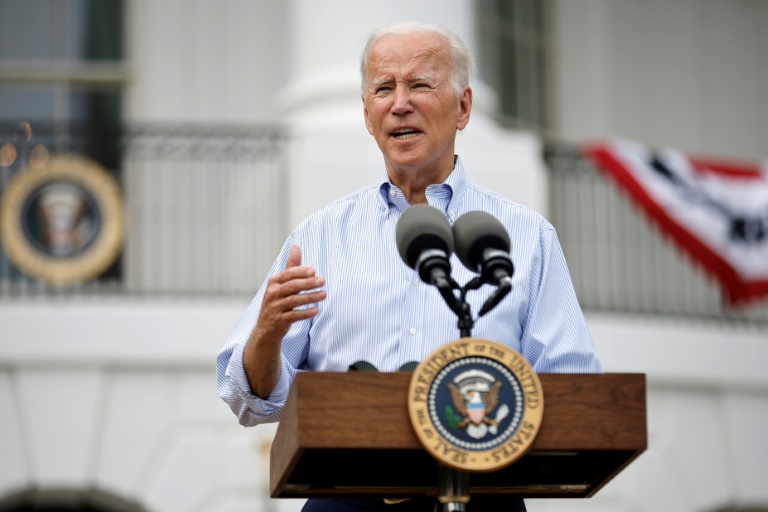
US President Joe Biden will announce Wednesday a series of executive measures to combat climate change, in an effort to push forward an environmental agenda stalled by an unsupportive Congress and a conservative Supreme Court.

Biden — who will deliver his address from a former coal power plant in Massachusetts — will make clear that time is running out to tackle global warming, highlighted by a devastating heatwave in Europe that has sparked fires, melted runways and spelled misery for millions.

But he will stop short of declaring a formal emergency, which would grant him additional policy powers.

“The president… is going to make it clear that just because Congress couldn’t get it done, he is going to move forward with every power available to him to make the change and the shift to clean energy,” White House climate advisor Gina McCarthy told CNN.

“The president will make very clear again that this is an emergency and we are going to act. But the president is going to outline that at his pace.”

For now, he is expected to use executive orders to provide additional funding for communities dealing with extreme heat and actions to boost US production of wind power.

The efforts are part of the administration’s goals to move “the US power sector away from the pollution, environmental injustice, and volatile price swings of the past,” a White House official said, and “toward the good-paying jobs, lower costs, and energy security of the future.”

-Repeated setbacks –

Biden began his term last year promising to fulfill campaign pledges to tackle the global climate crisis, but his agenda has faced blow after blow.

His first day in office, Biden signed an executive order to bring the United States back into the Paris Climate Agreement, followed later by an ambitious announcement that he was targeting a 50-52 percent reduction from 2005 levels in US net greenhouse gas pollution by 2030.

But his signature Build Back Better legislation, which would have included $550 billion for clean energy and other climate initiatives, is all but dead after failing to receive the necessary backing in Congress as Democratic Senator Joe Manchin said he would not support the bill.

And last month, the Supreme Court ruled that the Environmental Protection Agency (EPA) cannot issue broad greenhouse gas regulations without congressional approval.

McCarthy insisted however that “regulatory action is still strong,” saying: “We are going to move, not just with the EPA, but with others.”

The Biden administration has framed climate policies as a national security issue, made all the more urgent by soaring fuel prices in the wake of Russia’s invasion of Ukraine. 

“Not only does it affect our infrastructure… It has an impact on our readiness,” White House spokesman John Kirby said Tuesday. 

State Department spokesman Ned Price pointed to the extreme heat wave tormenting Europe this week — with Britain recording a temperature of 104 degrees Fahrenheit (40 degrees Celsius) — as more proof that climate action cannot wait. 

“We are committed to taking advantage of this moment and doing everything we can, including on the world stage,” Price told reporters, “to ensure that this decisive decade does not go by without us taking appropriate action.”

Biden to announce climate action as heatwave hits Europe

US President Joe Biden will announce Wednesday a series of executive measures to combat climate change, in an effort to push forward an environmental agenda stalled by an unsupportive Congress and a conservative Supreme Court.

Biden — who will deliver his address from a former coal power plant in Massachusetts — will make clear that time is running out to tackle global warming, highlighted by a devastating heatwave in Europe that has sparked fires, melted runways and spelled misery for millions.

But he will stop short of declaring a formal emergency, which would grant him additional policy powers.

“The president… is going to make it clear that just because Congress couldn’t get it done, he is going to move forward with every power available to him to make the change and the shift to clean energy,” White House climate advisor Gina McCarthy told CNN.

“The president will make very clear again that this is an emergency and we are going to act. But the president is going to outline that at his pace.”

For now, he is expected to use executive orders to provide additional funding for communities dealing with extreme heat and actions to boost US production of wind power.

The efforts are part of the administration’s goals to move “the US power sector away from the pollution, environmental injustice, and volatile price swings of the past,” a White House official said, and “toward the good-paying jobs, lower costs, and energy security of the future.”

-Repeated setbacks –

Biden began his term last year promising to fulfill campaign pledges to tackle the global climate crisis, but his agenda has faced blow after blow.

His first day in office, Biden signed an executive order to bring the United States back into the Paris Climate Agreement, followed later by an ambitious announcement that he was targeting a 50-52 percent reduction from 2005 levels in US net greenhouse gas pollution by 2030.

But his signature Build Back Better legislation, which would have included $550 billion for clean energy and other climate initiatives, is all but dead after failing to receive the necessary backing in Congress as Democratic Senator Joe Manchin said he would not support the bill.

And last month, the Supreme Court ruled that the Environmental Protection Agency (EPA) cannot issue broad greenhouse gas regulations without congressional approval.

McCarthy insisted however that “regulatory action is still strong,” saying: “We are going to move, not just with the EPA, but with others.”

The Biden administration has framed climate policies as a national security issue, made all the more urgent by soaring fuel prices in the wake of Russia’s invasion of Ukraine. 

“Not only does it affect our infrastructure… It has an impact on our readiness,” White House spokesman John Kirby said Tuesday. 

State Department spokesman Ned Price pointed to the extreme heat wave tormenting Europe this week — with Britain recording a temperature of 104 degrees Fahrenheit (40 degrees Celsius) — as more proof that climate action cannot wait. 

“We are committed to taking advantage of this moment and doing everything we can, including on the world stage,” Price told reporters, “to ensure that this decisive decade does not go by without us taking appropriate action.”

US home sales fall again in June as prices hit new record

US home prices hit another new peak in June amid short supply, while existing home sales fell for the fifth straight month amid the ongoing rise in mortgage rates, according to industry data released Wednesday.

Sales sank 5.4 percent compared to May, toppling to a 5.12 million annual rate, far below what economists were projecting, the National Association of Realtors (NAR) reported.

That was the weakest sales pace since January 2019, excluding the start of the pandemic in 2020, NAR Chief Economist Lawrence Yun told reporters.

After topping $400,000 for the first time ever, the median national home price continued to rise, hitting $416,000 last month, the data showed.

“A combination of higher prices and higher mortgage rates clearly has shifted the dynamics in the housing market,” Yun said. “Even people who want to buy are simply priced out, given these affordability challenges.”

With inflation soaring and American families struggling to make ends meet, the Federal Reserve has been aggressively raising interest rates to try to cool demand and ease the pressure. But that has put homes out of reach for many.

Separate data from the Mortgage Bankers Association released Wednesday showed demand for home loans fell 6.3 percent last week, in the third consecutive decline.

The Fed is watching the housing market closely for signs that scorching inflation might be easing.

While sales increased for homes above $500,000, NAR said there were large double-digit declines in the lower price categories, reflecting the affordability challenge and the fact rising prices are pushing some homes into higher price buckets.

Yun noted that price increases are slowing, while weakening demand is allowing inventories to build up, reaching 2.7 months’ supply in June from just 1.8 in January.

But, he said, even if the housing market returns to something more like normal by year end, with “more manageable” price increases, “I don’t foresee a nationwide price decline.”

Sales fell 14.2 percent compared to June 2021, while the median price is up 13.4 percent, according to the data.

Existing home sales make up 90 percent of the real estate market.

US home sales fall again in June as prices hit new record

US home prices hit another new peak in June amid short supply, while existing home sales fell for the fifth straight month amid the ongoing rise in mortgage rates, according to industry data released Wednesday.

Sales sank 5.4 percent compared to May, toppling to a 5.12 million annual rate, far below what economists were projecting, the National Association of Realtors (NAR) reported.

That was the weakest sales pace since January 2019, excluding the start of the pandemic in 2020, NAR Chief Economist Lawrence Yun told reporters.

After topping $400,000 for the first time ever, the median national home price continued to rise, hitting $416,000 last month, the data showed.

“A combination of higher prices and higher mortgage rates clearly has shifted the dynamics in the housing market,” Yun said. “Even people who want to buy are simply priced out, given these affordability challenges.”

With inflation soaring and American families struggling to make ends meet, the Federal Reserve has been aggressively raising interest rates to try to cool demand and ease the pressure. But that has put homes out of reach for many.

Separate data from the Mortgage Bankers Association released Wednesday showed demand for home loans fell 6.3 percent last week, in the third consecutive decline.

The Fed is watching the housing market closely for signs that scorching inflation might be easing.

While sales increased for homes above $500,000, NAR said there were large double-digit declines in the lower price categories, reflecting the affordability challenge and the fact rising prices are pushing some homes into higher price buckets.

Yun noted that price increases are slowing, while weakening demand is allowing inventories to build up, reaching 2.7 months’ supply in June from just 1.8 in January.

But, he said, even if the housing market returns to something more like normal by year end, with “more manageable” price increases, “I don’t foresee a nationwide price decline.”

Sales fell 14.2 percent compared to June 2021, while the median price is up 13.4 percent, according to the data.

Existing home sales make up 90 percent of the real estate market.

Firefighters gain upper hand in Athens suburbs wildfire

Greek firefighters on Wednesday gained the upper hand in a battle against a wildfire raging for a second day in mountainside suburbs north of Athens that had earlier forced hundreds of people to flee, an official said.

“At the moment there is no active front…for the most part the fire is in decline,” fire department spokesman Yiannis Artopios told reporters.

Nearly 500 firefighters, 120 vehicles, nine planes and 10 helicopters supported by army units had earlier battled to prevent the flames from causing further damage in the suburbs of Penteli, Pallini, Anthousa and Gerakas, home to some 90,000 people.

Greece has been so far spared the kind of scorching heatwave that has seen deadly wildfires destroy vast tracts of land in France, Portugal and Spain, but has instead faced gale-force winds.

Experts blame climate change for extreme weather events and warn that worse is yet to come.

Thirty people, including three firefighters, required medical attention for burns and breathing difficulties, the fire department said earlier.

Several buildings have sustained varying degrees of damage from the fire that broke out Tuesday, AFP images showed.

Citizen’s Protection minister Takis Theodorikakos said his officers had since Tuesday helped evacuate nearly 700 people to safety, noting that some had refused to leave.

“The sky was red… we left without taking anything with us,” a Pallini resident who lost his car and shed to the flames told ERT television.

“The civil protection authority was late in alerting us. The fire was scorching our backs, we left in the nick of time. Had we stayed another 30 seconds it would have burned us,” he added.

The house next door was completely gutted, the man said.

Eleni Gerasimidou, a popular Greek comedian, was among those whose homes in Pallini were damaged.

“The house is no longer inhabitable…it has sustained massive damage,” she told Alpha TV, pointing to the charred upper floor.

The father of Olympic pole vault Katerina Stefanidi, Yiorgos, told Alpha TV he and some neighbours had fought the flames “with spades and dirt” to save his home, without any help from the fire service.

– ‘Faster than a car’ –

“The fire was racing faster than a car,” he said.

Authorities warned residents to stay indoors and keep their windows shut. 

With winds racing at over 100 kilometres (62 miles) per hour, smoke from the fire billowed as far as the island of Crete, hundreds of kilometres to the south, satellite imagery showed.

Residents say fires have struck the area three times in the last three decades.

Greek media reported that an 84-year-old man in Anthousa shot himself dead in despair over the fire.

The wildfires around Mount Penteli north of Athens were fanned overnight by strong winds that constantly changed direction.

Residents in several areas, a paediatric hospital and the national observatory at Athens were evacuated as a precautionary measure.

– ‘Insane’ –

“It was insane, we did not know where to flee,” an elderly resident of Anthousa told ERT.

“Embers were falling from the sky, I’ve never seen anything like it,” he said.

Greece has set up a crisis cell and firefighters battled 117 wildfires in the country in the last 24 hours.

A force of 87 firefighters had earlier been dispatched against a blaze in the Peloponnese, a southern peninsula. Another fire broke out in Megara, west of Athens on Wednesday.

Athens has asked European countries to send firefighters. A squad from Romania helped tackle Tuesday’s mountain fire.

A heatwave and wildfires last year destroyed 103,000 hectares (255,000 acres) and claimed three lives in Greece.

The country’s worst fire disaster was in 2018 in the coastal suburb of Mati, claiming 102 lives, just a few kilometres from the area affected by Wednesday’s blaze.


Close Bitnami banner
Bitnami