AFP

Long lines in New York for monkeypox vaccine

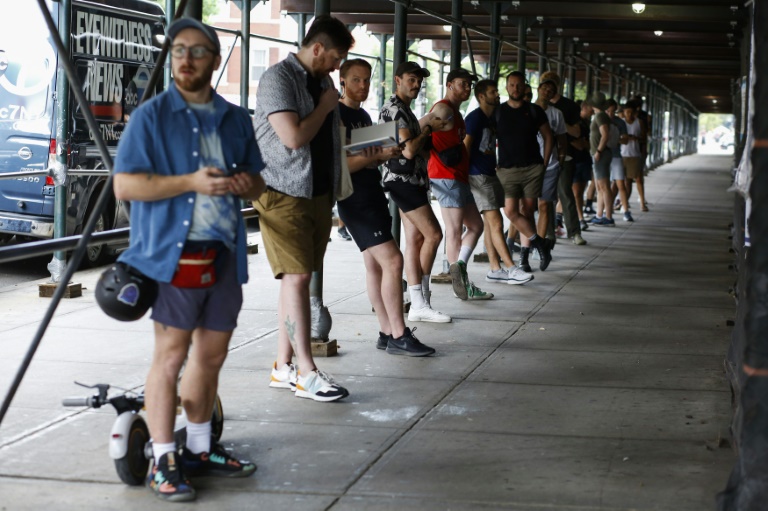
On a hot Sunday afternoon in New York, the epicenter of the US monkeypox outbreak, a long line of men aged 20 to 40 wait for a vaccine to protect themselves and their loved ones against the virus.

With its rows of tables and chairs and stacks of medical equipment, the vaccination center — a high school in Bushwick, Brooklyn — is reminiscent of a vaccine spot for Covid-19, a virus for which New York was also the US epicenter.

Everyone who spoke to AFP while waiting in line said they felt lucky to have gotten an appointment, as New York lacks doses. On Friday, 9,200 time slots became available on the city’s dedicated website at 6:00 pm.

They were all gone in seven minutes.

Three days earlier, site traffic was so high that the page crashed.

“It was frustrating, largely because especially with Covid, you’d think that we would have more of a structured process or vaccine rollout,” Aidan Baglivo, 23, told AFP. “There just wasn’t really anything.”

– ‘Shouldn’t be an issue’ –

The city of more than eight million people saw monkeypox infections climb last week, with 461 cases recorded Friday since the US outbreak began in May.

That number is up from 223 cases on Monday.

Baglivo, a data analyst, noted that people who are the most connected on social media have the highest chances of getting a vaccine appointment.

Robert, who declined to give his last name, told AFP he sat at his computer refreshing the website “like a crazy person” until he got a slot.

“This shouldn’t be an issue because there’s already a vaccine, and it (the rollout) should be… more efficient to prevent it from becoming more of an issue,” said the 28-year-old. Neither his partner nor his best friend have been able to get a vaccine.

“Every additional day where there’s not more people being vaccinated is a bummer.”

Anyone can catch monkeypox, which spreads through close physical contact, but the Jynneos vaccine is currently reserved for men who have sex with men, who make up the vast majority of cases.

Many LGBTQ people, of which there is a large population in New York, worry their community will be further stigmatized because of the virus.

– ‘Important to be proactive’ –

Nathan Tylutki, a 42-year-old actor, wonders if “there would be a quicker response to developing more vaccines if it wasn’t affecting queer people.”

In his opinion, there isn’t a lot of anti-vaccine sentiment in the LGBTQ community “because we’ve seen disease, we know what the AIDS epidemic” was like.

“We know that it’s important to be proactive about these kinds of things,” he told AFP.

Monkeypox is characterized by lesions on the skin — which can appear on the genitals or the mouth  — and is often accompanied by fever, sore throat and pain in the lymph nodes. It usually clears up on its own but can be extremely painful.

New York, on the US East Coast, has already either administered or scheduled 21,500 vaccines and hopes to speed up the process, promising more than 30,000 jabs for the whole state.

But due to a lack of doses, the Bushwick site is not expected to reopen Monday.

City health commissioner Ashwin Vasan said Sunday that New York needs tens of thousands more vaccines.

In line at the Bushwick site, fitness instructor Leroy Jackson has another concern.

“I am one of maybe two or three Black people on this line” out of more than 100, said the 27-year-old.

Access to appointments for minorities and underprivileged groups is even more limited, he pointed out.

Zelensky sacks 2 top Ukraine officials as EU mulls Russia sanctions

Ukraine faced new turmoil Sunday with President Volodymyr Zelensky announcing he sacked his top two law enforcement officials, in the government’s most serious shakeup since Russia launched its deadly invasion in February.

The domestic crisis came as the European Union prepared to discuss tightening sanctions against Russia on Monday, and as Kyiv accused Moscow of launching fresh strikes on multiple residential areas in eastern and southern Ukraine.

The new attacks came after Moscow announced it would step up its military operations and Ukraine accused Russia of installing missile launchers at Europe’s largest nuclear plant.

Zelensky said he was firing prosecutor general Iryna Venediktova and security chief Ivan Bakanov amid a high number of cases of suspected treason by Ukrainian law enforcement officials. 

In a national address, Zelensky said over 650 cases of suspected treason and aiding and abetting Russia by Ukrainian security officials are currently being investigated, including 60 cases of officials who he said have remained in territories occupied by Russia and are “working against our state.”

“Such a great number of crimes against the foundations of national security and the connections established between Ukrainian law enforcement officials and Russian special services pose very serious questions to the relevant leaders,” Zelensky said. 

“Each such question will be answered.”

Zelensky also highlighted the devastating military might Moscow has used against Ukraine, saying that as of Sunday Russian forces have launched more than 3,000 cruise missiles on targets in Ukraine.

– ‘High price’ –

With the conflict grinding on and increasingly spilling out into global energy and food crises, EU foreign ministers are considering banning gold purchases from Russia.

And more Russian figures could also be placed on the EU blacklist. 

“Moscow must continue to pay a high price for its aggression,” European Commission President Ursula von der Leyen said after forwarding the proposed measures. 

Brussels is expected to hold initial sanctions discussions Monday, but not make a same-day decision, according to a senior EU official.

The heaviest fighting continues to focus on the industrial east of Ukraine, and on Sunday, Donetsk regional governor Pavlo Kyrylenko accused Moscow of shelling “civilian infrastructure, especially education institutions”.

But Igor Besukh, a chef in the local city of Kramatorsk, just 20 kilometres (12 miles) from the frontline, was determined to stay strong in the face of Russian attacks.

Even after a Friday missile strike on Kramatorsk, which he admits scared him, Besukh continued operating his sushi restaurant, one of the few places still open in the city.

“War is war, but lunch must be served on time,” he said, quoting a popular saying.

– ‘Massive shelling’ –

Near Ukraine’s Black Sea coast, the southern city of Mykolaiv came under “massive shelling” Sunday, regional governor Vitaliy Kim said.

Kim added that several residential areas were shelled in the region a day earlier, with three people killed in the village of Shevchenkove and one woman killed in Shyrokiv where a “residential building was destroyed”.

In a BBC television interview broadcast Sunday, the head of Britain’s armed forces, Admiral Tony Radakin, estimated that 50,000 Russian soldiers had been killed or wounded in the invasion with nearly 1,700 Russian tanks and some 4,000 armoured fighting vehicles destroyed.

Radakin suggested that Russia’s land forces may pose less of a threat now, but more than 20 weeks since the invasion began, Moscow said Saturday it would step up its military operations.

Defence Minister Sergei Shoigu “gave the necessary instructions to further increase” military pressure, according to his ministry.

The orders come after Ukraine’s atomic energy agency accused Russians of installing missile launchers at the Zaporizhzhia nuclear plant and using the facility to shell the Dnipro region.

Russia’s defence ministry said in its daily briefing Sunday that it destroyed a “warehouse for Harpoon anti-ship missiles delivered to Ukraine by NATO” in the port city of Odessa.

Ukraine denied the claim, saying Russia destroyed the “storage facility” of a company with no military links.

Hundreds of kilometres from the frontline, Ukraine said missile strikes earlier in the week left 24 dead in the central city Vinnytsia, triggering international condemnation.

Russia’s defence ministry said it had targeted a meeting in Vinnytsia of the “command of the Ukrainian Air Force with representatives of foreign arms suppliers”. 

But a senior US defence official said on condition of anonymity that he had “no indication” there was a military target nearby.

Meanwhile, in Russia, police on Sunday detained journalist Marina Ovsyannikova, who in March interrupted a live TV broadcast to denounce the military action in Ukraine, her lawyer said.

No official statement has been made, but her detention comes days after Ovsyannikova, 44, demonstrated alone near the Kremlin holding a placard criticising Russia’s invasion and President Vladimir Putin.

J Lo and Ben Affleck tie the knot in Vegas

Celebrity couple Jennifer Lopez and Ben Affleck got married this weekend in Las Vegas, 18 years after their first romance failed, court records showed.

The couple tied the knot Saturday, according to a marriage license they filed in Clark County, Nevada, that was seen by AFP.

It lists the parties to the nuptials as Affleck, Benjamin Geza and Lopez, Jennifer and gives the latter’s “new name” as Affleck, Jennifer.

The pair — he is 49 and she is 52 — first met on the set of the widely panned movie “Gigli” in 2002.

They became a media sensation as they dated but postponed their planned 2003 nuptials, then announced their relationship was over in early 2004.

“Bennifer” — the couple’s public nickname from their first highly publicized relationship — set the internet alight last year when photos of them together again began circulating. 

Lopez and Affleck announced their engagement in April.

Lopez posted a video of herself appearing emotional and admiring a green ring in her newsletter, “On The JLo.” US media reported that the ring was an emerald-cut pale green diamond.

This is the fourth marriage for Lopez and the second for Affleck.

Lopez discussed her renewed relationship with Affleck in an interview with People in February.

“It’s a beautiful love story that we got a second chance,” she said.

Lopez was previously married to actor Ojani Noa, dancer Cris Judd and singer Marc Anthony, with whom she shares 14-year-old twins Max and Emme.

Affleck was married to actress Jennifer Garner and they are the parents of Violet, 16, Seraphina, 13, and Samuel, 10.

The gossip news outlet TMZ said the couple have been “seemingly inseparable” since they got back together, shopping together for a house and sometimes bringing their kids along.

TMS said that last month Lopez’s car was seen outside a huge mansion in Beverly Hills, with several moving trucks outside it and also at each of their current homes.

Of the wedding, TMZ put it this way: “They did it like a couple of kids looking to elope, saying “I do” out in the desert.”

'Thor' rules again at North American box office

Marvel’s latest superhero flick “Thor: Love and Thunder” pounded opponents for a second straight week to top the North American box office with an estimated $46 million haul, industry watcher Exhibitor Relations reported Sunday.

The comedic follow-up to 2017’s “Thor: Ragnarok” stars a muscle-clad, self-parodying Chris Hemsworth as the space viking who wields the mallet Mjolnir, but also finds himself pining for his ex-girlfriend Jane Foster (Natalie Portman), whose help he enlists to battle god butcher Gorr (Christian Bale).

The take was down sharply from its $144 million debut last weekend, but Thor still easily beat out “Minions: The Rise of Gru,” which scored second spot for the second straight week after a phenomenal opening weekend over the July 4th holiday. 

The latest goofy installment in Universal’s animated “Despicable Me” franchise about the reformed super-villain Gru and his yellow Minions took in $26 million in the Friday-to-Sunday period.

Third place went to “Where the Crawdads Sing,” the adaptation of Delia Owens’ novel about an abandoned girl who grows up in marshland of 1950s and 60s North Carolina and, at a murder trial years later, looks back on that rough and violent upbringing. The take was $17 million.

“This is a very good opening for a movie that combines young adult romance and suspense crime drama. Where the Crawdads Sing’s weekend number is above average, in spite of weak reviews,” said analyst David A. Gross of Franchise Entertainment Research.

“These films have never been strong overseas, and that will be the case here as well,” he added.

Dropping from third to fourth was Paramount’s “Top Gun: Maverick,” the crowd-pleasing sequel to the original 1986 film that once again features Tom Cruise as cocky US Navy test pilot Pete “Maverick” Mitchell.

The fighter ace feature, in its eighth week in theaters, has now grossed $618 million worldwide.

Baz Luhrmann’s music biopic “Elvis” — starring Austin Butler as the King alongside Tom Hanks as his exploitative manager, Colonel Tom Parker — slipped one spot to fifth in the Warner Bros film’s fourth weekend of release, at $7.6 million.

Another movie making its debut — Paramount’s animated comedy “Paws of Fury: The Legend of Hank” — scored a haul of $6.3 million for sixth place. It tells the tale of a hapless dog who is assigned to protect a village of cats.

Completing the top 10 were:

“The Black Phone” ($5.3 million)

“Jurassic World: Dominion” ($4.95 million)

“Mrs Harris goes to Paris” ($1.9 million)

“Lightyear” ($1.3 million)

EU mulls tightening Russia sanctions, Ukraine says cities hit

The European Union will discuss tightening sanctions against Russia on Monday, as Kyiv accused Moscow of launching fresh strikes on multiple residential areas in eastern and southern Ukraine.

The fresh strikes came after Moscow announced that it would step up its military operations and Kyiv accused Russia of installing missile launchers at Europe’s largest nuclear plant.

With the conflict grinding on and increasingly spilling out into global energy and food crises, EU foreign ministers are considering banning gold purchases from Russia, which would align with sanctions already imposed by G7 partners.

More Russian figures could also be placed on the EU’s blacklist. 

“Moscow must continue to pay a high price for its aggression,” European Commission President Ursula von der Leyen said after forwarding the proposed measures. 

Brussels is expected to hold initial sanctions discussions Monday, but not make a same-day decision, according to a senior EU official.

On Sunday, Donetsk region governor Pavlo Kyrylenko accused Moscow of shelling “civilian infrastructure, especially education institutions”.

“I was scared,” says 23-year-old chef Igor Besukh of a nearby missile attack on Friday in Kramatorsk, where his sushi place is one of the few restaurants open just 20 kilometres (12 miles) from the frontline.

Coming back to work the next day was not easy, he admitted, however “war is war, but lunch must be served on time,” he said, quoting a popular saying with a smile.

– ‘Massive shelling’ –

Near the coast of the Black Sea, the southern city of Mykolaiv came under “massive shelling” in the early hours of Sunday, regional governor Vitaliy Kim said.

Kim added that several residential areas were shelled in the region a day earlier, with three people killed in the village of Shevchenkove and one woman killed in Shyrokiv where a “residential building was destroyed”.

In a BBC television interview broadcast on Sunday, the head of Britain’s armed forces, Admiral Tony Radakin, estimated that 50,000 Russian soldiers had been killed or wounded in the invasion with nearly 1,700 Russian tanks and some 4,000 armoured fighting vehicles destroyed.

Radakin suggested that Russia’s land forces may pose less of a threat now, but more than 20 weeks since the invasion began, Moscow said on Saturday that it would step up its military operations.  

Defence Minister Sergei Shoigu “gave the necessary instructions to further increase” military pressure, according to his ministry.

The orders come after Ukraine’s atomic energy agency accused Russians of installing missile launchers at the Zaporizhzhia nuclear plant and using the facility to shell the Dnipro region.

The heaviest fighting continues to focus on the industrial Donbas region in the east, where several villages were hit by strikes Sunday with no casualties so far.

In Warsaw, nearly 2,000 demonstrators gathered on Sunday in front of Russia’s embassy to protest the invasion of Ukraine, an AFP journalist reported.

– ‘Enough death’ –

Carrying yellow and blue Ukrainian flags and chanting “enough death!” the Ukrainian and Polish protesters demanded that Russia is recognised as a “terrorist state”.

In his Saturday evening address, Ukrainian President Volodymyr Zelensky pledged that his country would “endure”.

Zelensky said Ukraine has “withstood Russia’s brutal blows” and managed to take back some of the territory it lost since the start of the war and will eventually recapture more occupied land.

Russia’s defence ministry said in its daily briefing Sunday that it destroyed a “warehouse for Harpoon anti-ship missiles delivered to Ukraine by NATO” in the port city of Odessa.

Ukraine denied the claim, saying the destroyed the “storage facility” of a company with no military links.

Hundreds of kilometres from the frontline, Ukraine said missile strikes earlier in the week left 24 dead in the central city Vinnytsia and triggered international condemnation.

The Russian defence ministry said it had targeted a meeting in Vinnytsia of the “command of the Ukrainian Air Force with representatives of foreign arms suppliers”. 

But a senior US defence official said on condition of anonymity that he had “no indication” there was a military target nearby.

Speaking to the BBC on Sunday, Radakin said Russia poses “the biggest threat” to the United Kingdom and the challenge would endure for decades.

UK leaders under fire as record heat beckons

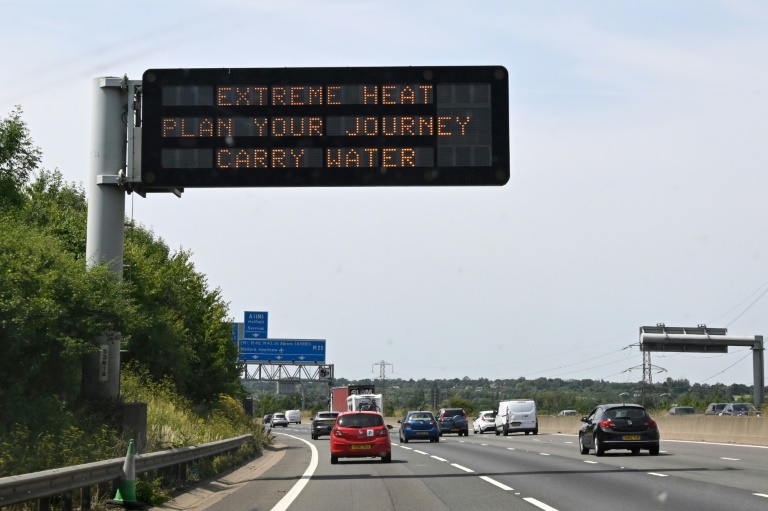
British Prime Minister Boris Johnson’s government stood accused Sunday of failing to take seriously an impending heat emergency as forecasters warned that lives were at risk.

Johnson missed a crisis ministerial meeting in Downing Street Saturday while he took a weekend break at his Chequers country retreat — and was hosting a farewell party for friends Sunday before he leaves office in September.

Deputy Prime Minister Dominic Raab then appeared to welcome the likelihood of temperatures topping 40 degrees Celsius (104 degrees Fahrenheit) in England for the first time.

“Obviously there is some common-sense practical advice we are talking about -– stay hydrated, stay out of the sun at the hottest times, wear sun cream — those sorts of things,” Raab told Sky News on Sunday.

“We ought to enjoy the sunshine and actually we ought to be resilient enough through some of the pressures it will place,” he added, insisting there was no reason for schools to close when the mercury peaks on Monday and Tuesday.

The comments raised eyebrows, as did Johnson’s absence from the Downing Street meeting about the government’s response to the heatwave. He was forced to resign partly because of other parties held during Covid lockdowns.

Speaking after Raab on Sky, College of Paramedics chief executive Tracy Nicholls said: “This isn’t like a lovely hot day where we can put a bit of sunscreen on, go out and enjoy a swim and a meal outside.

“This is serious heat that could actually, ultimately, end in people’s deaths because it is so ferocious,” she said. 

“We’re just not set up for that sort of heat in this country.” 

Contrary to Raab’s sang froid, after Saturday’s meeting, government minister Kit Malthouse warned that transport services face “significant disruption” during the heatwave and said the public should work from home if possible.

The UK capital is expected to see the highest temperatures and mayor Sadiq Khan advised Londoners only to use public transport if “absolutely necessary”.

Ambulance services are on crisis footing, and some schools in southern England have already said they will stay shut.

Police urged the public to stay out of waterways after a 16-year-old boy drowned in a canal in the Manchester region, northwest England, on Saturday.

The Met Office, Britain’s state meteorological agency, has issued a first-ever “red” warning for extreme heat, cautioning there is a “risk to life” and attributing the heatwave to man-made climate change.

Britain’s highest recorded temperature is currently 38.7C set in Cambridge, eastern England, on July 25, 2019. But that looks set to be surpassed in the Met Office’s projections for this week.

UK climate chief could quit as Tory race heats up

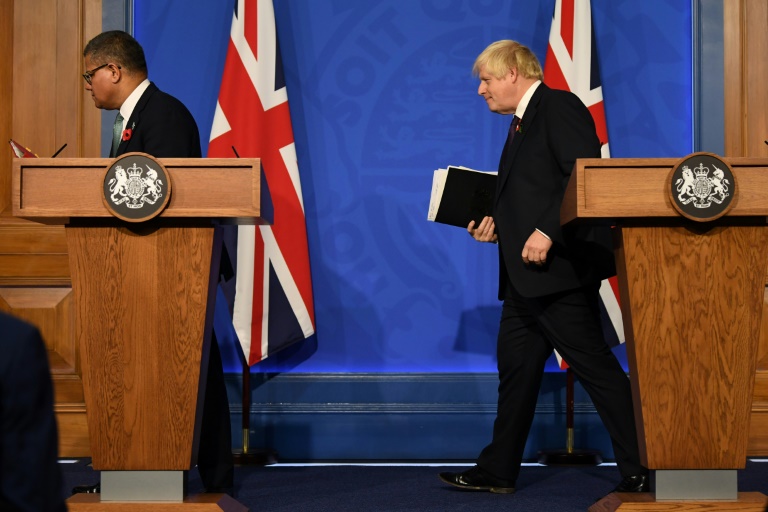
Britain’s climate minister has indicated he may resign as some Conservative leadership contenders equivocate on the government’s net zero target, ahead of a crunch TV debate Sunday and the final rounds of voting by MPs this week.

The intervention by COP26 president Alok Sharma came as a poll of Tory rank-and-file members, who will have the final say out of the two finalists, gave a surprise double-digit lead to outsider Kemi Badenoch.

Foreign Secretary Liz Truss was second, narrowly ahead of former grassroots favourite Penny Mordaunt and ex-finance minister Rishi Sunak, according to the unscientific poll by the ConservativeHome website.

Badenoch, a former junior minister with no cabinet experience, is running on an “anti-woke”, right-wing platform and has said net zero amounts to “unilateral economic disarmament” by Britain.

“Green levies”, backed by Sunak to help pay for the legally enshrined aim of achieving net-zero carbon emissions by 2050, have also been questioned by Truss and Mordaunt as Britons struggle with a cost-of-living crisis.

But with Britain facing record-breaking temperatures this week, Sharma told Sunday’s Observer newspaper that the target was “absolutely a leadership issue”, as the candidates wage an acrimonious battle to succeed scandal-tainted Prime Minister Boris Johnson.

“Anyone aspiring to lead our country needs to demonstrate that they take this issue incredibly seriously, that they’re willing to continue to lead and take up the mantle that Boris Johnson started off,” the minister said.

Asked if he could resign if candidates showed weakness on net zero, Sharma said: “Let’s see, shall we? I think we need to see where the candidates are. And we need to see who actually ends up in Number 10 (Downing Street).”

– ‘Back-burner’ amid heatwave –

Under Sharma’s chairmanship, nearly 200 countries pledged at a UN summit in Glasgow last November to speed up the fight against rising temperatures, after two weeks of marathon negotiations.

But India and China weakened the language of the final text to retain high-polluting coal, forcing tears and an exasperated apology from Sharma as he brought down the gavel.

Asked about Sharma’s threat, Truss supporter and former Tory leader Iain Duncan Smith told Sky News: “I’m sorry he feels that.” 

Truss still backs the principle of net zero but “we have to just put that slightly on the back-burner whilst we make sure people don’t suffer” from surging inflation, he said.

Asked whether she also still backed net zero, Mordaunt said on BBC television: “Yes, but it has to not clobber people.”

However, campaigners note that the green taxes make up a small fraction of overall energy bills in Britain, which have shot up on the back of Russia’s war in Ukraine.

And they say the current heatwave gripping Europe is a reminder that climate change is an existential threat. 

– Trans ‘smears’ –

The debate has ripped open Conservative tensions about the direction of economic and environmental policy under whoever succeeds Johnson when the winner is announced on September 5.

International environment minister Zac Goldsmith tweeted that with wildfires hitting Europe and temperature records being smashed, “it’s worth reflecting that there are still politicians being elected who think protecting our planet isn’t cost effective”.

Climate change barely figured in the first TV debate among the Conservative contenders on Friday. But Sharma will have the opportunity to grill them when he chairs a hustings organised by environmentalist Tory MPs on Monday.

After that, all the party’s MPs will hold another round of balloting to eliminate the bottom-placed candidate — likely to be backbencher Tom Tugendhat — before arriving at the final two in the coming days.

They will be reflecting on the outcome of the second TV debate, airing on the ITV network from 7:00 pm (1800 GMT) on Sunday, after Mordaunt came under concerted attack from Badenoch and Truss in the first one.

Mordaunt, who was briefly Britain’s first woman defence secretary before she was fired by Johnson, pushed back against claims that she was lying over her position now about rights for transgender women — a hot-button issue on the Tory right.

“There’s a number of smears going on in the papers,” she told the BBC.

Iran arrests several after protests at drying lake

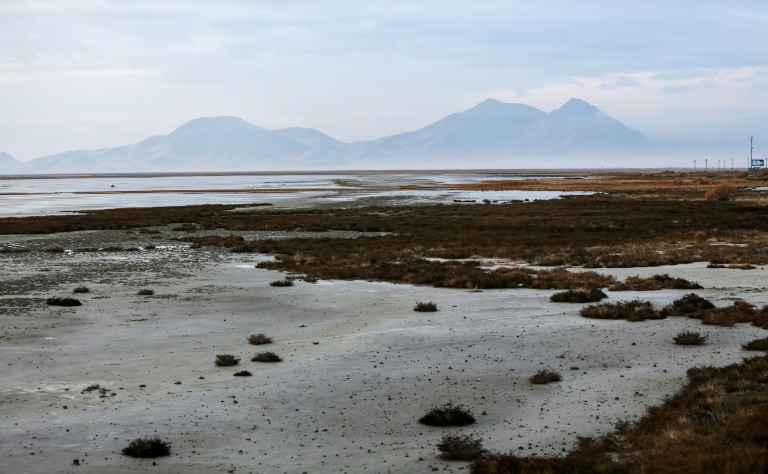
Iranian police have arrested several people for disturbing security after they protested the drying up of a lake once regarded as the Middle East’s largest, official media said Sunday.

Lake Urmia, in the mountains of northwest Iran, began shrinking in 1995 due to a combination of prolonged drought, and the extraction of water for farming and dams, according to the UN Environment Programme. 

Urmia, one of the largest “hypersaline” — or super salty — lakes in the world, is located between the cities of Tabriz and Urmia, with more than six million people dependent on agriculture around its shores.

On Sunday, Rahim Jahanbakhsh, the police chief of Iran’s West Azerbaijan province, reported the arrests. 

He described the suspects as “many evil and hostile elements, who had no other objective than to destroy public property and disturb the security of the population,” according to state news agency IRNA.

On Saturday, the Fars news agency reported that “dozens of people in the cities of Naghadeh and Urmia had protested against the authorities’ lack of attention to the drying up of Lake Urmia”.

Fars said protesters had shouted slogans in the provincial capital of Urmia warning the lake was shrinking.

“Lake Urmia is dying, parliament orders its killing”, some shouted, Fars reported, with others calling out that “Lake Urmia is thirsty”.

Largely arid Iran, like other nearby countries, has suffered chronic dry spells and heat waves for years, which are expected to worsen with the impacts of climate change.

In the last few months, thousands of people have demonstrated against the drying up of rivers, particularly in central and southwestern Iran.

Lake Urmia is an important ecosystems, a key stopping point for migratory birds, and home to an endemic shrimp as well as other underwater species.

EU mulls sanctions as Russia accused of shelling Ukraine from nuclear plant

The European Union will discuss tightening sanctions against Russia on Monday, as Moscow is accused of using the continent’s largest nuclear power plant to store weapons and launch missiles on the surrounding regions of southern Ukraine.

The situation at the captured Zaporizhzhia nuclear plant is “extremely tense”, Ukraine’s atomic energy agency chief Petro Kotin said, adding that the Russians had installed missile launchers and used the facility to shell the Dnipro region.

Describing “a deluge of fire”, regional governor Valentyn Reznichenko on Saturday said Grad missiles had pounded residential areas.

“Rescuers found two dead people under the ruins” in the riverside city of Nikopol, he said.

With the conflict grinding on and increasingly spilling out into global energy and food crises, the EU’s foreign ministers are considering banning gold purchases from Russia, which would align with sanctions already imposed by G7 partners.

More Russian figures could also be placed on the EU’s blacklist. 

“Moscow must continue to pay a high price for its aggression,” European Commission President Ursula von der Leyen said after forwarding the proposed measures. 

Brussels is expected to hold initial sanctions discussions Monday, but not make a same-day decision, according to a senior EU official. 

– Stepping up attacks –

More than 20 weeks since Russia invaded its neighbour, killing thousands and displacing millions of Ukrainians, Moscow announced on Saturday that it would step up its military operations.  

Minister Sergei Shoigu “gave the necessary instructions to further increase” military pressure, according to the Russian Defense Ministry.

The war-ravaged nation’s President Volodymyr Zelensky has already accused Russia of seeking to inflict maximum damage, but pledged that Ukraine would “endure”.

In his Saturday evening address, Zelensky said Ukraine has “withstood Russia’s brutal blows” and managed to take back some of the territory it lost since the start of the war, and will eventually recapture more occupied land.

“We will endure. We will win,” he said, and “rebuild our lives”.

While the heaviest fighting has continued to focus on the industrial Donbas region in the east, in the northeast near Ukraine’s second-largest city Kharkiv, the bombardments have been fast and hard in recent days. 

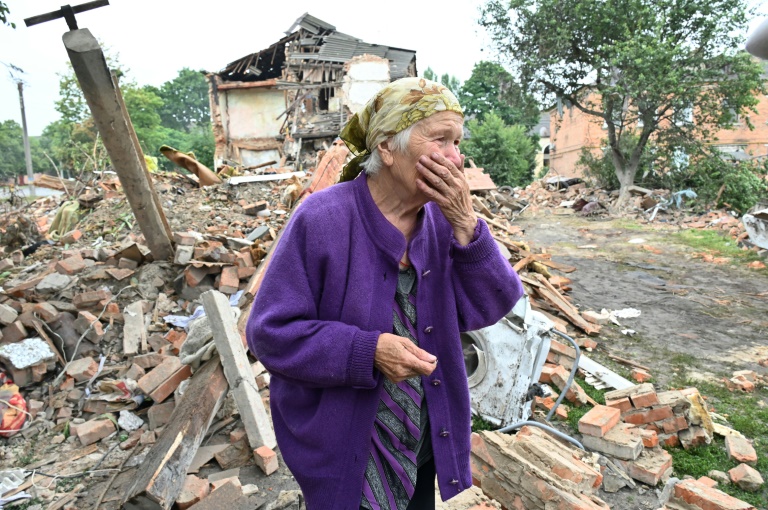
A Russian missile attack killed three in the town of Chuguiv over the weekend and destroyed a residential house and a local school. 

“Why me? Just because I was born in Ukraine?” asked resident Raiysa Kuval as she sat on the rubble.

“We were leaving peacefully, and they tore apart mother from father, child from mother, brother from sister… It’s unbearable.”

– Russia participation at G20 ‘absurd’ –

A two-day meeting of finance ministers from the Group of 20 major economies looked for solutions to the food and energy crises caused by the war but the gathering ended Saturday in Indonesia without a joint communique after the conflict divided the global forum.

The failure to issue a joint statement is expected to hinder coordinated efforts to address rising inflation and food shortages threatening to leave millions in developing nations at risk of hunger.

The failure to secure a joint communique came a week after Russian Foreign Minister Sergei Lavrov walked out of G20 talks in Bali over criticism of Moscow. 

Canada blasted Moscow’s participation in the meeting at all as “absurd,” with Finance Minister Chrystia Freeland saying from Bali that Russia’s presence “was like inviting an arsonist to a meeting of firefighters.”

– ‘Clearing’ Donbas town –

In the embattled Donbas region, grinding trench battles and artillery duels have morphed into a war of attrition.

Moscow-backed separatists said Friday they were closing in on their next target, Siversk, after wresting control of sister cities Lysychansk and Severodonetsk about 30 kilometres (18 miles) to its east.

Donetsk separatist official Daniil Versonov said rebel fighters were “clearing” eastern districts of Siversk in small groups.

Hundreds of kilometres from the frontline, missile strikes caused heavy civilian casualties in the central city Vinnytsia, with the death toll raised to 24 on Saturday.

“Unfortunately, one woman died in hospital today, she was 85 percent burned,” said Sergei Borzov, the governor of Vinnytsia region, adding that 68 people were still receiving treatment, including four children. 

In the face of international condemnation, the Russian Defense  Ministry said it had targeted a meeting in Vinnytsia of the “command of the Ukrainian Air Force with representatives of foreign arms suppliers”. 

But a senior U.S. defense official said on condition of anonymity that he had “no indication” there was a military target nearby.

What's next for the euro after slump against dollar?

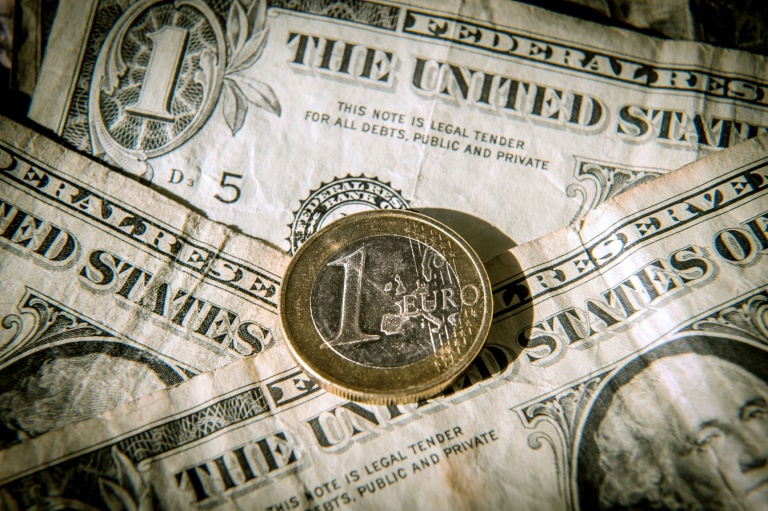
The euro’s plunge against the dollar, triggered by the Ukraine war and mounting risks to the EU economy, has driven the two currencies to parity for the first time in two decades.

The European single currency sank to $0.9952 on Thursday — a level not seen since the end of 2002, the year it was officially introduced.

But traders believe the euro could recover, provided it clears several hurdles in the coming months. 

The first to get over is to avoid the risk of a halt in Russian gas supplies to Europe, which would cause electricity prices to soar and force eurozone countries to limit some industrial activity. 

“If gas flows from Russia normalise, or at least stop falling, following the end of the Nord Stream 1 maintenance shut-down next week, this should somewhat decrease market fears of an imminent gas crisis in Europe,” Esther Reichelt, an analyst at Commerzbank, told AFP. 

With Russian gas giant Gazprom having warned it cannot guarantee that the pipeline will function properly, European countries fear that Moscow will use a technical reason to permanently halt deliveries and put pressure on them. 

French President Emmanuel Macron even said on Thursday that Russia was using energy “as a weapon of war”. 

If Nord Stream 1 “doesn’t turn back on, the euro falls as the economic shock waves will be felt worldwide as the European energy crisis could very well trigger a recession,” warned Stephen Innes, an analyst at SPI Asset Management. 

– ECB wake-up call –

“Recession would inevitably mean that the market becomes even more concerned about fragmentation risks in the eurozone,” added Jane Foley, a foreign exchange specialist at Rabobank. 

Like other central banks, the European Central Bank (ECB) is seeking to avoid stifling the economy by raising rates too sharply. 

But it also has to worry about a possible fragmentation of the debt market, with large differences in borrowing rates across the eurozone. 

The ECB has so far maintained an ultra-loose monetary policy to support the economy, while the US Federal Reserve has instead raised rates and promises to continue to do so to counter inflation. 

It will announce its monetary policy decision on Thursday, and has indicated that it will raise rates for the first time in 11 years. 

“If the ECB is aiming to give the euro a boost, it will have to deliver a 50-bp hike in July and/or signal that 75-bp moves are on the cards for September,” S&P analysts said in a note. 

“Speedier policy adjustments now would help anchor inflation expectations, reducing the risk of needing a restrictive policy stance further down the line,” they added. 

– Fed slowdown –

For economists at Berenberg, the euro’s fall is more attributable to the strength of the dollar, which has “appreciated strongly against a broad basket of currencies since mid-2021”. 

The dollar has benefited from the Fed’s tightening of monetary policy as it tries to limit inflation, which hit record highs again in June. 

“Markets are speculating that the Fed may raise rates by 100bp instead of 75bp at its next meeting on 27 July,” noted Berenberg.

“If so, this could strengthen the dollar further.”

UniCredit added: “Towards year-end, prospects of declining inflation and more-balanced messaging from central banks as the cyclical peak of official rates nears should support a return of risk appetite and ease USD demand.”

Should that happen, the euro could move away from parity in the last few months of 2022, they say. 

Close Bitnami banner
Bitnami