Africa Business

In key east DR Congo city, life continues despite rebel push

Armed rebels have advanced to just a few dozen kilometres away, but in eastern DR Congo’s main city of Goma, people are crowding bars and haggling in the market as usual. 

In recent weeks, the M23 rebels have seized swathes of territory across North Kivu province, displacing tens of thousands of people and pushing closer to Goma, a commercial hub of more than a million people. 

Despite the threat, many Goma residents are unfazed. 

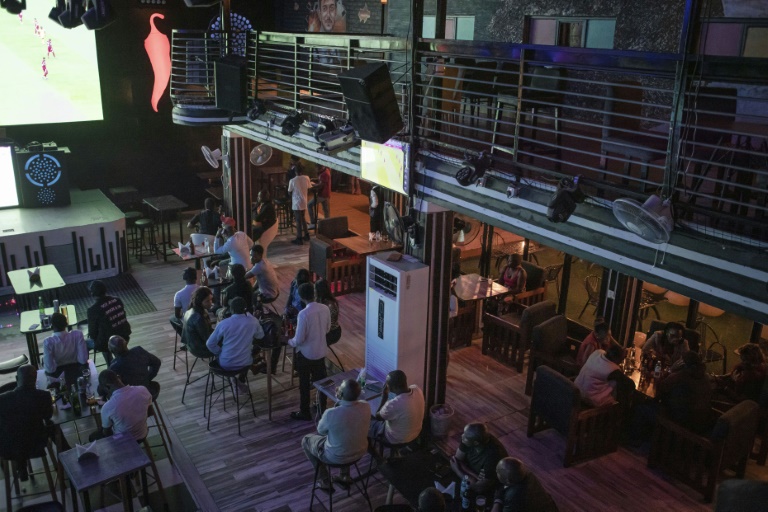
“The war is there of course, but that doesn’t prevent you from having a beer in the evening,” said Alain Zoeto, a 35-year-old hairdresser, attending a concert held at a bar in the city. 

“The government has a duty to protect us and we have this freedom,” he added, over the sound of Congolese rumba classics. 

Machozi Binego, who was dancing at the same bar with a group of friends, was similarly cheerful. 

“The people of Goma are still alive,” he said.

The largely Congolese Tutsi M23 took up arms in late 2021 after years of dormancy, claiming the DRC had failed to honour a pledge to integrate its fighters into the army, among other grievances.

The fighting has sent relations between the DRC and Rwanda into a nosedive, with Kinshasa accusing its smaller neighbour of backing the M23 — something UN experts and US officials have also said in recent months.

Goma lies on the border with Rwanda. But tensions haven’t stopped revellers packing the bars at night, with motorbike-taxis shuttling them around.

“I keep working because I know the M23 won’t come to Goma,” said Dani, a motorbike driver, near a popular watering hole. 

Over the weekend, football fans crowded the well-known Pili Pili bar to follow the World Cup opening match on the big screen.   

“I’m not afraid, it’s not the first time,” said Amos, 19, referring to Goma’s history of rebellions.

– ‘Not think too much’ – 

Over 120 armed groups are active across eastern Congo, many of which are a legacy of regional wars that flared at the turn of the century. 

Goma was at the centre of those wars, and has been subject to several rebel uprisings too.

The M23 captured Goma in 2012 before being driven out and going to ground. 

The forces of nature mean that the city’s people are no strangers to fear and hardship. 

The city has seen two eruptions from Mount Nyiragongo, one of the world’s most notorious volcanoes — one in 2002 and another just last year.

Joseph Katwaza, a 60-year-old exercising at a roundabout at the heart of Goma, said people “want to continue with life”, rebels or not. 

“Sport also helps me not think too much about the security situation,” he added.

Chantal Manyure, a 20-year-old who was also exercising in the spot popular with runners and rollerbladers, said “sport helps us to prepare ourselves psychologically”.

But she was also stoic about the prospect of a rebel attack on the city. “It’s not the first time,” she said. 

Elsewhere in Goma, life has continued in relative normality. 

Markets continue to do business, although consumers complain that prices are rising due to rebel-caused supply problems.

Many nonetheless have an eye out for trouble. Rumours of a rebel push sent people in a displaced persons’ camp fleeing last week, for example. 

And residents are alert to loud bangs in the night — worrying they might be the opening salvo of an attack. 
W. Africa, European partners bolster ties against jihadist threat

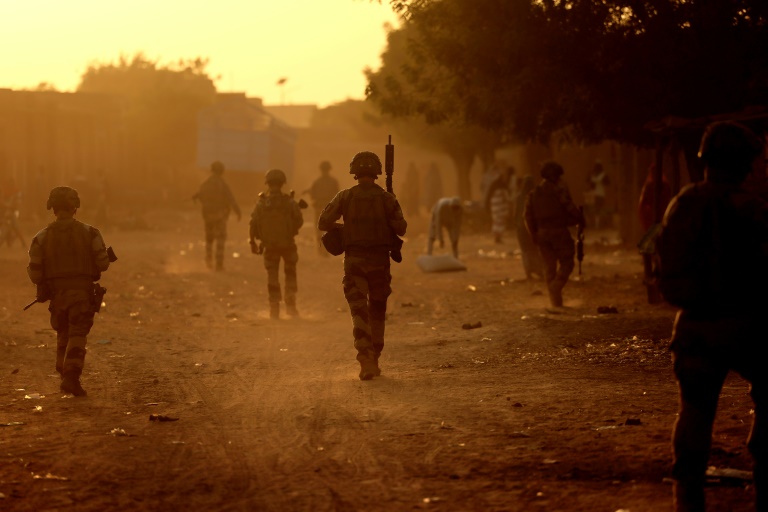
West African nations met with European leaders on Tuesday for talks on “homegrown” ways to prevent jihadist conflict in the Sahel from threatening countries on the Gulf of Guinea, but the get-together ended with no major announcement.

Coastal states Ghana, Benin, Togo and Ivory Coast face increasing threats and attacks from Islamist militants across their northern borders with Burkina Faso and Niger.

The summit in Ghana’s capital Accra also comes as more Western nations have withdrawn peacekeepers from Mali after its military junta strengthened cooperation with Russia.

Ghana’s President Nana Akufo-Addo said worsening Sahel security was “threatening to engulf the entire West African region”.

“Terrorist groups, emboldened by their apparent success in the region, are looking (for) new operational grounds, a development that has triggered a southward drift of the menace,” he said. 

Under the so-called Accra Initiative, heads of state from the Gulf of Guinea and leaders from Niger and Burkina Faso met in Ghana with representatives from the West African bloc ECOWAS, the EU, Britain and France.

Akufo-Addo called for a “home-grown initiative” to answer the threat as well as a comprehensive approach involving economic and social development to tackle the roots of jihadism. 

“We remain firm in our commitment to shoulder a greater part of the responsibility.”

At the end of the conference, West African leaders made no major announcements, according to a final communique seen by AFP.

However, they noted “the partners’ commitments” to support the initiative, and “recommended that concrete actions, particularly in terms of funding, be taken to support countries severely affected by terrorism”.

– Sahel spillover –

The Sahel conflict began in northern Mali in 2012, spread to Burkina Faso and Niger in 2015 and now Gulf of Guinea states are suffering sporadic attacks.

Ghana has beefed up security along its northern frontier and has so far escaped any cross-border attacks.

But Benin and Togo in particular have faced threats from across their northern borders with Burkina Faso.

Benin has recorded 20 incursions since 2021 while Togo has suffered at least five attacks, including two deadly assaults, since November 2021.

“For years we have been talking about the risk of contagion of the terrorist threat from the Sahel to the coastal states. Today this is not a risk any more, it is a reality,” European Council President Charles Michel told the summit.

French and other peacekeeping missions had been operating in Mali for almost a decade as a bulwark against the spread of violence.

But after two coups in Mali, the military junta increased cooperation with Moscow and allowed what Western nations call Russian mercenaries into the country.

That prompted France to pull out troops deployed under its Barkhane anti-jihadist mission. Britain and Germany last week said they would also end peacekeeping missions.

Berlin confirmed on Tuesday it would seek to withdraw its troops from the UN’s peacekeeping mission in Mali by May 2024.

British Armed Forces Minister James Heappey last week said the UK would be “rebalancing” its deployment, though he did not give details about what form that would take.

He said Accra Initiative countries would likely need different capabilities than the British long-range reconnaissance forces currently in Mali.

“The United Kingdom’s armed forces already enjoy great relationships with many of the countries within the Accra Initiative and we stand ready to build on that,” he said in Accra. 

“But this is a regional problem that you have here in West Africa and it’s right that you seek to provide the solution.”

Across the three Sahel nations, thousands of people have been killed, more than two million displaced and devastating damage has been inflicted on three of the poorest economies in the world.

S. Africa's Ramaphosa demands climate aid from rich world in UK state visit

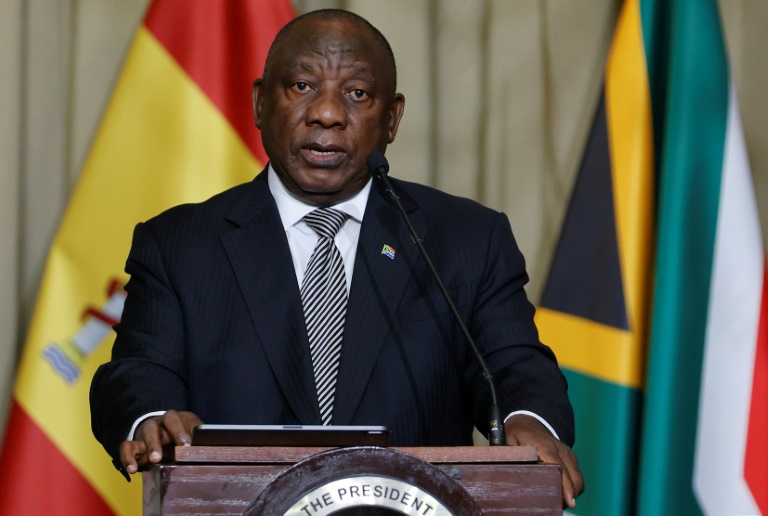
South African President Cyril Ramaphosa on Tuesday urged rich nations to help save vulnerable ones from climate change, as he made the first state visit of King Charles III’s reign.

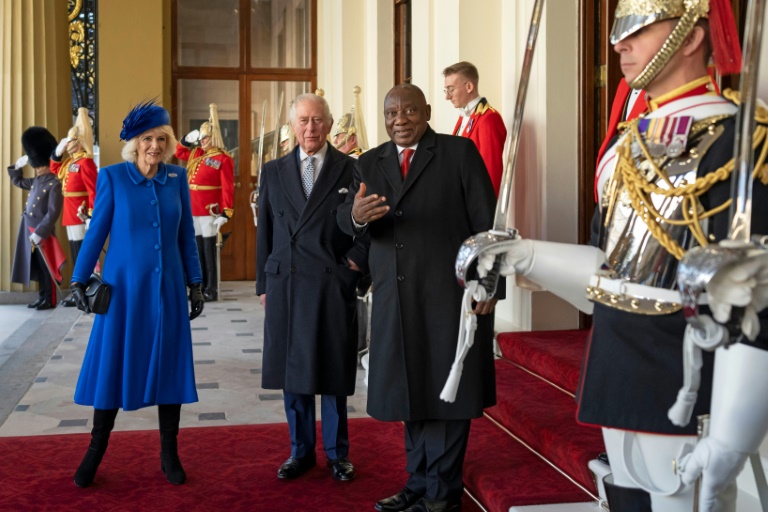
Gun salutes were fired across London as Charles and Queen Consort Camilla were joined by heir to the throne Prince William and his wife Catherine to greet Ramaphosa for a ceremonial welcome at Horse Guards Parade.

The monarch and Ramaphosa, both dressed in dark overcoats against the November chill, inspected the guard of honour together.

In a carriage procession escorted by mounted soldiers from the Household Cavalry, the parties then travelled to Buckingham Palace.

The two-day visit sees Charles finally presiding over proceedings after decades playing a supporting role to his mother, Elizabeth II, who died in September.

For Ramaphosa, a protege of anti-apartheid icon Nelson Mandela, however, it comes amid political difficulties and a threat of impeachment at home.

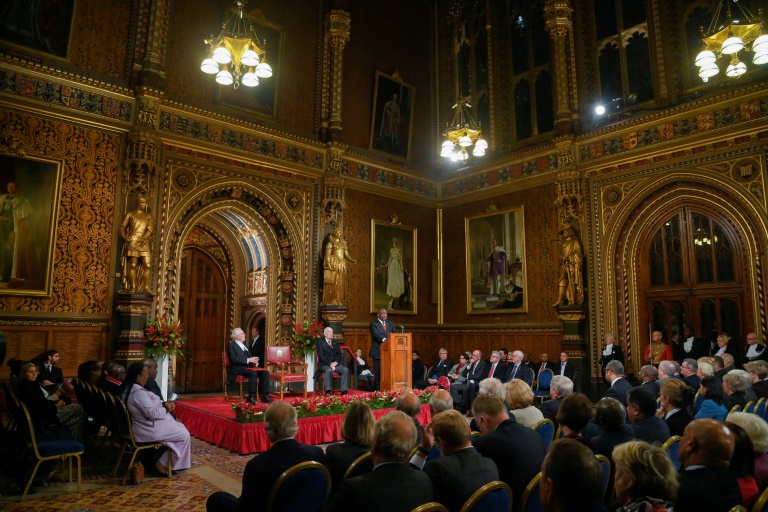
Addressing UK parliamentarians in the ornate Royal Gallery of the Palace of Westminster, Ramaphosa nodded at the corruption endemic in his country — including, for his critics, in the presidency itself.

He said his government was striving “to rebuild our economy in the wake of the pandemic and the era of state capture”, as he urged the UK government to let in more South African students ahead of talks Wednesday with British Prime Minister Rishi Sunak.

Following the recent COP27 climate meeting in Egypt, Ramaphosa said an agreement to create a fund for poor and developing nations needed to be turned into cash.

“This should not be seen as charity,” he said. 

“It is compensation for the harm done — and the harm yet to be done — to people in developing economies as a consequence of the industrialisation that wealthy countries have had over many years.”

The king, long known for his advocacy on issues relating to the climate, said “we must find and implement practical solutions to the twin, existential threats of climate change and biodiversity loss”.

Ahead of the speech in parliament, Ramaphosa toured nearby Westminster Abbey including a memorial stone for Mandela, who served as president of South Africa between 1994 and 1999. 

Afterwards, he went on to a state banquet hosted by Charles at Buckingham Palace.

Foreign Secretary James Cleverly said the choice of Ramaphosa for Charles’s first state visit was a sign of the UK’s “enduring commitment” to Africa, even as it eyes new partners in Asia post-Brexit.

– ‘Turbocharge growth’ –

At the start of the visit, the UK and South African governments announced the launch of the next phase of the “UK-South Africa Infrastructure Partnership”.

“South Africa is already the UK’s biggest trading partner on the continent, and we have ambitious plans to turbocharge infrastructure investment and economic growth together,” Sunak said.

Trade with South Africa, the continent’s second-biggest economy, is worth £10.7 billion ($12.7 billion) a year.

But political problems in South Africa threatened to cast a shadow over the ceremonial pomp and splendour of the state visit.

Ramaphosa is at risk of impeachment for allegedly covering up a crime, accused of concealing a multimillion-dollar cash theft.

He faces an accusation that he failed to report a heist at his luxury cattle farmhouse in which robbers took four million dollars in cash, and instead organised for the robbers to be kidnapped and bribed into silence.

He has faced calls to resign and the deeply divided ruling African National Congress (ANC) is due to hold a vote on its leadership in December.

The president has acknowledged a burglary but denies kidnapping and bribery, saying he reported the break-in to the police. 

South African lawmakers will discuss next month the findings of a special panel tasked with establishing whether Ramaphosa should face impeachment.

Zuma says court ruling ordering him to return to jail is 'cruel'

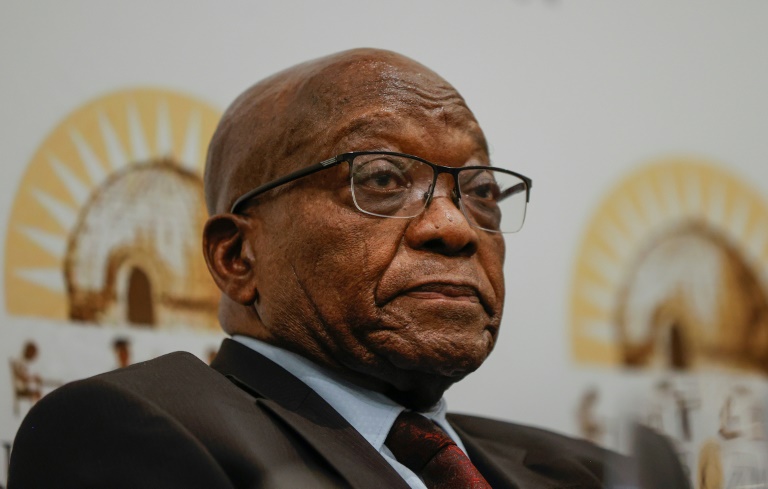
A South African court ruling that found former president Jacob Zuma was unlawfully granted medical parole and ordered his return to prison to complete his sentence, is “cruel” and “degrading”, his representatives said Tuesday.

Zuma, 80, had been handed a 15-month term in June 2021 for contempt of court, a move that triggered deadly unrest.

But he served only two months before being given parole for medical reasons that remain unclear.

Parole was granted by the head of South Africa’s prison service, despite an opinion by the service’s medical committee that Zuma did not meet the required conditions.

On Monday the Supreme court of appeal ruled that the parole was “unlawful”, that Zuma had not finished serving his sentence and must return to jail.

In a late night statement, Zuma’s foundation described the court’s decision as “an act of injustice. It is nothing but an exercise in cruelty and degrading punishment”.

The prison authorities last month announced that Zuma’s 15-month term was formally over.

“On what legal basis can an expired and fully served sentence be resurrected from its grave by a court of law?” the foundation asked.

“To impose further imprisonment after the expiry of a jail term is totally unheard of and it is indeed a textbook case of judicial overreach,” it added.

A prominent figure in the fight against apartheid, Zuma became president in 2009. He was jailed for refusing to testify to a high-level inquiry into massive state corruption that unfolded under his presidency.

He was forced to step down in disgrace by the ruling ANC in 2018 following mounting corruption allegations.

When his jail term was announced, violent protests broke out that spiralled into looting, leaving 350 people dead.

Zuma still has the option of approaching the Constitutional Court, the highest judicial instance in the land, to appeal the latest ruling.

S.Africa's Ramaphosa demands climate aid from rich world in UK state visit

South African President Cyril Ramaphosa on Tuesday urged rich nations to help save vulnerable ones from climate change, as he made the first state visit of King Charles III’s reign.

Gun salutes were fired across London as Charles and Queen Consort Camilla were joined by heir to the throne Prince William and his wife Catherine to greet Ramaphosa for a ceremonial welcome at Horse Guards Parade.

The monarch and Ramaphosa, both dressed in dark overcoats against the November chill, inspected the guard of honour together.

The parties then travelled to Buckingham Palace in a carriage procession escorted by mounted soldiers from the Household Cavalry.

The two-day visit sees Charles finally presiding over proceedings after decades playing a supporting role to his mother queen Elizabeth II, who died in September.

For Ramaphosa, a protege of anti-apartheid icon Nelson Mandela, however, it comes amid political difficulties and a threat of impeachment at home.

Addressing UK parliamentarians in the ornate Royal Gallery of the Palace of Westminster, Ramaphosa nodded at the corruption endemic in his country — including, for his critics, in the presidency itself.

He said his government was striving “to rebuild our economy in the wake of the pandemic and the era of state capture”, as he urged the UK government to let in more South African students ahead of talks Wednesday with British Prime Minister Rishi Sunak.

Following the recent COP27 climate meeting in Egypt, Ramaphosa said an agreement to create a fund for poor and developing nations needed to be turned into cash.

“This should not be seen as charity,” he said. 

“It is compensation for the harm done — and the harm yet to be done — to people in developing economies as a consequence of the industrialisation that wealthy countries have had over many years.”

Ahead of the speech in parliament, Ramaphosa toured the nearby Westminster Abbey including a memorial stone for Mandela, who served as president of South Africa between 1994 and 1999. 

Afterwards, he went on to a state banquet hosted by Charles at Buckingham Palace.

Foreign Secretary James Cleverly said the choice of Ramaphosa for Charles’s first state visit was a sign of the UK’s “enduring commitment” to Africa, even as it eyes new partners in Asia post-Brexit.

– ‘Turbocharge growth’ –

At the start of the visit, the UK and South Africa governments announced the launch of the next phase of the “UK-South Africa Infrastructure Partnership”.

“South Africa is already the UK’s biggest trading partner on the continent, and we have ambitious plans to turbocharge infrastructure investment and economic growth together,” Sunak said.

Trade with South Africa, the continent’s second biggest economy, is worth £10.7 billion ($12.7 billion) a year.

But political problems in South Africa threaten to cast a shadow over the ceremonial pomp and splendour of the state visit.

Ramaphosa is at risk of impeachment for allegedly covering up a crime, accused of concealing a multi-million-dollar cash theft.

He faces an accusation that he failed to report a heist at his luxury cattle farmhouse in which robbers took four million dollars in cash, and instead organised for the robbers to be kidnapped and bribed into silence.

He has faced calls to resign and the deeply divided ruling African National Congress (ANC) is due to hold a vote on its leadership in December.

The president has acknowledged a burglary but denies kidnapping and bribery, saying he reported the break-in to the police. 

South African lawmakers will discuss next month the findings of a special panel tasked with establishing whether Ramaphosa should face impeachment.

Nienaber vows Springboks still focussed amid 'disappointing' Erasmus row

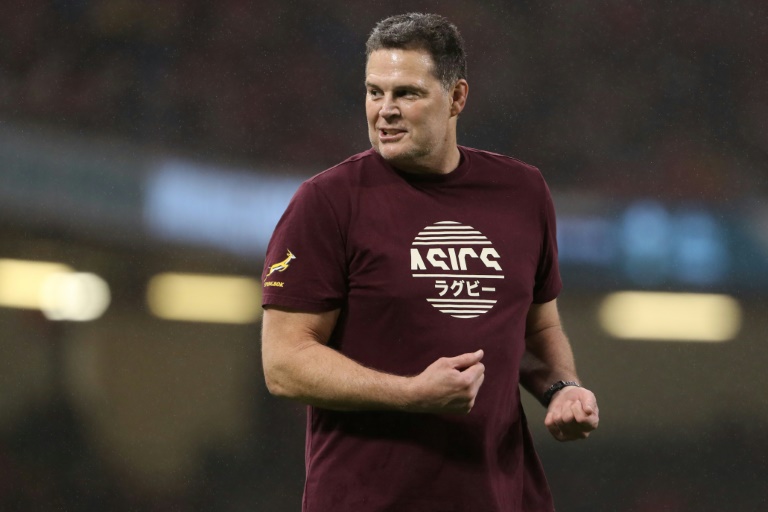
South Africa head coach Jacques Nienaber has insisted Rassie Erasmus’s latest ban will have no effect when the Springboks face England at Twickenham on Saturday, adding “all the facts” have yet to be made public.

Erasmus, South Africa’s director of rugby, is serving a two-game matchday ban handed out by World Rugby following his criticism of refereeing decisions during the ongoing Autumn Nations Series on social media.

As a result, Erasmus missed the Springboks’ 63-21 win over Italy in Genoa last weekend and the 50-year-old, who guided South Africa to 2019 World Cup glory, will not be at Twickenham this weekend either.

But Nienaber, speaking after naming his team to play England, told reporters on Tuesday that Erasmus’s latest suspension had no bearing on his team’s morale.

“In terms of Rassie’s ban, no, from our side we focus on rugby,” he said.

Former Springbok flanker Erasmus has only recently completed a stadium ban following a World Rugby suspension for his infamous hour-long video criticising referee Nic Berry’s performance in the first Test between South Africa and the British and Irish Lions last year.

That did not stop Erasmus from publishing several videos on social media that appeared to question decisions made by referee Wayne Barnes during the Springboks’ recent 30-26 loss to France on November 12.

He had made similar comments on social media following South Africa’s defeat by Ireland a week earlier.

Erasmus said accusations his videos had led to threats of violence against experienced English referee Barnes were “completely unfounded”.

World Rugby chief executive Alan Gilpin said the governing body feared Erasmus’s comments could encourage angry supporters at all levels pf the game to make vitriolic posts of their own towards referees.

Meanwhile John Smit, South Africa’s 2007 World Cup-winning captain, told the BBC that Erasmus’s conduct has made the Boks “so easy to dislike”.

“Are you telling me Rassie is the only coach frustrated by a call that has gone the wrong way?” said Smit.

“Something has to be done. There has to be a line that has to be drawn.”

– ‘Quite sad’ –

Nienaber, however, said much of the debate about Erasmus’s posts was taking place without knowledge of the full facts.

“Sometimes it’s, I don’t want to say disappointing, what would the right word be? Maybe disappointing is the right word, when there’s only certain facts that go out and then people from the outside, who only have those facts available, form an opinion and give an opinion on something that happened and obviously they don’t know all the facts,” he said.

“It is quite sad if you think about it. I think if all the facts are out there that people will probably form a different opinion.”

Nienaber, pressed on what facts were missing, added: “I think it probably will come out.

“There’s a lot of confidentiality that we’re not allowed to talk about with media. It’s stuff we can’t discuss but we know the facts, we share with the players and everyone within the group.”

With Saturday’s game taking place outside World Rugby’s official window, Nienaber has made four personnel changes to the starting XV that thrashed Italy 63-21 in Genoa last weekend, with Makazole Mapimpi, Jesse Kriel, Evan Roos and Eben Etzebeth all recalled.

The Springboks will be without Cheslin Kolbe, Andre Esterhuizen, Cobus Reinach, Jasper Wiese and Vincent Koch, who have all returned to their respective English and French clubs.

Comoros ex-leader refuses to attend high treason trial

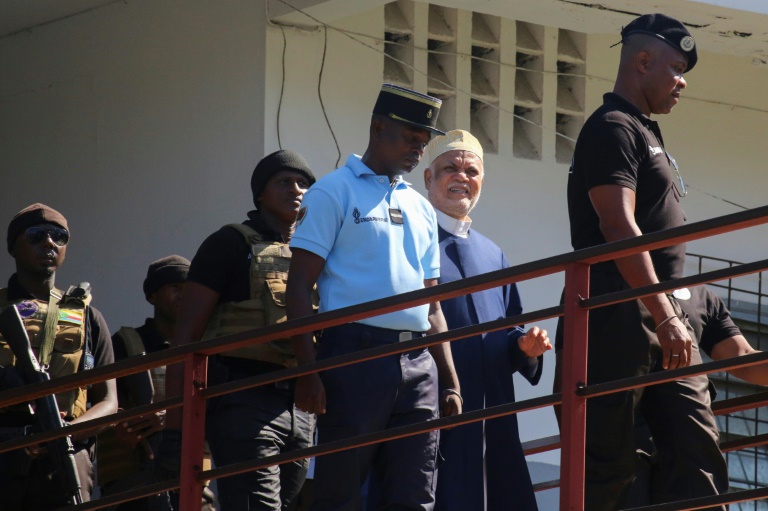
Comoros’ former president Ahmed Abdallah Sambi did not attend the second day of his high treason trial on Tuesday, as lawyers said there were no guarantees he would be judged fairly.

Sambi, 64, the main opponent to current president Azali Assoumani, is facing charges related to the alleged sale of Comorian passports. 

“We left the hearing because we did not have guarantees of a fair trial,” Mahamoudou Ahamada, one of the ex-president’s lawyers told a press conference. 

Jan Fermon, another lawyer added Sambi, who appeared in frail health at the first hearing in the capital Moroni on Monday, would no longer attend the proceedings, which are expected to end this week.

The defence team has argued that the president of the security court trying Sambi should recuse himself having previously sat on the panel that decided to indict the former leader.

But their request was denied, with the judge saying he had no knowledge of the merit of the case. 

Ali Mohamed Djounaid, who serves as prosecutor in the proceedings told AFP a verdict was to be announced before Thursday, regardless of whether the former president attended court or not. 

Sambi, who led the small Indian Ocean archipelago between 2006 and 2011, has already spent four years behind bars, despite the law limiting pre-trial detention to a maximum of eight months. 

“I do not want to be tried by this court,” Sambi, with a trimmed white beard said as he appeared before the judges on Monday, calling the court “illegal”. 

Sambi was originally placed under house arrest for disturbing public order.

– ‘Amicable settlement’ –

Three months later he was put under pre-trial detention for embezzlement, corruption and forgery, in a scandal involving the sale of Comorian passports to stateless people living in Gulf nations. He was then charged with high treason. 

His lawyers also accused government officials of seeking to pressure a co-defendant, French Syrian businessman Bashar Kiwan, into testifying against the former president in exchange for a pardon.

Kiwan told AFP he met the Minister of Foreign Affairs, Dhoihir Dhoulkamal, three times, with the last encounter only a few weeks ago in a chic Paris hotel, to “find an amicable settlement”. 

He also claimed to have been in touch with six other government representatives

“The exchanges were courteous at first but quickly became threatening,” he said.

The foreign affairs minister confirmed to AFP the meetings took place but disputed the version of events provided by Kiwan, adding it was the businessman who had initiated the encounters.

The Comoros islands — Anjouan, Grande Comore and Moheli — have endured years of grinding poverty and political turmoil, including about 20 coups or attempted coups, since independence from France in 1975.

Charles III welcomes S.Africa's Ramaphosa in first state visit as king

King Charles III on Tuesday welcomed South African President Cyril Ramaphosa to London for a milestone first state visit of his reign.

Gun salutes were fired across London as Charles and Queen Consort Camilla were joined by heir to the throne Prince William and his wife Catherine to greet Ramaphosa for a ceremonial welcome at Horse Guards Parade.

The monarch and Ramaphosa, both dressed in dark overcoats against the November chill, inspected the guard of honour together.

The parties then travelled to Buckingham Palace in a carriage procession escorted by mounted soldiers from the Household Cavalry.

The route along The Mall was decorated with the British and South African flags with the band of the Scots Guards playing the national anthems of both countries as the king and his guest arrived at the palace.

The two-day visit sees Charles finally presiding over proceedings after decades playing a supporting role to his mother Queen Elizabeth II, who died in September.

For Ramaphosa, a protege of anti-apartheid icon Nelson Mandela, however, it comes amid political difficulties and a threat of impeachment at home.

In the last state visit of Elizabeth’s record-breaking 70-year reign, the queen hosted US president Donald Trump and his wife Melania in June 2019.

Later in the day, Ramaphosa will visit parliament for an address to both the upper and lower houses.

A tour of Westminster Abbey will include the memorial stone for Mandela, who served as president of South Africa between 1994 and 1999. 

In the evening, Ramaphosa will attend a state banquet at Buckingham Palace.

Ramaphosa is also due to visit Downing Street for talks with Prime Minister Rishi Sunak.

– ‘Turbocharge growth’ –

At the start of the visit, the UK and South Africa governments announced the launch of the next phase of the UK-South Africa Infrastructure Partnership.

“South Africa is already the UK’s biggest trading partner on the continent, and we have ambitious plans to turbocharge infrastructure investment and economic growth together,” Sunak said.

Trade with South Africa, the continent’s second biggest economy, is worth £10.7 billion ($12.7 billion) a year.

Foreign Secretary James Cleverly said the choice of Ramaphosa for Charles’s first state visit was a sign of the UK’s “enduring commitment” to Africa, even as it eyes new partners in Asia post-Brexit.

But he added: “It’s important… that we also show that it’s not going to be at the expense of the incredibly important partnerships we have through the Commonwealth, through international fora, as well as the bilateral relationship (with South Africa).”

As well as trade, climate change and Charles’s vision for the Commonwealth are also expected to be discussed during the visit.

But political problems in South Africa threaten to cast a shadow over the ceremonial pomp and splendour of the state visit.

Ramaphosa is at risk of impeachment for allegedly covering up a crime, accused of concealing a multi-million-dollar cash theft.

He faces an accusation that he failed to report a heist at his luxury cattle farmhouse in which robbers took four million dollars in cash, and instead organised for the robbers to be kidnapped and bribed into silence.

He has faced calls to resign and the deeply divided ruling African National Congress (ANC) is due to hold a vote on its leadership in December.

The president has acknowledged a burglary but denies kidnapping and bribery, saying he reported the break-in to the police. 

South African lawmakers will discuss next month the findings of a special panel tasked with establishing whether Ramaphosa should face impeachment.

S.Africa's Ramaphosa leads in race for ANC president despite scandal

South African President Cyril Ramaphosa is firmly ahead in the race for head of the ruling African National Congress (ANC), garnering more than twice as many party nominations as his sole challenger, according to a tally issued Tuesday.

Ramaphosa, 70, has polled 2,037 nominations from party branches against 916 for his rival Zweli Mkhize, 66, an ex-health minister who resigned from government last year amid graft allegations, the party said.

“These are the two names nominated for position of (party) president,” Kgalema Motlanthe, former president of South Africa and head of the ANC’s electoral panel, told a news conference in Johannesburg.

The ANC, the party of Nelson Mandela, spearheaded the fight against apartheid and has governed South Africa since the advent of democracy in 1994.

It is due to hold a conference between December 16 and 20 to elect the party’s top leadership.

Whoever wins is likely to be the head of state after the 2024 national elections, if the ANC wins that vote.

Although party branches vary in size and how many delegates vote in each, the nominations can be indicative of the outcome. 

Votes will be cast in person by branch representatives on the first day of the conference.

Ramaphosa is seeking a second term at the helm after succeeding his scandal-tainted former boss, ex-president Jacob Zuma, in 2018.

Ramaphosa’s bid comes despite facing the risk of possible impeachment for allegedly covering up a 2020 crime.

Parliament will debate on December 6 whether he should answer allegations that he concealed a multi-million dollar cash theft at his farm.

Analysts have said Ramaphosa, who is currently in the United Kingdom for the first state visit hosted by King Charles III as monarch, stands a reasonable chance of staying on as ANC leader despite the controversy.

– Dipping support –

“Ramaphosa is still in a very strong position to be re-elected,” said Sithembile Mbete, lecturer in political sciences lecturer at the University of Pretoria.

“It seems a majority of the branches want to vote for Ramaphosa,” she said.

Pearl Mncube, an independent political analyst, said “while he (Ramaphosa) has been facing a decline in popularity over the years, his campaign has been the strongest so far”.

The once revered 110-year-old ANC has seen its popularity decline, with voters for the first time turning their backs on the party during last year’s local government elections.

It won only 46 percent of the ballots cast nationally — by far its worst showing since the end of white-minority rule.

Its fortunes are unlikely to swing much in the next national elections in 2024.

Polls suggest that support for the ANC will dip below 50 in the next national polls, said Mbete.

But the “ANC will most probably remain the biggest single party and will probably be able to form a coalition government”, she said.

Springboks make wholesale changes for England

South Africa coach Jacques Nienaber has made a raft of changes for the Springboks’ concluding Autumn Nations Series international against England at Twickenham on Saturday.

With the game taking place outside World Rugby’s official window for Test matches, the world champions will be without Cheslin Kolbe (wing), Andre Esterhuizen (centre), Cobus Reinach (scrum-half), Jasper Wiese (No 8) and Vincent Koch (prop), who have all returned to their respective English and French clubs.

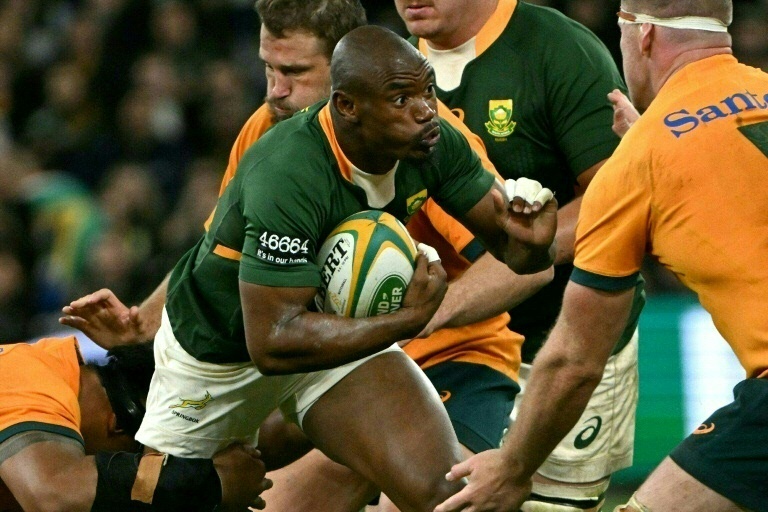
Nienaber had made six changes to the starting XV that thrashed Italy 63-21 in Genoa last weekend, with Makazole Mapimpi (wing), one of the try-scoring heroes of their 2019 World Cup final win over England in Japan, recalled.

Jesse Kriel is in at centre, while Evan Roos (No 8) and Eben Etzebeth (lock) are back in the pack, while Kurt-Lee Arendse has switched from left wing to right wing, with Damian de Allende moving from outside centre to inside centre.

“With this Test falling outside the international Test window, we knew we would have to make changes to the team, but we are pleased with the depth we have built in the wider squad in the last few months, and it is paying off for us this week,” said Nienaber.

“Every player in this squad has played Test rugby. It doesn’t get bigger than playing against England at a packed Twickenham in the last Test of the season for a player, and one can sense the excitement among the players about this occasion.”

Before the Italy match, South Africa had suffered narrow Autumn defeats by both Ireland (19-16) and 2023 World Cup hosts France (30-26).

– ‘Epic encounter’ –

England, who came from 19 points down to snatch a dramatic 25-25 draw with New Zealand at Twickenham last weekend, are due to name their team on Thursday.

The astonishing fightback against the All Blacks came after England launched their November campaign with a narrow 30-29 loss at home to Argentina before they overwhelmed Japan 52-13.

“England will enter this match with the same mindset as us –- to finish the season on a high note after a tough November campaign, and to build momentum with an eye on the World Cup,” said Nienaber.

“So, we are expecting them to throw everything they have at us. They are a well-balanced team with a strong pack of forwards and exciting backs, and they are well coached, so we know it is going to be an epic encounter.

“We lost against them by one point in our last two matches at Twickenham and the last time we beat them in London was in 2014, so we have to be accurate in all areas of our game, effective in our execution and we need to covert our chances into points.

“We had two narrow defeats against the top two teams in the world in Ireland and France and we defeated Italy, and it would be fantastic if we could finish the tour on a high note.”

This match will also see Springboks director of rugby Rassie Erasmus complete a two-game matchday ban imposed by World Rugby for his criticism of referees following the Ireland and France matches.

Team (15-1)

Willie le Roux; Kurt-Lee Arendse, Jesse Kriel, Damian de Allende, Makazole Mapimpi; Damian Willemse, Faf de Klerk; Evan Roos, Franco Mostert, Siya Kolisi (capt); Marvin Orie, Eben Etzebeth; Frans Malherbe, Bongi Mbonambi, Ox Nche

Replacements: Malcolm Marx, Steven Kitshoff, Thomas du Toit, Marco van Staden, Kwagga Smith, Jaden Hendrikse, Manie Libbok, Canan Moodie

Coach: Jacques Nienaber (RSA)

Close Bitnami banner
Bitnami