Africa Business

E.Guinea ruler seeks re-election against weakened opposition

Equatorial Guinea’s President Teodoro Obiang Nguema Mbasogo faces two opponents as he runs for a sixth term on Sunday, but critics see little hope for change in a country with next to no opposition.

Obiang has been in power for more than 43 years — the longest tenure of any living head of state today except for monarchs.

His re-election seems certain in one of the most authoritarian and enclosed states in the world.

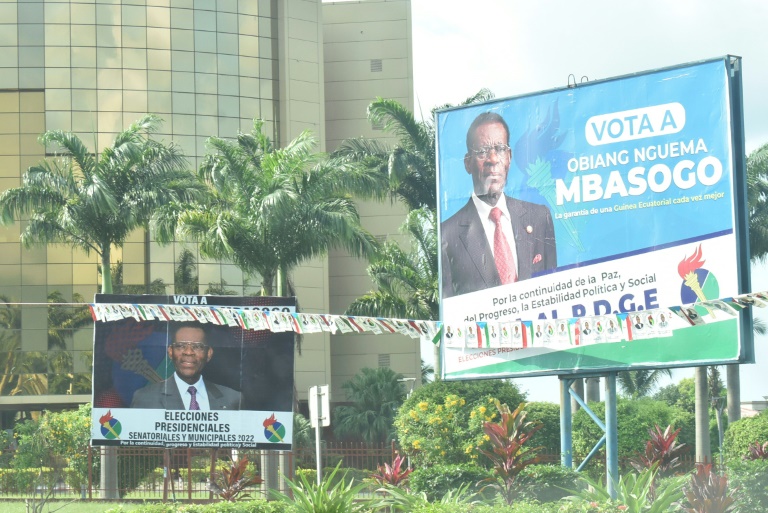
In the run-up to the Sunday’s vote, pictures of Obiang and his Democratic Party of Equatorial Guinea (PDGE), the country’s only legal political movement until 1991, have been splashed all over the capital Malabo.

Running against him is Andres Esono Ondo, 61, from the country’s only tolerated opposition party.

The secretary general of the Convergence for Social Democracy (CPDS) is a candidate for the first time and the sole representative of the muzzled opposition.

Ondo has said he fears “fraud” during the ballot, during which voters are to elect a president as well as members of parliament.

Malabo has levelled its own accusations against the politician, in 2019 accusing him of planning “a coup in Equatorial Guinea with foreign funding”.

He was detained for 13 days in Chad that year as he hoped to attend a congress of the Chadian opposition.

The third candidate is Buenaventura Monsuy Asumu of the Social Democratic Coalition Party (PCSD), a historic ally of Obiang’s ruling party.

The former minister is running for the fourth time, but has never done well in previous elections.

The opposition accuse him of being a “dummy candidate” without a chance.

– ‘Sham’ –

As in every election year, security forces have stepped up arrests in recent weeks.

State media has justified the crackdown as a bid to counter a “foiled plot” by the opposition to carry out attacks on embassies, petrol stations and the homes of ministers. 

In September, after a siege lasting more than a week, security forces stormed the home of one of Obiang’s main opponents, Gabriel Nse Obiang Obono.

His house had also served as an office for his banned Citizens for Innovation (CI) party. 

The assault left five dead — four activists and a policeman, according to Malabo. 

Dozens were injured and more than 150 people were arrested, including Obono. 

Leading rights activist Joaquin Elo Ayeto told AFP the incident had “discredited” the electoral process.

“The ruling party needs an ‘opposition’ to hold sham elections,” he said.

Allegations of fraud have plagued past polls.

In 2016, Obiang was re-elected with 93.7 percent of the vote.

His PDGE won 99 of the 100 seats in the lower house, and all 70 seats in the senate.

In 2009, the president scored more than 95 percent of the vote.

Members of the opposition, most of whom are in exile, hold no hope for a breakthrough on Sunday.

“Obiang’s elections have never been free or democratic, but marked by widespread and systematic… fraud,” they have said in a joint statement.

Despite all being obliged to vote, they urged “all citizens of Equatorial Guinea not to take part in any phase of the electoral process”.
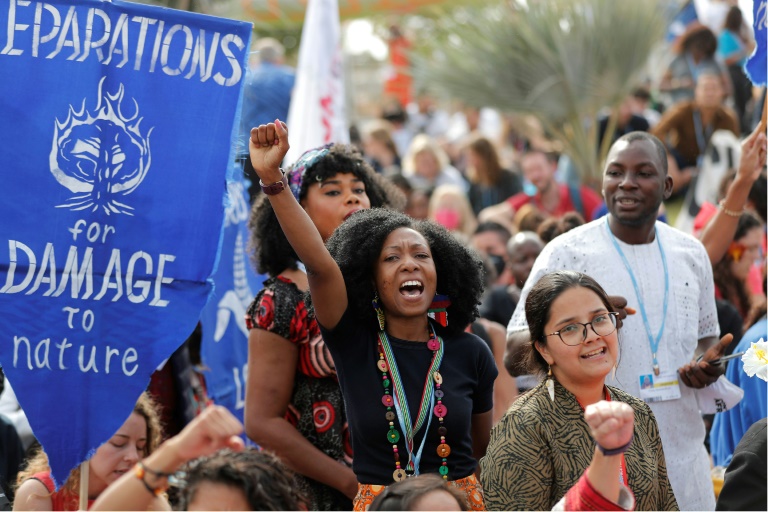
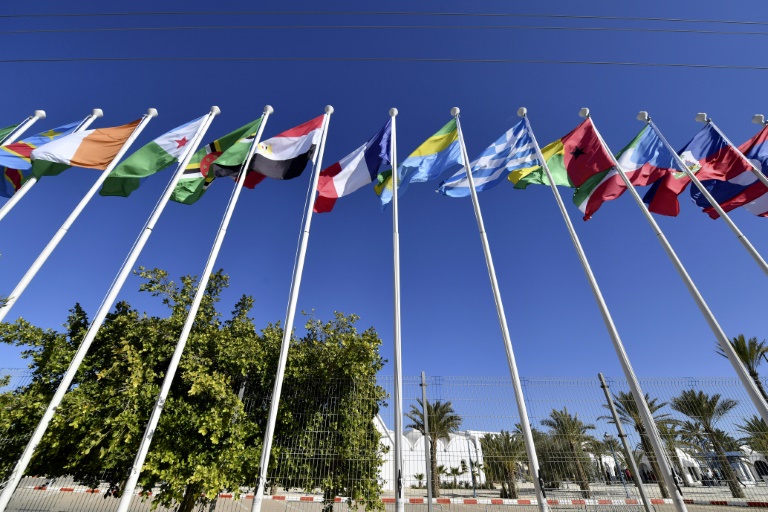
Climate damages are key flashpoint as UN COP talks go overtime

Climate negotiators were grappling for an agreement Saturday at the UN COP27 in Egypt after high stakes talks went deep into the night with key sticking points over funding for countries wracked by climate disasters and ambition in tackling global warming.

The meeting at the Red Sea resort of Sharm el-Sheikh has been dominated by the controversial issue of climate “loss and damage” funds to help developing nations cope with the impacts of increasingly intense and costly floods, heatwaves and droughts.

Wealthy nations, long reluctant to discuss the issue over fears of liability, have accepted that vulnerable nations are facing devastating impacts.

But there are disagreements over who pays and which countries are considered particularly affected.

With nations struggling to find common ground, Britain and several other countries circulated new suggestions trying to break the deadlock late Friday.

The issue was among a daunting list of outstanding areas of contention at the COP27 talks, where representatives from nearly 200 countries have gathered with the aim of driving forward action on climate change as the world faces a worsening onslaught of weather extremes.

Egyptian Foreign Minister Sameh Shoukry, who chairs the COP27 talks, told delegates on Friday — the day talks were officially due to end — that the negotiations would go into Saturday.

“I remain concerned at the number of outstanding issues,” he said.

Delegates are looking to find agreement on emissions-cutting ambitions and reaffirm a goal to limit average warming to 1.5 degrees Celsius from pre-industrial levels, which scientists say is a safer guardrail to avoid the most dangerous impacts.

– Pressure over $100 bn promise –

Rich countries are also under pressure to finally fulfil promises to provide $100 billion a year to help developing countries green their economies and adapt to future impacts.

For many vulnerable countries loss and damage is the defining issue of the conference, with some saying the success of the meeting hinges on the creation of a specific fund at the Egypt talks.

Richer nations, which have previously baulked at the issue over fears of open-ended liability, have accepted that countries in the crosshairs of increasingly destructive climate-driven disasters need funding help, but have called for a broader set of donors — and prioritising the most climate-vulnerable countries as recipients.

The G77 and China bloc of 134 developing countries launched an opening gambit on loss and damage this week, with a proposal to create a fund at COP27, with operational details to be agreed later.

A compromise response from the European Union, proposed late Thursday, suggested a fund specifically for the most vulnerable nations saying the money should come from a “broad funder base” — code for countries including China and Saudi Arabia that have become wealthier since they were listed as developing nations in 1992.

Britain and several other countries have circulated a new draft proposal document, seen by AFP and confirmed by a source close to the negotiations, which suggested the fund could be part of a range of “funding arrangements”.

The document, which has not been formally submitted to the UN process, suggested the new source of monies could be operationalised in two years.

But this would “only agree some ambiguous funding arrangements that kick the can down the road” said Mohamed Adow, of the think tank Power Shift Africa.  

French-speaking bloc to focus on development at Tunisia summit

The world’s club of French-speaking countries will meet in Tunisia from Saturday for talks focused on economic cooperation, more than a year after President Kais Saied began an internationally criticised power grab.

Around 30 heads of state and government, including French President Emmanuel Macron, his Senegalese counterpart Macky Sall and Canadian Prime Minister Justin Trudeau, are set to attend the summit of the International Organisation of Francophonie (OIF) on the southern Tunisian resort island of Djerba.

While the two-day summit and an associated economic forum will officially focus on digital technology’s role in development, it will also be an opportunity for Western and African leaders to discuss issues like Russia’s invasion of Ukraine.

Many African countries have decried what they see as a lack of international solidarity in the face of crises on their continent, in sharp contrast with European nations’ swift support of Kyiv.

The summit coincides with the final stage of UN climate talks in Egypt, and comes just days after G20 leaders met in Indonesia for a meeting dominated by the war in Ukraine, which is an OIF observer state. 

Normally held every two years, the meeting was postponed in 2020 due to the Covid-19 pandemic, and then last year after Saied sacked the government and suspended parliament, later dissolving the legislature entirely.

Hosting the summit is a “success” for Saied, said French political researcher Vincent Geisser.

It will see him “leave his isolation — at least temporarily”, Geisser told AFP, after Canada, France and other developed nations last year called on Saied to restore “constitutional order”.

– Economic cooperation –

The summit will belatedly celebrate the 50th anniversary of the now 88-strong group whose members, such as Armenia and Serbia, are not all French-speaking.

The world’s French-speaking community is around 321 million-strong, and is expected to more than double to 750 million in 2050.

Secretary general Louise Mushikiwabo, of Rwanda, who is up for re-election, said the bloc is “more pertinent than ever” and able to bring added value to “most of the world’s problems”.

She told AFP she would ask member states to “redouble their efforts” in the face of a decline in the use of the French language in international organisations, and recalled that promoting “peace, democracy and human rights” is also part of the OIF’s mission.

Senegalese civil society figure Alioune Tine instead criticised the OIF’s record on international crisis mediation.

The group has shown itself to be “totally powerless in the face of fraudulent elections, third mandates (of African leaders) and military coups” in Mali, Guinea, Chad and Burkina Faso, he said.

Summit coordinator Mohamed Trabelsi told AFP the meeting was “a recognition of the role of Tunisia in the Francophone space, and of its regional and international diplomacy”.

It is also an opportunity to “strengthen economic cooperation”, Trabelsi said.

But an official from OIF heavyweight Canada said Ottawa wanted to echo “concern” over “democratic participation” following Saied’s power grab in the only democracy to have emerged from the Arab Spring uprisings more than a decade ago.

Tunisia is confronted by a deep economic crisis which has pushed a growing number of its people to try to reach Europe.

Seeking to draw delegates’ attention to the issue, hundreds of protesters tried Friday to highlight the disappearance of 18 Tunisians onboard a boat that set out in September. Police prevented them from reaching Djerba.

US and allies condemn rebel advances in DR Congo

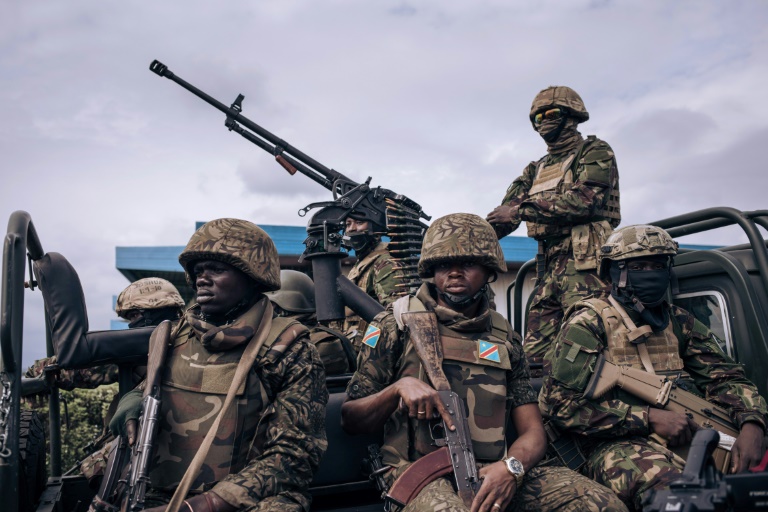
The United States, France, Britain and Belgium on Friday condemned “in the strongest terms” advances by the M23 rebel group in the eastern Democratic Republic of Congo, calling on them to pull back immediately and cease hostilities.

“The resumption of violence since 20 October, including in and around the towns of Rutshuru, Kiwanja, Rumangabo and Kibumba, undermines peace efforts and has caused further insecurity and significant human suffering,” the US said in a joint statement with the British, French and Belgian envoys for the Great Lakes region. 

They called on all parties to participate in a new round of peace talks scheduled for next week in Nairobi.

“All support to non-state armed actors must stop, including external support to M23,” the statement said. 

The March 23 movement, or M23, is a former Tutsi rebel group that took up arms again at the end of last year and seized the town of Bunagana on the border with Uganda in June. 

After a brief period of calm, it went on the offenive again in October, greatly extending the territory under its control. 

The East African Community (EAC) has announced that new peace talks are due to start in the Kenyan capital on November 21, although it has not yet specified who will be attending.

Kinshasa accuses Rwanda of providing M23 with support, something that UN experts and US officials have also pointed to in recent months. 

Kigali disputes the charge, accusing Kinshasa of collusion with the FDLR, a former Rwandan Hutu rebel group established in the DRC after the genocide of the Tutsi community in 1994 in Rwanda. 

Gridlocked UN climate talks head into overtime

UN climate talks were extended by a day Friday in an effort to break a deadlock as nations tussle over funding for developing countries battered by weather disasters and ambition on curbing global warming.

Representatives from nearly 200 countries have gathered at the COP27 in Egypt for two weeks with the aim of driving forward action on climate change as the world faces a worsening onslaught of weather extremes.

But wealthy and developing nations struggled to find common ground on a host of crucial issues, as the summit in the Red Sea resort of Sharm el-Sheikh spilled into overtime.

Egyptian Foreign Minister Sameh Shoukry, who chairs the COP27 talks, told delegates that the negotiations would go into Saturday.

“I remain concerned at the number of outstanding issues,” he said.

The daunting list of tasks includes finding agreement on emissions cutting ambitions and reaffirming a goal to limit average warming to 1.5 degrees Celsius from pre-industrial levels, which scientists say is a safer guardrail to avoid the most dangerous impacts.

Rich countries are also under pressure to finally fulfil promises to provide $100 billion a year to help developing countries green their economies and adapt to future impacts. 

But for many vulnerable countries the defining issue at the conference is money for the “loss and damage” caused by climate change — a controversial issue previously blocked by wealthy countries fearful of open-ended liability.

– ‘Crunch time’ –

A cascade of climate-driven extremes in recent months — from floods in Pakistan and Nigeria to heatwaves and droughts across the world — have shone a spotlight on the ferocious impacts of a warming world for emerging economies, as well as small island states threatened by sea level rise.

The G77 and China bloc of 134 developing countries launched an opening gambit this week, with a proposal to create a loss and damage fund at COP27, with operational details to be agreed later.

A compromise response from the European Union, proposed late Thursday, suggested a fund specifically for the most vulnerable nations.

But one key country, the United States, has remained discreet.

“It’s crunch time,” Rachel Cleetus, lead economist at the Union of Concerned Scientists’ climate programme, told AFP. “There’s no time anymore for the US to sit on the sidelines.” 

A US State Department spokesperson declined to comment, citing ongoing negotiations.

Cleetus said the US and China, the world’s two biggest polluters, “can really unlock this” in view of a thaw in climate relations following a meeting between Presidents Joe Biden and Xi Jinping earlier this week in Bali. 

Cleetus added China should also make its position clear, particularly on the issue of whether it would contribute to such a fund and pledge not to draw from it.  


– ‘Our final offer’ –

European Commission Vice President Frans Timmermans told reporters on Friday that the EU offer had two “very important” conditions that differ from the G77 proposal.  

It should be for “the most vulnerable” nations, he said, and the money should come from a “broad funder base” — code for countries including China that have become wealthier since they were listed as developing nations in 1992.

“I have to say this is our final offer,” Timmermans said.

Canadian Environment Minister Steven Guilbeault told reporters countries were “close” to an agreement but that “the funds should include all large emitters, which would include a country like China, and Saudi Arabia and Qatar”.

Pakistan’s climate minister Sherry Rehman, whose country chairs G77+China, expressed a willingness for “working with each other to find common ground”.

“It is up to all of us to steer a path that sends a powerful message from this COP,” she said.

She said the G77 had zeroed in on one of the options put forward in a draft loss and damage text “with a few changes that have been submitted and we are working on with each other”.

Timmermans said he had explained the EU proposal to US delegates who were “very interested in seeing” the 1.5C target reaffirmed.

Vulnerable nations and many wealthy emitters have stressed the need to maintain the 1.5C goal, while observers are calling for stronger language in the final COP27 statement on curbing planet-heating fossil fuels. 

Even with new commitments, the world is on track to heat up by about 2.5C by the end of the century — enough, scientists say, to trigger dangerous climate tipping points. 

With tight restrictions on demonstrations, several dozen activists on Friday protested inside the venue, holding signs demanding rich countries “pay up for loss and damage”. 

Ivory Coast, Ghana throw down gauntlet on cocoa price

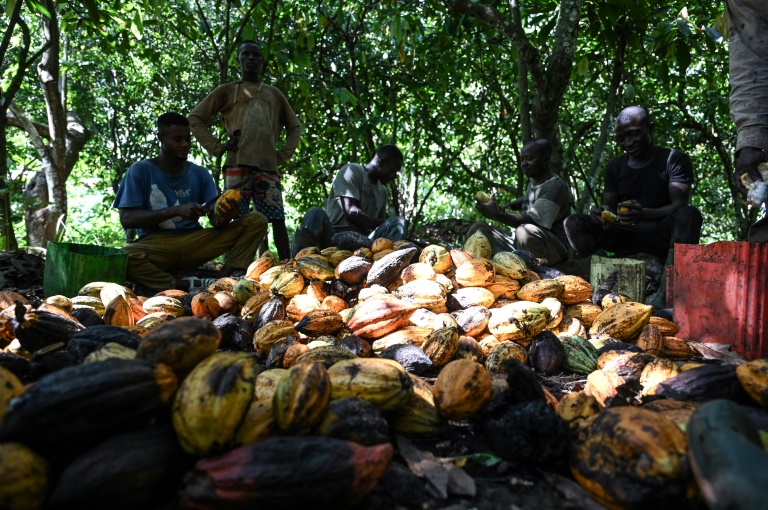
The world’s chocolate industry could be in for a turbulent ride as the two biggest cocoa producers set down demands for manufacturers to pay higher prices for their growers.

The quarrel focuses on the Living Income Differential (LID) — a policy that Ivory Coast and Ghana introduced in 2019 to fight poverty among cocoa farmers in the global $130-billion chocolate market.

Under it, Ivory Coast and Ghana vowed to charge a premium of $400 per tonne on all cocoa sales, starting with the 2020/21 harvest.

But trade boards in the countries — the Ivorian Coffee-Cocoa Council (CCC) and the Ghana Cocoa Board (Cocobod) — say the scheme is being undermined as cocoa traders depress the price of another premium that operates in parallel.

“We’ve introduced the Living Income Differential as a means of improving the farmer income,” said Fiifi Boafo, Cocobod’s spokesperson.

“You have these companies circumventing these processes to ensure that the Living Income Differential effect is not felt in (their) lives.” 

The two countries together account for 60 percent of the world’s cocoa but their farmers earn less than six percent of the industry’s global revenue.

They boycotted a bridge-building meeting in Brussels late last month and set November 20 as a deadline for bringing buyers into line.

They are threatening to punish corporations by barring them from visiting plantations to estimate harvests — a key factor in cocoa price forecasting.

They are also threatening to suspend sustainability programmes that chocolate giants use to enhance their image with fast-growing ethnic consumers.

“This boycott and also ultimatum is to draw attention to the fact that inasmuch as it is important for us to talk about deforestation, it is important to talk about child labour, it is equally important to talk about the farmer income,” said Boafo.

– Premium pressure –

The LID premium is being completed by a price stabilisation fund to help buffer the international price of cocoa in the event of big market fluctuations.

Some experts say the chocolate giants have factored the LID into their costs but claw back some of this by exerting pressure on another premium based on the quality of cocoa beans.

This premium, known as the origin differential, has plunged below zero in recent years, effectively cancelling out part of the LID.

Covid is being used as “a pretext not to pay,” CCC President Yves Brahima Kone told AFP. “The thing is, the multinationals have increased their profits — they are able to pay.”

The World Cocoa Foundation, an umbrella group of public entities and corporations aimed at supporting sustainability in the sector, declined to comment on the faceoff.

Among corporations, Nestle said it strongly backed efforts for growers to maintain a decent standard of living and had been paying the LID since its inception.

Some experts say that time may weigh against Ivory Coast and Ghana if the row escalates.

Virtually all of Ivory Coast’s crop is purchased by roughly half a dozen majors. Of this, around 80 percent heads to Europe, the wealthy market where sustainability factors — environmental and labour criteria — count most for consumers.

“Ivory Coast’s economy is heavily dependent on cocoa income,” said one specialist. “It needs to sell its beans.”

“Stopping sustainability programmes is difficult to explain to the general public, and Ivory Coast’s image could (also) suffer.” 

Mali peacekeeping force in the balance as countries withdraw

A shadow has fallen over the United Nations’ peacekeeping mission in jihadist-embattled Mali, one of the UN’s biggest operations, after a string of countries announced they would pull out.

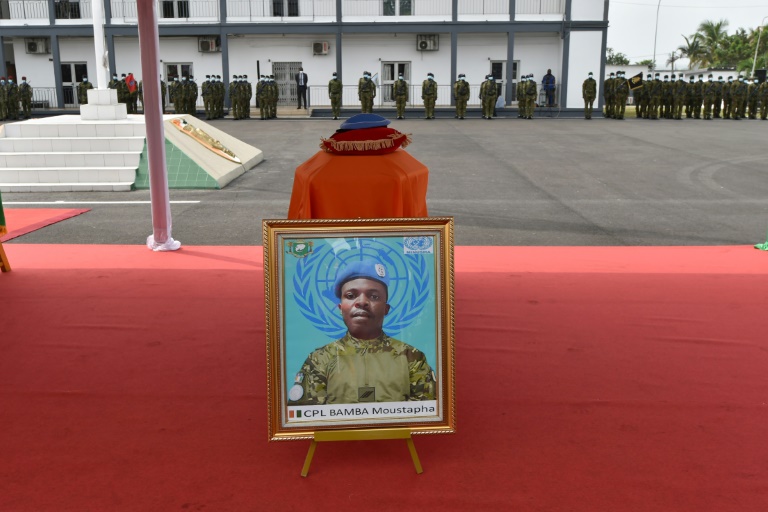
Britain and Ivory Coast this week became the latest to announce their withdrawal from MINUSMA, after similar announcements in past months from Sweden, El Salvador and Benin. 

Egypt, one of the biggest single contributors to MINUSMA, announced in July it would “temporarily suspend” participation in the force.

A German government source on Thursday said Germany was planning to extract its troops by the end of 2023, but there has been no official announcement.

If it too were to depart, MINUSMA would by the end of next year lose more than a quarter of the more than 12,000 personnel it had deployed in September.

“The rats are fleeing what seems to be a sinking ship,” an African diplomat said on condition of anonymity.

Jihadist violence began in northern Mali in 2012, and has since spread to neighbouring countries.

MINUSMA — the Multidimensional Integrated Stabilization Mission in Mali — was created in 2013 to help stabilise the country, and allowed “to use all necessary means” to achieve this end.

The following year it was further mandated to protect civilians, promote human rights and assist in the re-establishment of state authority.

– Heavy toll –

But the violence has grown from bad to worse since then, killing thousands of people — civilians, combatants, troops and police — and forcing hundreds of thousands to flee their homes.

MINUSMA has become the deadliest UN peacekeeping mission in the world, with 281 of its troops killed to date, of which 181 in attacks.

It is also the costliest blue helmet venture on the planet, racking up an annual bill of $1.26 billion.

Yet for many local populations and some African leaders, the mission is not doing enough.

It has in particular struggled to operate since a military coup in Bamako in 2020 and the alleged arrival the following year of Wagner operatives from Russia to bolster government forces.

Tensions between the peacekeepers and the junta erupted into the open in July, when Mali expelled a MINUSMA spokesman during a row over the detention of 49 Ivorian soldiers at Bamako airport.

MINUSMA said the Ivorians were intended for the mission, while Mali accused them of being mercenaries intent on toppling the government.

The junta has also hampered the mission’s investigations into allegations of human rights abuses by Malian forces.

Secretary-General Antonio Guterres has highlighted “restrictions on movement and access” of the UN mission, which was impeding its mandate of protecting civilians.

France this year withdrew its troops from the former French colony, deployed separately under its Barkhane anti-jihadist mission in the Sahel. The force had helped provide air support for MINUSMA.

– Holes to fill –

The reasons for the exodus from MINUSMA vary. 

Egypt announced its suspension after losing soldiers, Benin said it needed to focus on the jihadist threat on its own borders, while Britain objected to the Malian junta’s alleged ties with the Kremlin.

Ivory Coast, which is embroiled in a months-long row with Mali over its detained troops, gave no reason.

Sahel expert Yvan Guichaoua said MINUSMA now faced the challenge of finding numbers and skills to replace the departing soldiers.

The Egyptians had been tasked with escorting convoys for example, while the Swedes were in charge of “rapid response” by air. The British carried out weeks-long scouting missions in the country’s arid southeast, looking for fighters linked to the Islamic State group.

Jean-Herve Jezequel, head of the Sahel programme at the International Crisis Group (ICG) think tank, said the departure of the Ivorians — 875 troops — was “a big blow”.

“The backbone of MINUSMA is the contingents from countries of the global South,” Jezequel said.

In June, Guterres said a re-appraisal of MINUSMA’s mission was needed within six months.

– Help for civilians –

When asked if it was planning measures to replace departing contingents, MINUSMA replied in general terms.

“In a peacekeeping mission, contributing countries supply troops for a certain period,” it said.

“When they leave, others replace them and the plan is adjusted accordingly. It’s a well-established process that is mainly discussed at the political level and at the headquarters in New York.”

A UN official in Mali, who asked to remain anonymous, said that despite “problems”, MINUSMA had made huge contributions to civilian life.

They had helped fund infrastructure, provided logistics support to the judiciary and health sector, and even contributed to mediation between different communities.

“Whatever is said, MINUSMA does a lot in areas where the state has long given up due to lack of funding or will,” the source said.

Ivory Coast, Ghana throw down gauntlet on cocoa price

The world’s chocolate industry could be in for a turbulent ride as the two biggest cocoa producers set down demands for manufacturers to pay higher prices for their growers.

The quarrel focuses on the Living Income Differential (LID) — a policy that Ivory Coast and Ghana introduced in 2019 to fight poverty among cocoa farmers in the global $130-billion chocolate market.

Under it, Ivory Coast and Ghana vowed to charge a premium of $400 per tonne on all cocoa sales, starting with the 2020/21 harvest.

But trade boards in the countries — the Ivorian Coffee-Cocoa Council (CCC) and the Ghana Cocoa Board (Cocobod) — say the scheme is being undermined as cocoa traders depress the price of another premium that operates in parallel.

“We’ve introduced the Living Income Differential as a means of improving the farmer income,” said Fiifi Boafo, Cocobod’s spokesperson.

“You have these companies circumventing these processes to ensure that the Living Income Differential effect is not felt in (their) lives.” 

The two countries together account for 60 percent of the world’s cocoa but their farmers earn less than six percent of the industry’s global revenue.

They boycotted a bridge-building meeting in Brussels late last month and set November 20 as a deadline for bringing buyers into line.

They are threatening to punish corporations by barring them from visiting plantations to estimate harvests — a key factor in cocoa price forecasting.

They are also threatening to suspend sustainability programmes that chocolate giants use to enhance their image with fast-growing ethnic consumers.

“This boycott and also ultimatum is to draw attention to the fact that inasmuch as it is important for us to talk about deforestation, it is important to talk about child labour, it is equally important to talk about the farmer income,” said Boafo.

– Premium pressure –

The LID premium is being completed by a price stabilisation fund to help buffer the international price of cocoa in the event of big market fluctuations.

Some experts say the chocolate giants have factored the LID into their costs but claw back some of this by exerting pressure on another premium based on the quality of cocoa beans.

This premium, known as the origin differential, has plunged below zero in recent years, effectively cancelling out part of the LID.

Covid is being used as “a pretext not to pay,” CCC President Yves Brahima Kone told AFP. “The thing is, the multinationals have increased their profits — they are able to pay.”

The World Cocoa Foundation, an umbrella group of public entities and corporations aimed at supporting sustainability in the sector, declined to comment on the faceoff.

Among corporations, Nestle said it strongly backed efforts for growers to maintain a decent standard of living and had been paying the LID since its inception.

Some experts say that time may weigh against Ivory Coast and Ghana if the row escalates.

Virtually all of Ivory Coast’s crop is purchased by roughly half a dozen majors. Of this, around 80 percent heads to Europe, the wealthy market where sustainability factors — environmental and labour criteria — count most for consumers.

“Ivory Coast’s economy is heavily dependent on cocoa income,” said one specialist. “It needs to sell its beans.”

“Stopping sustainability programmes is difficult to explain to the general public, and Ivory Coast’s image could (also) suffer.” 

As climate talks drag, artist shows way to climate hell

Egyptian artist Bahia Shehab had one goal at the COP27 climate talks in Egypt: to let people experience the “hell” that is global warming. 

At first, she said, she wanted to “hack the rooms” to literally turn up the heat on delegates from nearly 200 countries who have been talking for two weeks about how to drive forward action against worsening climate change. 

With wealthy and developing nations struggling to agree on final deals, talks were extended to Saturday.

“There’s research that said that people who are in a hotter place, in a hotter room, they’re more likely to believe in climate change than those who are not,” Shehab said at Egypt’s Red Sea resort city of Sharm el-Sheikh, which is hosting the talks.

But due to security measures, instead of the “hack”, Shehab set up a public art installation dubbed “Heaven and Hell in the Anthropocene”. 

It features two adjacent rooms, one heated at 45 degrees Celsius (113 Fahrenheit) while the other is air-conditioned. 

“We wanted to come up with a scenario that is accessible to everyone,” she said. 

Campaigners the world over have been pulling public stunts targeting artworks to draw attention to global inaction over climate change.

In Milan on Friday, climate activists threw flour over a car repainted by American artist Andy Warhol.

“Do we really get outraged at the simulation of damage to works of art while the ongoing objective destruction of works of nature, ecosystems and our own lives leaves us indifferent?” the activists from the Last Generation group wrote in a statement.

Activists have also glued themselves to a Francisco Goya painting in Madrid, thrown soup at Vincent van Goghs in London and Rome, and mashed potatoes on a Claude Monet in Germany.

– Triggering questions –

Shehab has taken a more restrained approach with her art and says it works, producing an impact on many. 

“Scary,” a British visitor who gave her name as Jolene said of the “hell” room, in contrast with the “cool, clean, nice” environment she found in heaven.

The artist said she had already seen attitudes change.

“There’s one girl who walked out of ‘hell’ who said: ‘I will never throw trash on the ground ever again,'” she said.

“So to me, it’s not important whether they like it aesthetically or not but it’s really important that it triggers questions and that they reconsider their daily practice.”

Another artist, Rehab el-Sadek, sought to be the voice of indigenous populations across Egypt. She pitched a Bedouin-like tent inscribed with messages in Arabic, English and Spanish. 

“I want climate action to prioritise indigenous and local communities,” one message read. 

Sadek said that, with the COP taking place in the Sinai Peninsula, home to nomadic Bedouin, “we thought that the tent… will make a connection between locals and people around the world.”

Indian artist Shilo Shiv Suleman painted an entire mural at the COP27 complex to send a message “to the leaders of the world who consider the planet as a product”. 

The mural depicting animals in their natural habitat is a reminder “to return to ourselves — the mountains, the stars, the rivers and ways of being that placed us within the empire of the earth, not outside of it,” she said.

But art’s role is not limited to raising awareness, said Marguerite Courtel, a Paris-based expert on environmental transition and culture.

It should also develop techniques to fend off the impact of climate change, and she said a key question remains: Are the works themselves produced with “eco-responsibility”?

Gridlocked UN climate talks head into overtime

UN climate talks were extended by a day Friday in an effort to break deadlock as nations tussle over funding for developing countries battered by weather disasters and ambition on curbing global warming.

Representatives from nearly 200 countries have gathered at the COP27 in Egypt for two weeks with the aim of driving forward action on climate change as the world faces a worsening onslaught of weather extremes.

But wealthy and developing nations were struggling to find common ground on creating the fund, and on a host of other crucial issues, with only hours before the summit was scheduled to end in the Red Sea resort of Sharm el-Sheikh.

Egyptian Foreign Minister Sameh Shoukry, who chairs the COP27 talks, told delegates that the negotiations would spill into Saturday, a delay not unusual in such sprawling UN climate talks.

“I remain concerned at the number of outstanding issues,” he said.

The daunting list of tasks includes finding agreement on reaffirming a goal to limit average warming to 1.5 degrees Celsius from pre-industrial levels, which scientists say is a safer guardrail to avoid the most dangerous impacts.

Rich countries are also under pressure to finally fulfil promises to provide $100 billion a year to help developing countries green their economies and adapt to future impacts, and to hammer out future finance plans. 

But for many vulnerable countries the defining issues at the conference is money for the “loss and damage” caused by climate change — a controversial issue previously blocked by wealthy countries fearful of open-ended liability.

– ‘Crunch time’ –

A cascade of climate-driven extremes in recent months — from floods in Pakistan and Nigeria to heatwaves and droughts across the world — have shone a spotlight on the ferocious impacts of a warming world for emerging economies as well as small island states threatened by sea level rise.

The G77 and China bloc of 134 developing countries launched an opening gambit this week, a proposal to create a loss and damage fund at COP27, with operational details to be agreed later.

A compromise response from the European Union, proposed late Thursday, suggested a fund specifically for the most vulnerable nations.

The EU proposal indicated that the bloc has “shifted significantly”, said Rachel Cleetus, lead economist at the Union of Concerned Scientists’ climate programme. 

But she said the United States and China, the world’s two biggest polluters, “can really unlock this”, fresh from a thaw in their climate relations after a meeting between Presidents Joe Biden and Xi Jinping earlier this week in Bali. 

“It’s crunch time,” Cleetus told AFP. “There’s no time anymore for the US to sit on the sidelines.” 

Cleetus added that China should also make its position clear, particularly on the issue of whether it would contribute to such a fund and pledge not to draw from it.  


– ‘Our final offer’ –

European Commission Vice President Frans Timmermans told reporters on Friday that the EU offer had two “very important” conditions that differ from the G77 proposal.  

It should be for “the most vulnerable” nations, he said, and the money should come from a “broad funder base” — code for countries including China that have become wealthier since they were listed as developing countries in 1992.

“I have to say this is our final offer,” Timmermans said.

Pakistan’s climate minister Sherry Rehman, whose country chairs G77+China, expressed a willingness for “working with each other to find common ground”.

“It is up to all of us to steer a path that sends a powerful message from this COP that the implementation COP actually turned into a historic actionable COP,” she said.

She said the G77 had zeroed in on one of the options put forward in a draft loss and damage text “with a few changes that have been submitted and we are working on with each other”.

Timmermans said he had explained the EU proposal to US delegates who were “very interested in seeing” the 1.5C target reaffirmed.

Vulnerable nations, small island states and many wealthy emitters have stressed the need to maintain the goal of limiting warming to 1.5C, while observers are calling for stronger language in the final COP27 statement on curbing planet-heating fossil fuels. 

Even with new commitments, the world is on track to heat up by about 2.5C by the end of the century — enough, scientists say, to trigger dangerous climate tipping points. 

With tight restrictions on demonstrations, several dozen activists  on Friday protested inside the venue, holding signs demanding rich countries “pay up for loss and damage”. 

Close Bitnami banner
Bitnami