Africa Business

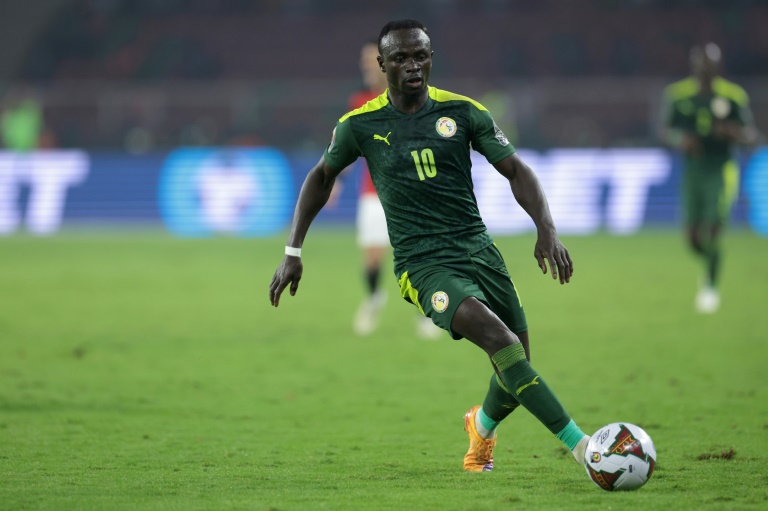
Hammer blow for Senegal as Mane ruled out of World Cup

Senegal star Sadio Mane has lost his race to be fit for the 2022 World Cup and has been withdrawn from their squad, the country’s football federation announced on Thursday. 

His club Bayern Munich added later that the 30-year-old, who was voted second in the Ballon d’Or last month behind Karim Benzema, had undergone “successful surgery” in Innsbruck where “a tendon was reattached to the head of his right fibula”.

Bayern said Mane “will begin his rehab in Munich in the next few days”.

The absence of the talismanic Mane is a massive blow to the Senegalese. He scored the winning penalty in a shootout victory against Egypt in the African Cup of Nations final and repeated the feat against the same opponents to qualify the Lions of Teranga for the World Cup.

Mane was voted African footballer of the year for his feats, and has scored 33 times in 92 matches for Senegal.

He picked up his shin injury playing for Bayern earlier this month but was named in the World Cup squad in the hope he could regain fitness.

But on Thursday Senegal said the former Liverpool star would not make it.

“Unfortunately, today’s (Thursday) MRI shows us that the improvement is not as favorable as we imagined and unfortunately we have to withdraw Sadio from the World Cup,” said team doctor, Manuel Afonso in a video on the official Senegal Twitter account. 

Senegal had originally hoped the forward would be fit in time for their opening game on November 21 against the Netherlands.

They will also take on hosts Qatar and Ecuador in Group A.

Senegal football federation chief Augustin Senghor told AFP Thursday there was no panic over the loss and said the player’s health had been paramount in their decision.

“We have been ready for this since the news of his injury,” Senghor said.

“We had been waiting for new test results and when they came in we all agreed his health had to come first.”

When asked how the team had taken the blow Senghor replied: “Zen”.

But Senegal international Pape Gueye told AFP that Mane would be missed.

“Mane is irreplacable,” he said.

“But we do have other options on the flank, and that’s a ray of hope on a dark day for Senegal.”

After naming Mane in his World Cup squad a week ago, coach Aliou Cisse was optimistic but cautious.

“Losing Sadio Mane is not an easy thing for a coach, for the team, even for African football,” he said.

Mane had been in Munich receiving treatment with his club.
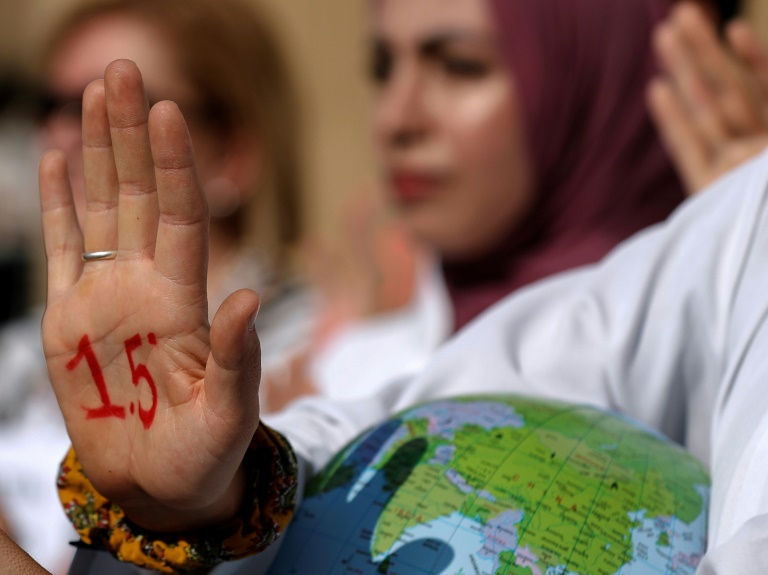
UN chief says stop 'blame game' at deadlocked climate talks

UN chief Antonio Guterres urged rich and developing nations to stop the “finger pointing” at deadlocked climate talks on Thursday and reach a deal on covering the losses suffered by vulnerable countries battered by weather disasters.

With the two-week COP27 conference in Egypt officially due to wrap up on Friday, negotiators faced a long night as they scrambled to find a compromise over the contentious issue of “loss and damage” and prevent the talks from collapsing.

Guterres said there was “clearly a breakdown in trust” between developed and emerging economies, adding that the most effective way to build confidence would be to find an “ambitious and credible agreement” on loss and damage and financial support for vulnerable countries.

“This is no time for finger pointing. The blame game is a recipe for mutually assured destruction,” he said, after flying back to Egypt from Bali where he had attended a G20 leaders meeting.

“The time for talking on loss and damage finance is over — we need action.” 

Developing nations least responsible for global emissions are pushing rich polluters to agree at COP27 on the creation of a fund to compensate countries facing huge losses from climate impacts.

After dragging their feet over loss and damage over concerns it would leave rich nations legally exposed to open-ended demands for compensation, the United States and European Union somewhat softened their position by agreeing to discuss the issue at COP27.

Hours after Guterres’s intervention, Sameh Shoukry, the COP27 president, urged delegates to approach the last hours of talks with “urgency”.

“We are not where we need to be in order to close this conference with tangible and robust outcomes,” he said at a session late Thursday.   

European Commission Vice President Frans Timmermans proposed the establishment of a “loss and damage response fund for the most vulnerable countries” as a compromise.

But he also said that the funding should come from a “broad donor base” — code for China, the world’s top polluter and second biggest economy, to participate.

– US silence –

An earlier proposal from China and some 130 developing nations — known as G77+China — limits the donor base to a list of two-dozen rich nations drawn up in 1992.

Timmermans has said that countries such as China, which were poorer 30 years ago, should not be left “off the hook” now that they have grown wealthier.

The G77+China proposal also says the fund would be used to assist “developing nations” in broader terms than the EU’s proposal.

“For us, the success of COP27 depends on what we get on loss and damage,” G77+China lead negotiator Nabeel Munir of Pakistan said after Timmermans spoke.

The United States, the world’s second biggest carbon emitter, did not address the open meeting while a Chinese representative did not directly mention loss and damage in his intervention.

A draft text published later on the COP27 website included some of the language in both proposals, without going into details into who would have to pay into the fund.

Earlier, Ralph Regenvanu, minister of climate change for the Pacific island of Vanuatu, warned that walking out of the talks “was discussed as an option” if developing nations come away empty handed.

“We are out of time and we are out of money and we are out of patience,” he said at a news conference.

Protests held within the conference compound have sought to keep up the pressure on delegates, with small but vocal crowds of demonstrators chanting: “What do we want? Climate justice!” 

– ‘The clock is ticking’ –

The deadlock on loss and damage is holding up agreement on a broad range of issues that nations are hoping to address at COP27.

Developed countries want countries to reaffirm their commitment to meeting the aspirational goal of limiting global warming to 1.5 degrees Celsius — a tough target as CO2 emissions are expected to hit an all-time high this year.

Timmermans said that for the EU, the 1.5C target and loss and damage “are two sides of the same coin”.

“We sincerely hope that by this offer that we are making tonight, we can bring parties closer together because we believe it is urgent that we show to all our constituents that we want this COP to succeed,” he said.

Developing nations have also sought assurances at COP27 that rich countries will finally fulfil promises to provide $100 billion a year to help them green their economies and adapt to future impacts.

“The climate clock is ticking, and trust keeps eroding,” Guterres said. 

“The parties at COP27 have a chance to make a difference –- here and now. I urge them to act — and act quickly.”

W.Africa coastal states eye more cooperation over Sahel jihadism

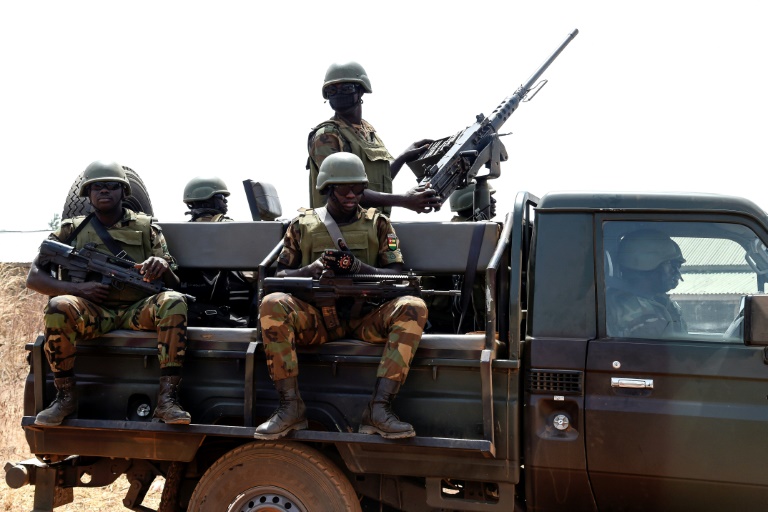
West African coastal states on Thursday held talks on boosting cooperation against jihadist violence spilling over from the Sahel after more countries announced they would pull their peacekeepers out of Mali.

Gulf of Guinea neighbours Benin, Ghana, Ivory Coast and Togo are confronting increased risks from Islamic State-allied and Al Qaeda militants waging war over their northern borders in the Sahel.

As part of the so-called Accra Initiative, representatives of coastal states, the European Union and others met in the Ghanaian capital for talks on security and intelligence cooperation.

Ghana’s National Security Minister Albert Kan-Dapaah said collaboration was needed as the threat from extremism is “more widespread than previously thought and transcending borders.”

“The threat landscape has consistently changed,” he said.

In the first quarter of 2022, Africa recorded 346 attacks, almost half of which were in the west of the continent, he said.

Launched in 2017, the Accra Initiative includes Benin, Togo, Ghana, Ivory Coast as well as Burkina Faso. Mali and Niger have also since joined.

The Accra meeting, extending to next week, will also involve representatives from the EU and British government and the 15-member West African bloc ECOWAS.

A summit with regional heads of state is planned for November 22, where leaders will discuss security proposals, according to the Accra Initiative executive secretary.

– Spreading insurgency –

The Sahel’s jihadist conflict began in northern Mali in 2012, spread to Burkina Faso and Niger in 2015 and now states on the Gulf of Guinea are suffering sporadic attacks. 

Across the three Sahel nations, thousands of people have been killed, more than two million displaced and devastating damage has been inflicted to three of the poorest economies in the world.

French and other peacekeeping missions had been operating in Mali for almost a decade as a bulwark against the spread of Islamist violence.

But after two coups in Mali, the military junta has moved closer to Moscow, receiving Russian weapons and allowing what Western countries call Russian mercenaries to operate.

That has eroded ties with Western partners. France earlier this year pulled out its troops under its Barkhane anti-jihadist mission.

This week, Ivory Coast, which is embroiled in a separate row with Mali over detained Ivorian soldiers, said it would withdraw its contingent from the UN peacekeeping mission MINUSMA by August 2023.

Britain also announced a pullout from MINUSMA within six months, and Germany warned its soldiers would quit the force by the end of next year “at the latest.”

British Defence Minister James Heappey said on Monday he would be joining the Accra meeting next week as the UK, France and others look at options for “rebalancing our deployment”.

“I will join colleagues from across Europe and West Africa in Accra to co-ordinate our renewed response to instability in the Sahel,” he said.

Benin and Togo in particular have faced an increased threat from across their northern borders with Burkina Faso.

Benin, which has recorded 20 incursions since 2021, is also in talks with Rwanda over logistical aid and military expertise.

Togo has suffered at least five attacks, including two deadly assaults, since November 2021. More than 4,000 people in northern Togo have been displaced this year alone, the government in Lome has said.

Jailed Egypt dissident was 'near death' on hunger strike: family

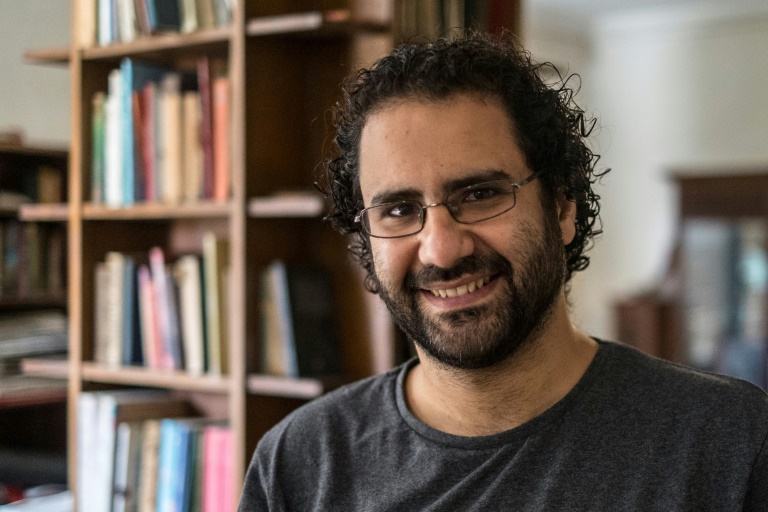
Jailed British-Egyptian activist Alaa Abdel Fattah was “near” to death behind bars, his family told AFP Thursday after the first family visit since he ended a seven-month long hunger strike.

“When we saw him today, he was exhausted, weak and vulnerable,” the activist’s aunt novelist Ahdaf Soueif said. “He was very, very thin and sometimes leaned against the wall”.

The pro-democracy blogger is currently serving a five-year sentence for “spreading false news” by sharing another user’s Facebook post about police brutality.

After seven months consuming what his family said was “100 calories a day”, Abdel Fattah escalated his strike to all food, and then water on November 6 to coincide with the start of the UN COP27 climate summit in Egypt.

World leaders at the COP27 summit raised his case with Egypt’s President Abdel Fattah al-Sisi.

On Monday he wrote a letter saying he had ended the strike, and on Thursday his family was allowed access for the first time in nearly a month in the prison, north of Cairo.

“We saw him in the visitation booth of Wadi al-Natroun prison, with a glass barrier between us, with one very faint headset that we could talk to him through one at a time,” his sister Sanaa Seif said.

– ‘Deteriorated severely’ –

His other sister Mona Seif — in London campaigning for his release — said news from the visit was “unsettling”.

“Alaa deteriorated severely in the past two weeks, but at least they got to see him, and he needed to see the family so much,” she wrote on Twitter.

Abdel Fattah recounted to his family how, five days into his food and water strike, he lost consciousness in the shower, at which point he was given fluids.

“He talked about all of this as a near-death experience,” Soueif said.

While Abdel Fattah has now ended his hunger strike, he “will have no choice but to resume his hunger strike imminently if there continues to be no real movement on his case”, Soueif added.

The family have submitted a new request for a presidential pardon, and hopes it could be granted were raised when the plea was picked up by one of Egypt’s most watched talk show hosts, the ardently pro-Sisi Amr Adib.

Intended to burnish the country’s image, COP27 has brought a wave of criticism over Egypt’s human rights record, with Abdel Fattah’s case making global headlines.

– ‘Free them all!’ –

On Thursday, civil society delegates at the closing of the COP27 People’s Plenary in Egypt’s seaside town of Sharm el-Sheikh chanted “Free Alaa! Free them all!”

Several speakers at the summit have ended with the words “You have not yet been defeated” — the title of Abdel Fattah’s book. It has become a rallying cry for activists, both at the climate talks and posting online, demanding climate justice and human rights.

“We hope that the incredible global attention on Alaa’s case, and the tens of thousands of people who are now standing by him, will lead to his release,” Soueif said, adding that her nephew had had no idea of the mass campaign supporting him.

“He has been completely in the dark as to what’s happening in the world outside,” she said.

But as the summit wraps up in coming days, Sanaa Seif worries that soon “the attention will be less.”

Egyptian human rights defenders — who have stepped into a rare spotlight on the summit’s sidelines — fear what will happen once the summit’s cameras are gone.

Rights groups estimate Cairo is holding about 60,000 political prisoners, many of them in brutal conditions and overcrowded cells. Egypt rejects the reports.

Goma at heart of DRC's bloodshed, natural beauty

Sandwiched between Lake Kivu in the south, the Rwandan border in the east, volcanoes and Virunga national park in the north, Goma is central to the Democratic Republic of Congo’s natural riches and bloodshed.

A decade ago, the city was occupied for just over a week by M23 rebels, who are again menacing the region. 

As with the rest of the huge central African country, Goma’s population is difficult to establish.

But estimates put the number of residents at between one and two million, making it the third or fourth largest city in the country. 

The town, 1,500 kilometres from Kinshasa, is adjacent to Rwanda, with two crossings linking it to Gisenyi in Rwanda — usually abuzz with traders selling their products on either side. 

Goma’s lake port allows smallholders and traders to transport vegetables and livestock products from the shores and the island of Idjwi, in the middle of the lake, by motor canoes. 

Speedboats shuttle back and forth from Bukavu, on the lake’s southern tip.  

– Eruptions –

Goma is also served by an international airport and a highway which leads to the north and provides access to Uganda.  

The region is known for its fertile soil, producing vegetables, coffee and cheeses. 

The city’s emblematic “chukudus”, large wooden scooters that withstood the advent of motorbikes, roll down the city’s slopes, laden with construction materials and produce from the fields.   

The area has significant tourism potential, boasting lakes, volcanoes and mountain gorillas, the main attraction of Virunga national park. 

Goma and Kivu came to worldwide attention in 1994, at the end of the Rwandan Tutsi genocide, when the town and then the region were overwhelmed by Hutu refugees. 

Among them were perpetrators of the genocide, some of whom are still in armed groups active in eastern DRC. 

In the wake of the genocide, the DRC has seen two regional wars, between 1996 and 2003, during which Goma was at the forefront, the backdrop to fighting and occupation. 

Armed groups, local and foreign-inspired, have proliferated. 

Goma has seen two eruptions from the nearby Nyiragongo volcano, one in 2002 and again in 2021, compounding the hardships faced by residents.

Despite evident challenges, the city, with its volcanic and dark soil and temperate climate, is among the most dynamic in the DRC. 

It benefits financially from the presence of humanitarian and UN personnel deployed in the region in response to the violence. 

Language proposal stirs thorny debate in troubled Mali

Mali gained independence from France in 1960, yet even today French is the language of government business, used on road signs and in state TV broadcasts. 

But on Bamako’s streets, French is rarely heard, and out in the bush even less so.

Mali has scores of its own languages — which is why, for some, it rankles that the tongue of the former colonial ruler is the only official language.

A few lines in the country’s draft constitution are now fanning calls for change, albeit at the cost of reminding the West African nation of some of its many problems.

“It’s been 60 years since independence — is it normal that French is our only official language?” asked Ali Guindo, a resident of the capital Bamako.

“We have lots of languages here in Mali,” he said outside his home in Torokorobougou district. “It would be good to cement them in our official culture.”

The debate has been sparked by the unveiling last month of a draft constitution, billed by the ruling junta as crucial for saving Mali from jihadist insurgents.

As in the 1992 constitution it is designed to replace, the charter identifies French as the “language of official expression.”

But, in a change, it also says local languages are “intended to become official languages.”

More than 70 languages are spoken in Mali, a deeply poor Sahel nation with a fast-growing population of some 21 million.

Of these 13 are recognised as “national” languages but French is the only official one, meaning that it is used for government and regulatory business, said Amadou Salifou Guindo, a specialist in sociolinguistics.

Among the major local languages, Songhay and Tamashek are widely spoken in the north; Fulfulde in central areas by the Fulani, an ethnic group also known as Peul; Bambara predominates in Bamako; and in the country’s far south, Senufo and Soninke prevail.

– Difficult debate –

The few words in the proposed Article 31 have now fired up discussion, from TV talk shows to chats over tea in informal get-togethers known as grins.

Among the questions: is it time to elevate vernacular languages to the status of official tongues? If so, which ones? And how can this be achieved?

But these questions also have swirling undercurrents.

One is Mali’s relationship with France, the country’s traditional ally, which has hit rock-bottom since the junta came to power in August 2020.

Some have used the bust-up to seize on Article 31 as a means to phase out French and make Bambara, the most-used language in Bamako, the official one instead.

But to do so touches on the sensitive question of national identity, potentially alienating speakers of other languages.

“Malians are afraid of an official language being imposed to the detriment of others,” said Guindo the linguist.

Another problem is rather more basic: teaching children to read and write in their local languages, which are rooted in oral traditions.

Under former president Moussa Traore who was ousted in 1991, experimental schools were set up that taught in vernacular languages.

The “revolutionary” idea foundered on a lack of state investment, and the schools came to be seen by parents and teachers as second class, writer and publisher Ismaila Samba Traore said.

– French dominates –

Local languages are still being taught, but on a small scale.

At the languages faculty at the University of Bamako, department head Mahamadou Kounta teaches Bambara to around 20 students.

The work, he says, is akin to sowing seed.

“When our students graduate, they will be able to read and write in the national languages and they in turn will be able to work to perpetuate them.”

Traore, who runs a publishing company called La Sahelienne, has been in business for 30 years.

He is one of the few publishers in Mali to bring out books in local languages — typically educational works ordered by international NGOs. 

Other than that, publishing remains overwhelmingly in French.

Changing the constitution will not by itself alter habits that have been entrenched for decades, Traore admitted.

“Certain processes cannot be achieved from one day to the other — you have to let things incubate,” he said.

bur-ah/lal/ri/lcm

S.Africa's ghost hunters look for clues in hollow rooms

Shortly after nightfall, flashlight in hand, Rivas Bright knocks twice on the broken window of an abandoned building in Pretoria, South Africa.

“Still!” he tells his fellow ghost hunters. They hold their breath, waiting for a response from the shadows.

It’s been around two years since Bright, 39, set up “The Upsidedown” a group of paranormal enthusiasts hunting ghosts in a bid to prove they are real. 

It’s a daunting task, given spirits are proverbially evasive. 

“It’s a broken science,” Nigel Mullinder, 29, a member of the team who during the day works at a casino, says of the study of paranormal events, which has drawn the interest of researchers and parapsychologists but produced little hard evidence.

Bright and his team of “sceptical believers” — five men and two women — have turned to tech to solve the mystery. 

Armed with an arsenal of tools including infrared cameras, motion and heat detectors, radios, and a self-developed app to uncover paranormal activity, they scout haunted buildings looking for clues in cavernous hallways and rusting stairwells. 

“(We) need a set of evidence that would allow us to prove that it’s not just the wind (blowing) through the window or a door closing because of some sorts of vibrations,” says Mullinder.

Tonight they have come to an abandoned building within the campus of one of South Africa’s largest universities, which asked not to be named. 

Night guards here have been spooked by creepy noises. 

Lucy Tsoeu, 46, says slamming doors and the clacking of a typewriter at night have led her to believe a ghost is hanging about. 

Her colleague Mpho Mthombeni, 30, says he has heard toilets flush and felt a strange presence when there was no one about. 

“What can I do? Do I pray, or shall I speak louder to scare them away?” asks Tsoeu.  

“Maybe they’ll be able to cool them down,” she says of the ghost hunters, half worried and half excited.

– Shadows, whispers and gunshots –

Sporting a grey T-shirt over black trousers, a shaved head and pierced ears, Bright, a retail chain store employee, says he has heard strange sounds and seen sinister shadows since a very young age. 

“My mother would claim to speak to spirits” in her kitchen, he says. 

Since he founded “The Upsidedown”, the group has gathered a few thousand followers on social media, spent several thousand dollars on equipment and searched about a dozen premises, following tip-offs from anxious locals. 

At the university building the group checks every room, placing their detecting tools on a floor covered with dead leaves. 

“We are literally a bunch of guys that stand in the dark, ask questions… and follow red and green blinking lights,” quips Bright.

Bright rings a bell to signal to the ghosts that he wants to talk to them — but there is no reply.  

“We are not here to hurt anybody or remove you from that place. All we’re looking for is answers,” says Bright.

Gunshots echo in the distance. Pretoria is the capital of what is considered one of the world’s most dangerous countries. 

“Did you hear that? I could clearly hear someone call my name,” says a member of the team. It’s hard to corroborate. 

As the hunt goes on, others in turn sense a movement or hear a sigh. 

The group, made up of white, middle class South Africans, has been to this building once before a month ago. 

Then, its members say they communicated with the spirits of children in a room that was used as a makeshift morgue during violent riots in the 1980s. 

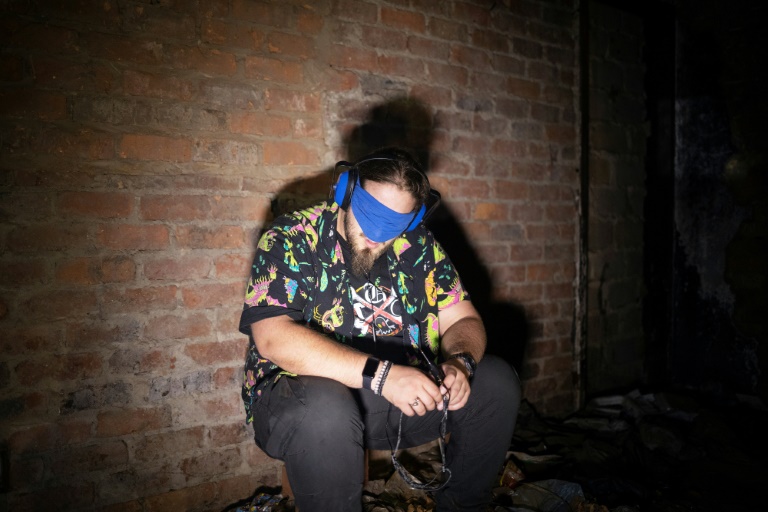
Mullinder tries to get in touch again, listening to a radio frequency meter while blindfolded. 

Everything is filmed to capture potential evidence. But the result is inconclusive. 

“I can understand why people would think we are crazy, but when we finally get that unsolvable massive piece of evidence… who’s the crazy one then?” says Bright. 

cld/ub/lcm

South Africa's Erasmus banned for two games over latest referee tweets

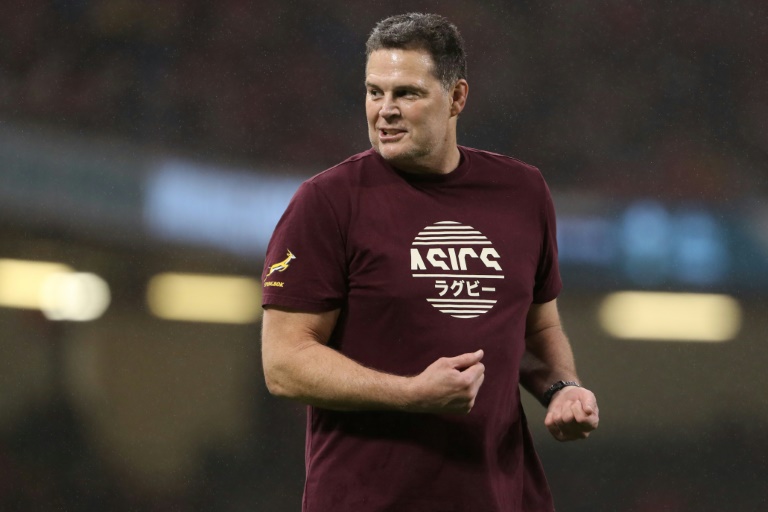
South Africa director of rugby Rassie Erasmus was suspended by World Rugby on Thursday following his criticism of refereeing decisions during the ongoing Autumn Nations Series.

Erasmus, now ruled out of this weekend’s Test against Italy in Genoa and next week’s match against England at Twickenham, has only just returned from a stadium ban following a World Rugby suspension for his infamous hour-long video criticising referee Nic Berry’s performance in the first Test between the Springboks and the British and Irish Lions last year.

That did not stop Erasmus from publishing several videos on social media on Sunday and Monday that appeared to question decisions made by referee Wayne Barnes during the world champion Springboks’ 30-26 loss to France last Saturday.

He had made similar comments on social media following South Africa’s defeat by Ireland a week earlier.

Earlier on Thursday, Erasmus said accusations his videos had led to threats against experienced English referee Barnes, a veteran of over 100 Tests, were “completely unfounded”.

He argued his videos “were not aimed at the officials, but to our SA fans on what we should do better”.

World Rugby, however, took a different view, after reviewing Erasmus’s posts.

“World Rugby condemns any public criticism of match official selection, performance or integrity, which undermines their role, the trust-based coach/match officials feedback process and the values of integrity, respect, solidarity and discipline that are at the heart of the sport,” the global governing body said in a statement.

“The behaviour of coaching staff and match officials are widely observed by fans, media and participants at every level, and such behaviours affect how the values are applied across the game.”

The statement added: “Having considered the matter World Rugby has issued a two-match ban against Rassie Erasmus and accordingly he may not take part in any match-day activity in relation to the two upcoming Test matches that South Africa has against Italy on 19 November, 2022 and England on 26 November, 2022. 

“The ban includes engagement with media and social media in relation to match officials.”

Sudanese officers fire tear gas as thousands protest coup

Sudanese security forces fired tear gas Thursday to disperse thousands of protesters calling for justice for scores of people killed since last year’s military coup, which deepened the country’s political crisis.

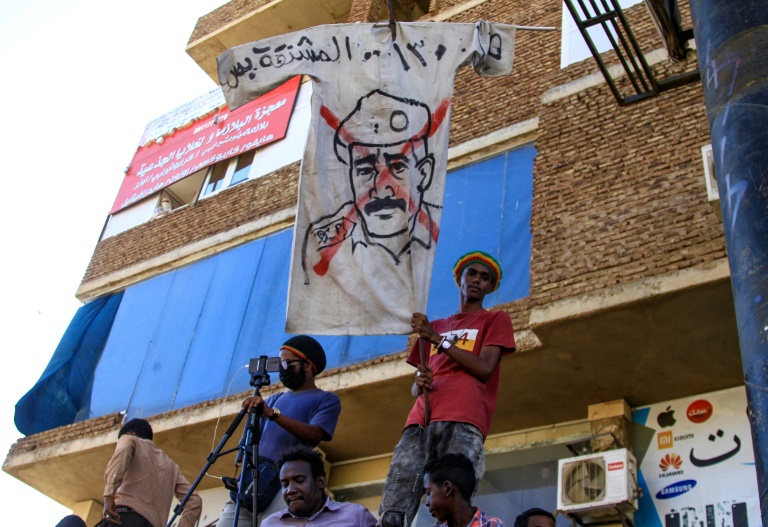
Some protesters flew flags and carried portraits of those killed in earlier crackdowns, while others waved a banner with the crossed out image of army chief Abdel Fattah al-Burhan, who led the military takeover last year.

Unrest has gripped Sudan since Burhan seized power in October 2021, derailing the country’s transition to civilian rule established following the 2019 ouster of dictator Omar al-Bashir.

Security forces later fired tear gas canisters to break up the crowds, AFP reporters said.

Poverty-stricken Sudan has been mired in political and economic turmoil that worsened after the coup, and near-weekly anti-coup protests have been met with a violent crackdown that has left at least 119 people dead, according to pro-democracy medics.

Thursday’s protests, which drew the largest crowds in northern Khartoum, marks one year since November 17, 2021. That day saw 15 people killed, the deadliest single-day crackdown on anti-coup demonstrations. 

“The martyr’s blood did not go in vain,” demonstrators chanted, while others called for the military to “go back to the barracks.” 

Some protestors criticised a possible deal between the military and Sudan’s main civilian bloc, the Forces for Freedom and Change (FFC), which was ousted in the coup.

– ‘Legitimate demands’ – 

The latest crackdown on protests comes a day after United Nations Human Rights Commissioner Volker Turk urged restraint while on a visit to Khartoum.

“I call on the relevant authorities clearly to instruct security forces to respond to the demonstrations in line with human rights laws and standards,” Turk told reporters on Wednesday.

“I have asked for the police to establish a way to engage with the communities, to accept the fact that they have legitimate demands, and I urged them not to see demonstrators as adversaries.”

Ongoing talks between the FFC and the military, which have lasted for weeks, are the latest bid to break the political stalemate. 

The two sides recently welcomed a transitional constitution developed by the Sudanese Bar Association as a basis for a lasting agreement. 

On Wednesday, the FFC said it had approved a two-phase political process based on the Bar Association’s initiative. 

The initial component would cover a constitutional framework establishing civilian government, while the second comprises a final deal tackling issues including transitional justice and reforms to the military. 

On Sunday, Burhan said the military was presented with a “document” on the political process.

“We noted down observations to preserve the army’s dignity, unity and independence,” said Burhan, during a visit to a military base west of Khartoum.

He also warned political factions against “interference” in the armed forces’ activities, saying “we consider anyone who tries to interfere in the army an enemy.”

DR Congo sends warplanes against advancing M23 rebels

The Democratic Republic of Congo deployed two warplanes against advancing M23 militants on Thursday in the country’s volatile east, sources said, after a regional bloc called for rebels to disarm.

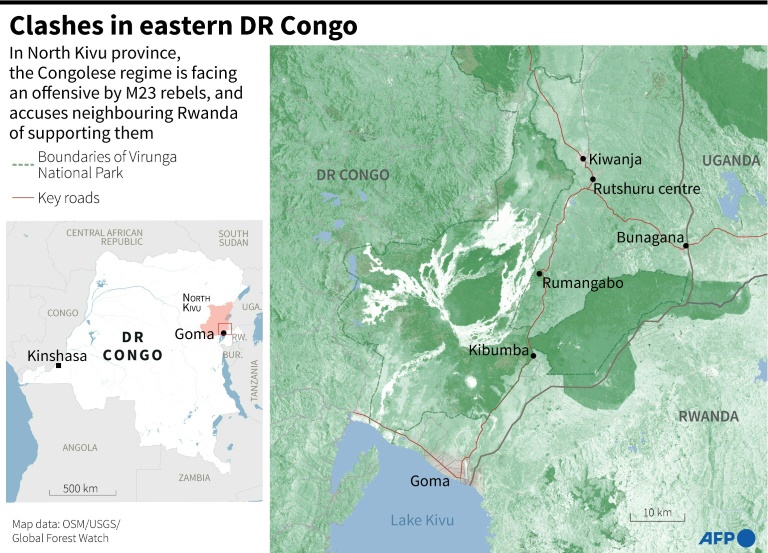
Tanks and two fighter jets targeted rebel positions in the town of Kibumba at noon, according to a resident who spoke to AFP via telephone from the region’s main city Goma. 

M23 fighters recently captured the town in North Kivu province, which lies just 20 kilometres (12 miles) north of Goma, a commercial hub of one million people.

A security official, who requested anonymity, confirmed the warplane strikes. “We have hope, we are moving forward,” he told AFP.

The retaliation by Congolese forces comes as the M23 has been pushing closer towards Goma, sparking fears of an attack on the city.

Drawn mostly from Congolese Tutsis, the rebel group has recently captured swathes of territory across North Kivu.

The advance has triggered a humanitarian crisis and a showdown with Rwanda — which the DRC accuses of backing the M23. 

Local residents and administrative officials told AFP that the M23 has also begun a push westwards into North Kivu’s Masisi territory, from its stronghold near the border with Uganda and Rwanda.

“The rebels are here,” a resident of Tongo, a town lying on the road leading to Masisi territory, said on Thursday. 

An official in the local administration, who requested anonymity, also told AFP late Wednesday that M23 fighters had entered his office. 

The DRC’s army has yet to communicate officially about the rebel advance. 

Thousands of people marched against the M23 in protests held across the country on Thursday, including more than 15,000 in the capital Kinshasa, according to the organisers. 

– Fleeing the enemy –

Thousands of people packed their belongings and headed towards Goma on Tuesday, amid rumours of a rebel advance, after troops were seen fleeing. 

The following day, a military tribunal in Goma sentenced three to death for “cowardice” and having “fled before the enemy,” among other charges, a court official said.

In practice, the death penalty in the DRC is commuted to life imprisonment. 

On Wednesday, the head of the newly created East African Community (EAC) military force in eastern DR Congo, Jeff Nyagah, said that rebels must pursue political negotiations and disarm. 

“Those who fail or refuse to voluntarily disarm, then we’ll go for them,” the Kenyan general warned.

Nyagah also vowed that the EAC force would protect Goma. 

Kenya’s former president Uhuru Kenyatta, a mediator for the crisis for the seven-nation EAC, had on Tuesday also urged militants to lay down their arms and engage in negotiations. 

The EAC has called for a “peace dialogue” in Kenya’s capital Nairobi on November 21. 

France’s foreign ministry on Wednesday condemned the latest violence and urged the M23 to withdraw from its occupied territory, according to a statement. 

– Rebel resurgence –

Over 120 armed groups are active across eastern Congo, many of which are a legacy of regional wars that flared at the turn of the century. 

The M23 first leapt to prominence in 2012 when it captured Goma, before being driven out and going to ground. 

But the rebel group re-emerged late last year, claiming that the DRC had failed to honour a pledge to integrate its fighters into the army, among other grievances. 

Despite official denials from Kigali, an unpublished report for the United Nations seen by AFP in August pointed to Rwandan involvement with the M23.

Rwanda accuses Kinshasa of colluding with Hutu militants who fled across the border after the 1994 Rwandan genocide. The DRC denies this. 

Close Bitnami banner
Bitnami